By Celebamerica Editorial Staff | Last updated: 6 November 2026
Anthony Joshua is the Watford kid who picked up boxing at 18, won Olympic gold in front of a home crowd four years later, and went on to become a two-time unified heavyweight champion of the world. Born Anthony Oluwafemi Olaseni Joshua on 15 October 1989, he is 37 years old as of November 2026, stands 6 ft 6 in tall, and carries a professional record of 30 wins and 4 defeats, with 27 of those wins coming by knockout.
His fortune is one of the most argued-over numbers in British sport. As of November 2026, published estimates of Anthony Joshua’s net worth run from about $80 million to about $320 million. The spread is wide because the sources measure different things: lower estimates lean on reported purses and endorsements, while the Sunday Times Rich List’s 2026 valuation of £240 million (around $320 million) counts his business holdings too. The middle of the range, around $150 million, is where Celebrity Net Worth lands. What nobody disputes is the scale of the money he has earned in the ring: his career fight purses alone are reported at more than $275 million gross. This biography traces the whole arc — the Meriden Estate childhood, the late start in boxing, the Olympic gold, the Klitschko night at Wembley, the Ruiz shock, the Usyk defeats, the losses that tested him, and the comeback that carried him into a long-awaited fight with Tyson Fury.
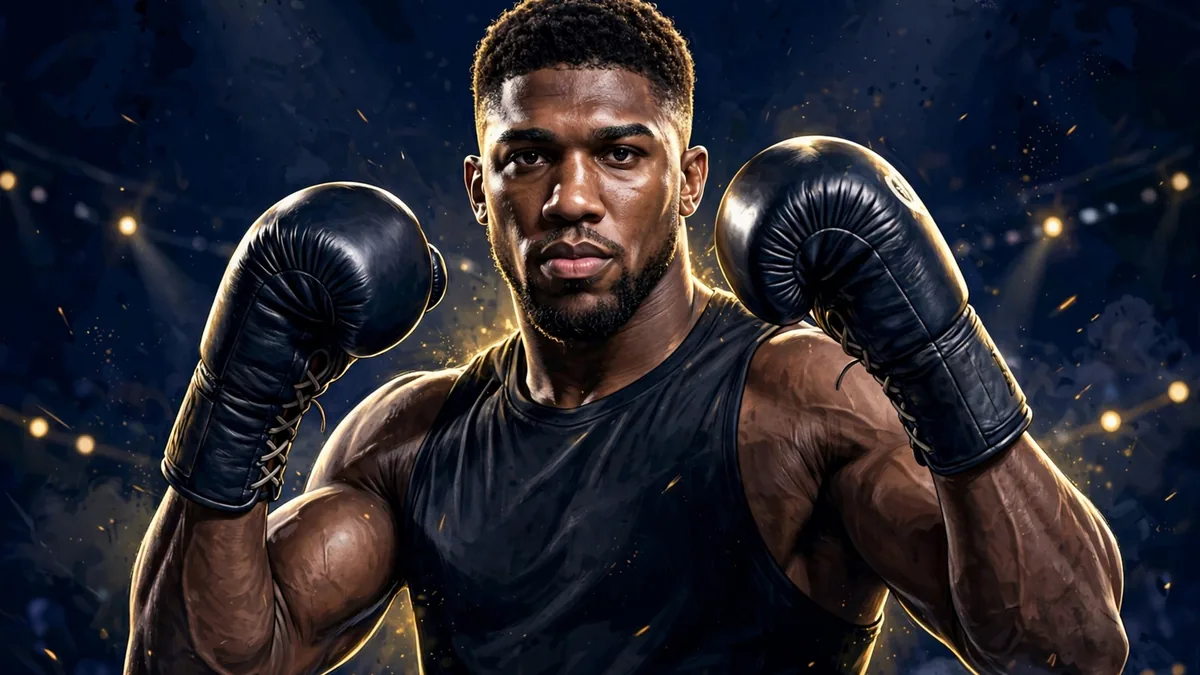
Quick Facts: Anthony Joshua
| Full Name | Anthony Oluwafemi Olaseni Joshua |
|---|---|
| Date of Birth | 15 October 1989 (age 37 as of November 2026) |
| Birthplace | Watford, Hertfordshire, England |
| Height | 6 ft 6 in (198 cm); reach 82 in (208 cm) |
| Nationality | British (Nigerian heritage, Yoruba) |
| Profession | Professional boxer, heavyweight |
| Professional Record | 30 wins (27 by knockout), 4 losses |
| Major Honours | Olympic super-heavyweight gold (London 2012); two-time unified heavyweight champion (IBF, WBA Super, WBO, IBO); MBE (2013), OBE (2018) |
| Estimated Net Worth (2026) | Between $80 million and $320 million depending on the source; around $150 million per Celebrity Net Worth; £240 million (about $320 million) per the Sunday Times Rich List 2026 |
| Primary Income Sources | Fight purses, pay-per-view shares, endorsements, 258 Management, Sparta Promotions, investments including Alpine F1 |
| Children | One son, Joseph (born October 2015) |
| Marital Status | Never married |
Table of Contents
- Quick Facts: Anthony Joshua
- Early Life and Family Background
- Amateur Career: From Finchley to Olympic Gold
- Turning Professional: The Matchroom Years Begin
- First World Title and the Rise to Stardom
- The Klitschko Night at Wembley
- The Ruiz Shock and the Saudi Rematch
- The Usyk Defeats and the Rebuild
- The Comeback Trail: Ngannou, Dubois, Paul and Prenga
- The Money: Net Worth, Purses and Business Empire
- Assets and Lifestyle
- Personal Life
- Controversies and Setbacks
- Legacy and What Comes Next
- Frequently Asked Questions
- Final Thoughts
- Sources and Reporting
Early Life and Family Background
Anthony Oluwafemi Olaseni Joshua was born on 15 October 1989 in Watford, Hertfordshire, to Nigerian parents who had both grown up in Sagamu, in Ogun State, southwestern Nigeria. His family background is Yoruba, and through his great-grandfather he holds an aristocratic rank among the Yoruba people — a detail Joshua himself has spoken about with pride. His mother, Yeta Odusanya, is Nigerian; his father, Robert Joshua, is part Nigerian and part Irish, and his grandmother was Irish. He has three siblings: Jacob, Janet and Loretta.
Some of Joshua’s earliest years were spent in Nigeria, where he attended Mayflower School, a boarding school in Ikenne. When his parents divorced, he returned to England at the age of 12, midway through Year Seven, and joined Kings Langley Secondary School in Hertfordshire. The family home was on the Meriden Estate in Garston, Watford — an estate known locally for its problems with crime and drugs. Friends and former teachers knew him as “Femi”, after his middle name Oluwafemi, which means “God loves me” in Yoruba.
At Kings Langley, Joshua’s talent was for football and athletics rather than boxing. He broke his school’s Year Nine 100 metres record with a time of 11.6 seconds, a mark that still gets mentioned whenever people talk about the speed he later carried into the ring for a man of his size. After school he worked on building sites as a bricklayer — a job he has returned to in interviews as a reminder of where he came from and what a different life might have looked like. Boxing, at that point, was not in his plans at all.
The people who knew him then describe a teenager with energy to burn and no clear outlet for it. That changed in 2007, when his cousin Gbenga “Ben” Ileyemi — himself a professional boxer — suggested he try the sport. Joshua was 18, unusually late for a future world champion. He walked into Finchley Amateur Boxing Club in Barnet, North London, and met coach Sean Murphy, who would become his first trainer and remains a close friend. Within a few years, the bricklayer from the Meriden Estate was wearing a Great Britain vest.
Amateur Career: From Finchley to Olympic Gold
Joshua’s amateur rise was startlingly fast. He won the Haringey Box Cup in 2009 and 2010, then took the senior ABA Championships in 2010 in only his 18th bout, beating Amin Isa to become British amateur champion at the GB Championships the same year. He won the ABA title again in 2011, and that October he was named Amateur Boxer of the Year by the Boxing Writers’ Club of Great Britain. His amateur record is listed at 40 wins and 3 defeats.
The 2011 World Championships in Baku, Azerbaijan, announced him to the wider boxing world. He beat the reigning world and Olympic champion Roberto Cammarelle of Italy, stopped Erik Pfeifer of Germany in the semi-final, and lost the final by a single point to the home boxer Magomedrasul Majidov, taking silver. The run also secured his place at the 2012 Olympic Games in London.
The London Olympics made him a household name. Fighting at super-heavyweight in front of a home crowd at ExCeL, he survived a disputed opening bout against the Cuban Erislandy Savón, winning 17–16 in a decision many ringside observers questioned. He then beat China’s Zhang Zhilei 15–11, edged Kazakhstan’s Ivan Dychko 13–11 in the semi-final, and met Cammarelle again in the final. After trailing on the cards through two rounds, Joshua levelled the scores at 18–18 and was announced the winner on count-back, becoming Olympic champion and the first British boxer to win super-heavyweight gold. The decision drew criticism from some experts, who called it a home verdict, but the medal was his, and it changed his life in a weekend.
Along the way, Joshua had turned down £50,000 to turn professional before the Olympics, telling reporters at the time that he had not taken up the sport for money — he wanted medals. He also won Superstars 2012, the BBC’s contest for British Olympic athletes. In the 2013 New Year Honours he was appointed a Member of the Order of the British Empire (MBE) for services to boxing. The OBE followed in 2018.
Turning Professional: The Matchroom Years Begin
On 11 July 2013 it was confirmed that Joshua had turned professional under the Matchroom Sport promotional banner, run by Eddie Hearn. He made his debut on 5 October 2013 at The O2 Arena in London, stopping Italian Emanuele Leo by technical knockout in the first round. The pattern of the early years was set at once: opponents stopped early, crowds growing with every outing. His second fight, against Paul Butlin in Sheffield three weeks later, ended in the second round. By the end of 2013 he was 3–0, all by stoppage.
The knockouts kept coming through 2014. He beat Dorian Darch, Héctor Ávila, Matt Legg and Matt Skelton, then took the vacant WBC International heavyweight title with a second-round knockout of Dennis Bakhtov in October 2014, aged 24. A first-round win over Michael Sprott the following month took him to 10–0, all by stoppage, with a total professional ring time of just 36 minutes and 36 seconds. The Ring magazine named him Prospect of the Year for 2014.
2015 brought the first real tests and the first domestic titles. A back injury had forced the cancellation of a January date with Kevin Johnson, but Joshua returned in April, stopped Jason Gavern and Raphael Zumbano Love, and in May handed Johnson the first stoppage defeat of his career — a man who had previously gone the distance with Vitali Klitschko, Tyson Fury and Derek Chisora. In September he won the vacant Commonwealth heavyweight title by stopping the previously undefeated Gary Cornish in just 90 seconds. Three months later came the grudge match with Dillian Whyte, a man who had beaten him as an amateur in 2009. Joshua survived the first scare of his professional career in the second round, then finished Whyte with a devastating uppercut in the seventh to claim the vacant British heavyweight title and defend his Commonwealth belt. Reports at the time said he earned around £3 million for the Whyte fight under a new five-year Matchroom deal that gave him a share of pay-per-view revenue — the first sign of the money that would follow.
First World Title and the Rise to Stardom
The step up to world level came quickly. In February 2016 it was announced that Joshua would face IBF heavyweight champion Charles Martin at The O2 Arena on 9 April. Martin was making the first defence of a belt he had won in January, and the fight lasted two rounds: Joshua set the pace, dropped Martin twice, and took the IBF title by knockout. He was a world champion in his 16th professional fight, less than three years after turning pro.
He defended the belt twice in 2016 — a seventh-round stoppage of Dominic Breazeale in June, and a third-round stoppage of Eric Molina in December — and by then he was no longer just a boxer. In 2017, SportsPro magazine named him the world’s most marketable athlete, ahead of footballers and golfers with far longer careers. Forbes would go on to rank him among the world’s 20 highest-paid athletes in 2019, 2020 and 2024, and 28th in 2023. The marketability was not an accident: a polite, well-spoken heavyweight with an Olympic gold medal, a physique built for posters, and a habit of winning by knockout was a sponsor’s dream, and the deals began to stack up.
The Klitschko Night at Wembley
On 29 April 2017, Joshua fought Wladimir Klitschko at Wembley Stadium in front of a crowd of around 90,000 — the biggest boxing attendance in Britain in decades — for the vacant WBA (Super) and IBO heavyweight titles, with his IBF belt also on the line. Klitschko, the long-reigning former champion, was the hardest test of Joshua’s career, and the fight lived up to it.
Joshua dropped Klitschko in the fifth round, was himself dropped heavily in the sixth, and looked in serious trouble as the fight wore on. In the eleventh, he found a right hand that sent Klitschko down again, followed up with a flurry, and the referee stopped it. The Ring and the Boxing Writers Association of America both named it Fight of the Year for 2017. Joshua was now the unified heavyweight champion, and the Wembley night remains the defining performance of his career — the fight his whole reputation was built on.
He completed the set of major belts in March 2018, beating Joseph Parker on points in Cardiff to add the WBO title. A defence against Alexander Povetkin at Wembley followed in September 2018, a seventh-round stoppage. By the end of 2018 he held the IBF, WBA (Super), WBO and IBO titles, had received his OBE, and was the biggest draw in the sport’s glamour division. The only fight the public kept asking for was the one that did not happen: a unification bout with Tyson Fury, the other British heavyweight champion, which would take years of failed talks to arrange.
The Ruiz Shock and the Saudi Rematch
Joshua’s first defeat arrived where nobody expected it. In June 2019 he travelled to Madison Square Garden in New York for his United States debut against Andy Ruiz Jr., a late replacement for Jarrell Miller, who had failed drug tests. Ruiz was a heavy underdog, and Joshua was a 25–1 favourite. Ruiz dropped Joshua four times and stopped him in the seventh round, taking all four of his titles in one of the great upsets in heavyweight history. The images of Joshua spitting out his mouthpiece and looking lost in the corner became the low point of his career.
The response was measured rather than panicked. Joshua exercised the rematch clause at once, and on 7 December 2019 the two met again in Diriyah, Saudi Arabia, in a bout billed as the “Clash on the Dunes”. This time Joshua boxed behind his jab, stayed out of trouble for twelve rounds, and won a clear unanimous decision to regain the IBF, WBA (Super), WBO and IBO titles. He was a two-time unified heavyweight champion at 30, and the rebuild looked complete.
The Usyk Defeats and the Rebuild
The second fall was slower and more complete. In September 2021, Joshua defended his titles against Oleksandr Usyk, the former undisputed cruiserweight champion, at Tottenham Hotspur Stadium. Usyk outboxed him over twelve rounds to win a unanimous decision and take the belts. The rematch, in Jeddah, Saudi Arabia, in August 2022, was closer — Joshua fought better, hurt Usyk late — but Usyk took a split decision, and Joshua had lost twice in a row for the first time.
The aftermath of the second Usyk fight was the rawest moment of his public career. Joshua picked up two of the belts and threw them out of the ring, then took the microphone and gave an emotional, rambling speech before leaving the arena. He apologised afterwards, and the incident has since been read as the moment the pressure of being Britain’s heavyweight flag-bearer finally showed. Behind the scenes, his team changed too: he parted with long-time trainer Robert McCracken, worked with Robert Garcia for the Usyk rematch, and later moved to the American trainer Derrick James.
What followed was a patient rebuild rather than a rush back to the top. In April 2023 he beat Jermaine Franklin on points at The O2, a win that steadied the ship without setting it alight. In August 2023 he knocked out Robert Helenius in the seventh round. In December 2023 he stopped Otto Wallin after five rounds in Riyadh, on the “Day of Reckoning” card in Saudi Arabia. Three wins, three different opponents, and the sense that Joshua was working his way back to contention rather than demanding it at once.
The Comeback Trail: Ngannou, Dubois, Paul and Prenga
March 2024 produced the most eye-catching win of the rebuild. Joshua faced Francis Ngannou, the former UFC heavyweight champion, in Riyadh, and knocked him out in the second round — a finish that looked more emphatic than anything Tyson Fury had managed against the same man five months earlier. It was Joshua’s best performance in years, and it put him back in line for a title shot.
The title shot came in September 2024, against Daniel Dubois, for the vacant IBF heavyweight title at Wembley Stadium. It went badly. Dubois dropped Joshua in the first round, again in the third, and finished him with a right hand in the fifth. It was the fourth defeat of Joshua’s career, and the first time he had been stopped by a British fighter. For the second time, a rebuild was needed.
Then came a tragedy away from the ring. In December 2025, Joshua was involved in a car crash in Ogun State, Nigeria, in which two members of his team were killed: Sina Ghami, his strength and conditioning coach, and Latif “Latz” Ayodele, his personal trainer. Joshua survived the crash. The deaths cast a shadow over everything that followed, and he later dedicated his next win to the two men.
His return to the ring came on 19 December 2025, against Jake Paul, the social media star turned professional boxer, at the Kaseya Center in Miami, in a heavyweight bout streamed on Netflix. Paul circled and clinched for four rounds, but Joshua’s size and pressure told: he dropped Paul twice in the fifth round and twice more in the sixth before a straight right hand ended it at 1:31 of the round. Paul later said the finishing punch broke his jaw and he underwent surgery. The win took Joshua to 29–4 with 26 knockouts and gave him his first victory in the United States.
The next outing was the strangest of his career. On 25 July 2026, Joshua faced the Albanian puncher Kristian Prenga at the Jeddah Superdome in Saudi Arabia, in a warm-up bout ahead of a planned fight with Tyson Fury. Prenga dropped him twice in the opening round — the first knockdown coming about 20 seconds in — and Joshua looked in real trouble. He recovered, found his range in the second round, and stopped Prenga with a right hand at 2:43 of the round. The result moved him to 30–4 with 27 knockouts, and he dedicated the win to Ghami and Ayodele. The fight drew questions from some viewers about Prenga’s approach in the second round, and his manager later said Prenga had been ill before the bout — but the result stands, and the Fury fight it was designed to protect stayed on track.
The Fury fight: Promoter Eddie Hearn confirmed after the Prenga win that a fight with Tyson Fury is signed for the final quarter of 2026, with November and a Thanksgiving-weekend date in New York among the options reported. As of 6 November 2026, no venue or exact date has been confirmed — it remains the biggest fight in British boxing, still waiting for its night.
The Money: Net Worth, Purses and Business Empire
Anthony Joshua’s wealth is one of the most debated figures in British sport, and the honest answer is a range, not a single number. As of November 2026, published estimates run from about $80 million to about $320 million. At the lower end, Novaline puts his net worth at $80 million to $100 million, and SurpriseSports lands on $80 million. Celebrity Net Worth puts the figure at around $150 million. At the top end, the Sunday Times Rich List’s 2026 edition values him at £240 million — roughly $320 million at current exchange rates — and ranks him the eighth-wealthiest sports figure in Britain, ahead of Tyson Fury, whose fortune the same list puts at £162 million. The Times had valued him at £195 million in June 2025, a £20 million rise on the year before.
The spread is not a mistake; it reflects what each source counts. The lower estimates lean on reported fight purses and endorsement income. The Sunday Times figure counts his business holdings as well — the companies, the property and the investments that sit behind the boxing. A fair reading of all of it is that Joshua is worth somewhere in the low hundreds of millions of dollars, with $150 million a reasonable mid-point and $320 million the highest credible valuation on the record.
The foundation of the money is the ring. His career fight purses are reported at more than $275 million gross, and the biggest nights were enormous: the Klitschko fight at Wembley, the two Ruiz fights, the two Usyk fights and the Saudi Arabia cards all carried purses in the tens of millions of dollars. Forbes put his on-field earnings at $75 million in its May 2024 assessment, a year that included the Ngannou win. One report put his purse for the December 2025 Jake Paul fight at around $94 million before tax. Even allowing for the usual gap between reported purses and what a fighter keeps after tax, team costs and training expenses, Joshua has been one of the highest-earning boxers of his generation.
For the full breakdown of his fortune, fight by fight, see our sister site’s deep look at Anthony Joshua’s net worth, which tracks the purses, the endorsements and the business holdings behind the headline figure.
Endorsements have been the second pillar. At his peak, Joshua’s commercial income was estimated at roughly $8 million to $15 million a year, and it held up even when results in the ring dipped — a sign of how well his team separated the brand from the boxing. His long-running deals have included Under Armour, Hugo Boss, Jaguar Land Rover, Beats by Dre, Lucozade Sport and Sky Sports, along with the DAZN streaming platform, which signed a landmark deal with Matchroom Boxing in 2018 reported at around $1 billion across its fighters and events over several years. In 2017, SportsPro named him the world’s most marketable athlete, and that marketability has been the through-line of his commercial career: brands wanted the Olympic champion who spoke well, looked the part and knocked people out.
The third pillar is the business he has built around himself. He runs his own management company, 258 Management, and the wider 258 Group, which handles his commercial activity, alongside Sparta Promotions Ltd, his promotional vehicle. In 2023 he joined a consortium that invested in the Alpine Formula One team, his highest-profile move into sports investment beyond boxing. He has also put money into property, and corporate filings reported in March 2026 show his companies paying him dividends of £10.1 million in 2024 and £6.3 million in 2023 — a rare public glimpse of the cash the business side actually produces.
| Income Stream | What We Know (Named Sources) |
|---|---|
| Fight Purses | More than $275 million gross across his career (Billionaires.Africa, June 2026); Forbes put on-field earnings at $75 million in its May 2024 assessment |
| Endorsements | Estimated at $8 million to $15 million a year (Billionaires.Africa); deals include Under Armour, Hugo Boss, Jaguar Land Rover, Beats, Lucozade Sport, Sky Sports |
| Business Holdings | 258 Management and 258 Group; Sparta Promotions Ltd; Alpine F1 investment through a consortium in 2023; company dividends of £10.1 million in 2024 and £6.3 million in 2023 (UK corporate filings, reported March 2026) |
| Net Worth Range (2026) | $80 million to $100 million (Novaline); around $150 million (Celebrity Net Worth); £240 million, about $320 million (Sunday Times Rich List 2026) |
| Peer Comparison | Sunday Times Rich List 2026: Joshua £240 million, ranked 8th among British sports figures; Tyson Fury £162 million, ranked 9th |
Assets and Lifestyle
Joshua’s lifestyle has always been quieter than his earnings would allow. He has spoken about buying property for his family and holds London property, though no audited figure for his real-estate portfolio exists in public records — one 2026 profile put his London property interests above £75 million, a figure that has not been independently confirmed and should be treated with care. His garage has been reported to include Range Rovers and a Jaguar, fitting for a man who spent years as a Jaguar Land Rover ambassador, but he is not known for showing off cars or watches on social media the way some fighters do.
In March 2026, corporate filings reported that Joshua had listed the United Arab Emirates as his country of residence across several of his companies — 258 Investments Ltd, 258 Management Limited, 258 Commercial Investments Limited, Sparta Promotions Limited and Volta Ankobra Holdings — a move that followed years in which his business interests had grown well beyond Britain. The filings were widely reported as a Dubai residency, and they sit alongside the dividend figures above as the clearest public evidence of how his money is structured.
His giving is more documented than his spending. In 2018 he set up the Anthony Joshua Foundation, which works with young people through education, skills training and community support. He also founded the AJ Boxing Club to give young people in his old neighbourhood a version of the outlet that Finchley ABC gave him. Neither venture is a vanity project: the foundation and the club are the two things he talks about most when he is asked what he wants to be remembered for outside the ring.
Personal Life
Joshua has never married, and he keeps his private life far more guarded than most sports stars of his profile. He has one son, Joseph, born in October 2015 to his former partner Nicole Osbourne. He has spoken in interviews about the balance between training camps and fatherhood, and about wanting his son to grow up away from the glare that follows him. Beyond that, he rarely discusses relationships in public, and reports about his dating life are best treated as rumour unless he confirms them himself.
His family remains close. His mother Yeta has been a constant presence at his fights, and he has credited her with keeping him grounded through the years when the money and the fame arrived together. His father Robert and his siblings have stayed largely out of the spotlight. Joshua’s tattoos tell the family story in shorthand: the word “Wisdom” on his right arm, an outline of Africa with Nigeria highlighted on his right shoulder, and a British lion on the back of his neck — Nigerian roots, British home, and a reminder to think before he acts.
Outside boxing, he trains, he invests, and he stays close to the gym culture that raised him. He is a practising Christian and has spoken about his faith in interviews, though he keeps it low-key. His public image — polite, disciplined, media-trained to a fault — has occasionally drawn criticism for being too polished, but it has also kept him out of the kind of tabloid trouble that has followed other heavyweights.
Controversies and Setbacks
Joshua’s record off the canvas is mostly clean, but there are two episodes that belong in any honest biography. The first came before he was famous. In 2011, while still an amateur, he was arrested and later pleaded guilty to possession of cannabis, receiving a 12-month community order and 100 hours of unpaid work. He has spoken about it since as a turning point — the moment he understood that a boxing career could be taken away as quickly as it had arrived. It is worth noting because it sits so close in time to the Olympic gold: the same year he was in court, he was also winning the ABA title and being named Amateur Boxer of the Year.
The second came after the second Usyk defeat in August 2022, when he threw two championship belts out of the ring and gave an emotional speech into the microphone before leaving the arena. He apologised within days, and most of the boxing world treated it as a man cracking under pressure rather than a character flaw — but it remains the most talked-about loss of composure in his career, and the moment when the public first saw the strain of carrying British heavyweight boxing on his own.
His career has also carried two sporting controversies that are worth recording fairly. The Olympic final in 2012 was decided on count-back after a level score, and some experts called it a home decision. And the Prenga fight in July 2026 drew questions from viewers about the Albanian’s approach in the second round after he had dropped Joshua twice in the first; Prenga’s manager later said his fighter had been ill for two weeks before the bout. Neither episode has produced any finding against Joshua, and both are recorded here because a biography that leaves them out would be incomplete.
Legacy and What Comes Next
Anthony Joshua’s legacy is already secure, whatever happens next. He is the only British boxer to win Olympic super-heavyweight gold and then unify the professional heavyweight division twice. He headlined the biggest boxing crowds Britain has seen in decades, he carried the division through the years when it had no undisputed champion, and he did it as a crossover star who brought new audiences — and new sponsors — into the sport. The Klitschko fight alone would be enough to define most careers; Joshua has had half a dozen nights of that size.
The question that remains is the one that has followed him since 2018: Tyson Fury. The two men are the defining British heavyweights of their era, and they have spent the best part of a decade not fighting each other. With the Fury bout reported as signed for the final quarter of 2026, Joshua has one more chance to add the fight his career has always lacked — and, at 37, with 34 professional fights behind him, the clock is not on his side. A win over Fury would complete the story. A loss would not erase it: two-time unified champion, Olympic gold medallist, and the richest British boxer of his generation by some measures is a record that stands on its own.
What happens after Fury is an open question. Joshua has talked about fighting on into his late thirties, and he has also talked about the businesses that will outlast his boxing. The 258 Group, the Alpine investment and the property interests all point to a second career that is already underway. For now, though, the ring still comes first — and the next chapter is the one British boxing has waited longest to read.
Frequently Asked Questions
How old is Anthony Joshua?
Anthony Joshua was born on 15 October 1989 in Watford, Hertfordshire, England, which makes him 37 years old as of November 2026. He won his Olympic gold medal at 22 and his first world title at 26.
What is Anthony Joshua’s net worth in 2026?
Published estimates of Anthony Joshua’s net worth in 2026 range from about $80 million to about $320 million. Novaline puts the figure at $80 million to $100 million, Celebrity Net Worth puts it at around $150 million, and the Sunday Times Rich List’s 2026 edition values him at £240 million (about $320 million). His career fight purses alone are reported at more than $275 million gross.
What is Anthony Joshua’s boxing record?
As of November 2026, Anthony Joshua’s professional record is 30 wins and 4 losses, with 27 of his wins coming by knockout. His four defeats came against Andy Ruiz Jr. (June 2019), Oleksandr Usyk (September 2021 and August 2022) and Daniel Dubois (September 2024). His most recent win was a second-round knockout of Kristian Prenga on 25 July 2026.
How tall is Anthony Joshua?
Anthony Joshua is 6 ft 6 in tall (198 cm), with a reach of 82 in (208 cm). He fights from an orthodox stance and has competed at heavyweight throughout his professional career.
Who has Anthony Joshua lost to?
Anthony Joshua has lost to four men across four fights: Andy Ruiz Jr. stopped him in the seventh round in June 2019, Oleksandr Usyk beat him on points twice (September 2021 and August 2022), and Daniel Dubois knocked him out in the fifth round in September 2024. He avenged the Ruiz defeat with a unanimous-decision win in their December 2019 rematch in Saudi Arabia.
Did Anthony Joshua win an Olympic gold medal?
Yes. Anthony Joshua won the super-heavyweight gold medal at the London 2012 Olympics, beating Italy’s Roberto Cammarelle in the final on count-back after the scores were level at 18–18. He also won a silver medal at the 2011 World Championships in Baku and was named Amateur Boxer of the Year in 2011.
Does Anthony Joshua have a wife or children?
Anthony Joshua has never married. He has one son, Joseph, who was born in October 2015 to his former partner Nicole Osbourne. Joshua keeps his private life out of the spotlight and rarely discusses relationships in public.
When is Anthony Joshua fighting Tyson Fury?
A fight between Anthony Joshua and Tyson Fury is reported as signed for the final quarter of 2026, with November and a Thanksgiving-weekend date among the options discussed. As of 6 November 2026, no venue or exact date has been officially confirmed. Joshua kept the fight alive with his second-round knockout of Kristian Prenga on 25 July 2026, which was arranged as a warm-up for the Fury bout.
Final Thoughts
Anthony Joshua’s story is the rare sporting biography that reads like a film script and still holds up to fact-checking: a bricklayer who started boxing at 18, won Olympic gold at 22, unified the heavyweight division twice, lost it all in a New York upset, won it back in the Saudi desert, lost it again to a great champion, and is still standing — still winning, still chasing the one fight that got away. The fortune, somewhere between $80 million and $320 million depending on who is counting, is the byproduct, not the point. The point is the arc: Watford to Wembley, the Meriden Estate to the Jeddah Superdome, and a career that has already outlasted two rebuilds. If the Fury fight finally happens, it will be the last line of the story. If it does not, the story is already complete enough.
Sources and Reporting
How we estimated: Anthony Joshua’s net worth is an estimate, not a published fact — his full finances are private. We compared named sources and published the range they produce rather than picking one number: Novaline ($80 million–$100 million), Celebrity Net Worth (around $150 million, as reported by Billionaires.Africa), and the Sunday Times Rich List 2026 (£240 million, about $320 million). Career purse totals, endorsement estimates and dividend figures are attributed to their sources in the text. Where sources disagree — most visibly on the net worth figure and on Joshua’s exact record at different points in 2026 — we used the most recent figures available as of 6 November 2026 and said so. Estimates may differ from private reality.
Sources consulted for this biography include Wikipedia, ESPN, The Ring, Forbes, Billionaires.Africa, Novaline, SurpriseSports, Sports Illustrated, British Boxing News and Big Fight Weekend. Fight dates, results and records were cross-checked against Wikipedia’s Anthony Joshua and Kristian Prenga pages and ESPN’s fight coverage. The Sunday Times Rich List figures are as reported by ESPN in October 2026. All source links above point to the outlets’ homepages or the specific articles cited; figures are estimates and should be read as such.