Last updated: November 7, 2026 · By Celebamerica Editorial Staff
The Undertaker stands 6 feet 10 inches tall (208 cm) on paper — that is the billed height WWE has listed for him for more than three decades. His real height, measured without boots and without the showmanship, is a little shorter: most careful estimates put Mark William Calaway at around 6 feet 8 inches (203 cm) at his peak. Either way, he was one of the tallest men ever to hold a WWE ring for a full career, and his size was never just a number on a roster sheet. It shaped the character, the entrance, the moves, and the fear he carried into every arena.
Born March 24, 1965, in Houston, Texas, Calaway turned a frame most people only see on a basketball court into the longest-running act in wrestling history. He debuted for WWE at Survivor Series on November 22, 1990, and did not retire until the same event exactly 30 years later. In between came 21 straight WrestleMania wins, seven world championships, and a 2022 Hall of Fame induction. This page answers the height question properly: the billed figure, the real figure, how he stacks up against the other giants of WWE, and how those extra inches built both the Deadman and a fortune Celebrity Net Worth puts at $17 million.
The Undertaker: Quick Facts
| Full Name | Mark William Calaway |
|---|---|
| Ring Name | The Undertaker (also “The Deadman”, “The Phenom”, “The American Badass”) |
| Date of Birth | March 24, 1965 (61 years old in 2026) |
| Birthplace | Houston, Texas, USA |
| Billed Height | 6 ft 10 in (208 cm / 2.08 m) |
| Real Height (estimated) | Around 6 ft 8 in (203 cm) at his peak |
| Billed Weight | 309 lb (140 kg); varied between roughly 299 and 328 lb across his career |
| Billed From | Death Valley (Houston, Texas in real life) |
| Estimated Net Worth (2026) | $17 million (Celebrity Net Worth); $17–20 million range reported by other outlets |
| Career | WWE, 1990–2020; 7-time world champion; 21-0 WrestleMania streak; WWE Hall of Fame, Class of 2022 |
| Primary Income Sources | WWE Legends contract (reported ~$2.5 million a year), merchandise and royalties, “1 deadMAN SHOW” tours, “Six Feet Under” podcast, real estate |
| Spouse | Michelle McCool (married 2010) |
Table of Contents
- The Undertaker: Quick Facts
- How Tall Is The Undertaker?
- Billed Height vs Real Height: The 6-Foot-10 Question
- The Undertaker’s Height in Every Unit
- How His Height Shaped the Deadman
- The Undertaker vs the Other WWE Giants
- Early Life: Growing Up Tall in Houston
- From Texas Red to the Deadman
- The Streak, the Titles, and 30 Years on Top
- Weight, Build, and the Physical Toll
- The Money: Net Worth and the Legends Deal
- Personal Life and Family
- Retirement and Life After the Ring
- Frequently Asked Questions
- Final Thoughts
- Sources & Reporting
How Tall Is The Undertaker?
The short answer is the one WWE has printed for 35 years: 6 feet 10 inches. That figure comes from his official WWE profile and is repeated by Wikipedia, which lists his billed height as 6 ft 10 in (208 cm) and his billed weight as 309 lb (140 kg). The SmackDown Hotel’s wrestling database, one of the most complete records of wrestler stats, lists the same 6 ft 10 in figure. GiveMeSport, ranking the tallest superstars in WWE history, placed him at 6 ft 10 in as well, and Sportskeeda’s height explainer agrees: “Standing at 6 foot 10 inches tall (or 208 cm), he is considered one of the greatest ‘big men’ in wrestling.”
But the number most fans quote is the billed height, and billed heights in wrestling are part of the show. Promoters have always rounded up — sometimes by a lot — because a taller wrestler looks more dangerous on a poster. The honest answer has two parts, and both matter:
- Billed height: 6 ft 10 in (208 cm). This is the official WWE figure, used on television, in video games, and on merchandise for his entire career.
- Real height: around 6 ft 8 in (203 cm) at his peak. That is the figure that shows up in side-by-side photo comparisons with athletes of known height, and it is the number older editions of his Wikipedia entry carried as his actual height alongside the billed listing.
Two inches is the gap between the character and the man, and it is a small gap by wrestling standards. Kane was billed at 7 feet while standing closer to 6 feet 8 inches. The Big Show was billed at 7 feet while measuring nearer 6 feet 11 inches in his prime. The Undertaker’s billing was, by the standards of the business, almost honest — and that is part of why the height felt real every time he walked to the ring.
The bottom line on the number: if someone asks how tall The Undertaker is, “6 foot 10” is the correct answer — it is the height the world knows him by. If they ask how tall Mark Calaway actually is, the best evidence says about 6 foot 8. This article uses the billed figure as the headline and flags the real figure wherever the difference matters.
Billed Height vs Real Height: The 6-Foot-10 Question
Why do two numbers exist at all? Because professional wrestling sells larger-than-life characters, and height is the cheapest special effect in the business. A wrestler’s billed height is set by the promotion, printed in programs, and announced on television. It is rarely measured with a tape. It includes wrestling boots, which add an inch or more, and it includes whatever rounding the office thinks the character deserves.
The Undertaker’s case is unusually well documented because he spent 30 years standing next to people whose heights are known. Photographs of Calaway beside fellow wrestlers, athletes, and actors — and his own appearances out of character on his “Six Feet Under” podcast and the “1 deadMAN SHOW” tour — have let fans and height researchers compare him directly against measured people. The pattern is consistent: he is clearly taller than the 6-foot-6 and 6-foot-7 wrestlers around him, and a shade shorter than the men billed at a genuine 6 feet 10 inches or above. That lands him at about 6 feet 8 inches barefoot in his prime.
There is a second wrinkle worth naming. Calaway is 61 years old in 2026, and people lose height with age as spinal discs compress — typically an inch or so over the decades after 40, more for someone who spent 30 years taking bumps for a living. Some recent estimates suggest that if he were measured today he might come in closer to 6 feet 7 inches. No public measurement confirms that, so it stays an estimate rather than a fact, but it is a fair piece of context: the 6-foot-8 figure describes his peak, not necessarily his height today.
None of this makes the billed number a lie in any way that matters. In wrestling, billed height is a costume, like the hat and the coat. The Undertaker was presented as 6 feet 10 inches, he looked 6 feet 10 inches under arena lights, and he worked like a man of that size. The two-inch difference is a footnote for height enthusiasts, not a scandal — and it is worth saying plainly because so many celebrity height pages pretend the billed number is a medical fact.
The Undertaker’s Height in Every Unit
Searches for a celebrity’s height come in every unit system, so here is the full conversion in one place. Both the billed figure and the real-height estimate are shown, because mixing them up is how wrong numbers spread.
| Measurement | Billed height | Real height (estimated, peak) |
|---|---|---|
| Feet and inches | 6 ft 10 in | 6 ft 8 in |
| Inches only | 82 inches | 80 inches |
| Centimetres | 208 cm | 203 cm |
| Metres | 2.08 m | 2.03 m |
For readers outside the United States, 208 cm is the number to remember — it is the figure on his Wikipedia infobox and the one most international outlets repeat. In the UK, where wrestling has a huge following, he is usually described simply as “six foot ten”. And for a quick mental picture: at 6 feet 10 inches billed, The Undertaker stood a full foot taller than the average American man (about 5 feet 9 inches), and about eight inches taller than the average WWE fan in the front row.
His weight converts just as neatly. The billed 309 pounds is 140 kilograms. Across his career, wrestling databases list his weight anywhere from 299 pounds in his final years to 328 pounds in his early prime, which is normal for a man who wrestled for three decades — weight moves with training, injuries, and age in ways height does not.
How His Height Shaped the Deadman
The Undertaker’s height did more than fill out a costume. It decided what kind of wrestler he could be, what moves looked believable from him, and why the character survived for 30 years while other gimmicks came and went.
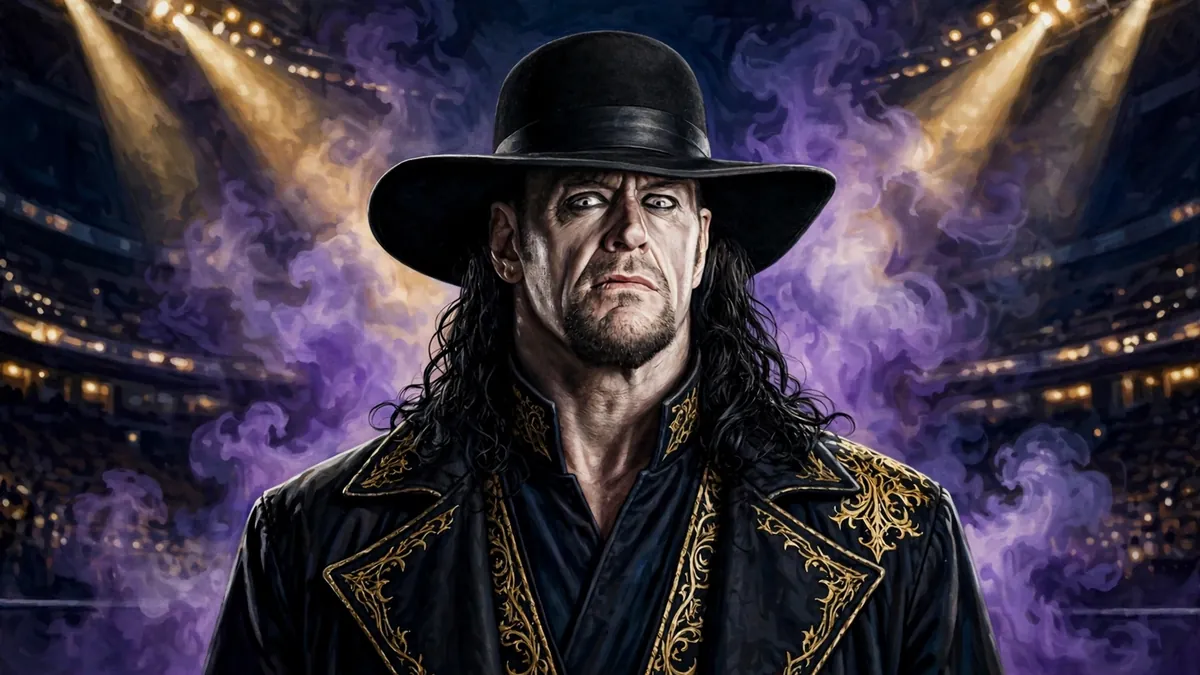
Start with the entrance, because that is where the height did its work. The lights go down, the gong sounds, and a 6-foot-10 figure in a long coat and wide-brimmed hat walks to the ring at a pace that feels like a funeral march. A shorter man doing the same walk looks like a man in a costume. At Calaway’s size, the walk looks like something arriving. The hat adds a couple of inches on top of the boots, so by the time he reached the ring he towered over the ring announcer, the referee, and usually his opponent too. WWE understood this and shot him from low angles for years, letting the camera look up at him the way a fan in the front row would.
Then there is the move set. The Chokeslam — lifting a grown man clean off the mat by the throat with one hand — only looks right when the man doing it is visibly bigger than the man receiving it. The Tombstone Piledriver, his finishing move, is an upside-down hold that demands the height and leverage to hoist an opponent’s full weight onto your shoulders; at 6 feet 10 inches and around 300 pounds, Calaway could perform it on men who outweighed him. The Last Ride, a raised powerbomb, is the same story. And Old School, the famous rope walk where he strolled along the top rope arm-in-arm with his opponent, needed long legs and balance that a giant rarely has — it became a signature precisely because a man that tall should not have been able to do it.
His size also set the terms of his rivalries. The Undertaker’s best opponents were either giants who could match him — Kane, billed at 7 feet, his storyline half-brother; The Big Show, billed at 7 feet; The Great Khali, billed at 7 feet 1 inch — or smaller, faster men whose whole story was surviving a monster: Shawn Michaels at 6 feet 1 inch, Edge, CM Punk, AJ Styles at 5 feet 11 inches. The height gap was the plot. When AJ Styles faced him in the Boneyard Match at WrestleMania 36 in 2020, the visual of the 5-foot-11 Styles staring up at the Deadman in a graveyard did half the storytelling before a punch was thrown.
There is one more thing his height gave him, and it is easy to miss: longevity. Big men in wrestling usually break down early because their joints carry more weight through every bump. Calaway’s career lasted 30 years at the top of the card, which is almost unheard of for a man his size. He paid for it — knees, hips, and shoulders that needed surgery after surgery in his final decade — but the fact that he was still main-eventing WrestleMania in his mid-50s says something about how carefully he worked. He wrestled a style that protected his body: slow, deliberate, built on presence rather than high-flying risk. The height made the slow style work, and the slow style made the career last.

The Undertaker vs the Other WWE Giants
The Undertaker’s height only means something in context, so here is how he stacks up against the men he shared rings with. All figures below are billed heights — the numbers WWE used — because that is the only consistent basis for comparison. Real heights, where known, are noted in the text.
| Wrestler | Billed height | How he compares to The Undertaker |
|---|---|---|
| The Great Khali | 7 ft 1 in (216 cm) | Three inches taller; one of the few men who genuinely dwarfed him |
| The Big Show | 7 ft 0 in (213 cm) | Two inches taller on paper; in reality the gap was smaller |
| Kane | 7 ft 0 in (213 cm) | Two inches taller billed; his real height was close to Calaway’s |
| Kevin Nash | 6 ft 10 in (208 cm) | Exactly the same billed height |
| The Undertaker | 6 ft 10 in (208 cm) | The benchmark for this table |
| Triple H | 6 ft 4 in (193 cm) | Six inches shorter; their WrestleMania matches were built on that gap |
| Brock Lesnar | 6 ft 3 in (191 cm) | Seven inches shorter — and the man who ended the Streak |
| Roman Reigns | 6 ft 3 in (191 cm) | Seven inches shorter; beat him at WrestleMania 33 |
| Shawn Michaels | 6 ft 1 in (185 cm) | Nine inches shorter; their two WrestleMania matches are among the best ever |
| AJ Styles | 5 ft 11 in (180 cm) | Eleven inches shorter; his final opponent, in the Boneyard Match |
A few things jump out of that table. First, The Undertaker is tied with Kevin Nash at 6 feet 10 inches, and only three men in WWE history were billed taller than him in a meaningful way: Khali, Big Show, and Kane. GiveMeSport’s ranking of the 16 tallest superstars in WWE history placed him 13th — not because he was short, but because WWE has employed a handful of genuine seven-footers over the decades. Second, the men who beat him at WrestleMania were both much shorter than him. Lesnar at 6 feet 3 inches ended the Streak at WrestleMania 30 in 2014, and Reigns at the same height beat him at WrestleMania 33 in 2017. Size was never a shield for him; it was a target.
Third, and most interesting for height watchers: Kane’s billed 7 feet and the Undertaker’s billed 6 feet 10 inches were storyline numbers for two men of very similar real height. Glenn Jacobs (Kane) and Mark Calaway standing side by side in the late 1990s looked near-identical in stature, which is why their “Brothers of Destruction” pairing worked visually. The two-inch billed gap between them was kayfabe — part of the fiction that Kane, the younger brother, was the bigger monster.
Early Life: Growing Up Tall in Houston
Mark William Calaway was born on March 24, 1965, in Houston, Texas, the youngest of five sons. He grew up in a working-class household where being the smallest of nothing was ever an option — by high school he was already the tall kid, and the height that would define his career was obvious early.
At Waltrip High School in Houston, Calaway played basketball, the natural sport for a teenager of his size. He was good enough to keep playing after graduation, first at Angelina College in Lufkin, Texas, and then at Texas Wesleyan University in Fort Worth, where he played for the Rams. Basketball gave him two things wrestling would later demand: footwork for a big man, and comfort performing in front of a crowd. It also gave him a sense of what his body could do — a tall man who could move is rarer than a tall man, and it is what separated him from the plodding giants who came before him.
College did not lead to a basketball career, and Calaway left school to work. Before wrestling, he worked as a bouncer and in debt collection — jobs where size is the qualification. The story, told many times since, is that he walked into a wrestling school because he was tall, athletic, and needed work, and the business has a way of finding men like that. He trained under Buzz Sawyer, a tough veteran of the Texas scene, and made his professional debut in 1984 at the age of 19, wrestling as Texas Red in World Class Championship Wrestling.
The early years were a tour of the territories: Texas, then Memphis, then a run in World Championship Wrestling as “Mean” Mark Callous from 1989 to 1990. He was tall, he was strong, and he could work — but he was also one more big man in a business full of them. What he did not yet have was a character that made the height mean something. That arrived in the autumn of 1990, when he signed with the World Wrestling Federation and walked into the Survivor Series as the mystery partner of Ted DiBiase’s Million Dollar Team. The Deadman was born that night, and the height finally had a purpose.
From Texas Red to the Deadman
Calaway’s first five years in wrestling are a lesson in how much a character matters. As Texas Red, he was a tall Texan in a mask. As “Mean” Mark Callous in WCW, he was a tall man with a mean streak and a manager, Paul E. Dangerously (later Paul Heyman), who talked for him. Both runs showed the same problem: size alone does not make a star. WCW let him go in 1990, and in most tellings of the story that release is the luckiest break of his life, because it sent him to Vince McMahon’s WWF at exactly the moment McMahon was looking for a new kind of monster.
The Undertaker debuted at Survivor Series on November 22, 1990. The presentation was built entirely around scale and stillness: the lights died, the gong rang, and a huge man in a black hat and long coat walked to the ring without hurrying, without smiling, without acknowledging the crowd at all. He eliminated two men in minutes and stood over them while the arena tried to work out what it had just seen. It was the first time his height had been staged rather than simply listed, and the difference was immediate.
What followed was a slow build that the modern business would never allow. The Undertaker did not talk much for years — Paul Bearer, his manager, did the talking while the Deadman stood beside him, silent and enormous. The character went through phases — the original supernatural Deadman, the biker “American Badass” from 2000 to 2003, and the return to the Deadman in 2004 — but the silhouette never changed. Long coat, long hair, hat, and a man who had to duck through doorways. By the time he reached his 30th year in the company, he was the last active link to the era he debuted in, and the height that had once been a novelty had become a monument. For the full story of those three decades, our sister site’s biography covers his career in depth — The Undertaker’s full biography on GuideNetWorth runs through the 30-year run, the championships, and the fortune it built.
The Streak, the Titles, and 30 Years on Top
No discussion of The Undertaker is complete without the Streak, because it is the record his height helped protect. From his first WrestleMania match — a win over Jimmy “Superfly” Snuka at WrestleMania VII in 1991 — he won 21 straight matches at WWE’s biggest show of the year. The run lasted from 1991 to 2013 and included wins over Triple H (three times), Shawn Michaels (twice), Ric Flair, Randy Orton, Edge, CM Punk, and Kane. It became the most famous undefeated run in wrestling, and the Streak itself became a bigger draw than most championships.
Brock Lesnar ended it at WrestleMania XXX on April 6, 2014, in one of the most shocking moments in wrestling history — the crowd in New Orleans fell silent when the three-count came down. Calaway went on to win four of his next five WrestleMania matches and finished with a 25-2 record at the event, the second loss coming against Roman Reigns at WrestleMania 33 in 2017. His final match was the cinematic Boneyard Match against AJ Styles at WrestleMania 36 in 2020, filmed in a graveyard during the pandemic era, which gave the Deadman a farewell that fit the character perfectly.
The championships tell the same story of longevity. Calaway won the world title seven times — four WWE Championships and three World Heavyweight Championships — across three different decades. His first WWE Championship came just a year after his debut, when he beat Hulk Hogan at Survivor Series in 1991. His last world title run came in 2010. He also won the Royal Rumble in 2007, becoming the first man to win it from the number 30 spot, and held tag team gold six times. No other wrestler in history has held world titles in the 1990s, 2000s, and 2010s while working for the same company the whole time.
The numbers only make sense when you remember the size of the man carrying them. A 6-foot-10 wrestler main-eventing for 30 years is a physical achievement as much as a creative one. Every bump, every fall from the top rope, every Chokeslam landed on a 250-pound opponent went through a frame that was never built for that kind of punishment. The Streak is usually talked about as a storytelling triumph. It was also an endurance record, and height was part of the cost.

Weight, Build, and the Physical Toll
Height is only half of a wrestler’s physical profile, and The Undertaker’s weight tells its own story. WWE billed him at 309 pounds (140 kg) for most of his career, but wrestling databases show the number moving: around 328 pounds in his early prime, closer to 299–305 pounds in his final years. The SmackDown Hotel database lists 305 pounds for his 1987–2007 period and 299 pounds from 2008 to 2020. That is a man who got lighter as he got older, which is the opposite of what usually happens to retired athletes — and a sign of how deliberately he managed his body in his last decade.
The build was never that of a bodybuilder. Calaway was long and lean for his size, with long arms that made the Chokeslam look effortless and long legs that made the rope walk possible. He was not the most muscular man on the roster, and he did not need to be: the height did the intimidating, and the wrestling did the rest. Fans who met him out of character often said the same thing — that he looked taller in person than on television, because television flattens everyone to the same frame.
The cost of carrying that frame through 30 years of wrestling was steep. By the end of his career, Calaway had undergone multiple surgeries, including operations on his knees, hips, and shoulders, and he has spoken openly since retiring about the pain he worked through in his final years. In his “Last Ride” documentary series, he admitted he was wrestling hurt for much of the 2010s and that the decision to retire was as much about his body as about the character. A 6-foot-10 man taking bumps is a physics problem: the same fall that a 5-foot-10 wrestler absorbs in a split second hits a taller man’s joints with more leverage and more force. The fact that he lasted 30 years is, in its own way, as remarkable as the Streak.
Since retiring, Calaway has stayed in shape but on his own terms. He has appeared on his podcast and his stage show looking leaner than his wrestling prime — the 309-pound Deadman was a working weight, not a resting one — and he has talked about training for health rather than for the ring. At 61, he is still an imposing figure in a room. The hat and coat are mostly retired. The height is not.
The Money: Net Worth and the Legends Deal
A height article still owes readers the money picture, because the size of the man and the size of the fortune are part of the same story. Celebrity Net Worth puts The Undertaker’s net worth at $17 million, a figure repeated by most outlets covering him in 2026. The Times of India, in a March 2026 report, gave a $17–20 million range. The honest figure is therefore a range with a $17 million anchor — the kind of estimate that fits a man who never disclosed his finances and whose earnings came from contracts the public never saw in full.
Where does it come from? The biggest piece is the WWE Legends contract he signed around 2019 and renewed in 2024, which multiple outlets report pays him around $2.5 million a year. That deal covers promotional appearances, special programming around WrestleMania, ambassadorial work, and the right to use the Undertaker name and likeness — and it keeps paying even though he has not wrestled since 2020. It is, in effect, a pension for a character WWE still sells: the Deadman appears on merchandise, in video games, and on WWE Network documentaries, and Calaway gets paid for all of it.
The second piece is his own work since retiring. The “1 deadMAN SHOW” is a one-man theatre tour in which Calaway tells stories from his career on stage — it has run to sold-out rooms in the US and the UK. His “Six Feet Under” podcast, launched in 2023, is a steady earner in the wrestling podcast market. Both ventures trade on the same thing the height traded on: presence. People pay to be in a room with a man who spent 30 years being the most feared figure in wrestling.
The third piece is real estate. Calaway lives in the Austin, Texas area, and Celebrity Net Worth notes his property holdings there. Some outlets also report that he co-founded The Calaway Company, a real estate investment firm focused on commercial property. That last detail should be treated as reported rather than confirmed — it appears in lower-tier outlets and not in WWE’s own materials — but the Austin property base itself is well documented. A Texas ranch and a portfolio of property is exactly the kind of quiet wealth a man who protected his privacy for 30 years would build.
One more honest note: $17 million makes him wealthy, but it does not put him near the top of wrestling’s rich list. The Rock, John Cena, and the McMahon family sit far above him, because they turned wrestling fame into film, business, and ownership. Calaway’s fortune is smaller because his character was, by design, a mystery — he rarely did talk shows, rarely endorsed products, and stayed out of the public eye. The money reflects the choices: 30 years of top pay, carefully kept, rather than a second career in Hollywood.
Personal Life and Family
Behind the Deadman is a family man who guarded his private life almost as fiercely as the character. Calaway has been married three times. His first wife was Jodi Lynn, with whom he has a son, Gunner Vincent Calaway, born in 1993. His second wife was Sara Frank, with whom he has two daughters, Gracie and Chasey. In 2010 he married former WWE wrestler Michelle McCool, and the couple adopted a daughter, Kaia Faith, in 2012. The family lives in the Austin, Texas area.
McCool is the only one of his wives who shared the wrestling world, and the two of them are a familiar sight at WWE events now — Calaway as an ambassador and occasional on-screen presence, McCool as a Hall of Fame-calibre star in her own right who still makes appearances. Their household is, by wrestling standards, unusually settled: the same home base, the same small circle, and a deliberate distance from the spotlight that defined his career.
That privacy was a professional choice as much as a personal one. For most of his career, Calaway refused to break character in public — no talk shows, no social media, no out-of-costume interviews. The idea was that if fans saw Mark Calaway the man, they would stop believing in The Undertaker. It worked, and it meant that the tall, silent figure in the ring stayed mysterious for three decades. Since retiring, he has loosened up: the podcast, the stage show, and regular appearances on WWE programming have let fans meet the man behind the hat for the first time. He is, by most accounts, warm, funny, and generous with younger wrestlers — the opposite of the character in every way except height.
Retirement and Life After the Ring
The Undertaker’s retirement was staged with the same care as his debut. His final match, the Boneyard Match against AJ Styles, took place at WrestleMania 36 in April 2020, filmed in a graveyard during the pandemic with no live crowd. It was a strange, cinematic farewell — a fight in a cemetery, ending with the Deadman riding off on a motorcycle — and it worked because the character had always belonged to the dark. On November 22, 2020, exactly 30 years to the day after his debut at Survivor Series 1990, WWE held his “Final Farewell” at the same event, and Calaway told the crowd his time had come.
The Hall of Fame followed on April 1, 2022, when he headlined the Class of 2022 in Dallas. The induction speech, delivered in character and then out of it, ran long and said what the retirement ceremony had not: that he had given everything to the business, and that the business had given him a life. Vince McMahon inducted him, and the two men — the promoter who created the character and the wrestler who carried it for 30 years — shared a moment that closed the book on an era.
Retirement has not meant disappearance. Calaway launched the “Six Feet Under” podcast in 2023, tours with the “1 deadMAN SHOW”, and in 2025 joined WWE’s “LFG” series on A&E as a coach, mentoring the next generation of wrestlers. He also appears at WrestleMania week events and WWE conventions, where fans still line up to meet the man they watched for three decades. The 6-foot-10 frame is still there, and so is the presence — he remains, even in a suit and without the hat, the tallest man in most rooms he walks into.
Frequently Asked Questions
How tall is The Undertaker?
The Undertaker is billed at 6 feet 10 inches (208 cm) — the height WWE has listed for him throughout his career and the figure carried by Wikipedia and the major wrestling databases. His real height is a little shorter, at around 6 feet 8 inches (203 cm) at his peak.
What is The Undertaker’s real height?
Most careful estimates put Mark Calaway’s real height at about 6 feet 8 inches (203 cm) in his prime, based on side-by-side comparisons with people of known height and older reference listings that separated billed height from actual height. WWE’s billed figure of 6 feet 10 inches includes boots and the usual promotional rounding.
How tall is The Undertaker in cm?
Billed, The Undertaker is 208 cm tall. His estimated real height is about 203 cm. In metres, that is 2.08 m billed and about 2.03 m in reality.
How much does The Undertaker weigh?
WWE billed him at 309 pounds (140 kg) for most of his career. His weight varied across three decades in the ring: wrestling databases list him at around 328 pounds in his early prime and closer to 299–305 pounds in his final years.
Is The Undertaker taller than Kane?
On paper, no: Kane was billed at 7 feet while The Undertaker was billed at 6 feet 10 inches. In reality, the two men were very close in height, and their “Brothers of Destruction” pairing worked visually because they looked almost identical in stature. The two-inch gap was storyline billing, not a real measurement.
Who is taller, The Undertaker or Big Show?
The Big Show was billed at 7 feet, two inches taller than The Undertaker’s billed 6 feet 10 inches, and he was genuinely taller — though the real gap was smaller than the billed gap suggests. The Great Khali, billed at 7 feet 1 inch, is the one man who clearly dwarfed him.
How old is The Undertaker in 2026?
The Undertaker is 61 years old in 2026. He was born Mark William Calaway on March 24, 1965, in Houston, Texas, and he retired from WWE in 2020 after a 30-year career.
What is The Undertaker’s net worth in 2026?
His net worth is estimated at $17 million, according to Celebrity Net Worth, with other outlets reporting a $17–20 million range. His income comes mainly from a reported $2.5 million-a-year WWE Legends contract, his “1 deadMAN SHOW” tours, the “Six Feet Under” podcast, and Texas real estate.
Final Thoughts
The Undertaker’s height is one of those facts that sounds simple until you look at it properly. The billed number is 6 feet 10 inches. The real number is closer to 6 feet 8 inches. Both are true in their own way: one is the height of a character, the other is the height of a man. What matters is what he did with it. He turned a tall frame into a 30-year career, a 21-match WrestleMania winning run, seven world championships, and a fortune estimated at $17 million — and he did it by understanding that size is only scary when it moves slowly, speaks rarely, and never breaks character. The Deadman is retired now, and the hat is mostly in a closet in Austin. The height is still there, and so is the record it helped build.
Sources & Reporting
How we estimated: The headline height is WWE’s billed figure — 6 ft 10 in (208 cm) — as listed by Wikipedia and The SmackDown Hotel’s wrestler database, cross-checked against GiveMeSport’s ranking of the tallest WWE superstars and Sportskeeda’s height explainer. The real-height estimate of about 6 ft 8 in (203 cm) comes from side-by-side comparisons and older reference listings that distinguished billed height from actual height; it is an estimate, not a measurement. The net worth figure is Celebrity Net Worth’s $17 million estimate, with a $17–20 million range from The Times of India (March 2026); the Legends-contract figure of about $2.5 million a year is reported by multiple outlets and has never been confirmed by WWE. Where sources disagree, this article publishes the range and names who says what. Net worth figures for public personalities are estimates built from public reporting, not audited financial statements.
- Wikipedia — The Undertaker profile (billed height 6 ft 10 in, billed weight 309 lb, born March 24, 1965, Houston)
- WWE — official Undertaker profile and Hall of Fame coverage
- The SmackDown Hotel — wrestler database (height, weight by era, career history)
- GiveMeSport — tallest superstars in WWE history, ranked
- Sportskeeda — “How tall is The Undertaker really?”
- Celebrity Net Worth — The Undertaker net worth ($17 million)
- The Times of India — March 2026 report ($17–20 million range)
- Cageside Seats — WWE Hall of Fame Class of 2022 coverage (Streak 21-0, 25-2 final record, seven world titles)
- GuideNetWorth — The Undertaker Biography 2026 (sister-site biography, $17–20M range)