Last updated: November 9, 2026 · By Celebamerica Editorial Staff
Randy Orton is a 14-time world champion, a third-generation wrestler, and one of the longest-serving stars in WWE history — still headlining pay-per-views at 46 years old in 2026. Born Randal Keith Orton on April 1, 1980, in Knoxville, Tennessee, he has spent more than 24 years with WWE, won the WWE Championship 10 times and the World Heavyweight Championship four times, and holds the record for the most pay-per-view matches in company history. His estimated net worth in 2026 sits in a wide range of $7 million to $25 million, with most mid-tier trackers clustering between $11 million and $15 million, built on two decades of top-tier WWE contracts, merchandise, and acting work.
Orton’s story is not a straight line to the top. He washed out of the United States Marine Corps as a teenager, rebuilt himself in WWE’s developmental system, became the youngest world champion in company history at 24, and then spent the next two decades reinventing himself — from the cocky “Legend Killer” to the cold “Viper” to the unlikely comedy tag-team star of RK-Bro. In 2022 a back injury nearly ended his career for good. He came back 18 months later, signed a five-year extension in 2024, won the 2026 Elimination Chamber, and challenged Cody Rhodes for the Undisputed WWE Championship at WrestleMania 42. This biography covers the full run: the family business, the rise, the money, the injury, the comeback, and the family life that keeps him grounded in Missouri.
Randy Orton: Quick Facts
| Full Name | Randal Keith Orton |
|---|---|
| Date of Birth | April 1, 1980 (46 years old in 2026) |
| Birthplace | Knoxville, Tennessee, United States |
| Height / Weight | 6 feet 5 inches (196 cm) · billed at 250 lbs |
| Headline Value | 14-time world champion (10 WWE Championships, 4 World Heavyweight Championships); tied for the third-most world title reigns in WWE history |
| Estimated Net Worth (2026) | $7 million – $25 million (most trackers: $11 million – $15 million) |
| Primary Income Sources | WWE contract and salary, pay-per-view bonuses, merchandise royalties, acting roles, WWE 2K video game appearances |
| Key Works | Evolution (2003–2004), Legend Killer run, Legacy stable, RK-Bro, WrestleMania main events, films 12 Rounds 2: Reloaded and The Condemned 2 |
| Current Status | Active on WWE SmackDown; signed through 2029 on a five-year extension |
| Spouse | Kim Marie Kessler (married November 2015) |
| Residence | St. Charles, Missouri |
Table of Contents
- Randy Orton’s Early Life and Wrestling Roots
- From the Marines to the Squared Circle
- The Evolution Years and the Legend Killer
- The Prime Years: Legacy, Royal Rumbles, and Title Unification
- The Viper, the Wyatt Family, and RK-Bro
- The Back Injury and the 2023 Comeback
- Randy Orton in 2026: Elimination Chamber and WrestleMania 42
- Randy Orton’s Net Worth and Income in 2026
- Where the Money Comes From
- Net Worth Growth Over the Years
- Real Estate, Cars, and Assets
- How Orton Compares to His Peers
- Personal Life: Wife, Children, and Life in Missouri
- Controversies and Setbacks
- Frequently Asked Questions
- Final Thoughts
- Sources and Reporting
Randy Orton’s Early Life and Wrestling Roots
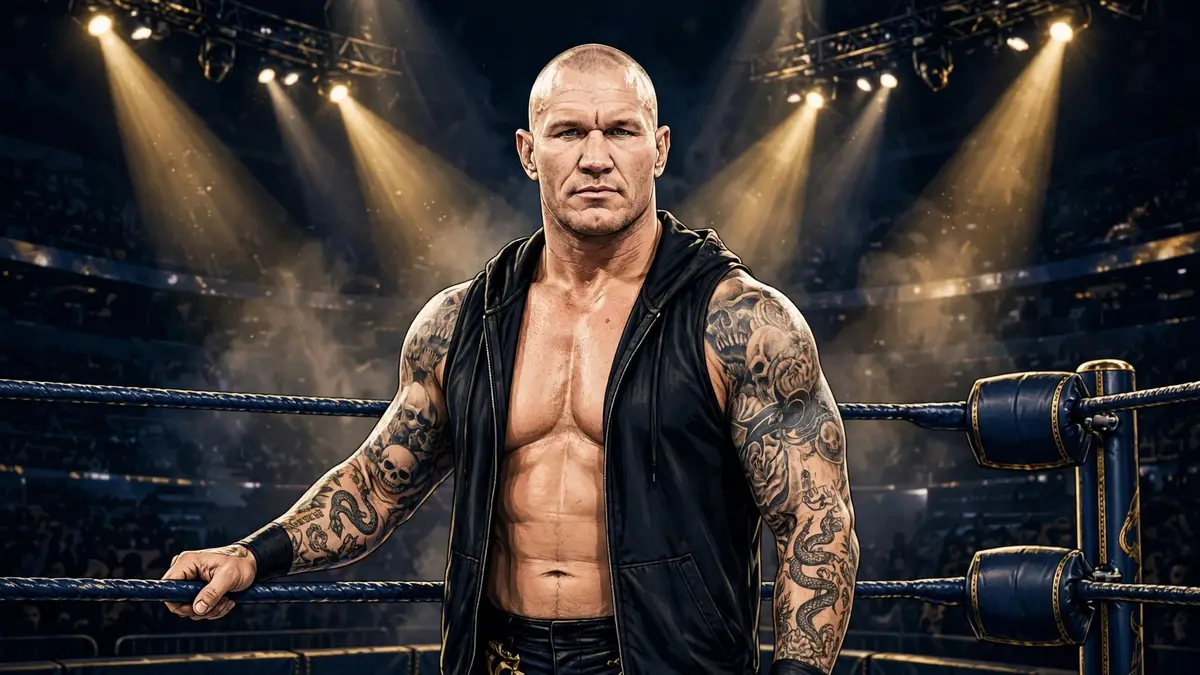
Randy Orton was born into wrestling. His grandfather, Bob Orton Sr., was a professional wrestler. His father, “Cowboy” Bob Orton Jr., was a WWE Hall of Famer known for the cast he wore on his forearm and for his work as Roddy Piper’s bodyguard during the Rock ‘n’ Wrestling era of the 1980s. His uncle Barry Orton wrestled too. The family business was not a hobby in the Orton house — it was the dinner-table conversation, the family trade, and the standard a young Randy was expected to measure himself against.
Orton grew up in the St. Louis area of Missouri after being born in Knoxville, Tennessee. He attended Hazelwood Central High School, where he played football and dabbled in amateur wrestling, but he was not a standout athlete in the way his father had been. Friends and family from that period describe a teenager who knew he wanted to wrestle but had not yet found the discipline the job demands. That gap between ambition and discipline would define the first chapter of his adult life — and nearly end his wrestling career before it started.
What set Orton apart from other second- and third-generation wrestlers was the weight of the name. Fans and promoters expected a finished product. WWE signed him in 2000, when he was only 20, largely on the strength of his bloodline and his look: 6 feet 5 inches tall, athletic, and carrying the same sharp features as his father. The company saw a future main-eventer. Orton himself has said in interviews over the years that he arrived in WWE too young, too cocky, and unprepared for the grind of the road. The early years of his career read as a slow education in professionalism, paid for in suspensions, backstage heat, and missed chances before the talent finally caught up with the opportunity.
From the Marines to the Squared Circle
After high school, Orton enlisted in the United States Marine Corps in 1998. The decision lasted less than a year. He went absent without leave, and in 1999 he received a bad conduct discharge after spending time in military confinement. It is a chapter Orton has never hidden from — he has spoken about it openly in interviews and in WWE-produced documentaries — and it became the first real test of his character. The Marines taught him, by his own account, what happens when you quit on a commitment, and the lesson stuck. When he finally committed to wrestling, he committed completely.
His father trained him, and Orton made his professional debut on March 18, 2000, for the Mid-Missouri Wrestling Association–Southern Illinois Conference Wrestling (MMWA-SICW) in St. Louis. WWE signed him the same year and sent him to Ohio Valley Wrestling (OVW), its developmental territory in Louisville, Kentucky. In OVW he won the Hardcore Championship twice and learned the unglamorous side of the business: long drives, small crowds, and the daily work of building a match from nothing. The polish came later. In Louisville, the job was repetition.
Orton’s main-roster debut came on the April 25, 2002 episode of SmackDown, where he faced Hardcore Holly. He was 22 years old, green, and visibly learning on television. His first year on the main roster was uneven — a shoulder injury in late 2002 kept him off television for months, and when he returned in early 2003, WWE had a plan that would change everything: pair the young third-generation star with Triple H, Ric Flair, and Batista in a new faction built around the past, present, and future of the business.
The Evolution Years and the Legend Killer
Evolution debuted in 2003, and it was the making of Randy Orton. Triple H was the present, Ric Flair was the past, Batista was the muscle, and Orton was the future — the youngest member of the group, groomed in plain sight. The faction gave Orton something he had lacked: a clear identity and two of the greatest talkers in wrestling history standing beside him every week. He won the Intercontinental Championship in December 2003, defeating Rob Van Dam at Armageddon, and held it for more than seven months — at the time, one of the longest Intercontinental reigns in years.
It was during this run that the “Legend Killer” character took shape. Orton began targeting Hall of Famers and beloved veterans — Mick Foley, Shawn Michaels, Harley Race — and disrespecting them on camera, spitting on their legacies and then beating them in the ring. The gimmick was perfect for him: it turned his real-life reputation as a cocky young star who had been handed everything into a character the audience loved to hate. His feud with Mick Foley in 2004, which peaked in a brutal Hardcore match at Backlash, proved Orton could work the violent, physical style that earns respect in a locker room. Foley later praised him publicly, and that endorsement carried real weight.
The payoff came at SummerSlam on August 15, 2004. Orton defeated Chris Benoit to win the World Heavyweight Championship, becoming the youngest world champion in WWE history at 24 years old — a record that stood for well over a decade. The celebration lasted one night. The next evening on Raw, Triple H turned on him, and Orton was thrown out of Evolution. The betrayal was the best thing that ever happened to his career: it made him a babyface overnight and set up a months-long feud with Triple H that carried WWE’s flagship show through the autumn of 2004.
The Prime Years: Legacy, Royal Rumbles, and Title Unification
Orton spent the rest of the decade collecting championships and main events. He feuded with The Undertaker through 2005 in a nine-month rivalry that included a WrestleMania 21 match and a Hell in a Cell bout. He won his first WWE Championship in 2007, and by the end of the decade he was firmly established as one of the company’s top three stars alongside John Cena and Triple H. His 2009 run stands out: he won the Royal Rumble in January, formed the Legacy stable with Cody Rhodes and Ted DiBiase Jr. — two more second-generation wrestlers he mentored on screen — and feuded with Triple H in a deeply personal storyline built around attacks on the McMahon family. The Legacy run mattered for another reason: it paired Orton with a young Cody Rhodes, a partnership that would echo through both men’s careers for the next 17 years.
The early 2010s brought more gold. Orton won his second Royal Rumble in 2017, defeating Roman Reigns in the final moments of the match, which earned him a WrestleMania 33 title shot against Bray Wyatt — a feud that turned on Wyatt’s mind games and Orton’s decision to burn down the Wyatt Family compound on television. In 2013 he won the Money in the Bank ladder match, and in December of that year he defeated John Cena in a Tables, Ladders and Chairs match to unify the WWE Championship and the World Heavyweight Championship, becoming the first WWE World Heavyweight Champion and the final holder of the old World Heavyweight title. The unification was a historic moment: two world titles became one, and Orton’s name sits permanently on that line of the record book.
By the mid-2010s Orton had settled into the role he would hold for the rest of his career: the veteran who could be plugged into any main-event program and make it feel important. He feuded with Seth Rollins, Dean Ambrose, and Roman Reigns as The Shield rose. He worked with the company’s next generation without ever fading into the background himself. His in-ring style had changed too — slower, more deliberate, built around the sudden violence of the RKO, a finishing move that had become a pop-culture phenomenon in its own right, memed into a thousand viral videos of people being “RKO’d outta nowhere.”
The Viper, the Wyatt Family, and RK-Bro
The “Viper” persona — the cold, methodical predator who strikes without warning — became Orton’s defining character in the 2010s. Where the Legend Killer had been loud and arrogant, the Viper was quiet and patient. He would stand in the corner of the ring, hands on the ropes, coiled and still, while the crowd chanted his name. The character worked because it matched the man: Orton’s best matches were built on stillness, on the slow walk around the ring, on the moment when the audience realized the RKO was coming a half-second before it happened.
His 2016–2017 run with the Wyatt Family showed a different side of that character. Orton infiltrated Bray Wyatt’s cult-like stable, played the loyal follower for months, and then turned on Wyatt in spectacular fashion — burning down the compound and then defeating Wyatt for the WWE Championship at WrestleMania 33. The storyline was strange, theatrical, and memorable, and it gave Orton his 13th world championship.
Then came RK-Bro. In 2021, WWE paired the famously intense Orton with Matt Riddle, a laid-back, free-spirited surfer character who was his opposite in every way. On paper it should not have worked. In practice it became one of the most popular acts in WWE: Riddle’s goofy energy pulled something lighter out of Orton, and Orton’s deadpan reactions made Riddle funnier. The pair won the Raw Tag Team Championship twice and headlined shows together for more than a year. It also gave Orton something rare in a 20-year career — a genuinely new act, and proof that he could still surprise an audience that thought it had seen everything from him. RK-Bro ended in May 2022, when Orton suffered the back injury that would keep him away for a year and a half.
The Back Injury and the 2023 Comeback
Orton’s last match before the layoff was a tag-team title loss to The Usos on the May 20, 2022 episode of SmackDown. What fans did not know was that he had been wrestling through serious back trouble for years. The damage was severe enough that doctors told him his career might be over — spinal fusion surgery was discussed as a necessity, not an option, and even with surgery there was no guarantee he would wrestle again. Orton later said he spent months uncertain whether he would ever return to a ring.
He underwent spinal fusion surgery and began the slow work of rehabilitation. WWE kept him off television entirely, which only fed speculation: for 18 months, wrestling media ran regular stories about whether the Viper was finished. The company said nothing. Orton said nothing. Then, on November 25, 2023, at Survivor Series in Chicago, his music hit during the men’s WarGames match and the arena erupted. He returned as a surprise entrant, hit RKOs, and picked up the win for his team. It was one of the loudest pops of the year — 18 months of absence had only made the audience want him more.
The comeback was real, not ceremonial. Orton signed a new deal, and in August 2024 he publicly confirmed a five-year contract extension that keeps him with WWE through late 2029. The guaranteed value of the extension has not been publicly disclosed, and reports of a $10 million annual guarantee have not been confirmed by any contract or company filing, according to Celebrity Net Worth. What is confirmed is the length: five years, taking him to 49 years old, which strongly suggests Orton intends to finish his career where he started it.
Randy Orton in 2026: Elimination Chamber and WrestleMania 42
Orton stayed in the championship picture through 2024, challenging Roman Reigns in a Fatal Four-Way at the Royal Rumble, reaching the King of the Ring final against Gunther, and challenging Gunther again for the World Heavyweight Championship at Bash in Berlin. In 2025 he feuded with Kevin Owens, returned at Elimination Chamber in March to attack Owens after his match with Sami Zayn, and reached another King of the Ring final — losing this time to his former Legacy partner Cody Rhodes at Night of Champions.
After a three-month absence from television, Orton reappeared on the January 2, 2026 episode of SmackDown and went straight back into the main event scene. On February 28, 2026, he won the men’s Elimination Chamber match, earning a shot at the Undisputed WWE Championship at WrestleMania 42. The story wrote itself: the challenger was Cody Rhodes, the same man Orton had mentored in Legacy 17 years earlier, now the company’s top champion.
Their rivalry turned personal on the March 13, 2026 episode of SmackDown, when Orton attacked Rhodes and turned heel — the Viper persona returning in full. At WrestleMania 42 Night 1, Rhodes retained the title, but Orton attacked him with the punt kick after the match, keeping the feud alive. Orton was then sidelined again, this time by a back injury that kept him off television from April 19 to July 31, 2026, before he returned at SummerSlam 2026, interfering in Rhodes’ championship match against CM Punk with an RKO. He defeated Rhodes in a September 2026 rematch, and as of November 2026 he remains one of SmackDown’s featured attractions.
At 6 feet 5 inches tall, Orton has always carried the physical presence of a main-event heavyweight, and his size has been part of his act since his debut — the long frame, the coiled stillness before the RKO, the way he towers over most of the roster. Readers who want the full breakdown of Randy Orton’s height and how it compares with other WWE stars can find it on our sister site. At 46, with a new contract and a fresh heel run, the question around Orton is no longer whether he can still go — it is how the final chapter of his career will be written, and whether a 15th world title is still in him.
The number that defines him: 14 world championships. Ten WWE Championships and four World Heavyweight Championships put Orton level with Triple H for the third-most world title reigns in WWE history, behind John Cena and Ric Flair. He has also won the Royal Rumble twice (2009, 2017), Money in the Bank once (2013), and completed both the Triple Crown and the Grand Slam. No active wrestler on the SmackDown roster carries a résumé that long.
Randy Orton’s Net Worth and Income in 2026
Published estimates of Randy Orton’s net worth disagree by a wide margin, so this article publishes the honest range rather than picking one number and pretending it is settled. At the low end, Glimmer Sports puts him at around $7 million as of February 2026. In the middle, PlayersBio and Kemi Filani estimate about $11 million, and Surprise Sports — updated in October 2026 — estimates around $15 million. At the high end, Celebrity Net Worth lists him at $25 million, updated in October 2026. The CA Knowledge puts him at $6–8 million. The range we publish is therefore $7 million to $25 million, with most mid-tier trackers clustering between $11 million and $15 million.
Why the gap? Net worth trackers for wrestlers work from public information: reported salaries, known contract lengths, real-estate records, and merchandise estimates. None of them sees Orton’s bank statements, tax returns, or investment portfolio. Celebrity Net Worth’s higher figure appears to credit him with a larger share of career earnings and asset appreciation, including his long run as one of WWE’s highest-paid performers; the lower figures lean harder on his documented base salary and visible assets. Neither approach is wrong — they are different methods applied to incomplete data. Readers should treat every figure in this range as an estimate, not an audited fact.
What is solid is the salary picture. Orton’s pay was documented in unusual detail during his first divorce: court papers reported in July 2013 listed his WWE pay at $291,666 per month, roughly $3.5 million per year. Forbes estimated he earned $4.1 million in 2019, making him the third-highest-paid active WWE wrestler on its 2020 list, behind Brock Lesnar and Roman Reigns. Current reporting converges on an annual salary of $4 million to $5 million from WWE under his new five-year extension, per Surprise Sports, with pay-per-view bonuses and merchandise royalties on top. Glimmer Sports gives a wider $4–10 million annual range, but Celebrity Net Worth notes that claims of a guaranteed $10 million salary have not been confirmed by any actual contract or company filing.
Where the Money Comes From
Orton’s income has always been dominated by one source: WWE. Over 24 years with the company he has moved from a developmental salary in OVW to main-roster pay, to main-event money, to the veteran top-of-card deals he now holds. His earnings stack up in layers, and each layer tells a different part of the story.
| Income Stream | What It Covers |
|---|---|
| WWE base salary | Reported at $4 million–$5 million a year under the current deal (Surprise Sports); $3.5 million a year documented in 2013 divorce papers; Forbes put his 2019 earnings at $4.1 million |
| Pay-per-view and premium-event bonuses | Main-event talent earns bonuses tied to big shows; Glimmer Sports estimates $800,000–$1.5 million per major WrestleMania-scale event cycle for a star of Orton’s level |
| Merchandise royalties | RKO-branded shirts, figures, and replica title belts; Orton has been a consistent top seller for two decades, and his “RKO outta nowhere” fame keeps the merch moving |
| Video games | A fixture of the WWE 2K series for more than 20 editions, plus mobile games; appearances carry licensing payments |
| Acting | Lead roles in WWE Studios films 12 Rounds 2: Reloaded (2013) and The Condemned 2 (2015), a supporting role in That’s What I Am (2011), and a guest arc on USA Network’s Shooter (2016) |
| Endorsements and appearances | Smaller than his WWE pay but real: paid appearances, conventions, and the occasional brand deal; Orton has never chased the endorsement circuit the way some of his peers have |
The important thing to understand about Orton’s money is its steadiness. He never had a single breakout payday — no billion-dollar company sale, no acting franchise, no business empire. Instead he earned top-of-card money for an unusually long time. Twenty-four years of main-event pay, with only one long injury layoff, adds up to a large career total even without a single windfall. That is the quiet math behind the $11–15 million middle of the range: two decades of being one of the three or four best-paid wrestlers in the world.
Net Worth Growth Over the Years
No tracker publishes a year-by-year audited record of Orton’s wealth, so the timeline below is a reconstruction from the public record — salary reports, contract milestones, and the estimates trackers published at each stage. It shows the shape of his financial career rather than a precise balance at each point.
| Period | Career Stage and Reported Earnings |
|---|---|
| 2000–2003 | Developmental and early main-roster pay; OVW salary, then a first main-roster deal. Modest earnings by WWE standards; the Intercontinental title run in late 2003 marked the first real pay rise. |
| 2004–2009 | Youngest world champion at 24; Evolution money, then main-event pay. First WWE Championship in 2007; Royal Rumble win and Legacy run in 2009. Forbes-level earnings begin in this window. |
| 2010–2013 | Established top star. Divorce papers in 2013 document $291,666 a month — about $3.5 million a year. Money in the Bank win and title unification in December 2013 cap the period. |
| 2014–2019 | Peak earning years. Forbes estimates $4.1 million earned in 2019, third-highest among active WWE wrestlers. Film roles and WWE 2K licensing add to the base. |
| 2020–2022 | RK-Bro run keeps him featured; back injury in May 2022 ends the run. Earnings continue under his WWE deal during the layoff. |
| 2023–2026 | Comeback at Survivor Series 2023; five-year extension signed in 2024; current salary reported at $4–5 million a year. Trackers now estimate $7–25 million depending on method, most clustering at $11–15 million. |
Real Estate, Cars, and Assets
Orton lives in St. Charles, Missouri, in the St. Louis area he has called home since childhood. The most detailed public record of his property comes from Celebrity Net Worth, which notes a documented Missouri home sale: he sold a large home in the area in 2016 for about $775,000. Beyond that single sale, his property holdings are not publicly itemized, and this article will not invent a portfolio for him. He is known to own a substantial home in the St. Charles area, but no reliable public record gives its current value, so we do not publish one.
On cars, Orton’s taste runs to American muscle and luxury SUVs — he has been photographed with high-end vehicles over the years, including a Bentley, but no verified inventory of his garage exists in the public record, and the fan sites that publish lists of “Orton’s cars” do not cite sources. We leave those lists out. What the record does support is simpler: a wrestler who earned top money for two decades, kept his spending relatively quiet compared with peers who chased headlines, and stayed rooted in Missouri rather than relocating to Los Angeles or Miami. That steadiness is itself an asset story — the fortune survived because the lifestyle never outran the income.
How Orton Compares to His Peers
Context is what makes a net worth figure meaningful, so here is Orton’s range against the wrestlers his career is most often measured against. The comparison uses the same kind of published estimates — none of these figures is audited, and each tracker uses its own method, so treat the gaps as approximate.
| Wrestler | Estimated Net Worth (2026, published estimates) |
|---|---|
| John Cena | Widely estimated at $80 million+ — acting career and endorsements far beyond wrestling |
| Triple H | Estimated at $150 million+ — but most of that comes from his WWE executive role and stock, not in-ring pay |
| Roman Reigns | Estimated at $14–20 million — top current star, shorter career than Orton so far |
| Randy Orton | $7–25 million (most trackers: $11–15 million) |
| Cody Rhodes | Estimated at $8 million — rising fast, but a decade less at the top than Orton |
| Brock Lesnar | Estimated at $20–25 million — UFC paydays on top of WWE money |
The comparison flatters Orton in one way and humbles him in another. He sits comfortably alongside the other career wrestlers of his generation — Reigns, Rhodes, Lesnar — but far below the two men who turned wrestling fame into something bigger: Cena, through Hollywood, and Triple H, through the boardroom. Orton never pursued either path with the same intensity. His acting career stayed small, and he never moved into management. What he did instead was wrestle longer at the top than almost anyone. That is a choice, and the $11–15 million middle of his range is what that choice is worth.
Personal Life: Wife, Children, and Life in Missouri
Orton married Samantha Speno in 2007. The couple had a daughter, Alanna Marie, born in 2008, and divorced in 2013 — the divorce proceedings produced the unusually detailed salary disclosure cited above. In November 2015 he married Kim Marie Kessler, whom he met at a WWE show in 2012. The couple had a daughter, Brooklyn Rose, in 2016, and Kim’s children from a previous relationship are part of the family as well. Orton has spoken in interviews about how fatherhood changed his approach to the job — the road schedule that once felt like freedom started to feel like time away from home, and the five-year extension he signed in 2024 was negotiated, by several accounts, around a schedule that lets him be present for his family.
Outside the ring, Orton is known as a private person who avoids the celebrity circuit. He does not court tabloid attention, and his social media presence is lighter than most stars of his stature. His hobbies are well documented by fans: he is a keen tattoo collector — his arms and back carry extensive ink, including the tribal designs that have become part of his look — and he has been open about his interest in fitness and training outside the WWE Performance Center system. He also stays connected to the St. Louis wrestling community that raised him, appearing at local events and supporting the independent scene in Missouri.
Family is the thread that runs through his whole story. His father trained him. His grandfather set the standard. His wife and children are the reason he negotiated a lighter schedule in his forties. And his former Legacy protégé, Cody Rhodes, is now his chief rival — the student who became the champion Orton has to beat. Few wrestlers have a personal life so tightly woven into their on-screen story, and that is part of why Orton’s 2026 run feels like a final chapter rather than just another year.
Controversies and Setbacks
Orton’s career has had its share of trouble, and an honest biography does not skip it. The Marine Corps discharge in 1999 is the first item — he went AWOL and received a bad conduct discharge, a fact he has discussed openly and which WWE has addressed in its own documentaries. Early in his WWE career he also earned a reputation for backstage immaturity; stories from that era, including an incident in which he was fined for conduct on a tour, followed him for years. Orton himself has acknowledged that he arrived in WWE too young and had to grow up in public.
He was suspended twice under WWE’s Wellness Policy: a 30-day suspension in 2006 and a 60-day suspension in 2012 for a second violation. Both were announced by WWE at the time, and Orton served them without public complaint. In 2007 his name also appeared in reporting around an online pharmacy investigation into performance-enhancing drugs — he was among several wrestlers named in that coverage, and WWE maintained at the time that its Wellness Policy testing was in place. Orton has denied using steroids in interviews since, and no finding against him was ever published. We report the fact that his name appeared in that reporting, and the fact that nothing further was established, because both halves are true.
The back injury of 2022 was a different kind of setback — not a scandal but a genuine threat to his livelihood. Spinal fusion surgery and 18 months away from the ring would have ended many careers. That Orton returned at all, let alone to main-event level, is the strongest answer to the doubts that followed him early in his career. The controversies belong in the record; so does the recovery.
Frequently Asked Questions
How old is Randy Orton in 2026?
Randy Orton is 46 years old in 2026. He was born Randal Keith Orton on April 1, 1980, in Knoxville, Tennessee, and turned 46 on April 1, 2026.
How many world championships has Randy Orton won?
Orton has won 14 world championships: 10 WWE Championships and 4 World Heavyweight Championships. That ties him with Triple H for the third-most world title reigns in WWE history, behind John Cena and Ric Flair. He has won 20 championships in WWE overall, and 22 in major promotions.
What is Randy Orton’s net worth in 2026?
Published estimates range from $7 million to $25 million. Glimmer Sports puts him at about $7 million, PlayersBio and Kemi Filani at about $11 million, Surprise Sports at about $15 million, and Celebrity Net Worth at $25 million. Most mid-tier trackers cluster between $11 million and $15 million. His WWE salary is reported at $4 million to $5 million a year.
Is Randy Orton still wrestling in 2026?
Yes. Orton is active on WWE SmackDown in 2026. He won the men’s Elimination Chamber match in February 2026, challenged Cody Rhodes for the Undisputed WWE Championship at WrestleMania 42, turned heel by attacking Rhodes in March, and returned at SummerSlam 2026 after a back injury layoff from April to July.
Who is Randy Orton’s wife?
Randy Orton has been married to Kim Marie Kessler since November 2015. They met at a WWE show in 2012 and have a daughter, Brooklyn Rose, born in 2016. Orton was previously married to Samantha Speno from 2007 to 2013, and they have a daughter, Alanna Marie, born in 2008.
Why was Randy Orton out of WWE in 2022 and 2023?
Orton suffered a serious back injury that required spinal fusion surgery. His last match before the layoff was on May 20, 2022, and doctors told him his career might be over. After 18 months of rehabilitation he made a surprise return at Survivor Series on November 25, 2023.
How tall is Randy Orton?
Randy Orton is 6 feet 5 inches tall (196 cm) and WWE bills him at 250 lbs. His height has been part of his main-event presence since his debut — the long frame and coiled stillness before the RKO are signatures of his act.
What is Randy Orton’s real name?
His real name is Randal Keith Orton. He is a third-generation professional wrestler: his father is WWE Hall of Famer “Cowboy” Bob Orton Jr., his grandfather is Bob Orton Sr., and his uncle Barry Orton also wrestled.
Final Thoughts
Randy Orton’s biography is the story of a wrestler who was given everything — the name, the look, the early push — and then had to earn it anyway. He became the youngest world champion in WWE history at 24, then spent the next 22 years proving that the first title was not a fluke: 14 world championships, two Royal Rumbles, a Money in the Bank win, a title unification, and the record for most pay-per-view matches in company history. He survived the Marines discharge, the suspensions, and a back injury that should have ended his career, and he is still headlining at 46 on a contract that runs to 2029.
The money tells the same story as the career: not a windfall, but a fortune built slowly. A range of $7 million to $25 million, most likely $11 million to $15 million, earned across 24 years of top-card pay rather than a single breakout deal. Orton never became a movie star like Cena or an executive like Triple H, and his net worth reflects that. What he became instead is rarer — the wrestler who stayed at the top for a quarter of a century and is still there, still coiled in the corner, still waiting for the moment to strike.
Sources and Reporting
How we estimated: Net worth figures for public personalities are estimates built from public reporting, not audited financial statements. Where sources disagree we publish the range and name the sources behind each end of it, rather than presenting a single invented figure. Salary figures come from court documents reported in 2013, Forbes reporting from 2019–2020, and current tracker estimates; the guaranteed value of Orton’s 2024 contract extension has not been publicly disclosed. Career facts were checked against Wikipedia, The SmackDown Hotel, and wrestlingprofiles.com, with 2026 events verified against contemporary reporting.
- Wikipedia — Randy Orton (biography, title history, 2026 events)
- The SmackDown Hotel — Randy Orton profile (career stats, title reigns, 2026 timeline)
- Parade — Randy Orton Turns 46 (April 2026 career retrospective)
- Celebrity Net Worth — Randy Orton Net Worth ($25 million estimate, salary and contract reporting)
- Surprise Sports — Randy Orton Net Worth ($15 million estimate, updated October 2026)
- Glimmer Sports — Randy Orton 2026 ($7 million estimate, salary range)
- PlayersBio — Randy Orton Bio ($11 million estimate)
- Kemi Filani — Randy Orton Bio Update ($11 million estimate, June 2026)
- The CA Knowledge — Randy Orton Profile ($6–8 million estimate)