Last updated: November 15, 2026 · By Celebamerica Editorial Staff
Jerry Seinfeld was born Jerome Allen Seinfeld on April 29, 1954, in Brooklyn, New York — and he is now the richest stand-up comedian in American history. His net worth sits at an estimated $900 million to $1.1 billion as of November 2026, with Forbes listing him at $1.1 billion in its real-time tracking, Bloomberg having first called him a billionaire in March 2024, and Celebrity Net Worth holding at $900 million. The range is the honest answer: his own representative has publicly disputed the billionaire figures, so this biography shows the full spread instead of picking one number and pretending the argument does not exist.
What makes the story worth telling in full is how narrow the path was. Seinfeld did not build his fortune on a dozen franchises, a fashion label, or a tech exit. He built it on one sitcom, one voice, and one discipline — writing jokes every single day for fifty years. The show he co-created with Larry David ran for nine seasons on NBC, ended with 76 million people watching the finale, and then kept paying him for decades through syndication and streaming deals that are still among the largest in television history. He turned down a reported $110 million to make a tenth season, walked away at the peak, and somehow got richer after quitting. This is the complete story: the Brooklyn childhood, the fifteen-year grind in comedy clubs, the show about nothing, the money machine behind it, the cars, the family, and what he is doing at 72.
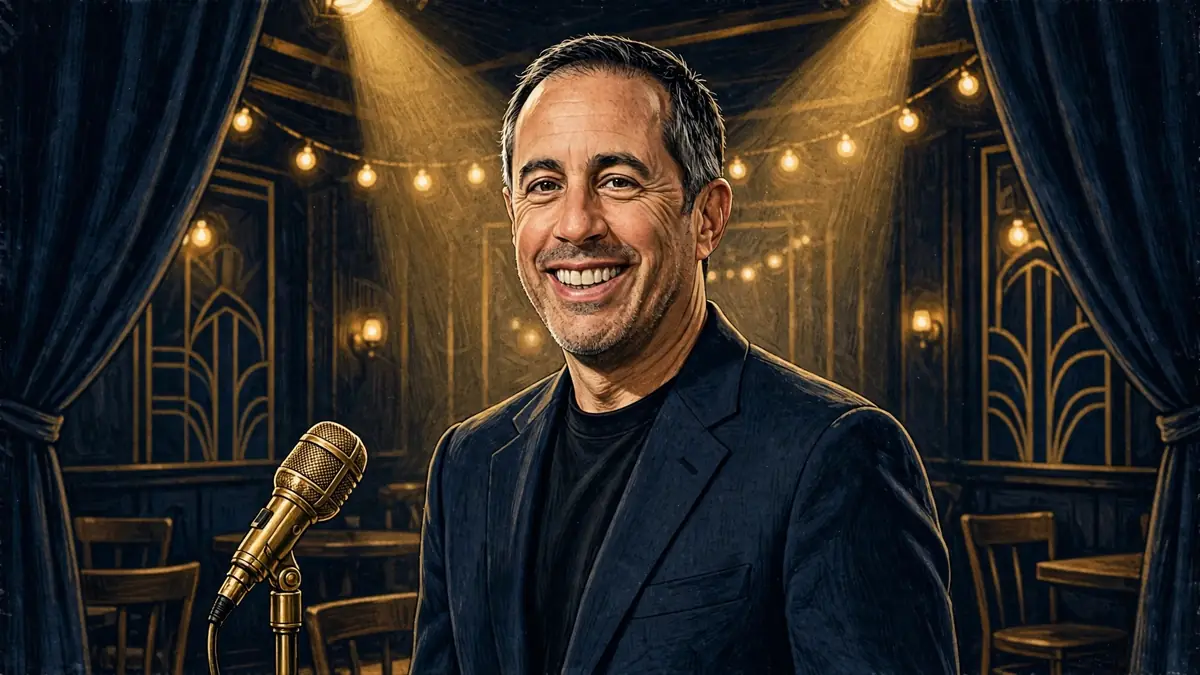
| Full Name | Jerome Allen Seinfeld |
|---|---|
| Date of Birth | April 29, 1954 (age 72 as of November 2026) |
| Birthplace | Brooklyn, New York City, New York, USA |
| Estimated Net Worth | $900 million – $1.1 billion (Forbes: $1.1 billion; Bloomberg: over $1 billion; Celebrity Net Worth: $900 million) |
| Primary Income Sources | Seinfeld syndication backend, Netflix streaming deal, stand-up touring, Netflix specials, books |
| Key Works | Seinfeld (1989–1998), Bee Movie (2007), Comedians in Cars Getting Coffee (2012– ), Unfrosted (2024) |
| Spouse | Jessica Seinfeld (married 1999) |
| Children | Three — daughter Sascha, sons Julian and Shepherd |
| Years Active | 1976–present |
| Awards | Primetime Emmy, Golden Globe (Best Actor, 1995), three Screen Actors Guild Awards, four Grammy nominations |
Table of Contents
- Early Life: A Brooklyn Kid Raised on Jokes
- The Club Years: Fifteen Years Before Anyone Knew His Name
- Seinfeld: The Show About Nothing That Changed Television
- The Money: Syndication, Streaming, and the Famous Refusal
- Net Worth Breakdown: Where the Fortune Sits
- After Seinfeld: Bee Movie, Coffee, and a Directing Debut
- Real Estate and the Famous Car Collection
- Personal Life: Jessica, Three Kids, and Giving Back
- Controversies: Duke, Walkouts, and Saying What He Thinks
- Awards and Legacy: The Comedian’s Comedian
- Frequently Asked Questions
- Final Thoughts
- Sources and Reporting
Early Life: A Brooklyn Kid Raised on Jokes
Jerome Allen Seinfeld was born on April 29, 1954, in Brooklyn, New York City, to Kálmán Seinfeld, a professional sign maker of Hungarian Jewish descent, and Betty Seinfeld, a homemaker of Syrian Jewish descent. The family soon moved to Massapequa, a suburb on Long Island in Nassau County, where Jerry grew up. His father ran a business called Seinfeld Signs, and the house was full of comedy: Kálmán collected jokes the way other men collected stamps, kept notebooks of one-liners, and told them as a hobby. Jerry was listening. By his own later accounts, he was eight years old when he started studying comedians on television the way other kids studied baseball cards — watching the timing, the pauses, the way a small observation could land like a punchline.
Massapequa High School gave him a stage of sorts, but the real education came later. After a stint at the State University of New York at Oswego, he transferred to Queens College of the City University of New York, where he graduated in 1976 with a Bachelor of Arts degree in communications and theater. College was where the interest hardened into a plan. He had already decided that stand-up was the job, and he treated it like a trade to be learned: write every day, test material in front of strangers at night, rewrite what failed, and keep the bits that worked. That routine, started in his early twenties, never really stopped. Fifty years later, he still talks about writing as a daily practice, and the yellow legal pads full of jokes are a running thread through every profile ever written about him.
The other thing Massapequa gave him was material. Seinfeld’s comedy has always been built from the ordinary — waiting rooms, airline food, dry cleaning, the social rules nobody wrote down. That instinct came from a suburban childhood spent noticing how people actually behave, and from a father who treated a well-turned joke as a small piece of craft. He was not a class clown in the loud sense. Friends and biographers describe a kid who watched first and spoke second, which is exactly the skill his act would later be built on.
The Club Years: Fifteen Years Before Anyone Knew His Name
Seinfeld’s first stand-up set came in 1976, the year he graduated, at Catch a Rising Star, the New York comedy club that was then the proving ground for a whole generation of comics. The early years were the classic club grind: short sets, late nights, small rooms, and long stretches where the money barely covered the subway. He worked the New York circuit — Catch a Rising Star, The Comic Strip, the Improv — and slowly built a reputation as the cleanest act in the room. While many comics of the era leaned on shock or profanity, Seinfeld’s material was observational and precise, built on the tiny frictions of daily life. Club owners noticed. So did other comics. He was the guy younger stand-ups studied, and the guy bookers trusted to close a show without clearing a room.
The breakthrough came on May 6, 1981, when he appeared on The Tonight Show Starring Johnny Carson. A Carson spot was the single most valuable five minutes in comedy at the time, and Seinfeld’s set — tight, clean, and built around the kind of everyday observations that played in every living room in America — worked. The appearance gave him his first national exposure and opened the door to the television work that followed: guest spots, a small recurring role on the sitcom Benson, and a growing profile as a road comic who could fill rooms on his own name. His first HBO special, Stand-Up Confidential, arrived in 1987 and showed a comedian on the edge of something bigger — polished, confident, and clearly ready for a larger stage than the club circuit could offer.
It is worth pausing on the length of that apprenticeship. Seinfeld spent roughly thirteen years doing stand-up before his sitcom premiered, and by the time NBC came calling he had already been a working comic for longer than most television stars’ entire careers. That matters, because it explains the show. The sitcom was not a lucky break for an unknown; it was a machine built by a craftsman who had spent a decade and a half learning exactly which lines made a room laugh. His peers knew it too. Dave Chappelle, Chris Rock, and the generation of stand-ups who followed have all, at different times, pointed to Seinfeld as the model of a comic who treated the craft as a discipline rather than a gift.
Seinfeld: The Show About Nothing That Changed Television
In 1988, NBC asked Seinfeld to develop a sitcom. He teamed up with Larry David, a friend and fellow comedian from the New York club scene, and the two built a pilot originally called The Seinfeld Chronicles. The premise was a deliberate joke in itself: a show about nothing, with no lessons, no character growth, and no big plots — just four people in a Manhattan apartment talking about the things that did not matter. NBC aired the pilot in July 1989, picked the series up, and Seinfeld ran for nine seasons and 180 episodes, from 1989 to 1998.
The cast around him became famous in their own right. Jason Alexander played George Costanza, a neurotic, scheming friend built partly from Larry David’s own life. Julia Louis-Dreyfus played Elaine Benes, the sharp-tongued ex-girlfriend who stayed in the group. Michael Richards played Kramer, the neighbor whose entrances — sliding through Jerry’s apartment door — became a piece of television grammar. The show’s genius was structural: tiny social rules (double-dipping a chip, the etiquette of the “close talker”, the morality of the parking space) were treated with the seriousness of a courtroom drama, and the characters never learned anything from week to week. That refusal to grow was the point, and it made the show endlessly rewatchable, because the jokes never depended on where the story was going.
By the mid-1990s, Seinfeld was the most watched comedy in America and a cultural force that rewrote the language. Phrases from the show — “yada yada yada”, “no soup for you”, “master of my domain”, “these pretzels are making me thirsty” — moved into everyday speech. The series won the Primetime Emmy Award for Outstanding Comedy Series in 1993, and Seinfeld himself won the Golden Globe for Best Actor in a Television Series Musical or Comedy in 1995. TV Guide later voted it the best show of all time, and Esquire called it the best situation comedy of all time. The finale, which aired on May 14, 1998, was watched by an estimated 76 million viewers, then the most-watched comedy ending in American television history.

The finale also set up the decision that defines Seinfeld’s biography. NBC wanted a tenth season, and the offer on the table was reported at around $110 million — for one more season of a show that had already made him rich. He said no. The reasoning he gave at the time, and has repeated since, was simple: the show had said what it had to say, and he would rather end it than watch it fade. It is the rarest decision in show business, and it is the one that explains the rest of his money story — because walking away at the peak did not stop the checks. It may have made them bigger.
The Money: Syndication, Streaming, and the Famous Refusal
The fortune was not built on salary. In the final season, Seinfeld was reportedly paid $1 million per episode, a huge number at the time, but the real money was always in the backend — the ownership stake in the show itself. Bloomberg’s March 2024 analysis, the one that first called him a billionaire, estimated that syndication and licensing deals for Seinfeld had earned him about $465 million, based on an assumed 15 percent stake in the show’s backend. The sitcom has been sold into syndication in market after market, then to cable, then to streaming, and each sale produced a new round of payments to the people who owned a piece of it. By Bloomberg’s count, the show’s reruns and licensing had generated billions in total revenue; Seinfeld’s cut was the single largest line in his fortune. For the full money picture, our sister site breaks down Jerry Seinfeld’s net worth in detail, including the Forbes and Celebrity Net Worth figures side by side.
The streaming era added a second wave. In 2019, Netflix acquired the global streaming rights to Seinfeld in a deal widely reported at more than $500 million for five years, taking over from Hulu. Bloomberg estimated that Seinfeld’s share of the Netflix sale was about $94 million. The deal mattered for another reason: it put the show in front of a new generation that had never watched it on NBC, and the audience numbers stayed strong enough that the show’s value did not fade with age. That is the unusual thing about this fortune. Most television money decays. Seinfeld’s has compounded, because the product — 180 self-contained episodes about everyday life — does not date the way topical comedy does.
Stand-up is the third leg. Seinfeld never stopped touring, and touring is where the cash is most direct: no network, no studio, just tickets. In 1998, the year the show ended, Guinness World Records named him the television actor with the highest annual earnings at $267 million, a figure driven by the show’s final-season economics and the syndication deals closing around it. Decades later, he still plays residencies — the Beacon Theatre in New York is a regular home — and his 2026 calendar has included Beacon dates, an added show at the Just for Laughs festival in Montreal, and dates across North America. Reports in the trade press put his typical annual earnings from touring and residuals at between $20 million and $50 million in a working year, which is why the fortune keeps growing even though he has not made a sitcom in nearly thirty years.
Books added a fourth stream. SeinLanguage, published in 1993, was a bestseller built from his stand-up observations, and Is This Anything?, published in 2020, gathered forty-five years of material from his personal notebooks, organized by decade, and became a New York Times bestseller. Neither book made him rich on its own. Both extended the brand — the comedian as a writer, not just a performer — and both sold steadily for years. That is the pattern of the whole career: no single windfall, but a set of income streams that were built once and kept paying, stacked on top of each other for decades.
The $110 million question. Turning down a tenth season looked, in 1998, like leaving money on the table. In hindsight it protected the asset. A tired tenth season would have weakened the show’s reputation and its rerun value; ending at the peak kept all 180 episodes in the premium tier of television history. The refusal is now the most quoted fact in his biography — and the clearest proof that he understood the business of his own work better than the network did.
Net Worth Breakdown: Where the Fortune Sits
Any honest number for Jerry Seinfeld has to be a range, because the sources that track celebrity wealth do not agree — and this time, the disagreement is on the record. Forbes lists him at $1.1 billion in its real-time tracking as of October 2026, and added him to its World’s Billionaires list in 2025. Bloomberg’s Billionaires Index put him past $1 billion in March 2024, in a feature headlined “Get Out! Jerry Seinfeld Is a Billionaire”. Celebrity Net Worth, meanwhile, holds at $900 million and has argued that the billionaire label rests on assumptions about earnings and investment returns that cannot be verified from public records. Seinfeld’s own representative, Amy Jacobs, has called Bloomberg’s calculation “inaccurate” and described the Forbes figure as “totally inaccurate” — without offering an alternative number. The dispute is part of the story, not a footnote to it, because the key inputs — his exact ownership percentages, his investment portfolio, his current streaming revenues — are not public. Nobody outside his camp sees the actual checks.
| Component | Estimate / Note |
|---|---|
| Seinfeld syndication backend | About $465 million (Bloomberg, March 2024, assuming a 15% stake) |
| Netflix streaming rights share | About $94 million (Bloomberg estimate of his share of the 2019 deal) |
| Stand-up touring | Steady eight-figure annual earnings in touring years; Beacon Theatre residencies ongoing in 2026 |
| Real estate | About $40 million in property per Bloomberg’s 2024 breakdown, including the Upper West Side apartment |
| Invested earnings | Bloomberg assumed earnings invested from 1990 onward, grown in line with the MSCI World Index |
| Car collection | Excluded from Bloomberg’s count entirely; reported to number around 150 Porsches |
| Books and specials | SeinLanguage (1993) and Is This Anything? (2020) bestsellers; Netflix specials including 23 Hours to Kill (2020) |
The timeline shows how the fortune matured. In 1998, the Guinness record year, he was the highest-earning television actor alive at $267 million in a single year. For the next two decades, the estimates sat in the high hundreds of millions as syndication checks kept arriving. The jump past $1 billion, in Bloomberg’s telling, came from adding up thirty years of those checks, assuming they were invested rather than spent, and pricing the show’s streaming value at its 2019 peak. Forbes reached the same neighborhood independently in 2025, which is why the top end of the range now carries two serious sources behind it. The bottom end — Celebrity Net Worth at $900 million — reflects a more cautious read of the same public record. Put together, the honest range is $900 million to $1.1 billion, anchored at the top by Forbes and at the bottom by Celebrity Net Worth, with Bloomberg’s 2024 valuation sitting in between.
How does that compare with his peers? The table below uses Celebrity Net Worth’s figures for all four names, so the comparison is apples to apples — and it shows how far ahead Seinfeld sits.
| Comedian | Estimated Net Worth (Celebrity Net Worth) |
|---|---|
| Jerry Seinfeld | $900 million |
| Kevin Hart | About $200 million |
| Dave Chappelle | About $75 million |
| Chris Rock | About $60 million |
The gap is not a talent ranking. It is an ownership story. Hart, Chappelle, and Rock are all richer than most movie stars, and all of them tour at arena scale. What Seinfeld has that they do not is a backend stake in a show that has been sold and resold for thirty years. Jim Carrey, the other great 1990s comedy star, built his fortune on movie salaries rather than ownership, and the comparison makes the same point from the opposite side: the biggest comedy fortune of the era belongs to the man who owned a piece of the show, not the man who was paid the most per job.
After Seinfeld: Bee Movie, Coffee, and a Directing Debut
The years after the sitcom ended were not a retirement. They were a second career, built at a slower pace and on his own terms. The first big move was film: Bee Movie, the 2007 DreamWorks animated feature, which he co-wrote, co-produced, and starred in as the voice of Barry B. Benson, a bee who sues the human race for stealing honey. The film made more than $290 million worldwide at the box office and became a streaming-era oddity — quoted, memed, and rewatched by a generation that was too young to have seen the sitcom first run. Seinfeld has said the film was a joy to make precisely because it was a different kind of writing problem, and its afterlife on the internet has kept his name in front of audiences who never watched a single episode of his show.
Stand-up remained the spine of his working life. I’m Telling You for the Last Time, his 1998 HBO special, was recorded on Broadway just after the sitcom ended, and it worked as a statement: the show was over, the act was not. He returned to the road, played theaters and arenas, and in 2017 released the Netflix documentary Jerry Before Seinfeld, which followed him back to the clubs where he started and showed the notebooks, the routines, and the daily writing habit in detail. The 2020 Netflix special Jerry Seinfeld: 23 Hours to Kill was filmed at the Beacon Theatre and drew strong reviews for material that was, by then, the product of more than forty years of refinement. At 72, he is still touring, and the 2026 dates show a performer who works because he wants to, not because he needs to.
The most durable post-sitcom project is Comedians in Cars Getting Coffee, which he launched in 2012. The format could not be simpler: Seinfeld picks a guest up in a classic car, they drive, they drink coffee, they talk. The guests have included nearly every major comedian alive, plus actors, musicians, and a sitting president. The show ran on Crackle before moving to Netflix, and it became a showcase for a side of Seinfeld the sitcom never showed — the enthusiast, the collector, the fan of other comics’ work. It also kept him current in a way few stars of his era managed: younger comedians who grew up watching him now appear on his show, and the conversations are the closest thing television has to a masterclass in the craft.
Then came directing. In 2024, Seinfeld directed his first feature film, Unfrosted: The Pop-Tart Story, a Netflix comedy about the invention of the Pop-Tart, which he also co-wrote and starred in alongside Melissa McCarthy, Jim Gaffigan, and Hugh Grant. The film was a departure — broad, silly, and deliberately absurd — and it proved that at seventy he was still willing to try a new job rather than repeat an old one. The same year, Duke University awarded him an honorary Doctor of Arts degree, a formal nod to a career that had already been recognized by every major entertainment award. He has also kept writing: Is This Anything? (2020) remains the best single document of his working method, forty-five years of jokes arranged by decade, straight from the notebooks.
Real Estate and the Famous Car Collection
Seinfeld’s property portfolio is modest by billionaire standards and telling in its own way. Bloomberg’s 2024 breakdown put his real estate at about $40 million, centered on an apartment on Manhattan’s Upper West Side overlooking Central Park, a home he has owned for decades, plus a Hamptons estate in East Hampton. There is no sprawling portfolio of trophy properties and no flipping. The homes are places he actually lives, bought long ago and held. That is consistent with everything else about his money habits: the fortune was built on ownership and patience, and the spending followed the same pattern.

The cars are the exception to that restraint, and they are the most famous part of his spending. Seinfeld owns one of the largest private Porsche collections in the world, reported to number around 150 cars, including some of the rarest Porsches ever built. The collection is not a garage full of new supercars. It is a curated archive: early Speedsters, 356s, a 1955 550 Spyder — the same model James Dean drove — and a series of racing Porsches that collectors consider among the finest in existence. In 2016, he sold a small group of them at a Gooding & Company auction at Amelia Island, including the 1955 550 Spyder, which fetched $5.35 million. The sale made headlines, but it was a thinning of the collection, not a liquidation. The cars are the one place where the discipline of the joke-writer gives way to the enthusiasm of the collector, and it is no accident that Comedians in Cars Getting Coffee is built around them: the collection is the hobby, the show is the hobby on camera, and both are expressions of the same obsession.
What the collection is worth is a question nobody can answer cleanly, because the cars are not publicly valued as a group. Bloomberg left the collection out of its billionaire calculation entirely, which is one reason Seinfeld’s own camp disputes the total — the cars alone could be worth tens of millions, and their value moves with the collector market. The honest statement is that the collection is a real asset, it is not counted in the headline figures, and any valuation that ignores it is, if anything, conservative. For a man whose fortune rests on an asset he built in his thirties, the cars are a reminder that he has been collecting things of lasting value — jokes, episodes, Porsches — for his entire adult life.
Personal Life: Jessica, Three Kids, and Giving Back
Seinfeld married Jessica Sklar on December 25, 1999. Jessica, now Jessica Seinfeld, is an author and philanthropist, and the marriage has lasted more than a quarter of a century — a rarity in the world he works in. The couple has three children: daughter Sascha, born in 2000, and sons Julian, born in 2003, and Shepherd, born in 2005. They live primarily in New York, and Seinfeld has kept his family life unusually private for a star of his scale. The children were not raised in the spotlight, and the family rarely appears in public together outside of the occasional premiere or charity event. Seinfeld turned 72 in April 2026 — our full Jerry Seinfeld age breakdown covers how old he was at every turn of his career, from the 1981 Tonight Show to the 2024 directing debut.
Jessica’s own work is a large part of the family’s public life. In 2001, she founded the Good+ Foundation (originally Baby Buggy), a charity that provides essential items — cribs, strollers, diapers, clothing — to families in need. The foundation has grown into one of New York’s most respected family-support nonprofits, and both Seinfelds are closely involved in its fundraising. Jerry’s own philanthropy is quieter: he has performed at countless benefits over the years, often without publicity, and he has given his time to causes connected to comedy, to New York, and to the organizations his wife runs. The pattern is the same as the rest of his life: the work is the point, and the announcement is not.
His daily life, by his own account, is deliberately unglamorous. He writes in the morning, works out, and treats comedy as a job with hours, not a mood. He has spoken for years about the discipline of showing up — the same advice he has given young comics who ask him how to get good. The answer is always the same: write every day, perform constantly, and keep the standard high for decades. It is not a glamorous answer, but it is the only honest one, and the life he has built is the evidence for it.
Controversies: Duke, Walkouts, and Saying What He Thinks
No honest biography can skip the last few years, because Seinfeld has made a point of saying what he thinks — and of refusing to apologize for it. The most visible episode came in May 2024, when Duke University invited him to deliver the commencement address and awarded him an honorary Doctor of Arts degree. A group of students walked out of the ceremony in protest of his public support for Israel, and the moment was filmed, shared, and argued over for days. Seinfeld did not engage with the protest directly. He delivered the speech, which was mostly about the value of hard work and the importance of humor, and left. The episode became a fixture of the culture-war coverage of comedy, and it followed him into his next appearance at the university.
In September 2025, speaking at Duke again, he likened the “Free Palestine” movement to the Ku Klux Klan, a comparison that drew sharp criticism and renewed the debate about his views. Supporters argued that he was defending the right of comedians to speak plainly; critics argued that the comparison was reckless. Seinfeld has not backed away from the positions behind either episode, and he has made his broader view clear in interviews: comedy, in his telling, is a space where people should be free to say what they think, and he has resisted the idea that comedians should tailor their material to the politics of the room. Readers will have their own views of that stance. It is part of the record either way, and it is part of why his recent public appearances draw the attention they do.
There have been lighter controversies too. Early in his career, he was briefly linked to a much younger woman, a relationship that drew tabloid coverage at the time and has been discussed in profiles ever since. He has never made a secret of his love life before marriage, and the episode is a matter of public record rather than a secret. What is more striking, across a fifty-year career at the top of American entertainment, is how few controversies there have been. There are no lawsuits that define him, no scandals that derailed a project, no public feuds that consumed a year. The arguments that attach to his name are arguments about what he said, not what he did — which is, for a celebrity biography, an unusual and telling fact.
Awards and Legacy: The Comedian’s Comedian
The trophy shelf is full. Seinfeld won the Primetime Emmy Award for Outstanding Comedy Series in 1993. Seinfeld himself won the Golden Globe for Best Actor in a Television Series Musical or Comedy in 1995. He has three Screen Actors Guild Awards and four Grammy nominations, the last for his comedy albums. He has an honorary doctorate from Duke University. These are the formal markers, and they are the least interesting part of the legacy.
The real legacy is structural. Before Seinfeld, the sitcom was a machine with rules: a lesson, a hug, a moral. After it, the rules were optional. Shows from It’s Always Sunny in Philadelphia to Curb Your Enthusiasm — the series Larry David built next, and the closest thing to a sequel the show ever had — owe their existence to the proof that an audience would follow characters who never improved. The observational style he pioneered, the comedy of noticing, moved from clubs into television writing rooms and then into the culture at large. The way people talk about the small rules of daily life — the etiquette of the elevator, the politics of the restaurant reservation — owes something to a show that treated those rules as seriously as a courtroom treats the law.
There is also the financial legacy, which is less discussed and just as real. Seinfeld proved that a comedian could own the means of production — could hold a backend stake in a show, keep it, and let it pay for thirty years. The model has shaped how comedians negotiate ever since. When Kevin Hart builds a production company and a touring empire, or when Dave Chappelle negotiates for ownership of his specials, they are walking a path that Seinfeld helped clear. The money was never the point of the work, but it was the proof of the work’s value — and it is the reason this biography, of a man who told jokes about cereal and dry cleaning, ends with a number in the billions.
Frequently Asked Questions
How old is Jerry Seinfeld in 2026?
Jerry Seinfeld is 72 years old as of November 2026. He was born on April 29, 1954, in Brooklyn, New York, and turned 72 on April 29, 2026. He was 27 when he made his Tonight Show debut in 1981, 35 when Seinfeld premiered in 1989, and 44 when the show ended in 1998.
What is Jerry Seinfeld’s net worth in 2026?
Jerry Seinfeld’s net worth is estimated at $900 million to $1.1 billion as of November 2026. Forbes lists him at $1.1 billion in real-time tracking, Bloomberg first valued him above $1 billion in March 2024, and Celebrity Net Worth holds at $900 million. His own representative has disputed the billionaire figures as inaccurate, which is why the honest answer is a range rather than a single number.
How did Jerry Seinfeld become a billionaire?
The fortune rests on ownership, not salary. Bloomberg estimated that syndication and licensing deals for Seinfeld earned him about $465 million, based on an assumed 15 percent stake in the show’s backend. The Netflix streaming deal added an estimated $94 million to his share, and decades of stand-up touring, specials, and books added the rest. Bloomberg assumed his earnings were invested from 1990 onward and grew with the market, which is how thirty years of checks became a ten-figure total.
Did Jerry Seinfeld really turn down $110 million?
Yes. After Seinfeld ended in 1998, NBC offered a reported $110 million for a tenth season, and he turned it down. He has said the show had said what it had to say, and he would rather end it at its peak than watch it fade. In hindsight, the decision protected the show’s rerun value — a tired final season would have weakened the asset that still pays him today.
Who is Jerry Seinfeld’s wife?
Jerry Seinfeld is married to Jessica Seinfeld, an author and philanthropist. They married on December 25, 1999, and have three children: daughter Sascha and sons Julian and Shepherd. Jessica founded the Good+ Foundation in 2001, a charity that provides essential items to families in need.
What is Jerry Seinfeld doing now in 2026?
At 72, Seinfeld is still touring. His 2026 calendar has included residencies at the Beacon Theatre in New York, an added date at the Just for Laughs festival in Montreal, and shows across North America. He directed his first feature film, Unfrosted, for Netflix in 2024, and Comedians in Cars Getting Coffee remains his signature ongoing project.
How many episodes of Seinfeld are there?
There are 180 episodes of Seinfeld across nine seasons, airing on NBC from 1989 to 1998. The series finale, which aired on May 14, 1998, was watched by an estimated 76 million viewers, then the most-watched comedy ending in American television history.
What is Jerry Seinfeld’s car collection worth?
Seinfeld’s collection is reported to number around 150 Porsches, one of the largest private Porsche collections in the world. Its total value is not publicly known, and Bloomberg excluded the cars from its billionaire calculation entirely. One data point: a 1955 Porsche 550 Spyder from the collection sold at auction in 2016 for $5.35 million. The collection alone is likely worth tens of millions, which would make the headline net worth figures conservative rather than generous.
Final Thoughts
Jerry Seinfeld’s biography is, at its core, a story about patience. He spent thirteen years in comedy clubs before anyone offered him a sitcom. He spent nine years making a show about nothing. He walked away from $110 million because the work was done, and then spent the next twenty-six years watching the work keep paying him. The fortune — $900 million to $1.1 billion, depending on whose math you trust — is not a lottery win. It is the compound interest on a single good decision, repeated daily for fifty years: write the joke, test it in front of strangers, keep the ones that work.
At 72, he is still doing the same thing, in the same rooms, with the same yellow legal pads. The Beacon Theatre dates, the new material, the willingness to direct a film for the first time at seventy — all of it says the same thing the career has always said. The show was about nothing, but the work was about everything. Readers looking for more long-form profiles in the same style will find them throughout our Biography section.
Sources and Reporting
This biography was researched from live reporting in November 2026. Birth date, birthplace, education, and career history are confirmed by Britannica and Wikipedia. Net worth figures come from Forbes (real-time profile, $1.1 billion as of October 2026), Bloomberg (billionaire status from March 2024, syndication estimate of $465 million), and Celebrity Net Worth ($900 million). The dispute over the Forbes and Bloomberg figures is reported by Forbes itself and by secondary coverage; Seinfeld’s representative Amy Jacobs has called the calculations inaccurate. Episode counts, finale viewing figures, and the $110 million refusal are documented across Britannica, Wikipedia, and contemporary reporting. The Duke commencement walkout (May 2024) and the September 2025 Duke appearance are matters of public record.
How we estimated: the net worth range of $900 million to $1.1 billion is built from named sources — Forbes, Bloomberg, and Celebrity Net Worth — not from a single figure. Where the sources disagree, we publish the range and say who anchors each end. Bloomberg’s component estimates (syndication, Netflix share, property, invested earnings) are the only published breakdown; Forbes and Celebrity Net Worth do not publish line-by-line holdings. Private wealth is never visible in full, so any figure for a living person is an estimate built from public reporting, and the true number may differ. Figures are as of November 2026.