PewDiePie biography: Felix Arvid Ulf Kjellberg, born 24 October 1989 in Gothenburg, Sweden, turned a bedroom gaming channel into the most-subscribed individual creator career in YouTube history — and an estimated net worth of $40–45 million as of November 2026, anchored by Celebrity Net Worth’s $40 million estimate. At 37, he lives in Japan with his wife Marzia and their son Björn, uploads when he feels like it, and in 2026 launched a free open-source AI workspace called Odysseus instead of chasing the algorithm that made him famous.
That last sentence is the whole story in miniature. PewDiePie did not flame out, get cancelled into silence, or sell his name to the highest bidder. He did something rarer in the creator economy: he walked away from the treadmill on his own terms, kept the fortune, and started building things for fun again. This biography traces the full arc — the Gothenburg childhood, the university dropout gamble, the six-year reign at the top of YouTube, the subscriber war with T-Series, the controversies that cost him corporate deals, the move to Japan, and the quiet second act of 2026.
Last updated: 11 November 2026. By Celebamerica Editorial Staff.
| Full Name | Felix Arvid Ulf Kjellberg |
|---|---|
| Date of Birth | 24 October 1989 (age 37) |
| Birthplace | Gothenburg, Sweden |
| Estimated Net Worth | $40–45 million as of 2026 (Celebrity Net Worth: $40 million) |
| Peak / Primary Income Sources | YouTube ad revenue, sponsorships, merchandise (Tsuki Market), book and game sales, brand deals |
| Key Ventures / Works | PewDiePie YouTube channel (110M subscribers), PewDiePie: Legend of the Brofist (2015), This Book Loves You (2015), Tsuki Market, Odysseus AI workspace (2026) |
| Spouse | Marzia Kjellberg (née Bisognin), married 19 August 2019 |
| Children | Son Björn, born 11 July 2023 |
| Current Residence | Tokyo, Japan (since May 2022) |
Table of Contents
- Early Life in Gothenburg
- Chalmers, the Hot Dog Stand, and the Dropout Gamble
- The First Channel and the Birth of PewDiePie
- The Rise: Horror Games, the Bro Army, and the Top Spot
- The T-Series Race and 100 Million Subscribers
- The Money: How PewDiePie Built His Fortune
- Net Worth Growth: Year by Year
- Business Ventures Beyond YouTube
- Life in Japan: The Move That Changed Everything
- Odysseus and the 2026 AI Pivot
- Personal Life: Marzia, Björn, and Family
- Controversies and the Cost of the Spotlight
- Legacy: What PewDiePie Changed About YouTube
- Frequently Asked Questions
- Final Thoughts
- Sources & Reporting
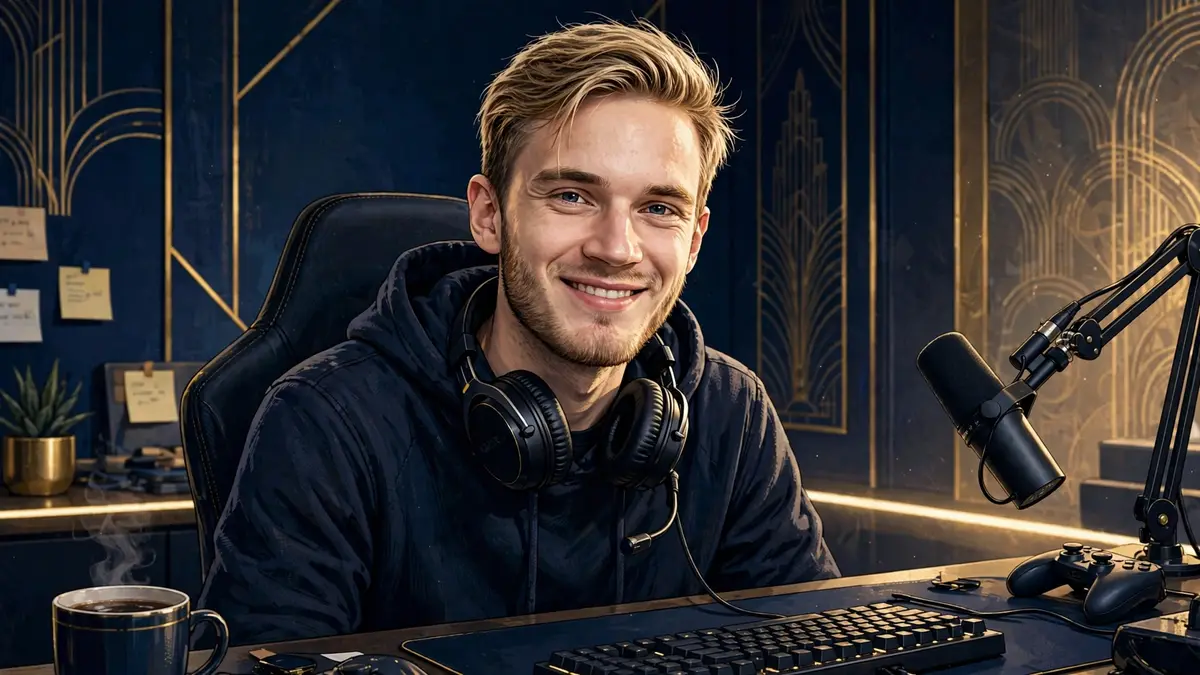
Early Life in Gothenburg
Felix Arvid Ulf Kjellberg was born on 24 October 1989 in Gothenburg, Sweden’s second-largest city and a port town with a reputation for dry humour and hard work. His mother, Lotta Kristine Johanna, worked as a chief information officer, and his father, Ulf Christian Kjellberg, was a corporate executive who later became a company chief executive. Felix also has an older sister, Fanny. The family was comfortable but not showy — the kind of household where good grades and a steady profession were the expected path, and where a son announcing he wanted to play video games for a living would land like a joke.
School came easily enough to Felix, but it never held his attention the way computers did. He has described himself as a shy kid who found his social footing online, in gaming communities where quick wit and timing mattered more than being loud in a room. Gothenburg in the late 1990s and early 2000s was a good place for that kind of kid: Sweden was wiring itself up early, broadband was common, and a generation of Swedish teenagers was growing up fluent in both English and the internet. Felix drew constantly as a boy — he later said he wanted to be an artist before games took over — and that visual streak would resurface years later in his merchandise designs and his hand-drawn video style.
His parents’ attitude toward gaming was sceptical, which is putting it mildly. His mother has said in interviews that she did not understand what he was doing on the computer all day, and his father worried the hobby was eating his son’s future. That tension never turned into a rupture — the family stayed close, and Felix has spoken warmly about his parents in later years — but it shaped the early story. He was not a child star pushed by ambitious parents. He was a teenager with a computer, a microphone, and a habit of talking to strangers on the internet while his parents wondered when he would get serious.
What set Felix apart even then was not raw gaming skill. He was good at games, but not a prodigy. What he had was timing, a feel for comedy, and an instinct for how to be interesting to watch. He recorded himself reacting to horror games with exaggerated screams, invented voices, and running jokes that made viewers feel like they were sitting next to a funny friend. In 2006, that was not yet a career. It was barely a hobby with an audience. Felix did it anyway.
Chalmers, the Hot Dog Stand, and the Dropout Gamble
After finishing school, Felix did the responsible thing. He enrolled at Chalmers University of Technology in Gothenburg to study industrial economics and management — a solid degree from a respected university, the kind of choice that reassured his parents. He lasted until 2011. By his own account, he found the coursework dull and the path ahead unappealing, and the pull of his growing YouTube channel was getting harder to ignore. He dropped out.
The dropout story has been polished into legend over the years, so the unglamorous details matter. Felix did not leave university with a plan and a safety net. He left with a channel that was earning almost nothing and a series of odd jobs to pay rent. He worked at a hot dog stand. He sold Photoshop art. He did freelance design work. He has said he lived on very little, and that his parents were not thrilled — his father, in particular, saw the decision as throwing away a real future for an internet fad.
That period is the part of the PewDiePie story most often skipped over, and it is the part that explains the rest. The hot dog stand years taught him something his university lectures never did: how to keep going when nobody is watching and nobody is paying. He uploaded videos while working shifts, edited late at night, and slowly built an audience one subscriber at a time. There was no viral moment, no talent scout, no lucky break. There was a daily habit, repeated for years, until the numbers started to move.
By 2011, the channel had grown enough that Felix could make a living from it, and the gamble started to look less like a gamble. He has since said he does not recommend dropping out of university — a fair warning from a man whose bet happened to pay off beyond anyone’s imagination. The honest version of the story is that he dropped out, got lucky, and worked relentlessly at the thing he got lucky with. The luck opened the door; the work kept it open.
The First Channel and the Birth of PewDiePie
PewDiePie’s YouTube history starts earlier than most fans realise. Felix created his first channel, under the username “Pewdie”, on 19 December 2006. The name was a joke — “pew” for the sound of a laser gun, “die” for what happens in a game. That channel was a casual experiment, and he eventually forgot the password to the associated Google account, which is why the PewDiePie channel most people know launched later, on 29 April 2010.
The early PewDiePie videos were Let’s Play recordings, mostly horror games: Amnesia: The Dark Descent, in particular, became his calling card. The formula was simple and, at the time, new. Felix played a scary game, screamed at the jump scares, talked to the game as if it could hear him, and cut the footage into short, punchy episodes. The audience was not watching for a walkthrough. They were watching for Felix. His commentary turned a solo game into a shared experience, and viewers started calling themselves the “Bro Army” — later shortened to “bros” — a fan community with its own in-jokes, fist-bump greeting, and loyalty that would later move mountains.
Growth in those early years was steady rather than explosive. The channel passed one million subscribers in 2012, a milestone that made Felix one of the bigger gaming creators on the platform but still a long way from the top. What was already visible, though, was his range. He was not only a horror gamer. He tried comedy sketches, vlogs, reaction videos, and collaborations with other creators, and he treated the channel like a playground rather than a single-format machine. That restlessness kept the audience from getting bored, and it kept Felix from getting bored — a risk that has ended plenty of creators who locked themselves into one format.
One of the smartest early moves was how he treated his audience. Felix answered comments, made videos responding to fan requests, and built the channel around a two-way relationship at a time when most big YouTubers still treated viewers as a number. The “Bro Army” was not a marketing slogan. It was a community that felt personal, and it stayed personal even as it grew into tens of millions. That loyalty would matter enormously in 2018 and 2019, when the whole internet showed up to defend his subscriber crown.
The Rise: Horror Games, the Bro Army, and the Top Spot
The climb from one million subscribers to the top of YouTube took less than a year of blistering growth, and it changed the platform. In August 2013, PewDiePie became the most-subscribed channel on YouTube, passing the comedy duo Smosh. He would hold that position for six years — longer than anyone before or since has held the crown as an individual creator. At the peak of the climb, the channel was adding hundreds of thousands of subscribers a month, and Felix’s face and voice were everywhere in the gaming world.
The content evolved as the audience grew. The horror-game Let’s Plays stayed, but Felix added “Fridays with PewDiePie” vlogs, meme reviews, the “LWIAY” (Last Week I Asked You) series built from fan submissions, and the long-running “Meme Review” show. He also leaned into a character his audience loved: a slightly unhinged, self-aware internet goblin who mocked his own fame even as he collected it. The humour was absurd, often crude, and deliberately low-budget — a counterweight to the polished, brand-friendly YouTube that was taking shape around him. While other creators hired teams and built studios, Felix kept the feel of a guy in a room talking to his friends.
That authenticity was the product. Felix never pretended to be a businessman in creator’s clothing, and his audience trusted him for it. He turned down deals that did not fit, mocked sponsor reads instead of delivering them straight, and talked openly about how strange it was to be rich and famous for screaming at video games. The honesty was disarming, and it made the rare serious moments land harder. When he talked about burnout, about hating the pressure to upload daily, or about wanting a normal life, millions of people believed him — because he had never given them a reason not to.
The numbers from this era still stagger. By 2016, the channel had passed 40 million subscribers, and Felix was the highest-paid YouTuber on the planet according to Forbes, which estimated his earnings at around $15 million that year. Time magazine named him one of the 100 most influential people in the world in 2016, a recognition that still feels odd for a man whose job was playing Amnesia and yelling. But influence is influence, and PewDiePie’s was real: he could move a game’s sales with a single video, launch a meme into the mainstream overnight, and summon his audience like a standing army. No individual creator had ever had that kind of reach before, and the industry was still figuring out what to do with it.
The T-Series Race and 100 Million Subscribers
The most famous chapter of the PewDiePie story is the subscriber race with T-Series, the Indian music label and film production company whose channel began closing in on his lead in late 2018. What started as a joke — Felix making videos about the threat to his crown — became the biggest event in YouTube history. The “Subscribe to PewDiePie” campaign spread everywhere: fans bought billboards, hacked printers, bought ads in Times Square, and turned the race into a global meme. Other creators piled in. Even people who had never watched a PewDiePie video found themselves picking a side.
The race was fun, and it was also revealing. PewDiePie versus T-Series was framed as a lone creator against a corporation, and that framing was exactly why it worked. Felix was the underdog even at the top, and the internet loves an underdog. He made diss tracks about T-Series, staged fake funerals for his subscriber lead, and treated the whole thing as a comedy show — which is why millions of people who had no stake in the outcome watched it like a sporting event.
T-Series passed PewDiePie in early 2019, taking the most-subscribed spot for good, and the moment was bittersweet. Felix had held the crown for six years, from August 2013 to early 2019, a run nobody is likely to match. But before the crown slipped away, he hit a milestone no individual creator had ever reached: in August 2019, PewDiePie became the first individual YouTuber to reach 100 million subscribers. The plaque YouTube sent him — the Red Diamond Creator Award — was a piece of platform history.
As of 2026, the channel sits at roughly 110 million subscribers with around 29.5 billion lifetime views, making it still one of the most-subscribed individual channels ever, behind only a handful of corporate and music channels. The subscriber count barely moves these days — Felix uploads far less often — but the number is almost beside the point now. The race ended, the crown moved on, and Felix’s legacy was already secure. He was the creator who proved one person with a camera could outdraw every media company on earth, and then he walked away from the contest before it consumed him.
The Money: How PewDiePie Built His Fortune
PewDiePie’s fortune was built the old-fashioned creator way: an enormous audience, monetised across many streams, over a very long time. The headline number first — Celebrity Net Worth puts his net worth at $40 million, and most 2026 trackers place him in a $40–45 million range. One recent tracker has gone as high as $60 million, but the $40–45 million band is where the serious estimates cluster, and it is the range we use here. Felix himself has addressed the figure only once in public, saying his real net worth is “much much” higher than $20 million — a teasing non-answer that confirmed the number was at least in the tens of millions while refusing to pin it down. For a fuller breakdown of how his fortune is counted, our sister site’s look at PewDiePie’s net worth covers the same estimates from the money angle.
YouTube advertising was the engine. At his peak, Felix was earning millions a year from ads alone — Forbes estimated his annual earnings at $12 million in 2015, around $15 million in 2016, and $12 million again in 2017, making him the highest-paid YouTuber in the world for those years. Those figures covered all income, not just ads, but the ad share was the backbone: with tens of billions of views over the channel’s life, even a modest rate per thousand views adds up to a fortune. His current annual earnings are far lower — most estimates put them in the $3–5 million range — because he uploads much less often now. The drop is voluntary, and it is the point. Felix traded income for time, and he could afford to.
Brand deals were the second stream, and Felix was picky about them in a way that cost him money and earned him trust. He turned down more deals than he took, and the ones he took were usually for products he actually used. Sponsorships for games, tech, and services aimed at his young audience paid well at his scale, but he never built his income around them the way many creators do. That caution looks smart in hindsight: when the controversies of 2017 hit, he had no single sponsor whose exit could sink him.
Merchandise was the third stream, and it was bigger than most people realise. His Tsuki Market brand — Japanese-inspired streetwear and lifestyle goods, built with Marzia — sold to a global audience that bought the aesthetic as much as the name. Add in book sales, his mobile game, and the occasional one-off project, and the picture is of a creator who never relied on a single cheque. That spread of income is exactly why the $40–45 million estimate is believable: a decade of top-tier earnings, invested rather than spent, adds up fast.
What Felix did with the money is harder to pin down, because he has always been private about his finances. He has said he does not live lavishly, and the public record backs that up — no fleet of supercars, no headline-grabbing purchases, no flaunted wealth. He and Marzia owned a home in Brighton, England, which they later sold, bought a home in Japan in 2018 before moving there in 2022, and have spoken about buying land in Japan to build a home. The pattern is a person who spends on a home and a life, not on a display. The wealth is real; the showing-off is not.
Net Worth Growth: Year by Year
No creator’s fortune arrives in a straight line, and PewDiePie’s is no exception. The table below is our best read of the public record — Forbes earnings reports, Celebrity Net Worth estimates, and the channel’s own milestones — and it shows a fortune that rose fast, peaked, and then settled into a slower, steadier phase as Felix stepped back from daily uploads.
| Year | Milestone & money picture |
|---|---|
| 2010 | PewDiePie channel launches (29 April). Earnings near zero; Felix works odd jobs including a hot dog stand. |
| 2012 | Channel passes 1 million subscribers. Ad revenue begins to cover living costs; Felix goes full-time. |
| 2013 | Becomes the most-subscribed channel on YouTube (August). Earnings climb into seven figures. |
| 2015 | Forbes estimates earnings of $12 million. Launches the game PewDiePie: Legend of the Brofist and the book This Book Loves You. |
| 2016 | Forbes estimates earnings of around $15 million — the highest-paid YouTuber in the world. Time names him one of the 100 most influential people. |
| 2017 | Forbes estimates earnings of $12 million, despite the loss of Disney and Google Preferred deals after the Wall Street Journal controversy. |
| 2019 | First individual creator to 100 million subscribers (August). T-Series takes the top spot. Marries Marzia. |
| 2022 | Moves to Japan (May). Uploads slow; annual earnings begin a long decline as he chooses family time over output. |
| 2023 | Son Björn born (July). Net worth estimates hold steady around $40 million as investment income offsets lower earnings. |
| 2026 | Estimated net worth $40–45 million (Celebrity Net Worth: $40 million). Launches Odysseus (31 May) and ends family vlogs (22 September). |
The shape of that table is the shape of a career managed on purpose. The fastest growth came between 2013 and 2017, when daily uploads, a young audience, and a booming ad market all lined up. After 2019, the income curve flattened — but the net worth did not fall, because Felix was no longer spending his peak years chasing more. A fortune built over a decade of top earnings, held in investments and property rather than burned on lifestyle, does not need new millions every year to stay intact. NetWorthCraft’s own profile of PewDiePie’s net worth reaches a similar range, which is reassuring: when independent trackers land in the same band, the number is more likely to be honest.
The honest caveat: no public estimate of a private person’s wealth is exact, and PewDiePie’s is harder than most because he has never disclosed his finances and his income now comes from many small streams rather than one big one. The $40–45 million range is the consensus of named trackers; the real figure could be somewhat higher or lower. What is not in doubt is the order of magnitude: this is a fortune built on a decade at the very top of YouTube, and it is secure.
Business Ventures Beyond YouTube
Felix has never been a natural empire-builder, and that is part of the story. Where other top creators built companies, hired dozens of staff, and launched product lines by the dozen, he kept his business footprint small and personal. The ventures he did pursue were extensions of things he actually liked, which is why they worked.
The first big one was the game. PewDiePie: Legend of the Brofist, released in 2015, was a side-scrolling platformer starring Felix and his pugs, and it sold well on the strength of his name alone. It was a novelty, but a profitable one, and it showed how much commercial power a single creator could wield. The same year brought This Book Loves You, a parody self-help book that became a New York Times bestseller. Both projects were one-offs, not the start of a publishing empire — Felix made them, enjoyed them, and moved on.
Revelmode, the multi-channel network he co-founded with Disney’s Maker Studios in 2016, was the closest he came to a corporate venture. The idea was a creator collective built around his taste and his audience, and it launched with fanfare. It folded in 2017 after the Wall Street Journal controversy cost Felix his Disney deal — a reminder that in the creator economy, the person is the company, and when the person stumbles, the company stumbles with them.
Tsuki Market, the streetwear and lifestyle brand he built with Marzia, has been the most durable venture. Inspired by Japanese design, it sells clothing and home goods to an audience that shares the couple’s taste, and it runs as a real business rather than a merch drop. Marzia’s own brand, Mai, sells pottery and home goods from Japan, and the two businesses together give the household an income stream that has nothing to do with YouTube’s algorithm. That independence is worth noting: when your money does not depend on a platform, the platform cannot control you.
Then there is the 2026 pivot, which is really a new kind of venture — Odysseus, the open-source AI workspace, covered in its own section below. It is free, open-source, and deliberately anti-commercial, which makes it a strange business move and a very Felix one. He spent a year building something he wanted for himself, gave it away, and watched it collect tens of thousands of GitHub stars. Whether it ever makes money is almost beside the point. It is the clearest sign yet of what his second act looks like: building for interest, not for income.
Life in Japan: The Move That Changed Everything
Felix and Marzia bought a home in Japan in 2018, years before they actually moved there. The move itself took until May 2022 — Japan’s immigration rules, then the COVID-19 border closures, kept delaying it — and Felix qualified for a five-year Business Manager visa by setting up a company in Japan. The couple settled in Tokyo, in the Setagaya ward, and the change of scenery changed the channel as much as it changed their lives.
Japan was not a random choice. Felix had loved Japanese culture for years — the games, the design, the food, the pace of life — and Marzia shared the enthusiasm. The move was also a deliberate step away from the life they had built in Brighton, England, where Felix had lived for years and where the pressure of being the world’s biggest YouTuber was constant. In Tokyo, he was just another foreigner with a camera. The anonymity was the point.
The Japan years are visible all over his recent content: vlogs about daily life, trips around the country, the small pleasures of a routine built around family rather than output. The upload schedule loosened, the videos got quieter, and the audience that stayed was the audience that liked Felix rather than the format. In March 2025, he confirmed the family had decided to stay in Japan permanently, and the couple have bought land to build a home there — a commitment that settles the question of whether the move was a phase.

The move also reframes the net worth story. A creator who relocates to Tokyo, buys land, and slows his output to a trickle is not a creator chasing the next million. He is a person who made his money, kept it, and is now spending it on the life he actually wants. That is the least dramatic way to be rich, and it may be the smartest.
Odysseus and the 2026 AI Pivot
The most unexpected PewDiePie story of 2026 has nothing to do with YouTube. On 31 May 2026, Felix launched Odysseus, a free, open-source, self-hosted AI workspace — his answer to ChatGPT, Claude, and Gemini, built to run on a user’s own computer with no telemetry and no subscription. He had spent the better part of a year building it in public, documenting the process on his channel, and the launch video was titled, with typical understatement, “MY trillion $Dollar Project is finally out!”
Odysseus bundles chat, autonomous agents, deep research, model comparisons, email management, notes, calendar, and an image editor into one dashboard, running in Docker on local hardware with local models via Ollama and similar tools, or optionally wired to cloud APIs. The pitch is ownership: your AI, your machine, your data. The project drew enormous attention for a self-hosted tool — its GitHub repository passed 44,000 stars within a month of launch and 81,000 by July 2026, according to reports at the time — and tech outlets from MakeUseOf to XDA Developers covered it seriously rather than as a celebrity curiosity.
Felix runs Odysseus on a rig reportedly worth $20,000 with eight GPUs, which tells you how seriously he takes it. In October 2026 he announced Ajax, a locally run AI model built to power Odysseus, with a release date of 3 October 2026 that came and went without a public download — the Odysseus site still listed it as “coming soon” days later, and reports noted no benchmarks had been published. He also said OpenAI had suspended his account twice during Ajax’s development, a claim that rests on his own account of the emails he received, since OpenAI has not publicly commented on the individual case.
Whether Odysseus becomes a lasting tool or a famous experiment, it matters for the biography. It is the first time Felix has built something ambitious outside entertainment, and it shows a side of him the gaming channel never did: a tinkerer who likes hard problems, who would rather build his own tools than rent someone else’s, and who is willing to spend a year on a project with no obvious payday. The creator who once screamed at horror games for a living is now, at 37, shipping open-source software. That is a second act with real substance to it.
Personal Life: Marzia, Björn, and Family
Felix met Marzia Bisognin in 2011, when she was an Italian YouTuber and he was a rising gaming creator. The story, as they have both told it, is charmingly ordinary for two people who became internet royalty: Marzia emailed Felix after watching his videos, they started talking, and she flew to Sweden to meet him. They dated for years, moved in together, and built a shared life that played out partly in public — Marzia’s own channel, their joint vlogs, the dogs — and partly behind closed doors.
They married on 19 August 2019 at Kew Gardens in London, in a small ceremony with close friends and family. The wedding photos, shared on social media, showed a couple who had been together for eight years and were in no rush to perform the moment for an audience. Marzia later took Felix’s surname, and her own career shifted from YouTube to design — her pottery and home-goods brand, Mai, is now her main work, run from Japan.
Their son, Björn, was born on 11 July 2023, and fatherhood changed the channel more than any business decision ever did. The family vlogs — videos of Felix, Marzia, and Björn’s daily life — became a regular feature, and Felix spoke openly about how much he loved being a father. Then, on 22 September 2026, he posted a video titled “Thank you and Goodbye”, announcing that the family vlogs would end. His reason was simple and hard to argue with: Björn is three years old, and he should be able to choose for himself whether to be online. Felix said the vlogs had been lovely, and that they were stopping while they were still lovely.
The decision is a fitting bookend to the personal-life section of this biography. Felix has always drawn a line between the public Felix and the private one, and the line has moved as his life has changed. The early channel was all performance; the middle years mixed performance with confession; the Japan years have been about protecting the part of his life that is not content. His two pugs, Edgar and Maya, remain the most photographed members of the household, and they seem unbothered by any of it.
Controversies and the Cost of the Spotlight
No honest biography of PewDiePie skips the controversies, because they changed his career. The first and most consequential came in February 2017, when the Wall Street Journal reported on a series of videos in which Felix had included antisemitic jokes and imagery. Felix said the jokes were meant as satire and that he did not support the views being referenced, but the fallout was immediate: Disney’s Maker Studios cut ties with him, YouTube cancelled the second season of his original show Scare PewDiePie, and he was removed from Google Preferred, the premium advertising programme. The deals were worth millions, and their loss was a real financial hit — though, as the net worth table above shows, his earnings recovered quickly, and Forbes still estimated $12 million for 2017.
Later in 2017, Felix used a racial slur during a livestream of PlayerUnknown’s Battlegrounds, aimed at another player. He apologised in a video shortly after, calling himself an idiot and saying there was no excuse, and the apology was widely seen as genuine. The game developer, PUBG Corp, filed a copyright complaint against one of his videos in response. The incident damaged his reputation with a part of his audience and with advertisers, and it remains the moment his critics point to most often.
The T-Series race brought its own trouble. Some fans took the “Subscribe to PewDiePie” campaign too far — hacking printers, defacing a war memorial in New York, and harassing people in the name of the campaign — and Felix repeatedly told his audience to stop. In March 2019, the Christchurch mosque attacker said “subscribe to PewDiePie” during his livestreamed attack. Felix responded the same day, calling the association disgusting and saying his heart went out to the victims. He has said since that the moment made him rethink what his name could be attached to, and it was one of the reasons he began pulling back from the platform’s more chaotic corners.
The controversies are part of the record, and they cost him real money and real partnerships. They also taught him something that shows in everything since: that a brand built on a person is fragile, that an audience can be a liability as well as an asset, and that stepping back from the spotlight is sometimes the only way to keep it from burning you. His later career — quieter, slower, more private — reads as a response to those lessons.
Legacy: What PewDiePie Changed About YouTube
PewDiePie’s legacy is not a single video or a subscriber count. It is the proof that one person, working alone, could become the biggest media figure on the planet — and the template he left for everyone who followed. Before him, YouTube’s biggest stars were mostly groups, networks, or professionals. After him, the solo creator with a camera and a personality became the platform’s default dream. MrBeast, whose rise eventually dwarfed Felix’s own numbers, has said openly how much the PewDiePie model shaped his thinking — and our own profile of MrBeast’s biography shows just how far that template has travelled. The streaming generation that followed, from Ludwig to Dream, works in a world PewDiePie helped build: our look at Ludwig’s net worth and Dream’s net worth both trace back to the same creator economy he opened up, and the peer group he came up with — including Markiplier, whose profile we cover in Markiplier’s age — still defines the era.
He also changed what a YouTube career could look like at the end. The standard arc used to be: rise, peak, fade, disappear. Felix wrote a different ending — rise, peak, step back, build something new — and in doing so gave every creator who followed a model for leaving the treadmill without leaving the internet. His semi-retirement is not a failure. It is a choice, and it is one more creators are making now, in part because he showed it was possible to survive it.
The subscriber records will be broken and rebroken. The numbers in this article will age. What will not age is the fact that for six years, the most-watched person on YouTube was a shy Swedish kid who screamed at horror games, and that he turned that absurd job into a fortune, a family, and a second act as a software builder. That is a biography worth telling in full.
For readers who want more creator life stories in the same style, our biography archive covers the YouTubers, streamers, and stars shaping the platform today.
Frequently Asked Questions
What is PewDiePie’s real name?
PewDiePie’s real name is Felix Arvid Ulf Kjellberg. He was born on 24 October 1989 in Gothenburg, Sweden. The name “PewDiePie” comes from the sound of a laser gun (“pew”), “die” from gaming, and “pie” — a joke name from his first channel, created in 2006.
What is PewDiePie’s net worth in 2026?
PewDiePie’s net worth is estimated at $40–45 million as of 2026, anchored by Celebrity Net Worth’s $40 million estimate. Some trackers have gone as high as $60 million, but the $40–45 million band is where most named estimates cluster. Felix himself has said only that his real net worth is “much much” higher than $20 million.
How old is PewDiePie?
PewDiePie is 37 years old. He was born on 24 October 1989 in Gothenburg, Sweden, which makes him 37 as of November 2026. He started his PewDiePie channel at 20 and became the most-subscribed creator on YouTube at 23.
Is PewDiePie still making YouTube videos?
Yes, but far less often than in his peak years. PewDiePie is semi-retired from daily uploads and posts when he feels like it, mostly vlogs and personal projects from Japan. On 22 September 2026 he ended his family vlogs to protect his son Björn’s privacy. His channel still has around 110 million subscribers and roughly 29.5 billion lifetime views.
Where does PewDiePie live now?
PewDiePie lives in Tokyo, Japan, with his wife Marzia and their son Björn. The couple moved to Japan in May 2022 after buying a home there in 2018, and in March 2025 Felix confirmed they had decided to stay permanently. They have bought land in Japan to build a home.
Who is PewDiePie’s wife?
PewDiePie’s wife is Marzia Kjellberg (née Bisognin), an Italian former YouTuber and designer. They met in 2011, when Marzia emailed Felix after watching his videos, and married on 19 August 2019 at Kew Gardens in London. Marzia now runs Mai, a pottery and home-goods brand based in Japan.
What is Odysseus, PewDiePie’s AI project?
Odysseus is a free, open-source, self-hosted AI workspace launched by PewDiePie on 31 May 2026. It runs on the user’s own computer with no telemetry or subscription, bundling chat, AI agents, deep research, model comparisons, and productivity tools as an alternative to ChatGPT, Claude, and Gemini. Its GitHub repository passed 81,000 stars by July 2026.
Why did PewDiePie lose the most-subscribed spot to T-Series?
T-Series, the Indian music label and film company, passed PewDiePie in early 2019 after a months-long subscriber race that became a global meme, with fans on both sides campaigning hard. PewDiePie had held the top spot since August 2013 — six years — and before losing it he became the first individual creator to reach 100 million subscribers in August 2019.
Final Thoughts
PewDiePie’s biography is not really a story about money, though the money is real: $40–45 million, built on a decade at the top of YouTube and held through a deliberate slowdown. It is a story about what happens when a shy kid from Gothenburg gets everything the internet can give him — the subscribers, the records, the fortune, the fame — and then decides, on his own schedule, what to do with it. He chose a quiet life in Tokyo, a wife and a son, and a year spent building free software instead of chasing views. Most creators never get to make that choice. Felix made it, and the choice itself is the most interesting thing about him now.
Sources & Reporting
How we estimated: PewDiePie has never disclosed his finances, so every figure in this article is an estimate from named public sources. The $40–45 million range is anchored by Celebrity Net Worth’s $40 million estimate, cross-checked against other 2026 trackers that cluster in the same band (one tracker goes as high as $60 million, which we note as an outlier). Annual earnings figures come from Forbes’ yearly highest-paid YouTuber lists ($12 million in 2015, around $15 million in 2016, $12 million in 2017). Subscriber and view counts are the channel’s public YouTube totals as reported in October 2026. Where sources disagreed, we published the range and named the anchor. Private wealth can differ from any public estimate.
Named sources consulted for this profile: Forbes (annual earnings lists), Celebrity Net Worth (net worth estimate), Time (Time 100, 2016), The Wall Street Journal (2017 reporting), MakeUseOf and XDA Developers (Odysseus launch coverage), Wikipedia (career timeline and milestones, cross-checked against reporting), and YouTube (channel statistics). Biographical dates — birth, channel launches, marriage, Björn’s birth, the Japan move, the Odysseus launch, and the end of family vlogs — were verified against live 2026 reporting before publication.