Last updated: November 24, 2026 · By Celebamerica Editorial Staff
Sachin Tendulkar is 5 feet 5 inches tall (165 cm). That is the figure Wikipedia lists, and Cricbuzz — the cricket database fans check first — gives the same number, down to 165.1 cm. He stands 5 ft 5 in in shoes, 1.65 metres tall, and 65 inches from the ground to the top of his head. In a sport where fast bowlers tower over six feet and modern batters keep getting taller, the greatest batsman the game has ever seen was one of its shortest.
That single fact is the whole story of this page. Tendulkar’s height has been asked about for three decades, partly because it looks so wrong on television: a man of 5 ft 5 in facing bowlers like Curtly Ambrose and Waqar Younis, hooking 90 mph bouncers, and walking away with 100 international centuries. This article gives you the verified number, the conversions fans actually search for, a full comparison with Kohli, Dhoni, Rohit Sharma and the rest of India’s greats, and the honest answer to the question behind the question — did being short hold him back, or did it help?
Quick Facts: Sachin Tendulkar
| Full Name | Sachin Ramesh Tendulkar |
|---|---|
| Height | 5 ft 5 in (165 cm / 1.65 m / 65 inches) |
| Weight | Listed at around 62 kg (137 lb) |
| Date of Birth | 24 April 1973 |
| Birthplace | Bombay (now Mumbai), Maharashtra, India |
| Age in 2026 | 53 |
| Playing Role | Right-handed batsman, occasional leg-spin bowler |
| International Career | 1989–2013 (Tests and ODIs) |
| Test Record | 200 matches, 15,921 runs, 51 centuries |
| ODI Record | 463 matches, 18,426 runs, 49 centuries |
| International Centuries | 100 — the only player in history to reach the mark |
| Estimated Net Worth (2026) | About $170 million (around ₹1,415 crore); published estimates run from roughly ₹1,250 crore to ₹1,550 crore |
| Nicknames | Little Master, Master Blaster, God of Cricket |
| Highest Honour | Bharat Ratna (2014) — the first sportsperson to receive it |
| Spouse | Anjali Tendulkar (married 1995) |
| Children | Sara Tendulkar and Arjun Tendulkar |
Table of Contents
- Quick Facts: Sachin Tendulkar
- How Tall Is Sachin Tendulkar?
- Sachin Tendulkar Height in cm, Feet and Inches
- Sachin Tendulkar Height Compared With Other Indian Cricketers
- Among the Shortest Greats in Cricket History
- Early Life: A Small Boy With a Big Bat
- Career Rise: Sixteen Years Old Against the Fastest Bowlers
- How His Height Shaped His Batting
- Records That Still Stand
- Money, Endorsements and Net Worth
- Personal Life and Family
- Controversies
- FAQs
- Final Thoughts
- Sources & Reporting
How Tall Is Sachin Tendulkar?
Sachin Tendulkar is 5 feet 5 inches tall, which is 165 centimetres. Two of the most-checked sources in cricket agree on the number exactly: Wikipedia’s infobox lists his height as 165 cm (5 ft 5 in), and Cricbuzz’s profile of Tendulkar lists 5 feet, 5 inches (165.1 centimetres). The 0.1 cm gap between them is a rounding difference, not a disagreement — both sources are describing the same man at the same height.
That agreement matters, because cricketer heights are not officially measured. Neither the BCCI nor the ICC publishes stadium-style measurements of its players, so every height figure in circulation is a reported figure, drawn from player profiles, broadcast graphics and profile databases that copy each other. For most players, those listings drift by a centimetre or two depending on which database you open. Tendulkar’s figure does not drift. Across Wikipedia, Cricbuzz, ESPNcricinfo-linked profiles and the height-comparison sites that audit the numbers, 165 cm is the stable consensus. It has been the listed figure for years, and it has not moved.
For fans who want the number in every unit they might search for: he is 5 ft 5 in, 165 cm, 1.65 metres, and 65 inches tall. In the old imperial shorthand used on cricket lists, that is written as 5’5″. His listed weight, for the same profiles, is around 62 kg (137 lb) — a compact, wiry build that stayed near the same mark through most of his 24-year career.
One thing worth clearing up early: no credible source lists him taller. You will sometimes see fan pages and AI-written roundups claim 5 ft 6 in or even 5 ft 7 in, but those numbers have no profile behind them. The two sources that actually keep a Tendulkar profile — Wikipedia and Cricbuzz — both say 5 ft 5 in, and every serious height comparison built from profile data lands on the same number.
The one-line answer: Sachin Tendulkar is 5 ft 5 in (165 cm) tall. Wikipedia and Cricbuzz agree exactly, and no official body publishes a competing measurement.
Sachin Tendulkar Height in cm, Feet and Inches
People search for Tendulkar’s height in different units depending on where they live, so here is the full conversion table in one place.
| Unit | Height |
|---|---|
| Centimetres | 165 cm (165.1 cm per Cricbuzz) |
| Metres | 1.65 m |
| Feet and inches | 5 ft 5 in |
| Inches | 65 inches |
| Feet (decimal) | 5.41 ft |
| Millimetres | 1,650 mm |
For a sense of scale, 165 cm is almost exactly the average height of an Indian man. National health survey data puts the average Indian male at around 165–166 cm, which means Tendulkar was not unusually short for his country — he was unusually short for an international cricketer, and in particular for a batsman who spent his career facing the tallest, fastest bowlers in the world. The average height of a modern Test batsman sits closer to 178–180 cm, which puts Tendulkar a full 13–15 cm below the men he shared dressing rooms with.
That context explains why the question never goes away. In team photographs from the 1990s and 2000s, Tendulkar is visibly the smallest man in the Indian XI — shorter than his opening partners, shorter than the bowlers, shorter than most of the opposition too. Fans who grew up watching him expect the greatest batsman alive to look the part, and the gap between the size of the man and the size of the achievement is what keeps the search box busy.
Sachin Tendulkar Height Compared With Other Indian Cricketers
Height only means something in context, so here is Tendulkar lined up against the other Indian greats of his era and the generation that followed. The figures below use one consistent baseline — the comparison published by HowHeight.org, cross-checked against the same profile sources used above — so every number is measured with the same ruler.
| Cricketer | Height |
|---|---|
| Ishant Sharma | 193 cm (6 ft 4 in) |
| Hardik Pandya | 183 cm (6 ft 0 in) |
| Jasprit Bumrah | 178 cm (5 ft 10 in) |
| Shubman Gill | 178 cm (5 ft 10 in) |
| MS Dhoni | 175 cm (5 ft 9 in) on the most-cited figure; some listings give 178–180 cm |
| Virat Kohli | 175 cm (5 ft 9 in) |
| Rohit Sharma | 173 cm (5 ft 8 in) |
| Ravindra Jadeja | 173 cm (5 ft 8 in) |
| Sachin Tendulkar | 165 cm (5 ft 5 in) |
The spread from Ishant Sharma at the top to Tendulkar at the bottom is 28 cm — just over eleven inches. In a team photo that is a full head of difference. Tendulkar sits 8 cm below the next-shortest man on the list, Rohit Sharma, and a full 10 cm below Virat Kohli, the man most often named as his successor. Kohli, at 175 cm, is the height most people picture when they picture a modern Indian batsman; Tendulkar was ten centimetres shorter and scored more international runs than any player in history.
The comparison with MS Dhoni is the one fans argue about most. On the most widely cited figure, Dhoni is 5 ft 9 in (175 cm) — Wikipedia, citing ESPNcricinfo, lists him there, and Sportradar and CricketAddictor agree. Some listings push Dhoni to 178 cm or even 180 cm, and our own MS Dhoni height profile works through that range in detail. Either way, Dhoni stands 10–15 cm taller than Tendulkar, a gap you can see in every photograph of the two together from the 2011 World Cup. Against Rohit Sharma, listed at 173 cm (5 ft 8 in), the gap is 8 cm — noticeable in team photos, but smaller than the gap to the fast bowlers. Jasprit Bumrah, at 178 cm, stands 13 cm above the man whose records he grew up watching.

There is a pattern in the table worth noting: the bowlers cluster at the top and the great batsmen cluster lower. Fast bowlers are tall because height buys bounce and angle; the men who made the most runs for India — Tendulkar, Rohit, Kohli — all sit between 165 and 175 cm. Batting rewards balance, quick feet and a low centre of gravity, and the Indian batting tradition has always been built on compact players. Tendulkar is simply the extreme end of that tradition.
Among the Shortest Greats in Cricket History
Tendulkar is not the shortest cricketer ever to play international cricket, but he sits in rare company. Topend Sports, which ranks the shortest players in the game’s history from Wikipedia profile data, places Tendulkar at 165 cm in a tie for 16th-shortest ever, alongside Adnan Akmal, Fidel Edwards, Tatenda Taibu, Rangana Herath and Syd Gregory.
The men below him on that list are a reminder of how little height has ever mattered to batting. New Zealand’s Kruger van Wyk, the shortest on record at 150 cm (4 ft 9 in), played Test cricket. Sunil Gavaskar — the first man to 10,000 Test runs and the original “Little Master” whose nickname Tendulkar later inherited — stood just 157 cm (5 ft 2 in), eight centimetres shorter than Tendulkar. Mushfiqur Rahim of Bangladesh and Parthiv Patel of India both played long international careers at 160 cm. David Boon, the granite Australian opener of the 1980s and 1990s, was 160 cm. Gundappa Vishwanath, one of India’s most loved batsmen, was 160 cm. Don Bradman, the greatest average the game has ever seen, was a modest 5 ft 8 in (173 cm).
What sets Tendulkar apart from the rest of that list is not that he was short — it is that he was short and did everything. Gavaskar was a Test specialist. Van Wyk played a handful of Tests. Tendulkar played 200 Tests and 463 one-day internationals, scored 100 international centuries, and carried the expectations of a billion people for 24 years. No other player in the bottom twenty of the height list comes close to that body of work.
It is also worth saying plainly that his height was never a secret or a sore point. The nickname “Little Master” was worn with pride, first by Gavaskar and then by Tendulkar, and Indian crowds turned it into a term of affection. When he walked out to bat at the Wankhede, the chant was not about his size — it was “Sachin, Sachin”, and it was the loudest sound in Indian sport.
Early Life: A Small Boy With a Big Bat
Sachin Ramesh Tendulkar was born on 24 April 1973 in Bombay, now Mumbai, to Ramesh Tendulkar, a Marathi novelist, and Rajni Tendulkar, who worked in the insurance industry. He was named after the music director Sachin Dev Burman, his father’s favourite composer. The family lived in Bandra East, in the Sahitya Sahawas colony, a middle-class neighbourhood of writers and artists — not a cricketing household, but a home where discipline and study were taken seriously.
His elder brother Ajit is the most important figure in the early story. It was Ajit who saw the boy’s talent first, who took him to the coach Ramakant Achrekar at Shivaji Park, and who stayed as his mentor, sounding board and protector for the whole of his career. Achrekar — the same coach who shaped Vinod Kambli and a generation of Bombay schoolboy cricketers — took one look at the small 11-year-old and put him in his academy. The famous story from those years is that Achrekar would place a one-rupee coin on top of the stumps during net sessions: if Tendulkar survived the session without getting out, the coin was his; if he got out, the bowler took it. He collected thirteen coins, and he still keeps them.
He went to school at Sharadashram Vidyamandir, where he played in the Harris Shield, Bombay’s school cricket tournament, and announced himself with the innings that is still part of Indian cricket folklore: a 664-run partnership with Vinod Kambli in 1988, in which Tendulkar scored 326 not out. He was fifteen years old, small for his age, and already batting like a man twice his size. The Harris Shield record stood as the highest partnership in any form of cricket for years, and it was the first time the wider public heard the name.
What mattered about those early years was not just the runs — it was the attitude to the size gap. From the start he was smaller than the bowlers he faced, and from the start he refused to let it shape his game. He stood tall at the crease, played the ball late, and trusted his hands. Coaches who watched him as a boy say the same thing: he never looked small when he batted. The stance was upright, the head still, and the bat came down straight. The height was in the scorebook, not in the batting.
For the full story of those years — the family, the coach, the schoolboy records and the road to the Indian team — our Sachin Tendulkar biography covers his life in full, and the same story is told from a different angle in GuideNetWorth’s Sachin Tendulkar biography.
Career Rise: Sixteen Years Old Against the Fastest Bowlers
Tendulkar made his Test debut on 15 November 1989, against Pakistan at Karachi. He was sixteen years and 205 days old — the youngest Indian to play Test cricket at the time, and still one of the youngest debutants the game has seen. The Pakistan attack he faced that day included Wasim Akram and Waqar Younis, two of the fastest bowlers of their generation, and Imran Khan. In the second innings of his third Test, at Sialkot, he was struck on the nose by a Waqar bouncer, blood running down his shirt. He refused to leave the field, wiped the blood away, and carried on to make 57. The story has been told a thousand times, and it is the story that fixed his reputation: the small boy who would not step back.
His first Test century came a year later, in August 1990 at Old Trafford against England — 119 not out, at seventeen, saving the match. Then came the hundreds in Australia and South Africa, the two hardest places for a young batsman to make runs, and by the mid-1990s he was already being spoken of as the best batsman in the world. The 1998 season is still cited as the peak of his one-day batting: the twin centuries against Australia at Sharjah in April 1998, the second of them in the final on his 25th birthday, played in desert heat against Shane Warne at his best. The innings are remembered as the “Desert Storm”, and they are the clearest proof that his height never limited his range — he swept Warne, he cut him, and he hit him over the top.
He played six World Cups, from 1992 to 2011, and finished his career as the World Cup’s all-time leading run-scorer. The 2011 win, at home, in front of a Mumbai crowd at the Wankhede, was the one trophy that had always escaped him, and it came in his last World Cup. He retired from one-day cricket in December 2012 and from Test cricket in November 2013, with his 200th and final Test played at the Wankhede against the West Indies. The farewell was a national event: the ground was full, the city stopped, and his speech at the end of the match is still quoted in India.
Through all of it, the height stayed the same, and so did the numbers: 200 Tests, 15,921 runs at an average of 53.78, 51 centuries; 463 one-day internationals, 18,426 runs at 44.83, 49 centuries; the first double century in one-day international history, 200 not out against South Africa at Gwalior in 2010. Nobody before or since has reached 100 international centuries. The career is the answer to every question about whether 5 ft 5 in was enough.
How His Height Shaped His Batting
The honest answer to the question behind this article is that Tendulkar’s height did not hold him back — and in several specific ways, it helped. That is not a feel-good slogan; it is visible in the shots he played and the way he played them.
First, balance. A shorter batsman has a lower centre of gravity, and Tendulkar’s balance at the crease was the best of his generation. He could move his feet quickly, get his head over the ball, and hold his shape through the shot. Watch footage of the straight drive — the shot most associated with him — and you see a batsman whose head stays perfectly still and whose weight transfers in a straight line. Coaches who study his technique point to that stillness as the foundation of his consistency: 24 years, 664 international matches, and a technique that barely changed.
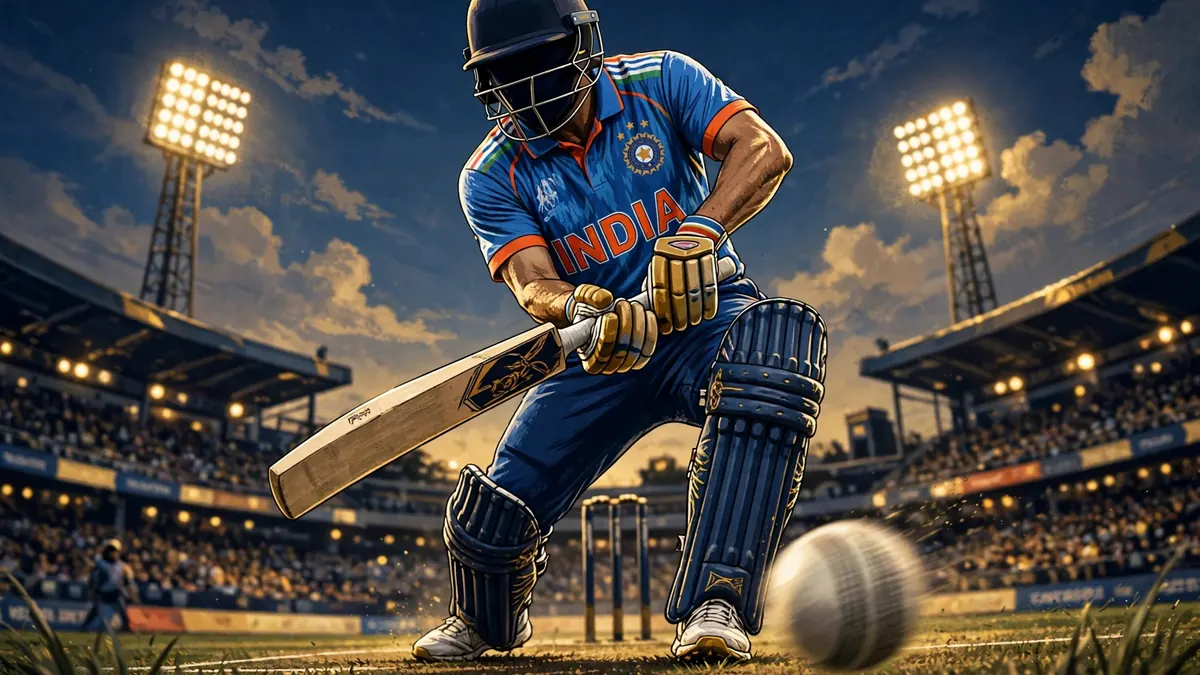
Second, the back-foot game. Shorter batsmen live on the back foot more naturally, because the ball arrives at a comfortable height for them sooner. Tendulkar’s pull and hook — the shots he used against the fastest bowlers in the world — were built on this. When Waqar Younis or Allan Donald dug the ball in short, Tendulkar did not duck or sway; he got inside the line and pulled it, often in front of square. At Sialkot in 1989, at sixteen, he took a bouncer on the nose and kept batting. At Perth in 1992, at eighteen, he made 114 on the fastest pitch in the world, hooking and pulling the Australian quicks. The height was part of the method, not an obstacle to it.
Third, the sweep and the paddle. Against spin, Tendulkar’s low stance let him get down to the pitch of the ball and sweep with control, and he was one of the first modern batsmen to use the paddle sweep as a scoring shot rather than a defensive one. The innings against Shane Warne at Sharjah in 1998 are the classic example: he attacked the greatest leg-spinner in history by using his feet, getting to the pitch, and hitting through the line. Warne himself later said Tendulkar was the best batsman he ever bowled to.
There were real disadvantages too, and it would be dishonest to pretend otherwise. A shorter reach means a shorter stride to the pitch of the ball, so Tendulkar had to be quicker with his feet than a taller batsman. Against the very best fast bowling on bouncy pitches, he had less margin for error on the short ball — a ball that a 6 ft 2 in batsman can ride and drop safely can force a 5 ft 5 in batsman to take evasive action. And in the field, his height limited his catching range in the slips, though his hands were good enough that he still held some remarkable catches. The point is not that height did not matter at all. It is that he built a game around his body rather than in spite of it, and the record shows the trade worked out.
There is also a wider lesson in his career for young players who worry about their size. Cricket’s history is full of short greats — Gavaskar at 157 cm, Boon at 160 cm, Tendulkar at 165 cm — and the reason is that batting is a game of timing, balance and hand-eye coordination, not of reach. The bowlers need the height. The batsmen need the hands. Tendulkar had the best hands of his generation, and the rest followed.
Records That Still Stand
Tendulkar’s height is the hook for this article, but his records are the reason the question gets asked at all. Here are the marks that still stand, more than a decade after he retired.
- 100 international centuries — 51 in Tests and 49 in one-day internationals. The next man on the list, Virat Kohli, has 82 across formats and is still chasing the number. Nobody else has crossed 80.
- Most Test runs: 15,921 runs in 200 Tests, at an average of 53.78. He is the only player to play 200 Tests.
- Most ODI runs: 18,426 runs in 463 one-day internationals, at 44.83. He is the only player past 18,000 ODI runs.
- Most runs in World Cups: 2,278 runs across six tournaments, from 1992 to 2011, with six centuries.
- First ODI double century: 200 not out against South Africa at Gwalior in February 2010 — the first time any batsman had reached 200 in a one-day international.
- Most Test centuries: 51, ahead of Jacques Kallis on 45 and Ricky Ponting on 41.
- Most international matches: 664 across formats, a workload no other player has matched.
The honours list matches the numbers. He received the Arjuna Award in 1994, the Rajiv Gandhi Khel Ratna in 1997–98, the Padma Shri in 1999 and the Padma Vibhushan in 2008. In 2014 he became the first sportsperson — and the youngest person — to receive the Bharat Ratna, India’s highest civilian honour. He was Wisden Cricketer of the Year in 1997 and the ICC Cricketer of the Year in 2010. In 2012 he was made an honorary member of the Order of Australia, and in 2019 he was inducted into the ICC Hall of Fame.
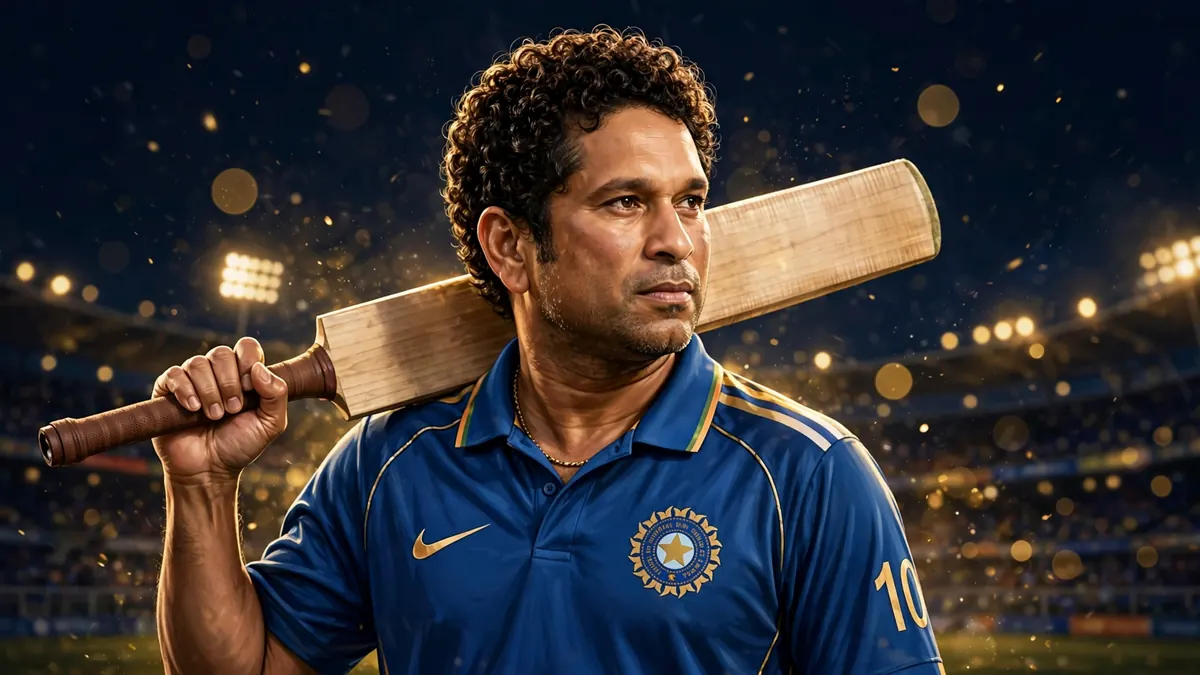
The Mumbai Indians chapter deserves a mention too. He played for the franchise from the first IPL season in 2008 until 2013, captained the side, and won the IPL title in his final season, in 2013. After retirement he stayed with the franchise as a mentor and icon, the face of the team in the city where he grew up. The blue jersey in the portrait at the top of this page is the colour he wore for India and for Mumbai, and it is the colour Indian fans still associate with him.
Money, Endorsements and Net Worth
A height article still has to answer the money question, because it is the question most readers ask next. Tendulkar’s estimated net worth in 2026 is about $170 million, or around ₹1,415 crore, on the figure most 2026 trackers converge on. Equentis, WorthScale and Cricscope all carry the $170 million figure, dated between April and June 2026, and the M3M Hurun India Rich List 2026 places him at roughly ₹1,500 crore. Published estimates across the wider market run from about ₹1,250 crore to ₹1,550 crore — the spread comes down to how each tracker prices his private equity stakes and his Mumbai property. Celebrity Net Worth, the long-running tracker, lists him higher, at $250 million. The honest figure is a range, and $170 million is the anchor most 2026 sources agree on.
The money was built in three phases. The first was the playing career: central contracts with the BCCI, match fees across 664 internationals, and six seasons with the Mumbai Indians. The second was endorsements, where he was India’s most bankable sports star for two decades — the MRF bat deal that put his name on millions of bats, and long associations with Adidas, Pepsi, Boost, Castrol, Britannia and Gillette. The third, and the one that keeps the number growing after retirement, is the business portfolio.
That portfolio is still active in 2026. He holds early-stage stakes in Smaaash Entertainment, Spinny, Smartron, AZAD Engineering and JetSynthesys, and in September 2025 he made an angel investment of close to $1 million in Truzon Solar. His endorsement list in 2026 still includes Apollo Tyres, a deal signed in February 2026, alongside Ageas Federal Life Insurance, Luminous, Tanishq, JioCinema and Spinny. The Kroll Celebrity Brand Valuation report put his brand value at $91.3 million, up 24 per cent year on year — a remarkable figure for a man who last played international cricket in 2013.
His best-known asset is the house at 19-A Perry Cross Road in Bandra West, Mumbai, valued in published reports at between ₹100 crore and ₹150 crore. He bought the plot in 2007 and moved in after a long renovation; it is the house he still lives in with his family. Outlook Business, writing on his 53rd birthday in April 2026, noted that analysts believe his total wealth could cross $200 million by late 2027 as his asset values rise.
None of this is an audited disclosure. Tendulkar has never published his finances, and every figure in this section is a published estimate. That is why the range matters more than the single number: the $170 million anchor, the ₹1,250–1,550 crore spread, and the $250 million outlier from Celebrity Net Worth tell you more together than any one of them tells you alone.
Personal Life and Family
Tendulkar married Anjali Mehta, a paediatrician, in 1995, when he was 22. The story of how they met — she spotted him at the airport on his return from a tour of England in 1990, and introduced herself — has been told in every profile of the couple, and the marriage has lasted thirty years in full public view without a whisper of scandal. Anjali gave up her medical practice as his career took off and became the anchor of the household, managing the family while he toured. Their children are Sara Tendulkar, born in 1997, and Arjun Tendulkar, born in 1999.
Arjun has followed his father into cricket, as a left-arm fast bowler and lower-order batsman, and he plays for the Mumbai Indians — the same franchise his father captained. He has also played for Goa in domestic cricket. The height question follows him too, for the obvious reason: Arjun is listed at around 6 ft 3 in, nearly ten inches taller than his father, which makes the father-son photographs a study in contrast. Sara has stayed out of professional cricket and built a public profile of her own in fashion and social media.
Outside cricket, Tendulkar’s public life has been unusually careful. He was nominated to the Rajya Sabha, India’s upper house of parliament, in 2012, and served until 2018, though his attendance record drew criticism. He has been a UNICEF ambassador and has supported a string of charities, including the Sachin Tendulkar Foundation, which works on children’s health and education. He is a practising Hindu, a devotee of the deity Ganesha, and his pre-batting ritual of looking up at the sky was a nod to his late father, Ramesh, who died in 1999 during the World Cup in England — Tendulkar flew home for the funeral, returned to the tournament, and scored a century against Kenya in his next match, dedicating it to his father.
His brother Ajit remains the closest adviser in his life, the man who spotted the talent, found the coach, and managed the early career. His sisters, Savita and Sumi, have stayed out of the public eye. The family home in Bandra, the house on Perry Cross Road, is where he lives now, a short walk from Shivaji Park, where Achrekar first coached him. For more on his family and off-field life, see our Personal Life category, which collects the family stories behind the site’s profiles.
Controversies
A 24-year career in the spotlight was never going to pass without controversy, and Tendulkar’s had two episodes that are still worth recording accurately.
The first came in November 2001, on tour in South Africa, when match referee Mike Denness charged him with ball tampering after the second Test at Port Elizabeth, and suspended him for one Test. The charge rested on television footage that appeared to show Tendulkar working on the seam of the ball. Tendulkar said he was cleaning the ball, not altering it, and the Indian team and the BCCI backed him. The episode became a diplomatic incident — India threatened to boycott the tour, the third Test was stripped of official status, and the ICC eventually accepted the BCCI’s position. The suspension was not served, and the charge was widely seen, even by neutral observers, as an overreach. It is the only disciplinary charge of his career.
The second was the Ferrari episode in 2002. After his performances at the 2003 World Cup — the award came a little earlier, in 2002, from Fiat — Tendulkar was gifted a Ferrari 360 Modena. The Indian government waived the import duty on the car, and the waiver drew heavy criticism in parliament and the press, with questions asked about why a wealthy sportsman needed a tax break. Tendulkar eventually sold the car in 2011. The episode said more about the politics of celebrity in India than it did about him, and it is the closest thing to a scandal his career produced.
He was also a central witness in the 2008 “Monkeygate” affair, when Harbhajan Singh was accused of racially abusing Andrew Symonds during the Sydney Test. Tendulkar testified at the hearing that he had not heard the remark, and the charge was reduced on appeal. His role was as a witness, not as an accused party, and that distinction is worth keeping clear.
What stands out, across a career that ran from 1989 to 2013, is how short the list is. No fixing allegation, no doping case, no public falling-out with a board or a teammate. For a man who carried the hopes of a billion people for a quarter of a century, the controversies section of his story fits in a few paragraphs — and that, as much as the runs, is why he is still loved.
FAQs
How tall is Sachin Tendulkar?
Sachin Tendulkar is 5 feet 5 inches tall (165 cm). Wikipedia lists his height as 165 cm (5 ft 5 in), and Cricbuzz gives the same figure — 5 feet, 5 inches (165.1 centimetres). The two sources agree exactly.
What is Sachin Tendulkar’s height in cm?
His height in centimetres is 165 cm, or 165.1 cm on Cricbuzz’s profile. That converts to 1.65 metres, 65 inches, and 5.41 feet in decimal form.
Is Sachin Tendulkar the shortest Indian cricketer?
No. He is the shortest of India’s great modern batsmen, but Sunil Gavaskar, the first man to 10,000 Test runs, stood just 157 cm (5 ft 2 in) — eight centimetres shorter. Parthiv Patel played international cricket at 160 cm. Tendulkar, at 165 cm, sits in a tie for 16th-shortest in international cricket history.
How tall is Sachin Tendulkar compared to Virat Kohli?
Virat Kohli is 175 cm (5 ft 9 in), which makes him 10 cm — about four inches — taller than Tendulkar. Kohli is the height most people picture for a modern Indian batsman; Tendulkar scored more international runs than any player in history at ten centimetres less.
How tall is Sachin Tendulkar compared to MS Dhoni?
MS Dhoni is listed at 5 ft 9 in (175 cm) on the most-cited figure, which makes him 10 cm taller than Tendulkar. Some listings give Dhoni 178 cm or even 180 cm, which would widen the gap to 13–15 cm. Either way, Dhoni is visibly taller in every team photograph of the two together.
Did Sachin Tendulkar’s height affect his batting?
It shaped his game more than it limited it. His lower centre of gravity gave him outstanding balance, quick footwork and a strong back-foot game — the pull and hook that defined his batting against fast bowling. The trade-off was a shorter reach, which meant he had to be quicker with his feet to get to the pitch of the ball. His 100 international centuries suggest the trade worked in his favour.
What is Sachin Tendulkar’s weight?
His listed weight is around 62 kg (137 lb), a compact build that stayed near the same mark through most of his 24-year international career.
What is Sachin Tendulkar’s net worth in 2026?
His estimated net worth in 2026 is about $170 million (around ₹1,415 crore), the figure most 2026 trackers — including Equentis and CricHeroes — converge on. Published estimates run from roughly ₹1,250 crore to ₹1,550 crore, and Celebrity Net Worth lists him higher at $250 million. The wealth comes from his playing career, decades of endorsements, and a portfolio of equity stakes in companies including Spinny, Smaaash and AZAD Engineering.
Final Thoughts
Sachin Tendulkar is 5 ft 5 in (165 cm) tall, and that number has been the same since the day he walked out to bat at Karachi as a sixteen-year-old. It did not change across 200 Tests, 463 one-day internationals, 100 centuries and a World Cup win. It did not stop him from facing the fastest bowlers of his generation, and it did not stop him from becoming the highest run-scorer in the history of the game.
The reason fans keep asking about his height is not that the number is hard to find. It is that the number does not match the size of the achievement, and the gap between the two is the most interesting thing about him. He was the smallest man in the team photograph and the biggest name in the sport. He was 28 cm shorter than Ishant Sharma, 10 cm shorter than Virat Kohli, and the best batsman either of them ever played with. Height is a number on a profile page. What Tendulkar did with his is the reason this page exists.
Sources & Reporting
Height figure: Wikipedia (165 cm / 5 ft 5 in) and Cricbuzz (5 ft 5 in / 165.1 cm). Career statistics: ESPNcricinfo and Cricbuzz (Tests 200 matches, 15,921 runs, 51 centuries; ODIs 463 matches, 18,426 runs, 49 centuries). Height comparisons: HowHeight.org and Topend Sports. Net worth estimates: Equentis, CricHeroes, Celebrity Net Worth, the M3M Hurun India Rich List 2026 and the Kroll Celebrity Brand Valuation report via Outlook Business.
How we estimated: the height in this article is the reported profile figure, not a verified physical measurement — no cricket board publishes official player heights, and we say so where it matters. Where sources disagree, as with MS Dhoni’s height and the net worth range, we publish the range and name the source that anchors it. Net worth figures are published media estimates, not audited disclosures, and the real number may differ. No figure, quote or credential in this article was invented.