Last updated November 6, 2026 · By Celebamerica Editorial Staff
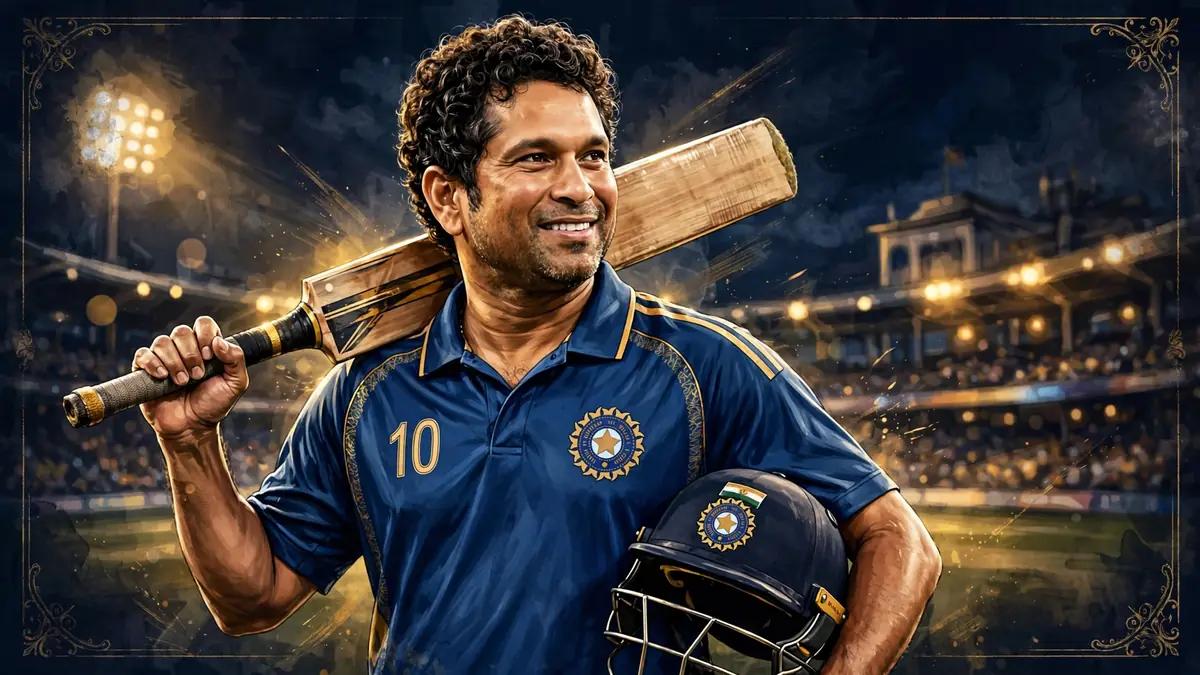
Sachin Ramesh Tendulkar was born on 24 April 1973 in Mumbai, and across 24 years of international cricket he became the most prolific batsman the game has ever seen: 100 international centuries, 34,357 international runs, and a World Cup winner’s medal in 2011. As of November 2026, his net worth is estimated at $170 million to $250 million (roughly ₹1,415–₹2,080 crore), with the $170 million figure from an April 2026 Outlook Business report anchoring the low end and Celebrity Net Worth’s $250 million marking the high end. He is 53 years old, married to Dr Anjali Tendulkar since 1995, and still one of the most bankable names in Indian sport more than a decade after his last match.
This is the full story of how a 16-year-old boy from Dadar faced Pakistan’s fast bowlers in Karachi, carried Indian cricket on his shoulders through the 1990s, rewrote the record books in every format, and then turned fame into a business portfolio that keeps growing in 2026 — from a new Apollo Tyres deal in February to a gaming investment announced in November. No other cricketer has matched his numbers, and no other Indian sportsman has stayed this relevant for this long after retirement.
| Full Name | Sachin Ramesh Tendulkar |
|---|---|
| Date of Birth | 24 April 1973 (age 53 in 2026) |
| Birthplace | Dadar, Mumbai, Maharashtra, India |
| Height | 5 ft 5 in (165 cm) |
| Estimated Net Worth (2026) | $170 million – $250 million (₹1,415–₹2,080 crore approx.); anchored at $170 million by Outlook Business, April 2026 |
| Primary Income Sources | Endorsements (Apollo Tyres, Tanishq, Luminous, Gillette, Ageas Federal, JioCinema), startup investments, real estate, Mumbai Indians mentorship and appearances |
| Key Ventures | SRT Sports Management, Sachin Tendulkar Foundation, investments in Spinny, Unacademy, Azad Engineering, JetSynthesys, Kissht, Hitwicket (Metasports) |
| Career Span | 1989–2013 (India); 200 Tests, 463 ODIs, 664 international matches |
| Signature Records | 100 international centuries (51 Tests, 49 ODIs); 15,921 Test runs; 34,357 international runs; first ODI double century (200*) |
| Family | Wife Dr Anjali Tendulkar (married 24 May 1995); children Sara Tendulkar and Arjun Tendulkar |
| Highest Honour | Bharat Ratna, 2014 — youngest recipient and first sportsperson to receive it |
Table of Contents
- Early Life in Mumbai
- Ramakant Achrekar and the Making of a Batsman
- A 16-Year-Old Against Pakistan
- The Rise: Desert Storm, Captaincy and the 1990s
- Records That May Never Be Broken
- The 2011 World Cup: The Dream Completed
- Mumbai Indians and the IPL Years
- The Farewell: 200 Tests and a Nation in Tears
- The Money: Net Worth, Endorsements and Investments
- House, Cars and Assets
- Personal Life: Anjali, Sara and Arjun
- Awards and Honours
- Rajya Sabha and the Sachin Tendulkar Foundation
- Life After Cricket in 2026
- Controversies
- Frequently Asked Questions
- Final Thoughts
- Sources and Reporting
Early Life in Mumbai
Sachin Tendulkar was born on 24 April 1973 in Dadar, a middle-class neighbourhood of Mumbai (then Bombay), into a Marathi family where books mattered as much as sport. His father, Ramesh Tendulkar, was a respected Marathi novelist, poet and professor; his mother, Rajni, worked in the insurance sector. He was named after the composer Sachin Dev Burman, a family favourite. He was the youngest of four children — elder brothers Ajit and Nitin and elder sister Savita were already grown when the youngest Tendulkar started showing an interest in a game that would take over his life.
The young Sachin was restless, energetic and, by his own family’s telling, hard to keep still. His elder brother Ajit, who had played club cricket himself, spotted something early: the boy did not just like hitting a ball, he studied it. Ajit became the first and most lasting influence on his career — the brother who would later give up his own ambitions to manage Sachin’s, and who still advises him today. When Sachin was 11, Ajit took him to Shivaji Park in Dadar, the famous Mumbai maidan that has produced generations of Indian cricketers, and introduced him to coach Ramakant Achrekar.
School came at Sharadashram Vidyamandir, a Mumbai school known for its cricket, which Achrekar advised the family to choose so the boy’s training would sit at the centre of his day rather than around its edges. The move worked. In 1988, still a schoolboy, Sachin and his childhood friend and batting partner Vinod Kambli put together a 664-run partnership in a Harris Shield inter-school match — a record that stood for decades and is still talked about in Mumbai cricket circles whenever school cricket comes up. The innings announced a talent that was no longer a family secret.
Ramakant Achrekar and the Making of a Batsman
Achrekar’s coaching at Shivaji Park was old-school in the best sense: hours of net practice, a sharp eye for a technical flaw, and a belief that a batsman is built by repetition rather than by talent alone. He made the young Tendulkar practise on a different pitch every day, face bowlers of every style, and bat until the light failed. One of his famous methods was to place a one-rupee coin on top of the stumps during net sessions — if the bowler dismissed Sachin, the bowler took the coin; if Sachin survived the session, he kept it. The boy collected plenty of coins.
What Achrekar drilled into him shows up in every highlight reel of the next 24 years: a straight bat, a still head, wrists that could place the ball into gaps that did not seem to exist, and a back-foot game that let a 5 ft 5 in batsman dominate fast bowlers a foot taller than him. He also taught him patience — the idea that a big innings is built in sessions, not in shots. Tendulkar has said many times that Achrekar was the single biggest influence on his cricket, and he remained devoted to his coach for the rest of the coach’s life, visiting him regularly until Achrekar’s death in 2019.
The domestic game came fast. In December 1988, aged 15, Tendulkar made his first-class debut for Mumbai in the Ranji Trophy against Gujarat and scored a century — the youngest Indian to score a hundred on first-class debut at the time. Within a year he had centuries in the Duleep Trophy and the Irani Trophy as well, completing a set of debut hundreds that told the selectors everything they needed to know. The national call-up was not a matter of if, only of when.
A 16-Year-Old Against Pakistan
The call came in November 1989, and it was about as hard a start as international cricket can offer: a Test series in Pakistan, against a bowling attack featuring Imran Khan, Wasim Akram and the teenage Waqar Younis, in front of crowds that were not feeling charitable. Tendulkar made his Test debut at Karachi on 15 November 1989, aged 16 years and 205 days — one of the youngest Test debutants in history. He scored 15 in his only innings, and was hit on the nose by a Waqar bouncer in the fourth Test at Sialkot, bleeding on the pitch. He refused to leave. The story of that bloody nose, and the youngster carrying on, became part of Indian cricket folklore within days.
His one-day debut followed a month later, on 18 December 1989, also against Pakistan — and it was a duck. It did not matter. What the tour showed the Indian dressing room was temperament: a 16-year-old who did not flinch against the fastest bowlers in the world. Within a year he had his first Test hundred, 119 not out at Old Trafford in August 1990, saving the match for India against England. He was 17. The century made him the second-youngest Test centurion in history at the time, and it confirmed what the domestic numbers had promised: this was not a prodigy who would fade, but a batsman built to last.
The early 1990s filled in the picture. A century at the WACA in Perth in 1992, on the fastest pitch in world cricket, against an Australian attack at full strength, is still rated by many judges as one of the great innings ever played by a visiting batsman. By the mid-1990s he was India’s best batsman by a distance, and the expectations that came with that were unlike anything Indian sport had seen: when Tendulkar walked out to bat, a billion people effectively stopped what they were doing. He learned to live with that weight for two decades, and it never broke him.
The Rise: Desert Storm, Captaincy and the 1990s
The second half of the 1990s turned Tendulkar from a great batsman into a national event. The defining week came in Sharjah in April 1998, in the Coca-Cola Cup against Australia. India needed to qualify for the final, and Tendulkar produced back-to-back masterpieces — 143 in the qualifier, played through a desert sandstorm that stopped play, and then 134 in the final to win the tournament. The innings became known as “Desert Storm”, and they are still the first clips anyone reaches for when the argument about the greatest one-day innings begins. He finished 1998 with 1,894 ODI runs in the calendar year, a record that stood for more than a decade.
Captaincy came twice and never sat comfortably. He led India in 1996–97 and again in 1999–2000, and both spells ended with him asking to step down. The team was in transition, the results were mixed, and — by his own later admission — the job took runs off his bat. The honest assessment of his captaincy is that he was a better batsman without it, and the selectors eventually agreed. His successor Sourav Ganguly built the team that would win overseas in the 2000s, and Tendulkar was free to do what he did best: bat, and bat long.
The 2000s brought the long grind of records. A tennis elbow injury in 2004 and 2005 kept him out for months and, for the first time, raised public questions about whether the best was past. His answer was the most productive late-career run of any batsman in the game’s history. Between 2008 and 2011 he scored centuries in every corner of the world, passed Brian Lara’s Test run record in 2008, and reached the one milestone no one had ever reached — a hundred international centuries.
Records That May Never Be Broken
The numbers are the biography in miniature. Tendulkar played 200 Tests — the only man to reach that mark — scoring 15,921 runs at an average of 53.78, with 51 centuries and 68 fifties, and a highest score of 248 not out against Bangladesh in 2004. In one-day internationals he played 463 matches, scoring 18,426 runs with 49 centuries. Add the two formats together and the totals are 664 international matches, 34,357 runs and 100 centuries. No one else has reached 100 international hundreds; the next-best active totals are not close, and the gap has only widened since he retired.
| Format | Matches | Runs | Average | Centuries | Highest |
|---|---|---|---|---|---|
| Tests | 200 | 15,921 | 53.78 | 51 | 248* |
| ODIs | 463 | 18,426 | 44.83 | 49 | 200* |
| T20Is | 1 | 10 | 10.00 | 0 | 10 |
| International total | 664 | 34,357 | — | 100 | 248* |
Two records within the records deserve their own mention. On 24 February 2010, against South Africa at Gwalior, he became the first batsman in history to score a double century in a one-day international — 200 not out off 147 balls, at the age of 36. And his 100th international century, against Bangladesh in the 2012 Asia Cup, took him past a mark that had been treated as unreachable when he started: a century of centuries. The celebrations were muted, because India lost that match, but the number itself has become shorthand for his career.
The less obvious records tell the story of durability. He is the only player to have scored a century in every Test-playing country, the first to cross 30,000 international runs, and the holder of the most runs in World Cup history (2,278 runs across six tournaments). He played in six World Cups, from 1992 to 2011, and scored 482 runs in the 2011 edition alone — India’s highest tally in that tournament. Longevity like that does not happen by accident: it takes a technique that adapts, a body that is looked after, and a hunger that does not fade when the money and the fame are already secure.
The 2011 World Cup: The Dream Completed
If there was one gap in Tendulkar’s career, it was the World Cup. He had carried India to the final in 2003, scoring 673 runs in that tournament — still a record for a single World Cup — only to lose to Australia in the final. He had watched the 2007 campaign end in the group stage. By 2011, at 37, this was understood to be his last chance, and the whole country knew it. The final was at his home ground, the Wankhede Stadium in Mumbai.
India’s run to the final was built on Tendulkar’s batting at the top of the order: 482 runs in nine matches, including centuries against England and South Africa, and a match-winning 85 in the semi-final against Pakistan at Mohali — an innings that was scratchy by his standards and priceless by any other measure. In the final against Sri Lanka on 2 April 2011, he was dismissed early for 18, and watched from the dressing room as Gautam Gambhir and MS Dhoni finished the job. When Dhoni hit the winning six, Tendulkar was carried around the Wankhede on his teammates’ shoulders — the image that closed the circle of a 22-year wait. He called it the proudest moment of his life, and Virat Kohli’s line that night — that Tendulkar had carried Indian cricket for 21 years and it was time the team carried him — became the quote of the tournament.
Mumbai Indians and the IPL Years
Tendulkar was the Mumbai Indians’ icon player when the Indian Premier League began in 2008, and he captained the side in its early seasons. He was named player of the tournament in 2010 after scoring 618 runs, and in 2011 he scored the first of his two IPL centuries. The IPL gave him something Test cricket never had: a home franchise, a home crowd every week, and a team built around him in his own city.
He retired from the IPL after Mumbai Indians won their first title in 2013, the same year he retired from Tests, and the franchise named him its “Team Icon” in 2014. He has stayed with the franchise ever since as a mentor, working with young batsmen in the nets and sitting in the dugout on match days. It is the one team role he kept after retirement, and it suits him: the master passing on technique rather than chasing another contract.
The Farewell: 200 Tests and a Nation in Tears
Tendulkar announced his retirement from one-day internationals on 23 December 2012. The Test farewell came eleven months later, in a two-match series against the West Indies arranged so that his 200th and final Test would be played at the Wankhede Stadium, his home ground in Mumbai. The match, from 14 to 16 November 2013, became a national event: tickets sold out in minutes, the stands carried banners for every one of his 100 centuries, and the farewell speech he gave after the match — thanking his father, his coach, his family, the fans — is still replayed every November.
He scored 74 in his final innings, and India won the match by an innings. The speech ended with the line that he would miss the sound of the crowd, and the whole stadium stood for minutes afterwards. He was 40. No farewell in Indian sport has been watched by more people, and none has been as clean: he left at the top, with the records intact, and never came back.
The Money: Net Worth, Endorsements and Investments
Here is where the reporting gets honest about what is known and what is not. Tendulkar has never disclosed his finances, and no audited figure exists. Published estimates for 2026 sit in a range, and the range itself is the story: an April 2026 Outlook Business report, citing multiple estimates, put his net worth at around $170 million (about ₹1,415 crore), a figure echoed by trackers including Equentis, WorthScale and Cricscope across April to June 2026. Celebrity Net Worth, updated more recently, carries a higher figure of $250 million. Other 2026 round-ups place him between ₹1,250 crore and ₹1,550 crore ($150–$190 million). Our anchored estimate for this article is $170 million to $250 million, with $170 million as the anchor — it is the figure the most 2026 reporting converges on — and Celebrity Net Worth’s $250 million as the high end of published estimates. The spread comes down to how each tracker values his private equity stakes and his Mumbai property, neither of which has a public price.
One stale figure deserves correcting: several low-quality sites still cite a Forbes net worth number for Tendulkar. Forbes maintains a profile page for him but publishes no net worth figure, so any article quoting “Forbes says” a number is quoting something that does not exist. The reliable named sources are Outlook Business, Celebrity Net Worth and the specialist trackers named above.
His brand value has kept rising long after retirement. The Kroll celebrity brand valuation study, cited by Outlook Business, put his brand value at $91.3 million in 2026, up 24% on the previous year — remarkable for a man who has not played an international match in 13 years, and a sign of how durable his name remains with advertisers. His current and recent endorsement partners include Apollo Tyres (a new deal signed in February 2026), Tanishq, Luminous, Gillette, Ageas Federal Life Insurance, JioCinema, BMW, Unacademy and Spinny. The historic list reads like a history of Indian advertising itself: MRF, Pepsi, Adidas and Boost all built campaigns around him in the 1990s and 2000s.
The endorsement money started early and grew fast. In 1995 he signed a five-year agreement with sports marketing company WorldTel, headed by Mark Mascarenhas, reportedly worth $6–7 million — an enormous sum for an Indian cricketer at the time. When it came up for renewal in 2001, he signed another five-year contract reportedly worth ₹100 crore, roughly $21 million at the exchange rate of the period. Those two deals alone set the template for athlete marketing in India, and they explain why his wealth kept compounding after the playing contracts stopped.
| Income / Asset Stream | What Is Known (2026) | Estimate / Note |
|---|---|---|
| Endorsements | Apollo Tyres, Tanishq, Luminous, Gillette, Ageas Federal, JioCinema, BMW, Unacademy, Spinny; brand value $91.3M (Kroll, via Outlook Business) | Largest current income stream |
| Startup investments | Spinny, Unacademy, Azad Engineering, JetSynthesys, Smartron, Smaaash, Kissht, Hitwicket (Metasports, Nov 2026) | Private stakes; values not disclosed |
| Real estate | Sea-facing Bandra West bungalow; reported $7.4M land acquisition in 2026 (Celebrity Net Worth) | Bungalow estimated at ₹80–100 crore |
| Cricket earnings (1989–2013) | BCCI contracts and match fees, IPL salary and prize money, WorldTel deals ($6–7M in 1995; ₹100 crore in 2001) | Historic base of the fortune |
| Business ventures | SRT Sports Management (with Anjali), Sachin Tendulkar Foundation, Indian Street Premier League strategic partnership | Long-term holdings |
The investment portfolio is the part of the story that keeps moving in 2026. He is a strategic investor and lead brand endorser at Spinny, the used-car platform, a role he took in 2021 when the company became a unicorn. He partnered with edtech firm Unacademy the same year, and backed JetSynthesys, the gaming and fan-engagement company behind his official app 100MB and the game “Sachin Saga Cricket Champions”. Reported later investments include Smartron (2016), Smaaash Entertainment, a stake in Azad Engineering that grew as the company expanded into defence and clean energy, a reported near-$1 million investment in Truzon Solar in September 2025, and a December 2024 role as investor and brand ambassador at fintech firm Kissht. The freshest addition came in November 2026, when he took a minority stake in Metasports Interactive, the company behind the mobile cricket game Hitwicket — becoming its brand ambassador and a playable character in the game. The financial terms of most of these deals were never disclosed, which is exactly why the published net worth figures vary as much as they do.
How the estimate was built: there is no official figure. The $170 million anchor comes from Outlook Business (April 2026, citing multiple reports) and is matched by Equentis, WorthScale and Cricscope; the $250 million high end comes from Celebrity Net Worth. The honest published range across 2026 trackers is roughly $150 million to $250 million, and this article uses $170 million to $250 million as its working range. Figures will move as his private stakes are revalued.
House, Cars and Assets
Tendulkar lives in a sea-facing bungalow in Bandra West, Mumbai, one of the city’s most expensive neighbourhoods. The house, which he bought and rebuilt in the early 2000s, is estimated by property reporting at ₹80–100 crore, and it is the centre of his family life — he has lived in Bandra for most of his adult life and is a familiar sight in the area. Celebrity Net Worth also notes a $7.4 million land acquisition in 2026, a sign that his property portfolio is still growing.
His car collection is the most written-about part of his private life, and for good reason: he is a genuine car enthusiast, not a collector for show. The best-known car is the Ferrari 360 Modena, gifted to him in 2002 and the subject of a brief customs-duty dispute that was settled when the duty was paid. The collection reported over the years also includes several BMWs — he has been associated with BMW India as a brand ambassador — along with other premium cars. He has always been careful to keep the collection private rather than display it, which is in keeping with how he handles money generally: the assets are real, the showing-off is not.

Personal Life: Anjali, Sara and Arjun
Tendulkar met his wife, Anjali Mehta, at Mumbai airport in 1990, when he was returning from his first international tour and she was there to pick up her mother. She is a paediatrician, the daughter of Gujarati industrialist Anand Mehta and British social worker Annabel Mehta, and she gave up her medical practice to run the family side of his life — managing his schedule, his foundation work and, with him, SRT Sports Management. They married on 24 May 1995, and the marriage has been one of the most stable in Indian public life: 31 years at the time of writing, with no public strain of the kind that usually follows fame at this scale.
They have two children. Sara Tendulkar, born in 1997, studied medicine in London and has become a public figure in her own right, with a large social media following and her own modelling and brand work. Arjun Tendulkar, born in 1999, followed his father into cricket as a left-arm fast bowler and lower-order batsman. He has played domestic cricket for Mumbai and Goa, and for the Mumbai Indians in the IPL — a career that carries the heaviest surname in Indian cricket and, to his credit, is being built quietly, in domestic cricket, rather than on the back of it. Tendulkar has spoken about letting Arjun find his own way in the game, and about keeping the family out of the spotlight wherever possible.
Off the field, Tendulkar is known for a private, home-centred life. He collects watches and cars, follows football closely, and spends much of his time on the foundation and on mentoring young cricketers. His autobiography, Playing It My Way (2014, written with Boria Majumdar), is the fullest account of his life in his own words, and the film Sachin: A Billion Dreams (2017) brought the story to cinemas. Both are worth reading and watching for anyone who wants the detail behind the numbers in this article.
Awards and Honours
No Indian sportsperson has been honoured as completely as Tendulkar. The list runs from the Arjuna Award in 1994 through to the Bharat Ratna in 2014, when he became the youngest recipient of India’s highest civilian honour and the first sportsperson ever to receive it. The full honours list is the clearest single picture of how the country regards him.
| Honour | Year | Note |
|---|---|---|
| Arjuna Award | 1994 | India’s top sporting honour at the time |
| Rajiv Gandhi Khel Ratna | 1997 | India’s highest sporting honour |
| Padma Shri | 1999 | Fourth-highest civilian honour |
| Padma Vibhushan | 2008 | Second-highest civilian honour |
| Bharat Ratna | 2014 | India’s highest civilian honour; youngest recipient; first sportsperson |
| Wisden Cricketer of the Year | 1997 | One of the game’s oldest honours |
| ICC Cricketer of the Year | 2010 | Sir Garfield Sobers Trophy |
| ICC World Test XI / ODI XI | Multiple years | Named in the ICC’s teams of the year across formats |
Rajya Sabha and the Sachin Tendulkar Foundation
In April 2012, while still an active cricketer, Tendulkar was nominated to the Rajya Sabha, India’s upper house of parliament, as one of the President’s nominated members. He served until April 2018. His attendance record in parliament was poor — he attended a small fraction of sessions — and it drew fair criticism, including from commentators who felt the nomination should have gone to someone who would use the seat. To his credit, he did not pretend otherwise: he used his Members of Parliament Local Area Development Scheme funds for projects including a school in his constituency area and, more visibly, donated his entire Rajya Sabha salary and allowances to the Prime Minister’s Relief Fund. The parliamentary chapter of his life is best read as an honour that did not fit him, rather than as a second career.
The philanthropy has been more durable. The Sachin Tendulkar Foundation, run under SRT Sports Management with his wife Anjali, works on education and healthcare for underprivileged children, supporting institutions and municipal hospitals that provide affordable care, and funding sports training for children from disadvantaged backgrounds. Unlike the parliament seat, the foundation is still active in 2026, and it is the part of his post-cricket life he talks about most. He has also supported causes including funding for underprivileged children’s education and COVID-19 relief during the pandemic, much of it without publicity.
Life After Cricket in 2026
Thirteen years after his last Test, Tendulkar’s calendar is still full. He mentors the Mumbai Indians, commentates occasionally, appears at cricket events around the world, and adds to his investment portfolio — the Hitwicket deal in November 2026 is the latest example. He turned 53 on 24 April 2026, an occasion marked by the usual round of tributes and by a fresh wave of net worth reporting that put him at around $170 million. He remains, by every measure that matters, the richest cricketer in the world: the 2026 rich lists place him ahead of Virat Kohli and MS Dhoni, the two active or recently retired players closest to him in commercial value.
| Cricketer | Estimated Net Worth (2026) | Main Income Now |
|---|---|---|
| Sachin Tendulkar | $170–$250 million | Endorsements, investments, real estate |
| Virat Kohli | $125–$130 million | Endorsements, businesses, cricket |
| MS Dhoni | $110–$130 million (reported) | Endorsements, businesses, IPL |
What is striking about the post-retirement years is how little has changed in the public’s regard for him. Cricketers retire and fade; Tendulkar retired and stayed. The reason is simple enough: the records have not been touched. No one has come near 100 international centuries, and the gap between his Test run total and the next-best is measured in thousands. Until someone breaks those numbers, every new great batsman will be measured against him — and that keeps his name, and his brand, in the conversation every season.
Controversies
A biography that skipped the difficult moments would not be honest, so here they are, briefly and factually. In November 2001, during the second Test against South Africa at Port Elizabeth, match referee Mike Denness accused Tendulkar of ball-tampering, based on television footage that appeared to show him working on the seam. The charge caused an uproar in India, where it was seen as an attack on the country’s most respected sportsman. The ICC later cleared him of the ball-tampering charge — the finding was that he had been cleaning the ball without the umpire’s permission, a far lesser offence — and the episode is now remembered mainly for the diplomatic row it caused between the BCCI and the ICC, which was resolved without a ban.
The second episode came in 2003, when a Ferrari 360 Modena gifted to him by the carmaker’s Indian arm became the centre of a customs-duty dispute. The car had been imported under a scheme that waived duty for sporting achievements, and questions were raised about whether the waiver applied. Tendulkar paid the duty, the matter was closed, and the car stayed in his collection. Neither episode damaged his standing in the long term, and both are worth recording because they show the other side of being the most famous sportsman in the country: every administrative detail of your life is public.
Frequently Asked Questions
When was Sachin Tendulkar born?
Sachin Tendulkar was born on 24 April 1973 in Dadar, Mumbai, Maharashtra, India. He turned 53 on 24 April 2026. His full name is Sachin Ramesh Tendulkar, and he was named after the composer Sachin Dev Burman.
How many centuries did Sachin Tendulkar score?
He scored 100 international centuries — 51 in Tests and 49 in one-day internationals — a world record. He also scored 15,921 Test runs and 34,357 international runs in total, both records. No other cricketer has reached 100 international hundreds.
What is Sachin Tendulkar’s net worth in 2026?
His net worth in 2026 is estimated at $170 million to $250 million (roughly ₹1,415–₹2,080 crore). The $170 million figure comes from an April 2026 Outlook Business report citing multiple estimates and is matched by trackers including Equentis, WorthScale and Cricscope; Celebrity Net Worth carries the higher $250 million figure. There is no official figure, so the range is the honest answer.
When did Sachin Tendulkar retire?
He retired from one-day internationals on 23 December 2012 and from Test cricket on 16 November 2013, after his 200th Test against the West Indies at the Wankhede Stadium in Mumbai. He also retired from the IPL after Mumbai Indians won the 2013 title.
Who is Sachin Tendulkar’s wife?
His wife is Dr Anjali Tendulkar (née Mehta), a paediatrician. They met at Mumbai airport in 1990 and married on 24 May 1995. They have two children: Sara Tendulkar, born in 1997, and Arjun Tendulkar, born in 1999, who plays domestic cricket as a left-arm fast bowler.
Did Sachin Tendulkar win the World Cup?
Yes. He won the ICC Cricket World Cup with India in 2011, when the final was played at his home ground, the Wankhede Stadium in Mumbai. He scored 482 runs in the tournament, including centuries against England and South Africa and 85 in the semi-final against Pakistan. It was his sixth and final World Cup.
How tall is Sachin Tendulkar?
Sachin Tendulkar is 5 feet 5 inches tall (165 cm). His height was often remarked on during his career because he was shorter than most of the fast bowlers he dominated, and his back-foot game was built around it.
What awards has Sachin Tendulkar won?
His honours include the Arjuna Award (1994), the Rajiv Gandhi Khel Ratna (1997), the Padma Shri (1999), the Padma Vibhushan (2008) and the Bharat Ratna (2014) — India’s highest civilian honour, of which he is the youngest recipient and the first sportsperson to receive it. He was also Wisden Cricketer of the Year in 1997 and ICC Cricketer of the Year in 2010.
Final Thoughts
Sachin Tendulkar’s biography is, in the end, a story about duration. Anyone can have a great year; very few can have a great quarter-century. He debuted at 16 against the most hostile attack in the world, played 200 Tests, scored 100 international centuries, won a World Cup at his home ground at 37, and then spent the next 13 years turning the fame into a business portfolio worth an estimated $170 million to $250 million — without a scandal, a comeback attempt, or a misstep big enough to dent the reputation. The records will be chased for as long as cricket is played, and the honest expectation is that most of them will survive. That is the measure of the man: not just what he did, but how long nobody else has managed to do it.
Sources and Reporting
Career statistics and match records in this article are drawn from the public record of international cricket as reported by ESPNcricinfo and the International Cricket Council. Biographical detail was checked against Vedantu, CricketBlog, Udaipur Dosti and BookMyShow. Net worth reporting comes from Celebrity Net Worth ($250 million), Outlook Business (April 2026, around $170 million, citing multiple reports) and CricHeroes (₹1,415 crore, with the ₹1,250–₹1,550 crore published spread). Investment reporting comes from The BuzzPedia, Trade Brains and AnimationXpress (Hitwicket investment, November 2026).
How we estimated: Sachin Tendulkar has never publicly disclosed his finances, and no audited net worth figure exists. This article’s range of $170 million to $250 million is built from named published estimates — Outlook Business (April 2026) and the trackers it cites at the low end, Celebrity Net Worth at the high end — with the gap driven by how each tracker values his private equity stakes and Mumbai property. Where sources disagreed, the article publishes the range and names the sources rather than picking a single number. All figures are estimates and may differ from private reality.