Rafael Nadal is 40 years old as of November 2026. Born on 3 June 1986 in Manacor, a small town on the island of Mallorca in Spain, Nadal turned 40 on 3 June 2026 — almost two years after he played his final professional match. The 22-time Grand Slam singles champion walked away from the sport in November 2024, and his fortieth year has turned out to be one of the busiest of his life off the court: a second son, a tenth anniversary for his academy, a return to the court for exhibitions, and — in the first week of November 2026 — a nomination to the board of directors of Real Madrid.
Age matters more than usual in Nadal’s story because his whole career was a race against the calendar. He won his first French Open at 19, spent 209 weeks as world No. 1, and kept winning majors into his late thirties, when most players have been retired for years. This page answers every version of the age question — how old he is now, how old he was at each milestone, how his age compares with Roger Federer, Novak Djokovic and the new generation — and folds in the money, the family and the 2026 news, so you do not need to search again.
By Celebamerica Editorial Staff | Last updated: 11 November 2026
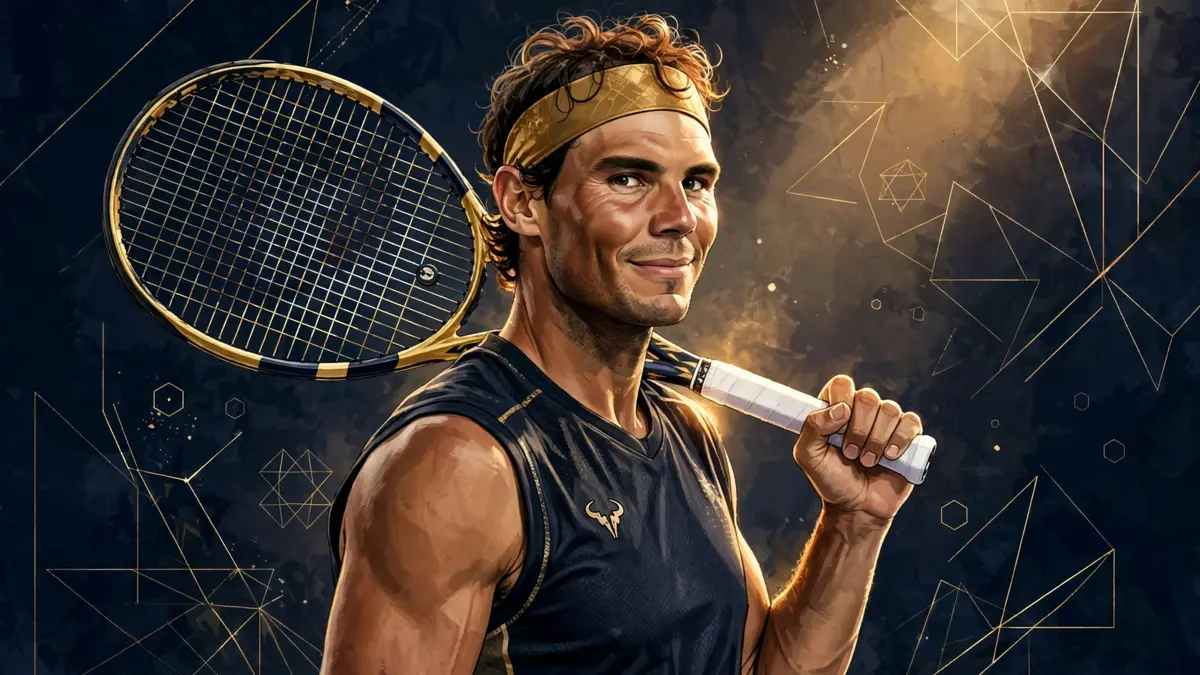
Rafael Nadal Quick Facts
| Full Name | Rafael Nadal Parera |
|---|---|
| Date of Birth | 3 June 1986 |
| Birthplace | Manacor, Mallorca, Balearic Islands, Spain |
| Age | 40 years old (as of November 2026) |
| Height | 6 ft 1 in (1.85 m / 185 cm) |
| Turned Professional | 2001, aged 15 |
| Retired | 19 November 2024 (Davis Cup Finals, Málaga), aged 38 |
| Grand Slam Singles Titles | 22 — including a record 14 French Open titles |
| ATP Singles Titles | 92 |
| Career Prize Money | More than $134 million (ATP official figures) |
| Estimated Net Worth | $200 million–$220 million (Celebrity Net Worth lists $220 million) |
| Peak Income Sources | Tournament prize money, Nike and Babolat endorsements, Rafa Nadal Academy, ZEL hotels |
| Wife | Maria Francisca Perelló (married October 2019) |
| Children | Rafael Jr. (born October 2022), Miquel (born August 2025) |
| Current Role (2026) | Board of directors nominee, Real Madrid (member vote 21 November 2026) |
Table of Contents
- Table of Contents
- Rafael Nadal Quick Facts
- How Old Is Rafael Nadal in 2026?
- Rafael Nadal’s Age at Every Career Milestone
- Early Life in Manacor
- The Teenage Rise: Pro at 15, Champion at 19
- The Clay King Years
- The Big Three and Age: Nadal vs Federer, Djokovic and Murray
- How Much Money Has Rafael Nadal Made?
- Assets, Business Ventures and the Rafa Nadal Academy
- Retirement at 38 and Life After Tennis
- Rafael Nadal’s New Role at Real Madrid
- Personal Life: Wife, Sons and Family at 40
- Controversies and Setbacks
- What Is Rafael Nadal Doing Now in 2026?
- Frequently Asked Questions
- Bottom Line
- Sources & Reporting
How Old Is Rafael Nadal in 2026?
Rafael Nadal is 40 years old. He was born on 3 June 1986, so he celebrated his 40th birthday on 3 June 2026. The maths is simple, but it catches people out because Nadal’s public image is frozen somewhere in his twenties — the sleeveless shirts, the long hair, the sprinting forehands on clay. He was 38 when he retired in November 2024, and the two years since have moved fast: a second child in August 2025, the tenth anniversary of his academy in Manacor in 2026, and a seat on the Real Madrid board put to a members’ vote on 21 November 2026.
For readers doing the sums another way: Nadal was 19 when he won his first French Open in June 2005, 22 when he won Wimbledon for the first time in 2008, 24 when he completed the career Grand Slam at the 2010 US Open, 36 when he won his record 22nd major at the 2022 French Open, and 38 years and five months old when he played his last professional match — a Davis Cup singles defeat to Botic van de Zandschulp in Málaga on 19 November 2024. He will turn 41 on 3 June 2027.
The short answer: Rafael Nadal was born 3 June 1986. He is 40 years old in November 2026 and turns 41 in June 2027.
Rafael Nadal’s Age at Every Career Milestone
Nadal’s career is best understood as a timeline of ages. He reached almost every landmark younger than anyone expected, and then kept adding landmarks long after the age when tennis players are supposed to fade. The table below pins the age to each moment, using ATP Tour records and the dates of the events themselves.
| Age | Date | Milestone |
|---|---|---|
| 3–4 | 1989–1990 | Starts playing tennis in Manacor, coached by his uncle Toni Nadal |
| 12 | 1998 | Wins the Spanish and European under-12 titles; also a promising footballer |
| 15 | 2001 | Turns professional |
| 16 | April 2003 | Wins his first ATP Tour match, in Monte Carlo |
| 17 | 2004 | Wins his first ATP title, in Sopot; helps Spain win the Davis Cup |
| 18 | 2005 | Breaks into the world top 10; wins 11 titles in the season |
| 19 | June 2005 | Wins his first Grand Slam, the French Open, on his debut in Paris |
| 20 | 2006 | Second French Open title; beats Federer in the Rome final |
| 22 | August 2008 | Becomes world No. 1 for the first time; wins Olympic singles gold in Beijing |
| 22 | July 2008 | Wins Wimbledon for the first time, beating Federer in a five-set final |
| 24 | September 2010 | Completes the career Grand Slam with the US Open title |
| 27 | 2013 | Returns from a seven-month knee injury layoff to win 10 titles, including two majors |
| 31 | 2017 | Wins the French Open for a tenth time — “La Décima” — and the US Open |
| 33 | 2019 | Wins his 19th major in New York; marries Maria Francisca Perelló in October |
| 35 | January 2022 | Wins the Australian Open for a second time, his 21st major, passing Federer and Djokovic |
| 36 | June 2022 | Wins a record-extending 14th French Open and his 22nd major — the last of his career |
| 36 | October 2022 | First son, Rafael Jr., is born |
| 38 | November 2024 | Retires after Spain’s Davis Cup quarter-final defeat in Málaga |
| 39 | August 2025 | Second son, Miquel, is born |
| 40 | November 2026 | Nominated to the board of directors of Real Madrid; members vote on 21 November |
Two ages in that table explain why Nadal is talked about the way he is. The first is 19: only a handful of men in the Open era have won a major as a teenager, and Nadal did it on his first attempt in Paris, beating Roger Federer in the semi-final along the way. The second is 36: his 2022 French Open title came after a chronic foot condition had left him playing on a numbed foot, and it made him the oldest French Open champion in history. Between those two bookends sits the longest prime men’s tennis has seen.
Early Life in Manacor
Rafael Nadal Parera was born on 3 June 1986 in Manacor, a market town of about 40,000 people on Mallorca, the largest of Spain’s Balearic Islands. His father, Sebastián Nadal, ran a restaurant and later a business in the town; his mother, Ana María Parera, worked in a perfumery. He has a younger sister, María Isabel. Sport ran in the family from both sides: his uncle Miguel Ángel Nadal was a professional footballer who played for Barcelona and Spain, and his other uncle, Toni Nadal, was a tennis coach in Manacor. Rafael Nadal’s biography traces how those two influences pulled at him as a boy — football on one side, tennis on the other — until tennis won out.
Toni put a racket in his nephew’s hand when Rafael was about three years old, and by the time he was eight he was winning regional junior tournaments. He played right-handed in everyday life but Toni trained him to play tennis left-handed, a decision that later gave his forehand its famous cross-court angle against right-handed opponents. At twelve he won the Spanish and European under-12 titles, and around the same age he was also a talented footballer — good enough that his family had to choose. His father, Sebastián, reportedly drew the line: the family would back tennis, but only if Rafael gave it everything. He did.
The choice shaped everything that followed. Nadal stayed in Manacor rather than moving to Barcelona or abroad, trained on the clay courts of the local club, and grew up in the same town where he still lives today. That rootedness became a theme of his whole career: he built his academy in Manacor, his foundation works there, and his two sons are growing up in the same place he did. For a player who spent two decades travelling the world, home never moved.
The Teenage Rise: Pro at 15, Champion at 19
Nadal turned professional in 2001, at fifteen, and his rise was fast even by the standards of teenage prodigies. He won his first ATP match in Monte Carlo in April 2003, aged sixteen, beating Ramón Delgado, and by the end of that year he was inside the world’s top fifty. In 2004, at seventeen, he won his first ATP title in Sopot, Poland, and played a part in Spain’s Davis Cup triumph, beating Andy Roddick in the final in Seville — the youngest player ever to win a Davis Cup final singles rubber at the time.
The 2005 season, played mostly at eighteen and nineteen, is still one of the great teenage seasons in tennis history. Nadal won eleven titles, including four Masters events, and finished the year ranked world No. 2 behind Federer. The peak came in June, two days after his nineteenth birthday, when he won the French Open on his debut at Roland Garros. He dropped only one set in the semi-final against Federer and beat Mariano Puerta in the final. No teenager had won in Paris since Mats Wilander in 1982, and nobody has done it since.
What made the teenage Nadal different was not just the results but the physical style. He arrived with heavy topspin, relentless court coverage and a competitiveness that older players found unsettling. His rivalry with Federer, five years his senior, began in those years and became the defining contest of the sport: Federer the elegant shot-maker, Nadal the relentless competitor. By the time Nadal turned twenty he had already won two French Opens and was being talked about as a future all-time great — a label he would spend the next eighteen years justifying.
The Clay King Years
If one number defines Nadal’s career, it is fourteen: his French Open titles, won between 2005 and 2022. No player in history has won a single tournament fourteen times, and no one has come close at any major. His record at Roland Garros stands at 112 wins and 4 defeats — a win rate above 96 percent at the one event where the whole sport’s history is measured. The 2022 title, won at thirty-six with his left foot numbed by injections to manage a chronic condition, is the one his rivals mention most often when asked what made him different.
But the clay-court story, on its own, sells him short. Nadal won majors on every surface — two Wimbledons, four US Opens, two Australian Opens — and completed the career Golden Slam by adding Olympic singles gold in Beijing in 2008 and doubles gold in Rio in 2016. His 2008 Wimbledon final against Federer, won 9–7 in the fifth set as darkness fell over Centre Court, is widely described as the finest match ever played. He finished five seasons as the year-end world No. 1 (2008, 2010, 2013, 2017, 2019) and spent 209 weeks at the top of the rankings.
The longevity is the part that ties back to his age. Nadal won majors in three different decades — his first in 2005, his last in 2022 — and his final title came seventeen years after his first, the longest span between first and last major titles in men’s tennis. Injuries kept interrupting him: knees, wrists, the foot, the hip that effectively ended his career in 2023. Each time he returned, and each return added to a record that looked unbreakable. When he finally stopped, it was not because he had lost the will but because his body had stopped letting him train the way his game demanded.
The Big Three and Age: Nadal vs Federer, Djokovic and Murray
Nadal’s age only makes full sense next to the two men he shared the sport with. Federer, Djokovic and Nadal — the “Big Three” — won 66 of 81 Grand Slam titles between 2003 and 2023, and their retirements have come in a staggered sequence that maps neatly onto their birthdays.
| Player | Born | Age (Nov 2026) | Grand Slams | Status |
|---|---|---|---|---|
| Rafael Nadal | 3 June 1986 | 40 | 22 | Retired November 2024 |
| Roger Federer | 8 August 1981 | 45 | 20 | Retired September 2022 |
| Novak Djokovic | 22 May 1987 | 39 | 24 | Still playing |
| Andy Murray | 15 May 1987 | 39 | 3 | Retired August 2024 |
| Carlos Alcaraz | 5 May 2003 | 23 | 6 | Active, world No. 1 contender |
| Jannik Sinner | 16 August 2001 | 25 | 4 | Active |
Federer, the oldest of the three, was five years Nadal’s senior and retired first, in September 2022, at 41. Roger Federer’s net worth reflects a career that ended with twenty majors and a fortune built on longevity and endorsements that outlasted his playing days. Djokovic, eleven months younger than Nadal, is the last of the three still standing: he was 39 in November 2026 and still competing, with a record 24 Grand Slam titles. Novak Djokovic’s height — 6 ft 2 in — is one inch more than Rafael Nadal’s height of 6 ft 1 in, a difference the two men themselves have joked about. Murray, born eight days before Djokovic, retired in August 2024 after the Paris Olympics; Andy Murray’s biography covers a career spent largely in the Big Three’s shadow, with three majors of his own.
The age gap between Nadal and the next generation is just as telling. Carlos Alcaraz’s age — 23 in November 2026 — makes him seventeen years younger than Nadal, and the two Spaniards played each other three times, including the 2024 Netflix Slam exhibition in Las Vegas and Nadal’s final season. Alcaraz has spoken about growing up watching Nadal, and Nadal has said the same about watching the younger man take over. Jannik Sinner’s net worth in 2026 tells the other half of that handover: at 25, the Italian is building the kind of fortune Nadal spent two decades assembling. Nadal retired at 38; the question hanging over Alcaraz and Sinner is whether either can still be winning majors at 36, as Nadal was in Paris in 2022.
How Much Money Has Rafael Nadal Made?
Nadal’s age and his money are linked: he earned for twenty-three professional seasons, and the fortune he built reflects both the prize money of a record-breaking career and the commercial value of a reputation that never took a hit. Rafael Nadal’s net worth is covered in full on our sister site; the headline here is that estimates put it in the $200 million–$220 million range, with Celebrity Net Worth listing $220 million.
The foundation of that figure is official prize money. The ATP Tour’s own records put Nadal’s career prize money at more than $134 million — the second-highest total in men’s tennis history, behind only Djokovic. That money arrived steadily rather than in one rush: his first million-dollar seasons came as a teenager, his biggest single paydays came with the major titles, and his late-career seasons still paid well because he kept reaching the business end of the biggest events. Prize money alone, after tax and costs, accounts for a large share of his wealth, but it is not the largest share.
Endorsements are where the age story pays off a second time. Nadal signed with Nike as a teenager and stayed with the brand for his whole career, one of the longest athlete-brand partnerships in sport. Babolat has supplied his rackets since he was a boy. Around those two anchors he built a portfolio that reads like a list of Spain’s biggest companies and global luxury brands: Kia, with whom he has worked since 2006; Banco Santander; the watchmaker Richard Mille, whose tourbillon watches sell for hundreds of thousands of dollars; Emporio Armani and Tommy Hilfiger; Telefónica’s Movistar; Infosys; and the Spanish health and skincare group Cantabria Labs. Sponsors stayed with him because his image never wavered — no scandal, no controversy that stuck, and a work ethic that brands could build campaigns around for two decades.
That clean image is also why his earning power has not collapsed since retirement. Retired athletes usually lose endorsement income quickly; Nadal has kept most of his partners, added boardroom roles, and turned his academy and hotel ventures into the next phase of his income. He is 40, not 25, and his money now comes from businesses he owns rather than from winning matches — a transition most athletes never manage as smoothly.
Assets, Business Ventures and the Rafa Nadal Academy
The most visible of Nadal’s businesses sits in his home town. The Rafa Nadal Academy by Movistar opened in Manacor in 2016 and celebrated its tenth anniversary in 2026, with Nadal returning to the court for an exhibition to mark the occasion. It is a full training centre — courts, fitness facilities, a school for young players — and it has become one of the leading academies in world tennis, drawing juniors from dozens of countries. It is also, in business terms, the asset that lets Nadal stay in tennis without playing it: coaching, events, and the academy brand all generate income while keeping him close to the sport.
His second big venture is hospitality. ZEL Hotels, a joint venture with the Spanish hotel group Meliá Hotels International, opened its first property in Mallorca in 2023 and has expanded since, aiming at the Mediterranean lifestyle market Nadal himself embodies. He also runs the Fundación Rafa Nadal, the charity he founded in 2008, which works with disadvantaged children in Spain and India through sport and education.
On property, Nadal has kept his base in Mallorca. Reports over the years have described a family estate in Porto Cristo, on the island’s east coast, and a home in Manacor itself — but unlike many athletes of his wealth, he has never made a show of his real estate, and the details of his holdings are private. What is public is the pattern: he invested in his home island, in businesses tied to his name and his sport, and in a foundation rather than in the kind of trophy assets that make headlines. At 40, with two young children, that pattern looks deliberate — the businesses are built to last longer than a playing career.
Retirement at 38 and Life After Tennis
Nadal announced his retirement in October 2024, choosing the Davis Cup Finals in Málaga as his farewell. He was 38, and he had known for some time that the decision was coming: a hip injury suffered at the 2023 Australian Open had kept him out for most of that year, and the 2024 season — a first-round exit at the French Open, a second-round defeat at the Paris Olympics — had shown him that his body could no longer do what his mind asked of it. His final match, on 19 November 2024, was a straight-sets singles loss to the Netherlands’ Botic van de Zandschulp. Spain lost the tie, and Nadal’s career ended not with a trophy but with a tearful farewell ceremony in front of a home crowd, his family in the front row.
The two years since have been deliberately quiet by his standards. He has said plainly that he has no interest in coaching for the foreseeable future, and he has turned down the kind of full-time tennis roles that would have kept him on tour. Instead he has built his days around his family in Mallorca, his work at the academy, and occasional public appearances. He still plays — exhibitions, academy events, the occasional hit with friends — but he has been clear that exhibition tennis is not a comeback. The competitive part of his life is finished, and he seems at ease with that in a way that surprises people who only knew him as the most intense competitor in the sport.
One return is already booked. In October 2026 organisers announced that Nadal will headline the MGM Slam exhibition in Las Vegas in late February 2027, his first time playing in the United States since retiring. It will be a rematch of sorts with the city where he faced Alcaraz in an exhibition in 2024, during his final season. The event is a show, not a tournament, and Nadal has framed it that way himself — a chance for American fans to see him once more, without the pressure that defined his career.
Rafael Nadal’s New Role at Real Madrid
The biggest news of Nadal’s fortieth year arrived on 4 November 2026. Real Madrid announced that its board of directors had agreed to put Nadal’s appointment as a board member to the club’s General Assembly of Delegate Members, with the vote scheduled for 21 November 2026. The club’s official statement named him as member number 67,778 and an honorary member of the club, calling him “one of the greatest legends in the history of sport and one of the most admired and recognised Spanish athletes in the world.”
Nadal accepted the same day, writing on X that he had taken the proposal “with great enthusiasm, a desire to learn and to contribute everything I can”, and thanking club president Florentino Pérez and the board. The appointment still needs the members’ ratification on 21 November, but it is expected to pass — it is the only item on the agenda of the extraordinary general assembly — and if it does, the 40-year-old will formally join the leadership of the club he has supported since childhood.
The move makes sense once you know Nadal’s history with the club. He is a lifelong Real Madrid fan, a regular in the stands at the Santiago Bernabéu, and close to Pérez. Earlier in 2026 he had publicly denied reports that he would stand for the club presidency in its first election in twenty years; the board role is a different thing — a governance seat, not a campaign — and the club has not said what specific responsibilities he will hold. For a man who spent his whole sporting life answering to coaches and federations, it is his first seat at the table where a club’s decisions are actually made.
Personal Life: Wife, Sons and Family at 40
Nadal married Maria Francisca Perelló — known as Xisca — in October 2019, in a ceremony at La Fortaleza in Mallorca. The two had been together since they were teenagers; she is from Manacor, studied business administration, and has worked with the Fundación Rafa Nadal. They kept the wedding private, with about 350 guests and no press access, in keeping with how they have handled their whole relationship. She rarely gives interviews, and Nadal has always guarded her privacy as fiercely as his own.
Their first son, Rafael Jr., was born in October 2022, when Nadal was 36. Their second son, Miquel, was born in August 2025, when Nadal was 39. In interviews in November 2026 — including a widely reported conversation with the Associated Press — Nadal described his days as built around his sons: school runs, office work at the academy, and family time, a routine he has called the best part of retirement. He has also said that fatherhood changed his relationship with his own career, giving him a reason to stop that went beyond injury. For readers following the family side of his story, our personal life profiles cover other celebrities in the same detail.
Family has always been the centre of Nadal’s life in a way that goes beyond the usual athlete cliché. His parents, his sister, and his uncles have been part of his team and his daily life from the start, and his uncle Toni coached him until 2017, when Carlos Moyá took over the lead coaching role. At 40, with two small children and a wife he has known since school, Nadal’s life looks less like a retired athlete’s and more like a man who simply went home — to the same town, the same family, and the same routines he had before the world knew his name.
Controversies and Setbacks
Nadal’s career was strikingly free of the controversies that touched many of his contemporaries, and the one episode that did reach him was resolved in his favour. In 2016, the hacking group Fancy Bears published confidential medical records showing that Nadal had received therapeutic use exemptions (TUEs) for anti-inflammatory treatment in 2009 and 2012. The World Anti-Doping Agency and the International Tennis Federation both confirmed that the exemptions had been properly granted for legitimate medical treatment, and no wrongdoing was found. Nadal himself called the leak an attack on his privacy and said he had never taken anything to improve his performance.
The real setbacks of his career were physical, not reputational. His knees troubled him from his early twenties; a wrist injury cost him the second half of 2014; a chronic foot condition, Müller-Weiss syndrome, was diagnosed in 2005 and managed for the rest of his career, flaring badly in 2021 and 2022; and the hip injury of January 2023 effectively ended his time as a competitive player. He also missed the 2009 Wimbledon title defence with knee tendinitis, and the 2012 US Open with a knee injury. Each absence produced the same round of questions about whether he was finished. Each time, the answer was a comeback — until the last one, when it was not.
There was one other public argument worth noting. In 2022, after his father was quoted suggesting Nadal might skip Wimbledon to protect his foot, and again around his retirement, the family pushed back against speculation in the press about his plans. Nadal has always been direct about shutting down rumours — including, in 2026, the reports that he would run for the Real Madrid presidency, which he denied before accepting the board role instead. It is a small record of controversy for a twenty-three-year career at the top of a global sport, and it is part of why sponsors and institutions still want him on their boards at 40.
What Is Rafael Nadal Doing Now in 2026?
As of November 2026, Nadal’s life has four parts. The first is family: two sons under five, a wife he has known since his teens, and a home in Mallorca. The second is the academy in Manacor, which marked its tenth anniversary in 2026 and where he spends much of his working week. The third is Real Madrid, where he is about to become a board member if the members ratify his appointment on 21 November. The fourth is the occasional return to the court: the academy anniversary exhibition in 2026, the MGM Slam in Las Vegas in February 2027, and the public appearances that come with being Spain’s most admired living athlete.
He was in Madrid in April 2026 for the Mutua Madrid Open, where he was welcomed as a five-time champion of the event and spoke about how well life was treating him in retirement. In November 2026 he gave interviews reflecting on his friendship with Federer, his view of the current generation led by Alcaraz and Sinner, and his decision not to coach. The picture that emerges is consistent: a 40-year-old who left the sport on his own terms, who misses the competition less than people expect, and who is building a second career out of the things that were always around the edges of the first — family, business, and the club he has loved since childhood.
Frequently Asked Questions
How old is Rafael Nadal?
Rafael Nadal is 40 years old as of November 2026. He was born on 3 June 1986 in Manacor, Mallorca, Spain, and turned 40 on 3 June 2026. He will turn 41 on 3 June 2027.
When did Rafael Nadal retire and how old was he?
Nadal retired on 19 November 2024, aged 38 years and five months. His final professional match was a Davis Cup singles defeat to Botic van de Zandschulp in Málaga, Spain. He announced the decision in October 2024, saying his body could no longer let him train and compete the way his game demanded.
How old was Rafael Nadal when he won his first Grand Slam?
Nadal was 19 when he won his first Grand Slam, the French Open, in June 2005 — two days after his nineteenth birthday. He beat Roger Federer in the semi-final and Mariano Puerta in the final, on his debut at Roland Garros. He went on to win the French Open a record 14 times.
How old is Rafael Nadal compared to Roger Federer and Novak Djokovic?
Nadal, born 3 June 1986, is 40 in November 2026. Roger Federer, born 8 August 1981, is 45 and retired in September 2022. Novak Djokovic, born 22 May 1987, is 39 and still playing, with a record 24 Grand Slam titles. Nadal sits between them in age and retired between them in time — after Federer, before Djokovic stops.
What is Rafael Nadal’s net worth at 40?
Estimates put Rafael Nadal’s net worth in the $200 million–$220 million range, with Celebrity Net Worth listing $220 million. The figure rests on more than $134 million in official ATP career prize money, decades of endorsements with Nike, Babolat, Kia and others, and his businesses — the Rafa Nadal Academy and the ZEL hotel venture with Meliá.
Is Rafael Nadal joining the Real Madrid board?
Yes — subject to a members’ vote. On 4 November 2026 Real Madrid’s board agreed to put Nadal’s appointment as a board member to the General Assembly of Delegate Members, with the vote on 21 November 2026. Nadal, member number 67,778 and an honorary member of the club, accepted the proposal the same day. He had earlier denied reports that he would stand for the club presidency.
How many children does Rafael Nadal have and how old are they?
Nadal has two sons with his wife, Maria Francisca Perelló. Rafael Jr. was born in October 2022, so he is four years old in November 2026. Miquel was born in August 2025, so he is one year old. Nadal has said his days in retirement are built around his sons, including the school run.
Will Rafael Nadal play tennis again?
Only in exhibitions. Nadal has ruled out a competitive comeback and said he has no plans to coach. He is scheduled to headline the MGM Slam exhibition in Las Vegas in late February 2027, his first time playing in the United States since retiring, and he played an exhibition for the tenth anniversary of his academy in Manacor in 2026.
Bottom Line
Rafael Nadal is 40 years old — born 3 June 1986, retired at 38, and now two years into a second act that looks nothing like a winding down. His age is the thread through the whole story: a prodigy at 15, a champion at 19, the dominant force on clay for seventeen years, and the oldest French Open winner in history at 36. The numbers that will outlast him are already set — 22 Grand Slams, 14 of them in Paris, 92 titles, more than $134 million in prize money — and the fortune built on them, estimated at $200 million–$220 million, now funds an academy, a hotel venture and a family life in the town where it all began. At 40, the newest line on his record is not a tennis result but a boardroom one: a seat at Real Madrid, voted on by the members on 21 November 2026. For the boy from Manacor who never left home, it is a fitting next chapter.
Sources & Reporting
Age, birth date and career milestones: ATP Tour (player profile and tournament records) and BBC Sport. Retirement and final match: Associated Press (November 2024 Davis Cup coverage) and ATP Tour. Real Madrid board nomination: Real Madrid (official statement, 4 November 2026) and TNT Sports. 2026 exhibitions and academy anniversary: Associated Press (October 2026) and ATP Tour. Net worth estimate: Celebrity Net Worth ($220 million); career prize money: ATP Tour official figures (more than $134 million). Endorsements and business ventures: Forbes and company announcements from Nike, Babolat, Kia and Meliá Hotels International.
How we estimated: Nadal’s age is a matter of public record — his birth date, 3 June 1986, is listed by the ATP Tour and every major tennis authority, so the age figure carries no uncertainty. Money figures are estimates, not facts about a private bank account: prize money is exact (ATP official records), while net worth is a range because sources differ — Celebrity Net Worth lists $220 million and other estimates sit lower, so we publish $200 million–$220 million and name the anchor source. Where dates or details conflicted between outlets (for example, the exact February 2027 date of the Las Vegas exhibition), we reported only what multiple sources agreed on. Figures may differ from private reality; this article will be updated if new sourced information emerges.