By Celebamerica Editorial Staff | Last updated: 7 November 2026
Rafael Nadal is 6 feet 1 inch tall — 1.85 metres, or 185 centimetres. That is the figure listed on his official ATP Tour profile and on Wikipedia, and it has stayed the same across his whole career, from the teenage prodigy who won his first French Open in 2005 to the retired champion who played his last match in November 2024. There is no competing official figure. A handful of fan forums argue he measures a fraction under that in bare feet, and one or two secondary profile pages round him down to 6 feet even, but every authoritative listing — the ATP, Wikipedia, and the tournament programmes that carried his name for two decades — says 6 ft 1 in.
Height is one of the most searched facts about Nadal because it sits at the centre of how he played. At 6 ft 1 in he was never the biggest man on the tour, yet he built the most feared clay-court game the sport has ever seen, won 22 Grand Slam singles titles, and spent 209 weeks as world No. 1. This page gives the full answer: the official measurement in every unit, how he compares with Federer, Djokovic, Murray, Alcaraz and Sinner, what his height meant for his serve, his movement and his famous topspin forehand, and the career and fortune that the 6 ft 1 in frame carried — including a net worth that the freshest reporting now puts far above the older $220 million figure most pages still repeat.
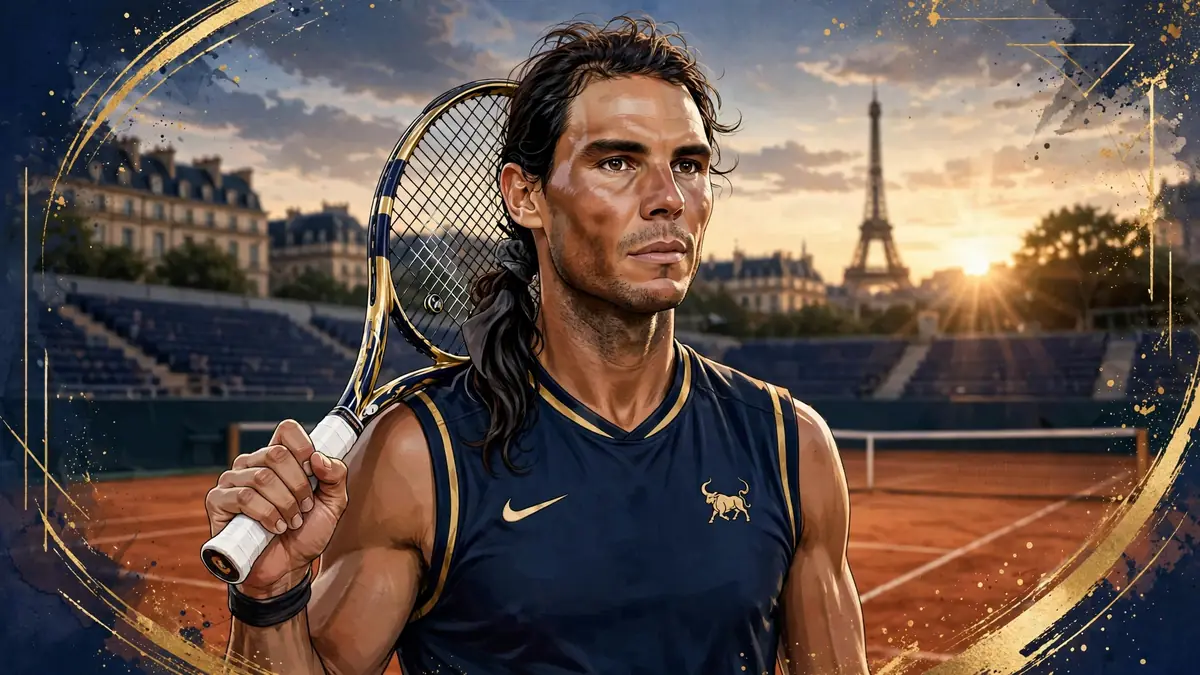
Rafael Nadal Quick Facts
| Full Name | Rafael Nadal Parera |
|---|---|
| Date of Birth | 3 June 1986 |
| Age | 40 years old (as of November 2026) |
| Birthplace | Manacor, Mallorca, Spain |
| Height | 6 ft 1 in (1.85 m / 185 cm) |
| Weight | 187 lbs (85 kg) |
| Plays | Left-handed (two-handed backhand) |
| Turned Pro | 2001 |
| Retired | 19 November 2024 (Davis Cup Finals, Málaga) |
| Grand Slam Singles Titles | 22 — including a record 14 French Open titles |
| Career Prize Money | $134,946,100 (official ATP figure, November 2026) |
| Estimated Net Worth | $220 million to $400 million — see the money section for the range and why it moved |
| Primary Income Sources | Tournament prize money, Nike and Kia endorsements, Richard Mille, Babolat, the Rafa Nadal Academy and related businesses |
| Key Ventures | Rafa Nadal Academy (Manacor, opened 2016), Rafa Nadal Foundation, hotel and restaurant interests, El Tenista wine (launched 2026) |
| Wife | María Francisca “Mery” Perelló (married 2019) |
| Children | Two sons — Rafael Jr. (born October 2022) and Miquel (born August 2025) |
Table of Contents
- Rafael Nadal Quick Facts
- The Official Height: 6 ft 1 in (1.85 m)
- Rafael Nadal Height Compared With Federer, Djokovic and the Rest
- How His Height Shaped His Game
- Is He Really 6 ft 1 in? The Barefoot Debate
- Early Life in Manacor: Growing Up Tall on Mallorca
- From Teenage Prodigy to World No. 1
- King of Clay: The Records His Height Helped Build
- Prize Money, Endorsements and Business Ventures
- The Fortune Behind the Frame: Net Worth in 2026
- Personal Life: Wife, Sons and Life in Mallorca
- Life After Tennis: What Nadal Is Doing in 2026
- Frequently Asked Questions About Rafael Nadal’s Height
- Final Thoughts
- Sources and Reporting
The Official Height: 6 ft 1 in (1.85 m)
The short answer never changes, and that is part of why it is trusted. Rafael Nadal’s height is listed as 1.85 m (6 ft 1 in) on Wikipedia, which cites the ATP as its source, and the ATP’s own head-to-head pages list him at 6’1″ (185 cm) alongside a playing weight of 187 lbs (85 kg). The same numbers appear in the Sportradar athlete database (185 cm, 85 kg) and in profile after profile published across his career. When a figure survives twenty-plus years of tournament programmes, broadcast graphics and official databases without a single revision, it is as settled as a listed height gets in professional sport.
For readers who think in different units, here is the full conversion:
- Metres: 1.85 m
- Centimetres: 185 cm
- Feet and inches: 6 ft 1 in
- Inches: 73 inches
- Weight: 85 kg / 187 lbs — a pairing that matters, because Nadal carried more muscle on his 6 ft 1 in frame than almost any rival of the same height
That weight-to-height ratio is worth pausing on. Roger Federer, listed at exactly the same height, typically played at around 10 to 15 pounds lighter than Nadal. The difference was visible every time the two men stood at the net together: same height, very different build. Nadal’s shoulders, forearms and legs were thicker, and his game was built around the power that build produced. His listed weight of 85 kg stayed steady through most of his career, even as injuries forced him to reshape his training again and again.
Against the average man, Nadal is clearly tall. The average adult man worldwide stands about 1.75 m (5 ft 9 in), so Nadal is roughly 10 cm — about four inches — taller than the global average. In Spain, where the average man is close to that same mark, he stands out in any crowd. But against the average professional tennis player, he is almost exactly average. Data drawn from ATP Tour profiles puts the average height of a top-100 male player at roughly 187 cm (6 ft 1.5 in). Nadal, at 185 cm, sits a fraction below that tour average — a fact that surprises people who assume a 22-time Grand Slam champion must tower over his opponents.
The one-line answer: Rafael Nadal is 6 ft 1 in (1.85 m) tall and weighs 187 lbs (85 kg), per the ATP Tour and Wikipedia. He is the same height as Roger Federer, one inch shorter than Novak Djokovic, and about four inches taller than the average adult man.
Rafael Nadal Height Compared With Federer, Djokovic and the Rest
The Big Three — Nadal, Federer and Djokovic — played 40-plus matches against each other across a decade and a half, and fans spent much of that time studying photographs of the three men standing side by side. The numbers explain what those photographs show: almost nothing separates them.
| Player | Height | Grand Slam Singles Titles |
|---|---|---|
| Rafael Nadal | 6 ft 1 in (1.85 m) | 22 |
| Roger Federer | 6 ft 1 in (1.85 m) | 20 |
| Novak Djokovic | 6 ft 2 in (1.88 m) | 24 |
| Andy Murray | 6 ft 3 in (1.90 m) | 3 |
| Carlos Alcaraz | 6 ft 0 in (1.83 m) | 7 (as of November 2026) |
| Jannik Sinner | 6 ft 2–3 in (1.88–1.91 m) | 5 (as of November 2026) |
| Daniil Medvedev | 6 ft 6 in (1.98 m) | 1 |
| Alexander Zverev | 6 ft 6 in (1.98 m) | 0 |
| Pete Sampras | 6 ft 1 in (1.85 m) | 14 |
Nadal vs Federer — identical. Both men are listed at 6 ft 1 in (1.85 m). The ATP itself noted in a May 2026 piece on the height of world No. 1 players that each of the four longest-tenured No. 1s stood between 6 ft 1 in and 6 ft 2 in, and it placed Nadal squarely in that band. Their rivalry — 40 matches across 15 years, including the 2008 Wimbledon final that many call the greatest match ever played — was fought between two men of identical stature with opposite games: Federer’s gliding, one-handed elegance against Nadal’s grinding, heavy-topspin power.
Nadal vs Djokovic — one inch. Djokovic is listed at 6 ft 2 in (1.88 m), a single inch taller than Nadal. That inch shows up in the head-to-head record in a small way: Djokovic’s extra reach helped him on the return of serve, and he leads their rivalry. But one inch never decided a match between them. Their 60 meetings — the most-played rivalry in men’s tennis history — were decided by fitness, nerve and tactics, not by the tape measure.
Nadal vs Murray — two inches. Andy Murray stands 6 ft 3 in (1.90 m), two inches above Nadal. Murray used the extra height on his serve and at the net, but Nadal won 17 of their 24 meetings, including the 2010 and 2011 French Open semi-finals and finals that mattered most.
Nadal vs Alcaraz — one inch the other way. Carlos Alcaraz, the Spaniard widely seen as Nadal’s heir, is listed at 6 ft 0 in (1.83 m) — one inch shorter than Nadal. The ATP’s May 2026 piece lists Alcaraz at 6 ft even. Alcaraz plays a game openly modelled on Nadal’s — heavy topspin, relentless defence, explosive movement — and does it from a slightly shorter frame, which makes his power all the more striking.
Nadal vs Sinner — one to two inches. Jannik Sinner is listed at 6 ft 2 in (1.88 m) in most ATP tables, though the ATP’s May 2026 article on No. 1 players gives him as 6 ft 3 in. Either way he stands one or two inches above Nadal, part of a generation that trends taller: the current world No. 1 group averages well above the 6 ft 1 in mark.
Nadal vs the giants — five inches. This is where the gap becomes real. Daniil Medvedev and Alexander Zverev both stand 6 ft 6 in (1.98 m), a full five inches taller than Nadal. On paper, that should have given them a crushing edge on serve. In practice, Nadal beat both men repeatedly at the biggest events, including his famous comeback from two sets down against Medvedev in the 2022 Australian Open final. The giants won the serving battle; Nadal won the movement battle. His lower centre of gravity, quicker first step and ability to slide into shots on clay more than offset the inches he gave away.
The pattern across the table is the real story. Four of the longest-reigning world No. 1 players in history — Djokovic, Federer, Sampras and Ivan Lendl — all stood between 6 ft 1 in and 6 ft 2 in. Nadal fits that band exactly. Tennis history suggests 6 ft 1 in to 6 ft 2 in is close to the sweet spot for the men’s game: tall enough to serve with authority and reach wide balls, short enough to move like a sprinter and change direction without the long levers working against you. Only two players above 6 ft 3 in have ever held the No. 1 ranking — Medvedev at 6 ft 6 in is one of them — and the giants of the serve have historically paid for their height with slower movement and more injuries.
How His Height Shaped His Game
Height in tennis is never just a number on a profile page. It changes the angles of a serve, the reach on a stretch volley, the height of the bounce a player can handle, and the way a body holds up across a five-set match. Nadal’s 6 ft 1 in frame shaped his game in ways that are easy to miss if you only watch the forehand.
The serve. At 6 ft 1 in, Nadal’s serve was good but never the weapon it is for the 6 ft 6 in servers. He could not simply hit over opponents the way Medvedev or Zverev can. What he did instead was use placement, spin and the left-handed angle. Serving from the ad court as a left-hander, his slice serve curved away from right-handed returners’ backhands, dragging them wide off the court and opening the space for his forehand. It was geometry, not height, that made the serve work — and it worked well enough to win 92 tour-level titles.
The topspin forehand. This is where Nadal’s height and build combined into something the sport had never seen. His forehand carried more revolutions per minute than any shot in tennis history, kicking up off the clay to shoulder height and beyond. At 6 ft 1 in with long arms and a powerful core, he could generate that spin without losing balance, and the ball bounced high enough to trouble even Federer, whose one-handed backhand had to meet it above his shoulder. On clay, where the bounce is highest, the effect was at its worst for opponents — and its best for Nadal.
Movement and defence. Here, being 6 ft 1 in rather than 6 ft 6 in was a gift. Nadal’s court coverage was the best of his generation: he chased down balls that looked like winners, slid into shots on clay with a balance that taller players could not copy, and turned defence into attack in a single stride. A taller frame carries more weight through every change of direction, and over a five-set match that cost adds up. Nadal’s frame let him play the long rallies — 20, 25, 30 shots — that broke opponents physically and mentally. His 81-match winning streak on clay, the longest single-surface streak in the Open Era, was built as much on his legs as on his racket.
The net and the overhead. The one place height cost him was above his head. Taller players reach high balls and overheads more comfortably, and Nadal occasionally looked stretched when opponents lobbed him or forced him to volley at full stretch. He compensated with anticipation — reading the lob early, taking the overhead on the move — and by keeping rallies on his terms, deep behind the baseline, where his height was never tested.
Durability. The harder truth is that Nadal’s body paid a price his height could not prevent. His knees, his left foot — where he lives with a chronic condition called Müller-Weiss syndrome — and his wrists all broke down across his career, and he retired in 2024 saying plainly that his body was finished. That is not a height story; it is a workload story. No frame, tall or short, survives two decades of the most physical tennis ever played without damage.
Is He Really 6 ft 1 in? The Barefoot Debate
Search “Rafael Nadal height” and you will find near-total agreement — and one small pocket of dissent. It is worth addressing head-on, because it is the question readers actually ask after the official figure.
The official figure is 1.85 m (6 ft 1 in), from the ATP and Wikipedia. The dissent comes from celebrity-height forums, where users who study photographs argue Nadal is closer to 183–184 cm (about 6 ft 0.5 in) in bare feet, and perhaps half an inch shorter than Federer when the two stand together. One well-known height-tracking site lists Nadal at 6 ft 0.25 in. The argument behind it is familiar to anyone who follows listed heights in sport: ATP measurements are taken once, early in a career, often in shoes, and a player measured in tennis shoes can gain two or three centimetres over a barefoot reading.
There is a grain of truth in the mechanics — shoes do add height — but the claim does not change the answer in any way that matters. Every player on the tour is measured the same way, so the comparisons still hold: Nadal and Federer are listed the same, Djokovic one inch taller, Alcaraz one inch shorter. The ATP figure is the one used by broadcasters, tournament programmes and record books, and it has never been revised. We report 6 ft 1 in (1.85 m) as the anchored figure and note the forum estimate of roughly 183–184 cm barefoot as the only dissenting view, so readers can see both and judge for themselves.
One more stray figure worth clearing up: a small number of secondary profile pages list Nadal at 6 ft 0 in while still giving his metric height as 185 cm. That is a rounding error, not a second measurement — 185 cm converts to 6 ft 1 in, not 6 ft 0 in. Any page that pairs “6’0″” with “185 cm” has simply rounded down.
Early Life in Manacor: Growing Up Tall on Mallorca
Rafael Nadal Parera was born on 3 June 1986 in Manacor, a town on the island of Mallorca in Spain’s Balearic Islands, to Sebastián Nadal Homar and Ana María Parera Femenías. His father ran a restaurant and later a glass and window business; his mother stayed close to home and the family. Tennis ran in the family blood: his uncle Miguel Ángel Nadal was a professional footballer who played for Barcelona and Spain, and his other uncle, Toni Nadal, became the coach who shaped Rafa’s game from childhood.
Rafa picked up a racket at four years old. He was born right-handed but played left-handed — a switch his uncle Toni encouraged, believing a left-handed forehand would give him an edge that right-handed juniors would struggle to handle. Toni was right, and the decision shaped everything that followed. By eight he was winning regional junior titles; by twelve he was winning Spanish and European age-group championships. He turned professional in 2001, at fifteen, and by eighteen he had announced himself to the world by beating world No. 1 Roger Federer at the Miami Open in 2004.
His height was already close to its adult mark by his late teens, and it gave him an early edge on the junior circuit: long enough levers to hit with power, but a frame still light enough to cover the court like a smaller player. The combination — height plus speed plus the left-handed topspin — was something junior opponents had no answer for. What set him apart even then, though, was not the tape measure. It was the work rate. Toni Nadal built his nephew’s game around humility, effort and respect for the sport, and the stories from Manacor are all the same: the teenager who practised longest, ran hardest, and never once acted like a star.
Manacor stayed home throughout his career. While other stars moved to Monte Carlo or Miami, Nadal kept living on Mallorca, trained at home, and in 2016 opened the Rafa Nadal Academy in his own town — a decision that said everything about how he saw himself. The boy from Manacor never left Manacor, even after becoming one of the most famous athletes on earth.
From Teenage Prodigy to World No. 1
Nadal’s rise was fast even by tennis standards. He won his first French Open in 2005, at nineteen, beating Federer in the semi-final and Mariano Puerta in the final — the first man to win Roland-Garros on debut since Mats Wilander in 1982. He won it again in 2006, 2007 and 2008, and by the time he beat Federer in the 2008 Wimbledon final — a match played in near-darkness that ended 9–7 in the fifth set — he was world No. 1 for the first time, ending Federer’s record 237-week run at the top.
The full story of that rise — the early titles, the rivalry years, the injuries and the comebacks — is told in depth in our sister site’s profile of the same man: Rafael Nadal’s biography on GuideNetWorth covers his life and career from Manacor to the top of the sport, and it pairs naturally with this page’s focus on his height and physical game.
What the numbers say, in brief: 92 ATP Tour singles titles, fifth-most in the Open Era. Twenty-two Grand Slam singles titles, second-most among men. Fourteen French Open titles — no player, man or woman, has won a single tournament that many times. Thirty-six Masters titles. Two Olympic gold medals: singles in Beijing in 2008 and doubles in Rio in 2016 with Marc López. Five year-end No. 1 finishes and 209 weeks at No. 1 in total. A career singles record of 1080 wins against 228 losses, a win rate of 82.6 percent. And a Davis Cup record that includes five titles with Spain, ending with his farewell in Málaga in November 2024.
The rivalry numbers are the ones fans quote. Nadal vs Federer: 40 matches, Nadal leading 24–16. Nadal vs Djokovic: 60 matches, Djokovic leading 31–29 — the most-played men’s rivalry in history. Nadal vs Murray: 24 matches, Nadal leading 17–7. Across all three rivalries, height never decided a match. Fitness, nerve and the clay under his feet decided them.
Injuries ran through the career like a thread. His knees troubled him from his early twenties; his left foot condition, Müller-Weiss syndrome, required injections and special shoes; wrist, hip and abdominal problems cost him months at a time, including most of 2023 and much of 2024. He kept coming back — the 2022 Australian Open title, won from two sets down against Medvedev at 35, was perhaps the greatest comeback of them all — until, in October 2024, he announced that the Davis Cup Finals in Málaga would be his last event. His final match, a singles loss to Botic van de Zandschulp on 19 November 2024, closed a 23-year professional career.
King of Clay: The Records His Height Helped Build
No discussion of Nadal’s height is complete without the surface that made him. Clay rewards the player who can run all day, slide into shots, and hit heavy topspin that kicks high off the dirt. Nadal’s 6 ft 1 in frame, his speed and his topspin were made for it — and the record book shows it.
- 14 French Open titles — a record at a single tournament that is unlikely ever to be matched. He won Roland-Garros in 2005, 2006, 2007, 2008, 2010, 2011, 2012, 2013, 2014, 2017, 2018, 2019, 2020 and 2022.
- 63 clay-court singles titles — the most by any man in history. Kia, his sponsor since 2004, marked the number in November 2026 with a one-off clay concept car presented to him at the Rafa Nadal Academy.
- 81 consecutive wins on clay — the longest single-surface winning streak of the Open Era, running from April 2005 to May 2007.
- 112 wins against 4 losses at Roland-Garros — a winning rate of 96.5 percent at a single Grand Slam.
- 50 consecutive sets won on clay — another record, set during his 2017–2018 run.
His height played a quiet part in all of it. The high bounce of the topspin forehand was hardest to handle on clay, where the ball already kicks up; the sliding movement that saved his legs was a clay-court skill; and the long rallies that clay produces suited a 6 ft 1 in athlete who could run forever far better than they suited a 6 ft 6 in server who wanted short points. On hard courts he still won plenty — two Australian Opens, four US Opens — and on grass he won Wimbledon twice. But clay was home, and his frame was built for it.

Prize Money, Endorsements and Business Ventures
A height article still needs the money picture, because it is the question most readers ask next — and because Nadal’s fortune is where the freshest reporting of 2026 changes the story. The figures below are all tied to named sources, and where those sources disagree, the range is stated plainly.
Prize money. The one hard, undisputed number is the official ATP prize-money total: $134,946,100 across singles and doubles, confirmed by the ATP’s prize-money leaders list of 2 November 2026. That put Nadal second all-time in career earnings from tournament play at his retirement, behind only Djokovic. Prize money alone, though, was never the main source of his wealth. Forbes has reported that his total pre-tax career earnings — prize money, appearances, endorsements and business — passed $550 million, and its year-by-year tallies show $515.2 million earned between June 2007 and June 2024 alone.
Endorsements. Nike was the anchor: Nadal wore Nike from his teens, and the relationship — clothing, shoes, and the sleeveless shirts that became his trademark — ran his whole career. Babolat supplied his rackets; he played with the same family of frames for years. Kia signed him in 2004, when he was still a teenager, made him a global brand ambassador in 2006, and extended the partnership again in October 2025 — a relationship of more than two decades that Kia celebrated in November 2026 with the clay EV4 concept car. Richard Mille, the watchmaker, put its timepieces on his wrist during matches — watches reportedly worth hundreds of thousands of dollars, worn while he played. Banco Sabadell, Telefónica, Tommy Hilfiger (a three-year deal that has since ended) and others filled out a portfolio that Forbes said earned him about $23 million from off-court work in 2024 alone, his final year on tour.
Business. The Rafa Nadal Academy, opened in Manacor in 2016, is the centrepiece — a training centre, school and sports complex that hosts junior players from around the world, including tour professionals such as Casper Ruud and Iga Świątek who have trained there. Around it sits a wider group: the Rafa Nadal Foundation, which works with socially disadvantaged children through education and sport; hotel and restaurant interests on Mallorca; and, in 2026, a new wine label, El Tenista, launched with the Viñas Familia Gil winery in Jumilla. His investment holding company, Aspemir, is the vehicle that ties much of it together — and its filings are the reason the net-worth estimates moved so sharply in 2026, as the next section explains.
The Fortune Behind the Frame: Net Worth in 2026
Most pages on the internet still say Rafael Nadal is worth $220 million. That figure was the long-standing estimate from Celebrity Net Worth, and it was repeated so widely that it became the default answer. The freshest reporting says it is out of date.
Celebrity Net Worth updated its Nadal page in 2026 and now puts his net worth at $400 million (snapshot dated 5 November 2026). The reason is unusually solid for a celebrity fortune: Spanish corporate filings for Aspemir, Nadal’s investment holding company, show the company ended 2024 with €375.4 million in net equity — roughly $428 million — up from about $389 million a year earlier, and with a €14.5 million (about $16.5 million) profit in 2024 after an extraordinary €94.1 million (about $107 million) profit in 2023. A holding company’s equity is not the same as cash in a person’s pocket, and Celebrity Net Worth says so plainly, but it is unusually strong evidence for the $400 million figure.
Forbes Spain’s rich list, published 3 November 2026, points the same way: it estimates Nadal’s fortune at €400 million, even while noting he does not make Spain’s top 100. Two independent sources landing within a few percent of each other, both dated November 2026, makes $400 million the best-anchored figure available today.
So what is the honest number? We publish it as a range — $220 million to $400 million, anchored at $400 million — because the older $220 million figure still circulates on many sites (Wealthy Gorilla, Augustman and others carried it through 2026), and private business interests mean no outsider can pin the exact figure. But readers should know the direction of travel: the newest evidence, from corporate filings and from Forbes, supports the top of the range, not the bottom. The $220 million figure is stale; $400 million is the current estimate.
For scale, $134.9 million of that fortune came from prize money alone — the part that is officially documented. The rest came from endorsements, the academy, hotels, restaurants and investments, much of it built while he was still playing and still growing now that he is retired.
Personal Life: Wife, Sons and Life in Mallorca
Nadal has always kept his private life quieter than his tennis, and the facts are simple. He married María Francisca Perelló — known as Mery or Xisca — in 2019, in a private ceremony at a castle on Mallorca. They had known each other since they were teenagers; she was a school friend of his younger sister, María Isabel. Perelló studied business management and went on to ESADE in Barcelona, and she now serves as director of the Rafa Nadal Foundation.
Their first son, Rafael Jr., was born on 8 October 2022. Their second son, Miquel, was born in August 2025 — named after Perelló’s father, who died in April 2023. The birth was revealed to People magazine, and baby Miquel appears in the final episode of the Netflix docuseries Rafa, released in May 2026. In interviews since retirement, Nadal has said fatherhood now orders his days: school runs at 8.30 in the morning, afternoons kept free for his sons, and office work fitted around family time. “I retired only two years ago, but it already feels like another life since I played tennis,” he told The Athletic in 2026. “I almost forget that I was a tennis player.”
He still lives on Mallorca, in Porto Cristo near Manacor, with the same childhood friends and the same island routines — sailing, family meals, and work at the academy. He has said his personal life never changed much, even at the height of his fame. The 6 ft 1 in frame that once covered tennis courts now covers school runs and academy boardrooms, and by his own account he prefers it that way.
Life After Tennis: What Nadal Is Doing in 2026
Retirement has been busier than the farewell suggested. Nadal runs the Rafa Nadal Academy and the Rafa Nadal Foundation day to day, and 2026 brought a run of new projects. The four-part Netflix docuseries Rafa, released in May 2026, opened up his private life — including his wife’s account of their teenage romance — more than anything he had allowed before. A luxury visual biography, Rafa Nadal, written with journalist Jon Wertheim and published by Assouline, arrived in November 2026 in editions priced from €120 to €3,000. He launched the El Tenista wine brand with Viñas Familia Gil. And in November 2026 he played an exhibition for the tenth anniversary of his academy, his first time back on court in weeks.
Two reports from November 2026 are worth noting with care, because neither is confirmed. Archysport reported that Nadal is expected to be approved as a member of the Real Madrid board of directors at the club’s general assembly on 21 November 2026 — he is a lifelong Madrid supporter, but the appointment had not been confirmed at the time of writing. The same outlet reported an exhibition match at the MGM Slam in Las Vegas on 28 February 2027. Both are reported, not settled, and we flag them as such rather than presenting them as fact.
What is settled is the legacy. Twenty-two Grand Slams, fourteen French Opens, 209 weeks at No. 1, a Davis Cup farewell in front of a home crowd, and a fortune now estimated at $400 million. The height — 6 ft 1 in — was never the headline. It was the frame that carried one of the greatest careers in sport, and it was exactly the right size for the job.
Frequently Asked Questions About Rafael Nadal’s Height
How tall is Rafael Nadal?
Rafael Nadal is 6 feet 1 inch tall (1.85 m / 185 cm), according to his official ATP Tour profile and Wikipedia. The figure has been consistent throughout his entire professional career, from his debut in 2001 to his retirement in November 2024.
How tall is Rafael Nadal in centimetres?
Rafael Nadal is 185 cm tall. That converts to 1.85 metres, 6 feet 1 inch, or 73 inches. His listed playing weight alongside that height is 85 kg (187 lbs).
Is Rafael Nadal taller than Roger Federer?
No — they are exactly the same height. Both Rafael Nadal and Roger Federer are listed at 6 ft 1 in (1.85 m). Their 40-match rivalry, one of the great rivalries in sport, was fought between two men of identical stature with very different games.
Is Rafael Nadal taller than Novak Djokovic?
No — Novak Djokovic is one inch taller. Djokovic is listed at 6 ft 2 in (1.88 m), while Nadal is 6 ft 1 in (1.85 m). That single inch never decided their 60 meetings, the most-played rivalry in men’s tennis history.
How much does Rafael Nadal weigh?
Rafael Nadal weighs 187 lbs (85 kg), per the ATP Tour. At the same height as Roger Federer, Nadal typically carried 10 to 15 pounds more muscle, which showed in his powerful shoulders, forearms and legs.
How old is Rafael Nadal and when did he retire?
Rafael Nadal was born on 3 June 1986 in Manacor, Mallorca, Spain, making him 40 years old as of November 2026. He retired on 19 November 2024, after playing his final match for Spain in the Davis Cup Finals in Málaga.
What is Rafael Nadal’s net worth in 2026?
Estimates range from $220 million to $400 million. Celebrity Net Worth updated its figure to $400 million in November 2026, supported by Spanish corporate filings showing his holding company Aspemir ended 2024 with about $428 million in net equity, and Forbes Spain estimated his fortune at €400 million the same month. His official career prize money alone was $134,946,100.
How many Grand Slam titles did Rafael Nadal win?
Rafael Nadal won 22 Grand Slam singles titles, including a record 14 French Open titles. He also won 92 ATP Tour singles titles, 36 Masters titles, two Olympic gold medals, and spent 209 weeks as world No. 1.
Final Thoughts
Rafael Nadal is 6 ft 1 in (1.85 m) tall — the same height as Roger Federer, one inch shorter than Novak Djokovic, and almost exactly the average height of a top professional tennis player. That average height turned out to be the sweet spot: tall enough to serve and reach with authority, short enough to move like the best defender the sport has ever seen. It carried him to 22 Grand Slam titles, 14 French Opens, 209 weeks at No. 1, and a fortune the freshest reporting puts at $400 million. The number on the profile page was never the story. What he did with the frame was.
Sources and Reporting
How we estimated: Height and weight come from the ATP Tour’s official player profiles and Wikipedia, which cites the ATP — the two sources agree exactly, so no range is needed on the headline figure. The barefoot estimate of roughly 183–184 cm comes from celebrity-height forums and is reported as an unverified dissenting view, not as an alternative official figure. Net worth is an estimate, not a filed personal balance sheet: we publish the $220 million to $400 million range because older pages still carry the lower figure, and anchor it at $400 million because Celebrity Net Worth’s November 2026 update and Forbes Spain’s November 2026 rich list both support that level, backed by Aspemir’s published corporate filings. Prize money ($134,946,100) is the official ATP total as of 2 November 2026. Career records (22 Grand Slams, 92 titles, 209 weeks at No. 1) come from the ATP and Wikipedia. Family details (marriage in 2019, sons born October 2022 and August 2025) are reported by Hello Magazine, Women’s Weekly and the Associated Press via Archysport. Figures may differ from private reality; where sources conflict we say so rather than picking one number silently.
Sources consulted: ATP Tour, Wikipedia, Celebrity Net Worth, Forbes, Hello Magazine.