Last updated: November 12, 2026 · By Celebamerica Editorial Staff
Novak Djokovic is 39 years old as of November 2026. The Serbian tennis great was born on May 22, 1987, in Belgrade, which makes him 39 years and about six months old today — and he turns 40 on May 22, 2027. That number is the whole story of his season: at an age when almost every male tennis player in history had already retired, Djokovic reached the Australian Open final, won his 102nd career title at the China Open in Beijing, and then told the world he still plans to play until the Los Angeles Olympics in 2028, when he will be 41.
This page answers the age question in full. You will find his exact date of birth, how old he was at every major milestone of his career, what his age means next to the other greats of the sport, how his 2026 season unfolded match by match, whether a 25th Grand Slam title is still realistic, and the money story his longevity has built — 24 Grand Slam singles titles, more than 100 tour titles, over $194 million in official prize money, and an estimated net worth of $240 million to $250 million as of 2026.
Novak Djokovic: Quick Facts
| Full Name | Novak Djokovic |
|---|---|
| Date of Birth | May 22, 1987 |
| Age (November 2026) | 39 years old (turns 40 on May 22, 2027) |
| Birthplace | Belgrade, Serbia (then SFR Yugoslavia) |
| Height | 6 feet 2 inches (1.88 m) |
| Turned Professional | 2003 (aged 16) |
| Grand Slam Singles Titles | 24 — the most by any man in tennis history |
| Career ATP Titles | 102 (as of October 2026) |
| Weeks at World No. 1 | 428 — the all-time record |
| Career Prize Money | More than $194 million (ATP), the most in tennis history |
| Estimated Net Worth | $240 million to $250 million (2026 estimate, anchored on Celebrity Net Worth) |
| Olympic Gold | Paris 2024 singles gold, beating Carlos Alcaraz in the final |
| Family | Wife Jelena Djokovic; children Stefan (born 2014) and Tara (born 2017) |
| Primary Income Sources | Tournament prize money, endorsements (Lacoste, Head, Asics, Hublot, Qatar Airways), business and advisory roles |
What’s Inside This Article
- Novak Djokovic: Quick Facts
- How Old Is Novak Djokovic in 2026?
- When Is Novak Djokovic’s Birthday?
- Early Life: Growing Up in Belgrade
- From Teenage Pro to World Number One
- What His Age Means in Tennis History
- Novak Djokovic in 2026: The Season So Far
- Can He Still Win a 25th Grand Slam?
- The Los Angeles 2028 Plan: Playing at 41
- The Money Behind the Longevity: Prize Money, Endorsements and Net Worth
- Personal Life: Family, Faith and Life Off Court
- Novak Djokovic Age: FAQs
- Final Thoughts
- Sources and Reporting
How Old Is Novak Djokovic in 2026?
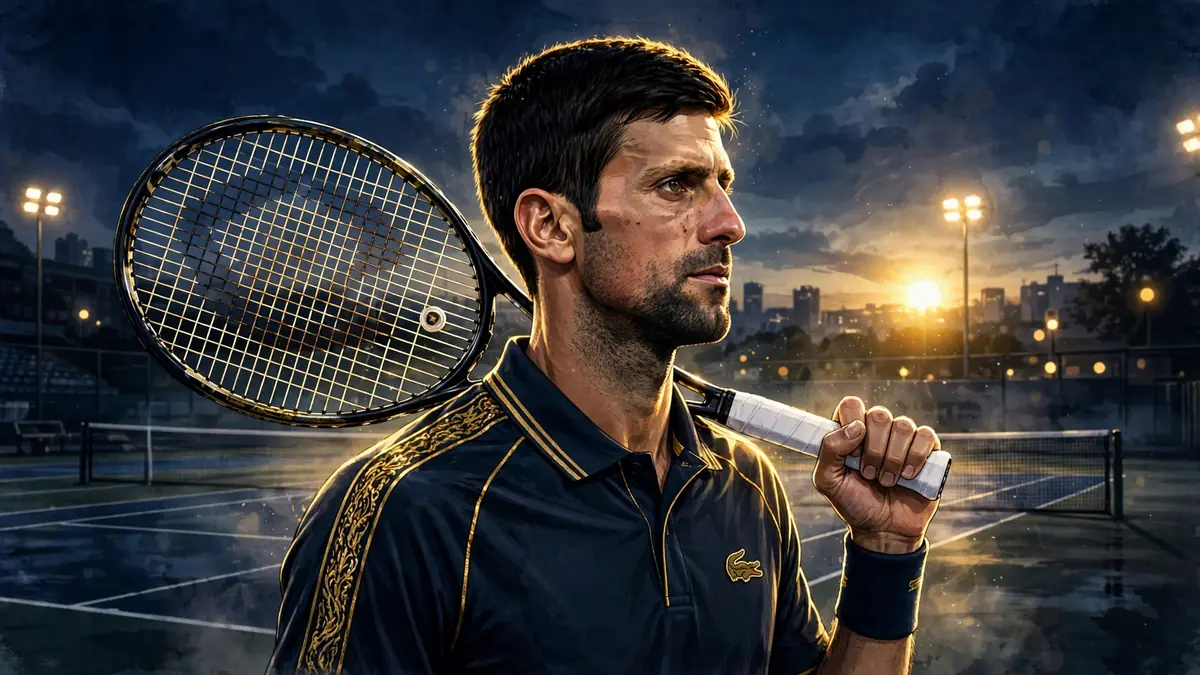
Novak Djokovic is 39 years old. He was born on May 22, 1987, so he spent the first five months of 2026 as a 38-year-old, celebrated his 39th birthday during the clay-court season in May, and will stay 39 until May 22, 2027, when he turns 40. The arithmetic is simple; the meaning of it is not. In men’s tennis, 39 is not an age at which players win Grand Slam finals places or beat the world’s best teenagers. It is an age at which the sport’s history books say the story should already be over.
That is why his age keeps coming up in every interview, every match report and every search. Reuters, reporting from the Paris Masters in early November 2026, kept calling him “the 39-year-old” in the same breath as describing him becoming the oldest match winner in that tournament’s history. Tennis Now used the same framing after his opening win in Paris: a 39-year-old who had just come back from a set down to beat Valentin Vacherot 6–7(5), 7–5, 6–1, then joked on court, “For an old guy, not so bad.” The joke lands because it is true in both directions — he is old for a tennis player, and he is still winning matches that younger men cannot.
The birthday itself has become a small annual event in the tennis calendar. On May 22, 2026, Roland Garros noted that Djokovic sat down with the media on his 39th birthday, relaxed and at ease, to talk about chasing a 25th major. He has spent more than half his life as a professional tennis player: he turned pro in 2003 at 16, won his first Grand Slam at the 2008 Australian Open at 20, and has now played tour-level tennis across four decades of his own life — his teens, his twenties, his thirties, and now the edge of his forties.
For readers who want the number in every format: he is 39 years old, born in 1987, and he will be 40 in May 2027. If he plays the Los Angeles Olympics in July 2028, as he says he intends to, he will be 41 years and two months old. His height of 6 feet 2 inches has barely changed across that span, but almost everything else about his game — the schedule, the training, the priorities — has been rebuilt around the fact that his body is 39 and the men across the net are often 15 years younger.
When Is Novak Djokovic’s Birthday?
Novak Djokovic’s birthday is May 22. He was born on May 22, 1987, in Belgrade, the capital of what was then Yugoslavia and is now Serbia. The date falls right in the middle of the European clay-court season, which means he has spent most of his birthdays either preparing for Roland Garros or playing in Rome or Geneva, rather than at home. In 2026, his 39th birthday landed during the build-up to the French Open, and the tournament’s own site marked the occasion with a long feature on a champion who arrived in Paris, in its words, without having won a single match on clay all year — and still talking openly about a 25th major.
His zodiac sign is Gemini, for readers who follow that, and he shares his birthday week with the business end of the clay season every single year. That timing has shaped his career in a small but real way: the birthday has almost always arrived with a Grand Slam two weeks away, so the questions he gets in late May are never really about cake. They are about whether this is the year the body finally says enough.
Here is the age timeline that the birthday creates:
- May 22, 1987 — born in Belgrade, Serbia.
- May 22, 2003 — turns 16; turns professional the same year.
- May 22, 2008 — turns 21; already a Grand Slam champion, having won the Australian Open that January.
- May 22, 2011 — turns 24; weeks away from the season that made him the dominant player of his generation.
- May 22, 2016 — turns 29; days later wins Roland Garros to complete the career Grand Slam and hold all four majors at once.
- May 22, 2023 — turns 36; weeks later wins Roland Garros for a record 23rd major.
- May 22, 2024 — turns 37; two months later wins Olympic gold in Paris.
- May 22, 2026 — turns 39; eight months later reaches the Australian Open final.
- May 22, 2027 — turns 40.
- July 2028 — would be 41 at the Los Angeles Olympics.
The pattern is worth pausing on. Most champions collect their defining achievements in their twenties and spend their thirties managing decline. Djokovic’s thirties contained some of his biggest ones: the 23rd major at 36, Olympic gold at 37, and now a Grand Slam final at 38 going on 39. His birthday is not just a date on a profile page. It is the measuring stick against which every one of those achievements looks more unlikely.
Early Life: Growing Up in Belgrade
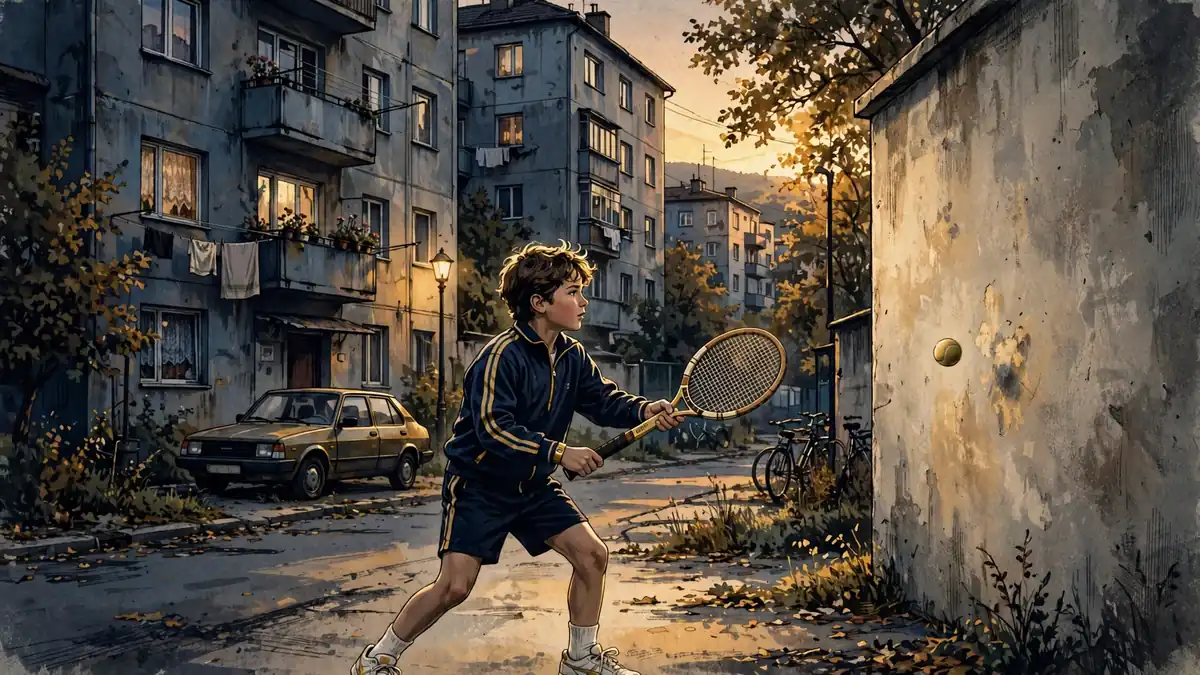
Novak Djokovic was born in Belgrade on May 22, 1987, to Srdjan and Dijana Djokovic, who ran a pizza restaurant and sports equipment shop in the Serbian capital. He was the oldest of three boys — Marko and Djordje followed — and he picked up a tennis racket for the first time at the age of four, at a small tennis camp on Mount Kopaonik where his parents had taken the family for the summer. The story has been told so many times that it sounds like a fable now: a four-year-old who watched the older children hitting balls and refused to leave the court, and a coach, Jelena Genčić, who watched him for a few minutes and told his parents that the boy had a gift she had only seen once before, in a young Monica Seles.
Genčić became his first real coach, and under her he learned the game at the Partizan Tennis Club in Belgrade. The setting was not the manicured academy world that produces most modern champions. Serbia in the 1990s was a country under sanctions and then under NATO bombing in 1999, when Djokovic was 11 years old. He has spoken many times since about those months: the air-raid sirens, the nights spent in shelters, and the mornings when he and his friends would go back to the tennis courts anyway, because the courts were open and the bombs, as he put it, fell at night. “I think that’s what made me the person I am today,” he has said of that period. The hardship became part of his public story — the boy who learned to play through air raids and grew up to own the sport.
At 12, his family sent him to Munich to train at the academy of former player Niki Pilić, a move that put real distance between him and home at an age when most children are still in primary school. He lived in Germany, learned to train like a professional, and spent his early teens travelling the junior circuit. He turned professional in 2003 at 16, and by 2005, still a teenager, he was inside the world’s top 100. His first ATP title came in Amersfoort in 2006, when he was 19. None of this was fast by the standards of the child prodigies the sport sometimes produces — he did not win a junior Grand Slam, and he was not the best teenager in the world — but the base was being built: a two-handed backhand that would become the best return shot the men’s game has ever seen, a body trained for flexibility rather than raw power, and a mind that had been hardened early.
The family stayed close through all of it. Srdjan and Dijana ran the family business, Marko and Djordje both played tennis at a lower level, and the whole family travelled with Novak in the early professional years, often on a tight budget. That closeness later became the foundation of his off-court life: the Novak Djokovic Foundation, set up in 2007 to fund early childhood education in Serbia, is run with his wife Jelena and has put millions into preschools and teacher training in the country where he grew up. For the full story of how that Belgrade boy became the most decorated men’s player in history, our sister site’s Novak Djokovic biography traces the same journey from a different angle.
From Teenage Pro to World Number One
Djokovic’s rise did not happen in a single breakthrough season. It happened in layers, and his age at each layer is part of what makes the record books read the way they do. He reached his first Grand Slam quarter-final at Roland Garros in 2006, aged 19, and his first semi-final at the French Open and Wimbledon in 2007, aged 20. Then, in January 2008, at 20 years and eight months old, he beat Roger Federer in the Australian Open semi-final and Jo-Wilfried Tsonga in the final to win his first major. He was the first player outside Federer and Rafael Nadal to win a Grand Slam since 2005, and for the first time the sport had a genuine third force.
What followed was the long apprenticeship. Between 2008 and 2010, Djokovic won one major and watched Federer and Nadal take the rest. He was world No. 3, respected, dangerous, but not yet the player who would define an era. The change came in 2011, when he was 23 turning 24. He started the season by winning the Australian Open, then went on a 41-match winning run, beat Nadal in six finals — including Wimbledon and the US Open — and finished the year with three Grand Slams and the world No. 1 ranking. It remains one of the great single seasons in tennis history, and it was built on a change that had little to do with technique: a gluten-free diet, a rebuilt fitness regime, and a new belief that he could outlast anyone, anywhere, for as long as a match lasted.
The decade that followed is the most dominant run the men’s game has seen. He completed the career Grand Slam at Roland Garros in 2016, aged 29, and in doing so held all four major titles at the same time — the first man to do that since Rod Laver in 1969. He passed Federer’s record for weeks at world No. 1, finishing with 428 weeks at the top, a figure no man or woman in the Open era has matched. He won the Australian Open ten times, more than anyone in history at a single major. He won the ATP Finals seven times. He finished the year as world No. 1 a record eight times.
The milestones kept arriving at ages when other champions were already retired or fading. He won his 21st major at Wimbledon in 2022, aged 35. His 22nd came at the 2023 Australian Open, aged 35. His 23rd, the outright men’s record, came at Roland Garros in June 2023, a month after his 36th birthday. His 24th came at the 2023 US Open, aged 36. And the one prize that had always escaped him — Olympic gold — arrived in Paris in August 2024, when he was 37, beating Carlos Alcaraz 7–6(3), 7–6(2) in a final that many people called the best match of the year. With that win he completed the career Golden Slam: all four majors plus Olympic gold, a feat only a handful of players in history have achieved.
Andy Murray, who coached him briefly in early 2025 before the two parted ways that May, has said since that he would not rule out Djokovic winning another major — and would not rule out him matching Murray’s own two Olympic singles golds if he reaches Los Angeles. That is the context for everything that follows in this article: the age is real, the decline in the legs is real, and yet the people closest to the sport keep refusing to write him off.
What His Age Means in Tennis History
To understand how unusual 39 is in men’s tennis, it helps to line Djokovic up against the other names in the record books. Roger Federer won his last Grand Slam at the 2018 Australian Open, aged 36, and played his final match at 41 — but his last four years were mostly injury and absence, not contention. Rafael Nadal won his last major at Roland Garros in 2022, aged 36, and retired in November 2024 at 38, after two seasons in which his body would no longer let him play a full schedule. Pete Sampras won his last major at 31 and retired at 32. Andre Agassi, the great late-career exception of the previous generation, reached the US Open final at 35 and retired at 36.
The deeper history is even starker. Ken Rosewall, the Australian whose longevity was once treated as unrepeatable, won the Australian Open at 37 in 1972 and reached the Wimbledon and US Open finals at 39 in 1974 — losing both, to Jimmy Connors. For half a century, Rosewall was the standard for what an old champion could do. Djokovic has now spent his late thirties doing things Rosewall never did: winning a Grand Slam at 36, winning Olympic gold at 37, and reaching a Grand Slam final at 38. Nobody in the Open era has played a major final at 39. Djokovic, who turns 40 in May 2027, has a genuine chance to be the first.
The comparison with his own rivals is just as telling. Rafael Nadal’s age was a running story for his last three seasons — the knees, the foot, the hip, and finally the decision at 38 that the body had given its answer. Nadal’s retirement in 2024 left Djokovic as the last of the Big Three still playing, and the only one still chasing titles. Federer retired in 2022 at 41, but he had not won a match at a major since 2021. Djokovic is the only one of the three who is still, at 39, beating top-ten players and reaching the last weekend of Grand Slams.
Why has he lasted when others did not? The honest answer is a mix of things that are hard to copy. His game was never built on the one weapon that ages fastest — the huge serve. It was built on return of serve, on movement, on flexibility and on the ability to turn defence into attack, and those are skills that erode more slowly than raw power. His body has been managed with an almost obsessive discipline: the diet change in 2010, the stretching and recovery routines, the careful choice of tournaments. And his schedule has shrunk as he has aged. In 2026 he played only a handful of events — seven tournaments up to and including the US Open, according to reports in October — picking his spots rather than grinding through the full tour calendar the way a 25-year-old must.
There is a cost to that strategy, and 2026 showed it. A lighter schedule means fewer matches, less rhythm, and a ranking that slips when the young players are winning every week. Djokovic dropped outside the world’s top 10 during the 2026 season, and for the first time since 2005 he failed to reach a single Masters 1000 quarter-final. The trade-off is the one he has chosen openly: he would rather arrive at the Australian Open, Wimbledon and the Olympics fresh than spend his year chasing ranking points. At 39, that is not a weakness in his planning. It is the planning.
The age record in one line: Djokovic is the only man in the Open era to win a Grand Slam at 36, win Olympic singles gold at 37, and reach a Grand Slam final at 38. If he reaches another major final after turning 40 in May 2027, he will stand alone in tennis history.
Novak Djokovic in 2026: The Season So Far
The 2026 season opened with the best and the worst of late-career Djokovic in the same month. At the Australian Open in January, he beat Lorenzo Musetti in the quarter-finals — a match in which, by his own account and by the reports of the day, he got lucky — and then stunned two-time defending champion Jannik Sinner in a five-set semi-final to reach his 11th Australian Open final. He was 38 at the time, and it was his first Grand Slam final since Wimbledon in 2024. In the final he took the first set against Carlos Alcaraz, the world No. 1, and then faded, losing 2–6, 6–2, 6–3, 7–5 in four sets. He left Melbourne Park with a runner-up speech that sounded like a farewell — “God knows what happens tomorrow, let alone in six or 12 months, so it has been a great ride” — and then, within days, confirmed that he was not retiring, and that the 2028 Olympics were still the plan. Carlos Alcaraz’s age — 23 in 2026 — is the other half of that final: the man who beat him was 15 years younger, and Djokovic still took a set off him on the biggest stage in the sport.
The middle of the season was harder. He went out in the third round of the French Open, reached the semi-finals at Wimbledon — where Sinner beat him — and then lost in the first round of the US Open, his earliest exit at a major since the 2006 Australian Open. Reports after the US Open raised questions about his health, and in November he told reporters that he had been dealing with an undefined health issue that gives him particular trouble in hot conditions, and that he was close to solving it. The first-round loss in New York, to a player ranked far below him, was the low point of the year — and it is worth saying plainly that at 39, the bad days now come more often, and they look worse, than they did at 29.
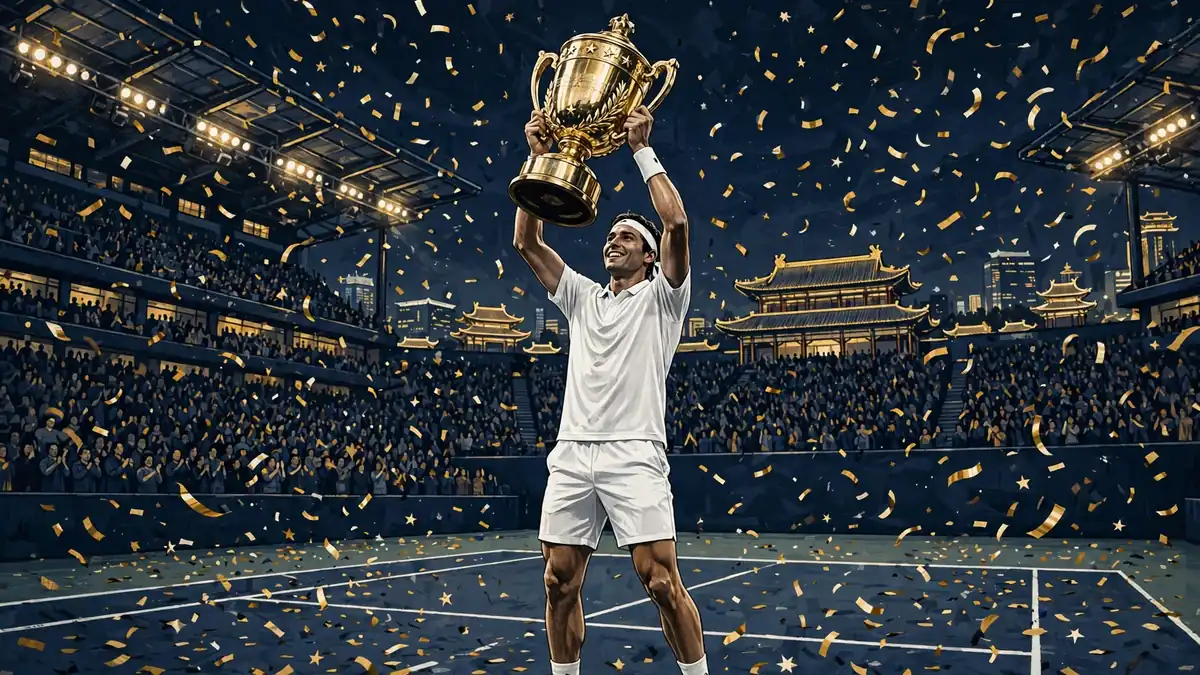
Then came Beijing. Djokovic arrived at the China Open in October for the first time in 11 years, and produced the week that saved his season. He beat Alexander Zverev in the quarter-final — becoming the oldest player to record a win over a top-two opponent since 1974 — then beat Daniil Medvedev in the semi-final, and then won the title when Alex de Minaur retired early in the second set of the final. It was his seventh China Open crown, his 102nd career ATP title, and it kept a remarkable run alive: he is now 34–0 in Beijing across his career, and he has won a title in 21 straight years. Three top-ten wins in a single week, at 39, after a season of early exits. It was the kind of week that makes people feel foolish for ever having doubted him, as one season review put it.
The autumn after Beijing was a slow fade. He lost in the second round in Shanghai to Hubert Hurkacz, lost in Basel to Jan-Lennard Struff, and then went to the Paris Masters chasing a place at the season-ending ATP Finals in Turin. He beat Valentin Vacherot in the first round to become the oldest match winner in the tournament’s history, then lost in the second round to Australian qualifier Rinky Hijikata, 2–6, 6–3, 6–3. The defeat ended his season and ended his hopes of qualifying for Turin. It was also, by one count, his tenth loss of 2026, and the first year since 2010 in which he failed to reach a Masters 1000 final.
So the season, in full, looks like this:
| Tournament (2026) | Result |
|---|---|
| Australian Open | Final — beat Sinner in the semi-final, lost to Alcaraz 2–6, 6–2, 6–3, 7–5 |
| French Open | Third round |
| Wimbledon | Semi-final — lost to Sinner |
| US Open | First round |
| China Open, Beijing | Champion — beat Zverev, Medvedev and de Minaur; 102nd career title |
| Shanghai Masters | Second round — lost to Hurkacz |
| Swiss Indoors, Basel | Early exit — lost to Struff |
| Paris Masters | Second round — beat Vacherot, lost to Hijikata; season ended |
| ATP Finals, Turin | Did not qualify |
That table is the honest picture of a 39-year-old champion: one great final, one great title, and a lot of early exits in between. The highs are still very high. The floor has dropped. And the question everyone asks next is whether the highs can happen one more time on the sport’s biggest stage.
Can He Still Win a 25th Grand Slam?
The 25th Grand Slam is the number that has hung over Djokovic since he won his 24th at the 2023 US Open. Twenty-four is already the men’s record, ahead of Nadal’s 22 and Federer’s 20, and it is a number no man had ever reached before him. Twenty-five would put him one clear of Margaret Court’s all-time record of 24 across the men’s and women’s game, and it would be the last piece of history left for him to take. He has now gone three full seasons without winning one — 2024, 2025 and 2026 — and the 2026 Australian Open final was the closest he has come since.
The case for him is straightforward. He reached a Grand Slam final in January 2026, which means he was two sets from the title as recently as ten months ago. He beat Sinner, the two-time defending champion, over five sets to get there. He beat three top-ten players in a single week in Beijing in October. His serve is still a weapon, his return is still the best in the sport when he is fresh, and his record in Melbourne — ten titles, and a court where he has lost only a handful of matches in his whole career — gives him one tournament a year where the draw, the surface and the history all bend in his favour. He has also confirmed he will play the 2027 Australian Open, which means the next real chance is only weeks away.
The case against him is just as straightforward, and it is mostly about age. To win a major now he has to beat two or three of the best players in the world in best-of-five-set matches, in the space of a week, with a 39-year-old body that has already told him it struggles in the heat. Sinner and Alcaraz are 24 and 23, they are the world’s top two, and they have beaten him in the biggest matches of the last two seasons — Sinner at Wimbledon in 2026, Alcaraz in the Australian Open final the same year. His own words after the Paris defeat in November were blunt: “I should’ve won this match.” He knows the chances are narrowing.
What the tennis world actually thinks is split. Andy Murray has said he would not rule out another Djokovic major. Mats Wilander picked the 2026 Australian Open run as Djokovic’s finest moment of the year, and praised a campaign that exceeded his expectations. Others are less sure: one former world No. 1 has called a 25th major “practically impossible” for him now. The truth sits between those two views. It is unlikely, and it is not impossible — and the Australian Open in January 2027, where he will be 39, is the most likely place for it to happen if it happens at all. If it does not happen there, the odds get longer with every birthday, because every birthday now takes him further from the last man who did this at his age, and there has never been one.
The Los Angeles 2028 Plan: Playing at 41
If there is one sentence that explains why Djokovic is still playing at 39, it is his own: the 2028 Los Angeles Olympics are “kind of a guiding star”. He first said it in 2025, after winning Olympic gold in Paris, and he has repeated it through 2026 — in Athens in November 2025, where he said the only thing that motivates him now is Los Angeles 2028; in Indian Wells in March 2026, where he called it “one of the long-term goals” and said he would try to make it; and again after the Australian Open final, when he told reporters he had said for a year and a half that he would like to play until the 2028 Olympics.
He will be 41 years old when the Los Angeles Games open on July 14, 2028, and he will arrive as the defending Olympic champion — the man who beat Alcaraz in Paris to complete the career Golden Slam. If he wins gold again, he would match Andy Murray’s two Olympic singles titles, a record Murray himself has said he would not rule out. It is a huge goal for a player who has, by his own admission and by the reporting of people close to his camp, been injury-prone over the last couple of years. Sport Klub journalist Saša Ozmo, who has covered Djokovic for years, has called it “a huge goal” and noted that Djokovic has always been known for wanting — and achieving — things that look crazy from the outside.
Djokovic has also been honest about what the plan might actually look like. After the Australian Open final he said that playing until 2028 “might mean playing one tournament a year, maybe ten, fifteen, two, or seven — I honestly don’t know.” He has said he does not want to make decisions about his schedule that far in advance, and that his only wish in the days after Melbourne was to be with his family. In February 2026, speaking to Corriere TV while attending the Winter Olympics in Milan, he said the same thing in different words: it is a long way off, but the desire to get there is clear.
There is also a farewell question wrapped inside the Olympic plan. People close to him have said that when the announcement comes, it will not be abrupt — not a sudden retirement, but a farewell built around a few chosen tournaments, the places that meant something to him. The Olympics would be the natural end point for that kind of goodbye: a last appearance for Serbia, with the flag, on the biggest stage, at 41. Whether the body allows it is the open question, and Djokovic knows it. “If his body holds up, and he can play on this kind of level, being a top-five player, then, OK,” Ozmo said. Everything about the next two years depends on that one condition.
The Money Behind the Longevity: Prize Money, Endorsements and Net Worth
Djokovic’s age is also a money story, because every extra year he plays adds to totals that no tennis player has ever reached. His career prize money, according to the ATP’s official records, has passed $194 million — the highest total in tennis history, ahead of Nadal’s roughly $135 million and Federer’s roughly $131 million. He became the first player to pass $100 million in career prize money back in 2016, and the ATP’s published career figure crossed $194 million by August 2026 as he kept playing. The 2026 season added to it in the usual uneven way: a runner-up cheque from the Australian Open, a winner’s cheque from Beijing, and smaller sums from the early exits.
His net worth is estimated at $240 million to $250 million as of 2026. The anchor for that range is Celebrity Net Worth, which puts him at $240 million, and the upper end reflects continued earnings into 2026. EssentiallySports, citing Celebrity Net Worth in July 2026, gives the same $240 million to $250 million range, and other outlets land in the same band. It is an estimate built from public reporting, not an audited balance sheet: his exact assets, taxes and private-company values are not public, and gross career earnings are not the same thing as money kept. Forbes’ 2026 tennis earnings ranking put his twelve-month income at $30.2 million before taxes and agents’ fees, and Forbes had estimated his off-court income at about $25 million in 2024.
The endorsements have been stable for years, which is itself a product of his longevity. Lacoste has dressed him on court since 2017, Head has supplied his rackets for his whole career, and Asics, Hublot and Qatar Airways round out a portfolio that has paid him tens of millions a year even in seasons when the titles slowed down. Mercedes-Benz and Seiko have also been long-term partners. The stability matters: sponsors pay for the audience and the story, and a 39-year-old still reaching Grand Slam finals is a better story than a 29-year-old winning routine titles.
Off the court, the business picture has widened in 2026. In June 2026 he joined General Atlantic, the global investment firm, as a global strategic advisor, working with its leadership, portfolio companies and investors. He has put money into restaurants and hospitality in Serbia, into the family’s business interests, and into the Novak Djokovic Foundation, which has spent years funding early childhood education in Serbia. He has also been a public voice on player welfare, helping to found the Professional Tennis Players Association, and that role has put him at odds with the sport’s governing bodies more than once — most notably in the long-running disputes over prize money shares and player representation.
| Money Fact | Figure and Source |
|---|---|
| Career Prize Money | More than $194 million (ATP, August 2026) — the most in tennis history |
| Estimated Net Worth | $240 million to $250 million (2026; anchored on Celebrity Net Worth’s $240 million) |
| Twelve-Month Income | $30.2 million before taxes and agents’ fees (Forbes 2026 tennis earnings ranking) |
| Off-Court Income | About $25 million in 2024 (Forbes) |
| First to $100M Prize Money | 2016 — the first tennis player ever to reach that mark |
| Biggest Single Payday | His 2015 season earned $21,646,145 in prize money alone (ATP year-end accounting) |
The controversies are part of the money story too, and they belong in an honest profile. His refusal to take the Covid-19 vaccine led to his deportation from Australia in January 2022 and kept him out of the United States for two seasons, costing him ranking points, prize money and the chance to defend titles at the Australian Open and the US Open. His public positions on the vaccine and on the sport’s politics have cost him some goodwill with parts of the public and, by his own account, some commercial opportunities — though his endorsement portfolio has held up, and Lacoste and his other major partners stayed with him through it all. None of that changes the arithmetic of his age or his earnings, but it is part of why the number 39 carries so much argument around it.
Personal Life: Family, Faith and Life Off Court
Djokovic married Jelena Ristić, his partner since their school days in Belgrade, in July 2014, weeks after he won Wimbledon that year. They have two children: Stefan, born in October 2014, and Tara, born in September 2017. The family is the reason he now gives, more than any other, for the lighter schedule. In October 2026, speaking before his return to Basel for the first time since 2011, he said plainly that his children and his wife are now the main reason he plays fewer tournaments. “My children, my wife,” was how he put it. The tennis is still there, but it no longer comes first in the way it did when he was 25.
His home life is split between Belgrade and Monte Carlo, where he has lived for years for tax and training reasons, and Marbella in Spain, where the family has also spent long stretches. He is a Serbian Orthodox Christian and has spoken often about his faith as a source of steadiness, particularly in the hard years. He speaks Serbian, English, German, French, Italian and Spanish, and he has used that range to build a public profile that is far bigger in Europe than that of most athletes: he is a national figure in Serbia in a way that goes beyond sport, and his words on politics, on the country’s place in the world, and on the treatment of Serbian athletes are reported as news at home.
His daily life at 39 is built around recovery as much as training. The diet that changed his career in 2010 — gluten-free, built around vegetables, fish and rice — is still the base, and he has added meditation, yoga and long stretching routines to a regime that now treats rest as training. He has a team built for this phase of his career: fitness coaches, physios, and a hitting partner, with the head-coach role having changed hands more than once in recent years, including the short-lived partnership with Andy Murray in early 2025. The through-line is the same as it was at 24: he prepares like a man who believes the next match is winnable, and he schedules like a man who knows he cannot play them all.
Novak Djokovic Age: FAQs
How old is Novak Djokovic in 2026?
Novak Djokovic is 39 years old as of November 2026. He was born on May 22, 1987, in Belgrade, Serbia, so he turned 39 in May 2026 and will stay 39 until his 40th birthday on May 22, 2027.
When does Novak Djokovic turn 40?
Novak Djokovic turns 40 on May 22, 2027. His birthday falls during the clay-court season, a few weeks before the French Open, which is why he has spent most of his birthdays preparing for Roland Garros rather than celebrating at home.
How tall is Novak Djokovic?
Novak Djokovic is 6 feet 2 inches tall (1.88 metres), according to Encyclopaedia Britannica. His height, reach and flexibility have always been central to his game, particularly his return of serve and his ability to defend from deep behind the baseline.
How many Grand Slam titles has Novak Djokovic won?
Novak Djokovic has won 24 Grand Slam singles titles, the most by any man in tennis history. The tally is 10 Australian Opens, 3 French Opens, 7 Wimbledons and 4 US Opens. He is chasing a 25th, which would move him past Margaret Court’s all-time record of 24 majors across the men’s and women’s game.
Is Novak Djokovic retiring?
Novak Djokovic has no fixed retirement date and has said he plans to keep playing until the Los Angeles Olympics in 2028, when he will be 41. He did leave his future open after losing the 2026 Australian Open final, saying he did not know if he would return to Melbourne, but he later confirmed he will play the 2027 Australian Open.
What happened to Djokovic at the 2026 Australian Open?
Djokovic reached the 2026 Australian Open final, beating two-time defending champion Jannik Sinner in a five-set semi-final. In the final he won the first set against world No. 1 Carlos Alcaraz, then lost 2–6, 6–2, 6–3, 7–5. It was his first Grand Slam final since Wimbledon 2024 and his 11th Australian Open final.
How many titles has Novak Djokovic won?
Djokovic has won 102 ATP singles titles as of October 2026, including 24 Grand Slams, 7 ATP Finals and a record 40 Masters 1000 titles. His most recent title came at the China Open in Beijing in October 2026, his seventh crown there, where he beat Alexander Zverev, Daniil Medvedev and Alex de Minaur.
What is Novak Djokovic’s net worth?
Novak Djokovic’s net worth is estimated at $240 million to $250 million as of 2026, anchored on Celebrity Net Worth’s $240 million figure. He has earned more than $194 million in official ATP career prize money — the most in tennis history — and Forbes put his twelve-month income at $30.2 million in its 2026 tennis earnings ranking.
Final Thoughts
Novak Djokovic is 39 years old, and that number is now the argument itself. At 39 he reached a Grand Slam final, won his 102nd title, became the oldest match winner in Paris Masters history, and lost ten matches to players who were, in most cases, a decade or more younger than him. Both halves of that sentence are true at the same time, and that is what makes him so hard to write about — and so hard to bet against.
The next twelve months will answer the only question that matters now. He turns 40 in May 2027, he will play the Australian Open in January as a 39-year-old, and he has told anyone who asks that the Los Angeles Olympics in 2028 are the guiding star. If the body holds and the draw breaks his way in Melbourne, a 25th Grand Slam is still on the table. If it does not, he will still have had the longest, richest and most decorated career any man has ever had in this sport — and he will have done the last part of it at an age when the history books said it could not be done. For more profiles of the sport’s biggest names, browse our celebrity profiles.
Sources and Reporting
How we estimated: The headline age is a matter of public record: Djokovic’s date of birth, May 22, 1987, is carried by the ATP, Encyclopaedia Britannica and every major outlet, and his age follows from it. The net-worth range of $240 million to $250 million is anchored on Celebrity Net Worth’s $240 million estimate, cross-checked against Forbes’ earnings figures and the ATP’s prize-money records. Prize-money figures are official ATP totals. Match results for the 2026 season are taken from Reuters reporting and the ATP’s own records, with scores cross-checked across multiple outlets. Where sources disagreed — for example, on the exact win-loss record for 2026 — we reported the figures the sources agree on (ten losses, one title) rather than picking one count. Net worth is an estimate, not an audited figure: Djokovic’s exact assets, taxes and private-company values are not public, and gross career earnings are not the same thing as money kept.
Named sources used in this article: ATP Tour, Celebrity Net Worth, Forbes, Reuters, Encyclopaedia Britannica, Roland Garros, Olympics.com, EssentiallySports, Tennis World USA and The Tennis Gazette. Figures were checked against live reporting in November 2026. If any figure changes — a new title, a new ranking, a retirement announcement — this page will be updated.