Manny Pacquiao’s net worth is estimated at $220 million as of November 2026, according to Celebrity Net Worth, whose latest snapshot of his fortune is dated November 5, 2026. Other 2026 analyses put the figure in a range of $220 million to $250 million, so $220 million is the anchored number and the top of the range reflects the more generous tallies. It is a fortune built the hard way: more than $500 million in reported career boxing and endorsement earnings, headlined by a reported $130 million payday for the 2015 Floyd Mayweather fight, then cut down by taxes, team shares, promoters and three decades of spending.
That number alone does not explain the man. Pacquiao is the only boxer in history to win world titles in eight weight divisions, a senator, a failed presidential candidate, a Hall of Famer inducted in June 2025, and — in one of the strangest second acts in sports — a 46-year-old who came out of retirement in July 2025 to fight for a world title again, then took a government post in September 2026 as secretary of the Philippines’ National Anti-Poverty Commission. This is the full story of how a boy from Kibawe who once sold goods on the street became one of the richest and most famous athletes the Philippines has ever produced.
By Celebamerica Editorial Staff | Last updated: November 7, 2026
Quick Facts
| Full Name | Emmanuel Dapidran Pacquiao Sr. |
|---|---|
| Date of Birth | December 17, 1978 (age 47 in November 2026) |
| Birthplace | Kibawe, Bukidnon, Philippines |
| Estimated Net Worth | $220 million (Celebrity Net Worth, snapshot November 5, 2026); range $220–$250 million |
| Boxing Record | 62 wins, 8 losses, 3 draws — 39 wins by knockout |
| Signature Achievement | Only eight-division world champion in boxing history; 12 major world titles across four decades |
| Peak Income Sources | Pay-per-view purses, the Mayweather fight, endorsements, MP Promotions |
| Key Ventures | MP Promotions, business and property holdings in the Philippines, Team Boxing League ownership (2026) |
| Political Career | Sarangani congressman 2010–2016; senator 2016–2022; NAPC secretary from September 8, 2026 |
| Spouse and Children | Married to Jinkee Jamora Pacquiao since May 1999; five children together |
| Height and Stance | 5 feet 5 inches (166 cm), southpaw, 67-inch reach |
Table of Contents
- Early Life: Poverty in Kibawe and General Santos
- Boxing Beginnings: Turning Pro at 16
- The Rise: From Flyweight to Global Star
- Eight Divisions: The Record That May Never Be Broken
- Biggest Fights and Paydays
- The Money: Where the Fortune Comes From
- Business Ventures and Endorsements
- Real Estate, Cars and Assets
- Net Worth Breakdown: How the Estimate Is Built
- The 2025 Comeback: Barrios and the Draw
- Hall of Fame Induction, June 2025
- Politics and Public Service
- Personal Life: Jinkee and the Pacquiao Family
- Controversies and Legal Issues
- Legacy: What Pacquiao Means to the Philippines
- FAQs About Manny Pacquiao
- Final Thoughts
- Sources and Reporting
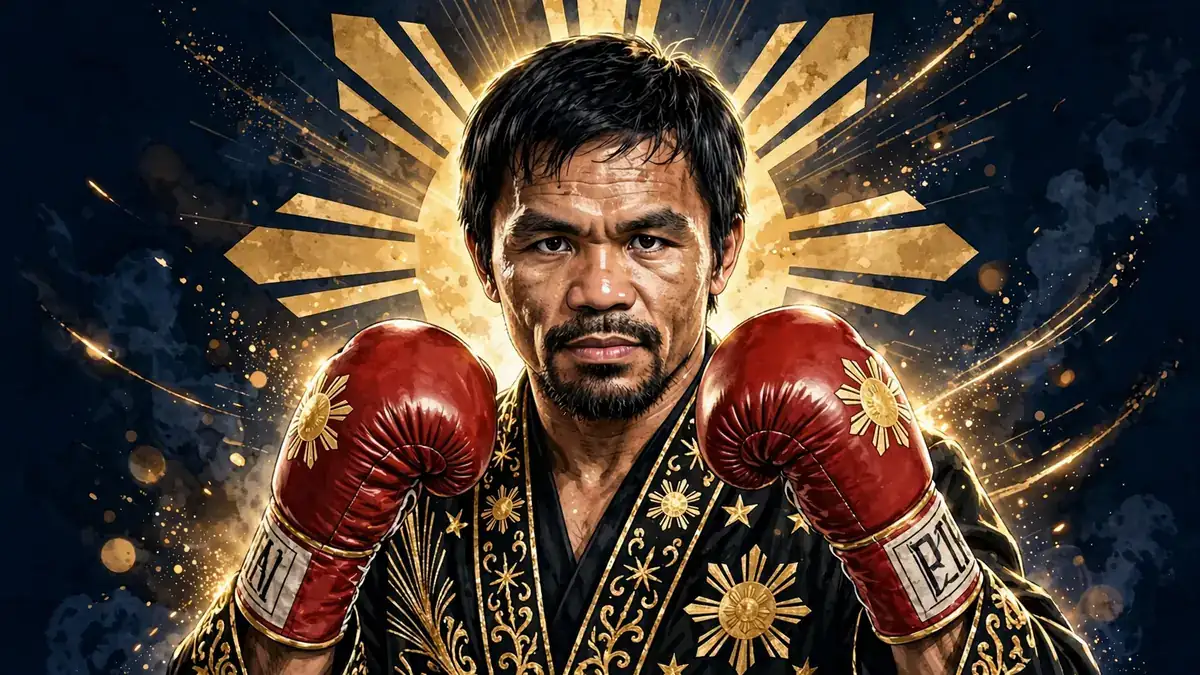
Early Life: Poverty in Kibawe and General Santos
Emmanuel Dapidran Pacquiao was born on December 17, 1978, in Kibawe, a small town in the province of Bukidnon on the island of Mindanao in the Philippines. His father was Rosalio Pacquiao and his mother was Dionisia Dapidran, who later became a minor celebrity in the Philippines in her own right as the boxer’s famously outspoken mother. The family had almost nothing. Pacquiao has spoken often about going hungry as a child, and the poverty of those years stayed with him long after the money arrived — it shaped both his politics and his philanthropy.
The family moved to General Santos City, where Pacquiao grew up. As a boy he worked street jobs to help feed the family, selling goods on the streets of the city. School came second to survival. He left home as a teenager, making his way to Manila, where he lived rough and trained in local gyms while fighting for tiny purses that barely covered food. It is the classic rags-to-riches opening, except that in Pacquiao’s case every part of it is documented: the street selling, the hunger, the stowaway-style journey to the capital, and the gym rat years before anyone outside the Philippines knew his name.
His maternal uncle introduced him to boxing, and the sport gave the teenager a way out that school and street work never could. Pacquiao was small, fast and relentless — a southpaw with a left hand that would later become one of the most feared punches in the sport. By his mid-teens he was fighting in the Philippine amateur and then professional ranks, where promoters quickly noticed a kid who threw punches in bunches and never seemed to tire.
Education came much later, after the fame. Pacquiao earned a bachelor’s degree in political science from the University of Makati in 2019 and a master’s degree in management from Philippine Christian University in 2022 — degrees he pursued while serving in the Senate, a detail that says a lot about how seriously he took the political career that boxing had made possible.
Boxing Beginnings: Turning Pro at 16
Pacquiao turned professional on January 22, 1995, at the age of 16. His debut was a four-round win, and he spent the next three years fighting almost exclusively in the Philippines, building a record the hard way on small cards. The early years were not a smooth climb. In February 1996 he was knocked out in three rounds by Rustico Torrecampo, a defeat that would have ended many young careers. Pacquiao kept going.
The first big prize came in December 1998, when he stopped Thailand’s Chatchai Sasakul in the eighth round to win the WBC flyweight title. He was 19 years old and a world champion. The reign was short: in September 1999 he lost the title to Medgoen Singsurat, stopped in three rounds after struggling badly to make the 112-pound limit. Losing a world title at 20, after failing on the scales, is the kind of setback that defines a fighter. Pacquiao’s response was to move up in weight and keep winning.
The move that changed everything came in 2001. Pacquiao, fighting at super bantamweight, took a short-notice fight against IBF champion Lehlo Ledwaba in Las Vegas and stopped him in six rounds. American audiences saw him for the first time: a whirlwind of punches, angles and energy. That same year he began working with trainer Freddie Roach at the Wild Card Gym in Los Angeles, a partnership that would become one of the most famous fighter-trainer relationships in modern boxing. Roach refined the raw aggression into something more controlled, and Pacquiao’s rise from that point was steep and fast.
The Rise: From Flyweight to Global Star
The fight that made Pacquiao a star in the United States came in November 2003, when he demolished Mexican great Marco Antonio Barrera in eleven rounds in San Antonio. Barrera was one of the best featherweights alive, and Pacquiao beat him up from the opening bell. A year later he fought Juan Manuel Márquez to a draw in a fight most observers felt he had edged, and the rivalry with Márquez would run for four fights across eight years, ending with a devastating sixth-round knockout loss in December 2012 — the only time Pacquiao was ever knocked out cold.
Between 2003 and 2010, Pacquiao’s run was extraordinary. He beat Erik Morales twice in their trilogy after losing the first meeting, stopped Barrera again, outpointed Márquez in their 2008 rematch, and then moved up to lightweight and beyond. In December 2008 he dismantled Oscar De La Hoya, the biggest pay-per-view star in the sport, forcing a corner retirement after eight one-sided rounds. It was a passing of the torch: De La Hoya never fought again.
The De La Hoya win turned Pacquiao from a boxing star into a mainstream celebrity. He appeared on talk shows, recorded songs, acted in films and became a household name in the Philippines on a scale no athlete before him had reached. In the Philippines, his fights were national events — crime rates reportedly dropped and streets emptied whenever he fought, a phenomenon the country’s press documented for years.
Eight Divisions: The Record That May Never Be Broken
No boxer in history has won world championships in eight weight divisions. Pacquiao did it across flyweight, super bantamweight, featherweight, super featherweight, lightweight, light welterweight, welterweight and light middleweight — a span of roughly 40 pounds, from 112 to 154. He won 12 major world titles in total, and he held world championships in four different decades: the 1990s, 2000s, 2010s and 2020s. That last point matters. It is not just that he won titles at many weights; it is that he kept winning them for more than 25 years.
The eighth divisional title came in November 2010, when he beat Antonio Margarito for the WBC light middleweight belt. By then the debate was no longer whether Pacquiao was great — it was where he ranked among the all-time greats. His speed was the weapon that made the weight climbing possible: he carried his hand speed and foot speed up with him, so bigger men found themselves hit by a smaller man they could not catch.
Pacquiao also became the oldest welterweight world champion in history at the age of 40, when he beat Keith Thurman by split decision in July 2019 to win the WBA welterweight title. Thurman was undefeated and a decade younger. Pacquiao dropped him in the first round and outworked him over twelve. It was the last great win of his first career, and it set up the final chapter that came two years later.
Biggest Fights and Paydays
The fight that defines Pacquiao’s earning power is the one he lost. On May 2, 2015, he faced Floyd Mayweather Jr. in Las Vegas in the richest fight ever staged. The bout generated more than $600 million in revenue, according to reports at the time, and Pacquiao’s reported share was about $130 million — the biggest single payday of his life. He lost a clear unanimous decision to Mayweather, and later revealed he had fought with a torn rotator cuff in his right shoulder, which required surgery after the bout. The fight underwhelmed as a spectacle, but as a business event it has never been matched.
His other major paydays came against the biggest names of his era. The De La Hoya fight in 2008, the Ricky Hatton knockout in 2009 — a second-round finish that remains one of the most replayed knockouts of the century — the Miguel Cotto win later that year, and the trilogy with Timothy Bradley all drew large pay-per-view audiences. The fourth Márquez fight in 2012, which he lost by knockout, was a pay-per-view hit too. Celebrity Net Worth puts his career boxing and endorsement earnings at more than $500 million, and some tallies of his gross career earnings run closer to $575 million. The gap between gross earnings and net worth is the story of taxes, promoters, trainers, managers and spending — the subject of the breakdown later in this article.
| Fight | Date | Result | Why It Mattered |
|---|---|---|---|
| Chatchai Sasakul | December 1998 | Win, KO 8 | First world title, WBC flyweight, age 19 |
| Lehlo Ledwaba | June 2001 | Win, KO 6 | IBF super bantamweight title; US breakthrough |
| Marco Antonio Barrera | November 2003 | Win, TKO 11 | Star-making win over a Mexican great |
| Oscar De La Hoya | December 2008 | Win, RTD 8 | Ended De La Hoya’s career; mainstream fame |
| Ricky Hatton | May 2009 | Win, KO 2 | Iconic one-punch finish at light welterweight |
| Antonio Margarito | November 2010 | Win, UD 12 | Eighth-division world title, a boxing first |
| Floyd Mayweather Jr. | May 2015 | Loss, UD 12 | Richest fight ever; reported $130M payday |
| Keith Thurman | July 2019 | Win, SD 12 | Oldest welterweight champion ever, at 40 |
| Yordenis Ugás | August 2021 | Loss, UD 12 | Final fight of his first career |
| Mario Barrios | July 19, 2025 | Draw, MD 12 | Comeback at 46 for the WBC welterweight title |
The Money: Where the Fortune Comes From
Pacquiao’s fortune has four pillars, and the first is by far the biggest: fight purses. Across a 26-year professional career he fought on pay-per-view more than 25 times, headlining some of the biggest-selling cards in the sport’s history. The Mayweather fight alone paid him a reported $130 million. The De La Hoya, Hatton, Cotto, Márquez and Bradley fights each paid millions more. Celebrity Net Worth’s figure of more than $500 million in career boxing and endorsement earnings is the most widely cited total, and it is consistent with the reported purses across his career.
The second pillar is endorsements. At his peak Pacquiao was one of the most marketable athletes on the planet, with deals spanning sportswear, telecoms, drinks, watches and consumer brands in the Philippines and beyond. His long-running association with Nike ended in 2016 after comments he made about same-sex marriage drew a public backlash — a rare case of an athlete losing a major sponsor over remarks rather than results. He also had deals with brands such as Hennessy and Smart Communications, and his face sold products across Southeast Asia for years.
The third pillar is promotion and business. Pacquiao founded MP Promotions, his own promotional company, which signs and develops fighters from the Philippines and the wider Asian market. Owning the promotion rather than merely fighting for one changed his economics: instead of paying a promoter’s cut on his own fights, he could keep a share of the business itself. In April 2026, Celebrity Net Worth reported that Pacquiao and MP Promotions had joined the ownership group of the San Diego TJ’s franchise in the Team Boxing League, a newer team-based boxing venture — a sign that his business interests in the sport are still growing at 47.
The fourth pillar is his political salary and public roles, which are small beside the boxing money but real: a congressman’s and senator’s pay in the Philippines, and now a cabinet-level post. None of that explains a $220 million fortune. The fortune is the boxing money, minus the very large sums that boxing takes back.
The tax and team cut: gross purses are not take-home pay. Analysts who have broken down Pacquiao’s earnings estimate that US federal and California taxes, Philippine taxes, and the shares owed to his promoter, trainer Freddie Roach, managers and team could absorb half or more of his gross fight income. That is why a man who earned more than $500 million in the ring is worth an estimated $220 million — and why the range of $220–$250 million reflects different views of how much survived.
Business Ventures and Endorsements
MP Promotions sits at the centre of Pacquiao’s business life. Founded to promote his own cards and develop young Filipino fighters, it gave him a promoter’s seat at the table after decades of sitting on the fighter’s side of it. The company has promoted cards in the Philippines and the United States, and its fighters include prospects from across Asia. For a man who once fought for purses measured in hundreds of dollars, owning the promotion is the full arc of the story.
Beyond boxing, Pacquiao has held business interests in the Philippines spanning property, retail and hospitality, and he has lent his name to ventures ranging from a basketball team — he has played and coached in the Philippine Basketball Association — to a short-lived foray into music and film. His singing career is a running joke in the Philippines and a genuine sideline: he has released albums and performed on television, and his 2014 single “Sometimes When We Touch” charted in the Philippines. None of these ventures individually moves the net worth needle, but together they form the portfolio of a man who has never relied on a single paycheque.
His endorsement peak came between 2008 and 2015, when he was the most famous athlete in Asia. Deals with Nike, Hennessy, Smart, and a string of Philippine brands made him a fixture on billboards from Manila to Los Angeles. The Nike split in 2016 cost him a major deal, but his earning power in the ring was already so large that the loss barely dented his overall fortune.
Real Estate, Cars and Assets
Pacquiao’s property holdings are spread across two countries. He owns homes in Los Angeles, where he has trained for most of his career at the Wild Card Gym, and extensive property in the Philippines, centred on General Santos City, where his family is based, and in Metro Manila. Outlets have reported a Beverly Hills mansion among his holdings. He also owns commercial property in the Philippines, and his family compound in General Santos is a well-known local landmark. Precise values for individual properties are not public, which is why this article does not attach a dollar figure to any single home.
His car collection has been widely reported in the Philippine press over the years and includes a string of luxury vehicles — Ferraris, Lamborghinis and high-end SUVs among them — though, as with the houses, no verified valuation of the collection exists. What is documented is the lifestyle: private jets for fight travel, a large entourage, and a generous hand. Pacquiao is famous in the Philippines for giving money away — to fans, to churches, to communities hit by typhoons — and that generosity is part of why his net worth, while huge, is not larger.
He is also a noted philanthropist. His foundation and personal giving have funded housing, medical help and disaster relief in the Philippines, and his political career was built in large part on the promise that a man who had lived in poverty would fight poverty. That promise is now, quite literally, his job description — see the politics section below.
Net Worth Breakdown: How the Estimate Is Built
No one outside Pacquiao’s accountants knows his exact net worth, and this site does not pretend otherwise. What follows is CelebAmerica’s own estimate, built from the reported figures named in this article. Celebrity Net Worth’s $220 million figure, snapshot-dated November 5, 2026, anchors it, and the $220–$250 million range reflects the more generous independent analyses.
| Component | Estimated Value | Basis |
|---|---|---|
| Retained fight purses (after tax and team cuts) | $120–$140 million | Career earnings reported above $500M (Celebrity Net Worth); heavy tax and team deductions |
| Endorsements and media income | $25–$35 million | Peak-era deals with Nike, Hennessy, Smart and Philippine brands |
| Business, promotion and investments | $40–$60 million | MP Promotions, Philippine business interests, Team Boxing League stake (2026) |
| Real estate and vehicles | $20–$30 million | Reported homes in Los Angeles and the Philippines; luxury car collection |
| Estimated total | $205–$265 million | Anchored at $220 million (Celebrity Net Worth) |
Two points keep the estimate honest. First, the Mayweather fight’s $130 million payday is a gross figure: after taxes in two countries and the shares owed to his team, the amount that stayed with Pacquiao was far smaller. Second, Pacquiao’s spending and giving have been unusually heavy for a star of his size — a large family, a large entourage, a political career funded in part from his own pocket, and a lifetime of philanthropy. A fighter who earned $500 million and kept most of it would be worth far more than $220 million. Pacquiao earned $500 million, paid a great deal of it away, and gave a great deal of the rest away.
How He Compares: Pacquiao vs Mayweather
The comparison that has followed both men since 2015 is instructive. Mayweather’s career earnings exceed $1 billion, roughly double Pacquiao’s reported total, yet 2026 reports citing Celebrity Net Worth put Mayweather’s net worth near $100 million — below Pacquiao’s $220 million — with Mayweather reported to be dealing with financial disputes and unpaid-earnings claims. The lesson is that career earnings and net worth are different numbers, and the fighter who earned less can end up worth more. Pacquiao’s fortune is the steadier of the two, built across a longer list of paydays and held together by property and business interests rather than a single windfall.
The 2025 Comeback: Barrios and the Draw
Pacquiao announced his retirement on September 29, 2021, weeks after losing to Yordenis Ugás in Las Vegas. He was 42, a senator, and heading for a presidential run. Most fighters who retire at that age stay retired. Pacquiao did not. After losing the 2025 Philippine Senate election, he announced in May 2025 that he would return to the ring, and on July 19, 2025, at the age of 46, he fought WBC welterweight champion Mario Barrios at the MGM Grand Garden Arena in Las Vegas.
The fight ended in a majority draw: two judges scored it 114-114 and the third had Barrios ahead 115-113, so Barrios kept his title. Pacquiao fought far better than almost anyone expected, pressing the younger champion for long stretches and landing the cleaner shots in several rounds. The result left the door open for more — and, sure enough, a rematch with Floyd Mayweather Jr. was announced for September 19, 2026, at the Sphere in Las Vegas, before being postponed. Celebrity Net Worth reported in 2026 that Pacquiao’s promoter confirmed in June that the scheduled date would not proceed amid contractual and legal complications. As of November 2026, no new date has been confirmed, and whether the rematch happens at all is an open question.
The comeback matters for this biography because it changed how the story ends. Pacquiao’s first retirement ended with a loss and a farewell. His return produced a draw against a reigning champion at 46 — and a Hall of Fame induction in the same summer. Whatever happens next, the Barrios fight is already one of the most remarkable late-career performances in boxing history.
Hall of Fame Induction, June 2025
Weeks before the Barrios fight, Pacquiao received boxing’s highest honour. On June 8, 2025, he was inducted into the International Boxing Hall of Fame in Canastota, New York, as part of the Class of 2025, in his first year of eligibility. The induction weekend ran from June 5 to 8, and Pacquiao was the headline name of a class that also included Vinny Paz and Michael Nunn. He was the last of the inductees to receive his honours on the day, and the Hall’s own report quoted his remark that he had worked hard to be better than the Manny Pacquiao of yesterday.

The induction was notable for its timing. Pacquiao was honoured as a retired great in June and fighting for a world title again in July — a sequence no Hall of Famer had ever produced. He joined the Philippines’ first Hall of Famer, Gabriel “Flash” Elorde, and his trainer Freddie Roach, who was inducted in 2012. For Filipino fans, the Canastota ceremony was the formal seal on a career that had already been celebrated at home for a quarter of a century.
Politics and Public Service
Pacquiao entered politics in 2010, when he was elected to the Philippine House of Representatives for the lone district of Sarangani, the province where he grew up. He held the seat for six years, then won a Senate seat in 2016 and served until 2022. In the Senate he was an active legislator on sports and social issues, and he used the platform to build a national profile that went beyond boxing. He also served as president of the PDP-Laban party for a period, one of the country’s major political organisations.
In September 2021 he declared his candidacy for President of the Philippines, and in the May 2022 election he finished well behind the winner, Ferdinand “Bongbong” Marcos Jr. The defeat did not end his political life. He ran for the Senate again in the 2025 elections and lost, a result that freed him to return to boxing — and that, in a twist, led to his most recent appointment. In September 2026, President Marcos appointed Pacquiao as secretary and lead convenor of the National Anti-Poverty Commission, the government body charged with coordinating the fight against poverty. He assumed office on September 8, 2026.
The appointment closed a circle. The boy who went hungry in Kibawe now runs the commission meant to keep other children from going hungry. Whether the role becomes a genuine second political career or a short appointment will be one of the stories to watch in 2027. What is certain is that Pacquiao’s public life now has three acts — boxer, senator, anti-poverty secretary — and that his fame, which once filled arenas, is now being spent on the poorest issue in Philippine public life.
Personal Life: Jinkee and the Pacquiao Family
Pacquiao married Maria Geraldine “Jinkee” Jamora in May 1999, when he was 20 and already a world champion. Jinkee, born in General Santos in January 1979, worked as a beauty consultant when they met, and she has been at the centre of his public life ever since — ringside for the biggest fights, a political figure in her own right as a former vice governor of Sarangani, and a fashion and business personality in the Philippines. Their marriage has lasted more than 27 years, an unusually long run for a sporting superstar.
Together they have five children: Emmanuel “Jimuel” Pacquiao Jr., the eldest, who has followed his father into boxing; Michael Stephen Pacquiao, who has pursued music and entertainment; Mary Divine Grace “Princess” Pacquiao, who has built a large following as a vlogger; Queen Elizabeth “Queenie” Pacquiao; and Israel Pacquiao, the youngest, born in 2014. Pacquiao also has a son, Emmanuel “Eman” Bacosa, born in 2004 from an earlier relationship, who is also pursuing a boxing career. The family lives between General Santos and Los Angeles, and the children have grown up in public, their milestones covered by the Philippine press.
Pacquiao is a devout evangelical Christian, and his faith became far more public after a religious conversion in 2012. He has preached, funded churches and spoken openly about how faith changed his lifestyle — he has said he gave up gambling, drinking and womanising after the conversion. The faith is also the source of his most controversial public moment, covered below.
Controversies and Legal Issues
No honest biography of Pacquiao skips the rough patches, and there are three that matter. The first is the 2016 controversy over his comments on same-sex marriage. In a television interview during his Senate campaign, Pacquiao made remarks about same-sex couples that drew a sharp public backlash. Nike ended its endorsement deal with him within days, and he apologised for the wording while standing by his religious beliefs. The episode cost him a major sponsor and remains the most cited example of his politics colliding with his brand.
The second is tax. In 2013, the Philippine Bureau of Internal Revenue froze some of Pacquiao’s assets over an alleged tax debt reported at the time at around 2.2 billion pesos, tied to his US fight earnings and a dispute over whether he had paid tax on them in the Philippines. The case dragged through the courts and the headlines for years, and it is one reason his finances have always been hard to pin down from the outside. Pacquiao has always maintained that he paid the taxes he owed.
The third is the Mayweather fight itself. After losing in 2015, Pacquiao revealed he had fought with a torn rotator cuff, and he faced a lawsuit from fans who said they had been misled about his fitness. The suit was eventually dismissed. The episode fed a lasting argument among fans about whether the fight was a fair contest — and it also explains why the proposed 2026 rematch, announced and then postponed, carries so much unfinished business for both men.
Legacy: What Pacquiao Means to the Philippines
Pacquiao’s legacy is bigger than any single record. He is the only boxer to win titles in eight divisions, but the numbers that Filipinos quote are different: the streets that emptied during his fights, the crime rate that dipped on fight nights, the pride of a country that saw a poor kid from Mindanao stand on the biggest stage in the world and beat the best fighters of his generation. He gave the Philippines a hero who was not a politician or a general but a boxer — and then he became a politician anyway.
His boxing legacy is secure. The Hall of Fame induction in 2025 settled the historical argument, and the Barrios draw at 46 added a final flourish that no one predicted. His political legacy is still being written: a congressman, a senator, a presidential candidate who lost, and now the secretary of the National Anti-Poverty Commission, a job that puts his own childhood at the centre of his work. If he makes a mark there, the third act may matter more than the first two.
For the rest of the boxing world, Pacquiao is the benchmark for what a small fighter can do: win at eight weights, beat 22 world champions, and still be standing — in the ring and in public life — at 47. Fighters who come after him will be measured against the eight-division record, and it is a record that may stand for a very long time.
FAQs About Manny Pacquiao
What is Manny Pacquiao’s net worth in 2026?
Manny Pacquiao’s net worth is estimated at $220 million as of November 2026, according to Celebrity Net Worth, whose latest snapshot is dated November 5, 2026. Other 2026 analyses put the figure in a range of $220 million to $250 million. His career boxing and endorsement earnings are reported at more than $500 million, with his biggest single payday the reported $130 million he earned for the 2015 Floyd Mayweather fight.
How old is Manny Pacquiao in 2026?
Manny Pacquiao was born on December 17, 1978, in Kibawe, Bukidnon, Philippines, which makes him 47 years old in November 2026. He turns 48 on December 17, 2026. He was 46 when he came out of retirement to fight Mario Barrios in July 2025.
Is Manny Pacquiao still boxing in 2026?
Yes, in a sense. After retiring in September 2021, Pacquiao returned to the ring on July 19, 2025, fighting WBC welterweight champion Mario Barrios to a majority draw at the MGM Grand in Las Vegas. A rematch with Floyd Mayweather Jr. was announced for September 19, 2026, but was postponed, and as of November 2026 no new date has been confirmed.
How many world titles did Manny Pacquiao win?
Pacquiao won 12 major world titles across eight weight divisions — flyweight, super bantamweight, featherweight, super featherweight, lightweight, light welterweight, welterweight and light middleweight. He is the only boxer in history to win world championships in eight divisions, and he held world titles in four decades, from the 1990s to the 2020s.
What is Manny Pacquiao’s boxing record?
Manny Pacquiao’s professional record is 62 wins, 8 losses and 3 draws, with 39 wins by knockout. He turned professional on January 22, 1995, at the age of 16, and his career spans from 1995 to the present, including his 2025 comeback draw with Mario Barrios.
Who is Manny Pacquiao’s wife?
Manny Pacquiao is married to Maria Geraldine “Jinkee” Jamora Pacquiao, whom he married in May 1999. Jinkee was born in General Santos in January 1979 and is a businesswoman and former vice governor of Sarangani. Together they have five children: Jimuel, Michael, Princess, Queenie and Israel.
What is Manny Pacquiao’s job in 2026?
On September 8, 2026, Pacquiao was appointed secretary and lead convenor of the Philippines’ National Anti-Poverty Commission by President Ferdinand Marcos Jr. He previously served as a congressman for Sarangani from 2010 to 2016 and as a senator from 2016 to 2022, and he ran for president in 2022.
Was Manny Pacquiao inducted into the Boxing Hall of Fame?
Yes. Pacquiao was inducted into the International Boxing Hall of Fame in Canastota, New York, on June 8, 2025, as part of the Class of 2025, in his first year of eligibility. He was the headline inductee of the class, alongside Vinny Paz and Michael Nunn.
Final Thoughts
Manny Pacquiao’s biography is not really a story about $220 million. It is a story about a boy who went hungry in Kibawe and ended up, nearly fifty years later, running the Philippine government’s anti-poverty commission — with eight-division history, a Hall of Fame plaque and a comeback draw at 46 along the way. The fortune is real, and it is anchored in named sources, but it is the smallest part of what makes him worth writing about. What will last is the record: twelve major titles, eight weights, four decades, and a country that stopped to watch him fight. Whatever the postponed Mayweather rematch brings, or doesn’t, that record is already in the books.
Sources and Reporting
This article was researched from live reporting and reference sources, including Celebrity Net Worth (net worth estimate, snapshot November 5, 2026; career earnings above $500 million; Mayweather payday; Team Boxing League ownership, April 2026; rematch postponement), ESPN (biography, record 62-8-3, comeback coverage), Wikipedia (biography, political career, National Anti-Poverty Commission appointment of September 8, 2026), the International Boxing Hall of Fame (Class of 2025 induction, June 8, 2025, Canastota), Boxing 247 (professional record, Barrios fight details and scorecards), and Forbes (business and boxing earnings coverage).
How we estimated: the $220 million net worth figure is Celebrity Net Worth’s published estimate, snapshot-dated November 5, 2026. Independent 2026 analyses give a range of $220 million to $250 million, and this article uses $220 million as the anchored figure. The component breakdown in the table above is CelebAmerica’s own estimate, built from the reported career earnings, purse and endorsement figures named in the article; it is an estimate, not a statement of Pacquiao’s private finances, which are not public. Figures may differ from reality. Where sources disagreed — most notably on the exact wedding date in May 1999 — the article gives the point of agreement and notes the difference.