Last updated: November 9, 2026 · By Celebamerica Editorial Staff
Mike Tyson — born Michael Gerard Tyson on June 30, 1966, in Brooklyn, New York — is the youngest heavyweight champion in boxing history, a title he won at 20 years and four months old on November 22, 1986. Sixty years old as of November 2026, he closed his professional career with a record of 50 wins, 44 of them by knockout, against 7 losses and 2 no contests. His net worth is estimated at about $30 million as of November 2026, according to Celebrity Net Worth — a figure that tells only the last chapter of a life that swung from a peak fortune near $300 million to bankruptcy in 2003 and back again.
Few athletes in any sport have lived as many public lives as Tyson. He was a feared teenage prodigy, an undisputed champion before his 22nd birthday, a convicted prisoner, a bankrupt ex-champion, a movie scene-stealer, a podcast host, a cannabis entrepreneur — and, in 2024, a 58-year-old man who walked back into a ring in front of 65 million Netflix viewers to fight Jake Paul. In October 2026, Netflix released TYSON, a four-part documentary series in which he tells the whole story in his own words. This biography follows that story from the streets of Brownsville to the comeback, with every money figure tied to a named source and every disputed number shown as a range.
Mike Tyson: Quick Facts
| Full Name | Michael Gerard Tyson |
|---|---|
| Date of Birth | June 30, 1966 (60 years old as of November 2026) |
| Birthplace | Brooklyn, New York, USA (raised in Brownsville) |
| Height | 5 feet 10 inches (178 cm) |
| Professional Record | 50 wins (44 KOs), 7 losses, 2 no contests — 58 fights |
| Headline Achievement | Youngest heavyweight champion in history — WBC title at 20 years, 4 months (November 22, 1986); first heavyweight to hold the WBC, WBA and IBF titles at once |
| Estimated Net Worth (2026) | About $30 million (range $25–35 million), per Celebrity Net Worth |
| Peak Fortune | About $300 million at the late-1980s peak, per Celebrity Net Worth |
| Career Boxing Earnings | About $370 million in reconstructed fight purses, per Celebrity Net Worth (some trackers still cite an older $443 million total) |
| Primary Income Sources | Boxing purses, Tyson 2.0 cannabis brand (Carma HoldCo), Hotboxin’ podcast, acting and appearances, live shows, Netflix projects |
| Spouse | Lakiha “Kiki” Spicer (married June 6, 2009) |
| Children | Seven; two with Spicer — daughter Milan and son Morocco |
| Hall of Fame | International Boxing Hall of Fame (2011); WWE Hall of Fame (2012) |
Table of Contents
- Mike Tyson: Quick Facts
- Brooklyn Beginnings: Brownsville, Tryon, and Cus D’Amato
- The Fastest Rise in Heavyweight History
- The Peak Years: Fear, Money, and the Douglas Shock
- Conviction, Prison, and the Long Road Back
- The Holyfield Fights and the Bite Heard Around the World
- The Money: Purses, Bankruptcy, and the Climb Back
- Tyson 2.0, the Podcast, and the Second Act
- The Jake Paul Fight and the 2024 Comeback
- TYSON on Netflix and the Mayweather Exhibition Question
- Personal Life: Family, Marriage, and Loss
- Legacy: Where Tyson Stands Among the Heavyweights
- Frequently Asked Questions
- Final Thoughts
- Sources and Reporting
Brooklyn Beginnings: Brownsville, Tryon, and Cus D’Amato
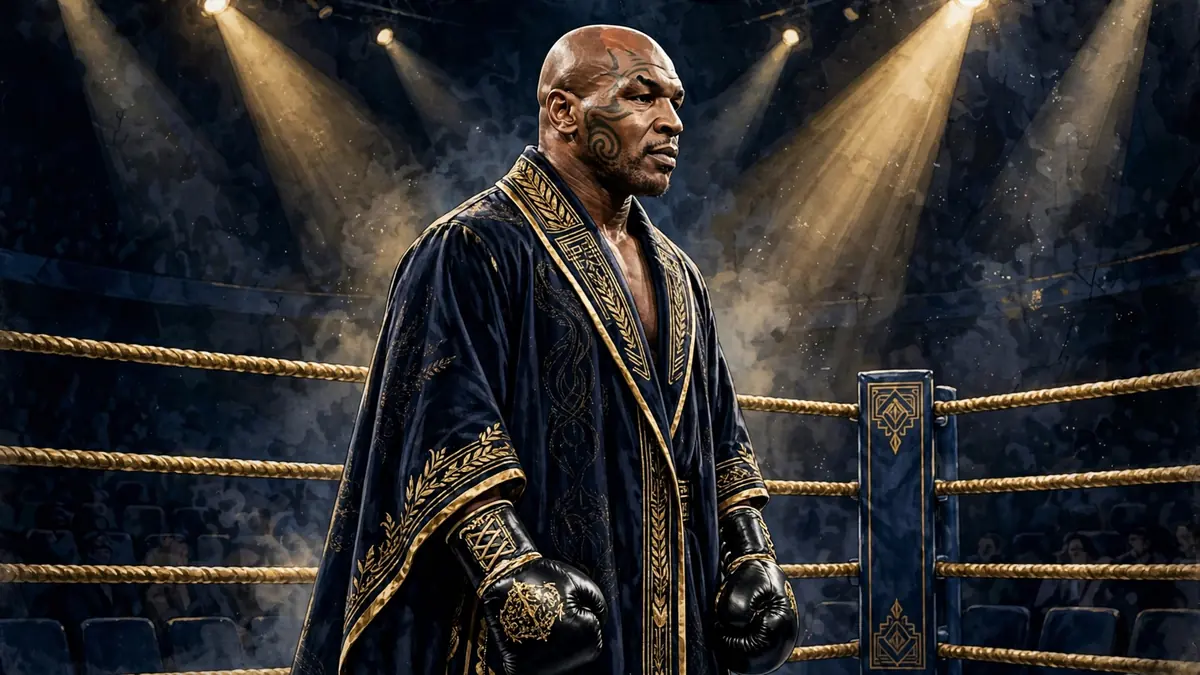
Michael Gerard Tyson was born on June 30, 1966, at Cumberland Hospital in Fort Greene, Brooklyn, to Lorna Smith Tyson and Jimmy Kirkpatrick. He grew up in Brownsville, one of the roughest neighbourhoods in New York in the 1970s, a place where street crews set the rules and a small boy learned early that size and nerve were currency. By his own later accounts, and by the reporting of outlets from the BBC to Britannica, he had been arrested 38 times by the age of 13.
The turn came at the Tryon School for Boys, a reform school in Johnstown, upstate New York, where Tyson was sent in 1978. There, a counsellor named Bobby Stewart — a former boxer himself — noticed the boy’s speed, coordination and appetite for the craft. Stewart introduced him to Cus D’Amato, the veteran trainer in Catskill, New York, who had guided Floyd Patterson and José Torres to world titles. D’Amato saw something in the 13-year-old that no one else had bothered to look for: a heavyweight who moved like a middleweight, with a short, compact frame that could generate shocking power.
Tyson moved into D’Amato’s house in Catskill and lived under the old trainer’s roof and rules. D’Amato taught him the peekaboo style — hands held high and tight to the cheeks, constant head movement, slipping punches and answering with short, violent combinations — and drilled into him the psychology of intimidation: a fight, he told the boy, is won before the first bell. When Tyson’s mother died in 1982, when he was 16, D’Amato became his legal guardian. The trainer’s death from pneumonia on November 4, 1985, a few months after Tyson turned professional, removed the one steadying hand in his life — a loss Tyson has talked about for the rest of his career, including in the 2026 Netflix series.
As an amateur, Tyson compiled a 24–3 record, won Junior Olympic titles in 1981 and 1982, and took the national Golden Gloves heavyweight championship in 1984. He never made the Olympics: he lost twice to Henry Tillman, who went on to win gold at the 1984 Los Angeles Games. The disappointment pushed him toward the professional ranks a year earlier than planned.
The Fastest Rise in Heavyweight History
Tyson turned professional on March 6, 1985, in Albany, New York, stopping Hector Mercedes in the first round. He was 18. What followed was the most concentrated run of destruction the heavyweight division had ever seen: 15 fights in his first year as a pro, nearly all of them ending early, most of them in the first round. Opponents arrived with game plans and left on stretchers. By the end of 1985 he was 15–0 with 15 knockouts, and the boxing press had stopped asking whether he was for real and started asking how far he could go.
The answer came fast. On November 22, 1986, at the Hilton in Las Vegas, Tyson faced Trevor Berbick for the WBC heavyweight championship. He knocked Berbick down twice and stopped him in the second round. At 20 years and four months old, he broke Floyd Patterson’s long-standing mark and became the youngest heavyweight champion in history — a record that still stands four decades later. His record at that point was 28–0, and the division had a new centre of gravity.
He did not stop at one belt. On March 7, 1987, he outpointed James “Bonecrusher” Smith over 12 rounds to add the WBA title. On August 1, 1987, he beat Tony Tucker on points to collect the IBF belt, becoming the first heavyweight ever to hold the WBC, WBA and IBF championships at the same time. He was 21. In 1988 he defended the unified crown against Larry Holmes, the former champion, stopping him in four rounds, and then against Michael Spinks — the unbeaten lineal champion — on June 27, 1988, in Atlantic City. That fight lasted 91 seconds. Spinks, who had never lost, was knocked down twice and counted out. Tyson’s purse for the night was reported at about $20 million, a figure that made him the highest-paid athlete in the sport.
The Peak Years: Fear, Money, and the Douglas Shock
At his peak, between 1986 and 1989, Tyson was the most feared fighter on the planet and one of the most famous athletes alive. His fights were events that stopped the sporting world: closed-circuit and pay-per-view numbers that promoters had never seen, purses that climbed into eight figures, and a style — the black trunks, the black boots, the towel over the head, no robe, no socks — that turned every ring walk into theatre. His peak net worth reached about $300 million, according to Celebrity Net Worth, built on purses that included the Spinks payday and a string of title defences worth millions each.
But the peak was already fraying. D’Amato was gone. Tyson’s marriage to actress Robin Givens in 1988 collapsed within a year, ending in divorce in 1989 amid public allegations of abuse and a televised interview, given jointly, that became one of the most uncomfortable moments in sports television. His management split apart: he fired longtime manager Bill Cayton, and promoter Don King took control of his career. The discipline that D’Amato had built around him — the early nights, the film study, the roadwork — thinned out. Trainers changed, preparation slipped, and the aura that had carried him through 37 straight wins began to depend on reputation alone.
It ended in Tokyo. On February 11, 1990, Tyson defended his titles against James “Buster” Douglas, a 42-to-1 underdog, at the Tokyo Dome. Douglas boxed a near-perfect fight, knocked Tyson down in the eighth round, and finished him in the tenth. It was one of the great upsets in sports history, and it broke the spell. Tyson won his next four fights, but the fighter who came back was not the same one who had left. The invincibility was gone, and the money machine that had run on it started to slow.
Conviction, Prison, and the Long Road Back
The lowest point of Tyson’s public life arrived off the canvas. In July 1991 he was arrested in Indianapolis on charges of raping Desiree Washington, an 18-year-old Miss Black America contestant. On February 10, 1992, an Indiana jury convicted him, and he was sentenced to six years in prison. He was released on March 25, 1995, after serving just under three years. The case is part of his biography because it shaped everything that followed — the lost prime years, the public image, and the way his later life is argued about — and it is stated here plainly, from the court record as reported by Britannica and the major news outlets, without embellishment on either side.
Prison changed the arithmetic of his career. He went in at 25, at an age when heavyweights usually collect their biggest paydays, and came out at 28 having lost three of the best years a fighter gets. He returned to the ring in August 1995 against Peter McNeeley in Las Vegas, winning by disqualification in the first round in front of a pay-per-view audience that proved his drawing power had survived the sentence. In March 1996 he stopped Frank Bruno in three rounds to regain the WBC title, and in September 1996 he knocked out Bruce Seldon in one round to take the WBA belt. For a few months, the comeback looked complete.
He also converted to Islam during his time in prison, taking the name Malik Abdul Aziz, and has spoken since about the reading and reflection that filled those years. The faith remained part of his life after release, even as the discipline around his career kept slipping.
The Holyfield Fights and the Bite Heard Around the World
The comeback ran into Evander Holyfield. On November 9, 1996, at the MGM Grand in Las Vegas, Holyfield — written off as a faded former champion — stopped Tyson in the 11th round to take the WBA title. It was a clean, disciplined beating, and it set up one of the richest rematches in boxing history.
The rematch, on June 28, 1997, produced the most infamous moment in modern boxing. In the third round, Tyson bit Holyfield’s right ear, tearing off a piece of it, and was penalised two points. Moments later he bit the other ear. Referee Mills Lane disqualified him. The Nevada State Athletic Commission revoked his boxing licence and fined him $3 million. The image of the bite became shorthand for Tyson in the public mind — the thing people who had never watched a fight knew about him — and it followed him for years, through parodies, Halloween costumes and, eventually, a cannabis edible shaped like a bitten ear (“Mike Bites”) that he would sell himself, turning the worst moment of his career into a product.
He was relicensed in 1998 and fought on, but the championship years were over. He lost to Lennox Lewis on June 8, 2002, in Memphis, knocked out in the eighth round in a fight that drew one of the largest pay-per-view audiences of the era. His guaranteed purse for that night was $17.5 million, with the event’s total pay-per-view revenue far higher. His last professional fight came on June 11, 2005, against Kevin McBride in Washington, D.C. Tyson quit on his stool after the sixth round. He was 38, and he told reporters afterwards that he no longer had the heart for it. His final professional record: 50 wins, 44 by knockout, 7 losses, and 2 no contests across 58 fights.
The Money: Purses, Bankruptcy, and the Climb Back
Tyson’s financial story is one of the most dramatic in sports: a fortune built faster than almost anyone’s, spent faster still, and then rebuilt slowly in middle age. Celebrity Net Worth puts his peak net worth at about $300 million and his current figure at about $30 million as of November 2026. The same outlet’s reconstructed fight-by-fight purse total now stands at about $370 million, though some trackers still carry an older $443 million total from an earlier version of the same table — the gap is a reminder that purse figures are industry-reported, not audited, and that promoters do not always disclose terms. Forbes once estimated his total career-plus-business earnings at close to $685 million. The honest range for his 2026 net worth is $25–35 million: Celebrity Net Worth anchors it at $30 million, The Street phrases it as $20–30 million, and our sister site’s money-focused profile of Mike Tyson’s net worth in 2026 lands on the same $30 million anchor with the full source-by-source breakdown.
| Fight | Date | Reported Purse |
|---|---|---|
| Trevor Berbick (WBC title) | Nov 22, 1986 | About $1.5 million |
| Michael Spinks (undisputed) | Jun 27, 1988 | About $20 million |
| Buster Douglas (loss) | Feb 11, 1990 | About $6 million |
| Frank Bruno II (WBC title) | Mar 16, 1996 | About $30 million |
| Evander Holyfield I | Nov 9, 1996 | About $30 million |
| Evander Holyfield II | Jun 28, 1997 | About $30 million |
| Lennox Lewis | Jun 8, 2002 | $17.5 million guaranteed (about $30 million reported with upside) |
| Jake Paul (Netflix) | Nov 15, 2024 | About $20 million reported; $2 million guaranteed on the filed contract |
Where did it all go? The 2003 bankruptcy filing listed about $23 million in debts. The causes were documented in court papers and in years of reporting: extravagant spending on houses, cars, jewellery and entourages; divorce settlements; tax debts; and the long, expensive relationship with Don King, whose management Tyson later sued, settling in 2004 for $14 million. By the time he filed, the $300 million peak was a memory. The Farmington, Connecticut mansion he had bought in the fat years was sold off; rapper 50 Cent later bought it, a neat symbol of one era’s excess passing to the next generation’s star.
The $10 million figure is stale. Pages still showing Tyson at $10 million are one refresh behind. That was the pre-Jake Paul estimate, cited by CBS News before the November 2024 fight. The reported $20 million payday from that fight — even against the $2 million guaranteed purse shown in the filed contracts published in May 2026 — is what lifted the current estimates to the $25–35 million range. Any profile that has not moved since the Paul fight is out of date.
The rebuild did not come from one windfall. It came from a dozen smaller ones stacked over a decade: acting roles, the one-man show, the podcast, appearances, and then the cannabis business, which is covered in the next section. It is a slower kind of wealth than the purses — steadier, and this time, so far, it has lasted.
Tyson 2.0, the Podcast, and the Second Act
The most durable part of Tyson’s second act is a cannabis company. He first entered the business with Tyson Holistic Holdings in 2016, and in October 2021 he launched Tyson 2.0, a premium cannabis brand built on a licensing model: franchise partners grow, manufacture and sell the products, and the brand takes its cut. The company sits inside Carma HoldCo (formerly Carma Holdings), co-founded by Tyson — who serves as chief brand officer — with chairman Chad Bronstein and chief executive Adam Wilks. The parent company also houses Ric Flair’s Ric Flair Drip brand and the rapper Future’s Evol brand.
The numbers are striking for a celebrity brand that many observers expected to flame out. Carma reported $50 million in revenue in its first year and forecast $160 million for 2023; Forbes, profiling Wilks in February 2025, estimated Carma’s revenue at about $200 million for the prior year, with Tyson 2.0 bringing in most of it. By 2023 the brand was in roughly 100,000 retailers across 40 US states and 17 countries, according to the Daily Mail’s reporting at the time. Tyson himself bought a 40-acre property in California City in 2017 that became Tyson Ranch, the brand’s home base. His ownership share in Carma has never been disclosed, which is the main reason net-worth estimates for him carry a wide range — the business could be worth far more, or far less, than the headline figure suggests.
The brand has also shown a talent for turning Tyson’s own history into marketing. The “Mike Bites” edibles, shaped like a bitten ear, took the Holyfield incident — the lowest moment of his career — and made it a bestseller. It is a neat summary of the whole second act: nothing wasted, everything repurposed.
Alongside the business runs the media career. Hotboxin’ with Mike Tyson, his long-running podcast, has become a fixture of the combat-sports conversation, with guests from across boxing, MMA and entertainment. On screen, he played himself to scene-stealing effect in The Hangover (2009) and its sequel, appeared in Ip Man 3 (2015), and toured his one-man show Mike Tyson: Undisputed Truth, directed by Spike Lee, on Broadway in 2012 and 2013. He has also worked as a fight commentator and made regular appearances on talk shows and in commercials — a familiar, self-aware public figure, a long way from the silent menace of the 1980s ring walks.
The Jake Paul Fight and the 2024 Comeback
On November 15, 2024, at AT&T Stadium in Arlington, Texas, Tyson fought Jake Paul in a professionally sanctioned bout streamed live on Netflix. He was 58; Paul was 27. The fight drew a reported 65 million concurrent streams, making it one of the most-watched sporting events in streaming history, and it ended with Paul winning by unanimous decision over eight rounds. Tyson looked his age — slow, tired, landing little — and the reaction afterwards was split between admiration that he had done it at all and discomfort at watching a 58-year-old take punches for a payday.
The payday itself became a story of its own. The reported figure was about $20 million for Tyson, widely cited in the days after the fight and the single biggest reason his estimated net worth jumped from about $10 million to about $30 million. Then, in May 2026, Bloody Elbow reported that signed bout contracts — filed with the Texas Department of Licensing and Regulation and listed for auction by Goldin Auctions — showed a guaranteed purse of just $2 million for each man. The two numbers are not necessarily in conflict: a $2 million guarantee plus a share of the event’s revenue could plausibly reach $20 million on an event of that size, and Netflix does not disclose its payments. What is certain is that the fight changed his balance sheet, and that the exact size of the cheque remains disputed — which is why this article publishes a range, not a single number.
Whatever the figure, the fight did something else: it put Tyson back at the centre of the sports conversation at 58, and it set up the next chapter — the documentary, the one-man show, and the question of whether he would fight again.
TYSON on Netflix and the Mayweather Exhibition Question
On October 13, 2026, Netflix released TYSON, a four-part documentary series directed by Floyd Russ, with all four episodes — titled Power, Greed, Trust and Human — dropping at once. The series runs about four hours and 23 minutes, carries a TV-MA rating, and is built around fresh interviews with Tyson himself, alongside archival footage and access to his family and closest confidants. It follows him from the Brooklyn childhood through the title years, the conviction and prison sentence, the bankruptcy, the comeback, and the Jake Paul fight. Within three days it had entered the US Top 10 on Netflix. A separate project, Mike Tyson: Return of the Mike, a filmed version of his one-man stage show, arrived on Netflix on November 3, 2026.
The other open question of 2026 is the Floyd Mayweather exhibition. The bout was announced in September 2025, with promoters CSI Sports initially targeting spring 2026. It never happened on that schedule: Tyson broke his hand during training, and in May 2026 CSI confirmed the exhibition was postponed, saying it would be rescheduled for the fall of 2026. Then the business side unravelled — Mayweather signed to face Greek kickboxer Mike Zambidis instead, CSI sued Mayweather in June 2026 for breach of contract, and a federal judge denied CSI’s emergency request to block the Zambidis fight. In an October 2026 interview, Mayweather said he believed the Tyson exhibition would land in December. As of November 9, 2026, no date, venue or broadcaster has been confirmed, and the bout should be treated as unconfirmed, not settled. If it happens, it will be an exhibition, not a sanctioned professional fight — and at 60, Tyson would be the oldest man ever to share a ring in a bout of this profile.
Personal Life: Family, Marriage, and Loss
Tyson has been married three times. His first marriage, to actress Robin Givens in 1988, lasted about a year and ended in divorce in 1989. His second, to Monica Turner, ran from 1997 to 2003 and produced two children, daughter Rayna and son Amir. On June 6, 2009, he married his longtime girlfriend Lakiha “Kiki” Spicer at the La Bella Wedding Chapel in Las Vegas. They have two children together, daughter Milan and son Morocco, and the marriage — now in its 17th year — is by far the longest and steadiest relationship of his life. He has seven children in total.
The wedding came 11 days after the worst tragedy of his life. In May 2009, his four-year-old daughter Exodus died in an accident at the family home in Phoenix, after becoming caught in a cord from a treadmill. Tyson has spoken about the loss rarely and briefly, and it is recorded here only as fact, out of respect for the family.
He stands 5 feet 10 inches tall (178 cm) — short for a modern heavyweight, and one of the reasons his style was built on getting inside taller men rather than fighting them at range. For the full breakdown of his measurements and how his height stacked up against the giants of his era, our sister site covers how tall Mike Tyson is in detail. His reach is 71 inches, and in his prime he fought at around 218 pounds. He has been open about his struggles with addiction, telling People in October 2026 that he has been free of alcohol and cocaine for ten years, and about his use of cannabis and psychedelics, which he credits with helping him stay steady. He lives in the Las Vegas area, where he has been based for much of his adult life.
Legacy: Where Tyson Stands Among the Heavyweights
Tyson’s place in boxing history is argued about more than almost any other champion’s, and the argument usually splits the same way: the fighter he was at 20, and the fighter he became after. At his best, he was the youngest champion ever, the first man to unify all three major belts, and a puncher whose early knockouts still fill highlight reels. His 44 knockouts in 50 wins are the mark of a finisher, and his 1986–1988 run — Berbick, Smith, Tucker, Holmes, Spinks — is one of the great two-year stretches any heavyweight has produced.
The counter-argument is the record against the very best of his era: he lost twice to Holyfield, was stopped by Lennox Lewis, and never beat an all-time great in his prime. His supporters answer that the prime was cut short by prison and by the loss of D’Amato, and that the Tyson who fought Holyfield and Lewis was a different, diminished man. Both readings have evidence behind them, and neither settles the question. What is not in dispute is the scale of his fame: he is one of the few boxers in history whose name is known by people who have never watched a fight, and the only heavyweight whose face tattoo is as recognisable as his record.
| Heavyweight | Estimated Net Worth | Source |
|---|---|---|
| Mike Tyson | About $30 million (range $25–35 million) | Celebrity Net Worth, 2026 |
| Floyd Mayweather Jr. | About $400 million | Yardbarker richest-boxers ranking, 2025 |
| George Foreman | About $300 million (at his death, March 2025) | Celebrity Net Worth |
| Lennox Lewis | About $140 million | Celebrity Net Worth, 2026 |
| Evander Holyfield | Estimates vary widely — about $1 million (Celebrity Net Worth) to about $80 million (other trackers) | Range across published estimates |
The comparison carries a lesson that runs through Tyson’s whole story. Foreman, who was broke when he left boxing in 1977, rebuilt a fortune bigger than Tyson’s peak through a grill — proof that a fighter’s second career can out-earn the first. Lewis, who beat Tyson in the ring, kept his money by fighting rarely and investing quietly. Holyfield, who beat him twice, earned comparable purses and kept far less. Tyson’s $30 million in 2026 sits in the middle of that group: less than the men who protected their money, more than the men who lost it entirely, and — unlike the $10 million figure that still circulates on stale pages — it is moving in the right direction.
Frequently Asked Questions
How old is Mike Tyson in 2026?
Mike Tyson was born on June 30, 1966, in Brooklyn, New York. He turned 60 years old on June 30, 2026. He was 58 when he fought Jake Paul in November 2024, making him the oldest man to take part in a sanctioned professional bout of that profile.
What is Mike Tyson’s net worth in 2026?
Mike Tyson’s net worth is estimated at about $30 million as of November 2026, according to Celebrity Net Worth, with an honest range of $25–35 million across published trackers. His peak fortune was about $300 million in the late 1980s, before his 2003 bankruptcy, and the current figure reflects the reported payday from the Jake Paul fight plus his Tyson 2.0 cannabis business, podcast and acting work.
What is Mike Tyson’s boxing record?
Mike Tyson’s professional record is 50 wins (44 by knockout), 7 losses and 2 no contests across 58 fights, from his debut on March 6, 1985, to his final bout against Kevin McBride on June 11, 2005. His amateur record was 24–3. He was inducted into the International Boxing Hall of Fame in 2011.
How did Mike Tyson become the youngest heavyweight champion?
On November 22, 1986, Tyson stopped Trevor Berbick in the second round in Las Vegas to win the WBC heavyweight title. He was 20 years and four months old, breaking Floyd Patterson’s long-standing record. He went on to add the WBA title against James Smith in March 1987 and the IBF title against Tony Tucker in August 1987, becoming the first heavyweight to hold all three belts at once.
Why did Mike Tyson go to prison?
On February 10, 1992, an Indiana jury convicted Tyson of raping Desiree Washington, an 18-year-old Miss Black America contestant, after an incident in Indianapolis in July 1991. He was sentenced to six years in prison and was released on March 25, 1995, after serving just under three years. He returned to the ring five months later.
Why did Mike Tyson bite Evander Holyfield’s ear?
In their rematch on June 28, 1997, Tyson bit Holyfield’s right ear in the third round, tearing off a piece of it, and then bit the other ear. Referee Mills Lane disqualified him, and the Nevada State Athletic Commission revoked his licence and fined him $3 million. Tyson has since said he was frustrated by what he saw as repeated headbutts from Holyfield; the incident remains the most infamous moment of his career.
Is Mike Tyson still married? Who is his wife?
Yes. Mike Tyson has been married to Lakiha “Kiki” Spicer since June 6, 2009, when they wed at the La Bella Wedding Chapel in Las Vegas. They have two children together, daughter Milan and son Morocco. Tyson has seven children in total, including Rayna and Amir from his marriage to Monica Turner (1997–2003). His first marriage, to actress Robin Givens, lasted from 1988 to 1989.
Will Mike Tyson fight Floyd Mayweather?
An exhibition between Mike Tyson and Floyd Mayweather was announced in September 2025, but it has not happened. Tyson broke his hand during training, and promoter CSI Sports confirmed in May 2026 that the bout was postponed, targeting the fall of 2026. A contract dispute followed, with CSI suing Mayweather in June 2026, and Mayweather said in an October 2026 interview that he believed it would land in December. As of November 9, 2026, no date, venue or broadcaster has been confirmed, so the fight should be treated as unconfirmed.
Final Thoughts
Mike Tyson’s biography refuses to fit a single shape. He was the youngest heavyweight champion in history and a bankrupt ex-champion. He was the most feared man in sport and a convicted prisoner. He lost a fortune of about $300 million and rebuilt a smaller, steadier one from cannabis, a podcast and a willingness to laugh at himself. At 60, with a Netflix documentary telling his story in his own words and a Mayweather exhibition still hanging in the air, he remains what he has been since 1986: impossible to ignore. The numbers in this article are estimates, and the honest range is $25–35 million — but the shape of the life behind them is not in doubt. It is the most dramatic rise, fall and second act in boxing history.
Sources and Reporting
How we estimated: every money figure in this article is tied to a named source, and where sources disagree we publish a range. The net-worth anchor is Celebrity Net Worth ($30 million as of its November 4, 2026 snapshot, peak about $300 million), with The Street’s $20–30 million range and our sister site’s $25–35 million estimate shown alongside it. Fight purses are industry-reported figures from Celebrity Net Worth’s reconstructed tables and contemporary reporting; promoters do not always disclose terms, so purse totals are approximations, not audited accounts. Carma HoldCo revenue figures come from Forbes (February 2025) and the company’s own 2022 press release. Dates, records and career facts were checked against Britannica, EBSCO’s Research Starters, Sports Illustrated, the Associated Press reporting carried by Athlon Sports, and Netflix’s own release information for the TYSON series. Net worth figures for public personalities are estimates built from public reporting — not audited financial statements — and the real figure may differ.
Sources consulted: Britannica, Celebrity Net Worth, Forbes, Sports Illustrated, Netflix, EBSCO, Athlon Sports, Bloody Elbow, Yardbarker, Guide Net Worth.