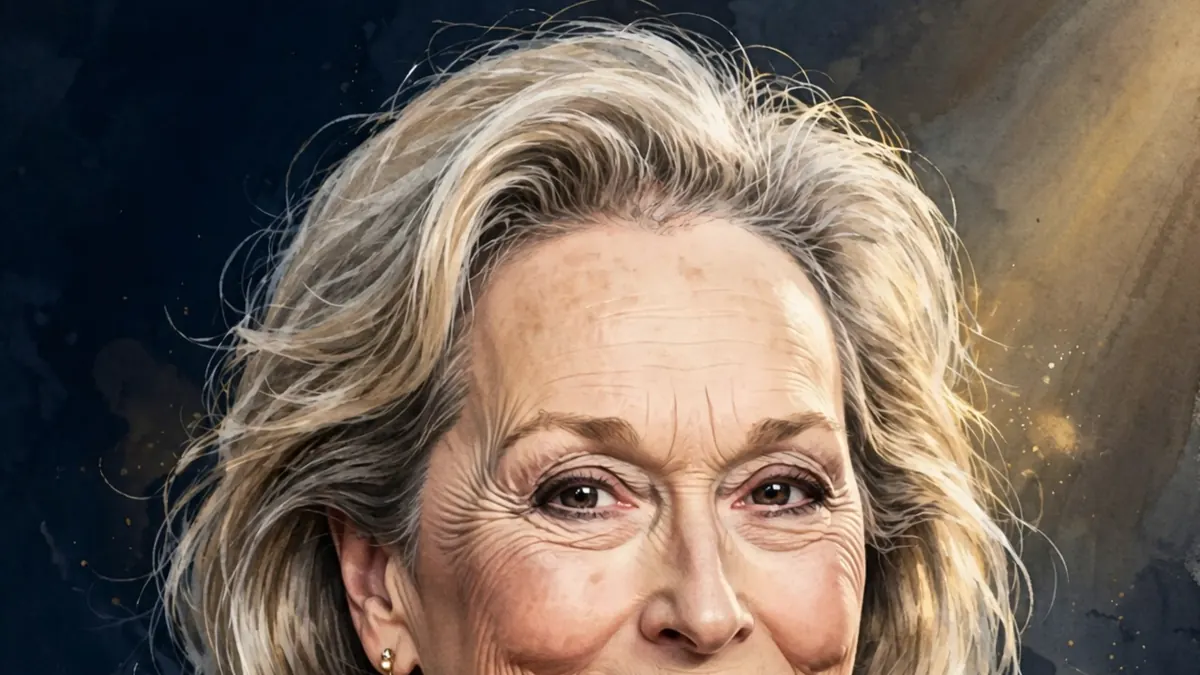
Meryl Streep is the most Oscar-nominated actor in history. Born Mary Louise Streep on June 22, 1949, in Summit, New Jersey, she has collected a record 21 Academy Award nominations and won three times, across a career that has now run for more than five decades. As of November 2026 she is 77 years old, still working at the top of the profession, and fresh from reprising Miranda Priestly in The Devil Wears Prada 2, released in May 2026.
Her net worth is estimated at $100 million, according to Celebrity Net Worth, whose page was updated on April 30, 2026. Parade puts the same $100 million figure on its 2026 profile, and Alux, updated in October 2026, agrees. A handful of smaller outlets publish higher numbers — up to $160 million — so the honest published range is $100 million to $160 million, anchored at $100 million by the two best-known estimators. This biography traces how a New Jersey schoolgirl who trained in opera became the benchmark every other screen actor is measured against, what she has actually been paid along the way, and what her life looks like away from the cameras. Last updated November 24, 2026.
Quick Facts
| Full Name | Mary Louise Streep |
|---|---|
| Date of Birth | June 22, 1949 (age 77 as of November 2026) |
| Birthplace | Summit, New Jersey, United States |
| Height | 5 ft 6 in (168 cm), as commonly listed |
| Estimated Net Worth | $100 million (Celebrity Net Worth, updated April 30, 2026; Parade, 2026); published range $100M–$160M |
| Primary Income Sources | Film salaries, television fees, stage work, residuals and back-end participation |
| Key Works | The Deer Hunter, Kramer vs. Kramer, Sophie’s Choice, Out of Africa, The Devil Wears Prada, Mamma Mia!, The Iron Lady, Only Murders in the Building |
| Awards | 3 Academy Awards (21 nominations), 8 Golden Globes, 3 Primetime Emmys, 2 BAFTAs, 2 SAG Awards |
| Spouse | Don Gummer (married September 30, 1978; separated since 2017) |
| Children | Four: Henry Wolfe, Mamie Gummer, Grace Gummer, Louisa Jacobson |
| Education | Vassar College (BA, drama, 1971); Yale School of Drama (MFA, 1975) |
Contents
- Early Life in New Jersey
- Vassar, Yale and the Long Apprenticeship
- Stage Beginnings in New York
- Film Breakthrough: The Deer Hunter and Kramer vs. Kramer
- Sophie’s Choice and the 1980s Peak
- The 1990s: Reinvention and Comedy
- The 2000s: Prada, Mamma Mia! and a Second Peak
- The Iron Lady and the 2010s
- Television and Only Murders in the Building
- The Devil Wears Prada 2 in 2026
- The Awards Record, in Numbers
- The Money: Net Worth, Salaries and Fees
- Real Estate and Assets
- Net Worth Over Time
- Personal Life: Don Gummer, John Cazale and Family
- Philanthropy and Public Voice
- Public Stances and the Weinstein Moment
- How Streep Compares With Her Peers
- Frequently Asked Questions
- Final Thoughts
- Sources and Reporting
Early Life in New Jersey
Mary Louise Streep was born on June 22, 1949, in Summit, New Jersey, the eldest of three children. Her father, Harry William Streep Jr., was a pharmaceutical executive. Her mother, Mary Wolf Wilkinson, was a commercial artist. The family lived in Basking Ridge and Bernardsville, New Jersey, comfortable, bookish households where the arts were taken seriously. Streep has two younger brothers, Harry William Streep III and Dana David Streep, both of whom acted at various points in their lives.
As a teenager Streep took opera lessons and sang seriously enough that a professional singing career was a real possibility for a while. She later told NPR that she did not love opera the way she loved other things — cheerleading, boys, and, later, smoking — and when her father fell ill and the family could no longer afford the lessons, she stopped and became a cheerleader. The voice training was not wasted. It gave her breath control, pitch and an ear for sound that would later feed the most famous skill in her acting kit: accents. Over her career she has played Polish, British, Australian, Danish, Italian and American characters, and the precision of the voices became part of her reputation.
At Bernards High School in Bernardsville she acted in school plays, cheered, and began to take the stage seriously. A school production gave her the first taste of what an audience feels like, and she has described the pull of performing from that point on as steady rather than sudden. There was no single moment of discovery. There was a bright, disciplined teenager who liked being watched while she worked, and who kept choosing the harder path — classical training, New York theatre — over the quicker one.
That steadiness matters to the story of her money as much as to the story of her art. Streep never had a single breakout payday that made her rich overnight. She built her fortune the slow way, over fifty years of top-of-the-market fees, and she kept working when most actors her age had stopped being offered leading roles. The New Jersey beginning explains the work ethic. The training explains the range. Both explain why, at 77, she is still first choice for the hardest parts in the business.
Vassar, Yale and the Long Apprenticeship
Streep studied drama at Vassar College and graduated cum laude with a bachelor’s degree in 1971. Vassar, one of the top liberal arts colleges in the United States, gave her a classical education and a stage to practise on, and she threw herself into productions while she was there. She then applied to the Yale School of Drama, the most selective acting programme in the country, and was accepted. She earned her Master of Fine Arts in 1975, working as a waitress and a typist to pay her way through, a detail she has mentioned in interviews and one that sits oddly beside the image of Hollywood royalty she later became.
Yale in the early 1970s was a hard school. The training was physical, vocal and relentless, and it produced actors who could handle Shakespeare, Chekhov and new American writing with the same ease. Streep arrived with a good ear and a strong voice and left with technique — the ability to build a character from the outside in, through posture, walk and accent, as well as from the inside out. Directors who worked with her in those years noticed the same thing audiences would notice for the next fifty years: she did the homework, and the homework showed.
The Yale years also gave her the people who would shape her early career. She worked in productions with actors who went on to long careers of their own, and she learned the New York theatre world from the inside, through the New York Shakespeare Festival and the Public Theater. By the time she left Yale she was not a star. She was something more useful: a trained actor with a reputation for reliability, range and hard work, ready for the stage roles that would make her name in New York before Hollywood ever called.
Stage Beginnings in New York
Streep made her stage debut in 1975 in Trelawny of the Wells at the Vivian Beaumont Theater, and spent the next two years working constantly in New York theatre. She appeared with the New York Shakespeare Festival, in productions at the Delacorte Theater in Central Park and at the Public Theater, and she built the kind of stage reputation that gets an actor noticed by film directors. It was on stage that Robert De Niro first saw her perform, and it was De Niro who pushed for her to be cast in The Deer Hunter. Her theatre work from this period is the part of her biography that fans of her films sometimes miss, and it is the foundation of everything that followed.

In 1976, during a production of Shakespeare’s Measure for Measure at the Delacorte, she met the actor John Cazale. He was fourteen years older, already respected for his work in The Godfather films and Dog Day Afternoon, and the two fell in love. They moved in together in New York. Within two years Cazale was diagnosed with terminal lung cancer, and Streep spent the last months of his life caring for him while still working. He died in March 1978. She was 28. Friends from that period have said the loss changed her permanently, and she herself has said that Cazale’s death forced her to confront her own mortality young, and to look at her work differently afterwards.
The stage years also taught her how to survive a profession that discards most of its people. Theatre pays little and demands everything, and Streep learned to be disciplined about money early: take the work, do it well, save what you can, and never assume the next job is coming. That discipline shows up again and again in her later career choices, in the low fees she accepted for films she believed in, and in the way she mixed big commercial jobs with small ones. She was never the actor who chased only the largest cheque. She chased the best part, and trusted that the cheques would follow.
Film Breakthrough: The Deer Hunter and Kramer vs. Kramer
Streep’s film debut came in Julia in 1977, a supporting role in Fred Zinnemann’s drama about Lillian Hellman and Julia. It was a small part, but it put her on screen with Jane Fonda and Vanessa Redgrave, and it showed film directors what the New York stage already knew. A year later came the role that changed everything. In Michael Cimino’s The Deer Hunter (1978) she played Linda, the girlfriend of De Niro’s character, in a film about Pennsylvania steelworkers sent to Vietnam. The film won five Academy Awards including Best Picture, and Streep earned her first Oscar nomination, for Best Supporting Actress.
De Niro had championed her casting after seeing her on stage, and the two of them would be linked ever after as actors of the same serious generation. Readers who want the other side of that partnership can read our profile of Robert De Niro’s biography, which covers his own long run from the same New York theatre world to the top of film. Streep’s own rise from that point was fast. In 1978 she also won a Primetime Emmy for the television miniseries Holocaust, playing a German woman married to a Jewish artist, a performance that brought her to a mass audience for the first time.
The following year she won her first Academy Award, Best Supporting Actress for Kramer vs. Kramer (1979), opposite Dustin Hoffman in the story of a custody battle. She was 30 years old, and she already had an Oscar, an Emmy and a reputation as the finest young actress in America. The speed of it is worth pausing on. Four years earlier she had been a Yale student working as a waitress. Now the industry’s biggest prize was hers, and the offers that followed were for leading roles, not supporting ones.
The money at this stage was modest by later standards. Young dramatic actresses in the late 1970s did not command the eight-figure fees that would come later, and Streep’s early pay was in line with a respected working actor, not a star. What mattered was the trajectory. Every film she made in those years added to her standing, and standing, in Hollywood, is what eventually converts into money. By the early 1980s she was the actress directors wrote parts for, and that is a position that pays.
Sophie’s Choice and the 1980s Peak
Sophie’s Choice (1982) is the performance most critics still name first when they talk about Streep. She played Sophie Zawistowski, a Polish survivor of Auschwitz living in Brooklyn, speaking English with a thick Polish accent and Polish and German in the flashback scenes. She won the Academy Award for Best Actress, her second Oscar in four years, and the role fixed her image as an actress who could do anything — any accent, any period, any emotional register — and make it look easy.
The 1980s that followed were a run of leading roles almost without a miss. Silkwood (1983), as the whistleblower Karen Silkwood, brought another Oscar nomination. Out of Africa (1985), opposite Robert Redford, was a box-office hit and won Best Picture. Ironweed (1987) and A Cry in the Dark (1988), in which she played Lindy Chamberlain with an Australian accent, brought two more nominations, and she won Best Actress at Cannes for A Cry in the Dark in 1988. By the end of the decade she had eight Oscar nominations and two wins, and she was 40 years old.
Off screen, these were also the years she built her family life. She married the sculptor Don Gummer on September 30, 1978, six months after Cazale’s death, and the couple bought a country estate in Salisbury, Connecticut, in 1985 for $1.8 million, according to Celebrity Net Worth. They lived there for years, raising their children away from Hollywood, and later bought a house in Brentwood, Los Angeles, in 1990 for a reported $3 million before moving back to Connecticut. The Salisbury house, by 2025 tax records cited by Celebrity Net Worth, carried an appraised value of about $6.5 million — a quiet illustration of how long-held property added to her wealth without any headlines.
The 1980s also set the pattern of her fees. She was now a leading lady who could open a serious film, and her pay rose into the millions per picture. She never published her contracts, and the exact numbers from this period are not public, but the direction of travel is clear from what came later: by the 2000s she was earning $5 million for a single film, and by the 2020s her reported fees were higher still. The 1980s were when the earning power was built, role by role, nomination by nomination.
The 1990s: Reinvention and Comedy
Hollywood has a habit of cooling on actresses once they pass 40, and the early 1990s tested Streep. The big dramatic leading roles thinned out, and she answered by doing something she had rarely been asked to do: comedy. Death Becomes Her (1992), opposite Goldie Hawn and Bruce Willis, was a dark, campy hit that showed she could be funny, vain and sly on screen. She has said she had a long-running friendly rivalry with Hawn over that film, and the two remained close. The film made money, and it reminded studios that Streep could sell tickets in a comedy as well as a drama.
The decade’s dramatic high point was The Bridges of Madison County (1995), Clint Eastwood’s adaptation of the bestselling novel, in which she played Francesca Johnson, an Italian war bride in Iowa. The film earned her another Oscar nomination and was a commercial success, proving that a quiet, adult romance led by a 46-year-old actress could still draw a crowd. Marvin’s Room (1996), with Diane Keaton, and Music of the Heart (1999), in which she played a violin teacher in Harlem and learned to play for the part, brought two more nominations. She ended the decade with 12 Oscar nominations in total, more than any other actor, and a reputation that no longer depended on youth at all.
The 1990s also included work that paid less and mattered more to her. She took smaller films, voice work and supporting roles when the part interested her, and she kept returning to the stage. That mix — a commercial hit, then a small film, then a play — became her signature career shape, and it is one reason her wealth grew steadily rather than in spikes. She was never dependent on a single franchise or a single studio, and she never stopped working long enough for the industry to forget her.
The 2000s: Prada, Mamma Mia! and a Second Peak
If the 1980s made Streep a great actress, the 2000s made her a commercial force. The decade opened with Adaptation (2002) and The Hours (2002), both Oscar-nominated performances, and the HBO miniseries Angels in America (2003), for which she won an Emmy. Then, in 2006, came the role that introduced her to a whole new generation: Miranda Priestly in The Devil Wears Prada.
Playing the ice-cold editor of Runway magazine opposite Anne Hathaway, Streep was paid a reported $5 million for the film, according to Celebrity Net Worth as cited by Parade. The film earned $326 million worldwide and turned Miranda Priestly into a cultural reference point — the boss everyone has worked for, or feared becoming. Streep earned a Golden Globe for the role and another Oscar nomination, her fourteenth. She has said she played Miranda as a woman under pressure rather than a villain, and that reading is what made the character last: audiences recognised the loneliness inside the power.
Two years later came the biggest box-office hit of her career. Mamma Mia! (2008), the ABBA musical in which she played Donna Sheridan, a single mother running a hotel on a Greek island, earned more than $600 million worldwide. It remains her highest-grossing film, and it proved something the industry had doubted: a musical led by a woman nearing 60 could out-earn most summer blockbusters. She followed it with Doubt (2008), as a stern nun opposite Philip Seymour Hoffman, and Julie & Julia (2009), playing Julia Child with joyful appetite, both of which brought Oscar nominations. By the end of the decade she had 16 nominations, and the second peak of her career was in full swing.
The fees followed the box office. Parade, summarising her peak earning years, reported that at one point Streep charged up to $20 million per film. That figure sits at the top end of her range and reflects the years when she was both a critical darling and a proven box-office draw — a combination very few actors ever hold at once. She also began to take producing and narration work, and her voice, trained in opera as a teenager, became a steady source of income in documentaries and audiobooks.
The Iron Lady and the 2010s
Streep’s third Academy Award came for The Iron Lady (2011), in which she played Margaret Thatcher, the former British prime minister. Parade reports she was paid $1 million for the role and donated the fee to help fund the National Women’s History Museum — a small, telling detail about how she thought about money and about the parts she chose. The performance itself was widely praised for its accuracy: viewers reported forgetting they were watching an actress, and the win made her the most Oscar-nominated actor in history by an even wider margin.
The 2010s kept her in leading roles that younger actresses would have envied. August: Osage County (2013), Into the Woods (2014), Florence Foster Jenkins (2016), in which she played the famously tone-deaf society singer, and The Post (2017), Steven Spielberg’s film about the Pentagon Papers, in which she played Washington Post publisher Katharine Graham opposite Tom Hanks as editor Ben Bradlee. The Post pairing is worth noting for readers who follow Hanks as well: our profile of Tom Hanks at his current age covers his own long career, including that same film. Streep earned Oscar nominations for August: Osage County, Into the Woods and Florence Foster Jenkins, taking her total to 19 by the end of the decade, then to 21 with nominations for The Post and Little Women (2019).
She also moved into streaming film. The Laundromat (2019) and Let Them All Talk (2020), Steven Soderbergh’s film shot largely on the Queen Mary 2, kept her visible on the platforms, and Parade reports she was paid $5 million for Let Them All Talk. In Don’t Look Up (2021), Adam McKay’s Netflix satire, she played a cynical American president; Variety later noted that the film’s back-end buyout model made it one of her largest paydays, bigger even than the reported $12.5 million upfront fee she later received for The Devil Wears Prada 2. The streaming era suited her: the platforms wanted prestige, and she was prestige.
Television and Only Murders in the Building
Television has been part of Streep’s career from the start — her Emmy for Holocaust in 1978 was one of her earliest prizes — but the 2010s and 2020s made it a second home. She joined Big Little Lies for its second season in 2019 as Mary Louise Wright, the grieving mother of Perry Wright, and stole every scene she was in. The role earned her another Emmy nomination and showed a new generation of television viewers what film audiences had known for decades.
In 2023 she joined Only Murders in the Building, Hulu’s hit comedy-mystery, as Loretta Durkin, a struggling actress with a past, opposite Steve Martin and Martin Short. The part was a gift: a comic, tender, slightly absurd character who got to sing, to fall in love, and to be the centre of a murder mystery. She stayed with the show for later seasons, and the role brought her an Emmy nomination and a new audience of younger viewers who knew her first as Loretta and only later discovered Sophie and Miranda. It also put her back on a weekly television schedule in her mid-70s, a workload most actors half her age would find demanding.
She also appeared in the Apple TV+ series Extrapolations (2023) and continued to narrate documentaries. Television fees for an actor of her standing are substantial, and the streaming platforms pay for prestige names; while her exact per-episode fees are not public, the steady television work of these years is one of the reasons her net worth has held at the $100 million level rather than drifting down after her film fees peaked.
The Devil Wears Prada 2 in 2026
The biggest entertainment story of Streep’s 2026 was the return of Miranda Priestly. The Devil Wears Prada 2, directed by David Frankel and written by Aline Brosh McKenna, the same team as the original, premiered in New York on April 20, 2026, and was released in the United States on May 1, 2026. Streep, Anne Hathaway, Emily Blunt and Stanley Tucci all returned, joined by Kenneth Branagh, Lucy Liu and Justin Theroux. The story picks up twenty years later, with Andy Sachs helping Miranda navigate a media business that has changed around Runway magazine.
The money behind the return was reported in detail. According to a May 2026 report by Variety, cited by Celebrity Net Worth and ComingSoon, Streep negotiated a base salary of $12.5 million to reprise the role, with box-office bonuses that could take her total past $20 million if the film kept filling seats. Hathaway and Blunt received the same $12.5 million under a reported “favoured nations” arrangement. The film was a commercial success: it opened to an estimated $233.6 million worldwide, according to Disney figures reported at the time, and box-office trackers put its worldwide gross at $693.5 million against a $100 million production budget, making it one of the highest-grossing films of 2026 and Streep’s biggest opening weekend ever.
The sequel matters to her biography for two reasons. First, it shows that at 77 she can still anchor a major studio release and open it at the top of the box office. Second, it added one of the largest single paydays of her career, late in a career that has already lasted fifty years. Most actors never get a sequel to their most famous role two decades later. Streep got one, and it paid her like a star half her age.
The Awards Record, in Numbers
No biography of Meryl Streep is complete without the numbers, because the numbers are the story. She holds the record for the most Academy Award nominations received by any actor: 21, with three wins. The wins came for Kramer vs. Kramer (1979, Best Supporting Actress), Sophie’s Choice (1982, Best Actress) and The Iron Lady (2011, Best Actress). The nominations span from 1978 (The Deer Hunter) to 2019 (Little Women), a stretch of 41 years. For comparison, Katharine Hepburn and Jack Nicholson, tied for second place, each received 12 nominations.

The rest of her honours fill a room. She has won 8 Golden Globe Awards from more than 30 nominations, 3 Primetime Emmy Awards, 2 BAFTA Awards and 2 Screen Actors Guild Awards. She has received the AFI Life Achievement Award (2004), the Kennedy Center Honors (2011), the Presidential Medal of Freedom (2014), the Golden Globe Cecil B. DeMille Award (2017) and an Honorary Palme d’Or at Cannes (2024), and she won Best Actress at Cannes in 1988 for A Cry in the Dark. She has also been honoured by the film academies of several countries, and her name is now used as shorthand for acting itself: to call a performance “Streep-like” is to pay it the highest compliment the profession has.
| Award | Wins / Nominations |
|---|---|
| Academy Awards | 3 wins from 21 nominations (record) |
| Golden Globes | 8 wins from 30+ nominations |
| Primetime Emmys | 3 wins |
| BAFTAs | 2 wins |
| SAG Awards | 2 wins |
| Cannes | Best Actress, 1988 (A Cry in the Dark); Honorary Palme d’Or, 2024 |
| National honours | AFI Life Achievement (2004); Kennedy Center Honors (2011); Presidential Medal of Freedom (2014) |
The Money: Net Worth, Salaries and Fees
Celebrity Net Worth puts Meryl Streep’s net worth at $100 million, on a page updated on April 30, 2026. Parade’s 2026 profile agrees at $100 million, and Alux, updated in October 2026, also lands on $100 million. That three-way agreement is the anchor for this article’s headline figure. A few smaller outlets go higher: Infocelebs and Celebrity High Earners publish $160 million, and one site, GlobeSpaceNews, claims $250 million while attributing it to Celebrity Net Worth — an attribution that does not match Celebrity Net Worth’s own published page. The honest published range is therefore $100 million to $160 million, anchored at $100 million. No major outlet publishes an audited balance sheet for her, and Forbes and Bloomberg, who cover billionaires, do not publish a Streep figure, so every number here is an outside estimate, not an official statement of her finances.
What is documented is how the money was made. Streep’s income has always come from acting fees first, and the reported fees trace a clear curve. Early in her career the pay was modest. By 2006 she was earning $5 million for The Devil Wears Prada, according to Celebrity Net Worth. She took $1 million for The Iron Lady in 2011 and gave it away. She earned a reported $5 million for Let Them All Talk in 2020. At her peak, Parade reports, she charged up to $20 million per film. And in 2026 she received a reported $12.5 million upfront for The Devil Wears Prada 2, with bonuses that could carry it past $20 million. Variety has noted that her Don’t Look Up deal, through a back-end buyout, may have paid her more than the Prada sequel did.
| Income Source | What Is Reported |
|---|---|
| Film salaries | The main source across five decades; reported fees from $1M (The Iron Lady, donated) to $12.5M upfront (Prada 2), with peak per-film fees up to $20M (Parade) |
| Television fees | Holocaust, Angels in America, Big Little Lies, Only Murders in the Building; exact fees not public, but prestige TV pays top rates |
| Back-end and bonuses | Box-office bonuses on Prada 2; back-end buyout on Don’t Look Up (Variety) |
| Stage work | Broadway and Public Theater roles across her career; modest fees, high prestige |
| Voice and narration | Documentary narration and audiobooks; steady work across decades |
| Residuals | Ongoing payments from a catalogue of more than 70 films and many television appearances |
| Real estate | Long-held property in Connecticut and New York; Salisbury estate bought for $1.8M in 1985, appraised near $6.5M in 2025 (Celebrity Net Worth) |
Two things keep the estimate at $100 million rather than higher. First, Streep has never built a business empire, a beauty brand or a production company on the scale of some of her contemporaries; her wealth is acting money, saved and invested over fifty years, not a company sale. Second, she has given a great deal away. She and Gummer are active philanthropists, and she has donated fees, funded arts education and supported the institutions that trained her. A fortune built on salaries, taxed over five decades, with generous giving along the way, lands at $100 million — an enormous sum, and a smaller one than the wilder estimates suggest. The $160 million figures published by smaller outlets appear to count gross career earnings or speculative property values without subtracting tax, fees and giving, and we do not adopt them.
How we estimated: the headline figure is Celebrity Net Worth’s $100 million estimate (updated April 30, 2026), cross-checked against Parade ($100 million, 2026) and Alux ($100 million, October 2026). Higher published figures ($160 million) are noted as the top of the range and not adopted as the anchor. Salary figures are each attributed to the outlet that reported them. No private financial records exist in public, so the total is an estimate and will differ from her private reality.
Real Estate and Assets
Streep and Gummer built a property portfolio quietly, over decades, and the pieces that are public tell a consistent story of long-term holding rather than flipping. The centrepiece is the country estate in Salisbury, Connecticut, bought in 1985 for $1.8 million. The couple raised their four children there, and Celebrity Net Worth reports that 2025 tax records listed the property with an appraised value of about $6.5 million. That is a gain of roughly $4.7 million over forty years on a single family home — the kind of slow, unglamorous wealth-building that matches everything else about her finances.
In 1990 the couple bought a house in Brentwood, Los Angeles, for a reported $3 million, and later moved back to Connecticut. They have also held property in New York City, including a Tribeca penthouse whose sale was reported at $15.8 million — a gross transaction figure shared with Gummer, not a personal profit, and not current equity. The pattern is the same throughout: buy well, hold for years, live in the house rather than trade it. There are no reports of the cars, yachts or trophy purchases that fill other celebrity wealth stories, and that absence is itself informative. Streep’s public life has never been built around display.
What else does she own? Beyond property, her assets are the usual ones for a working actor of her standing: residuals from a catalogue of more than 70 films, pension and union benefits from decades of Screen Actors Guild work, and investments that are not public. She has no reported business ventures, no brand deals of the kind that make headlines, and no endorsement portfolio. That is a choice, and it is part of why her net worth, while large, is smaller than that of stars who turned fame into companies. She sold performances, not products.
Net Worth Over Time
Streep’s wealth grew in steps that follow her career, not in jumps. The table below is an honest reconstruction from the reported fees and the published estimates, not a claim of audited figures. The early years are approximate because nobody published net worth estimates for working stage and film actors in the 1970s. The shape of the curve, though, is well supported: slow growth through the 1980s, a steep rise in the 2000s as her fees and box office peaked, and a plateau in the 2010s and 2020s as she kept earning at the top of the market while giving and spending at a normal rate for her position.
| Period | Career Position / Reported Basis |
|---|---|
| Late 1970s | Stage actor moving into film; first Oscar nomination (1978) and first win (1979); modest fees |
| 1980s | Leading lady; two Oscars by 1982; fees rising into the millions per film; Salisbury estate bought 1985 |
| 1990s | Reinvention through comedy and adult drama; steady high fees; 12 Oscar nominations by 1999 |
| 2000s | Second commercial peak; $5M for Prada (2006); Mamma Mia! over $600M worldwide (2008); peak fees up to $20M per film (Parade) |
| 2010s | Third Oscar (2011); prestige TV and streaming; net worth estimates settle near $100M |
| 2020s | Don’t Look Up back-end deal; Only Murders in the Building from 2023; Prada 2 $12.5M upfront (2026) |
| November 2026 | Estimated $100M (Celebrity Net Worth, April 2026; Parade, 2026; Alux, October 2026); published range $100M–$160M |
Personal Life: Don Gummer, John Cazale and Family
Streep’s personal life has been unusually private for a star of her size, and the facts that are public are mostly the ones she or her family chose to share. She met the sculptor Don Gummer in 1978, introduced by her brother Harry after Cazale’s death, and married him on September 30, 1978, six months after Cazale died. The marriage lasted 45 years in public view. In October 2023 a spokesperson confirmed to Page Six, as reported by People, that the two had in fact been separated for more than six years — since 2017 — while remaining married and caring for each other. They were last seen together publicly at the 2018 Academy Awards. Readers interested in Gummer’s own career and fortune can read our profile of Don Gummer’s net worth, which covers his sculpture career and the property the couple built together.
The couple have four children: Henry Wolfe Gummer, born in 1979, a musician who performs as Henry Wolfe; Mamie Gummer, born in 1983, an actress; Grace Gummer, born in 1986, an actress married to the record producer Mark Ronson; and Louisa Jacobson Gummer, born in 1991, an actress known for her starring role in HBO’s The Gilded Age. They also have five grandchildren. The children were raised largely in Salisbury, Connecticut, away from Hollywood, and Streep has spoken about the effort she and Gummer made to give them an ordinary childhood — school, chores, and a house full of books and music rather than premieres.
Cazale’s death remains the defining loss of her young life. She was 28 when he died of lung cancer in March 1978, and she has said the experience forced her to face her own mortality early and changed how she looked at her work. She rarely speaks about him in detail, and when she does it is with a restraint that has kept the story from becoming tabloid material. The marriage to Gummer that followed six months later surprised people who knew her, and she has never offered a public explanation for its timing beyond the fact of it. The family she built with Gummer — four children, five grandchildren, a home in Connecticut — is the private centre of a very public life.
She is also the godmother of Billie Lourd, daughter of her close friend Carrie Fisher, and she has kept close friendships across the industry for decades, including with the cast of The Devil Wears Prada, with whom she reunited in 2026. Her height is commonly listed as 5 ft 6 in (168 cm). She has lived most of her adult life between Connecticut and New York, and she has kept her home life out of the press to a degree that is rare among actors of her fame.
Philanthropy and Public Voice
Streep and Gummer have given steadily to arts organisations and education throughout their marriage, including to Vassar College, the Opus School in Harlem and the Silver Mountain Arts Foundation, which Gummer founded. She donated her $1 million fee for The Iron Lady to help fund the National Women’s History Museum, and she has supported the National Women’s History Museum and women’s education causes for years. She has also funded scholarships and supported the theatre companies that gave her a start, including the Public Theater and the New York Shakespeare Festival.
Her public voice has been most visible in speeches. At the 2017 Golden Globes, accepting the Cecil B. DeMille Award, she gave a speech criticising the incoming president without naming him, defending the press and immigrants and the arts, and closing with a tribute to her friend Carrie Fisher, who had died days earlier: “Take your broken heart, make it into art.” The speech was widely shared and widely argued over, and it set the tone for her public presence in the years since: she speaks rarely, but when she does, people listen.
She has also used her standing to speak for women in the industry, for pay equality and for older actresses, arguing that the best roles should not end at 40. Her own career is the argument: she has played leading roles in every decade of her adult life, and she is still doing it at 77. For more life stories from the same shelf of screen legends, our biography archive collects the profiles we have published so far.
Public Stances and the Weinstein Moment
No honest biography of Streep can skip the autumn of 2017. When the reporting about Harvey Weinstein’s conduct appeared, Streep condemned him publicly, saying the news was disgraceful and that she had not known about his behaviour. She had worked with Weinstein on several films, including The Iron Lady and August: Osage County, and she had praised him in award speeches in earlier years, as many actors had. The actress Rose McGowan, one of Weinstein’s accusers, criticised Streep publicly, arguing that she must have known. Streep responded that she did not know, and that she had never been told of assaults, while making clear she stood with the women who came forward.
The exchange was painful and public, and it is worth recording plainly because it shows the limits of what even the most powerful actress in the business knew about the system she worked in. Streep has since supported the Time’s Up movement and spoken about the need for structural change in the industry rather than individual blame. She has not made the episode a centrepiece of her public life, and this article does not present it as one. It is part of the record of a 77-year-old woman who has spent fifty years inside Hollywood and has watched it change, slowly, around her.
She has also spoken about the politics of her craft in a quieter way, through her choices: playing Katharine Graham in The Post, a publisher who risked her company to print the truth; playing a president in Don’t Look Up who ignored science; playing a nun in Doubt who may or may not be right. The roles are the argument. The speeches are the footnote.
How Streep Compares With Her Peers
Streep’s position becomes clearest when she is set beside the actors she is usually compared with. Katharine Hepburn, the previous record holder for acting Oscars, won four from 12 nominations — more wins, far fewer nominations, and a career that ended in the 1990s. Jack Nicholson also received 12 nominations, with three wins, matching Streep’s win total but with nine fewer nominations. Daniel Day-Lewis, the only actor with three Best Actor wins, has six nominations in total. No one else in film history has combined Streep’s volume of nominations with her volume of wins across five decades.
| Actor | Oscar Nominations | Oscar Wins |
|---|---|---|
| Meryl Streep | 21 (record) | 3 |
| Katharine Hepburn | 12 | 4 |
| Jack Nicholson | 12 | 3 |
| Daniel Day-Lewis | 6 | 3 |
| Robert De Niro | 9 | 2 |
The comparison also holds on money, though the numbers cut differently. Streep’s $100 million estimate is large, and it is smaller than the fortunes of stars who built companies or franchises — a reminder that her wealth comes from acting itself, not from turning fame into a business. That is, in the end, the point of her biography: she is the richest actress in the history of the profession in the only currency that matters to the profession, which is the work. The money followed the work. It never led it.
Frequently Asked Questions
How old is Meryl Streep in 2026?
Meryl Streep is 77 years old as of November 2026. She was born Mary Louise Streep on June 22, 1949, in Summit, New Jersey, so she turned 77 in June 2026.
What is Meryl Streep’s net worth in 2026?
Meryl Streep’s net worth is estimated at $100 million, according to Celebrity Net Worth (updated April 30, 2026), with Parade and Alux publishing the same $100 million figure in 2026. A few smaller outlets go as high as $160 million, so the honest published range is $100 million to $160 million, anchored at $100 million. It is an outside estimate, not an audited balance sheet.
How many Oscars has Meryl Streep won?
Meryl Streep has won three Academy Awards from a record 21 nominations. The wins were for Kramer vs. Kramer (1979, Best Supporting Actress), Sophie’s Choice (1982, Best Actress) and The Iron Lady (2011, Best Actress). Her nominations span from 1978 to 2019, a stretch of 41 years.
Who is Meryl Streep married to?
Meryl Streep married the sculptor Don Gummer on September 30, 1978, six months after the death of her partner, actor John Cazale. In October 2023 it was confirmed that Streep and Gummer had been separated since 2017, while remaining married and caring for each other. They have four children together.
How many children does Meryl Streep have?
Meryl Streep has four children with Don Gummer: Henry Wolfe (born 1979), a musician; Mamie Gummer (born 1983), an actress; Grace Gummer (born 1986), an actress; and Louisa Jacobson (born 1991), an actress known for HBO’s The Gilded Age. She also has five grandchildren.
What was Meryl Streep’s first movie?
Meryl Streep’s film debut was Julia in 1977, a supporting role opposite Jane Fonda and Vanessa Redgrave. Her breakthrough came a year later with The Deer Hunter (1978), which earned her first Academy Award nomination, followed by her first Oscar win for Kramer vs. Kramer in 1979.
Did Meryl Streep return for The Devil Wears Prada 2?
Yes. Meryl Streep returned as Miranda Priestly in The Devil Wears Prada 2, which premiered in New York on April 20, 2026, and was released in the United States on May 1, 2026. Variety reported she was paid a $12.5 million upfront salary, with box-office bonuses that could take her total past $20 million.
What is Meryl Streep’s most famous role?
Her most famous role is widely considered to be Miranda Priestly in The Devil Wears Prada (2006), the ice-cold fashion editor who became a cultural reference point. Her most acclaimed performance is usually named as Sophie Zawistowski in Sophie’s Choice (1982), which won her the Best Actress Oscar, while Mamma Mia! (2008) remains her highest-grossing film.
Final Thoughts
Meryl Streep’s biography is, in the end, a story about staying power. She arrived in New York as a Yale-trained stage actress, lost the love of her young life, married a sculptor, raised four children in Connecticut, and went on to collect more Oscar nominations than any actor who ever lived — 21 of them, across 41 years, with three wins. She earned an estimated $100 million doing it, not by building a brand or a franchise, but by being the best at the job, year after year, in every genre the business offered her.
At 77, with The Devil Wears Prada 2 behind her as one of the biggest hits of 2026 and Only Murders in the Building still running, she shows no sign of stopping. The record she holds will probably never be broken. The standard she set — that a woman could lead films at 30 and at 70, in drama and in comedy, on stage and on screen — is the part of her story that will outlast the numbers. That is the bottom line: the most nominated actor in history got there by doing the work, and the work is still going on.
Sources and Reporting
This biography was researched from live reporting and reference sources in November 2026. Named sources are hyperlinked to their homepages below; figures are attributed to the outlet that published them, and ranges are given where sources disagree.
- Celebrity Net Worth — Meryl Streep net worth estimate ($100 million, page updated April 30, 2026); reported salaries including $5 million for The Devil Wears Prada, $12.5 million for The Devil Wears Prada 2 per Variety, and the Salisbury estate purchase and appraisal.
- Parade — Meryl Streep net worth in 2026 ($100 million); reported fees including $5 million for Let Them All Talk, $1 million for The Iron Lady donated to the National Women’s History Museum, and peak per-film fees up to $20 million.
- Alux — Meryl Streep net worth estimated at $100 million as of October 2026; career honours summary.
- Variety — May 2026 reporting on the $12.5 million Prada 2 salary and the Don’t Look Up back-end deal, as cited by Celebrity Net Worth, ComingSoon and FandomWire.
- People — October 2023 reporting that Streep and Don Gummer had been separated for more than six years, since 2017.
- Wikipedia — biographical reference for birth, education, family, the Prada 2 release dates (April 20 and May 1, 2026) and worldwide gross, and the awards record; cross-checked against the named outlets above.
- Academy of Motion Picture Arts and Sciences — the Oscars record: 21 nominations and 3 wins, the most nominations of any actor.
How we estimated: the headline net worth figure is Celebrity Net Worth’s $100 million estimate (updated April 30, 2026), cross-checked against Parade ($100 million, 2026) and Alux ($100 million, October 2026). Higher published figures (up to $160 million) are noted as the top of the range and not adopted as the anchor. Salary figures are each attributed to the outlet that reported them. No private financial records exist in public, so the total is an estimate and will differ from her private reality. Figures, dates and credits were checked against live sources in November 2026; where a detail could not be verified it was left out. By Celebamerica Editorial Staff.