Last updated: November 5, 2026 · By Celebamerica Editorial Staff
Sebastian Vettel’s net worth in 2026 is estimated at $140 million. That is the figure published by Celebrity Net Worth, whose page on the four-time Formula 1 world champion was last updated in October 2024 and still carries a $140 million valuation in its structured data. PlayersBio, RacingNews365 and SurpriseSports all land on the same number in their 2026 updates, which makes $140 million the anchor for this profile — even though a few outlets stretch the range higher, to $150–$160 million, and one June 2025 ranking lists him at $180 million.
Vettel stopped racing at the end of 2022, so this is a fortune built entirely in the past: fifteen seasons of Formula 1 salary, win bonuses and a small set of endorsement deals, plus the investments and property he has kept since. His peak years at Ferrari paid him around $40 million a season, with RacingNews365 putting his top seasons at $50 million a year, and the salary-tracking site SalarySport totals his career F1 salary at $338.8 million. The gap between that career-earnings total and a $140 million net worth is the normal story of taxes, team costs, a quiet lifestyle and money that stays private — Vettel has never published his accounts, and no outlet has seen them, so every number here is an estimate drawn from named sources, not a bank statement.
This profile traces how the boy from Heppenheim who started karting at eight became the youngest world champion in Formula 1 history, what each team paid him along the way, what he owns now, and what his life looks like four years after he walked away from the sport.
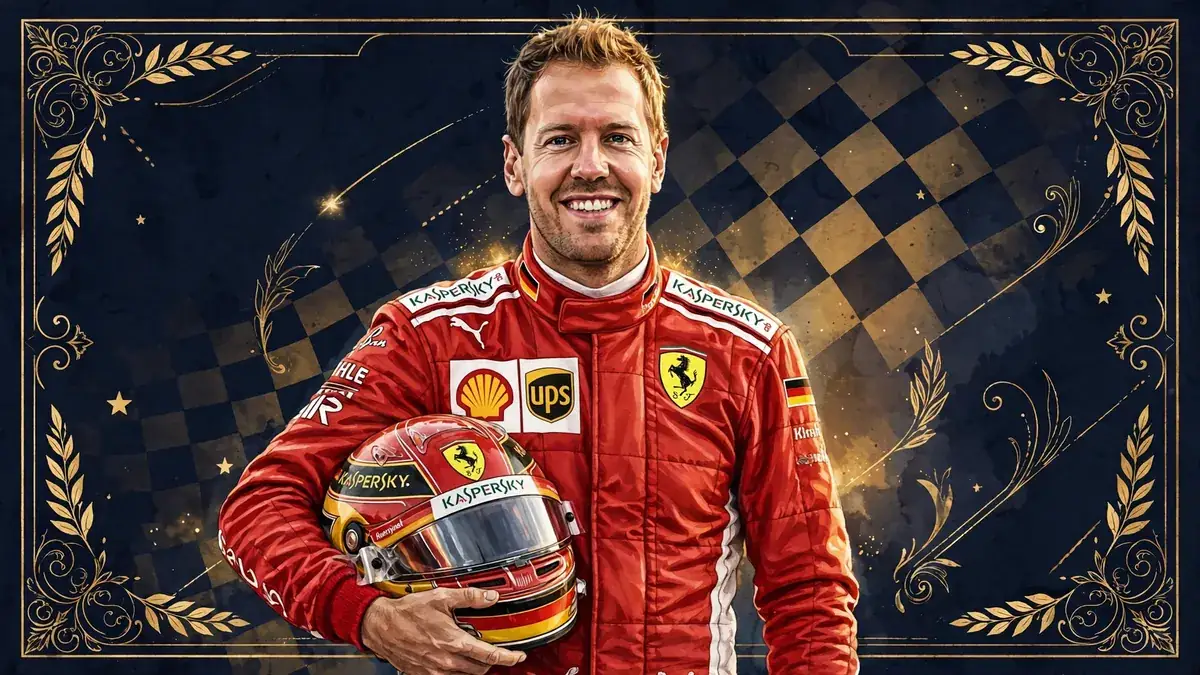
| Full Name | Sebastian Vettel |
|---|---|
| Date of Birth | 3 July 1987 |
| Birthplace | Heppenheim, West Germany |
| Age (2026) | 39 |
| Height | 1.75 m (5 ft 9 in) |
| Estimated Net Worth (2026) | $140 million (range across credible outlets: $140–$160 million) |
| Peak Annual Salary | Around $40–$50 million per year at Ferrari (2018–2020), per RacingNews365 |
| Career F1 Salary Total | $338.8 million, per SalarySport’s season-by-season tally |
| Primary Income Sources | Formula 1 salaries and win bonuses (Red Bull, Ferrari, Aston Martin), endorsements |
| Key Ventures | Co-owner, Germany SailGP Team (since May 2023); F1REST rainforest project; family farm in Switzerland |
| Wife | Hanna Prater (married early 2019) |
| Children | Three |
| Career Record | 4 world titles (2010–2013), 53 Grand Prix wins, 57 pole positions, 122 podiums, 299 starts |
Contents
- Early Life and Background in Heppenheim
- Karting and the Junior Formula Climb
- Formula 1 Debut and the First Win at Monza
- The Red Bull Dynasty: Four Straight Titles
- The Ferrari Years and the Peak Paydays
- Aston Martin and Retirement
- Net Worth Breakdown: Where the Money Came From
- Endorsements and Business Ventures
- Cars, Property and the Ferrari Collection Sale
- Net Worth Growth Timeline
- Personal Life: Hanna Prater and Family
- Life After Racing: 2023 to 2026
- Setbacks and Flashpoints on Track
- Frequently Asked Questions
- Final Thoughts
- Sources and Reporting
Early Life and Background in Heppenheim
Sebastian Vettel was born on 3 July 1987 in Heppenheim, a small town in Hesse, West Germany, to Norbert and Heike Vettel. His father worked as a carpenter, and the family home was an ordinary one — no racing money, no family team, no shortcut into motorsport. Vettel grew up with three siblings: two older sisters, Melanie and Stefanie, and a younger brother, Fabian. Melanie went on to work in equestrian sport, Stefanie became a physiotherapist for disabled children, and Fabian later tried his own hand at racing.
The detail that runs through every account of Vettel’s childhood is how early the obsession started. He was three years old when he began watching Formula 1 on television, and his hero was Michael Schumacher — the German driver who was then building the career that would make him the sport’s most successful champion. Vettel has spoken often about copying Schumacher’s mannerisms as a boy, and the parallel would later become one of the running threads of his own career: like Schumacher, he would leave a title-winning team to try to restore Ferrari, and like Schumacher, he would find that the second act did not match the first.
Heppenheim sits in the Bergstrasse region, about halfway between Frankfurt and Heidelberg, and it was there, on local kart tracks, that Vettel’s talent first showed itself. His parents supported the hobby without being able to fund a lavish version of it, which is a pattern familiar from many drivers’ stories: the early years ran on family sacrifice, borrowed equipment and results that kept attracting sponsors. What set Vettel apart was how quickly the results came, and how consistently they kept coming as the karts gave way to single-seaters.
School was never the centre of his life, though he finished his education alongside his racing. He speaks German, English, French and Italian — the last of those picked up during his six seasons at Ferrari, where he made a point of addressing the team in their own language. That habit, of learning the language of the people around him, says something about how he operated inside teams: he was known as a driver who worked the garage hard, who knew his engineers by name, and who treated the mechanics as part of the performance rather than background staff.
Karting and the Junior Formula Climb
Vettel started competitive karting at eight years old. Within a few seasons he was winning German junior karting titles, and by 2001 he had caught the eye of Red Bull, which signed him to its junior driver programme when he was still a child. Red Bull’s backing changed everything: it paid for the step up the ladder, and it tied his future to a team that was, at the time, still building its way toward Formula 1.
The step into cars came in 2003, in Formula BMW ADAC. Vettel won the championship in 2004 with 18 victories from 20 races — a season of near-total dominance that made his name inside the sport. From there he moved to the Formula 3 Euro Series in 2005, finishing fifth in his first year and runner-up in 2006, behind Paul di Resta. He also made his first appearance in a Formula 1 car as a test driver for BMW Sauber in 2006, and he drove Friday practice sessions for the team that year, at 19 years old.
What is easy to miss in the list of junior results is how fast the whole climb was: karting at eight, Formula BMW champion at 17, Formula 3 runner-up at 19, Formula 1 test driver the same year, and a race seat before he turned 20. There was no wasted season and no year spent waiting for a drive. Red Bull had a plan for him, and he kept hitting every mark in it.
The junior years also built the reputation that followed him into Formula 1: a driver who was quick over one lap, careful with tyres, and unusually good at reading a race. His qualifying record would later become one of his calling cards — 57 pole positions, the fourth-highest total in the sport’s history — and the roots of it were visible long before he reached the top.
Formula 1 Debut and the First Win at Monza
Vettel’s Formula 1 debut came at the 2007 United States Grand Prix, and it arrived by accident. BMW Sauber’s regular driver, Robert Kubica, had suffered a heavy crash in Canada the race before, and Vettel was called up as his replacement at Indianapolis. He finished eighth, scored a point on his debut, and at 19 years and 349 days became the youngest driver to score a World Championship point at that time. It was the kind of debut that makes teams pay attention.
Later that season Toro Rosso — Red Bull’s second team — signed him to replace Scott Speed from the Hungarian Grand Prix onward. The car was a midfield machine at best, and Vettel’s first races in it were about learning rather than winning. But at the 2007 Chinese Grand Prix he finished fourth in wet conditions, a result that hinted at what was coming.
The breakthrough arrived on 14 September 2008, at the Italian Grand Prix at Monza. In rain that turned qualifying into a lottery, Vettel put the Toro Rosso on pole position — the youngest pole-sitter in the sport’s history — and then led the race from lights to flag to win it. He was 21 years and 73 days old, the youngest Grand Prix winner the sport had seen, and he had done it in a car that had no business winning a race. Toro Rosso had never won before, and the victory remains one of the great underdog results in Formula 1 history.
That win did two things. It proved Vettel could win without the best car, and it made his promotion to Red Bull Racing — the senior team — inevitable. He moved up for 2009, and the next five seasons would define both his career and his fortune.
The Red Bull Dynasty: Four Straight Titles
Vettel joined Red Bull Racing for the 2009 season, alongside Mark Webber, and the team was ready. Designer Adrian Newey had built a car that could fight for wins, and Vettel won four races that year, finishing runner-up in the championship to Jenson Button’s Brawn. It was a strong first season at the front — and it was only the warm-up.
In 2010, Vettel won the title in the final race at Abu Dhabi, overtaking Fernando Alonso in the standings on the last day of the season. At 23 years and 134 days, he became the youngest world champion in Formula 1 history, taking a record that had belonged to Lewis Hamilton. The margin was four points. The season had swung back and forth all year, and Vettel won it by being the fastest driver when it mattered most.
What followed was a run of dominance that only a handful of drivers have ever matched. Vettel won the championship again in 2011 with 11 wins from 19 races, then in 2012 after a season-long fight with Alonso that again went to the final race, and then in 2013 with one of the great seasons in the sport’s history: 13 wins, including nine in a row to end the year — a record for consecutive victories that still stands. Across those four title seasons he collected 34 of his 53 career wins.
The money followed the results. SalarySport’s season-by-season tally puts his Red Bull pay in a band of roughly $8 million to $25 million a year, rising with each title, and RacingNews365 notes that his annual earnings at Red Bull reached about £13 million a season toward the end of his time there. He was not yet the highest-paid driver on the grid — that would come at Ferrari — but four titles made him one of the most marketable names in the sport, and his pay reflected it.
His Red Bull years also built the numbers that anchor his place in history. By the time he left the team at the end of 2014, he had 38 wins, 44 pole positions and four titles with them. Only Hamilton, Schumacher and — later — Max Verstappen have won more races. The 2014 season, the first of the hybrid era, was the one that broke the spell: the Red Bull was no longer the fastest car, Vettel was beaten by his new team-mate Daniel Ricciardo, and he finished fifth in the championship without a win. It was the first winless season of his career, and it pushed him toward the decision that would shape the second half of his working life.
The Ferrari Years and the Peak Paydays
At the end of 2014, Vettel signed for Ferrari, the team his childhood hero had carried to five straight titles. The deal, reported by RacingNews365 and others, paid him about $30 million a year at first, rising to around $40 million a year in salary and endorsements, with his final seasons at the team reported at $50 million a year. Forbes put his 2020 earnings — his last year at Ferrari — at $36.3 million, and PlayersBio notes that a three-year Ferrari contract signed in 2018 was worth $42 million a year, with bonuses on top. Whatever the exact figure in any single season, Ferrari was where Vettel became one of the best-paid athletes in the world: Forbes ranked him 18th on its list of the world’s 100 highest-paid athletes during his peak Ferrari years.
On track, the Ferrari years started well. He won three races in 2015, his first season, and finished third in the championship. In 2017 and 2018 he fought Hamilton for the title, leading the standings for long stretches of both seasons before Ferrari’s challenge faded in the second half of each year. He finished runner-up in both seasons — his best championship results at Ferrari — and added 14 wins in red across six seasons. The fifth title he had gone to Maranello to win never came.
The money, though, kept arriving. Six seasons at Ferrari at roughly $40 million a year in salary and endorsements works out at about £198 million before tax and costs, according to Sporf’s 2022 breakdown of his career earnings — the single biggest block of his fortune. It is also the reason his net worth sits where it does: the Ferrari contract was roughly double his Red Bull pay, and it ran for six years, which is a long time to be paid at the top of the sport.
The Ferrari years ended badly. In 2019 the team signed Charles Leclerc, who outscored Vettel and won twice in his first season, and in May 2020 Ferrari announced that Vettel’s contract would not be renewed. His final season, 2020, was his worst: no wins, 13th in the championship, and a car that was off the pace all year. He left Maranello with his reputation intact as a driver, but without the title that had been the whole point of going there.
Aston Martin and Retirement
Vettel signed for Aston Martin for 2021, taking a reported pay cut to about $15 million a year — the figure given by RacingNews365, FirstSportz and The Sports Rush, which reported the deal at €15 million a year. The team was a step down from Ferrari, but the role came with something extra: Vettel was named an ambassador for the Aston Martin car company, and reports at the time said he had taken a shareholding interest in the manufacturer as part of the move.
The results were modest. His best moment came at the 2021 Azerbaijan Grand Prix, where he finished second — Aston Martin’s first podium in its new identity — after a race of chaos in Baku. Across two seasons he scored one podium and a handful of points finishes, ending 12th in the championship in both 2021 and 2022. The car was never a front-runner, and by the middle of 2022 it was clear the partnership had run its course.
On 28 July 2022, Vettel announced his retirement in the first post on a brand-new Instagram account — he had stayed off social media for his whole career until that day. In the video he said he wanted to spend more time with his family and that his concern for the environment, and the contradiction of flying around the world burning fuel, had weighed on the decision. “Once you see the whole picture, it is hard to un-see,” he said, calling the climate crisis “the biggest challenge waiting for all of us.”
His last race was the Abu Dhabi Grand Prix in November 2022. He finished 10th, scored a final point, and was given a guard of honour by the other drivers before the race. He retired with 53 wins, 57 poles, 122 podiums, 38 fastest laps and four world titles from 299 starts — the fourth-highest win total and the fourth-highest pole total in the sport’s history.
Net Worth Breakdown: Where the Money Came From
The headline number is $140 million, anchored by Celebrity Net Worth. Here is how the main sources line up behind it, and where they disagree.
The anchor. Celebrity Net Worth lists Vettel at $140 million, a figure that has held steady on its page since its last update in October 2024. PlayersBio’s November 2026 update gives the same $140 million, RacingNews365 gives $140 million, SurpriseSports’ 2026 profile gives $140 million, and SportsDigest’s 2026 profile gives “around $140 million”. Five separate outlets landing on the same number is why $140 million is the figure this profile leads with.
The range. Not every outlet agrees. HypeProfiles puts him at $150–$160 million in its 2026 profile, and InterestingFootball’s June 2025 ranking of the richest F1 drivers lists him at $180 million. On the lower side, FirstSportz reported in 2024 that Crash.net put him at $109 million. So a fair reading of the credible outlets is a range of $140–$160 million, with $140 million as the most repeated figure and $180 million as the top outlier. Two content-farm pages found in the same search put him at $250 million and $450 million; those numbers carry no sourcing and no named author, and this profile does not use them.
Career salary. SalarySport, which tracks driver pay season by season, totals Vettel’s Formula 1 salary at $338.8 million across 16 seasons, with his best single season — 2018 at Ferrari — listed at $60 million. Its table shows the shape of his career clearly: roughly $8–$25 million a year at Red Bull, $30–$50 million a year at Ferrari, and $17 million a year at Aston Martin. Other outlets put the Ferrari peak slightly lower, at $40–$50 million a year, so the exact season figures vary by source — but every version agrees that Ferrari was the peak and that the career total sits in the low-to-mid hundreds of millions before tax.
Total career earnings. Salary is only part of the picture. SurpriseSports puts his total career earnings, including prize money and bonuses, at over $500 million, and Bharat Horizon puts his salary and bonus total past $350 million. These are different ways of counting the same career: base pay, win bonuses, championship bonuses and team payments all stacked together, before tax, agent fees and living costs. None of that money is his net worth — a driver who earned $338 million in salary over 16 years, paying tax in Switzerland and Germany and living the way a travelling athlete lives, keeping roughly $140 million is a believable outcome, and it matches the fact that Vettel was never a big spender.
What the numbers leave out. Vettel’s private investments are not public. He is not known to hold the kind of business empire some athletes build — no restaurant chain, no clothing line, no venture fund with his name on it. What is known is that he has put money into sustainability-linked projects, that he co-owns a sailing team, and that he lives on a farm he owns in Switzerland. The $140 million figure should be read as the best public estimate of a private fortune, not as an audited balance sheet.
How we read the range: when five outlets agree on $140 million and a few stretch to $150–$180 million, the honest answer is “$140 million, with credible estimates running to $160 million”. A profile that picks the biggest number it can find is not doing its readers a favour — the anchor is the number most sources repeat, and the range is where the honest disagreement sits.
Endorsements and Business Ventures
For a driver of his standing, Vettel’s endorsement income was strikingly small. Forbes estimated his endorsement earnings at roughly $300,000 a year — a figure repeated by Sporf and PlayersBio — which is a fraction of what Hamilton or Verstappen earned from sponsors. The reason was choice, not lack of offers: Vettel turned down most commercial deals, kept his helmet and race suit relatively clean, and guarded his private life so closely that he did not open a social media account until the day he announced his retirement.
The deals he did sign were long-running and low-key. Casio’s Edifice watch line was his most visible partnership, and he also worked with Infiniti during the Red Bull years, with the jeans brand Pepe Jeans, with the tyre retailer Tirendo, and with Shell during his Ferrari seasons. None of these was a headline-sized deal, and together they added a few million dollars across his career rather than tens of millions. That is a real difference between Vettel and the drivers above him on the rich lists: his fortune is almost entirely racing salary, not brand money.
Since retiring, his business activity has followed his interests rather than his bank balance. In May 2023 he became co-owner of the Germany SailGP Team alongside businessman Thomas Riedel, putting his name and money behind a sailing series that runs on foiling catamarans and pitches itself as a sustainable form of racing. He has also put money into his farm in Switzerland, where he grows food and runs the land in a way he has described as a small, practical attempt to live by the environmental values he talked about in his final racing seasons.
His most visible post-racing project is F1REST, an initiative he launched around the 2025 Brazilian Grand Prix in São Paulo to raise awareness about the preservation of the Amazon rainforest. It is a campaigning project rather than a business, but it shows where his time goes now: not toward building a commercial empire, but toward the causes he spent his last seasons in Formula 1 speaking about.
Cars, Property and the Ferrari Collection Sale
Vettel’s taste in cars is the opposite of what his salary might suggest. He has owned fast cars, as any racing driver does, but he has also been open about driving an electric Porsche in everyday life and keeping a diesel Volkswagen camper van that his family uses for camping trips. The camper van detail, which he mentioned in interviews after retiring, fits the picture of a man who was never much interested in showing off wealth.
The one well-documented car story of his post-Ferrari years is the sale of part of his collection. In 2021, five Ferraris from his personal collection were listed for sale through the dealer Tom Hartley Jnr — a sale that was widely reported at the time and that told its own story about his Ferrari years. The cars were the kind of machines a Ferrari driver accumulates over six seasons at Maranello, and letting them go was read by many as a clean break with that chapter of his life. The sale prices were not made public.
His home is a farmhouse in Thurgau, Switzerland, where he lives with his wife and children. The property has been described in profiles as a medieval-style farmhouse, and Vettel has spoken about working the land there himself — growing vegetables, keeping bees, and running the small farm that he mentioned in a BBC podcast appearance in September 2026. He moved to Switzerland during his racing career, as many drivers do for tax and privacy reasons, and he has stayed there since retiring. Unlike many of his peers, he has never been linked to a portfolio of houses in Monaco, London and Los Angeles; the Swiss farm is the home that keeps appearing in every account of his life.
That modesty is part of why the $140 million figure is believable. There are no reports of superyachts, private jets or sprawling property empires attached to his name. The fortune is there in the salary record; the spending record shows a man who kept most of it.
Net Worth Growth Timeline
Vettel’s wealth did not grow in a straight line — it tracked his contracts. The table below uses reported figures tied to specific years and sources, rather than guessing a net worth for every season. Where a figure is a salary rather than a net worth, it is labelled as such.
| Year | Milestone and reported figure |
|---|---|
| 2007 | F1 debut with BMW Sauber; first point at Indianapolis. Rookie salary, a fraction of what would follow. |
| 2008 | First Grand Prix win at Monza with Toro Rosso; promotion to Red Bull Racing confirmed for 2009. |
| 2010 | First world title at 23 — youngest champion in F1 history. Red Bull pay rising into eight figures a year. |
| 2013 | Fourth straight title; 13 wins in a season, nine in a row. Peak of the Red Bull years, with pay reported at $8–$25 million a year across the Red Bull period (SalarySport). |
| 2015 | Moves to Ferrari on a deal reported at about $30 million a year, rising toward $40 million (RacingNews365). |
| 2018 | Best-paid season: Ferrari contract reported at $42 million a year by Forbes-linked reports; SalarySport lists his 2018 salary at $60 million including bonuses. |
| 2020 | Final Ferrari season; Forbes puts his earnings that year at $36.3 million. Ferrari confirms he will leave. |
| 2021 | Joins Aston Martin at about $15 million a year (RacingNews365, FirstSportz); five Ferraris from his collection listed for sale. |
| 2022 | Retires at the end of the season. Celebrity Net Worth and Sporf both put his net worth at $140 million. |
| 2024 | Celebrity Net Worth page last updated (October 2024) still at $140 million; Crash.net, via FirstSportz, puts him lower at $109 million. |
| 2025 | InterestingFootball’s June 2025 ranking lists him at $180 million — the highest credible outlier. SailGP Germany co-ownership and F1REST project under way. |
| 2026 | Net worth estimated at $140 million by Celebrity Net Worth, PlayersBio, RacingNews365 and SurpriseSports; HypeProfiles gives $150–$160 million. Honest range: $140–$160 million. |
Personal Life: Hanna Prater and Family
Vettel married Hanna Prater in a private ceremony in early 2019. They had known each other since childhood in Heppenheim — she was his school friend long before he was a racing driver — and the relationship is one of the longest-running in the Formula 1 paddock. Hanna studied industrial design and has worked in fashion design, including as a stylist; she has kept a low profile throughout, rarely appearing at races and never seeking the spotlight that comes with being married to a world champion.
The couple have three children: two daughters, Emilie, born in January 2014, and Mathilda, born in September 2015, and a son born in 2019, whose name they have not made public. Vettel has spoken about how fatherhood changed his view of racing — that the job, which had once been his whole world, gradually took second place to family, and that the change played a real part in his decision to retire. When he announced his retirement, spending time with his family was the first reason he gave.
The family lives on their farm in Thurgau, Switzerland, and Vettel has described his post-racing life in plain terms: present for his children, working the land, and free of the travel schedule that kept him away from home for most of the year. His father Norbert, a carpenter, and his mother Heike still live in Germany, and his siblings have stayed close to the family — a long way from the celebrity world his career took place in.
Privacy has been a constant. Vettel avoided social media for his entire racing career, gave few interviews about his family, and has never shared photographs of his children publicly. That privacy is part of why so little is known about his private finances: the man who would not open an Instagram account until his retirement day is not the kind of person who talks about his bank balance.
Life After Racing: 2023 to 2026
Retirement has suited Vettel in a way that surprises people who expected a comeback. He has stayed close to motorsport without returning to it: in 2023 he became co-owner of the Germany SailGP Team, and in 2025 he teamed up with Mick Schumacher to represent Germany at the Race of Champions in Australia. He has also kept testing his fitness in new ways — on 27 April 2026 he completed the London Marathon in 2 hours, 59 minutes and 8 seconds, running to raise money for the Grand Prix Trust and the Brain & Spine Foundation.
His environmental work has grown rather than faded. The F1REST project, launched around the 2025 Brazilian Grand Prix, campaigns for the preservation of the Amazon rainforest, and he has kept up the litter-picking and waste-awareness work he started during his racing years — including the “Race Without Trace” litter pick at Silverstone that he organised while still a driver. He has also been candid about the contradiction at the heart of his activism, telling interviewers that he accepts the charge of hypocrisy from a man who spent fifteen years flying around the world to race cars, and arguing that the answer is to act anyway rather than stay quiet.
The comeback rumours have followed him since 2023, and he has answered them more firmly each time. In July 2025 he told Auto Motor und Sport that it was time to step aside for a new generation. Then, on 30 September 2026, speaking on the BBC’s Chequered Flag podcast after the Azerbaijan Grand Prix, he ruled out a return as a driver for good, while leaving the door open to a future off-track role in the sport. He said he was not actively pursuing a job — not speaking to teams or dropping his CV around — but that he was “still very much involved” and following Formula 1’s move toward sustainable fuels and its 2030 net-zero target with close interest. He also quashed rumours of an advisory role at Red Bull following Helmut Marko’s exit in 2025.
The same month, he gave fans a reminder of what they had lost: at Monza in September 2026, marking 30 years since Michael Schumacher joined Ferrari, Vettel drove one of Schumacher’s championship-winning Ferraris around the circuit where he had won his own first Grand Prix. It was a demonstration run, not a comeback — and by his own account in the weeks that followed, his driving career is closed. Today he manages a small farm at home, follows the sport from the outside, and says he values the privilege of being present for his family above everything the grid could still offer him.

Setbacks and Flashpoints on Track
No honest profile of Vettel can skip the moments that tested his reputation, because they are part of why his career is remembered the way it is. The most famous came at the 2013 Malaysian Grand Prix, in the incident known as “Multi-21”. His team had told both drivers to hold position — car 2 ahead of car 1 — with Webber leading and Vettel behind. Vettel ignored the order, passed his team-mate, and won the race. He apologised afterwards, but the moment stuck: it showed a driver who, when a win was in front of him, would take it over team orders. It also marked the beginning of the end of his partnership with Webber, who left the team at the end of that season.
Four years later, at the 2017 Azerbaijan Grand Prix in Baku, Vettel drove into the side of Lewis Hamilton’s car under a safety car, after believing Hamilton had brake-tested him. He was given a 10-second stop-and-go penalty and later apologised, but the incident cost him points in a title fight he would eventually lose, and it remains the most criticised moment of his career. Hamilton and Vettel, who had been respectful rivals for years, spoke afterwards and moved on — and their relationship in retirement has been warm, with Hamilton among those who paid tribute to Vettel when he announced he was stopping.
The third flashpoint came at the 2019 Canadian Grand Prix, where Vettel crossed the line first but was given a five-second penalty for rejoining the track unsafely ahead of Hamilton. The penalty handed the win to Hamilton, and Vettel’s protest on the podium — swapping the first- and second-place marker boards in front of the cars — became one of the defining images of that season. He kept the second-place trophy but made his view of the decision plain.
None of these moments involved money, the law or anything off track, and none of them dented his earnings. They matter because they show the other side of a driver often described as polite and private: on track, he was ruthless about winning, and he paid for it in criticism when that ruthlessness crossed a line. The record books remember the 53 wins; the paddock remembers all of it.
Frequently Asked Questions
What is Sebastian Vettel’s net worth in 2026?
Sebastian Vettel’s net worth in 2026 is estimated at $140 million, the figure published by Celebrity Net Worth and repeated by PlayersBio, RacingNews365 and SurpriseSports. A few outlets stretch the estimate to $150–$160 million, so the honest range across credible sources is $140–$160 million, anchored at $140 million.
How much did Sebastian Vettel earn at Ferrari?
Vettel earned around $40 million a year in salary and endorsements at Ferrari, with RacingNews365 putting his peak seasons in 2018–2020 at $50 million a year. Forbes reported his earnings in 2020, his final Ferrari season, at $36.3 million, and a three-year Ferrari contract signed in 2018 was reported at $42 million a year.
How much did Sebastian Vettel earn in his whole Formula 1 career?
SalarySport totals his Formula 1 salary at $338.8 million across 16 seasons, with his best season listed as 2018 at $60 million. Counting win bonuses and prize money, SurpriseSports puts his total career earnings at over $500 million. Both figures are before tax, agent fees and living costs, which is why his net worth of $140 million is far lower than his career earnings.
Is Sebastian Vettel still racing in 2026?
No. Vettel retired from Formula 1 at the end of the 2022 season, with his final race at the Abu Dhabi Grand Prix. In September 2026 he told the BBC’s Chequered Flag podcast that his driving career is closed and ruled out a return, though he said he would consider a future off-track role in the sport.
Who is Sebastian Vettel’s wife?
Sebastian Vettel is married to Hanna Prater, his childhood sweetheart from Heppenheim. They married in a private ceremony in early 2019 and have three children together — two daughters, Emilie and Mathilda, and a son born in 2019 whose name they have not made public.
How many world championships did Sebastian Vettel win?
Vettel won four Formula 1 world championships in a row with Red Bull Racing, in 2010, 2011, 2012 and 2013. He was 23 when he won his first title, making him the youngest world champion in the sport’s history. Across his career he won 53 Grands Prix, took 57 pole positions and stood on the podium 122 times.
What does Sebastian Vettel do now?
Since retiring, Vettel lives on a farm in Thurgau, Switzerland, with his family. He co-owns the Germany SailGP Team, runs the F1REST rainforest-awareness project, and campaigns on environmental issues. In April 2026 he completed the London Marathon in 2 hours, 59 minutes and 8 seconds, raising money for the Grand Prix Trust and the Brain & Spine Foundation.
Where does Sebastian Vettel live?
Vettel lives with his wife Hanna and their three children in a farmhouse in Thurgau, Switzerland. He moved to Switzerland during his racing career and has stayed there since retiring, working the small farm attached to the house and keeping his family life private.
Final Thoughts
Sebastian Vettel’s $140 million fortune is, in the end, a simple story told well: a boy from a carpenter’s family in Heppenheim who was fast enough, early enough, to spend fifteen years being paid at the very top of the most expensive sport in the world. Four world titles with Red Bull made him, six seasons at Ferrari paid him, and two quiet years at Aston Martin closed the account. The money was earned on track, not in boardrooms or on billboards — his endorsement income was small by the standards of a four-time champion, and his spending was smaller still.
What makes the number stick is how little of it he shows. No property empire, no yacht, no brand empire — just a farm in Switzerland, a family he protects fiercely, and a second act spent on sailing, rainforests and marathons. The fortune is real, the sources behind it agree on the figure, and the life it bought is quieter than almost any other $140 million in sport.
Sources and Reporting
Figures in this profile are estimates from named public sources. Vettel has never published his finances, and his exact net worth is private. The $140 million anchor comes from Celebrity Net Worth (page last modified 25 October 2024, structured data value $140,000,000). Supporting estimates come from PlayersBio ($140 million, November 2026 update), RacingNews365 ($140 million; Ferrari salary $40–$50 million a year), SurpriseSports ($140 million; career earnings over $500 million), SalarySport ($338.8 million career salary total), Forbes (2020 earnings $36.3 million; 2018 contract $42 million a year) and Wikipedia (biography, career statistics: 53 wins, 57 poles, 122 podiums, 299 starts). Career and retirement reporting draws on Formula 1, BBC Sport (retirement tributes; September 2026 Chequered Flag podcast) and Vettel’s official site, sebastianvettel.de. Outliers noted and not used as the anchor: HypeProfiles ($150–$160 million), InterestingFootball ($180 million, June 2025), FirstSportz/Crash.net ($109 million, 2024).
How we estimated: we took the figure most named sources repeat — $140 million — as the anchor, checked it against the salary record (a $338.8 million career salary total, per SalarySport, with a $40–$50 million peak at Ferrari), and reported the spread where sources disagree ($140–$160 million across credible outlets). Estimates of private wealth can differ from reality: taxes, fees, investments and spending are not public, and no figure here should be read as an audited balance sheet.
By Celebamerica Editorial Staff. CelebAmerica publishes researched net worth profiles built from named public sources. Estimates are labelled as estimates throughout.