Last updated: 16 November 2026. By Celebamerica Editorial Staff.
Kevin De Bruyne is a Belgian footballer who plays as an attacking midfielder for Serie A club Napoli and the Belgium national team, and his estimated net worth in 2026 is $130 million, according to Celebrity Net Worth, whose snapshot is dated 5 November 2026. Other outlets put the figure lower, so the honest range is $80 million to $130 million — the spread reflects different methods, not different facts, because De Bruyne has never published a personal balance sheet. What is not in dispute is how the money was made: a decade as one of the best-paid players in the Premier League, a peak wage of £400,000 a week at Manchester City, and a free transfer to Napoli in June 2025 that came with a signing bonus precisely because no transfer fee was due.
Born on 28 June 1991 in Drongen, a district of Ghent in Belgium, De Bruyne turns 35 in 2026. His story runs from a quiet boy who left home at 14 to join Genk’s academy, through a bruising spell at Chelsea where he barely played, to Wolfsburg, where he rebuilt himself into the best player in Germany, and then to Manchester City, where he spent ten seasons, made 422 appearances, won six Premier League titles and the 2023 Champions League, and finished as the second-greatest assist-maker in Premier League history. This biography covers all of it — the early years, every club, the Belgium career, the money, the injuries, and the family life he guards closely — with every figure tied to a named source.
Contents
- Quick Facts: Kevin De Bruyne at a Glance
- Early Life and Family in Drongen
- Genk: The Breakthrough Years
- Chelsea Setback and the Wolfsburg Revival
- The Manchester City Decade
- Napoli: A New Chapter in Italy
- Belgium: The Golden Generation’s Engine
- Playing Style, Records and Peer Comparison
- The Money: Salary, Contracts and Career Earnings
- Endorsements and Business Ventures
- Homes, Cars and Lifestyle
- Net Worth Breakdown and Growth Over Time
- Personal Life: Wife Michele and Family
- Injuries and Setbacks
- Frequently Asked Questions
- Final Thoughts
- Sources and Reporting
Quick Facts: Kevin De Bruyne at a Glance
| Full Name | Kevin De Bruyne |
|---|---|
| Date of Birth | 28 June 1991 (age 35 in 2026) |
| Birthplace | Drongen, Ghent, Belgium |
| Height | 1.81 m (5 ft 11 in) |
| Position | Attacking midfielder |
| Current Club | SSC Napoli (joined July 2025, free transfer) |
| National Team | Belgium (senior debut 2010; over 100 caps) |
| Estimated Net Worth | $130 million (Celebrity Net Worth, Nov 2026); range $80M–$130M across sources |
| Peak Salary | £400,000 per week at Manchester City (about £20.8 million a year) |
| Primary Income Sources | Club salaries, signing bonuses, Nike and EA Sports FC endorsements |
| Key Honours | 6 Premier League titles, 2023 UEFA Champions League (treble), 2018 World Cup third place with Belgium, 2× PFA Players’ Player of the Year |
| Wife | Michele Lacroix (married June 2017); three children |
Early Life and Family in Drongen
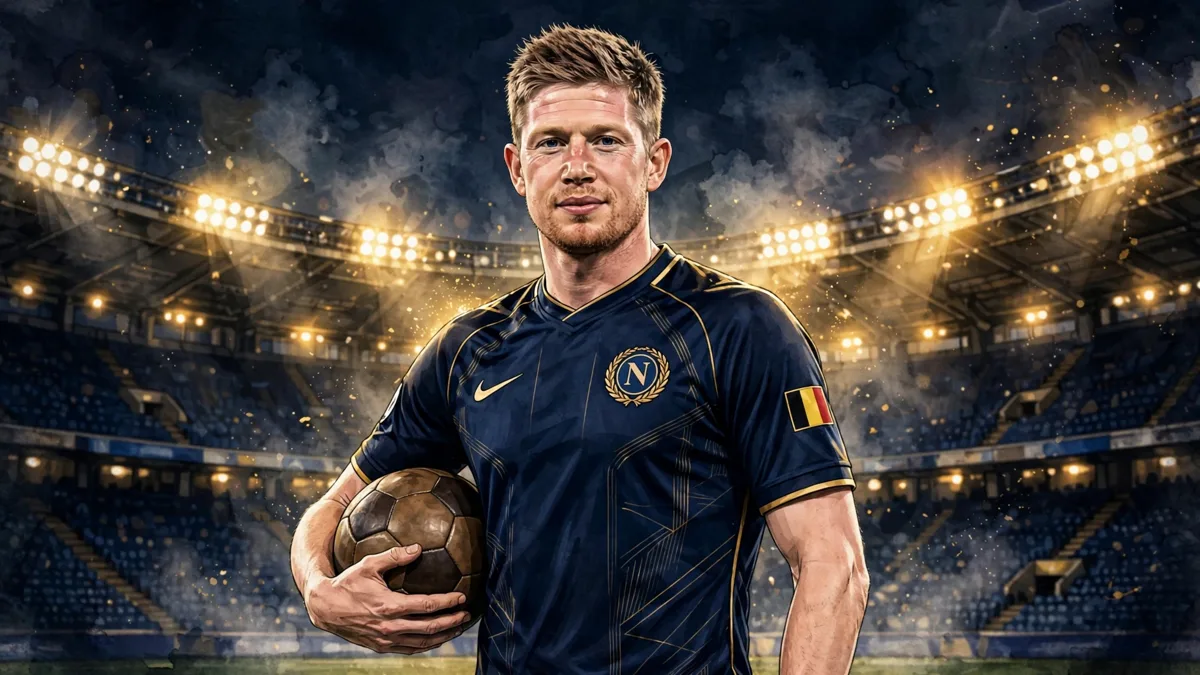
Kevin De Bruyne was born on 28 June 1991 in Drongen, a district of Ghent in East Flanders, Belgium. His father, Herwig De Bruyne, is Belgian; his mother, Anna De Bruyne, was born in Burundi and grew up in London before the family settled in Belgium. That mixed heritage later became a small piece of trivia in his story — De Bruyne could, in theory, have played for Burundi — but he never wavered from Belgium, the country where he grew up and learned the game.
Football started early. He kicked a ball around at local club KVV Drongen from the age of six, and by eight he had already asked his parents for a move to KAA Gent, convinced he needed better coaching. The family backed him, and at 14 he left home to join the youth academy of KRC Genk, a club with a reputation for developing young talent — Christian Benteke, Thibaut Courtois and Yannick Carrasco all came through the same system. Leaving home that young was not easy. In his autobiography, Keep It Simple, published in 2014, De Bruyne wrote about a host family who asked him to leave when he was 15 or 16 because he was too quiet. He has said since that the rejection stung at the time and sharpened him: he went back to Genk more determined, not less.
The academy years gave him the two things that would define his career. The first was technique — a first touch and a passing range that coaches at Genk noticed early and built the youth teams around. The second was a stubborn, almost stubbornly calm character. De Bruyne rarely raises his voice on a pitch, and he has never been a player who chases the spotlight off it. Teammates and coaches have described the same person for fifteen years: quiet in the dressing room, exacting on the training ground, and allergic to excuses.
He planned his route with unusual care for a teenager. Accounts of his youth describe a boy who decided at 11 that he would study Latin for two years, then move to a sports school, then give football everything at 18. It sounds like the kind of story that gets polished in hindsight, but the shape of his career fits it: every step was deliberate, and when a step went wrong — as it did at Chelsea — he corrected it rather than panicking.
Genk: The Breakthrough Years
De Bruyne made his senior debut for Genk in May 2009, at 17, and by the 2010–11 season he was a regular in the side that won the Belgian Pro League. He played 32 league games that season, scoring four goals and registering 17 assists — a number that already hinted at what he would become. Genk added the Belgian Cup in 2009 and the Belgian Super Cup in 2011, and De Bruyne finished his time there with 97 appearances and 16 goals across all competitions.
The move that followed showed how quickly European scouts had noticed him. In January 2012, Chelsea signed him, and the fee — around £7 million — was a serious sum for a 20-year-old from the Belgian league. But Chelsea also loaned him straight back to Genk for the rest of the season, and the pattern of the next eighteen months would test the patience he had built at 14. He was a Chelsea player who barely played for Chelsea, and the frustration of that period shaped the player he became.
Chelsea Setback and the Wolfsburg Revival
Chelsea sent De Bruyne on loan to Werder Bremen for the 2012–13 season, where he finally got regular Bundesliga football and showed what he could do with it — ten goals in 33 appearances, playing mostly on the wing. But when he returned to Stamford Bridge in the summer of 2013, José Mourinho had just returned as manager, and the Portuguese coach could not find a place for him. De Bruyne made only a handful of appearances in the first half of the 2013–14 season, and in January 2014 he asked to leave.
Wolfsburg paid £18 million for him, and the move changed everything. In Germany he was the main creator, not a squad option, and his numbers showed it. In the 2014–15 season he scored ten league goals and made 21 assists in the Bundesliga — a record for the division — as Wolfsburg won the DFB-Pokal and finished second in the league. He was named Bundesliga Player of the Season and Footballer of the Year in Germany, and he added the DFL-Supercup in 2015. In eighteen months he had gone from a player Mourinho did not trust to one of the most wanted midfielders in Europe. The revival was not luck; it was the same deliberate correction he had made as a teenager, applied to a career that had stalled.

The Manchester City Decade
In August 2015, Manchester City signed De Bruyne for £54 million — a club record at the time, with some outlets reporting the fee as £55 million. Pep Guardiola, who arrived as manager a year later, had made signing him a priority, and the Belgian became the creative centre of the side that would dominate English football for the next decade. The numbers tell the story in shorthand: 422 appearances, 108 goals, six Premier League titles, two FA Cups, five League Cups, the 2023 UEFA Champions League, the 2023 UEFA Super Cup and the 2023 FIFA Club World Cup.
The honours came in waves. The first league title arrived in 2017–18, the “Centurions” season in which City took 100 points. A domestic treble followed in 2018–19. Then came three straight titles from 2020–21 to 2022–23, and the peak of it all in 2022–23: a Premier League, FA Cup and Champions League treble, sealed in Istanbul against Inter Milan. City won the league again in 2023–24, their fourth in a row, a feat no English club had achieved before. Through it all, De Bruyne was the player Guardiola built attacks around — the one who could pick a pass no one else in the stadium had seen.
Individual awards followed. He was named PFA Players’ Player of the Year in 2020 and again in 2021, only the third player to win it in consecutive seasons. He won the Premier League Player of the Season award in 2019–20 and 2021–22, and he was the league’s Playmaker of the Season — the award for the most assists — four times. In the Ballon d’Or voting he finished third in 2022 and fourth in 2023, the highest a Belgian midfielder has ever placed.
His most lasting record may be the assists. By the time he left City, De Bruyne had 119 Premier League assists in 288 appearances, the second-highest total in the competition’s history, behind only Ryan Giggs on 162. He did it in far fewer games than Giggs, and he did it while playing in a side where the goals were shared around — a fact that makes the total more impressive, not less. His City teammate Erling Haaland, whose biography we have profiled here, has been the main beneficiary of that service since 2022, and the pairing of the Norwegian’s finishing with De Bruyne’s delivery became one of the most feared combinations in Europe.
The end, when it came, was quiet and mutual rather than bitter. In April 2025, De Bruyne announced he would leave City when his contract expired at the end of the 2024–25 season, after ten years at the club. The club marked his farewell with tributes across the final home game of the season, and he left as one of the greatest players in its history — a statement no one in Manchester would argue with.
Napoli: A New Chapter in Italy
On 12 June 2025, Napoli announced the signing of Kevin De Bruyne on a free transfer, and he officially joined on 1 July after his City contract expired. The deal runs to June 2027, with an option for a further year, and he took the number 17 shirt. For Napoli, it was a statement signing: a serial winner arriving without a transfer fee, on wages that made him the highest-paid player in Serie A. For De Bruyne, at 34, it was a fresh challenge in a fourth country, under a club and a city where football is closer to a religion than a sport.
The move carried a financial logic that suited both sides. Because Napoli paid no fee, they could afford a large salary and a signing bonus; because De Bruyne was a free agent, he could choose his destination rather than being sold to the highest bidder. Reports of his Napoli wages differ — Celebrity Net Worth puts the salary at roughly €6 million net per season, while other outlets report €11 million to €13 million gross — and the gap is explained by how Italian tax rules for incoming foreign players work and by whether the figure quoted is before or after tax. What is certain is that he remains one of the best-paid players in Italy.
His first months in Naples were interrupted by injury. A hamstring and thigh problem in the 2025–26 season kept him out for several months, and he returned to action in March 2026, working his way back into both the Napoli side and the Belgium squad. The setback was familiar territory — De Bruyne has missed long spells before and come back the same player — but at 34, every return is watched a little more closely than the last.
Belgium: The Golden Generation’s Engine
De Bruyne made his senior debut for Belgium in August 2010, and he has been a fixture of the national side ever since, earning more than 100 caps and scoring more than 30 goals. He came through every youth level — under-16s to under-19s — before the senior call-up, and he was at the heart of the so-called “golden generation” that took Belgium to number one in the FIFA world rankings and to the semi-finals of a World Cup.
The high point was Russia 2018. Belgium beat Brazil in the quarter-finals — De Bruyne scored the second goal, a driven finish from the edge of the box that is still replayed in highlight reels — and went on to beat England in the third-place play-off. De Bruyne was named in the FIFA World Cup Dream Team, and Belgium’s third-place finish remains the country’s best ever result at the tournament. The squad also reached the quarter-finals at the 2014 World Cup and at Euro 2016, and the last eight at Euro 2020.
The golden generation never won the major trophy its talent promised, and De Bruyne has been open about that disappointment. Belgium went out in the group stage at the 2022 World Cup and in the last 16 at Euro 2024, and the side has been rebuilding around younger players since. De Bruyne’s role has shifted with it: from the young creator in a team of stars to the senior figure younger players look to. He has never made a fuss about the change. He has simply kept turning up, kept creating, and kept wearing the shirt as if it were the first time.
Playing Style, Records and Peer Comparison
Ask any coach what makes De Bruyne different and the answer is the same: he sees the pass before the run is made. His crossing from the right half-space — whipped, flat, and aimed at the space between goalkeeper and defence — has become a signature, and his set-piece delivery is among the best in the world. He is not the fastest player on the pitch, and he is not the flashiest, but his first touch is immaculate, his shooting from distance is powerful, and his work rate off the ball is higher than most attacking midfielders manage. Guardiola once said he could play him anywhere across the front line and in midfield, and meant it literally.
The record book backs the reputation. He is second all-time for Premier League assists with 119, behind only Ryan Giggs. He has won the Premier League Playmaker award four times. He was named in the UEFA Team of the Year twice, the IFFHS Men’s World Team twice, and the France Football World XI. He finished third in the 2022 Ballon d’Or and fourth in 2023. At City he won six league titles; only a handful of players in the club’s history have more.
Set against his peers, the case for De Bruyne as the defining midfielder of his generation is strong. Lionel Messi, whose biography is profiled here, operates in a different register entirely — a goalscorer and creator in one — but among pure midfielders, De Bruyne’s combination of goals, assists and longevity has few equals. Mohamed Salah, profiled here in our biography of the Liverpool star, has matched him for consistency in the same league, and the two have pushed each other for the best part of a decade. Among the next generation, Jude Bellingham, whose age and rise we have covered, is the name most often mentioned as the heir to De Bruyne’s creative mantle in European football — a comparison Bellingham himself has called an honour. The numbers, though, are still De Bruyne’s: no active midfielder in the Premier League era has created as many goals as he has.
The Money: Salary, Contracts and Career Earnings
De Bruyne’s wealth was built the old-fashioned way for a footballer: a very large salary, paid for a very long time, by the richest clubs in the world. The fullest account of the money is on our sister page — for a detailed breakdown of Kevin De Bruyne’s net worth on GuideNetWorth — and the same-site companion piece, Kevin De Bruyne’s net worth here on CelebAmerica, carries the figure-by-figure version. This section is the biography’s own summary of how the earnings stacked up.
At Manchester City, De Bruyne was among the best-paid players in the Premier League. After signing a contract extension in April 2021, his wage was widely reported at £400,000 a week — roughly £20.8 million a year before bonuses — putting him behind only Erling Haaland among City’s earners. Celebrity Net Worth estimates his career on-field earnings at $150 million to $175 million, while SureBets, working from the salary database Capology, puts his gross career salary at $258.4 million, a figure that counts headline wages before tax, agent fees and other deductions. The two numbers measure different things, which is why they look so different — and why a net worth range, not a single figure, is the honest way to present it.
The transfer fees trace his rise in market value. Chelsea paid about £7 million in 2012. Wolfsburg paid £18 million in 2014. Manchester City paid £54 million in 2015 — a club record at the time, and a fee that looked like a bargain within two seasons. Napoli paid nothing in 2025, because De Bruyne arrived as a free agent, and the absence of a fee is exactly what allowed them to offer him a top Serie A salary plus a signing bonus.
At Napoli, the reported salary depends on the source. Celebrity Net Worth reports roughly €6 million net per season, with extra signing-bonus money because no transfer fee was due. SportsDunia reports about €13 million gross a year, and SportsLeo reports around €12 million net. The honest reading is that the package is worth in the region of €11 million to €13 million gross per season, with Italy’s tax rules for incoming foreign players lifting the net figure well above what the same gross pay would leave in England. Either way, he is the highest earner in Serie A, and the move has not cost him money — it has arguably made him more, once the signing bonus is counted.
Bonuses mattered too. City’s trophy hauls carried appearance and title bonuses, and the 2023 treble season was the most lucrative of his career. Champions League qualification and progress bonuses are standard at that level, and De Bruyne’s contracts at City were structured to reward exactly the kind of seasons he kept having.
The headline figure, settled: Celebrity Net Worth lists Kevin De Bruyne’s net worth at $130 million (snapshot 5 November 2026). Other outlets are lower — SportsDunia puts it at €75–88 million, IceCric at $100–120 million, SurpriseSports at $85–100 million — so we publish the range $80 million to $130 million, anchored at the Celebrity Net Worth figure. His career on-field earnings are estimated at $150 million to $175 million by Celebrity Net Worth, and his gross career salary at $258.4 million by Capology via SureBets. None of these figures is an audited balance sheet; all are estimates from public information.
Endorsements and Business Ventures
De Bruyne’s endorsement portfolio is smaller and quieter than those of the game’s biggest commercial stars, and that is a choice rather than an accident. His main deal is with Nike, which supplies his boots — he has worn the Nike Phantom line for years — and is reported to be worth €2 million to €3 million a year. He also has deals with EA Sports FC, appearing in the game’s marketing and ratings campaigns, with Therabody, the recovery-technology brand, and with Secretlab, the gaming-chair company. IceCric estimates his annual endorsement income at around $4 million, and Forbes was reported to have put his sponsorship revenue at $39 million over a period of a few years — a figure that covers several seasons rather than one.
He has never chased the fashion and fragrance deals that some footballers build second careers on. His one publishing venture is his autobiography, Keep It Simple, released in 2014, which covers his early life, the host-family rejection at Genk, and his rise through the Belgian league. He is also an ambassador for the Special Olympics, a role he has spoken about with more warmth than any commercial deal — the book itself describes how becoming an ambassador changed how he saw his own platform.
There are no widely reported business holdings, start-ups or property empires attached to his name, which is itself notable. De Bruyne has kept his commercial life narrow: boots, a game, recovery tech, and a book. The money has come from football, and the football has been enough.
Homes, Cars and Lifestyle
De Bruyne is famously private about his possessions, and this section is honest about what that means: very little of his property or car collection is publicly documented, and we will not invent a garage or a house to fill the gap. What is known is that he lived in Cheshire during his Manchester City years, in the same commuter belt where many of the club’s players settle, and that he has kept his family life out of the property pages. Reports of specific houses, cars and watches circulate on low-quality net-worth sites, but none of them is sourced well enough to repeat here.
What is documented is the lifestyle: he is a homebody by footballer standards. Teammates describe a player who goes home after training, spends time with his wife and children, and treats recovery — sleep, diet, and the Therabody equipment he endorses — as part of the job. He is not a nightclub regular, he rarely gives interviews about his wealth, and his social media is mostly football and family. The contrast with the louder end of the sport is part of why he is liked as much as he is admired.
One thing that is public: he owns a clothing brand interest and has appeared in fashion shoots, but the venture has never been presented as a business empire. The through-line of De Bruyne’s life off the pitch is restraint. He earns like a superstar and lives like a professional, and the gap between the two is where the net worth comes from.
Net Worth Breakdown and Growth Over Time
| Period | What happened | Estimated net worth |
|---|---|---|
| 2009–2012 (Genk) | First professional contract; Belgian league title; move to Chelsea for about £7 million | Under $5 million |
| 2012–2014 (Chelsea / Werder / Wolfsburg) | Loan spell in Germany; permanent move to Wolfsburg for £18 million; Bundesliga Player of the Season | $5–15 million |
| 2015–2018 (Man City, early years) | Club-record £54 million move; first two Premier League titles; wage rises with each extension | $15–40 million |
| 2019–2021 (Man City, peak) | Back-to-back PFA Player of the Year awards; April 2021 extension at £400,000 a week | $40–70 million |
| 2022–2024 (Man City, treble era) | Champions League treble; Ballon d’Or third place; peak commercial value | $70–100 million |
| 2025–2026 (Napoli) | Free transfer to Napoli; Serie A’s highest earner; signing bonus replaces transfer fee | $80–130 million |
The table above is our own estimate, built from the published salary figures and the named sources in the callout above — it is a guide to the shape of his wealth, not a bank statement. The pattern is the important part: slow growth through his early twenties, a sharp rise after the City move, and a plateau at the top once the £400,000-a-week contract and the endorsement deals were both in place. The Napoli move has not dented the total. A free transfer at 34, with a signing bonus and a top Serie A wage, is one of the best-paid ways to end a career in European football.
Peer comparison puts the figure in context. De Bruyne sits well below the game’s commercial giants — the Messis and Ronaldos, whose fortunes run into the hundreds of millions — and comfortably above most of his fellow midfielders. Among central midfielders of his generation, only a handful have earned more, and none of them has matched his combination of wages and longevity at the very top. That is the measure of his career in money terms: not the richest footballer alive, but one of the richest midfielders ever, and the richest Belgian player of his era.
Personal Life: Wife Michele and Family
Kevin De Bruyne married Michele Lacroix in June 2017. Michele, a Belgian model and entrepreneur, met De Bruyne long before he was a star — the couple’s story goes back to their teens — and she has been a constant through every move: Genk, London, Bremen, Wolfsburg, Manchester, and now Naples. The wedding, in the summer of 2017, was a private affair by football standards, and the couple have kept it that way ever since.
They have three children: Mason Milian, born in March 2016; Rome, born in October 2018; and Suri, born in September 2020. De Bruyne has said that becoming a father changed how he saw football — the game stopped being everything, and the bad results stopped following him home in the same way. He has also spoken about the practical side: three young children and a footballer’s schedule mean the family calendar is built around school terms and away trips, and Michele has managed much of that while building her own work.
The family moved to Naples with him in 2025, and De Bruyne has spoken warmly about the welcome they received — the city, he has said, treats its footballers like family, which suits a man who values exactly that. His parents, Herwig and Anna, remain close to the family, and his mother’s Burundian heritage is something he has acknowledged with pride rather than made a fuss of. The whole picture is of a player whose private life is settled, long-term, and deliberately kept out of the gossip pages — which, in modern football, is an achievement of its own.
Injuries and Setbacks
No biography of De Bruyne is complete without the injuries, because they are the one thing that has ever slowed him down. The first serious one came in October 2018, when he suffered knee ligament damage in a League Cup match against Fulham and missed two months. He returned, and then missed more time with a second knee problem in the same season — a stop-start year that cost him most of 2018–19.
The worst layoff came at the start of the 2023–24 season, when a hamstring injury picked up on the opening day against Burnley needed surgery and kept him out for five months. He returned in January 2024 and, in his first game back, set up a goal within minutes of coming on — the kind of return that reminded everyone what City had been missing. He has also dealt with ankle and facial injuries, including a fractured nose and eye socket sustained in the 2021 Champions League final, an injury he played through for part of the match before being forced off.
The Napoli spell brought another hamstring and thigh problem in the 2025–26 season, sidelining him for several months before his return in March 2026. Each time, the pattern has been the same: a long absence, a careful rehabilitation, and a return at the same level. At 35, the question is no longer whether he can come back — he has answered that half a dozen times — but how many more times he will need to.
The setbacks off the pitch were fewer but just as formative. The Chelsea rejection in 2013–14, when Mourinho would not play him, is the one he returns to most often in interviews. He has said he never blamed the manager — he simply wanted to play, and Wolfsburg offered him that. The lesson he took from it is visible in everything since: he does not wait for permission, and he does not stay where he is not wanted.
Frequently Asked Questions
How old is Kevin De Bruyne in 2026?
Kevin De Bruyne is 35 in 2026. He was born on 28 June 1991 in Drongen, a district of Ghent in Belgium, which makes him one of the older outfield players still starting regularly in a top European league.
What is Kevin De Bruyne’s net worth in 2026?
Kevin De Bruyne’s net worth in 2026 is estimated at $130 million by Celebrity Net Worth (snapshot 5 November 2026). Other outlets are lower — SportsDunia puts it at €75–88 million and IceCric at $100–120 million — so the honest range is $80 million to $130 million. His career on-field earnings are estimated at $150 million to $175 million by Celebrity Net Worth.
Why did Kevin De Bruyne leave Manchester City?
De Bruyne left Manchester City because his contract expired at the end of the 2024–25 season and was not renewed. He announced the departure himself in April 2025, after ten years, 422 appearances, six Premier League titles and the 2023 Champions League. He then joined Napoli on a free transfer in June 2025.
What is Kevin De Bruyne’s salary at Napoli?
Reports differ. Celebrity Net Worth puts his Napoli salary at roughly €6 million net per season, with extra signing-bonus money because Napoli paid no transfer fee. SportsDunia reports about €13 million gross a year and SportsLeo around €12 million net. The package is best understood as roughly €11–13 million gross per season, with Italy’s tax rules for incoming foreign players lifting the net figure.
Who is Kevin De Bruyne’s wife?
Kevin De Bruyne’s wife is Michele Lacroix, a Belgian model and entrepreneur. The couple married in June 2017 after being together since their teens, and they have three children: Mason Milian (born 2016), Rome (born 2018) and Suri (born 2020).
How many Premier League titles has Kevin De Bruyne won?
Kevin De Bruyne has won six Premier League titles with Manchester City: in 2017–18, 2018–19, 2020–21, 2021–22, 2022–23 and 2023–24. He also won two FA Cups, five League Cups and the 2023 UEFA Champions League with City, completing the treble in 2022–23.
How many assists does Kevin De Bruyne have in the Premier League?
Kevin De Bruyne recorded 119 Premier League assists in 288 appearances for Manchester City, the second-highest total in the competition’s history behind Ryan Giggs on 162. He won the Premier League Playmaker of the Season award four times.
Where is Kevin De Bruyne from?
Kevin De Bruyne is from Drongen, a district of Ghent in East Flanders, Belgium, where he was born on 28 June 1991. His father Herwig is Belgian and his mother Anna was born in Burundi and grew up in London. He started at local club KVV Drongen at six, moved to KAA Gent at eight, and joined the KRC Genk academy at 14.
Final Thoughts
Kevin De Bruyne’s biography reads like a manual for how to build a career without shortcuts. He left home at 14, was rejected by a host family, was frozen out at Chelsea, and answered each setback by finding a better place to play rather than complaining about the one he was in. The result is a career with no wasted years: a Belgian title at Genk, a revival at Wolfsburg, a decade of dominance at Manchester City, and now a late-career adventure at Napoli that has made him the best-paid player in Italy. The numbers — 422 City appearances, 119 Premier League assists, six league titles, a Champions League treble — will stand for a long time. The character behind them is the reason they exist.
At 35, with a net worth of $130 million on the Celebrity Net Worth estimate and a range of $80 million to $130 million across sources, De Bruyne has nothing left to prove and one thing left to enjoy: playing football on his own terms, in a city that loves the game as much as he does. Whether Napoli is the last stop or one more chapter before a farewell somewhere else, the story is already complete. He arrived in Manchester as a club-record signing who had failed at Chelsea, and he left as the finest midfielder the Premier League has seen in a generation.
For more football stories in this series, browse our biography archive and the net worth collection.
Sources and Reporting
Figures in this article are estimates from public sources and are presented as ranges where those sources disagree. De Bruyne has not released a personal balance sheet, so no published net worth figure is an audited fact.
How we estimated: the headline figure is anchored to Celebrity Net Worth ($130 million, snapshot 5 November 2026), the most current named-source estimate available. The published range of $80 million to $130 million reflects lower estimates from SportsDunia (€75–88 million), IceCric ($100–120 million) and SurpriseSports ($85–100 million), and the editorial range of $80–130 million published by SureBets in July 2026. Career earnings figures come from Celebrity Net Worth ($150–175 million on-field) and from Capology via SureBets ($258.4 million gross career salary). Salary figures for Napoli differ by source and by gross-versus-net treatment; we report both and explain the gap rather than picking one.
Named sources consulted for this article:
- Celebrity Net Worth — net worth $130 million, Napoli salary, career earnings
- SureBets — July 2026 editorial range $80–130 million, Capology salary data
- SportsDunia — net worth €75–88 million, Napoli salary €13 million gross
- SportsLeo — net worth $130 million, Napoli salary €12 million net
- IceCric News — net worth $100–120 million, Nike endorsement value
- SurpriseSports — net worth $85–100 million
- Wikipedia — career history, appearances, honours, transfer fees
- TheSportsDB — player profile and career timeline
- SportsLib — career summary and Napoli move
- Think Football Ideas — biographical facts, 119 Premier League assists
- Bioglance — Napoli contract to 2027, 2025–26 injury and March 2026 return
- FootballPickr — biography and career timeline
Where sources conflict — most often on the Napoli salary and the net worth total — we show the conflict and say which source anchors the figure we publish. If you spot an error, tell us and we will correct it.