Joel Embiid’s biography reads like a film script that nobody would believe if it were fiction. A boy from Yaoundé, Cameroon, who grew up dreaming of professional volleyball, picked up a basketball for the first time at 15, crossed an ocean alone at 16, and within a decade became the NBA’s Most Valuable Player, a two-time scoring champion, and an Olympic gold medallist. As of November 2026, his net worth is estimated at $140 million, anchored on Celebrity Net Worth’s updated figure and sitting inside an honest range of $120 million to $160 million.
Born Joel Hans Embiid on March 16, 1994, the 7-foot centre has spent his entire NBA career with the Philadelphia 76ers, the team that drafted him third overall in 2014 and then waited two full seasons for him to play a single game. What follows is the full story: the late start, the broken foot, the brother he lost, the MVP season, the Olympic gold, the contracts worth more than $500 million combined, and the injuries that still shape every week of his career in 2026.
Last updated: November 14, 2026. By Celebamerica Editorial Staff.
Joel Embiid at a Glance
| Full Name | Joel Hans Embiid |
|---|---|
| Date of Birth | March 16, 1994 (age 32; turns 33 on March 16, 2027) |
| Birthplace | Yaoundé, Cameroon |
| Nationality | Cameroonian, French (since July 2022), American (since September 2022) |
| Height / Weight | 7 ft 0 in (2.13 m) / around 280 lb |
| Position / Team | Centre, Philadelphia 76ers (No. 21) |
| Estimated Net Worth (2026) | $140 million, inside a $120 million to $160 million range (Celebrity Net Worth) |
| Career NBA Salary | $321,069,851 through the 2025-26 season (Spotrac) |
| Peak Income Sources | NBA contracts, Skechers and other endorsements (about $10 million a year off court, per Forbes) |
| Key Honours | NBA MVP 2023; 7× All-Star (2018-2024); 2× scoring champion (2022, 2023); Olympic gold, Paris 2024 |
| Partner / Family | Long-term partner Anne de Paula; son Arthur Elijah, born September 2020 |
| 2026 Status | Active for Philadelphia; managing right-foot plantar fasciitis, no back-to-backs (checked November 13, 2026) |
Table of Contents
- Early Life in Yaoundé: Volleyball First, Basketball at 15
- Kansas: One Season That Changed Everything
- The Draft, the Broken Foot, and Trust the Process
- From Debut to MVP: The Rise to the Top
- Olympic Gold in Paris and the Citizenship Question
- The Money: Contracts, Endorsements, and Business
- Net Worth Breakdown: Where the Fortune Sits
- Injuries and Availability: The Other Side of the Story
- Personal Life: Family, Faith, and Life Off the Court
- Legacy: What Embiid Means to the 76ers and Cameroon
- Joel Embiid Biography: Frequently Asked Questions
- Final Thoughts
- Sources and Reporting
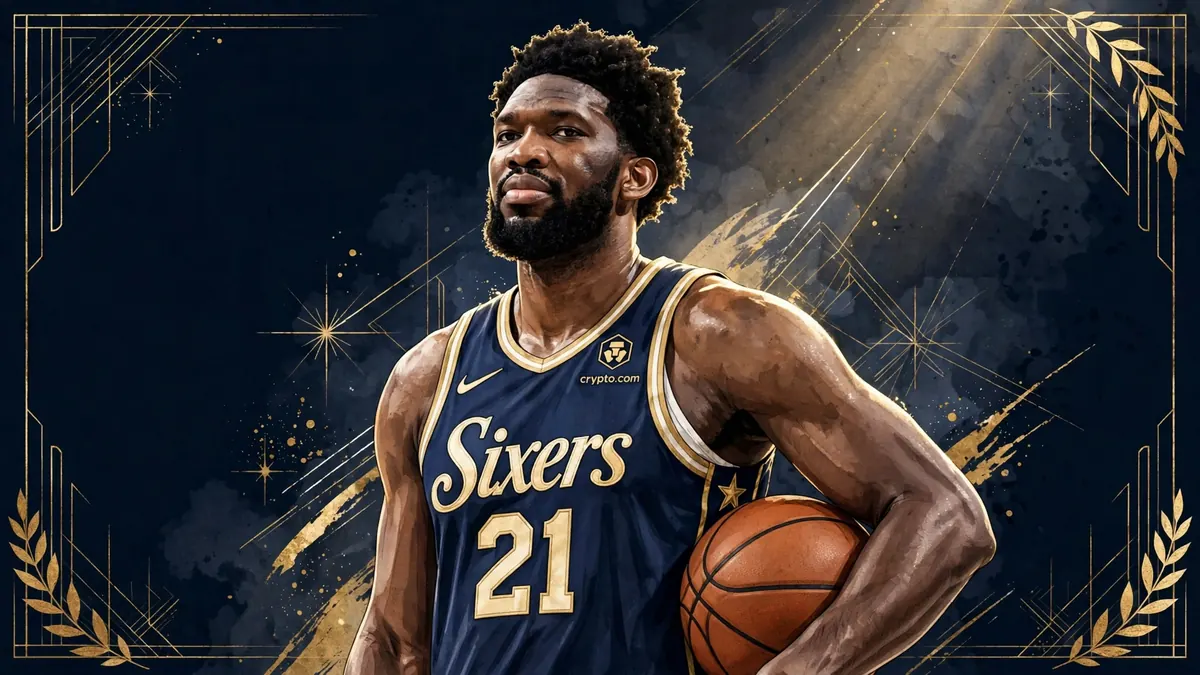
Early Life in Yaoundé: Volleyball First, Basketball at 15
Joel Hans Embiid was born on March 16, 1994, in Yaoundé, the capital of Cameroon, to Thomas Embiid, a colonel in the Cameroonian military, and his wife Christine. He was the oldest of three children, with a younger sister, Muriel, and a younger brother, Arthur. The family lived comfortably by local standards, and sport ran through the household. But the sport the Embiids had in mind for their tall son was not basketball. It was volleyball.
As a boy, Embiid played volleyball and soccer, and his parents assumed he would train at France’s National Institute of Sport and Physical Education and eventually play professional volleyball in Europe, perhaps for the Cameroon national team. He was already 6-foot-9 by the time he was 15. Basketball barely registered. He had watched the game on television and admired Hakeem Olajuwon, the Nigerian-born Hall of Fame centre whose footwork he would later study frame by frame, but he had never played it in any serious way.
That changed at a youth basketball camp in Cameroon run by Luc Mbah a Moute, a fellow native of Yaoundé who was then playing in the NBA for the Milwaukee Bucks. Mbah a Moute spotted the raw, long-limbed teenager and saw what nobody else had seen: a frame and a feel for movement that could translate to basketball. He talked Embiid and his family into a leap that still looks extraordinary in hindsight. At 16, Embiid left Cameroon alone for the United States to play high school basketball, arriving with little English and no real grounding in the game he was supposed to master.
He enrolled first at Montverde Academy in Florida, Mbah a Moute’s old school, where he started on the junior varsity team as a junior and grew frustrated with his lack of varsity minutes. For a time his fallback plan was simple and honest: use a basketball scholarship to get a college degree. He later transferred to The Rock School in Gainesville, Florida, where his game finally began to catch up with his size. Recruiters noticed. ESPN rated him a five-star recruit, sixth nationally in the class of 2013, and he committed to the University of Kansas in November 2012, choosing the Jayhawks over Texas and Florida. He has said since that the whole arc still feels unreal to him. “I always say my life is a movie, because everything just happens so fast,” he told Andscape. “Started playing at 16, living in a home by yourself, not knowing the language, playing JV my junior year when I got here… to ending up at Kansas, where I thought I had no chance of making the pros.”

Kansas: One Season That Changed Everything
Embiid played a single season of college basketball, and one season was all it took. At Kansas in 2013-14, playing for Hall of Fame coach Bill Self alongside future No. 1 pick Andrew Wiggins, he averaged 11.2 points, 8.1 rebounds and 2.6 blocks per game. The raw numbers were modest. The tape was not. Scouts watched a 7-footer who moved like a wing, blocked shots with timing rather than brute force, and showed a shooting touch that big men are not supposed to have after three years in the sport.
He was named the Big 12 Defensive Player of the Year, made the Big 12 All-Defensive Team and the All-Newcomer Team, and finished the season as a second-team All-Big 12 pick. By March, the conversation around him had shifted from whether he would be drafted to how high. He was so unsure of himself that he asked Self whether he could be redshirted, convinced the Jayhawks kept dunking on him in pick-up games. Self said no. On April 9, 2014, Embiid declared for the NBA draft, giving up his final three years of college eligibility. Before the draft he was, briefly, the presumptive No. 1 pick. Then his right foot broke during a pre-draft workout.
The injury was a fractured navicular bone, the kind of break that has ended the careers of big men before. He had surgery on June 20, 2014, six days before the draft, and was expected to miss four to six months. It did not scare Philadelphia off. On June 26, 2014, the 76ers selected him with the third overall pick, without ever having met him in person, making him the third Cameroonian-born NBA player after Ruben Boumtje-Boumtje and Luc Mbah a Moute, and the highest-drafted player ever from Cameroon.
The Draft, the Broken Foot, and Trust the Process
The foot did not heal on schedule. Embiid missed the entire 2014-15 season, then needed a second surgery, and missed the entire 2015-16 season too. Two full years passed between draft night and his first NBA game. In that span, tragedy struck as well. On October 16, 2014, his 13-year-old brother Arthur was killed in a car crash in Cameroon, struck after a runaway truck careered into a schoolyard. Embiid flew home for the funeral with the 76ers’ general manager Sam Hinkie at his side. He later wrote in The Players’ Tribune that he felt he had “lost my purpose in life” and wanted to quit basketball and go home to his family.
He did not quit. He rehabbed, he learned the language of the league from the bench, and he became the human face of “The Process” — the 76ers’ deliberate, much-debated rebuild under Hinkie that prized draft picks and patience over short-term wins. Fans adopted the slogan “Trust the Process,” and Embiid adopted it back, wearing it as a nickname and an identity. When he finally debuted on October 26, 2016, against the Oklahoma City Thunder, 844 days after the draft, he scored 20 points in 22 minutes. The wait, it turned out, had been worth it.
That rookie season he played only 31 games before a knee injury ended it, but he averaged 20.2 points, 7.8 rebounds and 2.5 blocks and made the NBA All-Rookie First Team. The pattern of his career was set in that first year: when he plays, he is among the best players alive; the question has always been how often he plays. The 76ers rewarded the promise quickly, signing him to a five-year, $148 million extension in October 2017 before he had played a full season. It was a bet on talent over availability, and for long stretches it looked like a bargain.
From Debut to MVP: The Rise to the Top
From 2017 onward, Embiid’s ascent was steady and, at its peak, overwhelming. He made his first All-Star team in 2018 and has been selected seven times in total, every year from 2018 through 2024. He earned All-NBA First Team honours in 2023, four Second Team selections, and three All-Defensive Second Team nods. He finished second in MVP voting twice, in 2021 and 2022, both times behind Nikola Jokic, a rivalry that defined the league’s centre debate for three seasons and gave the two men a shared story: two non-American big men trading the game’s highest individual honours while playing the position in completely different ways.
The scoring titles settled the argument about who could carry an offence. In 2021-22 Embiid averaged 30.6 points per game to lead the league, the first centre to do it since Shaquille O’Neal in 2000 and the first foreign-born player ever to win a scoring title. He did it again in 2022-23, averaging 33.1 points, 10.2 rebounds and 4.2 assists while shooting 54.8 percent from the field — the first centre since Moses Malone in 1982 to average more than 30 points a game. That season ended with the award that had eluded him: NBA Most Valuable Player for 2023, voted ahead of Jokic after two years as runner-up. It was the first MVP for a 76er since Allen Iverson in 2001, and it arrived in the same season Embiid finally made an All-NBA First Team.
The signature night of his career came on January 22, 2024, when he scored 70 points with 18 rebounds and five assists in a 133-123 win over the San Antonio Spurs, setting a franchise record and becoming one of only a handful of players in league history to reach 70. Weeks earlier, on January 2, he had posted a triple-double of 31 points, 15 rebounds and 10 assists while playing only three quarters against Chicago. At his best, Embiid is not merely a scorer; he is a centre who shoots free throws like a guard, defends the rim, and bends entire defences toward him. The numbers back it up: through the end of the 2025-26 season he had banked $321,069,851 in NBA salary alone, per Spotrac, the 17th-highest career total in league history.
What he has never done is win in the playoffs. For all the individual honours, Embiid has never reached a conference final, let alone an NBA Finals. Philadelphia has lost in the second round again and again, most painfully in Game 7s, and the gap between his regular-season dominance and his postseason record is the one line on his résumé that critics return to every spring. It is also the reason the 2026-27 season matters so much to his story: the window for a title run with this core is narrowing, and his body is the clock.
Olympic Gold in Paris and the Citizenship Question
Embiid’s international story is almost as unusual as his basketball beginnings. Born Cameroonian, he gained French citizenship in July 2022 after writing an open letter to President Emmanuel Macron saying he would play for no national team other than France, then gained American citizenship three months later, in September 2022. With three passports and three suitors, he chose Team USA for the Paris 2024 Olympics, a decision that drew sharp criticism in France, including from the head of the French basketball federation.
The choice paid off with gold. Team USA beat France 98-87 in the final at Bercy Arena, and Embiid, playing his first professional basketball for any team other than the 76ers, averaged 11.2 points and 3.8 rebounds across the tournament. His best game came when it mattered most: 19 points in the semifinal comeback win over Serbia, a team led by his old MVP rival Nikola Jokic. He shared the roster with LeBron James, Stephen Curry and Kevin Durant — three of the defining players of his era — and came home with the one honour his NBA career had not yet given him: a championship of any kind, even if it came in a USA jersey rather than a Sixers one. Skechers marked the moment by gifting him a pair of exclusive gold sneakers, a small detail that says something about how his sponsors now treat him: as a global figure, not just a Philadelphia one.

The Money: Contracts, Endorsements, and Business
Embiid’s wealth is built on contracts first and everything else second. The five-year, $148 million extension he signed in October 2017 was followed by a four-year, $196 million supermax extension in August 2021, and then by the deal that frames his current finances: a three-year extension agreed in September 2024, reported by ESPN at $192.9 million, which Spotrac values at $187.9 million in remaining money. The extension begins with the 2026-27 season and keeps him under contract in Philadelphia through 2028-29, subject to a player option in the final year. If he plays through the end of that deal, his career NBA salary will pass $500 million before endorsements, investments or anything else is counted.
Year by year, the paydays are stark. He earned about $55.2 million in base salary in 2025-26, and his 2026-27 salary is roughly $58 million, with further raises scheduled in the later years. For a full breakdown of how those contracts add up to his overall fortune, our sister site’s money-focused profile covers Joel Embiid’s net worth in detail, including the earnings-based analysis behind the $120 million to $160 million range.
Off the court, Forbes puts his endorsement income at roughly $10 million a year. His shoe story tells the arc of his commercial rise. He spent his early years with Under Armour, then in April 2024 signed a multi-year deal with Skechers to become the face of the company’s new basketball division, a move reported by The Athletic’s Shams Charania. He debuted his signature Skechers shoe on court and wore the brand through the Paris Olympics. Beyond shoes, his portfolio has included deals with Mountain Dew and other consumer brands, and in April 2024 he launched Miniature Géant, a production studio, with LeBron James’s SpringHill company — a first step from endorser to owner, and the kind of venture that tends to matter more to an athlete’s long-term wealth than any single shoe deal.
| Season | Base Salary (approx.) | Note |
|---|---|---|
| 2016-17 | $4.6 million | Rookie deal; debut season, 31 games |
| 2017-18 | $6.1 million | Five-year, $148 million extension signed October 2017 |
| 2021-22 | $31.6 million | Supermax extension (four years, $196 million, signed August 2021) begins |
| 2023-24 | $47.6 million | MVP defence season; 70-point game; meniscus surgery |
| 2025-26 | $55.2 million | 38 games; 26.9 points per game |
| 2026-27 | $58.0 million | Three-year, $192.9 million extension (September 2024) begins |
Salary figures: Spotrac and ESPN reporting. Career total through 2025-26: $321,069,851 (Spotrac).
Net Worth Breakdown: Where the Fortune Sits
Celebrity Net Worth’s updated page puts Embiid at $140 million in 2026, a sharp rise from the $85 million figure that circulated for years and still appears on slower-moving profile sites. That older number is stale: it predates the supermax years and the 2024 extension. The honest range, from an August 2026 earnings-based analysis, is $120 million to $160 million, with $140 million as the anchor. At the top end, some outlets publish $176 million to $178 million; those look high against the tax and spending math, since gross salary is not wealth. Federal, Pennsylvania and Philadelphia taxes, road-state jock taxes and an agent fee capped at 4 percent under NBPA rules take roughly half of a player’s pay before spending and investments enter the picture.
The breakdown behind the anchor figure is straightforward. Career NBA salary of $321 million through 2025-26 is the foundation. Endorsements at roughly $10 million a year add a steady second stream, now led by the Skechers deal. The Miniature Géant studio is a longer-term bet whose value is not public. What is not public, and what keeps any figure an estimate, is the other side of the ledger: his spending, his property, and his private investments. Unlike some stars, Embiid has no widely reported real-estate portfolio or headline business empire to itemise. He keeps his financial life quiet, and this profile does not invent holdings where none are documented. The $140 million anchor is best read as what the public record supports: a player who has earned more than $320 million on court, kept the biggest share of it in the supermax era, and still has up to $193 million in contracted salary ahead of him.
The stale figure to ignore: if you still see $85 million quoted for Embiid, that number is years out of date. It was the standard figure before his 2021 supermax extension and his 2024 extension reshaped his earnings. The current Celebrity Net Worth figure is $140 million.
Injuries and Availability: The Other Side of the Story
No honest biography of Embiid skips the games he missed, because the missed games are the other half of his story. It started before he ever played: two full seasons lost to the navicular bone in his right foot. Since then the list has grown long — knee trouble, a torn meniscus in January 2024 that needed surgery, an orbital fracture and concussion in 2018, a torn ligament in his thumb, and the left knee that has now been operated on more than once. He played 39 games in 2023-24, 19 games in 2024-25, and 38 games in 2025-26, when he still averaged 26.9 points, 7.7 rebounds and 3.9 assists. The production never really fell off. The availability did.
He had another arthroscopic procedure on his left knee in April 2025 and returned during the 2025-26 campaign. The 2026-27 season has brought a new problem to manage rather than a solved one: plantar fasciitis in his right foot, which he has called “painful” and which the team is treating as a condition to manage rather than cure. He told ESPN in October 2026 that he does not plan to play back-to-backs for the rest of his career, and the 76ers have held him to that — he missed the October 25 loss to Detroit and the November 1 game at Charlotte, both second nights of back-to-backs, and played six of the team’s first eight games as Philadelphia started 7-1.
The scares keep coming even on the nights he does play. On November 10, 2026, against Boston, he took a hard fall under the rim, went to the locker room for treatment, and returned for the second half. Two nights later, on November 12 against Toronto, he went down in the first quarter after colliding with guard Ja’Kobi Walter while setting a screen, pointed at his right knee, and was helped to the locker room — then returned to the game and finished with 20 points. As of November 13, 2026, he had played 10 games in the young season, averaging 17.7 points and 9.3 rebounds for a 9-3 Philadelphia team, in a smaller scoring role as teammates carry more of the offence. The 76ers are managing him like a player they need in April, not November. Whether that management finally buys him a deep playoff run is the open question of his thirties.
There is a cost beyond the box score. Resting the second night of back-to-backs costs Philadelphia regular-season games, and his absences have shaped the franchise’s planning for a decade — the reason the team keeps adding frontcourt depth behind him, and the reason trade speculation follows him every summer despite his contract. In May 2026, after the 76ers’ season ended, reporting around the team even touched on whether the franchise might listen to offers. Nothing came of it. He remains, by contract and by design, the centre of the team.
Personal Life: Family, Faith, and Life Off the Court
Off the court, Embiid’s life is anchored by the family he built after the one he lost. His long-term partner is Anne de Paula, a Brazilian model known for her Sports Illustrated Swimsuit appearances. In September 2020 the couple welcomed their first child, a son named Arthur Elijah — named for Embiid’s younger brother, who died in 2014. He announced the birth on Instagram, and the name was the whole story: a tribute, six years after the loss, carried into the next generation.
He is close to his parents and his sister Muriel, and he has spoken about how the distance from Cameroon shaped him — leaving home at 16, living alone in Florida, learning a new language while learning a new sport. His faith matters to him; his late brother Arthur was, by every account, a deeply spiritual boy who handed out crosses to classmates and donated toys to the poor, and Embiid has carried that memory openly, including in the Players’ Tribune essay where he wrote about nearly quitting the game after Arthur’s death.
He is also one of the league’s great personalities: a prolific social-media presence, a trash-talker with a sense of theatre, and a player who has never hidden his emotions — from the tears after playoff defeats to the dancing, the celebrations, and the long-running, mostly affectionate feud with the fans and media who doubt him. The same openness has occasionally cost him. In November 2024 he was suspended three games without pay after a physical confrontation with a columnist in the locker room following a loss to Memphis, an incident he has not repeated. It sits in his record as a reminder that the intensity that makes him great on the floor is not always easy to switch off away from it.
His Cameroonian roots remain central to how he presents himself. He has spoken about wanting to be an example for children in Cameroon and across Africa, and his rise — from a volleyball hopeful who had never played basketball to the MVP of the world’s best league — is routinely cited as proof that African talent does not need to follow the usual path to reach the top. He is the highest-drafted player ever from Cameroon, and the first Cameroonian to win an NBA MVP award.
Legacy: What Embiid Means to the 76ers and Cameroon
Embiid’s legacy is still being written, and that is the honest way to put it. At 32, he is already the greatest 76er of the post-Iverson era: an MVP, a two-time scoring champion, a seven-time All-Star, and the owner of the franchise’s single-game scoring record. He is also the player most associated with “The Process,” the rebuild that defined the franchise for a decade — the draft pick who made the patience look justified. His peers in the centre debate, Giannis Antetokounmpo and Jokic, both have championships. Embiid does not, and until he does, that gap will frame every assessment of his career.
What cannot be argued is the scale of the journey. He started playing organised basketball at 15, an age when most future MVPs had already been scouted for years. He crossed an ocean alone, learned the game in a second language, lost two seasons to injury before his debut, buried his younger brother in his rookie year, and still became the best player in the world for a season. The $140 million fortune, the $321 million in career salary, the gold medal — all of it follows from that beginning. For readers who want the full picture of his life beyond basketball, the biography section carries more profiles in the same style.
Joel Embiid Biography: Frequently Asked Questions
How old is Joel Embiid in 2026?
Joel Embiid is 32 years old in 2026. He was born on March 16, 1994, in Yaoundé, Cameroon, and he turns 33 on March 16, 2027.
What is Joel Embiid’s net worth in 2026?
Joel Embiid’s net worth in 2026 is estimated at $140 million, anchored on Celebrity Net Worth’s updated figure and sitting inside an honest range of $120 million to $160 million. The $85 million figure still seen on some sites is years out of date, and the $176 million to $178 million figures at the top end look high against the tax and spending math on his $321 million in career NBA salary.
How tall is Joel Embiid?
Joel Embiid is 7 feet 0 inches tall (2.13 metres) and weighs around 280 pounds. He plays centre for the Philadelphia 76ers and wears jersey number 21.
When was Joel Embiid drafted?
Joel Embiid was drafted third overall by the Philadelphia 76ers in the 2014 NBA draft, after one season at the University of Kansas. He had broken the navicular bone in his right foot six days before the draft and missed his first two full seasons before debuting on October 26, 2016.
Has Joel Embiid won an NBA championship?
No. Joel Embiid has never won an NBA championship and has never reached a conference final with the Philadelphia 76ers, despite winning the NBA MVP award in 2023 and two scoring titles. He has won a championship of a different kind: Olympic gold with Team USA at Paris 2024.
Who is Joel Embiid’s wife or partner?
Joel Embiid is not married. His long-term partner is Anne de Paula, a Brazilian model known for her Sports Illustrated Swimsuit appearances. Their son, Arthur Elijah, was born in September 2020 and is named after Embiid’s younger brother, who died in a car crash in Cameroon in 2014.
Why does Joel Embiid miss so many games?
Embiid has a long injury history, starting with the broken navicular bone in his right foot that cost him his first two seasons, followed by knee trouble, a torn meniscus in January 2024, and arthroscopic left knee surgery in April 2025. He played 39 games in 2023-24, 19 in 2024-25, and 38 in 2025-26. In 2026-27 he is managing right-foot plantar fasciitis and does not play back-to-backs.
What teams has Joel Embiid played for?
Joel Embiid has played for only one NBA team, the Philadelphia 76ers, since being drafted in 2014. Before that he played one season of college basketball for the Kansas Jayhawks (2013-14), and internationally he has represented Team USA, winning Olympic gold at Paris 2024.
Final Thoughts
Joel Embiid’s biography is the story of a late start that became an all-time career. A volleyball kid from Yaoundé who first touched a basketball at 15 is now a 32-year-old MVP with a $140 million fortune, more than $320 million in career salary, a three-year extension worth $192.9 million still ahead of him, and an Olympic gold medal. The injuries have taken plenty from him — whole seasons, playoff runs, and the certainty that his prime would last as long as his talent deserved. What they have not taken is the player himself. As of November 2026 he is still suiting up for Philadelphia, still the centre of the franchise, and still chasing the one honour his résumé lacks: a championship. If his body holds for one deep spring run, this biography gets a final chapter worthy of the beginning.
Sources and Reporting
Net worth anchor: Celebrity Net Worth (updated Joel Embiid page, $140 million; the stale $85 million figure and the $176 million to $178 million outliers are discussed in the breakdown above). Salary and contract figures: Spotrac (career earnings $321,069,851 through 2025-26; 2025-26 salary $55.2 million; 2026-27 salary $57,985,752) and ESPN (September 2024 extension reporting, $192.9 million). Endorsement estimates: Forbes (about $10 million a year off court); Skechers deal reporting: Bleacher Report and The Athletic (April 2024). Career and Olympic record: Team USA (2023 MVP season averages; Paris 2024 gold) and Sports Illustrated (the 2016 “I’m The Process” profile; Olympic gold coverage). Early life and the Arthur story: Andscape and The Players’ Tribune, via Embiid’s own writing. November 2026 status: ClutchPoints (November 10 and November 12, 2026 injury reports) and Larry Brown Sports (November 13, 2026).
How we estimated: no audited accounts for Embiid exist, so this article anchors on Celebrity Net Worth’s updated $140 million figure and tests it against hard inputs — Spotrac’s $321,069,851 in career NBA salary through 2025-26 and Forbes’ estimate of roughly $10 million a year in off-court income. Where sources disagree, we publish the range ($120 million to $160 million) and name the source behind each number. Figures are estimates and may differ from private reality. Reporting window: November 2026.