By Celebamerica Editorial Staff | Last updated: November 8, 2026
Jay-Z — born Shawn Corey Carter on December 4, 1969, in Brooklyn, New York — is the rapper who walked out of the Marcy Houses public housing project and built the largest fortune any musician has ever held. Forbes estimates his net worth at about $2.8 billion as of 2026, and Celebrity Net Worth independently lists the same $2.8 billion figure, making him the wealthiest music artist in history. He is also, by the reckoning of Billboard and Vibe in 2023, the greatest rapper of all time.
This biography follows the whole arc: the Brooklyn childhood, the years of rejection from major labels, the do-it-yourself label that changed hip-hop business forever, fourteen chart-topping albums, twenty-five Grammy Awards, the Roc Nation empire, the marriage to Beyoncé, and a 2026 anniversary year that put him back on the biggest stages in America — including a Super Bowl halftime headline slot announced for February 2027.
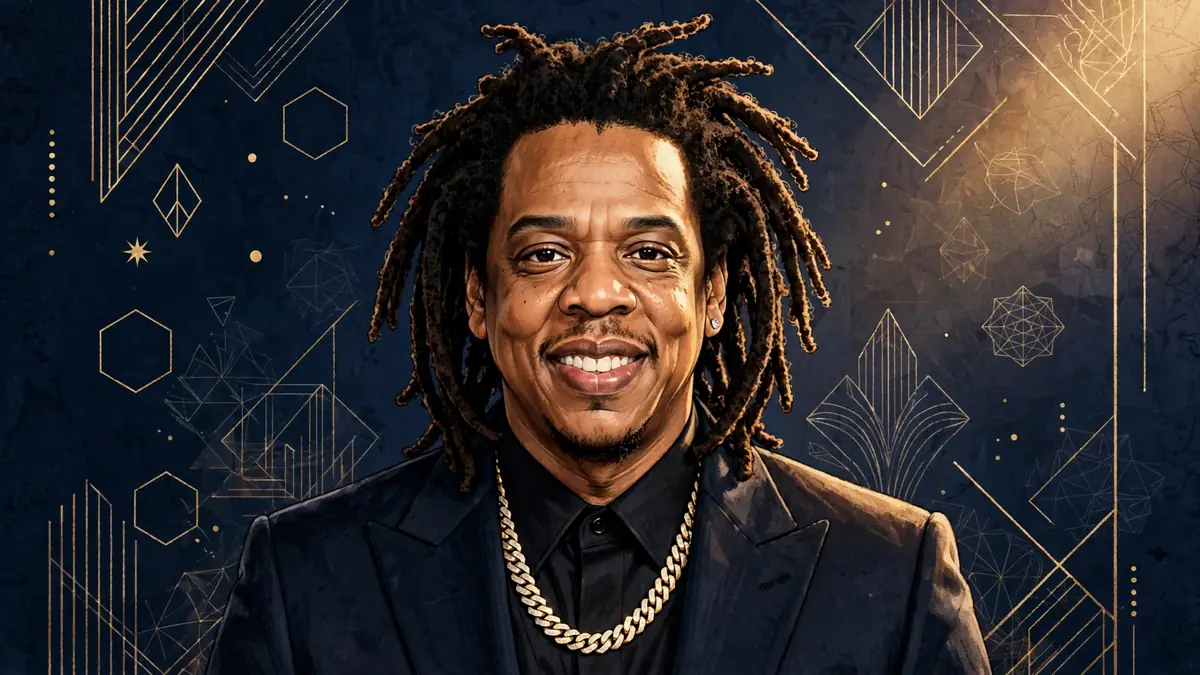
Quick Facts: Jay-Z at a Glance
| Full Name | Shawn Corey Carter |
|---|---|
| Stage Name | Jay-Z (stylized JAŸ-Z) |
| Date of Birth | December 4, 1969 (age 56 as of November 2026) |
| Birthplace | Brooklyn, New York City, New York, USA |
| Estimated Net Worth | About $2.8 billion as of 2026 — Forbes (March 2026) and Celebrity Net Worth (April 1, 2026) agree |
| Primary Income Sources | Music catalog and touring, Roc Nation, spirits equity (Armand de Brignac, D’Ussé), Tidal sale, investments |
| Key Ventures | Roc-A-Fella Records (co-founder, 1994), Roc Nation (founder, 2008), Rocawear, Tidal, 40/40 Club, MarcyPen Capital |
| Major Honours | 25 Grammy Awards; first rapper in the Songwriters Hall of Fame (2017); first living solo rapper in the Rock & Roll Hall of Fame (2021); four Emmy Awards |
| Spouse | Beyoncé (married 2008) |
| Children | Blue Ivy Carter, Rumi Carter, Sir Carter |
| Years Active | 1986–present |
Table of Contents
- Quick Facts: Jay-Z at a Glance
- Early Life in the Marcy Houses
- The Long Road to Reasonable Doubt
- Roc-A-Fella and the Breakthrough Years
- The Blueprint Era and the Def Jam Years
- Roc Nation and the Business Empire
- The Money: How the Fortune Was Built
- Net Worth Growth: From First Millions to Billions
- Real Estate, Art and the Assets Behind the Wealth
- Personal Life: Beyoncé, Family and Fatherhood
- Philanthropy and the Shawn Carter Foundation
- Controversies and Legal Battles
- Jay-Z in 2026: The Anniversary Year and What Comes Next
- Frequently Asked Questions
- Final Thoughts: The Marcy Blueprint
- Sources and Reporting
Early Life in the Marcy Houses
Shawn Corey Carter was born on December 4, 1969, in Brooklyn, New York City, and raised in the Marcy Houses, a public housing project in the Bedford-Stuyvesant neighbourhood. He was the youngest of four children born to Gloria Carter and Adnis Reeves. His father left the family when Shawn was eleven, a wound he would return to again and again in his lyrics — most plainly on “December 4th” from The Black Album, where his mother narrates his birth story over the beat.
The Marcy Houses shaped everything that followed. Carter has described a childhood spent between the playgrounds of the projects and the crack-era streets of 1980s Brooklyn, where he has said he sold drugs as a teenager before music gave him another way out. He attended Eli Whitney High School in Brooklyn and later George Westinghouse Career and Technical Education High School, where two of his classmates were future stars in their own right: Christopher Wallace, who became The Notorious B.I.G., and Trevor Smith, who became Busta Rhymes. The three teenagers were already trading rhymes in hallways and lunchrooms long before any of them had a record deal.
Music was in the house early. His mother bought him a boombox for his birthday, and he started writing rhymes to the instrumentals on the B-sides of records, memorising lyrics because he could not afford to write them down in the way other kids did. The nickname “Jazzy” — later shortened to Jay-Z — came from his neighbourhood, a nod to his mentor Jaz-O and to the J/Z subway lines that ran through his part of Brooklyn.
What set the young Carter apart was not just the writing. He had an unusual memory for lyrics, holding whole verses in his head without paper, and a business sense that showed up long before he had a business. When the labels said no, he did not keep knocking on the same door. He built his own door. That instinct — ownership over permission — would become the defining thread of his whole career.
The Long Road to Reasonable Doubt
Jay-Z began recording in the late 1980s as a protégé of Brooklyn rapper Jaz-O, appearing on Jaz-O’s tracks and learning the craft of the studio from the inside. His first recorded appearance came on “The Originators” in 1991, but the years that followed were a long grind of near-misses. He shopped demos to major labels and was turned down, again and again. The industry of the early 1990s did not know what to do with a rapper whose flow was conversational, whose references were dense with street economics, and who refused to play the gangsta caricature the labels were buying at the time.
Instead of waiting, Carter and two friends — Damon Dash, a Harlem hustler-turned-manager with a talent for promotion, and Kareem “Biggs” Burke — decided to release the music themselves. In 1994 they founded Roc-A-Fella Records, named after the Rockefeller family as a deliberate piece of branding: a kid from the projects claiming the name of American wealth for himself. The label had no distribution, no office to speak of, and no money beyond what the three partners could scrape together. What it had was a finished album.
Reasonable Doubt, released on June 25, 1996, through Roc-A-Fella with distribution by Priority Records, is now ranked among the greatest rap albums ever made. It did not sell in huge numbers on release — its reputation grew slowly, record by record, as listeners caught up to what Carter had done. The album introduced the mafioso rap persona that would define his early work: tailored suits, champagne, and the cold arithmetic of the drug trade, delivered with a calm that made the stories feel reported rather than performed. Guest spots from The Notorious B.I.G., Mary J. Blige, and Foxy Brown gave it weight, but the centre of the record was Carter’s voice — unhurried, precise, and already writing about money as a subject, not just a reward.
The album’s slow-burn path to classic status tells you something about Jay-Z’s career that the later billion-dollar headlines can hide: almost nothing he did arrived all at once. The acclaim, the sales, the wealth — each came a step behind the work itself. In 2025, Reasonable Doubt was inducted into the Grammy Hall of Fame, and in 2026 its thirtieth anniversary became the centrepiece of a year-long celebration. The record that once could not get a label deal is now treated as scripture.

Roc-A-Fella and the Breakthrough Years
The second Roc-A-Fella album, In My Lifetime, Vol. 1 (1997), arrived months after the murder of The Notorious B.I.G., a loss that shook Carter personally — the two had been close friends and collaborators. The album went platinum, but it was the third, Vol. 2… Hard Knock Life (1998), that made Jay-Z a mainstream star. Its title track sampled the musical Annie, a gamble that sounded absurd on paper and unstoppable on the radio. The album sold more than five million copies in the United States and won Jay-Z his first Grammy Award.
From there the run was relentless. Vol. 3… Life and Times of S. Carter (1999), The Dynasty: Roc La Familia (2000), and The Blueprint (2001) arrived in quick succession, each one tightening his grip on the culture. The Blueprint, released on September 11, 2001, is now widely treated as his masterpiece — recorded in a rush, built on soul samples from Kanye West and Just Blaze, and carrying the single “Izzo (H.O.V.A.)” into the mainstream. The Library of Congress later selected The Blueprint for the National Recording Registry, a rare honour for a hip-hop record.
Alongside the albums, Carter was building businesses. In 1999 he co-founded the clothing line Rocawear with Damon Dash, which grew into a major urban fashion brand with hundreds of millions in annual retail sales at its peak. In 2003 he co-founded the 40/40 Club, a chain of upscale sports bars, and bought into the New Jersey Nets, becoming a part-owner of an NBA franchise — a stake he would later sell when the team moved to Brooklyn and league rules barred him from holding both a team stake and his Roc Nation Sports agency. The pattern was already set: the music made the name, and the name was immediately put to work as capital.
The Black Album arrived in 2003, marketed as his retirement record. He was thirty-three, at the top of the rap world, and he walked away — or seemed to. The farewell tour ended at Madison Square Garden with a filmed concert, Fade to Black, and for two years the retirement held. It did not hold for long.
The Blueprint Era and the Def Jam Years
At the end of 2004, Jay-Z became president and chief executive officer of Def Jam Recordings, the label that had once been the centre of hip-hop and was then in need of direction. He held the post until the end of 2007, signing new acts — including a young Rihanna, whose first hit he helped steer — and overseeing the label’s roster from the executive chair. It was a remarkable turn for a man who had founded his own label a decade earlier because no major would sign him: he was now running one of the majors.
He came out of retirement with Kingdom Come in 2006, which debuted at number one, followed by American Gangster (2007), a concept album tied to the film of the same name, and The Blueprint 3 (2009), which carried the hit “Empire State of Mind” with Alicia Keys — a song that became an unofficial anthem of New York City. By the end of the decade he held the record for the most number-one albums by a solo artist on the Billboard 200, with fourteen in total, a record that still stands.
The 2010s brought the collaborations that closed out his imperial phase: Watch the Throne (2011) with Kanye West, a stadium-sized record that toured the world, and Magna Carta… Holy Grail (2013), which he released through a deal with Samsung that put the album in the hands of a million phone owners before it hit stores. Then came 4:44 (2017), the most personal record of his career — an album of apologies and admissions, recorded after his marriage to Beyoncé had been shaken by his infidelity, and released as a companion piece to her own Lemonade. Critics called it his most grown-up work. It earned him eight Grammy nominations and a new kind of respect: the rapper who had spent twenty years writing about money and power was now writing, plainly, about failure and repair.
The record that never left: In 2023, Billboard and Vibe ranked Jay-Z as the greatest rapper of all time. It was the first time the two publications had produced a joint all-time ranking, and they put the kid from Marcy at the top of it — ahead of every rival, every era, every style.
Roc Nation and the Business Empire
On April 1, 2008, Jay-Z founded Roc Nation, a full-service entertainment company built in partnership with Live Nation, with the intent of succeeding Roc-A-Fella as his main vehicle. He serves as chairman. What began as a record label and management firm grew into one of the most powerful companies in entertainment: artist management, publishing, touring, film and television, and a sports agency, Roc Nation Sports, that represents athletes across the NFL, NBA, and football. Its first signed artist was J. Cole, who went on to become one of the defining rappers of his generation under the Roc Nation banner.
Roc Nation’s reach now extends well past music. The company’s long-term partnership with the NFL, signed in 2019, put Jay-Z and his team at the centre of the Super Bowl halftime show — advising on and producing the performances that have become the biggest nights in American television. That role has since come full circle: in October 2026 the NFL, Apple Music, and Roc Nation announced that Jay-Z himself will headline the Super Bowl LXI halftime show on February 14, 2027, at SoFi Stadium in Los Angeles.
The business portfolio around Roc Nation is wide. The Rocawear intellectual property was sold to Iconix Brand Group in 2007 for $204 million in cash, with up to $35 million more in stock tied to performance. He co-founded the streaming service Tidal in 2015, buying the platform for roughly $56 million and relaunching it with a group of artist co-owners; Sprint bought a 33 percent stake for $200 million in 2017, and Block Inc. (formerly Square) bought a majority stake in 2021 for $297 million in cash and stock, with Jay-Z joining Block’s board. His investment firm, MarcyPen Capital Partners, backs early-stage companies, and his stakes have included shares in Block and Uber. In late 2026, reports emerged that MarcyPen was in talks to buy luxury group LVMH’s 50 percent stake in Fenty Beauty — no deal had been signed or announced as of late October 2026, and the reports remain unconfirmed by the parties involved.
The two deals that did the most for the fortune were the spirits sales. He bought into Armand de Brignac champagne — “Ace of Spades” — in 2006 and took full ownership in 2014, then sold half the brand to LVMH in 2021 in a deal Forbes estimated was worth at least $315 million to him, valuing the brand at about $630 million. In 2023 he sold a majority of his stake in D’Ussé cognac to Bacardi for a reported figure of about $750 million, at a brand valuation of roughly $3 billion, according to Celebrity Net Worth. Forbes has said plainly that since he became hip-hop’s first billionaire in 2019, his fortune has nearly tripled “thanks in large part to his lucrative liquor businesses.”
The Money: How the Fortune Was Built
The first thing to understand about Jay-Z’s wealth is how little of it comes from rap itself. Forbes has put his music catalog at roughly $75 million of the total — a real number, but a small slice of a fortune measured in billions. The money was made the way the lyrics said it would be: by owning things, not just performing on them. The breakdown below follows Forbes’ reporting and the disclosed deal values behind it.
| Wealth Source | Estimated Value / Deal |
|---|---|
| Spirits (Armand de Brignac + D’Ussé) | Largest category; Forbes and Celebrity Net Worth reporting puts the combined spirits value at well over $1 billion, built on the LVMH half-sale (2021) and the Bacardi D’Ussé sale (2023, about $750 million) |
| Roc Nation | Entertainment company founded 2008; label, management, publishing, touring, film/TV and sports agency — a core holding, not separately valued in public estimates |
| Music catalog and royalties | About $75 million, per Forbes’ 2019 breakdown — under 4 percent of the total fortune |
| Tidal | Bought for about $56 million (2015); majority sold to Block for $297 million in cash and stock (2021) |
| Rocawear | IP sold to Iconix for $204 million cash (2007), plus up to $35 million in performance stock |
| Real estate | Portfolio valued above $300 million, per 2026 reporting — including the Bel Air mansion bought with Beyoncé in 2017 |
| Investments and art | Stakes in Block and Uber, early-stage bets via MarcyPen Capital, and a fine-art collection including works by Jean-Michel Basquiat, per Forbes |
For the full dated breakdown of how the $2.8 billion figure is put together, see our sister site’s money-focused profile: Jay-Z’s net worth in 2026 on NetWorthCraft walks through the Forbes and Celebrity Net Worth estimates deal by deal. The figure itself is an estimate, not a bank statement — private company stakes, art, and property have no daily ticker price, and Forbes values private holdings at a discount and subtracts a large sum for lifestyle costs before publishing its totals.
The touring money deserves its own note. Jay-Z has never been a constant road act — he tours in bursts, and the bursts are large. The 2026 Yankee Stadium run, three shows in July, grossed more than $42 million and sold 136,934 tickets, the highest-grossing three-show run by a rapper in history. Earlier tours, including the joint On the Run tours with Beyoncé, grossed hundreds of millions across their runs. But touring has always been the amplifier for Jay-Z, not the engine: the engine is equity.
Net Worth Growth: From First Millions to Billions
Celebrity Net Worth has tracked Jay-Z’s fortune since 2009, and its staircase shows the shape of the story better than any single number. The early millions came from records and Rocawear. The nine-figure jump came from the spirits and streaming deals of the 2010s and 2020s. The billion-dollar line was crossed in 2019, when Forbes named him hip-hop’s first billionaire — and the fortune has nearly tripled since, on the strength of the liquor exits.
| Year | Estimated Net Worth |
|---|---|
| 2009 | About $300 million (Celebrity Net Worth) |
| 2013 | About $500 million |
| 2017 | About $700 million |
| 2019 | About $930 million, then $1 billion — Forbes names him hip-hop’s first billionaire |
| 2022 | About $1.3 billion |
| 2023 | About $2 billion, after the D’Ussé sale to Bacardi |
| 2025 | About $2.5 billion |
| 2026 | About $2.8 billion — Forbes (March 2026) and Celebrity Net Worth (April 1, 2026) agree |
A note on the range: some outlets still carried the older $2.5 billion figure into early 2026, because Forbes’ real-time profile updates through the year. The current anchor is $2.8 billion, printed by Forbes in March 2026 and matched by Celebrity Net Worth in April 2026, and confirmed again on Forbes’ real-time profile in October 2026. Where dated prints disagree, the range is $2.5 billion to $2.8 billion; the most recent named prints agree on $2.8 billion.
How does he compare with the other musician billionaires on Forbes’ 2026 celebrity list? The gap is wide.
| Musician | Forbes 2026 Estimate |
|---|---|
| Jay-Z | About $2.8 billion — the richest musician in the world |
| Taylor Swift | About $2 billion |
| Bruce Springsteen | About $1.2 billion |
| Beyoncé | About $1 billion |
| Rihanna | About $1 billion |
| Dr. Dre | About $1 billion |
The comparison also shows why the combined Carter-Knowles household figure — about $3.8 billion on Forbes’ individual estimates — is often quoted and just as often misused. The two fortunes are separate. Beyoncé’s billion, built on touring and music, is hers; Jay-Z’s $2.8 billion is his. Neither figure includes the other’s assets.
Real Estate, Art and the Assets Behind the Wealth
Jay-Z and Beyoncé’s property portfolio is reported to be worth more than $300 million, and the centrepiece is the Bel Air mansion they bought in 2017 for $88 million — a modern compound with eight bedrooms, eleven bathrooms, four swimming pools, and a fifteen-car garage, set behind gates in one of Los Angeles’ most private neighbourhoods. The purchase was, at the time, one of the most expensive home sales in the city’s history.
The rest of the portfolio is spread across the coasts: a Tribeca penthouse in Manhattan bought in the mid-2000s, a home in the Hamptons, and property in New Orleans, among others. The homes are held the same way the rest of the fortune is held — quietly, through entities, with very little of the detail ever confirmed on the record. What is documented is the scale: this is a property collection in the hundreds of millions, not a single trophy house.
The art collection is the other asset that rarely makes the headlines but matters to the total. Forbes lists a fine-art collection including works by Jean-Michel Basquiat among his holdings, and Jay-Z has collected Basquiat for years — a through-line from his own lyrics, where Basquiat is a recurring reference, to his walls. Art, like the private company stakes, is valued by estimate rather than by sale, which is one more reason the $2.8 billion figure is best read as a careful approximation rather than a precise balance.
The cars have always been part of the image, from the Maybachs of the Blueprint era to the Rolls-Royces of the later years, but they are a rounding error next to the equity stakes. The same is true of the 40/40 Club and the other smaller holdings: real businesses, real revenue, and a small share of a fortune built on selling half of a champagne house and most of a cognac brand.
Personal Life: Beyoncé, Family and Fatherhood
Jay-Z and Beyoncé began dating in the early 2000s, after collaborating on the hit “03 Bonnie & Clyde” in 2002, and married in a private ceremony on April 4, 2008, at his Tribeca penthouse. They are, by any measure, the most powerful couple in music — and also one of the most private. The wedding had no press, no photographs, and no announcement for days. That privacy has been a deliberate strategy ever since: the family appears on its own terms, in its own work.
Their first child, Blue Ivy Carter, was born on January 7, 2012. She has already appeared on her parents’ records — credited as a featured artist on “Brown Skin Girl” at the age of seven, and later winning a Grammy of her own as a songwriter — and has joined her mother on stage during the Renaissance and Cowboy Carter tours. Twins Rumi and Sir Carter were born on June 13, 2017. Rumi has also appeared on Beyoncé’s recent work, including a feature on Cowboy Carter.
Fatherhood changed the subject matter of Jay-Z’s music in a way that is easy to hear across his later albums. 4:44 is, among other things, a record about being a father and a husband who failed and tried to repair it — an unusually public admission from an artist who had spent two decades projecting control. He has spoken in interviews about the therapy he undertook with Beyoncé, and about the work of staying present for his children while running companies that never stop. The family lives mainly between Los Angeles and New York, and the children are kept out of the press as far as two of the most famous parents on earth can manage it.
His mother, Gloria Carter, remains a central figure in his life and his public work — the co-founder of the Shawn Carter Foundation, and the subject of “Smile” on 4:44, in which Jay-Z raps about his mother’s sexuality and her life in the open for the first time. His father, Adnis Reeves, died in 2003; the two had reconciled before his death, and Jay-Z has said the reconciliation was one of the most important things he ever did.
Philanthropy and the Shawn Carter Foundation
In 2002, Jay-Z founded the Shawn Carter Foundation with his mother, Gloria Carter, to increase access to higher education for students facing socioeconomic hardship. The foundation provides scholarships, college tours, and support for young people from backgrounds like his own, and it has raised millions through its annual galas and partnerships. It is the longest-running piece of his public life outside music — older than Roc Nation, older than the billionaire headlines — and it is the one he talks about with the least self-promotion.
The foundation’s work is the quiet side of a philanthropic record that also includes Roc Nation’s social justice arm, Team Roc, which has campaigned on criminal justice reform, funded legal support in high-profile cases, and taken out newspaper advertisements calling for reform in the wake of police killings. Jay-Z has also supported education and water-access causes in Africa, and he and Beyoncé have given to disaster relief and housing efforts. The giving is real, and it is also — like the business career — organised through institutions he controls, rather than one-off cheques.
It is worth saying plainly: philanthropy is a small share of the story of a $2.8 billion fortune, and the foundation’s budgets are a fraction of the wealth it sits beside. But it is the part of the story that reaches back to Marcy most directly. The foundation’s scholarships go to kids from neighbourhoods like the one he left, and that, more than the champagne deals, is the through-line he himself keeps returning to.
Controversies and Legal Battles
No biography of Jay-Z is complete without the two legal episodes that have followed him, and both are matters of public record. In December 1999, he was involved in a stabbing incident at the Kit Kat Klub in New York, after a dispute with record executive Lance Rivera. Jay-Z pleaded guilty in 2001 to misdemeanor assault and was sentenced to three years’ probation. He has addressed the incident in his music since, including on “The Story of O.J.”, and the case is long closed.
In December 2024, a civil lawsuit was filed accusing Jay-Z and Sean “Diddy” Combs of sexually assaulting a thirteen-year-old girl at a party in 2000. Jay-Z denied the allegations forcefully and publicly, calling them a blackmail attempt, and his lawyers moved to dismiss the case. The lawsuit was voluntarily dismissed in February 2025. The accuser’s lawyer withdrew the claim, and no criminal charges were ever filed. The episode is included here because it was widely reported and because readers searching for Jay-Z’s biography in 2026 will find it — the record is that the claim was made, denied, and dismissed.
There have been other, smaller storms: the long-running feud with Nas, settled on record with “Black Republican” in 2006; the falling-out with Damon Dash and the split of Roc-A-Fella in the mid-2000s, which ended a partnership and a friendship; the public criticism of the Tidal artist payouts, including Nicki Minaj’s 2025 complaint that she was offered far less than she believed her stake was worth when Block bought the company. None of these dented the career. The Dash split, in particular, is worth understanding: it was the moment Jay-Z chose the corporate structure — Roc Nation, Live Nation, the boardroom — over the street-level partnership that had built Roc-A-Fella, and it set the direction of everything that followed.
Jay-Z in 2026: The Anniversary Year and What Comes Next
2026 has been a victory lap with receipts. The year-long “JAY-Z 30” celebration marked thirty years of Reasonable Doubt and twenty-five years of The Blueprint, with pop-ups, subway takeovers, limited vinyl and merch, and an eight-part HBO docuseries rounding out the push. The centrepiece was live: three sold-out shows at Yankee Stadium on July 10–12, 2026, which grossed more than $42 million and sold 136,934 tickets — the highest-grossing three-show run by a rapper in history. Jay-Z broke the venue’s concert attendance record on the first night, then broke his own record the next night. Further sold-out shows followed in London, Paris, and Los Angeles.
The year also kept him in the producer’s chair for the biggest night in American television. Roc Nation has helped produce and select the Super Bowl halftime performers since 2019, and the 2026 show — Bad Bunny’s Super Bowl LX performance — won seven Emmy Awards, becoming the most decorated halftime show in history. Jay-Z himself is a four-time Emmy winner. Then, on October 26, 2026, the NFL, Apple Music, and Roc Nation announced that Jay-Z will headline the Super Bowl LXI halftime show himself, on February 14, 2027, at SoFi Stadium in Los Angeles — thirty years after Reasonable Doubt, on the biggest stage in music.
What comes next is, for the first time in years, a question with a public answer: a halftime show to prepare, an anniversary catalogue to keep selling, and a business empire — Roc Nation, MarcyPen, the remaining spirits stakes — that no longer needs him in the studio to grow. He has not announced a new album, and he has not needed to. The story of Jay-Z’s career has always been that the music opens the door and the ownership walks through it. In 2026, at fifty-six, he is still walking through doors he built himself.
Frequently Asked Questions
Who is Jay-Z?
Jay-Z is the stage name of Shawn Corey Carter, born December 4, 1969, in Brooklyn, New York. He is a rapper, songwriter, record executive, and businessman — ranked the greatest rapper of all time by Billboard and Vibe in 2023, a 25-time Grammy winner, and the founder of Roc-A-Fella Records and Roc Nation.
What is Jay-Z’s net worth in 2026?
Jay-Z’s estimated net worth is about $2.8 billion as of 2026, according to both Forbes (March 2026) and Celebrity Net Worth (April 1, 2026). That makes him the wealthiest music artist in history. Some older prints still show $2.5 billion, so the dated range is $2.5 billion to $2.8 billion, with the most recent named sources agreeing on $2.8 billion.
How old is Jay-Z?
Jay-Z was born on December 4, 1969, which makes him 56 years old as of November 2026. He turns 57 on December 4, 2026.
How did Jay-Z become a billionaire?
Forbes named Jay-Z hip-hop’s first billionaire in 2019. Music was only a small part of it — his catalog is worth roughly $75 million by Forbes’ count. The fortune was built on ownership: the Armand de Brignac champagne brand (half sold to LVMH in 2021), D’Ussé cognac (a majority stake sold to Bacardi in 2023 for a reported $750 million), Roc Nation, the Tidal sale to Block, the Rocawear sale, real estate, and investments.
Is Jay-Z married to Beyoncé?
Yes. Jay-Z and Beyoncé married in a private ceremony on April 4, 2008. They have three children: Blue Ivy Carter (born January 7, 2012) and twins Rumi and Sir Carter (born June 13, 2017). Forbes estimates Beyoncé’s own fortune separately at about $1 billion.
How many Grammy Awards has Jay-Z won?
Jay-Z has won 25 Grammy Awards from 89 nominations, according to the Recording Academy. He is also a four-time Emmy winner, the first rapper inducted into the Songwriters Hall of Fame (2017), and the first living solo rapper inducted into the Rock and Roll Hall of Fame (2021).
What is Jay-Z doing in 2026?
2026 is his “JAY-Z 30” anniversary year, marking 30 years of Reasonable Doubt and 25 years of The Blueprint. He played three record-breaking sold-out shows at Yankee Stadium in July 2026, grossing more than $42 million, and in October 2026 it was announced he will headline the Super Bowl LXI halftime show on February 14, 2027, at SoFi Stadium in Los Angeles.
Where did Jay-Z grow up?
Jay-Z grew up in the Marcy Houses, a public housing project in the Bedford-Stuyvesant neighbourhood of Brooklyn, New York. He was raised mostly by his mother, Gloria Carter, after his father left the family when he was eleven. The Marcy Houses remain the setting and subject of much of his best-known music.
Final Thoughts: The Marcy Blueprint
Jay-Z’s biography is usually told as a rags-to-riches story, and it is one — but the riches are the least interesting part of it. The interesting part is the method. He was turned down by every major label, so he founded his own. He was offered a retirement, so he took the executive chair instead. He was handed a streaming service, a champagne brand, and a cognac label, and he sold them at the top. At every turn, the move was the same: own the thing, don’t rent it.
That is why the $2.8 billion figure, for all the headlines it generates, is almost a footnote to the life. The fortune is the receipt, not the story. The story is a kid from the Marcy Houses who memorised his own lyrics because he had no paper, who built a label because nobody would sign him, who ran Def Jam because he had already run his own, and who, thirty years after his debut album, is headlining the Super Bowl. Billboard and Vibe called him the greatest rapper of all time. The numbers — twenty-five Grammys, fourteen number-one albums, $2.8 billion — agree. The Marcy Houses are still there. So is he.
Sources and Reporting
This biography was researched from live reporting and reference sources in November 2026, including Forbes, Celebrity Net Worth, Wikipedia, AllMusic, Billboard, Rolling Stone, Ebony, Hypebeast, Variety, The Recording Academy, and Parade. Net worth figures are third-party estimates based on disclosed transactions and reported valuations, not audited financials.
How we estimated: the headline figure of about $2.8 billion is anchored to Forbes’ March 2026 celebrity-billionaire reporting and Celebrity Net Worth’s April 1, 2026 listing, which agree. Older prints of $2.5 billion are noted where they appear, and the dated range ($2.5 billion–$2.8 billion) is given rather than a single false-precision number. Deal values (the LVMH and Bacardi sales, the Tidal and Rocawear exits) are reported figures from named outlets, not valuations we calculated ourselves. Private holdings such as art and real estate are estimated by the sources cited, and the true figure may differ from any published estimate. Figures are current as of November 8, 2026.