Chris Rock is one of the most influential comedians alive — a stand-up who rewrote what a comedy special could say, a three-time Oscar host, a film director, and the creator of one of the best-loved sitcoms of the 2000s. Born Christopher Julius Rock on February 7, 1965, in Andrews, South Carolina, and raised in the Bedford-Stuyvesant neighbourhood of Brooklyn, he has spent four decades turning sharp observations about race, money, family and fame into some of the most quoted routines in comedy history.
As of November 2026, Chris Rock is 61 years old and his estimated net worth sits at $60 million, anchored to Celebrity Net Worth’s 2026 figure (last updated March 2, 2026), with a few smaller outlets putting the total as high as $75 million. That fortune was built the hard way: decades of touring, a $40 million Netflix deal, blockbuster film roles, and a television empire — then cut down by a divorce settlement reported at around $40 million. This biography traces the whole arc, from a bullied Brooklyn schoolboy who dropped out at 17 to the comic who walked back on stage at the Oscars and refused to flinch.
By Celebamerica Editorial Staff | Last updated: November 14, 2026
Chris Rock at a Glance: Quick Facts
| Full Name | Christopher Julius Rock III |
|---|---|
| Date of Birth | February 7, 1965 |
| Birthplace | Andrews, South Carolina, United States (some sources list nearby Georgetown, South Carolina) |
| Age in 2026 | 61 years old |
| Height | 5 feet 10 inches (1.78 m) |
| Occupations | Stand-up comedian, actor, writer, producer, film director |
| Years Active | 1984–present |
| Estimated Net Worth | $60 million (Celebrity Net Worth, 2026; some outlets as high as $75 million) |
| Primary Income Sources | Stand-up tours, Netflix specials, film and television roles, writing, producing and directing |
| Breakthrough | Bring the Pain (HBO, 1996) |
| Signature Works | Saturday Night Live (1990–1993), Bring the Pain, The Chris Rock Show, Everybody Hates Chris, Madagascar (voice of Marty), Top Five, Good Hair |
| Major Awards | 3 Grammy Awards (Best Comedy Album), 4 Primetime Emmy Awards, Golden Globe nomination |
| Spouse | Malaak Compton-Rock (married 1996, divorced 2016) |
| Children | Two daughters, Lola Simone and Zahra Savannah |
| Residence | Alpine, New Jersey |
Table of Contents
- Early Life: Andrews, South Carolina to Bed-Stuy, Brooklyn
- First Gigs: Catch a Rising Star and Eddie Murphy
- Saturday Night Live: The Bad Boys Era
- Bring the Pain: The Special That Changed Stand-Up
- Film and Television: From the Big Screen to Everybody Hates Chris
- Behind the Camera: Directing and Good Hair
- The Money: Net Worth, Netflix and the Divorce
- Net Worth Timeline: How the Fortune Grew
- Real Estate and Assets
- Personal Life: Family, Marriage and Divorce
- The 2022 Oscars Slap
- Chris Rock in 2026: Misty Green and What Comes Next
- How Chris Rock Compares to His Comedy Peers
- Frequently Asked Questions
- The Bottom Line
- Sources and How We Estimated
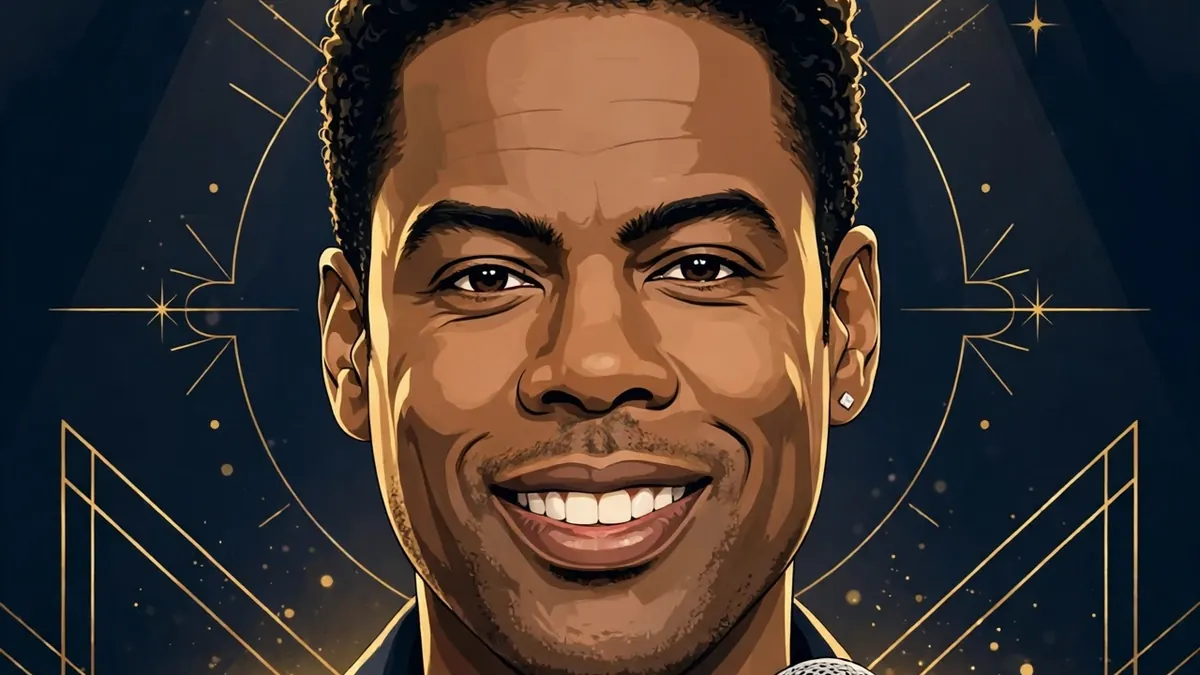
Early Life: Andrews, South Carolina to Bed-Stuy, Brooklyn
Christopher Julius Rock was born on February 7, 1965, in Andrews, South Carolina, a small town in Georgetown County. A few reference works list Georgetown, the county seat a short drive away, as his birthplace — a mix-up that still trips up half the internet — but Wikipedia and IMDb both record Andrews, and that is the figure used here. He was the eldest of seven children born to Julius Rock, a truck driver and newspaper deliveryman whose own father had been a preacher, and Rosalie Tingman Rock, a teacher and social worker who worked with mentally handicapped children. The family moved north while Chris was still young, settling in Bedford-Stuyvesant, Brooklyn, then one of New York’s toughest neighbourhoods.
Bed-Stuy in the 1970s and early 1980s was not an easy place to grow up, and Rock has talked openly about how hard those years were. He was bused to a mostly white elementary school, P.S. 22, where he was bullied and beaten by other children because of his race — an experience he later mined for comedy in Everybody Hates Chris, the sitcom built directly from his childhood. The show’s premise was not invented for television: the young Chris really did ride the bus across Brooklyn to a school where he did not belong, really did get picked on, and really did come home to a crowded house where money was tight and his parents held the family together with discipline and humour.
School never suited him. Rock dropped out of high school at 17, though he later earned his high-school-equivalency diploma. What he had instead of grades was an ear: he listened to the preachers, the street-corner arguers and the comics on his parents’ record player, and he started to notice how a well-timed line could flip a room. His father, Julius, died in 1988, just as Chris’s career was beginning to move — a loss that has shadowed his work ever since, including the way he writes about fathers and family. In 2008, the PBS series African American Lives 2 profiled Rock’s family history, and a DNA test traced his ancestry to Cameroon, specifically the Udeme people of the country’s north.
The early years matter because they explain the comedy. Rock’s best material has always been observational in the plainest sense: he watched how people actually lived, how race shaped everyday exchanges, how money changed behaviour, and he reported it back with jokes that landed because they were true before they were funny. That eye was formed on the streets of Bed-Stuy and in the bus rides across Brooklyn, long before anyone paid him to hold a microphone.
First Gigs: Catch a Rising Star and Eddie Murphy
Rock began performing stand-up in New York clubs in 1984, when he was 19. The rooms were small, the pay was often nothing, and the crowds were not always kind. His early sets borrowed from the greats — Richard Pryor and George Carlin above all — but the delivery was his own: a preacher’s cadence, a street-corner debater’s timing, and a willingness to say the thing the room was thinking but would not say out loud.
The break came at Catch a Rising Star, the Manhattan club where a young comic could be spotted by the right person on the right night. Eddie Murphy was in the audience one evening, liked what he saw, and took Rock under his wing. Murphy was then the biggest comedy star on the planet, and his backing opened doors that years of open mics never could. He gave Rock his first film role — a small part as a valet at the Playboy Mansion in Beverly Hills Cop II (1987) — and, just as importantly, he gave him a model for how a Black comic could build a career that ran from the stage to the screen and back again.
Rock spent the rest of the 1980s grinding: club dates, small television spots, and his first comedy album, Born Suspect, released in 1991. He also picked up film work where he could, including a sharp turn in New Jack City (1991) as Pookie, a crack addict whose scenes still get cited as one of the rawest performances of his career, and the lead in the rap parody CB4 (1993). None of it made him rich. All of it made him ready.
Saturday Night Live: The Bad Boys Era
In 1990, Rock joined the cast of NBC’s Saturday Night Live, arriving as part of a new wave of young performers brought in to revive a show that had gone stale. Alongside Chris Farley, Adam Sandler, Rob Schneider and David Spade, he became one of the so-called “Bad Boys of SNL” — a group whose energy and youth pulled the programme back to life in the early 1990s. Rock stayed for three seasons, from 1990 to 1993, and the run gave him something no club date could: a national audience that knew his face and his name every Saturday night.
He was never entirely comfortable inside the sketch format, and he has said so since. SNL’s writers’ room was not built for a comic whose strength was a solo voice on a bare stage, and Rock often felt his best material was being bent to fit other people’s sketches. Still, the exposure was priceless. His recurring characters — including Nat X, the militant host of a talk show that lampooned Black nationalist rhetoric — showed a comic willing to make audiences laugh at ideas they were afraid to touch. The SNL years also locked in the friendships that would shape his film career: his bond with Adam Sandler, forged on that stage, would later carry him into The Longest Yard and the Grown Ups films, two of the biggest paydays of his acting career.
When he left SNL after the 1992–93 season, he did what few cast members dared: he walked away from the safest job in comedy to bet on himself. He spent a season on Fox’s In Living Color in 1993, but that show was cancelled soon after he arrived, and for a while it looked like the bet might not pay off. Rock was a recognisable face with no obvious next step — a household name who could not get a special, a sitcom, or a film lead. The years between SNL and his comeback are the least glamorous part of his story, and the most instructive: he went back to the clubs, rebuilt his act from scratch, and waited for the material to catch up with the ambition.
Bring the Pain: The Special That Changed Stand-Up
The comeback arrived in 1996, when HBO filmed Chris Rock: Bring the Pain. The special was a detonation. Rock took on race, relationships, money and politics in a single hour, with bits — about the difference between Black people and a certain other group he refused to name politely, about the price of a good marriage, about the way America talks about race when it thinks nobody is listening — that became part of the language. It won him two Primetime Emmy Awards, made him one of the most popular comedians in America overnight, and is still cited as one of the finest stand-up hours ever recorded.
What made Bring the Pain different was not just the jokes but the nerve behind them. Rock was saying things on a premium cable stage that network television would not have touched, and he was saying them to a mixed audience that laughed because the observations were precise, not because they were comfortable. The special reset his career and, in the view of many comics who followed, reset the form itself: after 1996, the idea that a stand-up special could be a cultural event — appointment viewing, quoted for years — became the standard every major comic chased. Comedy Central later ranked Rock No. 5 on its list of the 100 greatest stand-ups of all time, and Rolling Stone placed him at No. 5 on its list of the 50 best stand-up comics of all time.
HBO knew what it had. Rock followed with a three-year run as host of The Chris Rock Show (1997–2000), a late-night talk show that won him another Emmy and let him range across interviews, sketches and stand-up in a single hour. He also served as a correspondent on Bill Maher’s Politically Incorrect during the 1996 presidential race, a gig that suited his habit of treating politics as raw material rather than a sermon. His book Rock This! became a New York Times bestseller, and by the end of the decade he was no longer a comic trying to be heard — he was a comic other comics studied.
The specials kept coming, and each one kept the standard high: Bigger & Blacker (1999), Never Scared (2004), Kill the Messenger (2008), Tamborine (2018) for Netflix, and Selective Outrage (2023), Netflix’s first live-streamed comedy special. The through-line across nearly thirty years of specials is consistency: Rock never stopped touring, never stopped writing new material, and never let the acting career swallow the stand-up. The stage is where the money started, and it is still where his reputation is made.
Film and Television: From the Big Screen to Everybody Hates Chris
Rock’s film career runs in parallel with his stand-up, and it is longer and more varied than most people remember. After the early roles in Beverly Hills Cop II, New Jack City and CB4, he built a steady run of supporting parts that showed range: a fallen angel in Kevin Smith’s Dogma (1999), a detective’s son in Lethal Weapon 4 (1998), and a hitman with a conscience in Nurse Betty (2000). He carried his first leading-man comedy, Down to Earth (2001), and followed it with Head of State (2003), which he also directed.
The mid-2000s were his peak as a box-office draw. He joined Adam Sandler in The Longest Yard (2005), a remake that took in more than $190 million worldwide, and the same year he voiced Marty the zebra in DreamWorks’ Madagascar — a role he would return to in two sequels and a string of spin-offs, and one that introduced him to an entire generation of children who had never seen a stand-up special. The Madagascar films grossed well over $2 billion combined across the franchise, and Rock’s voice work on them remains some of his most widely heard performing.
But the project that defined his television legacy was the one he built from his own childhood. Everybody Hates Chris, which ran on UPN and The CW from 2005 to 2009, was developed, written and produced by Rock, who also narrated every episode as the adult Chris looking back on his teenage years in Bed-Stuy. The show turned the bullying, the bus rides, the strict father and the loving mother into a warm, sharp sitcom that won a Golden Globe nomination and a devoted audience — and it proved Rock could build a hit that had nothing to do with a microphone. In 2024, the story came back as an animated series, Everybody Still Hates Chris, with Rock again narrating, a rare second life for a sitcom nearly twenty years after it first aired.
The later filmography kept widening: Death at a Funeral (2010), the Grown Ups films (2010 and 2013) alongside Sandler, Top Five (2014), the Saw spin-off Spiral (2021), David O. Russell’s Amsterdam (2022), and a supporting turn in the Netflix biopic Rustin (2023). On television, his most dramatic role came in 2020, when he played Loy Cannon, a Black crime boss in 1950s Kansas City, in the fourth season of FX’s Fargo — a performance that earned him some of the best dramatic reviews of his career and showed a side of him the comedy world had not seen before.
Behind the Camera: Directing and Good Hair
Rock has always been as interested in making the thing as in starring in it. He directed his first feature, Head of State, in 2003, playing a Washington alderman who runs for president after a freak accident — a broad political comedy that let him put his own obsessions about race and power on screen. He followed it with I Think I Love My Wife (2007), a remake of Éric Rohmer’s Chloe in the Afternoon, and then with the film many critics consider his best work as a director: Top Five (2014), a smart, funny, quietly sad portrait of a comedian trying to be taken seriously as an actor, with Rock playing a version of himself and directing a cast that included Rosario Dawson, Gabrielle Union and Cedric the Entertainer. Top Five premiered at the Toronto International Film Festival to warm reviews and is now the film most often cited when people argue that Rock’s talent as a filmmaker has been underrated.

His most successful work behind the camera, though, may be a documentary. Good Hair (2009), which Rock produced and hosted, explored the Black hair industry — its economics, its chemistry, its cultural weight — with a mix of interviews, hidden-camera salon visits and genuine curiosity. The film won a Special Jury Prize at the Sundance Film Festival and took in more than $4 million at the box office, a strong result for a documentary, and it showed Rock’s instinct for finding a subject everyone had an opinion about and nobody had properly examined. In 2026 he returned to directing with Misty Green, a film he wrote and directed and in which he also appears, released theatrically on October 9, 2026 — his first feature as a director in more than a decade.
Directing has never been a side hobby for Rock; it is the other half of his career. The stand-up made him famous, the acting made him rich, but the directing and producing — Everybody Hates Chris, Good Hair, Top Five — are the work that will outlast the tour dates. They are also the work that explains the money: a comic who only performs gets paid for the night, but a comic who owns the show gets paid for years.
The Money: Net Worth, Netflix and the Divorce
Chris Rock’s estimated net worth is $60 million as of 2026, according to Celebrity Net Worth, whose profile was last updated on March 2, 2026. That is the figure most 2026 outlets cite — Parade’s January 2026 profile uses the same number — and it is the anchor for this page. A few smaller sites put the total higher, around $75 million, so a fair range is $60–75 million, with $60 million the number the strongest sources agree on. Much larger figures — $100 million, $120 million, even $150 million — appear on lower-tier sites with no verifiable backing, and this page does not use them.
The headline number hides a more interesting story: Rock should be considerably richer than he is. Celebrity Net Worth itself notes that his fortune “could be much higher” but for a divorce settlement that cost him tens of millions — reportedly as much as $40 million — when his twenty-year marriage ended in 2016. That single payment, made at the peak of his earning power, is the reason his net worth has held roughly steady for a decade rather than climbing. For the full breakdown of that figure, including the divorce maths and the Netflix deal, see the detailed money page on our sister site: Chris Rock’s net worth on GuideNetWorth. NetWorthCraft covers the same fortune from a different angle in its own Chris Rock net worth profile.
The biggest single deal of his career came in 2016, when Netflix paid him $40 million for two comedy specials, according to The Hollywood Reporter. The first, Tamborine, arrived in 2018; the second, Selective Outrage, was released in March 2023 as Netflix’s first live comedy special. The deal made Rock one of the highest-paid stand-up comedians in the world and set the template for the streaming-era special: a nine-figure market in which a single hour from a proven headliner could command a fee that once belonged only to film stars.
Forbes tracked the peak. Between June 2016 and June 2017, the magazine reported that Rock earned $53 million, making him the second-highest-paid comedian in the world during that span; Celebrity Net Worth puts the same window at roughly $60 million. Either way, it was the richest single year of his career, fuelled by the Netflix deal and the Total Blackout tour that followed it. He had been on the Forbes Celebrity 100 before — debuting in 2009 with an estimated $42 million in annual earnings — but 2016–17 was the year the touring, the streaming money and the brand all landed at once.
Touring remains the engine. Rock has toured almost continuously since the 1990s, and a headliner of his stature can command high six-figure fees per arena date, with merchandising and VIP packages on top. His Ego Death world tour ran through 2022 and 2023, playing theatres and arenas across North America and Europe, and he has kept up a steady run of dates since. Film and television pay differently — voice work on the Madagascar franchise, ensemble paydays on the Grown Ups films, his Fargo salary — but the stand-up is the base: it is the income stream no studio, network or streamer can take away, because it belongs to him and the audience in the room.
Then there is the deal that got away. In a 2026 interview covered by AfroTech, Rock revealed that Eddie Murphy beat him to the role of Donkey in Shrek — a part that would have paid him for a franchise that went on to gross billions. “I’m out of $30 million just cause Eddie went downstairs,” Rock said, describing how Murphy took the role after hearing about it first. It is a story Rock tells with a laugh, but it is also a window into how he thinks about money: the fortune is real, the missed fortune is part of the story, and the joke is the only way to tell it.
Net Worth Timeline: How the Fortune Grew
| Year | Milestone | Money Detail |
|---|---|---|
| 1984–1990 | Club circuit, Catch a Rising Star, first film role | Small club fees; early career earnings minimal |
| 1990–1993 | Saturday Night Live cast member | Network salary; national exposure |
| 1996 | Bring the Pain (HBO) | Two Emmys; breakout special resets his market value |
| 1997–2000 | The Chris Rock Show (HBO) | Talk-show salary; another Emmy |
| 2005 | The Longest Yard, Madagascar, Everybody Hates Chris | Box-office and TV money arrive together |
| 2009 | Forbes Celebrity 100 debut | Estimated $42 million earned that year |
| 2016 | Netflix deal signed | $40 million for two specials (The Hollywood Reporter) |
| 2016–2017 | Peak earning year | $53 million (Forbes); roughly $60 million (Celebrity Net Worth) |
| 2016 | Divorce from Malaak Compton-Rock finalised | Reported settlement of around $40 million |
| 2018 | Tamborine (Netflix) | First special under the Netflix deal |
| 2023 | Selective Outrage (Netflix, live) | Second special under the Netflix deal |
| 2026 | Misty Green released; touring continues | Estimated net worth $60 million (Celebrity Net Worth) |
Real Estate and Assets
Rock’s best-known asset is his home in Alpine, New Jersey, a wealthy borough in Bergen County that has long been a haven for celebrities who want Manhattan within reach and privacy the rest of the time. He bought the property in 2001, and it has been his base ever since — the house he came home to after tours, the house his daughters grew up in, and the house that featured in the divorce proceedings when the marriage ended. Alpine’s property values have climbed steadily over the past two decades, so the home is likely worth several times what he paid for it, though no public record states a current valuation and this page does not guess at one.
Beyond the house, Rock’s assets are the kind that do not show up in property records: the rights to his specials, his share of Everybody Hates Chris and its animated revival, his directing fees, and a touring business that has run profitably for thirty years. He has never been a flashy spender by celebrity standards — no yacht stories, no car collection splashed across magazines — and the public record shows a career built on owning his work rather than collecting things. That is consistent with the numbers: a $60 million fortune that survived a $40 million divorce is the fortune of someone who kept earning, not someone who kept buying.
Personal Life: Family, Marriage and Divorce
Rock married Malaak Compton in 1996. Compton, a former UNICEF worker who later founded the style and image consultancy StyleWorks, was a steady presence through the busiest years of his career, and the couple had two daughters together: Lola Simone, born in 2002, and Zahra Savannah, born in 2004. For two decades the marriage looked, from the outside, like one of the steadier unions in comedy — which is why its end, when it came, surprised so many people.
The divorce was finalised in August 2016, after Rock filed in late 2014. Celebrity Net Worth reports that he gave up tens of millions in the settlement — reportedly as much as $40 million — and the split was widely covered at the time. Rock has addressed the marriage and its end in his stand-up since, with the candour that has always been his trademark: he has joked about the cost, about his own part in the breakdown, and about what twenty years of marriage teaches a person. The material is funny because it is unsparing, including about himself.
Since the divorce, Rock has kept his private life mostly private. He has been linked publicly to actress Megalyn Echikunwoke, with whom he had a relationship that ended in 2020, and to other partners since, but he does not parade his relationships, and this page does not speculate about them. What the record shows is a father who has stayed close to his daughters, a son who lost his father young, and a man whose family — the Bed-Stuy household he grew up in, the one he built with Malaak, and the one he has now — has been the raw material for most of his best work. His current age and the maths of his life are covered in full on our own site’s Chris Rock age page.
The 2022 Oscars Slap
On March 27, 2022, Chris Rock was presenting the award for Best Documentary Feature at the 94th Academy Awards — his third time hosting or presenting at the ceremony, having hosted in 2005 and 2016 — when he made a joke about Jada Pinkett Smith’s shaved head, comparing her to G.I. Jane. Pinkett Smith, who has alopecia, did not laugh. Her husband, Will Smith, walked onto the stage, struck Rock across the face, returned to his seat and shouted at him to keep his wife’s name out of his mouth. Rock, stunned, kept the show moving. Minutes later, Smith won the Best Actor award for King Richard and gave a tearful speech; the Academy later banned him from its events for ten years.
The slap became one of the most-watched moments in television history, and it put Rock in a position no comedian wants: the story was no longer his joke, it was someone else’s reaction to it. What followed said a lot about him. He did not press charges. He did not go on a press tour. He finished the tour dates he already had booked, and when he finally addressed the incident on stage, he did it in his own time and on his own terms — first with a few careful lines, then, a year later, with Selective Outrage, a full Netflix special built around the night, the reaction, and what it felt like to be hit in front of a billion people and keep going. The special was the most talked-about comedy hour of 2023, and it did something the headlines never could: it gave Rock the last word.
The incident also changed how people talk about him. Before 2022, Rock was a comedy elder statesman, respected and a little taken for granted. After it, he was something else — a comic who had absorbed the most public humiliation imaginable and answered it with work rather than revenge. The tour that followed sold out arenas, and the special’s numbers were strong enough that Netflix treated it as a flagship live event. Whatever the slap cost him in the moment, it did not cost him his career; if anything, it reminded a new generation why he mattered.
Chris Rock in 2026: Misty Green and What Comes Next
At 61, Rock is working as hard as ever. In 2025 he signed with WME (William Morris Endeavor) for representation across film, comedy tours, directing, books and other ventures — a move that signalled a new phase rather than a wind-down. The same year, he kept up a steady run of tour dates, and in 2026 he returned to directing with Misty Green, the film he wrote and directed and in which he also appears, released theatrically on October 9, 2026. It is his first feature as a director since Top Five in 2014, and it puts him back behind the camera at an age when most comics are coasting on old material.
The animated revival Everybody Still Hates Chris, which began in 2024, continues to run, with Rock narrating — a neat full circle for a show built from his childhood, now being discovered by viewers who were not born when the original aired. Between the film, the series and the tour, Rock’s 2026 looks less like a victory lap than a second act: a comic-director-producer who owns his catalogue, still writes new material, and still fills rooms. The money follows the work, as it always has. The fortune is $60 million today because the work never stopped.
How Chris Rock Compares to His Comedy Peers
Rock’s $60 million puts him in the middle of the comedy rich list — far behind the moguls who turned stand-up into business empires, and far ahead of most working comics. The comparison is instructive, because it shows what different careers buy. Dave Chappelle, Rock’s closest peer in influence, is reported by Celebrity Net Worth at around $75 million — a similar figure built on a similar base of specials and touring, though Chappelle’s Netflix deal was larger. Kevin Hart, a generation younger, is reported at roughly $450 million, a fortune built not just on stand-up but on a production company, a media empire and a relentless output of films. Adam Sandler, Rock’s old SNL running mate, sits at a reported $440 million on the back of his Netflix film deals and Happy Madison productions. Eddie Murphy, the mentor who discovered Rock, is reported at $200 million. And Jerry Seinfeld, the outlier who turned a sitcom into a near-billion-dollar fortune, is reported at around $950 million.
| Comedian | Reported Net Worth (Celebrity Net Worth, 2026) | Built On |
|---|---|---|
| Chris Rock | $60 million | Stand-up, Netflix specials, film, TV, directing |
| Dave Chappelle | ~$75 million | Stand-up, Netflix specials, touring |
| Eddie Murphy | $200 million | Film franchises, stand-up, voice work |
| Adam Sandler | ~$440 million | Netflix films, Happy Madison, touring |
| Kevin Hart | ~$450 million | Film, touring, Hartbeat production company |
| Jerry Seinfeld | ~$950 million | Seinfeld syndication, touring, Netflix |
The gap between Rock and the top of that table is not a gap in talent — on any honest ranking of stand-up craft, Rock sits at or near the top. It is a gap in business models. Seinfeld owned a sitcom that ran in syndication forever; Hart built a company; Sandler signed a multi-film Netflix deal that turned him into a studio. Rock’s fortune is the fortune of a performer who kept the stage at the centre and added directing and producing around it, rather than turning himself into a corporation. The $40 million divorce is the other half of the gap: without it, the number would look very different. For readers who want more lives in this vein, our celebrity biography archive covers the same treatment for the comics and stars who shaped the same era.
The one number to remember: $60 million, anchored to Celebrity Net Worth’s March 2026 update, with a fair range of $60–75 million. Everything else in this biography — the $40 million Netflix deal, the $53 million peak year, the $40 million divorce — is the story of how that number was built, cut down, and rebuilt.
Frequently Asked Questions
What is Chris Rock’s net worth in 2026?
Chris Rock’s estimated net worth is $60 million as of 2026, according to Celebrity Net Worth, whose profile was last updated on March 2, 2026. Some smaller outlets put the figure as high as $75 million, so a fair range is $60–75 million. The total was shaped by a $40 million Netflix deal and a divorce settlement reported at around $40 million in 2016.
How old is Chris Rock?
Chris Rock is 61 years old in 2026. He was born on February 7, 1965, in Andrews, South Carolina, and raised in Bedford-Stuyvesant, Brooklyn, New York.
How tall is Chris Rock?
Chris Rock is 5 feet 10 inches tall (1.78 m), according to IMDb. He is of average height for an American man, and his stage presence — the thing that fills arenas — has never depended on it.
Who was Chris Rock married to?
Chris Rock was married to Malaak Compton-Rock from 1996 to 2016. They had two daughters together, Lola Simone (born 2002) and Zahra Savannah (born 2004). The divorce was finalised in August 2016, with a settlement reported at around $40 million.
What happened between Chris Rock and Will Smith at the Oscars?
At the 94th Academy Awards on March 27, 2022, Rock made a joke about Jada Pinkett Smith’s shaved head while presenting an award. Will Smith walked on stage and slapped Rock, then shouted at him from his seat. Rock kept the show going, did not press charges, and addressed the incident a year later in his Netflix special Selective Outrage. The Academy banned Smith from its events for ten years.
What is Chris Rock best known for?
Chris Rock is best known for his stand-up comedy, above all the 1996 HBO special Bring the Pain, which won two Emmys and made him a star. He is also known for Saturday Night Live (1990–1993), The Chris Rock Show, creating Everybody Hates Chris, voicing Marty the zebra in Madagascar, directing Top Five, and hosting the Academy Awards three times (2005, 2016 and 2022).
How much did Netflix pay Chris Rock?
Netflix paid Chris Rock $40 million for two comedy specials, according to The Hollywood Reporter. The deal was signed in 2016 and produced Tamborine (2018) and Selective Outrage (2023), the latter being Netflix’s first live-streamed comedy special.
What is Chris Rock doing now in 2026?
In 2026, Chris Rock released Misty Green, a film he wrote, directed and appears in, which opened in theatres on October 9, 2026. He continues to tour as a stand-up, narrates the animated series Everybody Still Hates Chris, and signed with WME in 2025 for representation across film, touring, directing and books.
The Bottom Line
Chris Rock’s biography is the story of a kid from Bed-Stuy who got bullied on the bus to a school where he did not belong, dropped out at 17, and turned the sharpest eye in comedy into a $60 million career that has lasted forty years. He did it without a gimmick: no catchphrase, no character, no empire — just a microphone, a point of view, and the nerve to say what the room was thinking. The specials, the sitcom, the films and the directing are all the same project, and the work is still going in 2026.
What lasts is not the money, though the money is real — $60 million, a $40 million Netflix deal, a $53 million peak year, and a $40 million divorce that explains why the number is not higher. What lasts is the voice: the preacher’s cadence from the Bed-Stuy streets, the jokes that became part of the language, and the night at the Oscars when he was hit in front of the world and kept the show moving. That is the biography. The rest is arithmetic.
Sources and How We Estimated
This biography was researched from live sources in November 2026. Key sources: Wikipedia (biography, birth date and place, career timeline, awards); Encyclopaedia Britannica (career overview, updated October 26, 2026); Celebrity Net Worth (net worth $60 million, updated March 2, 2026, divorce settlement reporting); Parade (2026 net worth profile, Forbes earnings figures); AfroTech (Shrek/Donkey account, 2026); IMDb (height, filmography, family details); EBSCO Research Starters (career overview, WME signing 2025). Peer net-worth figures are Celebrity Net Worth estimates as reported in 2026.
How we estimated: the $60 million net-worth figure is anchored to Celebrity Net Worth (updated March 2, 2026), the source most 2026 outlets cite, and is corroborated by Parade’s January 2026 profile. Where sources disagree — the $75 million upper figure, Forbes’ $53 million versus Celebrity Net Worth’s roughly $60 million for the 2016–17 earning year, and the Andrews versus Georgetown birthplace — this page states the range and names the source behind each figure rather than picking one silently. All net-worth figures are public estimates, not statements from Rock or his representatives, and his true private finances are not publicly known. Career facts are drawn from the named sources above; any figure or date this page could not verify from a named source was left out.