Last updated: 16 November 2026 | By Celebamerica Editorial Staff
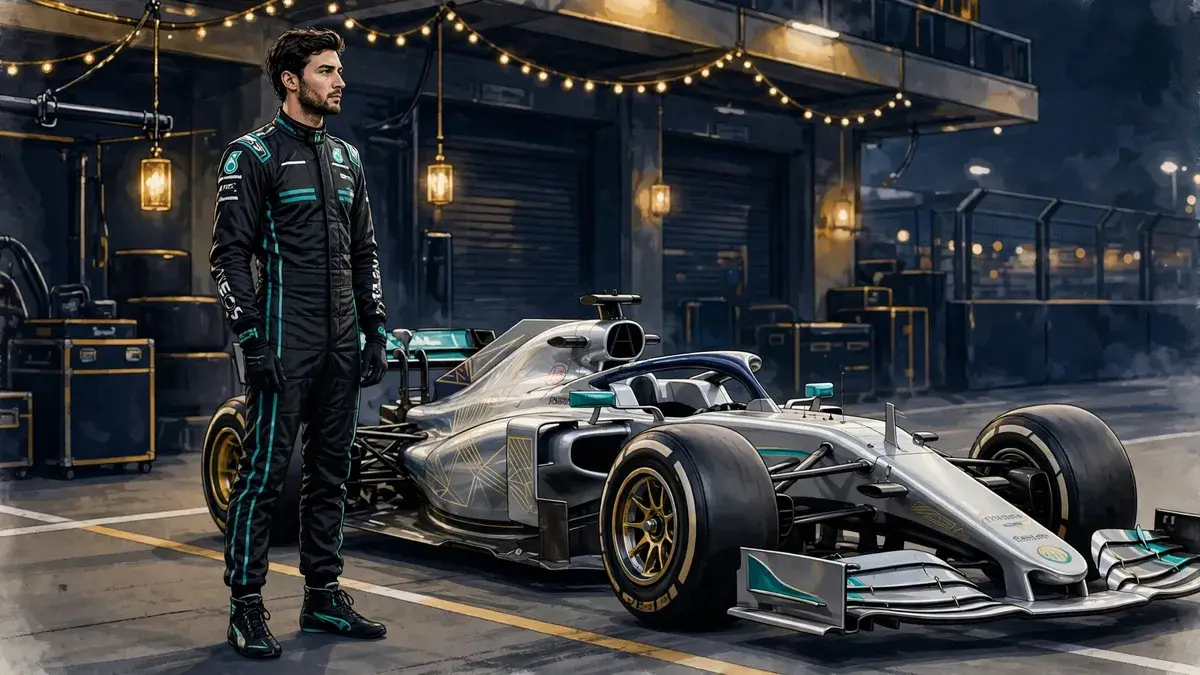
George Russell is 6 feet 1 inch tall (1.85 metres), which makes him one of the tallest drivers on the 2026 Formula 1 grid. The Mercedes team leader stands a full four inches taller than his former team-mate Lewis Hamilton, and only Haas rookie Oliver Bearman is taller among the current full-time drivers. That height has shaped his whole career in ways fans rarely see, from a seat fitting that forced him into race boots a size too small to a cockpit built around a frame that was never meant to fold into a single-seater.
This page settles the number with dated sources, lines Russell up against every other driver on the 2026 grid, and covers the career and money behind the measurement: a Mercedes contract paying a reported $34 million base salary in 2026, an estimated net worth of around $40 million, five Grand Prix wins, and an engagement announced in August 2026. Every figure below is tied to a named source, and where sources disagree, the range is shown rather than hidden.
| Full Name | George William Russell |
|---|---|
| Date of Birth | 15 February 1998 |
| Birthplace | King’s Lynn, Norfolk, England |
| Height | 6 ft 1 in (1.85 m) |
| Weight | Approximately 70 kg (154 lbs) |
| Age (2026) | 28 years old |
| Team | Mercedes-AMG Petronas Formula One Team |
| Car Number | 63 |
| Estimated Net Worth (2026) | Around $40 million (range $20–$40 million across sources) |
| 2026 Base Salary | Approximately $34 million (Mercedes) |
| Primary Income Sources | Mercedes salary, performance bonuses, endorsements (UBS, Adidas, Amaffi, Pershing Yachts) |
| Key Career Marks | GP3 champion 2017, Formula 2 champion 2018, five Grand Prix wins, Mercedes team leader from 2025 |
| Partner | Carmen Montero Mundt (engaged August 2026) |
In This Article
- How Tall Is George Russell?
- George Russell’s Height on the 2026 F1 Grid
- Early Life and Background
- Karting and the Junior Formulas
- The Williams Years
- Mercedes and the Team Leader Role
- The Money: Net Worth, Salary and Contract
- Endorsements and Business Interests
- Height and the Cockpit: How Russell Fits In
- Does His Height Help or Hurt?
- Personal Life and Engagement
- Controversies and the Verstappen Row
- Frequently Asked Questions
- Final Thoughts
- Sources and Reporting
How Tall Is George Russell?
George Russell is 6 feet 1 inch tall, which converts to 1.85 metres or 185 centimetres. That figure is the settled answer across the strongest sources, and it has held steady for years: Autosport reported him at 6 ft 1 in back in December 2020, when he stood in for Lewis Hamilton at the Sakhir Grand Prix, and the same number appears in F1 Chronicle’s grid-wide height survey reviewed in July 2026 and in NextBiography’s profile updated in September 2026. HeightsBySide, which cross-checks public listings and last reviewed Russell’s entry on 30 September 2026, also lists 1.85 m (6 ft 1 in).
There is one wrinkle worth naming. A handful of outlets round the number down in feet while keeping the metric figure intact: F1 Oversteer, for example, describes Russell as “1.85m or 6ft tall”. That is a rounding choice, not a different measurement — 1.85 metres is 6 ft 0.8 in, so some writers trim it to 6 ft and others round it up to 6 ft 1 in. The metric figure is the anchor, and 6 ft 1 in is the honest imperial reading of it. Healthy Ton lists the same height as 185.5 cm, a half-centimetre difference that sits inside normal measuring variation and changes nothing about the headline figure.
| Source | Date | Height Listed |
|---|---|---|
| Autosport | 3 December 2020 | 6 ft 1 in |
| F1 Chronicle (2026 grid survey) | Reviewed July 2026 | 185 cm (6 ft 1 in) |
| NextBiography | Updated 12 September 2026 | 6 ft 1 in (1.85 m) |
| HeightsBySide | Reviewed 30 September 2026 | 1.85 m (6 ft 1 in) |
| Along the Racing Line | 16 July 2021 | 6 ft 1 in |
| Healthy Ton | Profile listing | 6 ft 1 in (185.5 cm) |
| F1 Oversteer | 2026 profile | 1.85 m, rounded to “6 ft” |
Put together, the evidence points one way: Russell’s height is 6 ft 1 in, or 1.85 m. Anyone quoting 6 ft flat is using the same 1.85 m measurement with a rougher rounding. His weight is reported at around 70 kg (154 lbs) by Healthy Ton and NextBiography, which is light for a man of his height and is part of why he fits into the car at all — more on that below.
The short answer: George Russell is 6 ft 1 in (1.85 m) tall. The 6 ft figure you will see in some places is the same measurement rounded down, not a competing claim.
George Russell’s Height on the 2026 F1 Grid
Formula 1 drivers are short by the standards of professional sport. The cockpit is a tight carbon-fibre shell, every extra centimetre of driver costs the team packaging space and weight distribution headaches, and the sport has always selected for compact builds. Against that backdrop, Russell is a giant of the grid. F1 Chronicle’s July 2026 survey places him fourth tallest among the full-time drivers, and a February 2026 Yardbarker piece ties him for second with Esteban Ocon and Alex Albon at 6 ft 1 in — the small difference comes down to whether Ocon and Albon are listed at 186 cm or rounded to the same 6 ft 1 in as Russell. Either way, Russell sits in the top handful.
| Driver | Team (2026) | Height |
|---|---|---|
| Oliver Bearman | Haas | 188 cm (6 ft 2 in) |
| Esteban Ocon | Haas | 186 cm (6 ft 1 in) |
| Alex Albon | Williams | 186 cm (6 ft 1 in) |
| George Russell | Mercedes | 185 cm (6 ft 1 in) |
| Nico Hülkenberg | Audi | Over 6 ft |
| Gabriel Bortoleto | Audi | Over 6 ft |
| Lewis Hamilton | Ferrari | Approximately 5 ft 9 in |
| Max Verstappen | Red Bull | Approximately 5 ft 11 in |
| Charles Leclerc | Ferrari | Approximately 5 ft 11 in |
| Yuki Tsunoda | Red Bull | 159 cm (5 ft 3 in) |
The contrast at the ends of the grid is striking. Yuki Tsunoda, listed at 159 cm (5 ft 3 in), is a full ten inches shorter than Russell, and teams have to build two very different seating positions, pedal boxes and steering columns to accommodate that spread. Russell is also around four inches taller than Lewis Hamilton, his team-mate for three seasons at Mercedes — a gap Autosport flagged in 2020 when Russell first climbed into Hamilton’s car and found the cockpit “cosier” than his own Williams. For wider context, the tallest driver in Formula 1 history is widely held to be Hans-Joachim Stuck at 6 ft 4 in, a mark Russell comes within three inches of matching.
Height comparisons are a running theme across this site’s Formula 1 coverage, and Russell’s place in the pecking order is easy to check against his rivals: Lewis Hamilton’s height shows just how much taller Russell is than the seven-time champion he partnered at Mercedes, while Max Verstappen’s height and Charles Leclerc’s height put Russell a couple of inches clear of the two other drivers most often talked about as the fastest of his generation. Oscar Piastri’s height rounds out the comparison with the McLaren driver who has become one of Russell’s closest on-track rivals.
Early Life and Background
George William Russell was born on 15 February 1998 in King’s Lynn, Norfolk, England, to parents Steve and Alison Russell. He grew up with an older brother, Benjy, and a sister, Cara, in a family that ran a seed merchant business — a long way from the moneyed backgrounds of many junior drivers, and a detail that matters when tracing how his career was funded. His parents were not independently wealthy, as Formula One Salaries notes in its profile of his earnings, and the family poured its resources into karting because the talent was obvious early.
Russell started karting at the age of seven. The number 63 he carries on his Mercedes is a tribute to his brother Benjy, who raced with that number in karting. From the start he was tall for his age, and the height that now defines him on the grid was already a talking point in the junior categories — a tall kid in a sport where the machinery is built small. He moved through the British and European karting ranks with a string of titles, and by his mid-teens the question was not whether he would reach single-seaters but how fast he would climb once he got there.
His schooling ran alongside the racing, and the family made the usual sacrifices of a karting household: long weekends at circuits, budgets stretched thin, and a teenager learning to manage his own career before he could legally drive on the road. That self-reliance became a hallmark. In 2021, Along the Racing Line profiled him as “George the Giant” and described the teenage Russell marching into Mercedes team boss Toto Wolff’s office, CV in hand, to tell him he would be a Mercedes champion one day. It was a bold move from a junior driver with no right to that confidence — and it worked.
Karting and the Junior Formulas
Russell’s junior record is one of the cleanest ladders in modern Formula 1: he won at every step, usually at the first attempt. After karting, he moved into single-seaters in 2014 and won the BRDC Formula 4 Championship in his first season. The following years took him through Formula 3 machinery and into the two series that now feed Formula 1 directly. In 2017 he won the GP3 Series with ART Grand Prix in his rookie season, and in 2018 he won the FIA Formula 2 Championship with the same team, again as a rookie.
That back-to-back rookie-title run is rare. GP3 and Formula 2 are where future Formula 1 drivers are sorted from the merely quick, and winning both at the first attempt put Russell on every team principal’s list. Mercedes signed him to its junior programme in 2017, the same year he won GP3, and from that point his path was mapped: a Formula 1 debut with Williams, the Mercedes customer team, followed by a graduation to the works team when a seat opened. His junior rivals included Lando Norris, who raced against him through the karting and junior years and is now one of the defining rivalries of their generation — Norris’s own story is told in Lando Norris’s biography on this site.
The junior years also built the reputation that still follows him: fast, meticulous, and unusually polished off track. He was the driver who prepared like an engineer, the one team bosses trusted with feedback, and the one who treated media and sponsor work as part of the job rather than a chore. Those traits mattered when Mercedes weighed him against more experienced options, and they matter still — they are why he was handed the team leader role when Hamilton left.
The Williams Years
Russell made his Formula 1 debut with Williams in 2019, driving for a team at its lowest point in decades. The car was the slowest on the grid, and his first two seasons produced no points at all — a brutal apprenticeship that hid his speed from casual viewers but not from the paddock. His qualifying performances told the real story: he regularly dragged the Williams into positions it had no business occupying, and his streak of out-qualifying his team-mates became a running stat in the sport’s coverage.
The breakthrough moments came in bursts. At the 2020 Sakhir Grand Prix, Hamilton tested positive for COVID-19 and Russell was called up to stand in at Mercedes. He qualified second, led most of the race, and looked set for a debut win until a pit-stop error and a late puncture dropped him to ninth. It was still the drive of the season, and it proved — to anyone still doubting — that he belonged in a front-running car. The Autosport report on that weekend is also where the 6 ft 1 in figure entered the record in such vivid terms: at that height, Russell was more than four inches taller than Hamilton, and the Mercedes cockpit built around Hamilton was a tight fit. He raced that weekend in boots one size smaller than normal just to squeeze in.
Back at Williams, the results finally arrived. He scored his first points for the team at the 2021 Hungarian Grand Prix, finishing eighth, and his first podium came at the rain-shortened 2021 Belgian Grand Prix, where he qualified second in the wet and was classified second after the race was stopped. That qualifying lap at Spa, in a Williams, in the rain, remains one of the most celebrated laps of his career. By the end of 2021, Mercedes had seen enough: Russell was announced as Hamilton’s team-mate for 2022.
Mercedes and the Team Leader Role
Russell joined Mercedes full-time in 2022, partnering the most successful driver in the sport’s history. The car that year was a handful — the new ground-effect regulations had produced a bouncing, unpredictable machine — but Russell outscored Hamilton across the season, finishing fourth in the championship to Hamilton’s sixth, and took his first Grand Prix win at the São Paulo Grand Prix on 13 November 2022. Formula 1’s own report called it a commanding performance: he won the Saturday sprint, led the Grand Prix from the front, and brought home a Mercedes one-two ahead of Hamilton. It was Mercedes’ only win of 2022, and it arrived in Russell’s first season with the team.
His win count has grown steadily since: Austria and Las Vegas in 2024, Canada and Singapore in 2025, taking him to five Grand Prix victories through the end of the 2025 season. The 2025 season also brought a contract extension, announced in October 2025, that carried him into Formula 1’s new regulatory era. And when Hamilton moved to Ferrari, Russell became Mercedes’ outright team leader — a role NextBiography’s September 2026 profile says Mercedes handed him formally for the 2026 season, with rookie Kimi Antonelli alongside him. He also serves as a director of the Grand Prix Drivers’ Association, the body that represents drivers’ interests with the FIA, a position that reflects the standing he holds among his peers.
The step up to team leader changed how he is judged. Where he was once measured against Hamilton, he is now measured against the championship itself, and against Max Verstappen, the benchmark of the current era. That comparison is a live one: Russell and Verstappen’s rivalry spilled into public view at the end of 2024, covered in the controversies section below, and their on-track battles remain one of the sport’s main attractions.
The Money: Net Worth, Salary and Contract
George Russell’s estimated net worth sits at around $40 million as of 2026, according to Celebrity Net Worth, which published that figure on 19 March 2026 and ties it to a salary of $34 million a year. PlanetF1’s August 2026 survey of driver wealth lands on the same $40 million number. Not every source agrees: bet365’s driver profile from August 2026 puts the range at $20–$40 million, and Net Worth Breakdown lists a lower $15 million figure that appears to rest on older salary assumptions — its own text cites a $7 million annual salary that predates his 2025 contract extension. The honest reading is a range of $20–$40 million anchored at $40 million by the two most current sources.
The salary behind that wealth is the story of the last two years. Russell’s Mercedes base salary for 2026 is reported at $34 million, a figure carried by NBC Sports’ March 2026 driver salary survey and repeated by Formula One Salaries and F1 Salaries, which last updated its Russell page on 8 November 2026. That puts him joint third-highest paid on the grid, level with Charles Leclerc. With performance bonuses worth up to $16 million and personal sponsorship income on top, Formula One Salaries estimates his total 2026 earnings at $50–$53 million. F1 Salaries puts his potential income at $50 million and his career earnings at around $120.5 million through the end of 2027 on current terms — though that last number is a projection, not a bank balance.
For the full breakdown of his fortune, including how the contract years stack up, see George Russell’s net worth on GuideNetWorth, our sister site, which covers the money angle in detail. The outline here is enough to show the shape of it: a driver whose pay roughly doubled when the October 2025 extension landed.
| Period | What Changed | Money Detail (Sourced) |
|---|---|---|
| 2019–2021 | Williams debut and apprenticeship | Modest early-career pay at the back of the grid; no wins, first points in 2021 |
| 2022 | Mercedes move; first Grand Prix win at São Paulo | Salary steps up with the works team; first win November 2022 |
| 2024 | Wins in Austria and Las Vegas | Established front-runner pay; cumulative F1 salary earnings building toward $50 million |
| October 2025 | Multi-year Mercedes extension signed | Base salary rises to a reported $34 million for 2026 (NBC Sports, March 2026) |
| June 2026 | 2027 option secured | Seat confirmed through end of 2027, expected at the same $34 million rate (F1 Salaries, November 2026) |
| 2026 | Mercedes team leader | Net worth estimated at $40 million (Celebrity Net Worth, March 2026; PlanetF1, August 2026) |
The contract structure matters as much as the headline number. Celebrity Net Worth describes the October 2025 extension as a multi-year deal widely understood in the paddock to work as a “1+1” structure — 2026 guaranteed, with an option for 2027. Mercedes confirmed the one-year deal for 2026 on 15 October 2025, naming Russell alongside Kimi Antonelli, and F1 Salaries reports the 2027 option was secured in June 2026, shortly after the Barcelona race. NextBiography values a potential two-season package at $68–$100 million including bonuses. Driver salaries sit outside Formula 1’s $215 million cost cap, which is why teams can pay figures like these without touching the spending limit that governs car development.
Through the end of the 2025 season, Celebrity Net Worth puts Russell’s cumulative Formula One salary earnings at just under $50 million. He earned about $26 million in 2025, according to F1 Salaries — a figure that shows how steep the jump to the $34 million 2026 base really is. PlanetF1’s older $26 million annual figure for his Mercedes deal now reads as the pre-extension rate, which is why it is lower than the current reporting.
Endorsements and Business Interests
Endorsements are a smaller slice of Russell’s income than the Mercedes salary, but they are growing as his profile rises. PlanetF1 lists sponsorships with UBS, Amaffi Perfume House and Pershing Yachts, and Formula One Salaries adds Adidas to that roster. The UBS relationship is the most visible — the Swiss bank has been a Mercedes team partner and a personal backer — while Amaffi, the niche perfume house, fits the polished, fashion-conscious image Russell has built away from the track.
That off-track image is deliberate. Russell is one of the most marketable drivers of his generation: fluent, presentable, active on social media, and comfortable in the sponsor and fashion worlds that Formula 1 now courts. His fiancée Carmen Montero Mundt works in finance and investment management, and in 2026 she co-founded a skincare brand, Barriers, with Óscar Valls Bartolomé — a venture Russell’s circle is close to, though the business is hers rather than a joint project. There is no public record of Russell holding major property portfolios or business ventures of his own on the scale of some older drivers, and this article does not invent any. His wealth, as far as public sources show, comes from racing pay and endorsements rather than outside business empires.
The car collection question comes up often with Formula 1 drivers, and it is worth answering honestly: Russell has spoken about his love of cars, but no reliable source publishes a verified inventory of his personal collection, so none is listed here. What is documented is the machinery he races — the Mercedes W16 he campaigned in 2026 — and the fact that his height makes the car itself a piece of engineering built around him, which is where this article turns next.
Height and the Cockpit: How Russell Fits In
A Formula 1 cockpit is not built for a 6 ft 1 in man. The driver sits almost lying down, knees bent tight against the chassis, feet working pedals in a footwell barely wider than a shoebox, with the steering wheel inches from the chest. Every millimetre of driver is a packaging problem for the engineers, and Russell’s height has been a running engineering story since his debut.
The clearest illustration came at the 2020 Sakhir Grand Prix, when he stood in for Hamilton at Mercedes. Autosport reported on 3 December 2020 that Russell underwent a seat fitting in the Mercedes W11 and found it tighter than his Williams surroundings — hardly surprising, since the car had been built around Hamilton, who is more than four inches shorter. Russell’s solution was almost comically direct: he raced the weekend in Formula 1 boots one size smaller than normal so his feet would fit the pedal box. He qualified second and led most of the race anyway. It remains the most famous footnote of his height, and it is sourced to a contemporary Autosport report rather than paddock legend.
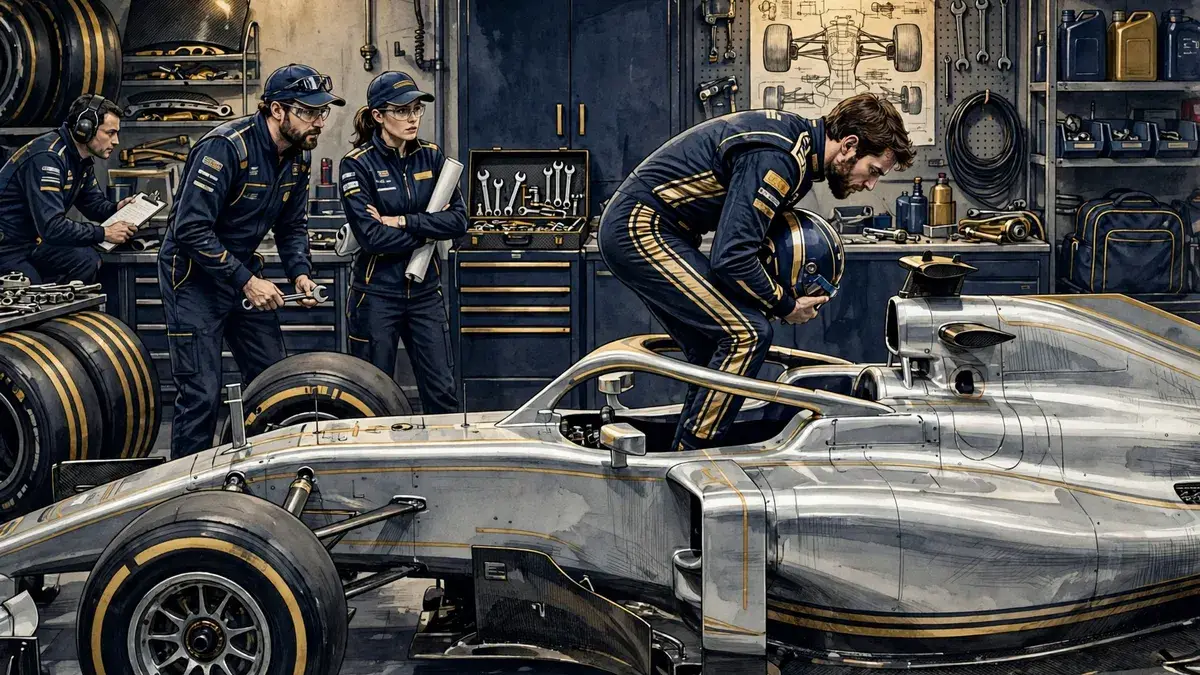
Seat fittings for a tall driver are a craft in themselves. The seat is moulded to the driver’s body in foam and carbon fibre, and for Russell that means a longer seat, a pedal box pushed as far forward as the regulations allow, and a steering column angle that lets his knees clear the wheel. Teams also manage his weight carefully: at around 70 kg he is light for his height, and lightness matters because the regulations set a minimum weight for car plus driver. A lighter driver gives the team more freedom to place ballast where it helps handling — low and central — rather than carrying it in the driver. In that sense his build is an asset: tall, but light enough that the team can work around the height.
Does His Height Help or Hurt?
The honest answer is that it mostly hurts, slightly, and Russell overcomes it. Height costs a driver in three ways. First, a taller body raises the car’s centre of gravity, even by a small amount, and in a sport that chases grams and millimetres that counts. Second, a longer torso and legs make the cockpit packaging harder, limiting how the team can route cooling, electronics and the fuel cell around the driver. Third, a taller driver has more surface area to cool and more mass moving around under braking and cornering, though at 70 kg Russell keeps that last cost low.
Against those costs, the advantages are real but modest. Longer arms and legs give a driver more leverage and finer control over the steering and pedals, and a taller driver often has a better view over the car’s nose and the halo — though the halo and the high cockpit sides limit that benefit. Some tall drivers also argue that their longer reach helps them feel the car through the wheel. None of this is measurable in lap time the way a better wing is, and no serious analyst would claim height wins races. The fairest summary is that Russell’s height is a small handicap he has engineered around, and his results — five wins, regular podiums, a team leader role — show it has not held him back.
There is also a commercial angle. Formula 1’s modern audience likes its stars visible, and Russell’s height makes him stand out in every driver parade, podium photograph and press conference. He is the driver fans can pick out of a crowd without looking at the race suit. In a sport where marketability increasingly shapes a driver’s value, being literally the biggest presence in the room does not hurt.
Personal Life and Engagement
Russell’s personal life has been steady and, by Formula 1 standards, quiet. He has been with Carmen Montero Mundt since 2020, when the two met on a blind double date in London — Montero Mundt had been invited for drinks at Soho House in White City by a friend whose date brought his flatmate Russell along. She is Spanish-born, from Jerez in southern Spain, the youngest of four siblings, and moved to London at 18 to study business management and finance at the University of Westminster, where she earned her degree. She has built a career in finance and investment management, and in 2026 she co-founded the skincare brand Barriers.
On 9 August 2026, Russell announced their engagement on Instagram, with a ring emoji and a white heart, after six years together. The proposal came during an intimate candlelit dinner beside the beach. Two months earlier he had told The Times that Carmen brings him stability when it comes to racing and a way to disconnect, adding that she was without doubt his future. Coverage of the engagement, including detailed profiles in August 2026, also notes that the couple went public in September 2020, shortly after that first date, and that Montero Mundt has been a constant presence through the Williams years, the Mercedes move and the step up to team leader.
Outside racing, Russell is known for his routine: early mornings, strict training, and a schedule built around recovery as much as speed. He has spoken about the discipline of managing his weight — at 70 kg he is one of the lighter drivers on the grid despite his height, and staying there takes constant work. He is close to his family, who supported the karting years from King’s Lynn, and his brother Benjy’s number 63 remains on his car as a reminder of where the whole journey started.
Controversies and the Verstappen Row
For most of his career Russell has been one of the paddock’s least controversial figures — polished, careful with his words, and a director of the Grand Prix Drivers’ Association. That changed at the end of 2024, when a stewards’ room dispute with Max Verstappen at the Qatar Grand Prix turned into the most public row of his career.
The sequence, as widely reported at the time, was this: in qualifying at Losail, Russell was judged to have driven unnecessarily slowly ahead of Verstappen and was given a one-place grid penalty, which handed Verstappen pole position. What happened next spilled out of the stewards’ room and into the press. Russell said Verstappen had threatened him in the meeting, telling him he would deliberately crash into him; Verstappen, in turn, called Russell a loser in the media and accused him of lying to the stewards. The exchange dominated the season finale in Abu Dhabi, with both drivers giving sharply different accounts of the same conversation.
Nothing was formally sanctioned beyond the original grid penalty, and the episode faded once the season ended, but it marked a shift in how Russell is perceived. He had shown he would not back down from the sport’s dominant driver, and the paddock noticed. The two have raced each other hard since, and the rivalry remains one of the live threads of the 2026 season. It is the only genuine controversy of Russell’s Formula 1 career to date, and it is worth recording because it changed his image from the polite junior to a driver willing to fight his corner in public.
Frequently Asked Questions
How tall is George Russell?
George Russell is 6 feet 1 inch tall (1.85 metres or 185 centimetres). The figure is confirmed by Autosport, which reported him at 6 ft 1 in in December 2020, and by F1 Chronicle’s 2026 grid survey and NextBiography’s September 2026 profile, both of which list 185 cm.
How tall is George Russell in cm?
George Russell is 185 centimetres tall. Some listings give 185.5 cm, a half-centimetre difference that sits inside normal measuring variation. The metric figure is the anchor for his height: 185 cm converts to 6 ft 0.8 in, which is why most sources round it to 6 ft 1 in.
Is George Russell the tallest F1 driver?
No. George Russell is the fourth tallest driver on the 2026 grid, according to F1 Chronicle’s July 2026 survey. Haas rookie Oliver Bearman is the tallest at 188 cm (6 ft 2 in), followed by Esteban Ocon and Alex Albon at 186 cm. Russell sits just behind them at 185 cm, tied or within a centimetre of Ocon and Albon depending on the source’s rounding.
How much does George Russell weigh?
George Russell weighs around 70 kg (154 lbs), according to Healthy Ton and NextBiography. That is light for a man of his height, and it helps his team: a lighter driver gives Mercedes more freedom to place ballast low in the car, which improves handling.
How old is George Russell?
George Russell is 28 years old in 2026. He was born on 15 February 1998 in King’s Lynn, Norfolk, England, and will turn 29 in February 2027.
What is George Russell’s net worth in 2026?
George Russell’s net worth is estimated at around $40 million in 2026, according to Celebrity Net Worth (March 2026) and PlanetF1 (August 2026). Other sources give a lower range, with bet365 listing $20–$40 million, so the honest figure is a $20–$40 million range anchored at $40 million. His Mercedes base salary for 2026 is reported at $34 million.
Does George Russell’s height affect his driving?
His height is a small handicap that he and Mercedes have engineered around. A taller driver raises the car’s centre of gravity slightly and makes the cockpit harder to package, but Russell’s light weight of around 70 kg offsets much of that cost. The most famous example came at the 2020 Sakhir Grand Prix, when he raced in boots one size too small to fit into Lewis Hamilton’s Mercedes cockpit — and still qualified second and led most of the race.
Who is George Russell’s fiancée?
George Russell is engaged to Carmen Montero Mundt, his partner since 2020. They met on a blind double date in London, and Russell announced their engagement on Instagram on 9 August 2026. Montero Mundt is Spanish-born, works in finance and investment management, and co-founded the skincare brand Barriers in 2026.
Final Thoughts
George Russell is 6 ft 1 in (1.85 m) tall — one of the tallest drivers on the 2026 grid, a full ten inches clear of the shortest, and a driver whose height has shaped his career in concrete ways, from a seat fitting in boots a size too small to a cockpit built around a frame the sport was never designed for. He has turned what could have been a handicap into a footnote: five Grand Prix wins, a $34 million Mercedes salary, an estimated $40 million net worth, the team leader role at one of Formula 1’s great teams, and an engagement to the partner who has been with him since the Williams years.
The number itself is settled. The story behind it is a driver who outgrew the machinery built for smaller men and made it fit anyway — and who, at 28, is now measured not against his height but against the championship.
Sources and Reporting
Height figures in this article come from Autosport (3 December 2020), F1 Chronicle’s 2026 grid height survey (reviewed July 2026), NextBiography (updated 12 September 2026), HeightsBySide (reviewed 30 September 2026), Along the Racing Line (16 July 2021), Healthy Ton and F1 Oversteer. Grid comparisons draw on F1 Chronicle and Yardbarker (4 February 2026). Career details come from Formula 1’s own race reports, including the São Paulo Grand Prix coverage of 13 November 2022. Money figures come from Celebrity Net Worth (19 March 2026), PlanetF1 (14 August 2026), bet365 (4 August 2026), Formula One Salaries and F1 Salaries (updated 8 November 2026). Engagement reporting draws on coverage published in August 2026.
How we estimated: George Russell’s height is taken from the metric figure, 1.85 m, which the strongest sources agree on; the imperial reading is 6 ft 1 in, with some outlets rounding the same measurement to 6 ft. His net worth is an estimate, not a disclosed figure: the range across current sources is $20–$40 million, anchored at $40 million by Celebrity Net Worth and PlanetF1. Salary figures are reported estimates from driver pay surveys, not figures released by Mercedes. Private wealth may differ from these public estimates.
Source homepages: Autosport · F1 Chronicle · Formula 1 · Celebrity Net Worth · PlanetF1 · NextBiography · HeightsBySide