Oscar Piastri is 1.78 metres tall — 5 feet 10 inches — and weighs around 68 kilograms. That is the figure on his official McLaren driver profile, and it matches the measurement Autosport published in its full rundown of Formula 1 driver heights. As of November 2026, the 25-year-old Australian sits almost exactly on the average for the current Formula 1 grid, one centimetre taller than his McLaren team-mate Lando Norris and three centimetres shorter than the grid’s midfield benchmark. His height has never held him back: he won seven grands prix in 2025, led the drivers’ championship for most of the season, and finished third in the world standings, 13 points behind Norris.
Piastri’s size keeps coming up in searches because Formula 1 is one of the few sports where a driver’s body is part of the engineering. The car has a minimum weight, the cockpit narrows to 45 centimetres near the pedals, and every kilogram of driver has to be balanced with ballast. This page settles the number with dated, per-source checks, shows where Piastri sits against every driver on the 2026 grid, explains what his height does and does not change inside the car, and rounds out the picture with his salary, net worth, career so far and personal life.
Last updated: 15 November 2026.
Oscar Piastri Quick Facts
| Full Name | Oscar Jack Piastri |
|---|---|
| Date of Birth | 6 April 2001 |
| Birthplace | Melbourne, Victoria, Australia |
| Height | 1.78 m (5 ft 10 in) — McLaren official profile; Autosport, February 2024 |
| Weight | 68 kg (Autosport); one profile lists 70 kg — see the weight section below |
| Age (November 2026) | 25 years old |
| Team | McLaren Formula 1 Team (since 2023) |
| Car Number | 81 |
| Estimated Net Worth (2026) | $20 million – $50 million (Sports Illustrated anchors the top end; F1 Chronicle puts the conservative range at $12 million – $20 million) |
| McLaren Salary (2026) | Reported $13 million base (Spotrac) to around $20 million base (F1 Chronicle), with bonuses on top |
| Contract | Multi-year McLaren extension signed March 2025, through at least the end of 2028 |
| Career Highlights | Formula Renault Eurocup champion 2019, FIA Formula 3 champion 2020, FIA Formula 2 champion 2021; 7 Grand Prix wins and 16 podiums in 2025; 3rd in the 2025 World Drivers’ Championship with 410 points |
| Girlfriend | Lily Zneimer |
| Parents | Chris Piastri and Nicole Piastri |
Table of Contents
- How Tall Is Oscar Piastri? The Official Answer
- Oscar Piastri Height in Feet and Inches
- How Oscar Piastri Compares on the 2026 F1 Grid
- Why Height Matters in Formula 1
- Oscar Piastri vs Lando Norris: The One-Centimetre Teammate Gap
- How Piastri Compares With F1’s Tallest and Shortest Drivers
- Oscar Piastri’s Weight and Fitness
- Early Life and Background
- Career Rise at McLaren
- The Money: Salary, Contract and Net Worth
- Endorsements and Off-Track Income
- Personal Life
- The Webber Split and What Comes Next
- Frequently Asked Questions
- Final Thoughts
- Sources and Reporting
How Tall Is Oscar Piastri? The Official Answer
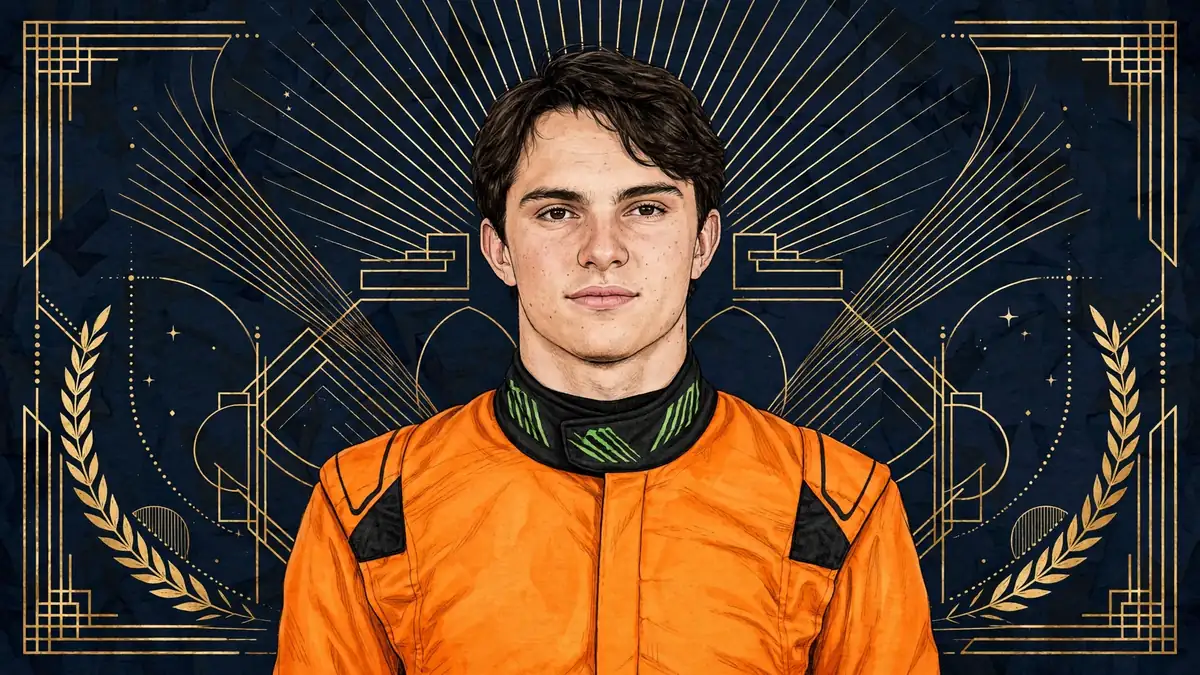
Oscar Piastri stands 178 centimetres tall. McLaren’s own driver profile lists his height as “178cm, 5ft 10in” alongside his birth date of 6 April 2001 in Melbourne, and that team-published figure is the strongest single source for the number. Autosport’s grid-wide driver height survey, published 28 February 2024 and updated 1 March 2024, records the same measurement — Oscar Piastri, 1.78 m, 5 ft 10 in, 68 kg — and the 2026 grid table published by Grixme in 2026 repeats 1.78 m and 68 kg for him. When the team, a specialist motorsport outlet and an independent 2026 grid survey all print the same figure, there is not much left to argue about.
That said, you will see a different number if you dig far enough. A handful of lower-grade bio pages list Piastri at 1.80 m (5 ft 11 in), and at least one 2025 net-worth roundup attributes the 1.80 m figure to Wikipedia. The honest way to handle that is to say it plainly: the 1.80 m reading exists, it traces to crowd-edited pages rather than to the team or to a specialist outlet, and every authoritative source — McLaren first among them — says 1.78 m. We anchor on 1.78 m (5 ft 10 in) and treat 1.80 m as an outlier, not a competing estimate.
The same pattern shows up with his weight. Autosport and the 2026 grid table both give 68 kg. Photographer Kym Illman’s driver profile lists 70 kg. Two kilograms is a rounding difference as much as anything else — a driver’s weight moves a little across a season with training and hydration — so 68 kg is the figure we use, with the 70 kg reading noted rather than hidden.
Per-source adjudication (checked 15 November 2026): McLaren official driver profile — 178 cm / 5 ft 10 in. Autosport driver heights survey (28 Feb 2024, updated 1 Mar 2024) — 1.78 m, 5 ft 10 in, 68 kg. Grixme 2026 grid table — 1.78 m, 68 kg. Sportskeeda player profile — 1.78 m, 68 kg. Outlier: some bio aggregators list 1.80 m (5 ft 11 in), attributed to Wikipedia; not adopted. Settled figure: 1.78 m (5 ft 10 in), 68 kg.
Oscar Piastri Height in Feet and Inches
For readers working in feet and inches, 1.78 metres converts to 5 feet 10 inches — 70 inches in total, or 178 centimetres on the nose. In centimetres he is 178 cm; in metres, 1.78 m. The conversion is exact enough that no rounding argument changes the answer: 1.78 m × 3.28084 gives 5.84 feet, which is 5 feet 10.1 inches, so “5 ft 10 in” is the clean figure every source uses.
Put next to an ordinary man, Piastri is a little taller than average. The average adult male in Australia stands around 175–176 cm, and the average man in the United States is about 175 cm (5 ft 9 in), so Piastri clears both by a couple of centimetres. He is also a touch above the average for his own sport: the 2026 Formula 1 grid averages 1.77 m (about 5 ft 9.7 in), which puts him one centimetre above the mean of the twenty drivers he races against every other Sunday.
That framing matters because of the assumption most fans start with — that Formula 1 drivers are all small. They are not. The 2026 grid stretches 21 centimetres from its shortest driver to its tallest, and Piastri sits near the middle of it. He is taller than Lewis Hamilton (1.74 m), taller than Fernando Alonso (1.71 m), shorter than Max Verstappen (1.81 m) and a full ten centimetres shorter than Oliver Bearman, the grid’s tallest driver at 1.88 m. The sport does not pick one body shape; it picks speed, and speed turns up in frames of all sizes.
How Oscar Piastri Compares on the 2026 F1 Grid
The table below uses the published 2026 grid figures, cross-checked against Autosport’s 2024 survey where the two overlap. Piastri’s row is the one to find first: 1.78 m, 68 kg, McLaren, one centimetre above the grid average of 1.77 m and two kilograms below the grid average weight of 70 kg.
| Driver | Team | Height | Weight | vs Piastri |
|---|---|---|---|---|
| Oliver Bearman | Haas | 1.88 m (6 ft 2 in) | 68 kg | 10 cm taller |
| Esteban Ocon | Haas | 1.86 m (6 ft 1 in) | 66 kg | 8 cm taller |
| Alexander Albon | Williams | 1.86 m (6 ft 1 in) | 74 kg | 8 cm taller |
| George Russell | Mercedes | 1.85 m (6 ft 1 in) | 70 kg | 7 cm taller |
| Nico Hülkenberg | Audi | 1.84 m (6 ft 0 in) | 78 kg | 6 cm taller |
| Gabriel Bortoleto | Audi | 1.84 m (6 ft 0 in) | 71 kg | 6 cm taller |
| Lance Stroll | Aston Martin | 1.82 m (6 ft 0 in) | 70 kg | 4 cm taller |
| Max Verstappen | Red Bull | 1.81 m (5 ft 11 in) | 72 kg | 3 cm taller |
| Charles Leclerc | Ferrari | 1.80 m (5 ft 11 in) | 69 kg | 2 cm taller |
| Oscar Piastri | McLaren | 1.78 m (5 ft 10 in) | 68 kg | — |
| Carlos Sainz | Williams | 1.78 m (5 ft 10 in) | 64 kg | Same height |
| Lando Norris | McLaren | 1.77 m (5 ft 10 in) | 68 kg | 1 cm shorter |
| Pierre Gasly | Alpine | 1.77 m (5 ft 10 in) | 70 kg | 1 cm shorter |
| Lewis Hamilton | Ferrari | 1.74 m (5 ft 9 in) | 73 kg | 4 cm shorter |
| Franco Colapinto | Alpine | 1.74 m (5 ft 9 in) | 71 kg | 4 cm shorter |
| Liam Lawson | Racing Bulls | 1.74 m (5 ft 9 in) | 72 kg | 4 cm shorter |
| Arvid Lindblad | Racing Bulls | 1.73 m (5 ft 8 in) | 68 kg | 5 cm shorter |
| Sergio Pérez | Cadillac | 1.73 m (5 ft 8 in) | 63 kg | 5 cm shorter |
| Valtteri Bottas | Cadillac | 1.73 m (5 ft 8 in) | 69 kg | 5 cm shorter |
| Kimi Antonelli | Mercedes | 1.72 m (5 ft 8 in) | 70 kg | 6 cm shorter |
| Fernando Alonso | Aston Martin | 1.71 m (5 ft 7 in) | 68 kg | 7 cm shorter |
| Isack Hadjar | Red Bull | 1.67 m (5 ft 6 in) | 65 kg | 11 cm shorter |
A few things jump out of that table. First, Piastri shares his exact height with Carlos Sainz at 1.78 m, and he is one of only two drivers at that mark. Second, the McLaren pair are almost twins on paper — Piastri 1.78 m and 68 kg, Norris 1.77 m and 68 kg — which is handy for a team building two cars to the same packaging. Third, the spread is wide enough that “ideal F1 height” is not a real thing: the 2025 championship was fought between Norris (1.77 m), Verstappen (1.81 m) and Piastri (1.78 m), three men within four centimetres of each other, while the tallest man on the 2026 grid, Bearman at 1.88 m, and the shortest, Hadjar at 1.67 m, both race at the front of the midfield. Height does not sort winners from also-rans. The car, the tyres and the driver inside it do that.
Why Height Matters in Formula 1
Height matters in Formula 1, but not in the way most fans assume. There is no height limit in the sport. The FIA has never set a maximum or a minimum driver height, and there is no rule that says a driver must weigh a particular amount. What the regulations do set is a minimum weight for the car and a reference mass for the driver, and it is those numbers — not the driver’s body — that turn height into an engineering problem.
The first problem is packaging. At its narrowest, near the pedals, a Formula 1 cockpit is about 45 centimetres wide. A taller driver folds longer legs into that space, with knees rising toward the chassis and hands fighting legs for room through corners, while the nose of the car narrows toward the front and pushes a tall driver’s feet into the tightest part of the footwell. Alex Albon, at 1.86 m, was questioned about fitting into a cockpit when he debuted; across three teams it never became a problem. George Russell, at 1.85 m, won the 2025 Singapore Grand Prix in tropical heat, and Oliver Bearman, the tallest man on the 2026 grid at 1.88 m, scored points in Singapore too, finishing ahead of the grid’s shortest driver. Tall drivers cope. The cost they pay is a harder packaging job for their engineers, not slower lap times.
The second problem is weight, and here the rules have changed in the drivers’ favour. Under the 2026 regulations the 82 kg figure that gets quoted so often is a reference mass — the driver plus any ballast added to reach it — not a demand that the driver personally weighs 82 kg. A driver who weighs 64 kg does not have to gain 18 kg; the team bolts 18 kg of ballast into the car instead. Piastri, at 68 kg, carries 14 kg of ballast to reach the reference mass. That ballast is not dead weight either: engineers place it low in the car, where it helps the centre of gravity. A lighter driver actually hands the team more freedom about where the weight goes, which is why the old complaint — that heavier drivers were punished — has faded.
It was not always like this. In 2013, Nico Hülkenberg, then 1.84 m and 74 kg, was one of the heaviest drivers on the grid, and McLaren’s team boss at the time, Martin Whitmarsh, publicly confirmed the team was “not talking to Nico” as the heavier 2014 hybrid engines made minimum weight harder to hit. Hülkenberg later said he was sure his height cost him chances at top teams, even though no team ever told him so directly. He never got that McLaren seat. The system that quietly blocked him no longer exists, because the reference-mass rule took the driver’s own weight out of the equation.
The third place height shows up is the weighbridge after the race — and this one catches teams, not drivers. Officials weigh the car after every grand prix to confirm it still meets the minimum mass once the fuel has burned off. At the 2024 Belgian Grand Prix, George Russell won on the road, only for his Mercedes to come in at 796.5 kg after the fuel sample was drained — 1.5 kg under the 798 kg minimum. He was disqualified and Lewis Hamilton inherited the win. Mercedes’ engineering director partly blamed the shortfall on Russell losing weight during the race itself, sweating in a cockpit that can reach 50°C. The margins are that fine: a driver’s own body shedding water weight can tip a legal car under the line. That is why the scale comes out after every race, and it has nothing to do with judging anyone’s fitness.
So what does Piastri’s 1.78 m actually cost him? Very little. He is tall enough that his legs fill the cockpit properly and short enough that packaging is straightforward. His 68 kg leaves 14 kg of ballast for McLaren to place where it helps most. His body mass index works out at 21.5 — 68 kg divided by 1.78 squared — right in the 21-to-23 band where almost every driver on the 2026 grid lands, from Hadjar at 23.3 to Russell at 20.5. That clustering is the real story of F1 bodies: not one height, but one ratio, maximum lean muscle packed into the most efficient frame a driver can carry.
Oscar Piastri vs Lando Norris: The One-Centimetre Teammate Gap
Put the two McLaren drivers side by side and you need a tape measure to tell them apart. Oscar Piastri is 1.78 m and 68 kg. Lando Norris’s height is 1.77 m, and he weighs the same 68 kg. One centimetre, zero kilograms. Their body mass indexes are 21.5 and 21.7. For a team building two cars around the same monocoque, that is about as convenient as a driver pairing gets: the seat, the pedals, the steering column and the ballast placement barely change between the two garages.
The closeness makes a neat point about the 2025 title fight. Norris beat Piastri to the championship by 13 points — 423 to 410, with Max Verstappen wedged between them on 421 — after both men won seven races each. If size decided championships, the man one centimetre taller would have some edge to point to. He does not. The gap came down to the second half of the season, when Piastri’s form dipped after he had led the standings from round five to round twenty, and Norris adapted to changing conditions a fraction sooner. Same car, same weight, one centimetre apart, thirteen points apart at the flag. The sport is decided by everything except the tape measure.
Off track, the pair are the core of McLaren’s revival. They delivered the team back-to-back constructors’ championships, sealed the second of them as early as the Singapore Grand Prix in October 2025, and both signed long-term deals — Norris’s running to 2027 and beyond, Piastri’s extension signed in March 2025 and running through at least the end of 2028. When Zak Brown, McLaren’s chief executive, was asked after the 2025 finale whether Norris would “become Superman” now he was champion, Piastri’s answer was dry and telling: “No, I don’t think so… he’s still Lando Norris.” The dynamic between them is famously calm for a title fight, and the 2026 season — in which Norris sits one place ahead of Piastri in the standings after the São Paulo Grand Prix — is testing whether that calm holds a second time around.
How Piastri Compares With F1’s Tallest and Shortest Drivers
Oliver Bearman, at 1.88 m, is the tallest driver on the 2026 grid — a full ten centimetres taller than Piastri, and the same height as many professional basketball guards. He is also the same weight as Piastri, 68 kg, which means Bearman carries his 14 kg of ballast just like his shorter rival. Esteban Ocon and Alexander Albon share second place at 1.86 m. Albon’s case is worth lingering on: when he arrived in Formula 1, fans wondered whether a 1.86 m driver could fit comfortably in a cockpit at all. Three teams later — Toro Rosso, Red Bull, Williams — it has never been an issue, and he has been one of the tallest men on the grid in 2019, 2020, 2022, 2023 and 2024 without it costing him a seat.
At the other end, Isack Hadjar stands 1.67 m, eleven centimetres shorter than Piastri and the shortest driver on the 2026 grid. He is 65 kg, which leaves 17 kg of ballast for his team to place. The interesting thing about Hadjar is that his height gives him no visible advantage either: he is quick because he is quick, not because he is small. The same applies in reverse to the tall men. George Russell, the second-tallest active driver for years at 1.85 m, won in Singapore’s heat in 2025; Bearman scored points at the same race. Climate does not stop tall drivers, and a low centre of gravity does not hand short drivers free lap time.
Within the championship fight itself, the heights tell the same story. Max Verstappen’s height is 1.81 m — three centimetres taller than Piastri — and he finished second in the 2025 standings on 421 points, two behind Norris. Lewis Hamilton’s height is 1.74 m, four centimetres shorter than Piastri, and he remains the most successful driver of his generation with seven world titles. Charles Leclerc’s height is 1.80 m, two centimetres taller than Piastri, and he has spent his Ferrari career fighting at the front in the same machinery as Hamilton. Five drivers, a spread of seven centimetres, five different career arcs. If there were a perfect height for Formula 1, one of them would have found it by now.
The history backs that up. Michael Schumacher, the seven-time champion, stood 1.74 m. Ayrton Senna was 1.75 m. Alain Prost was 1.65 m. Sebastian Vettel was 1.74 m. On the tall side, Mark Webber — the man who managed Piastri from 2019 until November 2026 — was 1.84 m and won nine grands prix. The sport’s all-time greats cover almost the full range of the current grid, which is the strongest evidence there is that height is a footnote in a driver’s story, not the headline.
Oscar Piastri’s Weight and Fitness
Piastri weighs 68 kg, according to Autosport’s survey and the 2026 grid table, with one profile (Kym Illman’s) listing 70 kg. At 1.78 m that gives him a body mass index of 21.5, squarely inside the 21-to-23 band where nearly every driver on the grid sits. That number is not an accident. Formula 1 drivers train to carry as much lean muscle as possible on the lightest frame they can, because the car punishes excess weight and the driver pays for weakness in the neck and core.
The physical load is hard to overstate. Through a fast corner, a driver’s head and helmet can put well over 20 kg of lateral force through the neck, corner after corner, for up to two hours. Cockpit temperatures can reach 50°C, and drivers routinely lose several kilograms of water weight over a race distance — enough, as Russell’s 2024 Belgian disqualification showed, to change whether the car is legal at the finish. Piastri’s training, like every driver’s, is built around neck strength, core stability, heat tolerance and reaction speed, not around looking a particular way. He has spoken in the past about the unglamorous side of the job: the hours in the gym, the simulator sessions, the weight management that keeps him at his fighting weight all season.
There is also a quiet advantage in being 68 kg rather than heavier. Under the 82 kg reference-mass rule, McLaren adds 14 kg of ballast to Piastri’s car. Because ballast can be placed low in the chassis, it helps the car’s centre of gravity rather than hurting it. Compare that with Nico Hülkenberg at 78 kg, who needs only 4 kg of ballast, or Sergio Pérez at 63 kg, who needs 19 kg. Piastri sits in the sweet middle: light enough to give his engineers room, heavy enough that the ballast is not extreme. It is one more way in which his frame — 1.78 m, 68 kg — lands in the comfortable centre of the sport’s demands.
Early Life and Background
Oscar Jack Piastri was born on 6 April 2001 in Melbourne, Victoria, Australia, to Chris and Nicole Piastri. He grew up in the suburb of Brighton, and like most Australian racing drivers he started in karts — small, fast and unforgiving. Karting in Australia is a long way from the European junior ladder, and the Piastri family made the decision early that if Oscar was going to make it, he would have to race in Europe, where the teams, the scouts and the championships are. He moved to England as a teenager, leaving home to chase a career that most kids only dream about.
The gamble paid off with unusual speed. Piastri won the Formula Renault Eurocup in 2019, his first year in cars at a serious level, then took the FIA Formula 3 championship in 2020 as a rookie, then the FIA Formula 2 championship in 2021 — again as a rookie. Three championships in three consecutive years, each at the first attempt, is a record no other driver has matched in the modern junior ladder. It is the kind of run that makes Formula 1 teams take notice, and it is why his arrival in the sport carried so much expectation.
What is easy to miss in that run is how much of it was funded by the family. The Piastri family had the resources to back a competitive karting career and the move to Europe, and Oscar has never hidden that his parents’ support was the foundation of it. There is no published figure for the family wealth, and we do not invent one. What the record shows is a family that backed its son’s talent all the way to the door of Formula 1 — and a driver who repaid that backing by winning everything he entered.
Career Rise at McLaren
Piastri’s path into Formula 1 had a twist worthy of the sport’s silliest season. After winning Formula 2 in 2021, he spent 2022 as Alpine’s reserve driver, waiting for a race seat that never opened. When Fernando Alonso left Alpine for Aston Martin in the summer of 2022, Alpine announced Piastri as its driver for 2023 — only for Piastri to publicly refuse the seat on social media, saying he had not signed and would not be driving for Alpine. The dispute went to Formula 1’s Contract Recognition Board, which ruled in McLaren’s favour: Piastri had a valid contract with McLaren, and he joined the team for 2023 alongside Lando Norris. It was a bruising, public start to a Formula 1 career, and it set the tone for a driver who has been calm and direct ever since.
His rookie season in 2023 produced a sprint-race win in Qatar and a first grand prix podium in Japan, enough to earn a contract extension that September. In 2024 he won his first two grands prix — Hungary and Azerbaijan — and finished fourth in the championship with 292 points. Then came 2025, the season that made him a genuine title contender: seven wins, 16 podiums, 410 points and a championship lead he held from round five to round twenty, before a late-season dip let Norris and Verstappen past him. He finished third, 13 points behind Norris, and called it “by some margin” his best season in Formula 1. McLaren, meanwhile, sealed back-to-back constructors’ titles, the second of them in Singapore in October 2025. The full story of that rise, from Melbourne karting to the title fight, is told in our Oscar Piastri biography.
The 2026 season has been harder. After the São Paulo Grand Prix in November 2026, Piastri sits seventh in the drivers’ championship with 152 points, winless so far in the campaign and one place behind Norris. McLaren’s car has not carried the advantage it enjoyed in 2025, and the field has closed up. At 25, with a contract running to at least the end of 2028, he has time on his side — Norris needed seven seasons to win his first title — but the 2026 reset is a reminder that in Formula 1, momentum is rented, not owned.
The Money: Salary, Contract and Net Worth
Piastri’s pay has climbed as fast as his results. His rookie deal in 2023 was worth around $2 million a year. The extension he signed in March 2025 changed everything: reports put his base salary at around $20 million a year (F1 Chronicle), with performance bonuses of up to $10 million that can take his total annual package to about $30 million, while Spotrac’s contract database lists a $13 million base for 2026 under the same deal. The gap between those two figures is a reminder that Formula 1 salaries are never officially published — teams do not disclose them, so every number is an estimate built from paddock reporting. We give the range, name the sources, and let the reader see the disagreement rather than picking the bigger number for effect.
What is not in doubt is the scale of the jump. Sportico, in its January 2026 ranking of the world’s highest-paid athletes, put Piastri 96th globally with total 2025 earnings of about $38 million — roughly $35 million in salary and bonuses and $3 million in endorsements — making him one of only four Formula 1 drivers on the list. Forbes’ Formula 1 pay reporting for 2025 put his racing income at about AU$56 million (around $37.5 million), built from an AU$15 million base and an AU$41 million bonus. However you cut it, his 2025 season was worth the thick end of $40 million to him.
His net worth is estimated at $20 million to $50 million as of November 2026. The range is wide because his fortune is still young: the conservative estimate from F1 Chronicle puts him at $12 million to $20 million, while Sports Illustrated places him closer to $50 million after his breakout 2025 season. A separate editorial estimate from SureBets, published July 2026, lands at $40 million to $55 million. Our sister site’s Oscar Piastri net worth breakdown works through the same figures and reaches a similar range. The honest summary is that he is worth somewhere in the tens of millions, the top of the range reflects his 2025 earnings and his new contract, and the exact figure is private — as it is for every driver on the grid.
The contract itself is the anchor of that wealth. Signed in March 2025, days before his home race in Australia, the multi-year extension runs through at least the end of 2028 and replaced a deal that had been due to run out after 2026. McLaren announced it as a long-term commitment, and the timing — on the eve of the season in which he would win seven races — now looks like a bargain for the team. For Piastri, it means four more years of guaranteed top-team income while he chases the championship that slipped away in 2025.
Endorsements and Off-Track Income
Endorsements are the smallest part of Piastri’s income today, and that is normal for a driver this early in his career. Sportico credits him with about $3 million a year in endorsement income, against roughly $35 million from McLaren. The brands attached to him are mostly the ones that come with the team — McLaren’s partner roster — plus a small number of personal deals in automotive and lifestyle categories that fit his low-key image. He is not yet a driver whose face sells watches and cologne on billboards, and that is by choice as much as circumstance: his public persona is famously calm, dry and private, and he has built his brand on results rather than noise.
That will change if the championship arrives. A world title tends to double a driver’s commercial value overnight — Norris’s own endorsement portfolio grew sharply after his 2025 title — and Piastri’s management change in November 2026 suggests his commercial operation is being rebuilt with exactly that in mind. For now, his off-track income is a footnote next to his salary. The car pays him; the sponsors will follow the trophies.
Personal Life
Piastri keeps his private life out of the spotlight, and there is not much of it on the public record — which, in the age of driver-as-influencer, is itself a statement. He is in a relationship with Lily Zneimer, who has been named in driver profiles as his girlfriend, and he is close to his parents, Chris and Nicole, who supported his move from Melbourne to Europe as a teenager. He has sisters, and his family remains based in Australia while his racing life is run out of the United Kingdom, where McLaren is based in Woking.
Outside racing, he is known for a dry sense of humour and a love of cricket and Australian rules football — the standard Melbourne upbringing, transplanted to a Formula 1 paddock. He is also, by all accounts, one of the calmest drivers on the grid under pressure, a trait that showed in his 2025 title fight: he led the championship for 16 rounds, lost it by 13 points, and walked out of Abu Dhabi saying he was “very, very proud” of the season and that he had learned lessons he would carry into 2026. If you want more on the drivers he races against every weekend, our Celebrity profiles section covers the grid’s biggest names.
The Webber Split and What Comes Next
On 9 November 2026, the day after the São Paulo Grand Prix, Piastri and the management team led by Mark Webber and Ann Webber announced they had mutually agreed to end their management agreement after seven years. Webber, a former Red Bull and Williams driver who started 217 grands prix, had managed Piastri since 2019, guiding him from junior champion to McLaren race winner and through the Alpine contract dispute of 2022. Both sides described the split as mutual. Webber’s statement said that “following our reduced trackside involvement this season, we have collectively agreed that now is an appropriate time to bring our management agreement to a close,” adding that it would allow Piastri to build on his achievements under a new management structure.
The timing raised eyebrows — it came during a difficult 2026 campaign in which Piastri sits seventh, winless — but neither side has given a single triggering dispute as the reason, and we will not guess at one. What is on the record is that Webber had already stepped back from regular trackside duties during the 2026 season, with former Prema race engineer Pedro Matos and performance coach Emma Murray taking larger roles in Piastri’s support team, and that the decision to separate was made a number of races before the announcement, according to RACER. The split does not affect his McLaren contract, which runs through 2028, and no successor manager has been named. For a driver who has spent his whole Formula 1 career under one management roof, the change is the biggest off-track story of his season — and the next chapter of his career will be shaped by whoever takes over.
Frequently Asked Questions
How tall is Oscar Piastri?
Oscar Piastri is 1.78 metres tall, which is 5 feet 10 inches. The figure comes from his official McLaren driver profile, which lists his height as 178 cm / 5 ft 10 in, and it is confirmed by Autosport’s driver height survey and the 2026 grid table, both of which record 1.78 m.
How much does Oscar Piastri weigh?
Oscar Piastri weighs 68 kg, according to Autosport’s survey and the 2026 grid table. One driver profile lists 70 kg, a two-kilogram difference that likely reflects training and hydration changes across a season. At 1.78 m and 68 kg, his body mass index is 21.5.
Is Oscar Piastri taller than Lando Norris?
Yes, by one centimetre. Piastri is 1.78 m and Norris is 1.77 m, and both weigh 68 kg. They are the closest-matched driver pairing on the grid by size, which makes building their two McLaren cars to the same packaging almost identical work for the team.
Who is the tallest F1 driver in 2026?
Oliver Bearman of Haas is the tallest driver on the 2026 grid at 1.88 m (6 ft 2 in), ten centimetres taller than Piastri. Esteban Ocon and Alexander Albon share second place at 1.86 m. The shortest driver is Isack Hadjar at 1.67 m.
Is there a height limit in Formula 1?
No. The FIA has never set a maximum or minimum driver height. The real constraint is the car: the cockpit narrows to about 45 centimetres near the pedals, so a taller driver gives engineers a harder packaging job, not a barrier to racing. Drivers from 1.67 m to 1.88 m all race on the current grid.
How old is Oscar Piastri?
Oscar Piastri was born on 6 April 2001 in Melbourne, Australia, which makes him 25 years old as of November 2026. He made his Formula 1 debut for McLaren in 2023 at the age of 21.
What is Oscar Piastri’s salary and net worth?
Piastri’s McLaren base salary is reported at $13 million (Spotrac) to around $20 million (F1 Chronicle) for 2026, with bonuses that can take his total package to about $30 million. Sportico put his total 2025 earnings at about $38 million, ranking him 96th among the world’s highest-paid athletes. His net worth is estimated at $20 million to $50 million as of November 2026.
Did Oscar Piastri split with his manager Mark Webber?
Yes. On 9 November 2026, Piastri and the management team led by Mark and Ann Webber mutually agreed to end their seven-year management agreement. Webber had managed Piastri since 2019 and guided him into Formula 1. The split does not affect Piastri’s McLaren contract, which runs through at least the end of 2028, and no successor manager has been named.
Final Thoughts
Oscar Piastri is 1.78 m (5 ft 10 in) tall and weighs 68 kg — a figure anchored by his own team’s official profile and confirmed by every specialist source that has measured the grid. He sits one centimetre above the Formula 1 average, one centimetre above his team-mate, and almost exactly in the middle of a grid that stretches from 1.67 m to 1.88 m. His height has never been the thing that decides his races. The seven wins of 2025, the 13-point title near-miss, the contract through 2028 and the $20 million to $50 million fortune all come from what he does inside a cockpit that fits him just fine — and from a calm under pressure that no tape measure can capture. The 2026 season has been a step back, and the split from the manager who guided him since 2019 marks the end of an era, but at 25, with a long-term McLaren deal in his pocket, Piastri’s story is still closer to its beginning than its end.
Sources and Reporting
Height and weight figures: McLaren official driver profile (mclaren.com); Autosport, “F1 driver heights: the shortest and tallest drivers on the grid” (28 February 2024, updated 1 March 2024) (autosport.com); Grixme, “F1 Driver Height & Weight 2026” (grixme.com); Sportskeeda player profile (sportskeeda.com). Career and 2025 championship: Formula 1 official site (formula1.com); ESPN (espn.com); Speedcafe (speedcafe.com); Auto Action (autoaction.com.au). Salary and net worth: F1 Chronicle (f1chronicle.com); Spotrac via F1 Salaries (f1salaries.com); Sportico (sportico.com); Sports Illustrated (si.com). Management split: RACER (racer.com); ESPN (9 November 2026); Speedcafe (9 November 2026).
How we estimated: Piastri’s height is a published fact, not an estimate — we anchor it on McLaren’s official profile and cross-check it against Autosport and the 2026 grid table, noting the 1.80 m outlier where it appears. Salary and net-worth figures are estimates: Formula 1 teams do not publish driver pay, so we report the range between named sources (Spotrac’s $13 million base and F1 Chronicle’s roughly $20 million base; Sports Illustrated’s roughly $50 million net worth against F1 Chronicle’s $12 million to $20 million) rather than a single invented number. Private wealth is never fully visible from outside; these figures are the best public estimates available as of 15 November 2026.