By Celebamerica Editorial Staff | Last updated: November 8, 2026
Deontay Wilder is 6 feet 7 inches tall (201 cm). That is the height listed by Wikipedia, Sporting News, and most boxing record books as of November 2026 — and it is the figure this article anchors on. One source disagrees: BoxRec’s official record database lists Wilder at 198 cm (6 feet 6 inches), so honest reporting puts his height in a narrow range of 6 ft 6 in to 6 ft 7 in (198–201 cm), with 6 ft 7 in as the most widely published number. His reach is not disputed anywhere: 83 inches (211 cm), one of the longest reaches of any heavyweight champion in the modern era.
Height is not a side detail in Wilder’s story. At 6 ft 7 in, with that 83-inch reach and a lean frame that usually weighs in between 212 and 231 pounds, Wilder built one of the most feared punching records in boxing history — 43 knockouts in 45 wins, a knockout-to-win rate above 95 percent, and a five-year run as WBC heavyweight champion with 10 straight title defences. This page answers every version of the height question fans actually search for — his height in feet, inches and centimetres, his reach, his weight, how he measures up against Tyson Fury, Anthony Joshua and Oleksandr Usyk — and then tells the full story of the man behind the measurements, from a late start in a Tuscaloosa gym to the top of the heavyweight division and back again.
Deontay Wilder Quick Facts
| Full Name | Deontay Leshun Wilder |
|---|---|
| Nickname | The Bronze Bomber |
| Date of Birth | October 22, 1985 (age 41 as of November 2026) |
| Birthplace | Tuscaloosa, Alabama, United States |
| Height | 6 ft 7 in (201 cm) — most sources; BoxRec lists 198 cm (6 ft 6 in), so the honest range is 6 ft 6 in–6 ft 7 in |
| Reach | 83 in (211 cm) |
| Weight / Division | Heavyweight — typically 212–231 lbs (96–105 kg) at weigh-ins |
| Stance | Orthodox |
| Professional Record | 45 wins (43 by knockout), 4 losses, 1 draw — as of November 2026 |
| Major Title | WBC heavyweight champion, January 2015 – February 2020 (10 successful defences) |
| Olympic Medal | Bronze, heavyweight, Beijing 2008 |
| Estimated Net Worth | Approximately $30 million as of 2026 (Surprise Sports, PlayersBio, SportsLeo); some outlets put the figure closer to $40 million |
| Primary Income Sources | Boxing purses and pay-per-view shares, endorsements, appearances |
| Key Career Moments | 2008 Olympic bronze; WBC title win over Bermane Stiverne (2015); Fury trilogy (2018–2021); wins over Luis Ortiz, Dominic Breazeale and Robert Helenius; comeback wins over Tyrrell Herndon (2025) and Derek Chisora (2026) |
Table of Contents
- Deontay Wilder Quick Facts
- How Tall Is Deontay Wilder?
- Deontay Wilder Height in Feet, Inches and Centimetres
- The 6 Ft 6 In vs 6 Ft 7 In Dispute: What the Sources Actually Say
- Deontay Wilder Reach and Wingspan: 83 Inches of Trouble
- Height and Weight: How Heavy Is Deontay Wilder?
- Early Life: A Late Start in Tuscaloosa
- Amateur Career and the 2008 Olympic Bronze
- The Rise to WBC Heavyweight Champion
- The Tyson Fury Trilogy
- Recent Fights: Parker, Zhang, Herndon and Chisora
- How His Height Shaped His Fighting Style
- Deontay Wilder Height Compared: Fury, Joshua, Usyk and More
- The Money Behind the Height: Purses and Net Worth
- Endorsements and Business Ventures
- Personal Life
- Controversies and Talking Points
- Deontay Wilder Height FAQs
- Final Thoughts
- Sources and Reporting
How Tall Is Deontay Wilder?
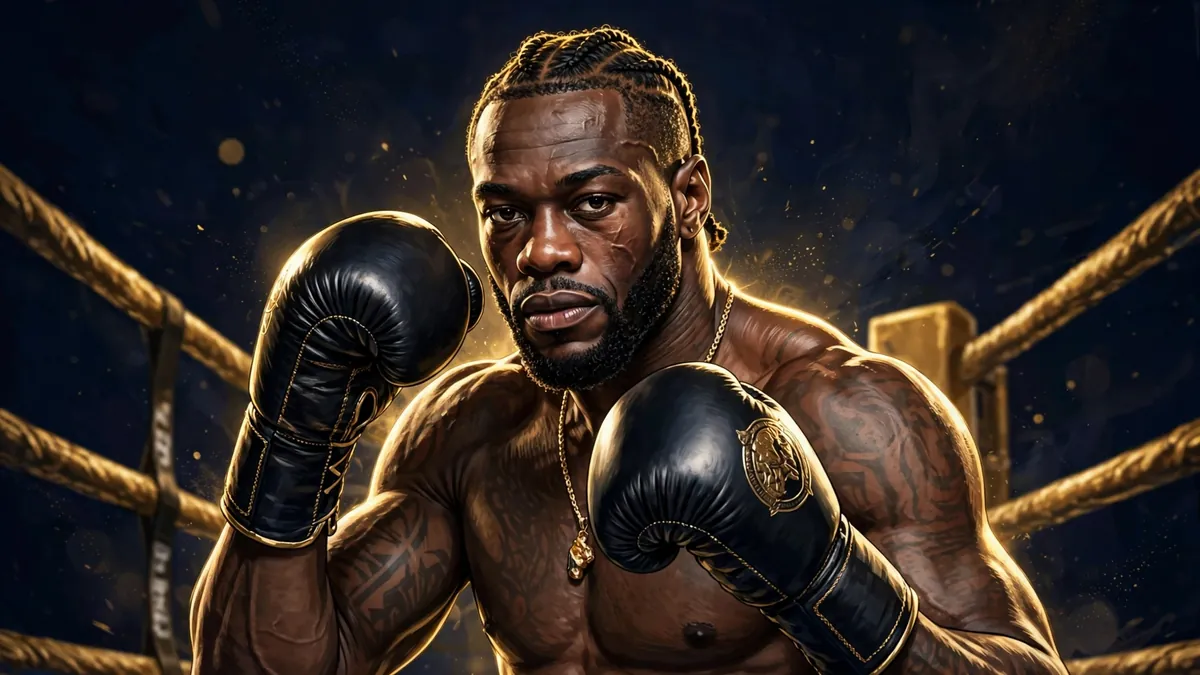
Deontay Wilder stands 6 feet 7 inches tall. In metric terms that is 201 centimetres, or 2.01 metres. The number appears the same way across the most consulted boxing references: Wikipedia’s infobox lists “6 ft 7 in (201 cm)”, Sporting News listed him at 6-7 in its fight-night bio for the Dominic Breazeale defence, and boxing database Champinon lists 6 ft 7 in (201 cm) alongside his 83-inch reach. Surprise Sports, in its 2026 biography of Wilder, gives the same figure — 6 ft 7 in (201 cm) — and so do the long-running biography sites Sportytell and Facts Bios.
That makes Wilder one of the taller heavyweight champions of his generation, though not the tallest. He gives away two inches to Tyson Fury, who is listed at 6 ft 9 in, and he stands an inch taller than Anthony Joshua at 6 ft 6 in. Against most of the men he fought during his title reign, Wilder was the taller man in the ring — and when he was not, as against the 6 ft 6 in Zhilei Zhang, his 83-inch reach still gave him the longer arms.
For fans who want the short version: if you see “6’7” next to Wilder’s name, that is the standard listed height, and it is the number to use. The only wrinkle is BoxRec, covered in full below, which records him a single inch shorter. A one-inch gap between sources is normal in boxing, where heights are measured at different times, in different shoes, and sometimes rounded by promoters. It does not change the picture: Wilder is a genuinely tall heavyweight, and his height has been a real weapon in his career, not just a line on a tale-of-the-tape graphic.
Deontay Wilder Height in Feet, Inches and Centimetres
Searches for a celebrity’s height come in several forms, so here are all of them in one place, with the conversions done properly:
- In feet and inches: 6 feet 7 inches
- In inches: 79 inches
- In centimetres: 201 cm
- In metres: 2.01 m
- BoxRec’s listing: 198 cm, which converts to 6 feet 6 inches (78 inches)
- Reach: 83 inches (211 cm), or 6 feet 11 inches fingertip to fingertip
- Height-to-reach difference: his reach is 4 inches longer than his height — an ape index of +4, which is a big edge in boxing
That last number deserves a pause. Most people have a reach roughly equal to their height. Wilder’s arms stretch four inches past his height, which means that even when an opponent matches him for height, Wilder can still touch them from a distance where they cannot touch him. It is the physical fact that explains so much of his style: a long, spearing jab that keeps men at range, and then a straight right hand that travels down a line most heavyweights cannot reach across.
For comparison, the average American man is about 5 ft 9 in (175 cm) tall. Wilder stands a full 10 inches above that average. Put him in a normal crowd and he is the man you spot first. Put him next to an NBA shooting guard and he still looks the part — 6 ft 7 in is a working height for a basketball forward, and Wilder carries it on a frame built for punching rather than jumping.
The 6 Ft 6 In vs 6 Ft 7 In Dispute: What the Sources Actually Say
Any honest height article has to deal with the one-inch disagreement, because a reader who checks two sites will find it within minutes. Here is exactly where each figure comes from, so you can judge for yourself.
The case for 6 ft 7 in (201 cm). Wikipedia lists Wilder at 6 ft 7 in (201 cm) in its infobox, citing its boxing sources. Sporting News, one of the most careful mainstream sports outlets, printed “Height: 6-7” in its official bio box ahead of the Breazeale fight in May 2019. Champinon, a boxing record database, lists “Height: 6 ft 7 in (201 cm)”. Sportytell lists 6 ft 7 in (201 cm) with a reach of 83 in (211 cm). Facts Bios lists 6 feet 7 inches (201 cm) with a weight of 97 kilograms. Surprise Sports, updated in October 2026, lists 6 ft 7 in (201 cm). Even BoxRec’s own wiki biography — the text written from Wilder’s official website — calls him “chiseled 6-foot-7-inch Deontay Wilder” twice. That is six independent listings against one, and they include the sources most fans and journalists actually use.
The case for 6 ft 6 in (198 cm). BoxRec’s structured record for Wilder — the database row that lists stance, height and reach for every professional boxer — gives “Height: 198 cm, Reach: 211 cm”. That is a serious source: BoxRec is the record-keeper of professional boxing, and its numbers are used by commissions and broadcasters. But note what it means: BoxRec’s own biography text on the same page says 6-foot-7, so the database figure and the site’s own prose disagree with each other. A plausible reading is that 198 cm was measured early in Wilder’s career, or rounded down, while 201 cm is the figure his team and promoters have used ever since.
Our adjudication: We anchor on 6 ft 7 in (201 cm), because it is the figure used by the majority of named sources, including Wikipedia and Sporting News, and by BoxRec’s own biography text. We record the range as 6 ft 6 in–6 ft 7 in (198–201 cm) so that the BoxRec database figure is not hidden. If a future official measurement settles the inch, this page should be updated to match it.
This kind of one-inch gap is common in boxing. Promoters have always had a reason to add an inch, commissions measure fighters at different ages, and a man measured in socks at 20 is not the same man measured in shoes at 35. What matters for understanding Wilder is not the single inch but the band: he is a 6 ft 6 in to 6 ft 7 in heavyweight with an 83-inch reach, and every part of his career makes sense inside that band.
Deontay Wilder Reach and Wingspan: 83 Inches of Trouble
If Wilder’s height is argued over by an inch, his reach is not argued over at all. Every source agrees: 83 inches (211 cm). Wikipedia lists it, BoxRec lists it in both its database row and its prose (“possessing tremendous punching power and an 83-inch reach”), Sporting News printed 83 inches in its fight bio, and Sportytell and Champinon both give 83 in (211 cm).
An 83-inch reach is rare air. It is longer than the reach of most men who ever held the heavyweight title, and it is the physical gift that made Wilder’s right hand so hard to see coming. A punch thrown from 83 inches away arrives from outside the range where most opponents can answer, and Wilder’s right hand — thrown straight, fast, and with his full body behind it — became the most feared single punch in the division. His knockout-to-win rate, above 95 percent, is the highest in heavyweight championship history, according to Wikipedia’s summary of his record.
Reach also shaped how opponents had to fight him. To land on Wilder, a shorter-armed heavyweight had to walk through the jab and the threat of the right hand, taking risks with every step forward. Luis Ortiz, a skilled Cuban southpaw with a 78-inch reach, found that out twice: in both of their fights, Wilder’s length kept Ortiz working at a distance he did not like, and in both fights the right hand eventually found its mark. Dominic Breazeale, listed at 6 ft 7 in himself, still gave away reach to Wilder — and lasted one round.
For readers who like the numbers, here is the tale of the tape that mattered most in Wilder’s career:
| Measurement | Deontay Wilder |
|---|---|
| Height | 6 ft 7 in (201 cm); BoxRec lists 198 cm |
| Reach | 83 in (211 cm) |
| Reach advantage over height | +4 inches |
| Stance | Orthodox |
| Division | Heavyweight (over 200 lbs) |
| Typical fight weight | 212–231 lbs (96–105 kg) |
| Knockout rate | 43 knockouts in 45 wins — above 95% |
Height and Weight: How Heavy Is Deontay Wilder?
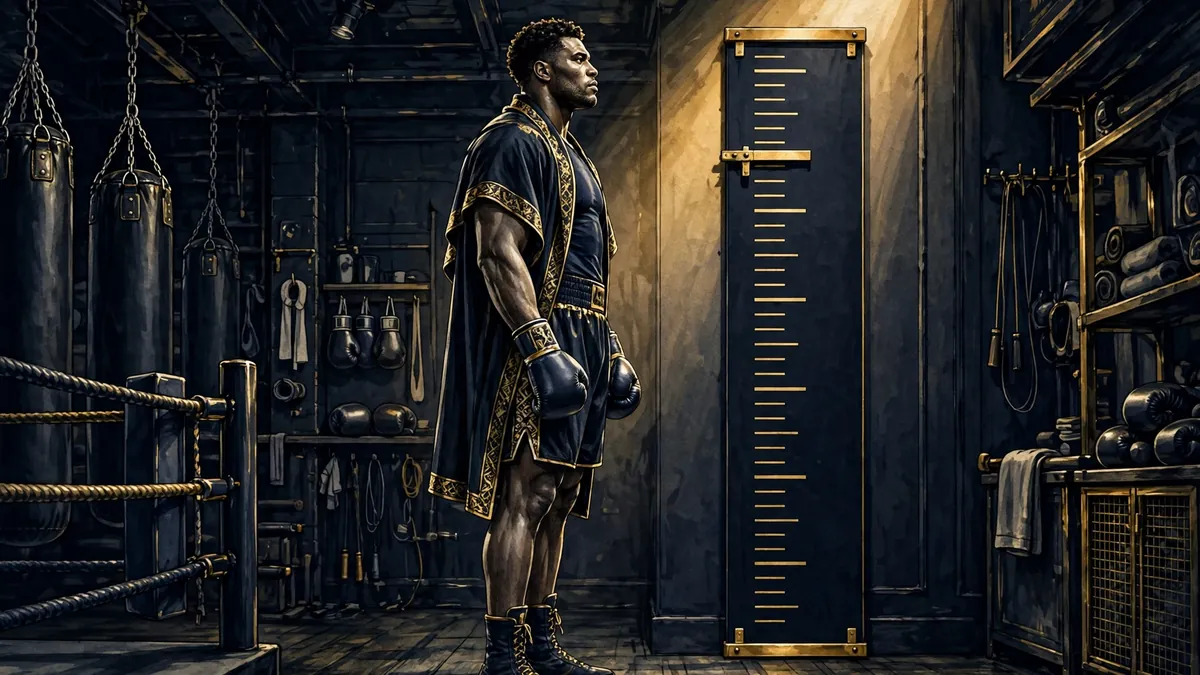
Wilder fights at heavyweight, the division with no upper weight limit, so his weight has moved around more than a smaller man’s would. Most sources put his fighting weight between 212 and 231 pounds (96 to 105 kilograms). Facts Bios lists 97 kilograms (214 lbs); Sportytell lists 96 kg; older profiles from his title reign often list him around 214–220 lbs.
The top of that range came in the second Fury fight, in February 2020, when Wilder weighed in at 231 pounds — the heaviest of his career, according to Wikipedia’s reporting of the bout. The extra weight was deliberate: his team wanted more mass behind his punches against a bigger man. It did not work. Fury stopped him in seven rounds, and Wilder’s camp later pointed to the heavy ring-walk costume he wore that night as a factor in his tired legs — a claim that became one of the most talked-about excuses in recent boxing, covered in the controversies section below.
What is striking about Wilder’s weight is how light he is for his height. A 6 ft 7 in heavyweight who weighs 214 pounds is lean — very lean. Tyson Fury, two inches taller, has weighed as much as 273 pounds. Anthony Joshua, an inch shorter than Wilder, usually weighs around 240–250 pounds. Wilder’s leanness is part of his speed: less mass to move means a faster right hand, and his punch has always been about speed and timing rather than bulk. The trade-off is that he can be pushed around by heavier men in the clinch, which is exactly what Fury did to him in their second and third fights, leaning on him and draining his legs.
For readers tracking his recent career: Wilder weighed in lighter for his comeback bouts, closer to the 210–220 pound band, as his team tried to get the speed and snap back into his legs after two years of inactivity and defeats. The scale will be worth watching again when he faces Jai Opetaia in December 2026 — a cruiserweight moving up, against whom Wilder’s size should be a clear edge.
Early Life: A Late Start in Tuscaloosa
Deontay Leshun Wilder was born on October 22, 1985, in Tuscaloosa, Alabama. He did not grow up dreaming of boxing. He grew up in a working-class home, played football and basketball at Tuscaloosa Central High School, and after graduation went to Shelton State Community College with plans to play football or basketball. Boxing was not on his mind at all — until life forced it onto his agenda.
In 2005, when Wilder was 19, his daughter Naieya was born with spina bifida, a serious birth defect of the spine. The medical bills and the need to provide for a child with long-term care needs changed everything. Wilder dropped out of college and took work where he could find it, including driving a beer truck, but the money was not enough. A friend suggested boxing. Wilder walked into a gym in Tuscaloosa at the age of 20 — years later than almost every boxer who ever won an Olympic medal — and found that he could punch.
That late start is the key to understanding Wilder. Most elite boxers have been fighting since they were eight or nine years old. Wilder had his first amateur bout at 20. He learned the sport as an adult, which left gaps in his technique that critics would point to for his whole career — his footwork was never textbook, his jab was never a classic weapon, and his defence relied on athleticism more than craft. But it also gave him something no gym can teach: a reason. He has said many times that he fights for his daughter, and the nickname that followed him — the Bronze Bomber — came later. The hunger came first.
Amateur Career and the 2008 Olympic Bronze
Wilder’s amateur career lasted barely three years, and it was one of the fastest rises in American boxing. He won the National Golden Gloves and the United States championships in 2007, in only his 21st amateur fight — an almost unheard-of rate of progress. A year later, he won the US Olympic trials and earned a place on the American team for the Beijing Olympics.
At Beijing in 2008, Wilder won the bronze medal in the heavyweight division. It was the only boxing medal the United States won at those Games, and it made Wilder a name before he had thrown a single professional punch. The medal also gave him his nickname: the Bronze Bomber, a nod to Joe Louis, the Brown Bomber, and to the colour of the medal he had won. He turned professional in November 2008, two months after the Olympics, stopping Ethan Cox in the second round in Nashville, Tennessee.
The Olympic run matters to the height story, too. At 6 ft 7 in, Wilder was a big heavyweight even in the amateurs, and his length and punching power stood out at once against men who had been boxing since childhood. What he lacked in polish he made up for in physical gifts — and in the amateurs, where bouts are short and scoring rewards clean punches, his right hand was enough.
The Rise to WBC Heavyweight Champion
Wilder’s professional rise was built on knockouts. He won his first 32 professional bouts by knockout, a streak that took him from club shows in Alabama to the edge of a world title. Along the way he picked up the WBC Continental Americas heavyweight title in December 2012 and defended it twice. His power was so consistent that the question around him was never whether he could punch — it was whether he could box well enough at the top level to deliver that punch against a champion.
The answer came on January 17, 2015, against Bermane Stiverne at the MGM Grand in Las Vegas. Wilder won a clear unanimous decision over 12 rounds to take the WBC heavyweight title, becoming the first American world heavyweight champion since 2007 — the longest gap without an American heavyweight champion in the sport’s history, as Wikipedia notes. He had gone the distance for the first time in his career to do it, which answered one question, even as others remained.
What followed was a five-year reign. Wilder defended the WBC title 10 times between 2015 and 2020, tying Muhammad Ali’s second reign for consecutive heavyweight title defences, and stopping eight of those challengers. The names on that list tell the story of the reign: Artur Szpilka, Chris Arreola, Gerald Washington, Luis Ortiz (twice, in two hard fights), and Dominic Breazeale, knocked out in a single round in May 2019. His height and reach were central to all of it — a long jab to control distance, and a right hand that ended arguments.
For the full arc of Wilder’s life and career beyond his height — his early years, his family, and the road from Tuscaloosa to the title — the Deontay Wilder biography on GuideNetWorth covers the story in depth, including his $30 million fortune and the Fury trilogy paydays.

The Tyson Fury Trilogy
No account of Wilder’s career is complete without Tyson Fury, and no account of his height is either — because Fury is the one man who made Wilder look small. Fury is listed at 6 ft 9 in, two inches taller than Wilder, with an 85-inch reach, two inches longer. In their three fights, Wilder was the smaller man in the ring for the first time in his championship life, and it showed.
The first fight, in December 2018 in Los Angeles, ended in a split-decision draw. Wilder dropped Fury twice, including a huge knockdown in the 12th round that looked like the end of the fight — until Fury rose from the canvas in a moment that became one of the most replayed scenes in modern boxing. Wilder kept his title, but the draw set up one of the great rivalries of the era.
The rematch, in February 2020, was a different fight entirely. Fury came in heavier, fought aggressively, leaned on Wilder in the clinch, and stopped him in the seventh round. Wilder lost his title after five years and one month — the tenth-longest individual heavyweight title reign, per BoxRec’s records. The third fight, in October 2021, was the best of the three: Wilder dropped Fury twice, Fury dropped Wilder three times, and Fury won by knockout in the 11th round. It was named by many outlets as the fight of the year.
The trilogy changed Wilder’s career and his bank balance. Surprise Sports puts his earnings at roughly $10 million for the first Fury fight, about $28 million for the second, and around $20 million for the third, with SalarySport’s purse database recording a $35 million purse for the February 2020 rematch as his single biggest payday. Those three fights account for the bulk of the $148.4 million in career purses SalarySport records for Wilder between 2012 and 2026 — and they are the reason his net worth, estimated at about $30 million by Surprise Sports, PlayersBio and SportsLeo, sits where it does.
Recent Fights: Parker, Zhang, Herndon and Chisora
After the Fury trilogy, Wilder’s career went into a long, uneven stretch. He returned in October 2022 with a first-round knockout of Robert Helenius in Brooklyn — a reminder that the right hand was still there. But the next two fights went badly wrong. In December 2023, Joseph Parker beat him by a wide unanimous decision in Riyadh, Saudi Arabia, in a fight where Wilder landed very little. Six months later, in June 2024, Zhilei Zhang stopped him in the fifth round at the Kingdom Arena in Riyadh, landing two right hooks that ended the fight at 1:51 of the round. Wilder had lost four of his last five fights, and many in the sport — including Fury himself — said openly that he should retire.
Wilder did not retire. After a 13-month layoff, he returned on June 27, 2025, against Tyrrell Herndon at the Charles Koch Arena in Wichita, Kansas, and won by seventh-round technical knockout, with the referee stepping in at 2:15 of the round. The Ring’s report noted that Wilder, who turned 40 that October, “looked solid and sharp” against an outmatched opponent, and the win lifted his record to 44-4-1 with 43 knockouts. Then, on April 4, 2026, he beat Derek Chisora by split decision over 12 rounds in Greenwich, London, taking his record to 45-4-1 with 43 knockouts, according to Box.Live and MartialBot. SalarySport records a $6 million purse for the Chisora fight.
As of November 2026, Wilder’s next fight is scheduled: he is set to face Jai Opetaia, the undefeated cruiserweight champion, on December 11, 2026, at the Principality Stadium in Cardiff, as part of the Fury vs. Joshua card, according to SportsLeo and Box.Live. Opetaia is smaller and younger, and the fight is a test of whether Wilder’s height, reach and power still carry him against the next generation. Fury, asked about the bout, has warned that Wilder should be “nowhere near a ring” — a remark that says as much about the concern around Wilder’s late career as it does about their old rivalry.
How His Height Shaped His Fighting Style
Wilder’s height and reach did not just help him — they defined him. His whole style is built on distance. He fights tall, behind a long jab, keeping opponents at the end of his arms, and he waits for the opening to throw the right hand. That punch, thrown straight down the middle, is the most dangerous weapon any heavyweight of his era owned. It is also a punch that needs room: Wilder’s best knockouts came when he had space to step into the shot, and his worst nights came when opponents took that space away.
The strengths of the style are obvious. Against men who had to cross open ground to reach him, Wilder’s jab and right hand were a wall. His 43 knockouts in 45 wins are the proof. His height also helped him defensively in an unusual way: because he is lean and loose, he could lean back from punches that would have caught a squarer, more upright heavyweight, and his long arms let him tie opponents up in the clinch when they did get close.
The weaknesses are just as clear, and his critics have named them for years. Wilder’s footwork was never smooth — he could look awkward moving around the ring, and his balance sometimes left him open after throwing the right hand. His jab, for a man with an 83-inch reach, was never the controlling weapon it could have been; he often used it as a range-finder rather than a scoring punch. And when a bigger man took away his space, as Fury did in the rematch by walking him down and leaning on him, Wilder had no plan B. His height gave him distance, but distance is only useful if you can keep it.
There is also the simple fact that height alone never won Wilder a fight. His greatest asset was never the 6 ft 7 in — it was the punch that came at the end of those long arms, and the belief that one clean shot could change any fight. That belief carried him through the Fury trilogy, through the Ortiz rematches, and through a comeback at 40 that most fighters would not have attempted. It is why, even now, with four losses on his record, no opponent walks into a Wilder fight relaxed.
Deontay Wilder Height Compared: Fury, Joshua, Usyk and More
Height only means something next to other people, so here is how Wilder stacks up against the heavyweights who defined his era. All figures are the commonly listed ones, and the same one-inch source gaps that affect Wilder apply to his rivals too.
| Heavyweight | Listed height |
|---|---|
| Tyson Fury | 6 ft 9 in (206 cm) — 2 inches taller than Wilder, 85-inch reach |
| Deontay Wilder | 6 ft 7 in (201 cm) — 83-inch reach |
| Anthony Joshua | 6 ft 6 in (198 cm) — 1 inch shorter than Wilder, 82-inch reach |
| Zhilei Zhang | 6 ft 6 in (198 cm) — 1 inch shorter than Wilder |
| Luis Ortiz | 6 ft 4 in (193 cm) — 3 inches shorter than Wilder |
| Joseph Parker | 6 ft 4 in (193 cm) — 3 inches shorter than Wilder |
| Oleksandr Usyk | 6 ft 3 in (191 cm) — 4 inches shorter than Wilder |
| Derek Chisora | About 6 ft 2 in (187 cm) — around 5 inches shorter than Wilder |
| Robert Helenius | 6 ft 7 in (200 cm) — the same height as Wilder |
The table makes the shape of Wilder’s career clear. Against Ortiz, Parker and Usyk, he would hold a clear height edge — and in the Ortiz fights, that edge was visible, with Wilder’s jab keeping the Cuban at bay until the right hand landed. Against Fury, the edge ran the other way, and Fury used it: a taller man with longer arms who could jab with Wilder, lean on him, and take away the distance Wilder needed. Against Joshua, the gap is a single inch — the two men are near enough the same size that a fight between them would be decided by skill and timing, not by the tape measure. It is a fight fans have wanted for years, and one that Surprise Sports once projected could have paid Wilder $40–50 million across two bouts. It never happened.
One more comparison is worth making, because it puts Wilder’s build in perspective. At 6 ft 7 in and roughly 214 pounds, Wilder is tall and lean for a heavyweight. Wladimir Klitschko, the long-reigning champion before him, was 6 ft 6 in and usually weighed around 240 pounds. Lennox Lewis was 6 ft 5 in and around 250 pounds. Wilder gives away 25–35 pounds to the classic big heavyweights — and that leanness is both his speed and his soft spot, the reason his punch is so fast and the reason heavier men can wear him down in the clinch.
The Money Behind the Height: Purses and Net Worth
This is a height article, not a net-worth profile, but no Wilder story is complete without the money, because his height and his punch are what earned it. As of 2026, Wilder’s net worth is estimated at approximately $30 million by Surprise Sports, PlayersBio, SportsLeo and UrbanSplatter, all publishing in 2026. One outlet, HeadlineFinds, puts the figure closer to $40 million, so the honest range is $30–40 million, anchored at $30 million by the majority of 2026 sources.
The gap between his career earnings and his net worth is the interesting part. SalarySport’s purse database records $148.4 million in purses for Wilder between 2012 and 2026, with the biggest single purse — $35 million — coming in the Fury rematch of February 2020. Surprise Sports breaks the Fury trilogy down as roughly $10 million for the first fight in 2018, about $28 million for the second in 2020, and around $20 million for the third in 2021. PlayersBio reports that Wilder earned $46 million in 2020 alone, including about $500,000 from sponsorships, and that Forbes placed him at number 56 on its highest-paid celebrities list that year.
Why is a man who earned well over $100 million in the ring worth $30 million? The same reason as most boxers: taxes, trainer and management fees, promoter cuts, and the cost of a long career. SportsLeo puts it plainly, estimating that 30 to 40 percent of a top boxer’s gross goes to trainers, promoters, managers and tax before the fighter sees it. Wilder’s early career also paid far less — around $1 million per fight before the Fury era, according to Surprise Sports — and his biggest paydays were concentrated in just three fights.
| Fight | Year |
|---|---|
| Tyson Fury I (draw) | 2018 — about $10 million (Surprise Sports); $14 million purse (SalarySport) |
| Luis Ortiz II | 2019 — about $20 million for the rematch (Surprise Sports) |
| Tyson Fury II (loss) | 2020 — about $28 million (Surprise Sports); $35 million purse (SalarySport) |
| Tyson Fury III (loss) | 2021 — about $20 million (Surprise Sports); $27.5 million purse (SalarySport) |
| Derek Chisora (win) | 2026 — $6 million purse (SalarySport) |
| Career purses total | $148.4 million, 2012–2026 (SalarySport) |
| Estimated net worth | About $30 million as of 2026 (Surprise Sports, PlayersBio, SportsLeo) |
Endorsements and Business Ventures
Wilder’s endorsement income has always been smaller than his purses, and smaller than the endorsement money earned by crossover stars. PlayersBio reported about $500,000 in sponsorship income for 2020, a modest sum next to his fight pay, and his public brand deals have been fewer and quieter than those of Anthony Joshua or Tyson Fury. That is partly a matter of style: Wilder’s appeal has always been the punch, not the persona, and his market is boxing fans rather than the mainstream.
What he has done with his money is more interesting than the endorsements. UrbanSplatter reports that Wilder has invested in a new gym, and PlayersBio notes investments in luxury real estate and automobiles — the standard portfolio of a wealthy athlete. He has also stayed visible in the sport as a draw: his comeback fights in Wichita and London sold on his name alone, and the Opetaia bout in December 2026 is on a major card because Wilder still moves tickets. At 41, his brand is his record — 43 knockouts — and that brand still has value as long as the right hand still lands.
Personal Life
Wilder’s personal life has stayed closer to home than his career. He is engaged to Telli Swift, a television personality, and his family life has been public in the way of a modern athlete — present on social media, but not the centre of his story. The person who shaped his life most is his eldest daughter, Naieya, whose birth with spina bifida in 2005 is the reason he started boxing at all. He has spoken about her often over the years, and the story is told in full in his biographies, including the BoxRec biography drawn from his official website.
Outside the ring, Wilder lives in Alabama, where he was born, and trains between Alabama and Las Vegas. He turned 41 on October 22, 2026, which makes him one of the oldest active heavyweights in the sport — older than Fury, older than Joshua, and older than Usyk. The question that follows him now is not about his height or his reach. It is about time: how much of the old power is left, and whether a man who started boxing at 20, won an Olympic medal at 22, and held a world title for five years has one more big night in him.
Controversies and Talking Points
Two episodes from Wilder’s career are worth recording, because readers will meet them in any search, and both are best reported as claims rather than settled facts.
After the Fury rematch in February 2020, Wilder said his ring-walk costume — a heavy, elaborate outfit honouring Black History Month — had tired his legs before the fight began. The claim was widely mocked, including by Fury, and Wilder’s own team did not repeat it as an excuse for long. It is best understood as a frustrated champion reaching for an explanation in the hours after his first defeat, and it is worth noting that Wilder later dropped the claim and took the loss on his record without further dispute.
Wilder also accused Fury of cheating in their fights, suggesting that Fury’s gloves had been tampered with. Fury denied the claim, no evidence was produced, and no boxing authority took action. The accusation soured a rivalry that had been one of the best in the sport, and it is still raised by fans of both men. Reported straight — a claim made, denied, and never proven — it is part of the record, and it belongs in any complete account of Wilder’s career.
Deontay Wilder Height FAQs
How tall is Deontay Wilder?
Deontay Wilder is 6 feet 7 inches tall (201 cm), according to Wikipedia, Sporting News and most boxing sources. BoxRec’s record database lists him at 198 cm (6 feet 6 inches), so the honest range is 6 ft 6 in to 6 ft 7 in (198–201 cm), with 6 ft 7 in as the most widely published figure.
How tall is Deontay Wilder in cm?
Wilder is 201 cm tall at the commonly listed height of 6 ft 7 in. The one source that differs, BoxRec’s database, lists 198 cm. His reach is 211 cm (83 inches) on every source, with no disagreement.
What is Deontay Wilder’s reach?
Deontay Wilder’s reach is 83 inches (211 cm). Every major source agrees on this figure, including Wikipedia, BoxRec and Sporting News. His reach is 4 inches longer than his height, which gave him a distance edge over almost every heavyweight he faced.
How much does Deontay Wilder weigh?
Wilder usually weighs between 212 and 231 pounds (96–105 kg) at heavyweight weigh-ins. His heaviest recorded weight was 231 pounds for the Tyson Fury rematch in February 2020. He is lean for his height — far lighter than Fury or Joshua at a similar size.
Is Deontay Wilder taller than Tyson Fury?
No. Tyson Fury is listed at 6 ft 9 in (206 cm), two inches taller than Wilder, with an 85-inch reach. Fury is the one man who made Wilder look small, and he used that size advantage in their second and third fights.
Is Deontay Wilder taller than Anthony Joshua?
Yes, by one inch. Wilder is listed at 6 ft 7 in (201 cm) and Joshua at 6 ft 6 in (198 cm). Their reaches are close too — Wilder 83 inches, Joshua 82 inches — so a fight between them would be decided by skill and timing rather than size.
How old is Deontay Wilder?
Deontay Wilder was born on October 22, 1985, in Tuscaloosa, Alabama, which makes him 41 years old as of November 2026. He started boxing at 20, won Olympic bronze at 22, and held the WBC heavyweight title from 2015 to 2020.
What is Deontay Wilder’s record and net worth?
As of November 2026, Wilder’s professional record is 45 wins (43 by knockout), 4 losses and 1 draw. His net worth is estimated at approximately $30 million by Surprise Sports, PlayersBio and SportsLeo, after career purses of $148.4 million recorded by SalarySport.
Final Thoughts
Deontay Wilder is 6 feet 7 inches tall, with an 83-inch reach and a right hand that made those numbers matter. The single inch of doubt — BoxRec’s 198 cm against the 201 cm used by Wikipedia, Sporting News and most other sources — is worth recording honestly, but it does not change the story. Wilder was a tall, long, lean heavyweight who turned his physical gifts into a five-year title reign, 10 defences, an Olympic medal, and 43 knockouts in 45 wins.
At 41, with a fight against Jai Opetaia set for December 11, 2026, the height question has a different edge than it once did. The measurements have not changed. What has changed is everything around them — the speed, the timing, the recovery. If Wilder wins in Cardiff, it will be because the 6 ft 7 in frame and the 83-inch reach still deliver the punch that built his name. If he loses, it will not be the tape measure that beat him. It will be time, which no height can outrun.
Sources and Reporting
How we estimated: Height figures in this article come from named, published sources, not from guesswork. Where sources disagree — the 6 ft 6 in vs 6 ft 7 in gap — we publish the range and say which figure the majority anchors on, rather than picking one and hiding the other. Net worth is an estimate built from publicly reported purses and pay-per-view shares; it is not a bank statement, and private taxes, fees and spending mean the real figure may differ. Fight records and purses are drawn from boxing databases and fight reporting dated to November 2026.
Sources consulted: Wikipedia — Deontay Wilder; BoxRec; Sporting News; The Ring; Surprise Sports — Deontay Wilder Net Worth in 2026; PlayersBio — Deontay Wilder Net Worth; SportsLeo — Deontay Wilder Net Worth; SalarySport — Deontay Wilder Fight Purses; Box.Live — Deontay Wilder Record; Champinon — Deontay Wilder; Sportytell — Deontay Wilder Biography. Sister-site biography: GuideNetWorth — Deontay Wilder Biography 2026.