By Celebamerica Editorial Staff | Last updated: 25 November 2026
Adam Scott’s net worth is estimated at $50 million to $60 million as of November 2026. Celebrity Net Worth anchors the figure at $50 million, while Golf Monthly puts it closer to $60 million, and the truth sits somewhere in that range. Behind the number is one of the steadiest careers golf has ever seen: a 2013 Masters title, a spell as world number one, 14 PGA Tour wins, and verified career earnings of $80.76 million, according to Spotrac.
Scott is the golfer who never chased the loudest deal or the quickest payday. He stayed loyal to the PGA Tour while rivals took guaranteed LIV Golf money, kept the same blue-chip sponsors for more than a decade, and kept making cuts into his mid-forties. In June 2026 he played his 100th consecutive major championship, a streak no active golfer can match. This page works through the full picture: the prize money, the UNIQLO and Rolex deals, the homes in Switzerland and the Bahamas, and why the $75 million-plus figure you will see on some rich lists is an earnings floor, not a net worth.
| Full Name | Adam Derek Scott |
|---|---|
| Date of Birth | 16 July 1980 (46 years old as of November 2026) |
| Birthplace | Adelaide, South Australia, Australia |
| Estimated Net Worth | $50 million – $60 million (Celebrity Net Worth: $50 million; Golf Monthly: about $60 million) |
| Career Prize Money | About $80.76 million in verified total career earnings, per Spotrac (early 2025) |
| Peak Income Sources | PGA Tour prize money, UNIQLO ambassadorship, Rolex, Titleist, Mercedes-Benz |
| Key Career Marks | 2013 Masters champion, former world No. 1 (11 weeks in 2014), 14 PGA Tour wins, 100 consecutive major starts |
| Spouse | Marie Kojzar (married April 2014) |
| Children | Three — daughter Bo Vera and sons Byron and Björn |
| Residence | Switzerland (tax resident since 2013), with a home in the Bahamas |
Contents
- From Adelaide to the World Stage
- Turning Professional and the First Wins
- The 2013 Masters: The Green Jacket That Changed Everything
- World Number One and the Peak Years
- Career Prize Money: The Eighty Million Dollar Engine
- Endorsements: UNIQLO, Rolex, Titleist and Mercedes-Benz
- The Net Worth Breakdown: Where the Money Sits
- Net Worth Growth, Year by Year
- Homes and Assets: Switzerland, the Bahamas and Queensland
- Personal Life: Marie Kojzar and Three Children
- Longevity: One Hundred Straight Majors
- How Adam Scott Compares With Golf’s Richest
- Not the Actor: Clearing Up the Other Adam Scott
- Frequently Asked Questions
- Final Thoughts
- Bottom Line
- Sources and How We Estimated

From Adelaide to the World Stage
Adam Derek Scott was born on 16 July 1980 in Adelaide, South Australia. His father worked in golf course management, so the game was part of daily life from the start rather than a hobby picked up later. The family moved to Queensland while Scott was still a boy, and he grew up playing junior golf on the Gold Coast, where the warm climate meant he could play all year round.
By his late teens Scott was the best junior in Australia. He won the Australian Boys’ Amateur and represented his country at amateur level before leaving for the United States on a golf scholarship. He enrolled at the University of Nevada, Las Vegas, one of the strongest college golf programmes in America, and spent two years there sharpening his game against the best young players in the country. The move mattered: American college golf gave him weekly competition at a standard Australian junior golf could not match, and it put him on the radar of agents and sponsors before he had played a single professional event.
Scott turned professional in 2000, at 20 years old, and the decision looked right from the first season. He won on the European Tour in 2001, at the Alfred Dunhill Championship in South Africa, and finished the year inside the world’s top 100. For a 21-year-old from Adelaide, that was a fast start. His swing, long and smooth, drew praise from the start. Commentators called it the best-looking swing in golf, and that reputation stuck with him for the whole of his career. It also helped his marketability: sponsors like a golfer who looks good on a poster, and Scott looked good on posters from the beginning.
Readers who want the full story of those early years can read Adam Scott’s full biography on Guide Net Worth, which covers his amateur career and family background in detail.
Turning Professional and the First Wins
Scott’s first years as a professional followed a clear pattern: win early, win often, and keep climbing. After the 2001 Dunhill win he added the Qatar Masters and the Scottish PGA Championship in 2002, both on the European Tour. By 2003 he had a PGA Tour card and a growing reputation as the next Australian star after Greg Norman.
The win that changed his standing came in March 2004, at THE PLAYERS Championship at TPC Sawgrass. Scott was 23, the youngest winner of the event at the time, and he held off a chasing pack on one of the hardest finishing stretches in golf. The victory was worth $1.44 million, then the biggest cheque of his life, and it announced him as a player who could win the events that matter most. He added the Booz Allen Classic later that year and finished 2004 inside the world’s top ten.
What followed was a decade of steady accumulation rather than a single hot streak. Scott won the Tour Championship in 2006, the Byron Nelson Championship in 2008, and kept adding European Tour titles through the 2000s. He was not the kind of player who won five times in a season. He was the kind who won once or twice a year, made most of his cuts, and banked a large cheque almost every time he teed it up. That is a slower way to build wealth, and it is also a surer one: there were no fallow years where the money stopped.
The one gap in the record was a major championship. Scott came close at the 2012 Open Championship at Royal Lytham, leading by four shots with four holes to play before Ernie Els passed him. It was the kind of defeat that ends some careers. For Scott, it set up the win that defines him.
The 2013 Masters: The Green Jacket That Changed Everything
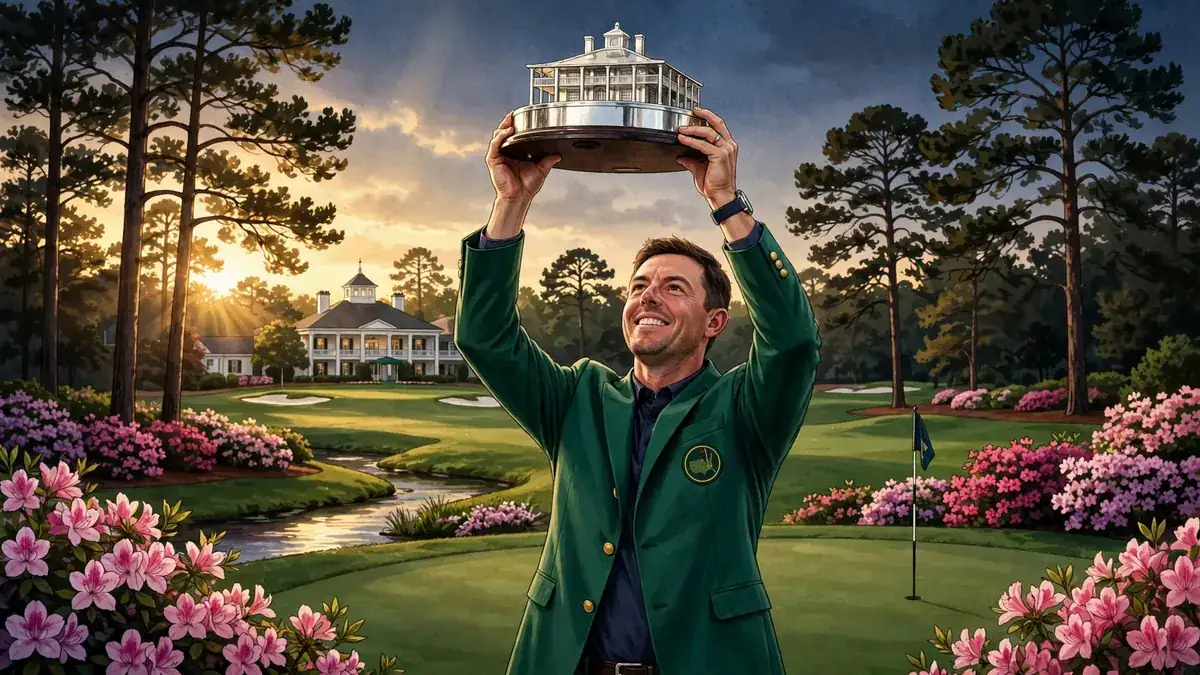
On 14 April 2013, Adam Scott won the Masters Tournament at Augusta National, beating Ángel Cabrera of Argentina in a sudden-death playoff. He birdied the 72nd hole to take the lead, watched Cabrera match him, and then birdied the second playoff hole, the 10th, to close it out. He became the first Australian to win the green jacket in the tournament’s 77-year history, ending a wait that stretched back to Greg Norman’s near misses in the 1980s and 1990s.
The win was worth $1.44 million in prize money, but the money was the smallest part of it. A Masters title rewrites a golfer’s commercial value overnight. Within weeks Scott signed as a global ambassador for UNIQLO, the Japanese clothing brand, a deal that has now run for more than a decade and is reported to be worth several million dollars a year. His existing deals with Rolex and Titleist gained new weight: he was no longer a promising Australian with a pretty swing, he was a Masters champion, and Masters champions sell watches and golf clubs.
The win also settled the question that had followed him since Lytham. Scott has spoken since about how the 2012 defeat taught him to stay patient over 72 holes, and the 2013 Masters was the proof. He did not overpower Augusta. He played it the way he plays everything: calmly, shot by shot, and without panic when Cabrera pushed him to a playoff.
World Number One and the Peak Years
Thirteen months after the Masters, in May 2014, Scott passed Tiger Woods to reach world number one in the Official World Golf Ranking. He held the spot for 11 weeks. It was the peak of his career as a player, and it came at the perfect time commercially: the world number one is the golfer every sponsor wants, and Scott’s calm, polished image fitted the role.
The peak years brought more big wins. He won the WGC-Bridgestone Invitational in 2011, before the Masters, and the WGC-Cadillac Championship in 2016, after the anchoring ban forced him to change putters. He won the Honda Classic and the WGC event in back-to-back weeks in early 2016, a two-week run that showed he could still beat the best fields in the world. His most recent PGA Tour win came at the Genesis Invitational in February 2020, at Riviera, one of the most respected courses on tour.
Scott also became a fixture of the Presidents Cup. He has played on eleven consecutive International teams, from 2003 through 2024, a run of loyalty to the team event that no other International player matches. The Presidents Cup pays appearance money rather than a winner’s cheque, but the value is in the profile: two weeks of global television every two years, in front of the sponsors who pay for everything else.
Through the late 2010s and early 2020s, Scott’s ranking slid from the top ten into the 30s and 40s, but his income did not fall off a cliff. That is the point of his financial story. A golfer who wins once every few years and makes 18 of 20 cuts, as Scott did in 2026, keeps earning. The cheques get smaller than they were in 2014, but they keep coming, and the endorsement deals, signed for years at a time, keep paying whatever the ranking says.
Career Prize Money: The Eighty Million Dollar Engine
Prize money is the foundation of Adam Scott’s fortune, and it is the one part of the figure that can be checked to the dollar. Spotrac, which tracks athlete earnings from official records, puts Scott’s verified total career earnings at $80.76 million as of early 2025. That number includes FedEx Cup bonuses and other official payouts on top of straight tournament prize money, which is why it runs higher than the PGA Tour’s own official money list.
The road to that total was gradual. Forbes reported that by 2016, Scott’s career PGA Tour earnings had passed $42 million, which already put him among the highest earners in the sport’s history. He passed the $50 million mark in official PGA Tour prize money during 2018 and 2019, and kept adding to it through the 2020s. Golf Monthly, in its own tally, puts his career prize money above $73 million, while Alux uses roughly $75 million earned on tour as the floor for its wealth ranking. The exact total depends on what you count — official tour money only, or bonuses and international events as well — but every serious tally lands between $73 million and $81 million.
His best single seasons show how the money stacked up. The 2015–16 season, when he won twice in consecutive weeks, brought in about $6.5 million in official money. The 2013 Masters season, with the green jacket and a string of high finishes, was worth a similar sum. Even in his mid-forties, the cheques have stayed large: in the 2026 season he made 18 of 20 cuts, posted three top-ten finishes and banked $5.27 million in official prize money, per GolfData’s season records updated in November 2026. For a 46-year-old in a sport that now belongs to players in their twenties, that is a remarkable late-career return.
Two things are worth noting about the prize money. First, Scott turned down LIV Golf. While contemporaries such as Cameron Smith took guaranteed nine-figure contracts to join the Saudi-backed tour, Scott stayed with the PGA Tour. That choice cost him a huge one-off payment, and it is the main reason his net worth is $50 million to $60 million rather than far higher. Second, prize money is gross, not net. Tour players pay their caddie around 10 percent of winnings, plus travel, coaching and management costs, and tax in more than one country. Scott’s reported earnings are the top line; what stayed in his pocket is a smaller number, and that gap is one reason the net worth estimates sit below the career earnings total.
| Career Earnings Measure | Figure |
|---|---|
| Spotrac verified total career earnings (early 2025) | $80.76 million |
| Alux on-tour earnings floor (October 2026) | Roughly $75 million |
| Golf Monthly career prize money tally | More than $73 million |
| Forbes: PGA Tour earnings by 2016 | More than $42 million |
| 2026 season official money (GolfData, November 2026) | $5.27 million from 20 starts |
| Best season, 2015–16 | About $6.5 million |
Endorsements: UNIQLO, Rolex, Titleist and Mercedes-Benz
If prize money is the engine of Scott’s wealth, endorsements are the steady income that keeps running when the wins slow down. Forbes has listed his endorsement partners as UNIQLO, Rolex, Titleist and Mercedes-Benz, a group of four blue-chip brands that has barely changed in a decade. That stability is unusual in golf, where players swap sponsors every few years, and it is worth real money.
UNIQLO is the biggest of the four. Scott signed as a global ambassador shortly after the 2013 Masters, and the deal has run ever since, with UNIQLO dressing him on course in its LifeWear range. The brand does not publish what it pays its ambassadors, and estimates in the golf press put the deal in the low millions of dollars a year. Over thirteen years, that is tens of millions of dollars for wearing a shirt. The fit works both ways: UNIQLO gets a Masters champion who is famously well turned out, and Scott gets a sponsor that does not ask him to change who he is.
Rolex is the longest relationship of all. Scott’s association with the Swiss watchmaker stretches back more than two decades, to the early years of his career, and it has survived every swing change and ranking slide. Titleist supplies his clubs and balls, a deal that dates to his amateur days, and Mercedes-Benz has been his car partner. None of these deals is a one-year stunt. They are the kind of long-term partnerships that pay a golfer well into his forties, long after the wins have thinned out.
Surprise Sports, in its breakdown of Australian golfers’ income, estimates Scott’s current annual income at roughly $11 million: about $3 million from tournament golf, $6 million from endorsements and $2 million from business ventures. The split is the story. At 46, endorsements now earn him about twice what tournament golf does. That is the payoff for two decades of careful brand management: he never had a scandal, never feuded with a sponsor in public, and never gave a brand a reason to walk away.

The Net Worth Breakdown: Where the Money Sits
So how does $80.76 million in career earnings become a net worth of $50 million to $60 million? The table below is our own estimate breakdown, built from the sourced figures above. It is an estimate, not an audit: Scott’s private accounts are not public, and no outlet has seen his tax returns. What it does show is the shape of the fortune, and why the range is honest.
| Component | Estimated Value |
|---|---|
| Career prize money and bonuses (gross, per Spotrac) | $80.76 million |
| Endorsement income over career (UNIQLO, Rolex, Titleist, Mercedes-Benz) | $40 million – $50 million |
| Real estate (Switzerland, Bahamas, Queensland) | $10 million – $15 million |
| Less: caddie fees, travel, coaching, management (career) | –$15 million – –$20 million |
| Less: taxes across Australia, the United States and Switzerland | –$40 million – –$55 million |
| Less: living costs over a 26-year career | –$10 million – –$15 million |
| Estimated net worth, November 2026 | $50 million – $60 million |
The most common mistake in net worth coverage of golfers is to treat career earnings as net worth. Alux, for example, lists Scott at $75 million-plus, but it says so itself: that figure is a floor built from career earnings, not a net worth estimate. Career earnings are gross, before tax, before the caddie’s 10 percent, before flights and hotels for 26 seasons. A golfer who earned $80 million on course and tens of millions more from sponsors, then paid tax in three countries and lived well for a quarter of a century, ends up with a net worth below his gross earnings. That is exactly what the $50 million to $60 million range shows, and it is why we anchor on Celebrity Net Worth’s $50 million and Golf Monthly’s $60 million rather than the higher earnings-based figures.
For readers who follow the money across golf, our Net Worth category carries the same breakdown treatment for the sport’s other big earners.
Net Worth Growth, Year by Year
Scott’s wealth grew slowly and then stayed flat, which is the pattern of a golfer who earned steadily rather than landing one huge deal. Surprise Sports tracked the arc: about $40 million in 2015, about $45 million in 2020, and about $50 million in 2025, growth of roughly 25 percent across a decade. Compare that with a golfer who took LIV money and the difference is plain: Scott’s fortune grew by a quarter in ten years, while his former Presidents Cup teammates who joined LIV doubled theirs overnight. He chose the tour, the ranking points and the majors over the payout, and the growth table shows the cost of that choice.
| Year | Estimated Net Worth |
|---|---|
| 2005 (after THE PLAYERS win) | About $8 million – $10 million |
| 2010 (pre-Masters, established tour star) | About $25 million – $30 million |
| 2013 (Masters win, UNIQLO deal signed) | About $35 million – $40 million |
| 2015 (world No. 1 spell behind him) | About $40 million |
| 2020 (Genesis win, late-career peak) | About $45 million |
| 2025 (career earnings pass $80 million) | About $50 million |
| 2026 (100th straight major, strong season) | $50 million – $60 million |
The 2013 jump is the one that matters. A Masters win is worth far more than its $1.44 million cheque: it is the UNIQLO deal, the higher appearance fees, the better end of every renewal for the next decade. The years after 2015 are flatter because Scott stopped winning majors and his ranking drifted, but the endorsement income kept the total rising slowly instead of falling. That is the benefit of deals signed for years rather than months.
Homes and Assets: Switzerland, the Bahamas and Queensland
Scott’s property portfolio mirrors his career: spread across three countries, bought quietly, and held for years. He has been a resident of Switzerland for tax purposes since 2013, and the family is based there, in the Crans-sur-Sierre area. He also keeps a home in the Bahamas at Albany, the resort community where he spends around 15 weeks a year and where he married Marie Kojzar in 2014. The Bahamas base makes sense for a tour golfer: it is a short flight to Florida events, and the climate allows year-round practice.
In Australia, Scott bought a house at Sanctuary Cove in Queensland in 2006 for $2.75 million and sold it in 2024 for $5.35 million, close to doubling his money across eighteen years. He still owns a holiday home at Sunshine Beach, on the Queensland coast. The Sanctuary Cove sale is one of the few Scott property deals with a public price on both ends, and it shows the same patience as the rest of his money: buy, hold, sell when the time is right.
Beyond property, Scott’s assets are the usual ones for a golfer of his standing: his endorsement contracts, his tournament earnings, and whatever private investments he holds. He is not known as a business builder in the way some golfers are — there is no Scott golf course design firm or clothing label on the scale of Greg Norman’s empire. His wealth is golf wealth: prize money, sponsors and property, held rather than flipped.
The LIV question: Scott was linked with LIV Golf when it launched in 2022, and he spoke openly about listening to what was on offer. In the end he stayed with the PGA Tour, and he has since played a role in the tour’s discussions with the Saudi fund as a player director. The decision cost him a guaranteed contract worth many times his annual income, and it is the single biggest reason his net worth is $50 million to $60 million instead of far higher. It also kept him eligible for the majors and the Presidents Cup, which is where his 100-start streak was built.
Personal Life: Marie Kojzar and Three Children
Scott married Marie Kojzar, a Swedish architect, in April 2014, in a small, secret ceremony in the Bahamas. The wedding was so private that most of the guests thought they were attending a party at the couple’s Bahamas home. The couple had met in 2001, when Kojzar was working as a nanny for Danish golfer Thomas Bjørn, and they dated on and off through the early 2000s before splitting up in 2008. They got back together shortly after Scott’s Masters win in 2013.
Kojzar was born in Stockholm in 1981 and studied architecture at the Royal College of Art in London before working in London and Sweden. The couple have three children: daughter Bo Vera, born in February 2015 at Pindara Private Hospital in Queensland, and sons Byron and Björn, born in 2017 and 2020. Scott has said that fatherhood changed his routines on tour — the travel, the practice hours and the recovery all had to be reshaped around family life — and that the adjustment took patience.
The family splits its time between Switzerland and the Bahamas, and Scott is officially a resident of Switzerland for tax purposes. Before his marriage, Scott was in a relationship with Serbian tennis player Ana Ivanovic in 2010; they broke up in September of that year. He has kept his private life quiet throughout his career, giving few interviews about his family and keeping his children out of the public eye.
For the full picture of Scott’s life off the course, including his age at every turning point of his career, see how old Adam Scott is in 2026 on this site.
Longevity: One Hundred Straight Majors
In June 2026, at the US Open at Shinnecock Hills, Adam Scott played his 100th consecutive major championship. The streak stretches back to the 2001 Open Championship, when he was a fresh-faced 21-year-old, and it has now run for nearly 25 years without a break. No other active golfer is close: Jordan Spieth, the next man on the list, has played 53 consecutive majors, barely half Scott’s total.
The numbers inside the streak are just as striking. Scott has made 74 cuts in those 100 majors and recorded 20 top-ten finishes. He has never missed a major through injury, loss of form or failure to qualify for a quarter of a century. That takes more than talent. It takes a body that holds up, a ranking that never falls far enough to lose exemptions, and a schedule managed year after year to keep the streak alive.
The streak is also a money story. Every major start carries a large purse and world ranking points, and 100 of them in a row means 100 weeks of high-profile golf with no gaps. It is the reason Scott’s earnings kept growing into his forties while other players his age faded from the rankings. As long as he keeps qualifying — he was ranked 49th in the world after Shinnecock Hills, comfortably inside the exemption lines — the streak will keep running, and the next major on the calendar, the 2027 Masters, would take him past 102 in a row.
How Adam Scott Compares With Golf’s Richest
Scott’s $50 million to $60 million puts him in the second tier of golf wealth: far behind the sport’s billionaires, and comfortably ahead of most of his own generation. The table below uses published estimates from the same season, so the numbers are comparable.
| Golfer | Estimated Net Worth |
|---|---|
| Tiger Woods | About $1.5 billion (Alux, October 2026) |
| Justin Thomas | $75 million-plus (Alux, October 2026) |
| Adam Scott | $50 million – $60 million |
| Jason Day | $50 million (Surprise Sports, 2026) |
Tiger Woods sits alone at the top, with Alux putting him at about $1.5 billion as of October 2026 — the only golfer in the billionaire class. Justin Thomas, a two-time major winner a generation younger than Scott, is listed at $75 million-plus, ahead of Scott largely because his two PGA Championship wins and FedEx Cup title came with bigger purses in the modern era. Jason Day, Scott’s fellow Australian and a former world number one himself, sits at the same $50 million mark, with $71.3 million in career earnings behind it. Day and Scott are the two richest Australian golfers of their generation after Greg Norman, whose business empire puts him around $400 million.
Rory McIlroy, who completed the career Grand Slam at the 2025 Masters, sits well above Scott in wealth, and Rory McIlroy’s biography on this site covers his rise. Scottie Scheffler, the dominant player of the mid-2020s, is building his fortune far faster than Scott ever did, as Scottie Scheffler’s biography shows. The comparison is kind to Scott in one respect: none of them has his streak. One hundred straight majors is a record that money cannot buy, and it is the achievement that will define him when the cheques stop.
For the full earnings picture of the golfer Scott passed for world number one, see Tiger Woods’ net worth, and for the younger American who now sits above him on the rich lists, see Justin Thomas’ net worth.
Not the Actor: Clearing Up the Other Adam Scott
One quick note for anyone who arrived here by mistake: this article is about Adam Scott the golfer, born 16 July 1980 in Adelaide, Australia. There is a second famous Adam Scott, the American actor born 3 April 1973 in Santa Cruz, California, best known for Parks and Recreation and Severance. The actor’s net worth is estimated at $8 million to $20 million, depending on the source — a different person, a different career, and a much smaller fortune. If you searched for the actor, you want his page, not this one. The golfer is the one with the green jacket.
Frequently Asked Questions
What is Adam Scott’s net worth in 2026?
Adam Scott’s net worth is estimated at $50 million to $60 million as of November 2026. Celebrity Net Worth anchors the figure at $50 million, while Golf Monthly puts it at about $60 million. The range reflects the gap between his verified career earnings and his private spending, taxes and investments.
How much prize money has Adam Scott earned in his career?
Spotrac puts Adam Scott’s verified total career earnings at $80.76 million as of early 2025, a figure that includes FedEx Cup bonuses on top of official tournament prize money. In the 2026 season alone he banked $5.27 million in official money from 20 starts, per GolfData’s season records.
How did Adam Scott win the 2013 Masters?
Adam Scott won the 2013 Masters at Augusta National by beating Ángel Cabrera of Argentina in a sudden-death playoff. He birdied the 72nd hole to take the lead, Cabrera matched him, and Scott birdied the second playoff hole, the 10th, to become the first Australian to win the green jacket.
Was Adam Scott ever world number one?
Yes. Adam Scott reached world number one in May 2014, passing Tiger Woods, and held the top spot in the Official World Golf Ranking for 11 weeks. He won 14 times on the PGA Tour, including THE PLAYERS Championship in 2004 and two World Golf Championship events.
Who is Adam Scott’s wife?
Adam Scott’s wife is Marie Kojzar, a Swedish architect born in Stockholm in 1981. They met in 2001, reunited after his 2013 Masters win, and married in a small, secret ceremony in the Bahamas in April 2014. They have three children: daughter Bo Vera and sons Byron and Björn.
How old is Adam Scott?
Adam Scott is 46 years old as of November 2026. He was born on 16 July 1980 in Adelaide, South Australia, which puts his 47th birthday on 16 July 2027. At 45, he played his 100th consecutive major championship at the 2026 US Open.
Is Adam Scott the golfer the same person as Adam Scott the actor?
No. Adam Scott the golfer was born on 16 July 1980 in Adelaide, Australia, and won the 2013 Masters. Adam Scott the actor was born on 3 April 1973 in Santa Cruz, California, and is best known for Parks and Recreation and Severance. The actor’s net worth is estimated at $8 million to $20 million, well below the golfer’s $50 million to $60 million.
What brands does Adam Scott endorse?
Adam Scott’s main endorsement partners are UNIQLO, Rolex, Titleist and Mercedes-Benz, according to Forbes. The UNIQLO deal began shortly after his 2013 Masters win and has run for more than a decade, while his Rolex association stretches back over twenty years. Endorsements now earn him about twice what tournament golf does each year.
Final Thoughts
Bottom Line
Adam Scott’s net worth of $50 million to $60 million is the fortune of a golfer who chose longevity over jackpots. He turned down LIV Golf money, kept the same sponsors for a decade, and kept making cuts until his 100th straight major at the age of 45. The $80.76 million in career earnings is the headline, but the real story is the patience behind it: a Masters title in 2013, a spell as world number one in 2014, and then twelve more years of steady cheques. Golfers with bigger fortunes mostly got them in one deal. Scott built his one season at a time, and at 46 he is still adding to it.
Sources and How We Estimated
How we estimated: Adam Scott’s net worth is an estimate built from public records, not a statement of his private finances. We anchored the range on Celebrity Net Worth ($50 million) and Golf Monthly (about $60 million), and checked it against his verified career earnings — $80.76 million per Spotrac as of early 2025 — and the earnings-based floors published by Alux (roughly $75 million on tour) and Deemples ($57 million in purses, 2022). Where sources disagreed, we published a range and named the source behind each end of it. Prize money is gross, before tax, caddie fees and costs, which is why the net worth range sits below the career earnings total. Figures will move as the 2026–27 season progresses, and we will update this page when they do.
Sources consulted: Celebrity Net Worth, Golf Monthly, Spotrac, PGA Tour, Alux, Forbes, Surprise Sports, Today’s Golfer, Deemples Golf.