Drew Barrymore net worth is estimated at $85 million as of November 2026, according to Celebrity Net Worth, whose profile of the actress was updated on March 25, 2026. Parade repeated the same $85 million figure in 2026, citing Celebrity Net Worth. A handful of lower-authority trackers put her higher — $125 million is the most common rival number — so the honest range is $85 million to $125 million, with $85 million as the anchored figure.
That number covers one of the longest careers in Hollywood. Barrymore started working before her first birthday, became the most famous child actor on the planet at seven in E.T. the Extra-Terrestrial, lost nearly everything to addiction as a teenager, rebuilt herself into a rom-com star who commanded $15 million a film, and then turned producer, author, beauty founder and daytime talk-show host. The $85 million is not a pile of acting cheques. It is the sum of four decades of film salaries, producing profits from Flower Films, a talk show renewed through 2028, several consumer brands, book deals and a long run of well-timed property deals. This page works through every piece of it, with each figure tied to the source that reported it.
By Celebamerica Editorial Staff | Last updated: November 25, 2026
Quick Facts: Drew Barrymore at a Glance
| Full Name | Drew Blythe Barrymore |
|---|---|
| Date of Birth | February 22, 1975 (age 51 in 2026) |
| Birthplace | Culver City, California, USA |
| Estimated Net Worth | $85 million (Celebrity Net Worth, updated March 25, 2026; repeated by Parade in 2026). Rival trackers claim up to $125 million, giving a range of $85M–$125M. |
| Peak Film Salary | $15 million for Music and Lyrics (2007), per Celebrity Net Worth and Parade |
| Primary Income Sources | Film acting, producing (Flower Films), hosting and executive-producing The Drew Barrymore Show, books, brand deals |
| Key Ventures | Flower Films (co-founded 1995), Flower Beauty (2013–2025), Beautiful by Drew, Drew Magazine, Barrymore Wines |
| Breakout Role | Gertie in E.T. the Extra-Terrestrial (1982), age 7 |
| Height | 5 ft 4 in (163 cm) |
| Children | Two daughters, Olive (born 2012) and Frankie (born 2014), with ex-husband Will Kopelman |
| Marital Status | Single; married and divorced three times |
Table of Contents
- Quick Facts: Drew Barrymore at a Glance
- Who Is Drew Barrymore?
- Early Life: Born Into Hollywood’s Oldest Acting Dynasty
- Child Stardom: E.T. and the Price of Early Fame
- The Comeback: Reinventing Herself in the Nineties
- Peak Paydays: The Rom-Com Years and the Fifteen-Million-Dollar Peak
- Flower Films: The Production Company That Changed the Math
- The Drew Barrymore Show: Daytime Television’s Second Act
- The Business Empire: Flower Beauty, Beautiful by Drew and More
- Real Estate: A Decade of Buying, Renovating and Selling
- Net Worth Breakdown: Where the Eighty-Five Million Comes From
- Net Worth Growth: Four Decades in Numbers
- How She Compares: Fellow Talk-Show Hosts and Rom-Com Stars
- Personal Life: Marriages, Motherhood and a New Chapter
- Controversies and Public Scrutiny
- Frequently Asked Questions
- Final Thoughts: The Bottom Line
- Sources and How We Estimated
Who Is Drew Barrymore?
Drew Barrymore is an American actress, producer, director, author and talk-show host whose career has run, with one long interruption, since 1975. She is the seventh generation of the Barrymore acting family, a line that stretches back to the nineteenth-century stage. Her great-grandfather Maurice Barrymore was a stage star; her grandfather John Barrymore was one of the most celebrated actors of the silent era; her great-aunt Ethel Barrymore won an Academy Award. Drew was born into that name, and for the first decade of her life it opened every door in Hollywood. Then, for a stretch in her teens, it nearly destroyed her.
What makes her money story different from most celebrity fortunes is how many times the income stream changed shape. The child star earned a child star’s pay. The adult comeback earned rom-com pay, which in the early 2000s was among the best in the business for a woman: $9 million for the first Charlie’s Angels, $14 million for the sequel, $15 million at her peak. Then she stopped chasing the biggest cheque and started owning the project instead. Flower Films, the company she co-founded with Nancy Juvonen in 1995, produced her own hits and, because it owns the Charlie’s Angels film rights, kept earning from the franchise long after she stopped starring in it. The talk show she launched in 2020 turned her into a daily television presence with a contract now running to 2028. Around all of that sits a set of consumer brands — cosmetics, kitchenware, a magazine, wine — that sell directly to the same audience that watches her show.
None of this was a straight line. Barrymore has spoken openly, in her memoir Little Girl Lost (1990) and in interviews across three decades, about drinking at nine, using drugs at twelve, two stints in rehab before she was fourteen, and being legally emancipated from her parents at fourteen. The comeback that followed is the reason the $85 million figure exists at all: a child star who flames out at thirteen does not usually get a second act, let alone a third and a fourth.
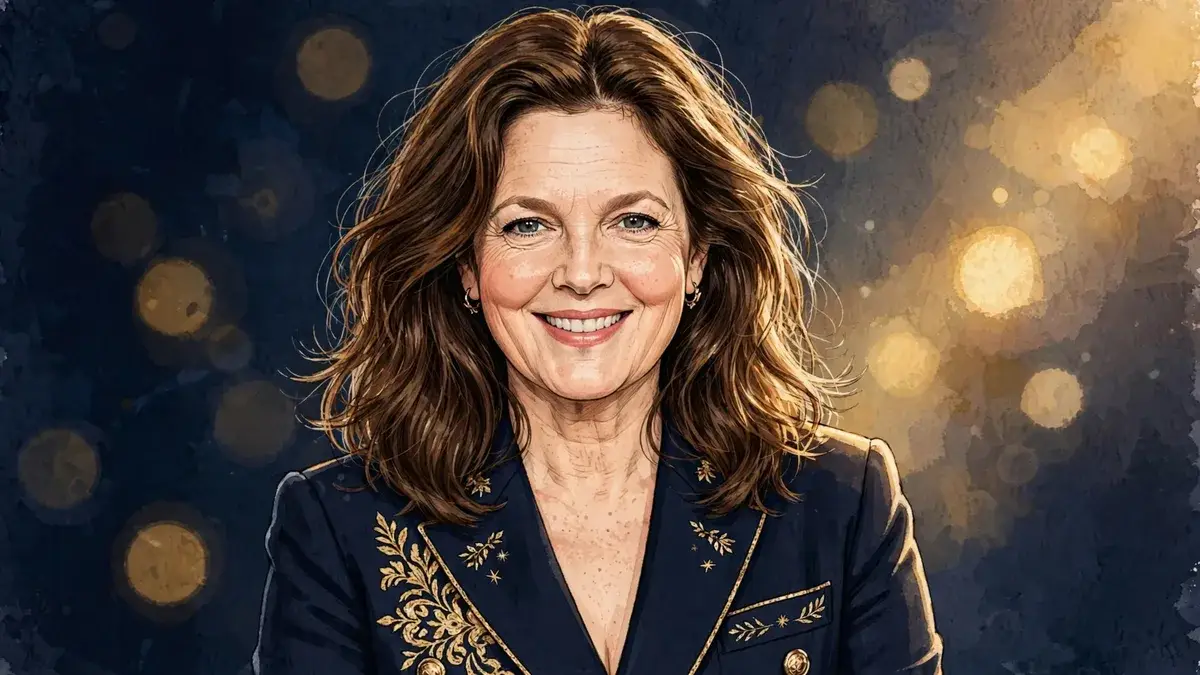
Early Life: Born Into Hollywood’s Oldest Acting Dynasty
Drew Blythe Barrymore was born on February 22, 1975, in Culver City, California. Her father, John Drew Barrymore, was an actor; her mother, Jaid Barrymore, was an aspiring actress. Her parents split before she was born, and she was raised largely by her mother in Los Angeles, in and out of the orbit of a family name that everyone in the business already knew.
The Barrymore name was both a gift and a weight. Her godparents were director Steven Spielberg and actress Sophia Loren, a measure of how connected the family was. Her first job came at eleven months old: a dog-food commercial. The story, retold many times including by Celebrity Net Worth, is that a dog nipped her during the audition and she laughed instead of crying, which won her the part. Her feature-film debut followed at five in the science-fiction drama Altered States (1980).
She grew up on sets rather than in classrooms, and the adults around her treated her as a small professional long before she was old enough to understand what that meant. That early start explains the shape of her whole career: she had already been famous for a decade by the time most actors get their first audition, and she had already burned out and rebuilt herself before she turned twenty-five.
Child Stardom: E.T. and the Price of Early Fame
In 1982, at seven years old, Barrymore played Gertie in Steven Spielberg’s E.T. the Extra-Terrestrial. The film became the highest-grossing movie of its time, taking in more than $790 million worldwide, and Gertie — the little sister who befriends the stranded alien — made Barrymore the most recognisable child in the world. She followed it with Firestarter (1984) and Irreconcilable Differences (1984), earning a Golden Globe nomination for the latter at nine.
The pay for those early roles was modest by later standards, and the fame came with almost no protection. Barrymore has been candid that she started drinking at nine and using drugs by twelve. She entered rehab at thirteen, left, relapsed, and went back. At fourteen she petitioned for, and won, legal emancipation from her parents. Her first memoir, Little Girl Lost, was published in 1990, when she was fifteen — a book no fifteen-year-old should have had the material to write.
For the money story, the child-star years matter in two ways. First, they produced almost no lasting wealth: child-actor earnings in the early 1980s, even for a star, were a fraction of what she would later command, and the money was not managed with the discipline that surrounds young stars today. Second, the crash that followed cost her the years when a working actress normally builds her career. By the time she was eighteen, casting directors saw a cautionary tale, not a leading lady. The fortune she eventually built was earned almost entirely after that point, which is why the timeline below starts low and climbs late.

The Comeback: Reinventing Herself in the Nineties
The rebuild began in the early 1990s with deliberately unglamorous work. She took the title role in the erotic thriller Poison Ivy (1992), a low-budget film that signalled she was done being anyone’s child star. She followed it with steady supporting work — Boys on the Side (1995), Mad Love (1995), for which she was paid a reported $1.5 million — and a small but unforgettable turn as Casey Becker in the opening scene of Scream (1996). The Scream role lasted about twelve minutes on screen and did more for her career than most leading roles do: it told Hollywood she was back, and that she was in on the joke.
The real turn came with the romantic comedies. The Wedding Singer (1998), opposite Adam Sandler, was a hit that paired her with the decade’s biggest comedy star; the two would reunite for 50 First Dates (2004) and Blended (2014), and their partnership became one of the most bankable pairings of the era. Ever After (1998), a Cinderella retelling in which she carried the film alone, earned her a reported $3 million and proved she could open a movie without a male co-star. Never Been Kissed (1999) followed, and it was also the first film produced by her own company — the moment acting pay and producing profit started to stack.
By the end of the decade she had done something rare: she had gone from a washed-up former child star to one of the most reliable box-office draws in Hollywood, and she owned a piece of the films she was starring in. That ownership is the thread that runs through everything that came after.
Peak Paydays: The Rom-Com Years and the Fifteen-Million-Dollar Peak
The 2000s were Barrymore’s highest-earning years as an actress, and the numbers are unusually well documented because Celebrity Net Worth and Parade both track her per-film pay in detail.
| Film | Year | Reported Salary |
|---|---|---|
| Mad Love | 1995 | $1.5 million |
| Ever After | 1998 | $3 million |
| Charlie’s Angels | 2000 | $9 million |
| Charlie’s Angels: Full Throttle | 2003 | $14 million |
| Music and Lyrics | 2007 | $15 million |
The Charlie’s Angels films were the centrepiece. Barrymore played Dylan Sanders in the 2000 reboot and its 2003 sequel, Full Throttle, and both films cleared $250 million at the worldwide box office. She was paid a reported $9 million for the first film and $14 million for the sequel — and, as a producer through Flower Films, she earned on the other side of the ledger too. Her highest single payday came in 2007, when she earned a reported $15 million for the musical romantic comedy Music and Lyrics opposite Hugh Grant. Celebrity Net Worth notes that $15 million a picture was her peak rate as a movie star.
She also worked at the other end of the scale when the project mattered to her: a reported $500,000 for the cult hit Donnie Darko (2001) and $250,000 for Confessions of a Dangerous Mind (2002). Those small cheques tell their own story — by then she could afford to choose, and she was choosing projects her company was producing. Other box-office successes in the period included 50 First Dates (2004), which took in nearly $200 million worldwide, Fever Pitch (2005) and He’s Just Not That Into You (2009).
She directed, too. Her feature directorial debut, the roller-derby drama Whip It, arrived in 2009, and the same year she won a Golden Globe for Best Actress in a Miniseries or Television Film for playing Little Edie Beale in HBO’s Grey Gardens. From 2017 to 2019 she starred in the Netflix comedy Santa Clarita Diet, her first sustained television acting role. In March 2021 she said she was taking an indefinite break from acting — not because the work had dried up, but because the talk show had become the bigger job.
Flower Films: The Production Company That Changed the Math
Flower Films is the single most important decision in Barrymore’s financial life. She co-founded the production company with her producing partner Nancy Juvonen in 1995 — Parade dates the founding to 1997, a small discrepancy in the record that does not change the substance. The idea was simple: instead of waiting for studios to offer her roles, she would develop and produce her own films, and take a producer’s share of the profit on top of her acting fee.
The company’s slate reads like a list of her career highlights: Never Been Kissed (1999), Donnie Darko (2001), 50 First Dates (2004), Fever Pitch (2005) and He’s Just Not That Into You (2009). It also produced both Charlie’s Angels films — and, because Flower Films owns the film rights to the franchise, it produced the 2019 reboot as well, earning from a series Barrymore no longer starred in. That is the difference between a salary and an asset: a salary stops when the shoot ends, and a rights library keeps paying.
Flower Films also moved into television, producing Santa Clarita Diet and, with Big Ticket Pictures and CBS Media Ventures, The Drew Barrymore Show itself. Barrymore is an executive producer of her own talk show, which means she earns as a producer as well as a host — a double dip that most daytime hosts do not get. No public valuation of Flower Films exists, and this article does not invent one. What the record does show is a company that has been active for thirty years, has produced a string of profitable films, and owns a franchise that has generated more than half a billion dollars at the box office across its installments.
Why the $125 million figure is treated with caution: several lower-authority trackers, including Net Worth Breakdown and TheRichest, put Barrymore at $125 million, and some pages cite $130 million or even $140 million. None of them points to a verifiable primary source, and some wrongly attribute the higher number to Forbes or to Celebrity Net Worth. No Forbes net worth page for Barrymore exists. The $85 million figure comes from Celebrity Net Worth itself, updated March 25, 2026, and repeated by Parade — the two strongest directly checked sources. This article anchors on $85 million and reports $85 million to $125 million as the full range.
The Drew Barrymore Show: Daytime Television’s Second Act
The Drew Barrymore Show premiered on September 14, 2020, distributed by CBS Media Ventures. It was a gamble: a film star with no news background, hosting a daytime talk show built around warmth, celebrity interviews and lifestyle segments. Six years on, it is the anchor of her working life — and, by Parade’s account, her primary source of income today.
The show’s renewal record tells the story. It was renewed for a sixth season in August 2024, ahead of the fifth-season premiere; the sixth season began on September 8, 2025, and CBS described it as the show’s most-watched season to date. Then, on March 9, 2026, CBS Media Ventures announced a two-season renewal for seasons seven and eight, taking the programme through 2028, with upgraded time slots in seven of the top forty markets. In a daytime field that has been shrinking — The Kelly Clarkson Show and Sherri were both ending as Barrymore’s show was renewed — that is a strong vote of confidence from the stations that carry it.
Her exact talk-show salary has never been publicly disclosed, and this article does not guess at it. What can be said is that she is both host and executive producer, that the show is produced by her own company alongside CBS, and that a two-season renewal through 2028 locks in several more years of that income. Daytime hosts of her standing typically earn in the low millions per year from hosting alone, with producing fees and brand tie-ins on top — but without a reported figure, the honest statement is that the show is her steadiest current income stream, not a number we can pin down.
The talk-show world she now belongs to is small, and her peers’ fortunes put her own in perspective. Ellen DeGeneres, whose daytime run defined the genre for nearly two decades, built a fortune reported near $500 million. Oprah Winfrey turned talk into a multi-billion-dollar empire. Jimmy Fallon, another host who moved from comedy into nightly television, is listed near $70 million. Barrymore sits between Fallon and DeGeneres — a film star who came to television late and built a durable second career out of it.
The Business Empire: Flower Beauty, Beautiful by Drew and More
Barrymore’s business career is a case study in selling to her own audience. She launched Flower Beauty, an affordable cruelty-free cosmetics line, in 2013, and it became her most visible consumer brand — sold at mass retailers, priced for the same viewers who watched her show. Parade reports that the line ended in 2025, after a twelve-year run. One widely repeated claim, from TheRichest, that Flower Beauty alone earned her $50 million a year is not backed by any verifiable source and is not relied on here; the line was a real, long-running business, and its scale was real, but its exact contribution to her fortune is not public.
The brand that has taken its place is Beautiful by Drew, her home and kitchenware line sold at Walmart, which she has built out alongside the show — the estate she renovated in Harrison, New York, was furnished and styled as a showcase for it. She also publishes Drew Magazine, a quarterly lifestyle magazine launched in 2021, and she has a wine line, Barrymore Wines, produced with Carmel Road. Add her books — Wildflower (2015), a New York Times bestseller, and Rebel Homemaker (2021) — and the picture is of a celebrity who monetises attention in several directions at once, rather than depending on any single cheque.
The model resembles what Kris Jenner built with her family: a famous name turned into a set of consumer products aimed at a loyal, mostly female audience. The difference is scale — Jenner’s empire is far larger — but the logic is the same. Barrymore’s audience trusts her taste in kitchens and cosmetics because she spends an hour a day on television talking about exactly those things.

Real Estate: A Decade of Buying, Renovating and Selling
Property has been a steady, if secondary, contributor to Barrymore’s wealth, and Celebrity Net Worth documents the run in detail. The pattern is consistent: buy a characterful house, live in it or renovate it, sell it for more.
| Property | Details (per Celebrity Net Worth and property reporting) |
|---|---|
| Montecito, California | Bought 2010 for $5.5 million (6,258 sq ft, six bedrooms, 7.5 bathrooms, two acres, guesthouse). Listed 2013 for $7.5 million; sold that year for $6.35 million. |
| Hollywood Hills, California | Sold in the summer of 2018 for about $16.5 million. |
| Hamptons, New York | Bought 2019 for a little over $5.5 million (5,600 sq ft, 1.7 acres). Listed May 2024 for $8.45 million; accepted $8.25 million in December 2024. |
| Harrison, New York | Bought 2024 for $4.4 million (12 acres, 18th-century Colonial, 7,274 sq ft). Listed March 2026 for $4.99 million; reporting in the months after put the closing price at about $4.5 million. |
The Harrison estate is the most recent chapter and the most revealing. The house, at 19 Winfield Avenue, was built in 1748 — before the United States existed — and Barrymore spent two years renovating it, curating every detail as part of her Beautiful by Drew brand. She told The Wall Street Journal she felt an immediate connection to the property when she found it, and bought it as an alternative to the Hamptons, closer to Manhattan, where she lives with her daughters. She listed it in March 2026 through Compass agent Kori Sassower at $4.995 million; by May it had found a buyer, and later reporting put the sale at about $4.5 million — roughly what she paid, once the renovation is counted as the real cost. It was a design project as much as an investment, and the return was measured in brand value as much as in dollars.
Her main home is in Manhattan, where she relocated in 2023 to keep her children closer to their father. She has also been reported house-hunting in the city, viewing co-operatives priced above $5 million. Taken together, the property record shows a buyer who makes money on most deals — the Montecito and Hamptons sales both cleared a profit — without treating real estate as her main business.
Net Worth Breakdown: Where the Eighty-Five Million Comes From
No audited breakdown of Barrymore’s fortune exists, and any allocation is an estimate built from the public record. The shape of it, though, is clear from the sources above:
| Income Stream | What the Record Shows |
|---|---|
| Film salaries (1980–2021) | Peak rate of $15 million a picture; major paydays of $9 million and $14 million for the two Charlie’s Angels films; dozens of films across four decades. The largest single block of her lifetime earnings. |
| Producing (Flower Films) | Producer fees and profit shares on Never Been Kissed, Donnie Darko, 50 First Dates, Fever Pitch and the Charlie’s Angels franchise, whose film rights the company owns. Ongoing value, not a one-off fee. |
| Television (The Drew Barrymore Show) | Host and executive-producer income since 2020, renewed through 2028. Her primary current income source, per Parade. Salary not publicly disclosed. |
| Consumer brands | Flower Beauty (2013–2025), Beautiful by Drew (Walmart), Drew Magazine, Barrymore Wines, plus book royalties from Wildflower and Rebel Homemaker. Real businesses, but no public revenue figures. |
| Real estate | Profitable sales in Montecito ($5.5M to $6.35M) and the Hamptons ($5.5M to $8.25M); the 2018 Hollywood Hills sale at about $16.5M; the Harrison estate roughly break-even after renovation. |
The $85 million figure is best read as the sum of a long acting career’s after-tax savings, producing profits that kept arriving after the acting slowed, and brand income — minus four decades of living, taxes, three divorces and the cost of raising two children in New York. It is an estimate, not an audited accounting, and Celebrity Net Worth says as much on its own page: its figures are calculated from public sources, and private holdings, taxes and investment returns are not fully visible.
For readers browsing our wider net worth coverage, the pattern will look familiar: the celebrities whose fortunes last are usually the ones who stopped renting out their name by the day and started owning something — a company, a catalogue, a brand. Barrymore did all three.
Net Worth Growth: Four Decades in Numbers
Barrymore’s wealth did not arrive in one windfall. It accumulated in stages, and each stage reflects a different version of her career:
| Period | What Was Happening |
|---|---|
| 1975–1982 | Child model and commercial work; film debut in Altered States. Earnings small; fame arrives with E.T. at seven. |
| 1982–1989 | Child stardom at its peak, then addiction, rehab and emancipation at fourteen. Little lasting wealth from this period. |
| 1990–1999 | The rebuild: Poison Ivy, Scream, The Wedding Singer, Ever After. Pay rises from five figures to $3 million a film; Flower Films founded in 1995. |
| 2000–2009 | Peak earning years: $9 million and $14 million for Charlie’s Angels, $15 million for Music and Lyrics; producing profits stack on top of acting fees; Grey Gardens wins a Golden Globe. |
| 2010–2019 | Acting slows; Flower Beauty launches (2013); Santa Clarita Diet runs on Netflix; books and brands grow; Montecito and Hollywood Hills property sales land. |
| 2020–2026 | The Drew Barrymore Show launches and is renewed through 2028; Beautiful by Drew and Drew Magazine expand the brand business; Hamptons sale closes at $8.25 million; net worth settles at the $85 million anchor. |
One detail worth noting: the Barrymore family as a whole was ranked by Lovemoney in November 2026 at a combined $88 million — Drew’s $85 million plus about $3 million attributed to her mother, Jaid. She carries the dynasty’s fortune almost single-handedly.
How She Compares: Fellow Talk-Show Hosts and Rom-Com Stars
Placed beside the people she actually works alongside, Barrymore’s $85 million looks like exactly what it is: the fortune of a star who had two careers instead of one.
| Person | Estimated Net Worth | Why the Comparison Works |
|---|---|---|
| Drew Barrymore | $85 million (Celebrity Net Worth, 2026) | Child star turned rom-com lead turned producer and talk-show host. |
| Cameron Diaz | $140 million (per a 2026 comparison by Crop Magazine) | Her Charlie’s Angels co-star; the highest-paid of the trio at the time, earning $12 million for the first film and $20 million for the sequel. |
| Jimmy Fallon | About $70 million (Celebrity Net Worth) | Late-night host of the same generation; Barrymore’s talk-show income is the closest parallel. |
| Ellen DeGeneres | About $500 million (Celebrity Net Worth) | Daytime’s defining host for two decades; shows what a long talk-show run plus producing can build. |
| Oprah Winfrey | About $3 billion (Forbes) | The outer limit of the talk-show-to-empire path; her own network and brand dwarf everyone else in the genre. |
| Adam Sandler | About $440 million (Celebrity Net Worth) | Her most frequent co-star — The Wedding Singer, 50 First Dates, Blended — whose Netflix-era producing deals took him far past rom-com pay. |
The comparison cuts both ways. Against pure film stars of her generation she is ahead of most, because she kept earning after she stopped headlining movies. Against the great television empires she is a long way behind, because she came to daytime late and never built a network. And against her own co-stars, the gap is instructive: Diaz earned more per film in the Charlie’s Angels years, but Barrymore owned a piece of the franchise — which is why her fortune kept growing after the cameras stopped.
Personal Life: Marriages, Motherhood and a New Chapter
Barrymore has been married three times. Her first marriage, to bar owner Jeremy Thomas in 1994, lasted about two months. Her second, to comedian Tom Green, ran from 2001 to 2002. Her third, to art consultant Will Kopelman, lasted from 2012 to 2016 and produced her two daughters, Olive, born in 2012, and Frankie, born in 2014. She has been single since the divorce and has said publicly that she enjoys her independence, while not closing the door on dating.
Motherhood changed how she works. She moved to Manhattan in 2023 to keep the girls closer to their father, and she has built her schedule — a daytime show taped in New York, brands she can run from home — around being present for them. The talk show’s warmth, which viewers either love or find too much, is not an act she puts on for the cameras; it is the same openness she has brought to interviews about her childhood, her addiction and her divorces for thirty years. That candour is part of the brand, and it is also the reason her audience has stayed with her through every reinvention.
She is 5 ft 4 in tall, and she turned 51 on February 22, 2026. She remains close to her Charlie’s Angels co-stars Cameron Diaz and Lucy Liu, and to her Flower Films partner Nancy Juvonen, the professional relationship that has lasted longer than any of her marriages.
Controversies and Public Scrutiny
Barrymore’s public life has had two distinct kinds of trouble: the teenage years, which she has documented herself, and one professional misstep as a talk-show host.
The teenage years need little retelling here because she has told the story herself, in Little Girl Lost and in countless interviews: drinking from nine, drugs from twelve, rehab at thirteen, emancipation at fourteen, and a stretch in her late teens when work was scarce and the tabloids were unkind. The point for this article is that she survived it, and that the survival is the foundation of the fortune. A star who does not recover does not get to the $15-million-a-film years.
The second episode came in September 2023, during the Writers Guild of America strike. Barrymore announced that The Drew Barrymore Show would resume production with new episodes despite the strike, drawing swift criticism from striking writers and their supporters. She posted a tearful video defending the decision, then deleted it, apologised, and paused the show until the strike ended. The fallout was real but brief: she was dropped as host of the National Book Awards ceremony that year, and the show’s return was delayed. By the time the sixth season premiered in September 2025 — the show’s most-watched season to date — the episode had faded into a footnote, though it remains a useful reminder that a host whose brand is warmth can be judged harshly when she is seen to be on the wrong side of a labour dispute.
Beyond those two chapters, her public record is notably quiet for someone who has been famous for forty-four years. No lawsuits over money, no public financial disputes, no bankruptcy filings. For a net worth article, that absence is itself a finding: the fortune was built steadily, in public, with the receipts mostly visible.
Frequently Asked Questions
What is Drew Barrymore’s net worth in 2026?
Drew Barrymore’s net worth is estimated at $85 million as of 2026, according to Celebrity Net Worth, whose page was updated on March 25, 2026. Parade repeated the $85 million figure in 2026. Some lower-authority trackers claim $125 million, so the full range is $85 million to $125 million, with $85 million as the anchored figure.
How did Drew Barrymore make her money?
Four streams built her fortune: film salaries across four decades, peaking at $15 million a picture; producing through Flower Films, the company she co-founded in 1995, which owns the Charlie’s Angels film rights; hosting and executive-producing The Drew Barrymore Show, her primary income source today; and consumer brands including Flower Beauty, Beautiful by Drew, Drew Magazine and her wine line, plus book royalties and profitable property sales.
How much did Drew Barrymore make for Charlie’s Angels?
She was paid a reported $9 million for Charlie’s Angels (2000) and $14 million for the sequel, Charlie’s Angels: Full Throttle (2003), according to Celebrity Net Worth and Parade. She also earned as a producer through Flower Films, which produced both films and owns the franchise rights. Her co-star Cameron Diaz earned $12 million for the first film and $20 million for the sequel.
What is Drew Barrymore’s salary for her talk show?
Her exact talk-show salary has never been publicly disclosed, and no reliable figure exists. What is public is that she is both host and executive producer of The Drew Barrymore Show, which premiered in September 2020 and was renewed in March 2026 for seasons seven and eight, running through 2028. Parade describes the show as her primary source of income.
How old is Drew Barrymore?
Drew Barrymore is 51 years old in 2026. She was born on February 22, 1975, in Culver City, California. She became famous at seven in E.T. the Extra-Terrestrial (1982) and has now been working in Hollywood for more than four decades.
Is Drew Barrymore married?
No. Drew Barrymore is single. She has been married and divorced three times: to bar owner Jeremy Thomas (1994-1995), comedian Tom Green (2001-2002) and art consultant Will Kopelman (2012-2016). She has two daughters with Kopelman, Olive (born 2012) and Frankie (born 2014), and lives in Manhattan.
What businesses does Drew Barrymore own?
Her main business is Flower Films, the production company she co-founded with Nancy Juvonen in 1995. She also founded the cosmetics line Flower Beauty in 2013, which ended in 2025; runs the Beautiful by Drew home and kitchenware line sold at Walmart; publishes Drew Magazine; and has a wine line, Barrymore Wines. She is also an author, with the bestseller Wildflower (2015) and Rebel Homemaker (2021).
Where does Drew Barrymore live?
Drew Barrymore lives in Manhattan, New York, where she moved in 2023 to keep her daughters closer to their father. She previously owned homes in Montecito and Hollywood Hills in California and in the Hamptons, all of which she has sold. In 2024 she bought a 12-acre estate in Harrison, New York, for $4.4 million, listed it in March 2026 for $4.99 million, and later reporting put the sale at about $4.5 million.
Final Thoughts: The Bottom Line
Drew Barrymore’s net worth of $85 million is the fortune of a survivor. She earned it twice over: once as a child star who lost everything before she was fourteen, and again as an adult who rebuilt herself into a rom-com star, then a producer, then a brand owner, then a talk-show host with a contract running to 2028. The peak film salary of $15 million a picture is only part of the story. The part that lasted is Flower Films, the company she started in 1995 that still owns the Charlie’s Angels rights, and the talk show that turned her personality into a daily business.
The honest range is $85 million to $125 million, and the honest anchor is $85 million — the figure from the strongest source, updated in March 2026 and repeated by Parade. The higher numbers floating around the internet have no verifiable source behind them, and some are wrongly pinned to Forbes, which has never published a net worth figure for her. If the talk show runs its full course through 2028 and the Beautiful by Drew line keeps growing, the next revision of this number is more likely to go up than down. For now, $85 million is the figure the evidence supports — earned the hard way, over forty-four years, by a woman who has been famous since before she could talk and is still, at fifty-one, finding new ways to get paid for it.
Sources and How We Estimated
How we estimated: the anchored figure is Celebrity Net Worth’s $85 million estimate, from its Drew Barrymore profile updated March 25, 2026, repeated by Parade in 2026. The $125 million rival figure comes from lower-authority trackers (Net Worth Breakdown, TheRichest) with no verifiable primary source; it is reported here as the top of the range, not as a competing fact. Salaries, property prices and dates come from Celebrity Net Worth’s profile, Parade, and property reporting (6sqft, Grazia, Mansion Global via reporting). The talk-show renewal through 2028 comes from CBS Media Ventures’ March 9, 2026 announcement as reported by TheWrap and TVNewsCheck. No figure in this article is invented: where a number is not public — her talk-show salary, Flower Films’ valuation, Flower Beauty’s revenue — the article says so rather than guessing. Net worth figures are estimates drawn from public sources; private holdings, taxes and investment returns are not visible, so the real number may differ.
Sources consulted:
- Celebrity Net Worth — Drew Barrymore Net Worth (updated March 25, 2026)
- Parade — Drew Barrymore’s Net Worth (2026)
- TheWrap — The Drew Barrymore Show Renewed Through 2028
- 6sqft — Drew Barrymore’s Westchester Estate
- Grazia — Drew Barrymore Sells Her 1748 Home
- TheRichest — 8 Ways Drew Barrymore Earns and Spends Her Fortune
- Lovemoney — Hollywood’s Richest Families (Barrymore: $88 million combined)