Daniil Medvedev’s net worth is estimated at $20 million to $25 million as of November 2026. The anchor for that range is Celebrity Net Worth, which lists the Russian star at $20 million on a page updated on 21 November 2026. Other published estimates run higher — Surprise Sports puts him at $23 million and SuperTennis at $30 million — while a few outlets stretch to $35 million or beyond. The honest picture sits at the lower end of that spread, because the one hard number behind all of it is his official career prize money: $55,060,133, confirmed in the ATP Prize Money Leaders release of 9 November 2026.
Medvedev is the former world No. 1 who beat Novak Djokovic to win the 2021 US Open, the man with the flat groundstrokes, the 6-foot-6 frame and the deadpan press conferences. He has spent a decade near the top of men’s tennis, banking 23 ATP singles titles and reaching six Grand Slam finals. This page works through every part of his money story — the prize money year by year, the Lacoste and Tecnifibre deals, the Monte Carlo base, the family life with wife Daria — and explains why the published net worth figures disagree so sharply.
By Celebamerica Editorial Staff | Last updated: 22 November 2026
Table of Contents
- Daniil Medvedev Net Worth at a Glance
- Early Life and Background
- From Moscow Courts to World Number One
- The 2021 US Open Win That Changed Everything
- Prize Money: The Engine of the Fortune
- Endorsements and Off-Court Income
- Homes, Cars and Lifestyle in Monte Carlo
- Net Worth Breakdown and Growth Over Time
- How Medvedev Compares With His Tennis Peers
- Personal Life: Wife Daria and Family
- Controversies and On-Court Flashpoints
- The 2026 Season and What Comes Next
- Frequently Asked Questions
- Bottom Line
- Sources and How We Estimated
Daniil Medvedev Net Worth at a Glance
| Full Name | Daniil Sergeyevich Medvedev |
|---|---|
| Date of Birth | 11 February 1996 |
| Birthplace | Moscow, Russia |
| Estimated Net Worth | $20 million – $25 million (as of November 2026; anchored at Celebrity Net Worth’s $20 million estimate) |
| Career Prize Money | $55,060,133 (ATP Prize Money Leaders, 9 November 2026) |
| Peak Income Sources | ATP tournament prize money; Lacoste apparel deal; Tecnifibre racquet deal; Bovet watches; HyperX and BMW partnerships |
| Key Ventures and Works | 2021 US Open champion; 2020 ATP Finals champion; former world No. 1; 23 ATP singles titles; co-owner of esports organisation M80; game ambassador for Ubisoft’s Rainbow Six Siege |
| Height | 6 ft 6 in (1.98 m) |
| Residence | Monte Carlo, Monaco (since 2017) |
| Spouse | Daria Medvedeva (married 12 September 2018) |
| Coach | Gilles Cervara (2017–2025); Thomas Johansson and Rohan Goetzke from September 2025 |
Early Life and Background
Daniil Sergeyevich Medvedev was born on 11 February 1996 in Moscow, Russia, to Sergey Medvedev and Olga Medvedeva. He grew up with two older sisters, Julia and Elena, in a middle-class household where nobody had played professional tennis. His father worked in business and his mother looked after the home, and the family pushed education as hard as sport. That mix — a maths-and-physics brain inside a 6-foot-6 athlete — still shapes how Medvedev plays and talks about the game.
Medvedev first picked up a racquet at six years old, taking lessons with coach Ekaterina Kryuchkova at a local club after his parents signed him up. He was not a child prodigy in the usual sense. Coaches who saw him early remember a gangly kid with awkward movement and a flat, unusual way of hitting the ball. What he did have, from the start, was a stubborn streak and a sharp tactical mind. He liked chess, liked puzzles, and liked working out how to beat opponents who hit harder than he did.
School came first for a long time. Medvedev attended a specialised school focused on mathematics and physics, then began studying economics and commerce at the Moscow State Institute of International Relations (MGIMO), one of Russia’s most selective universities. He later completed a coaching diploma at the Russian State University of Physical Education, Sport, Youth and Tourism. The MGIMO chapter did not last — tennis pulled him away before he finished — but it explains the dry, analytical way he breaks down matches in press conferences, and the reputation he earned early on as one of the tour’s cleverest minds.
The family made a big call when Daniil was still a teenager: he would base himself in France to train properly. He moved to train at the Elite Tennis Center in Cannes, and later settled in Monte Carlo, Monaco, where he has lived and trained since 2017. The move was about weather, facilities and sparring partners, and it also put him inside the same tax-friendly Monaco base used by a long line of tennis stars. He turned professional in 2014 at 17, made his ATP main-draw debut at the 2015 Kremlin Cup in Moscow, and then spent three grinding years on the lower rungs of the tour before his first title arrived at the 2018 Sydney International.
Those early years were lean. Medvedev has joked more than once that he once described himself as the worst player in the top 100, and the joke lands because it was close to how his game looked: no huge serve by the standards of a man his height, no classic technique, just depth, patience and an uncanny ability to read where the next ball was going. The money in that period was modest — Futures and Challenger cheques, a few hundred thousand a year at best — and it is worth remembering that when people quote his $55 million in career prize money, the great bulk of it arrived after 2019.
From Moscow Courts to World Number One
Medvedev’s rise did not follow the usual script. There was no teenage Grand Slam breakthrough, no junior world No. 1 tag to live up to. Instead, 2019 became his breakout year in one long, relentless surge: he reached six finals in a row across the North American hard-court summer, won Cincinnati and Shanghai, and reached his first Grand Slam final at the US Open, where he pushed Rafael Nadal to five sets in a match many still call one of the best finals of the decade. He finished 2019 ranked No. 5 in the world, and his prize money for the season came to roughly $7.9 million.
The following year confirmed it was no flash in the pan. Medvedev won the 2020 ATP Finals in London, beating Dominic Thiem in the final after knocking out Nadal and Djokovic back to back — the first player ever to beat the world’s top three at the season-ending championships. He also helped Russia win the ATP Cup that year. By then his game had a clear identity: a deep return position that swallowed serves, flat groundstrokes hit on the rise from the baseline, and a habit of turning defence into attack without ever looking rushed.
His coach through all of this was Gilles Cervara, the Frenchman who had worked with him since 2017. Cervara’s role is hard to overstate. He took a player whose technique coaches kept trying to rebuild and instead built a system around what Medvedev already did well. The partnership lasted eight years and carried Medvedev to the top of the rankings, a Grand Slam title and 20-plus tour titles. It ended in September 2025, after that year’s US Open, when the two announced a split. Medvedev then began working with former Australian Open champion Thomas Johansson and coach Rohan Goetzke, a pairing that started as a trial through the end of the 2025 season before continuing into 2026.
The ranking peak arrived on 28 February 2022, when Medvedev became world No. 1, ending the long grip of Djokovic, Nadal and Roger Federer on the top spot. He has held the position across several spells, and his career-high ranking is the single most valuable line on his commercial CV: sponsors pay for a world No. 1, and Medvedev’s deals were renegotiated in the slipstream of that rise. His career win-loss record in singles stands at 472–200, according to ATP profile data, and his 23 ATP singles titles place him among the most decorated active players on tour.
What makes the rise unusual is how little of it depended on clay or grass. Medvedev is a hard-court specialist in the purest sense. His best results have almost all come on the surface where his flat hitting skids through the court, and his Grand Slam record reflects it: six finals, all on hard courts, with the single title in New York. His Australian Open finals in 2021, 2022 and 2024, and his US Open finals in 2019, 2021 and 2023, tell the story of a player who reached the very top of the sport on his own terms, with a style nobody else plays.
The 2021 US Open Win That Changed Everything
If one match explains Daniil Medvedev’s fortune, it is the 2021 US Open final. Novak Djokovic arrived in New York chasing the calendar-year Grand Slam, something no man had achieved since Rod Laver in 1969. He had won the Australian Open, the French Open and Wimbledon already that season, and the whole tennis world expected him to complete the set. Medvedev beat him 6–4, 6–4, 6–4 in straight sets, in a performance of cold, almost surgical precision that lasted under two and a half hours.
The win carried a winner’s cheque of $2.5 million, but the real value was everything around it. A Grand Slam title changes a player’s earning power overnight: appearance fees rise, sponsors renegotiate, and the player’s name starts appearing on the lists that agents and brands actually read. Forbes had already listed Medvedev among the highest-paid tennis players in 2020, eighth on its ranking with earnings above $11 million for the year. After the US Open title and the world No. 1 ranking that followed, his commercial value stepped up again.
Medvedev’s celebration became part of tennis folklore. After match point he flopped onto the court in a pose borrowed from the FIFA video game — the “dead fish” celebration — and the crowd at Arthur Ashe Stadium, which had spent the match roaring for Djokovic’s history bid, roared for him instead. It was the first time many casual sports fans had really noticed him, and it cemented an image that sponsors liked: a dry-witted, self-aware star who did not take himself too seriously off the court, however ruthless he was on it.
The title also settled the question of whether his 2019 run had been a one-off. Between 2019 and 2023 he reached six Grand Slam finals, winning one and losing five — to Nadal in 2019, Djokovic in 2021 in Australia, Nadal again in the 2022 Australian Open after leading two sets to love, Djokovic at the 2023 US Open, and Jannik Sinner in the 2024 Australian Open after again leading by two sets. Those near-misses matter to the money story too: a Grand Slam finalist’s cheque is still enormous, and Medvedev’s 40 Grand Slam singles appearances have produced about $16.7 million in Slam prize money alone, roughly 30 per cent of his career total, according to Tennis Prize Money’s calculations from published payouts.

Prize Money: The Engine of the Fortune
Prize money is the one part of Medvedev’s wealth that can be counted exactly, and it is the backbone of the whole estimate. The ATP’s official Prize Money Leaders release of 9 November 2026 puts his career total at $55,060,133 across singles and doubles. That places him eighth on the all-time ATP prize-money list, and it is a figure that has been rising by millions a year for most of the past decade.
The year-by-year picture shows where the money came from. His best season by a distance was 2023, when he won five titles — Rotterdam, Doha, Dubai, Miami and Rome — and banked about $11.55 million in prize money, including a career-best $12 million season total recorded by tour trackers once doubles and team events are counted. The 2019 breakthrough season brought in roughly $7.9 million. The 2021 title season brought about $8.3 million. The 2024 season, a year without a title, still paid around $6.52 million, and 2025 brought roughly $3.5 million, including the Almaty title that ended a drought stretching back to Rome in 2023.
| Season | Prize Money (approx.) | Titles | Notes |
|---|---|---|---|
| 2019 | $7.9 million | 4 | Breakthrough year; first Grand Slam final at the US Open |
| 2020 | $3.6 million | 2 | ATP Finals champion in London |
| 2021 | $8.3 million | 4 | US Open champion; beat Djokovic in the final |
| 2022 | $4.4 million | 1 | Reached world No. 1 in February |
| 2023 | $11.55 million | 5 | Best season; titles in Rotterdam, Doha, Dubai, Miami and Rome |
| 2024 | $6.52 million | 0 | Australian Open finalist; no title |
| 2025 | $3.5 million | 1 | Almaty title ended the title drought |
| 2026 (to November) | $4.07 million | 2 | Brisbane and Dubai titles; Indian Wells final |
| Career total | $55,060,133 | 23 | ATP Prize Money Leaders, 9 November 2026 |
A word of caution is needed here, because it sits at the heart of why net worth estimates for tennis players vary so much: prize money is not net worth. The $55 million is gross earnings before tax, before coaching and travel costs, before agent fees, and before the cost of running a professional tennis life at the top level, which runs into six figures a year for a player with a full team. Medvedev lives in Monte Carlo, where personal income tax treatment is famously light, which helps him keep more of it than a player based in London or Paris would. Even so, a sensible rule of thumb used across tennis reporting is that a player keeps roughly half to two-thirds of career prize money after all costs, and that is exactly the range the anchored net worth figure reflects.
There is another wrinkle in the numbers. Different tracking sites snapshot the ATP data on different dates, so their career totals disagree by a few million at any given moment. Tennis365, reporting after the Almaty Open final in October 2026, had Medvedev at $53,521,048 before that event, with $4,071,436 earned in 2026 alone. The US Open’s own player profile, compiled earlier in the season, showed $52,798,447. Those are not contradictions — they are the same climbing total photographed at different times. The ATP release of 9 November 2026, at $55,060,133, is the freshest official figure available, and it is the one this article uses.
The number to remember: $55,060,133 in official career prize money as of 9 November 2026. Every net worth estimate for Medvedev starts from that figure, then adds endorsement income and subtracts a decade of taxes and costs. That is why the honest answer is a range, not a single number.
Endorsements and Off-Court Income
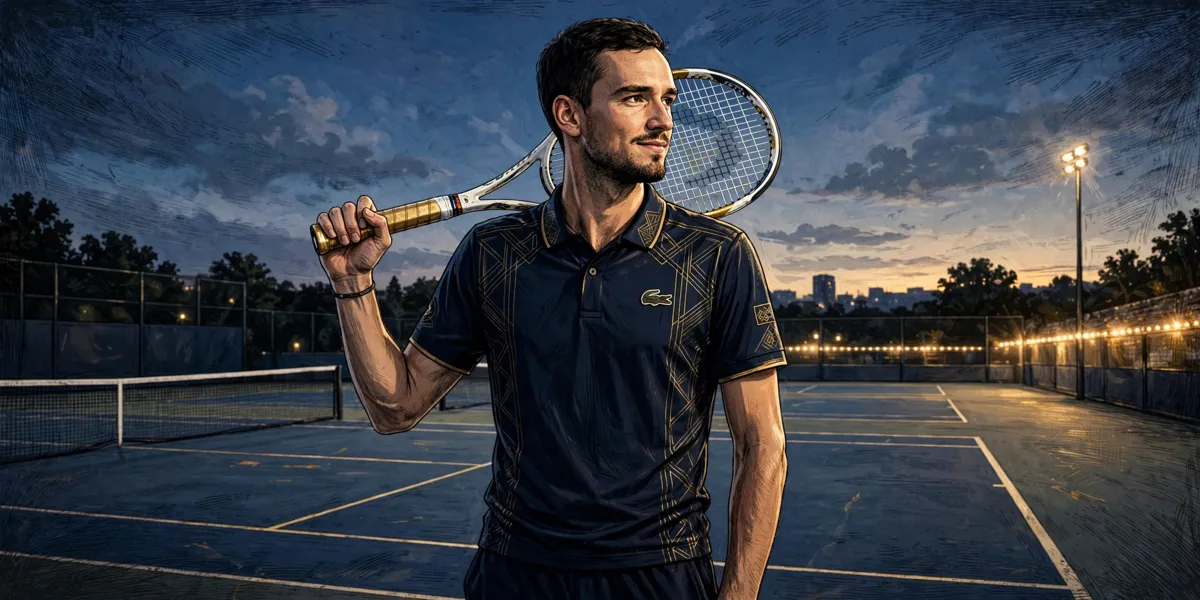
Prize money pays the bills, but endorsements are what turn a rich tennis player into a wealthy one. Medvedev’s off-court portfolio is anchored by two long-running deals. Lacoste has dressed him since 2019, supplying his apparel and shoes, and the French brand extended the partnership through 2026 after his Paris Masters title. The deal even includes a personalised crocodile logo, a detail covered in a Forbes feature on his personal brand strategy — a small thing, but the kind of thing brands only offer to players they see as long-term faces, not short-term signings. Tecnifibre supplies his racquets; he plays a customised version of the TFight 305 RS, a frame built for flat hitters who take the ball early.
Around those two pillars sits a wider set of deals. Bovet, the Swiss luxury watchmaker, made him the face of the brand in 2019. HyperX, the gaming peripherals brand, signed him as an ambassador — a natural fit for a player who is open about his love of video games and who celebrated his biggest win with a FIFA pose. BMW has used him as a brand ambassador, and the Russian bank Tinkoff backed him earlier in his career. He has also worked with the liquor brand 1537 Guijao and, more recently, taken a co-ownership stake in the esports organisation M80, as well as serving as a game ambassador for Ubisoft’s Rainbow Six Siege.
How much is all of that worth? The honest answer is that nobody outside the deals knows the exact figures, because tennis endorsement contracts are private. Reporting from Sportskeeda, summarised by Surprise Sports, put his endorsement income at around $15 million in a single year following his rise to world No. 1, on top of his tournament winnings. That figure should be read with care — it is a reported estimate, not a filed account — but it fits the shape of his career: in his best years, his off-court income roughly matched his on-court prize money, and in leaner years the sponsorship cheques kept arriving even when the titles did not.
There is one more income stream that rarely makes the headlines: appearance fees. Top players are paid simply to show up at certain 500-level and 250-level events, and a former world No. 1 with a Grand Slam title commands a serious fee. Medvedev’s choices of where to play — his regular appearances in Dubai, Rotterdam and Doha — line up with the tournaments known for paying them. The fees are never disclosed, and this article does not guess at them, but they are a real part of how a player of his standing adds to his income between the big paydays.
His wife Daria’s venture is part of the picture too. She co-founded RawQ, an energy-bar brand that Medvedev has publicly supported. It is a small business rather than a fortune-maker, but it shows the couple’s instinct for building income beyond the court — the same instinct behind the M80 esports stake and the gaming ambassadorships. Medvedev’s commercial identity is not the classic tennis-star portfolio of watches and cars alone; it leans into gaming and esports, where his own interests genuinely sit.
Homes, Cars and Lifestyle in Monte Carlo
Medvedev has lived in Monte Carlo, Monaco, since 2017, and trains between Monaco and France. The principality is home to a large share of the tennis tour for reasons that are no secret: the weather, the training facilities, and a tax regime that takes no personal income tax. For a player who has earned more than $55 million in prize money, the choice of base is worth millions over a career, and it is one of the reasons his net worth sits as high as it does relative to his prize money.
What he actually owns there is not a matter of public record. Some profiles claim a Monaco property holding worth around $5 million, and older biographies mention a home in Moscow as well, but neither figure comes from a property registry or a named source with a document behind it, so this article does not present them as fact. What can be said safely is that Monte Carlo property is among the most expensive real estate on earth, and a player of Medvedev’s standing living there for nearly a decade is not renting a studio flat. The honest position is that his property wealth is real but unquantified, and any net worth figure that claims to price it precisely is guessing.
His cars are better documented, at least in outline. The BMW ambassadorship has put him behind the wheel of the brand’s cars at promotional events, and tennis players of his level typically run a small fleet rather than a single showpiece car. Beyond that, Medvedev’s lifestyle is famously low-key for a sports star of his wealth. He is not known for a watch collection splashed across social media, or for a yacht, or for the kind of spending that fills gossip columns. His public image is a player who goes home to Monte Carlo, plays video games, spends time with his wife and two young daughters, and comes back to work.
That restraint is part of the financial story. The players who end up wealthy are not always the ones who earned the most — they are the ones who kept the most. Medvedev’s decade at the top has been built on consistency rather than flash, and his spending, as far as anyone can see from the outside, matches the same pattern. No private jet stories, no nightclub headlines, no property empire announced in the press. Just prize money, endorsements, and a Monte Carlo base that keeps the tax bill low.

Net Worth Breakdown and Growth Over Time
So why do the published numbers disagree so much? Put the main estimates side by side and the spread is startling: Celebrity Net Worth says $20 million, Surprise Sports says $23 million, SuperTennis says $30 million, Tennis Net Worth published both $35 million and, in a separate piece, $75 million, and Velontia says $50 million. GlimmerSports lands in the middle at $20 million to $25 million, and InfoSeeMedia puts him at $21 million. That is a range from $20 million to $75 million for the same man, in the same year, and a reader is entitled to ask which one is right.
| Source | Estimate | Dated | Notes |
|---|---|---|---|
| Celebrity Net Worth | $20 million | Updated 21 November 2026 | Most-cited tracker; updated most recently |
| Surprise Sports | $23 million | 2026 | Built from prize money plus Lacoste and Tecnifibre deals |
| GlimmerSports | $20–$25 million | 2026 | Range estimate; prize money plus endorsements |
| InfoSeeMedia | $21 million | June 2026 | Close to the Celebrity Net Worth anchor |
| SuperTennis | $30 million | 2026 | Applies a prize-money multiplier for endorsements |
| Tennis Net Worth | $35 million | April 2026 | One of two conflicting figures from the same outlet |
| Velontia | $50 million | 2026 | Assumes $8 million-plus a year in endorsements |
| Tennis Net Worth | $75 million | 2026 | Outlier; same outlet also published $35 million |
The spread has a simple explanation. The low estimates start from the verified prize money and add a modest amount for endorsements after tax and costs. The high estimates take the $55 million in career prize money, add a generous endorsement figure on top of it, and forget to subtract anything — as if a tennis player kept every dollar he ever won. The $75 million figure fails a basic sanity check: it is higher than his entire career prize money plus a decade of endorsements would support after tax, and the same outlet published a $35 million figure for the same player in the same year. This article treats $75 million as an outlier and does not use it.
The growth of his wealth over time tells a cleaner story than any single estimate. InfoSeeMedia’s timeline puts him at $18 million in 2023, rising to about $21 million by 2026, and that shape matches the prize-money record: the fortune was built in two waves. The first wave ran from 2019 to 2023, when he banked roughly $36 million of his career prize money and won his Grand Slam title. The second wave is the endorsement income that followed the world No. 1 ranking, which kept paying even through the title drought of 2024 and the early part of 2025. The 2026 rebound — two titles and an Indian Wells final — has added more than $4 million in prize money alone this year, and it is why the freshest estimates edge upward rather than down.
| Period | What happened | Effect on wealth |
|---|---|---|
| 2014–2018 | Turned pro; first title in Sydney in 2018 | Modest earnings; building phase |
| 2019–2020 | US Open final; ATP Finals title; top five ranking | Prize money jumped to about $7.9 million in 2019 alone |
| 2021–2023 | US Open title; world No. 1; five titles in 2023 | Peak earning years; endorsements renegotiated upward |
| 2024–2025 | No title in 2024; Almaty win in 2025 | Prize money slowed; sponsorship income carried the year |
| 2026 | Brisbane and Dubai titles; Indian Wells final | More than $4 million in new prize money; estimates edge up |
Our method, set out in full at the foot of this page, is straightforward: take the verified prize money, add a realistic allowance for endorsement income across a decade at the top, subtract tax, team costs and living expenses, and anchor the result to the most-cited independent estimate. That gives $20 million to $25 million, anchored at Celebrity Net Worth’s $20 million. It is the range a careful reader can defend, and it is the figure this article publishes.
How Medvedev Compares With His Tennis Peers
Medvedev’s wealth only makes sense next to the players he shares a locker room with. He sits eighth on the all-time ATP prize-money list, behind the three giants of the last twenty years and a cluster of younger stars who have caught up fast. The table below uses official ATP prize-money figures and Grand Slam title counts — the two numbers that can be checked rather than guessed.
| Player | Career prize money | Grand Slam titles | Career-high ranking |
|---|---|---|---|
| Novak Djokovic | $197.0 million | 24 | No. 1 |
| Rafael Nadal | $134.9 million | 22 | No. 1 |
| Jannik Sinner | $70.7 million | 4 | No. 1 |
| Carlos Alcaraz | $69.1 million | 6 | No. 1 |
| Daniil Medvedev | $55.1 million | 1 | No. 1 |
The comparison is revealing. Carlos Alcaraz has already passed Medvedev in career prize money — $69.1 million to $55.1 million — despite turning professional six years later, and Jannik Sinner sits ahead of him too at $70.7 million, having passed him quickly on the back of four Slam titles in two seasons. Alcaraz owns six Grand Slam titles to Medvedev’s one, and the speed with which both younger rivals have overtaken him in earnings is a measure of how the sport’s money has shifted toward its new stars. And he is a long way behind Djokovic and Nadal, whose two-decade dominance produced prize-money totals no current player is likely to match. Readers curious about the two veterans can read more on this site: how tall Novak Djokovic is and Rafael Nadal’s height are both covered in our profiles of the two greats, while Carlos Alcaraz’s net worth shows how the young Spaniard’s fortune is catching up fast.
The gap that matters most for the net worth question is the Slam count. One Grand Slam title, against six finals, is the thin spot in Medvedev’s CV, and it is the reason his endorsement income, while strong, never reached the level of a multi-Slam champion. A second Slam would have changed his commercial value overnight, in the same way the first one did in 2021. It is also the reason the high-end estimates look wrong: players with one Slam and $55 million in prize money do not, as a rule, end up with $50 million or $75 million in net wealth after a decade of costs. The $20 million to $25 million range is consistent with where a player of his record sits among his peers.
There is a second comparison worth making, and it flatters Medvedev. Of the players in the table, he is the only one who reached world No. 1 with a single Grand Slam title, and the only one who did it with a playing style that coaches spent years trying to talk him out of. That is not a money fact, exactly — but it is the reason his story gets told, and the reason sponsors keep paying for a player whose best years may still be ahead of him.
Personal Life: Wife Daria and Family
Medvedev married Daria Chernyshkova, a former junior tennis player and Moscow State University journalism graduate, in Moscow on 12 September 2018, after the couple had dated for around four years. She now goes by Daria Medvedeva, and she has been a constant presence in his box at tournaments, as well as working closely with him on travel and logistics for his team. Medvedev has said more than once that he credits her with a large part of his growth as a player — not in the vague way athletes usually thank their partners, but specifically, pointing to the stability she brought to his life just as his career was taking off.
The couple have two daughters: Alisa, born in 2022, and Vika, born in 2025. Fatherhood has changed his public image in a visible way. The player once known for mid-match meltdowns and sarcastic exchanges with umpires now talks in press conferences about getting home to his children, and about how the birth of his first daughter steadied him during the hardest stretch of his career. It is a genuine shift, and it has made him a more sympathetic figure to sponsors and fans alike.
Daria’s own venture, the RawQ energy-bar brand she co-founded, is a small but telling detail. It is the kind of business a tennis family starts when they are thinking about life after the tour, and Medvedev has promoted it publicly. The family home is Monte Carlo, where they have lived since 2017, and where the children are growing up a short walk from the training courts. His parents, Sergey and Olga, and his sisters Julia and Elena, remain based in Russia, and Medvedev has spoken about the difficulty of that distance since the war in Ukraine began — a subject he handles carefully in public, saying little beyond what is asked of him.
Off the court, his interests are well known and slightly unusual for a tennis star. He is a serious gamer, a fan of FIFA and of the Rainbow Six Siege franchise he now represents as an ambassador, and his US Open trophy celebration was a gaming reference that millions of viewers understood at once. He reads, he follows football, and he has a dry, self-deprecating sense of humour that comes out best in press conferences, where his answers often run longer and funnier than the questions. At 6 feet 6 inches tall, he is one of the tallest players ever to reach world No. 1, and his height is a running theme in profiles of him — readers can compare him with Novak Djokovic’s height on this site, where the two greats’ very different builds are set side by side.
Controversies and On-Court Flashpoints
No honest profile of Medvedev can skip the flashpoints, because they are part of why he is famous. The most replayed came at the 2019 US Open, during his run to the final, when he taunted the New York crowd after a middle-finger gesture was caught on camera, then leaned into the booing so theatrically that the crowd ended up cheering him by the end of the tournament. He later said the crowd’s energy had fired him up rather than rattling him, and the episode became a turning point in his relationship with American fans.
There have been other incidents: smashed racquets, heated exchanges with umpires, a fine for unsportsmanlike conduct at the 2024 Australian Open, and the occasional on-court outburst that costs him a point penalty. None of them has ever involved anything beyond the court — no legal trouble, no doping issue, no scandal away from tennis. The pattern is a player whose temper flares under pressure and who has, over the years, learned to channel it rather than eliminate it. His coaches have spoken openly about this: the fire is part of what makes him compete so hard, and the work has been about aiming it, not extinguishing it.
One off-court subject deserves a careful note. Since 2022, Russian players have competed under restrictions imposed after the invasion of Ukraine: no flag, no anthem, and a ban from Wimbledon in 2022, when Russian and Belarusian players were barred from the tournament. Medvedev has been asked about the war repeatedly and has consistently given short, careful answers, saying he wants peace and declining to be drawn into political statements. This article does not speculate about his private views. What can be recorded as fact is that the restrictions cost him playing opportunities — including a Wimbledon he would have been among the favourites to win — and that he has continued to compete, and to be ranked, as a neutral athlete.
The 2026 Season and What Comes Next
The 2026 season has been a genuine revival. Medvedev opened the year by winning the Brisbane title, then won in Dubai for the second time, and reached the final at Indian Wells, where he lost to Jannik Sinner — the player who has become his defining rival of the new era. His 2026 prize money stands at $4,071,436, according to Tennis365’s reporting after the Almaty Open, and his ranking has climbed back inside the world’s top five, with Tennis Prize Money listing him at No. 5 in its November 2026 update.
The Grand Slams in 2026 were mixed: a fourth-round run at the Australian Open, a first-round exit at Roland-Garros, a third-round finish at Wimbledon, and a fourth-round run at the US Open. His four Slam cheques for the year came to $1,167,163, according to Tennis Prize Money’s calculations. That is a long way from his best seasons, but the two titles and the Indian Wells final tell the more important story — that after a title drought stretching from Rome 2023 to Almaty 2025, he is winning tournaments again.
The coaching picture has kept moving too. After the split with Gilles Cervara in September 2025, Medvedev worked with Thomas Johansson and Rohan Goetzke, and reports during 2026 have described further changes, with Johansson parting ways in July 2026 and new partnerships being trialled, including one heading into the Cincinnati Open. Coaching churn at this stage of a career is not unusual — players in their thirties often search for a fresh voice — but stability would help if he wants another deep Slam run.
What comes next depends on the one thing he has not yet added to: a second Grand Slam title. At 30, with his game built on movement and anticipation rather than raw power, he has years left at the top if his body holds. The hard-court season remains his hunting ground, and the Australian Open and US Open remain his best chances. Readers following the next generation can compare his age with the rising stars on this site — how old Jannik Sinner is and Carlos Alcaraz’s age show just how young the players now chasing him are. If Medvedev adds another major, every estimate on this page will need revising upward. Until then, $20 million to $25 million is the figure the evidence supports. For more tennis fortunes in this series, browse the net worth category on CelebAmerica.
Frequently Asked Questions
What is Daniil Medvedev’s net worth in 2026?
Daniil Medvedev’s net worth is estimated at $20 million to $25 million as of November 2026. The range is anchored at Celebrity Net Worth’s $20 million estimate, updated on 21 November 2026, with Surprise Sports at $23 million and GlimmerSports at $20 million to $25 million in the same area. Higher figures up to $50 million and $75 million exist online, but they are outliers that count his career prize money without subtracting tax and costs.
How much prize money has Daniil Medvedev earned in his career?
Medvedev has earned $55,060,133 in official ATP career prize money across singles and doubles, according to the ATP Prize Money Leaders release of 9 November 2026. That places him eighth on the all-time ATP prize-money list. His best season was 2023, when he banked about $11.55 million and won five titles, and about $16.7 million of his career total has come from Grand Slam singles prize money alone.
How old is Daniil Medvedev?
Daniil Medvedev was born on 11 February 1996 in Moscow, Russia, which makes him 30 years old as of November 2026. He turned professional in 2014 at 17, won his first ATP title in Sydney in 2018, and reached world No. 1 in February 2022 at the age of 26.
How tall is Daniil Medvedev?
Daniil Medvedev is 6 feet 6 inches tall (1.98 m), making him one of the tallest players ever to reach world No. 1. His height shapes his game: a huge wingspan on the return, deep court positioning, and flat groundstrokes that skid through the court on hard surfaces.
Who is Daniil Medvedev’s wife?
Daniil Medvedev is married to Daria Medvedeva, formerly Daria Chernyshkova, a former junior tennis player and Moscow State University journalism graduate. They dated for around four years before marrying in Moscow on 12 September 2018. The couple have two daughters, Alisa, born in 2022, and Vika, born in 2025. Daria co-founded the RawQ energy-bar brand.
What brands does Daniil Medvedev endorse?
Medvedev’s main endorsements are Lacoste for apparel and shoes, a deal running since 2019 and extended through 2026, and Tecnifibre for racquets. He also works with Bovet watches, HyperX gaming peripherals, and BMW, and he has a co-ownership stake in the esports organisation M80 and serves as a game ambassador for Ubisoft’s Rainbow Six Siege. Reported estimates put his endorsement income at around $15 million in the year after he reached world No. 1.
Has Daniil Medvedev won a Grand Slam?
Yes. Medvedev won the 2021 US Open, beating Novak Djokovic 6–4, 6–4, 6–4 in the final and denying Djokovic the calendar-year Grand Slam. He has reached six Grand Slam finals in total: the US Open in 2019, 2021 and 2023, and the Australian Open in 2021, 2022 and 2024. He also won the 2020 ATP Finals in London.
Where does Daniil Medvedev live?
Daniil Medvedev lives in Monte Carlo, Monaco, where he has been based since 2017 and where he trains alongside his time in France. He was born and raised in Moscow, Russia, and moved to France as a teenager to train before settling in Monaco. He lives there with his wife Daria and their two daughters.
Bottom Line
Daniil Medvedev’s net worth is estimated at $20 million to $25 million as of November 2026, anchored at Celebrity Net Worth’s $20 million figure and built on $55,060,133 in verified ATP career prize money. He is the proof that a tennis fortune does not need a textbook game or a shelf full of Grand Slam trophies: one US Open title, a spell at world No. 1, 23 tour titles and a decade of consistency have produced one of the most durable earning careers in the modern game. The 2026 revival — titles in Brisbane and Dubai, a final at Indian Wells — suggests the story is not finished, and a second Grand Slam would push every figure on this page higher. Until then, the honest number is $20 million to $25 million, and the player behind it remains one of the most fascinating, and most underestimated, figures in tennis.
Sources and How We Estimated
How we estimated: No tennis player’s net worth is ever published in a filing, so every figure on this page is an estimate built from public sources. We anchored our range at Celebrity Net Worth’s $20 million estimate (page updated 21 November 2026), cross-checked it against Surprise Sports ($23 million), GlimmerSports ($20–$25 million) and InfoSeeMedia ($21 million), and treated higher figures — SuperTennis $30 million, Tennis Net Worth $35 million, Velontia $50 million and the same outlet’s $75 million outlier — with caution, because they count career prize money without subtracting tax, agent fees, coaching and travel costs. The hard anchor is the ATP’s official Prize Money Leaders release of 9 November 2026, which puts Medvedev’s career prize money at $55,060,133. Estimates of private wealth may differ from reality; endorsement contract values are private and are reported here only where a named outlet has published them.
Sources consulted:
- Celebrity Net Worth — Daniil Medvedev Net Worth
- Tennis Prize Money — Daniil Medvedev net worth and career prize money
- Surprise Sports — Daniil Medvedev Net Worth 2026
- GlimmerSports — Daniil Medvedev Bio in 2026
- Wikipedia — Daniil Medvedev
- Tennis365 — Medvedev prize money after the Almaty Open final
- SuperTennis — Daniil Medvedev player profile
- Tennis Net Worth — Daniil Medvedev Net Worth 2026
- Velontia — Daniil Medvedev Net Worth 2026
- InfoSeeMedia — Daniil Medvedev Net Worth