Caleb Williams’ net worth is estimated at $10 million to $14 million as of November 2026, anchored by Celebrity Net Worth’s $14 million figure published in January 2026. The Chicago Bears quarterback built that fortune on an unusual foundation: a rookie contract that is fully guaranteed, a college career that made him one of the first true millionaires of the NIL era, and an investment firm he launched before his second NFL season. Few 25-year-old athletes have ever had this much of their money locked in this early — and that is exactly why the numbers around Williams are so widely misunderstood.
Search for Caleb Williams’ net worth and you will find answers anywhere from $3.5 million to $30 million. The spread is not a mystery once you see how each outlet counts. The low figures count only cash already in hand, mostly from his college years. The $30 million figure counts career earnings and contract value as if they were wealth already banked. Neither is how net worth works. This article settles the figure with dated, per-source adjudication, breaks down every income stream behind it — the $39.49 million Bears deal, the reported $10 million in college NIL money, the endorsement portfolio, and the 888 Midas investment business — and explains why the next contract, not the current one, is where Williams’ wealth could explode.
Last updated: November 22, 2026. All figures are public estimates, not audited numbers — see the Sources and Reporting section at the end for how we estimated.
Caleb Williams Quick Facts
| Full Name | Caleb Sequan Williams |
|---|---|
| Date of Birth | November 18, 2001 |
| Birthplace | Washington, D.C., United States |
| Age | 25 (turns 25 on November 18, 2026) |
| Height / Weight | 6 ft 1 in / 215 lbs |
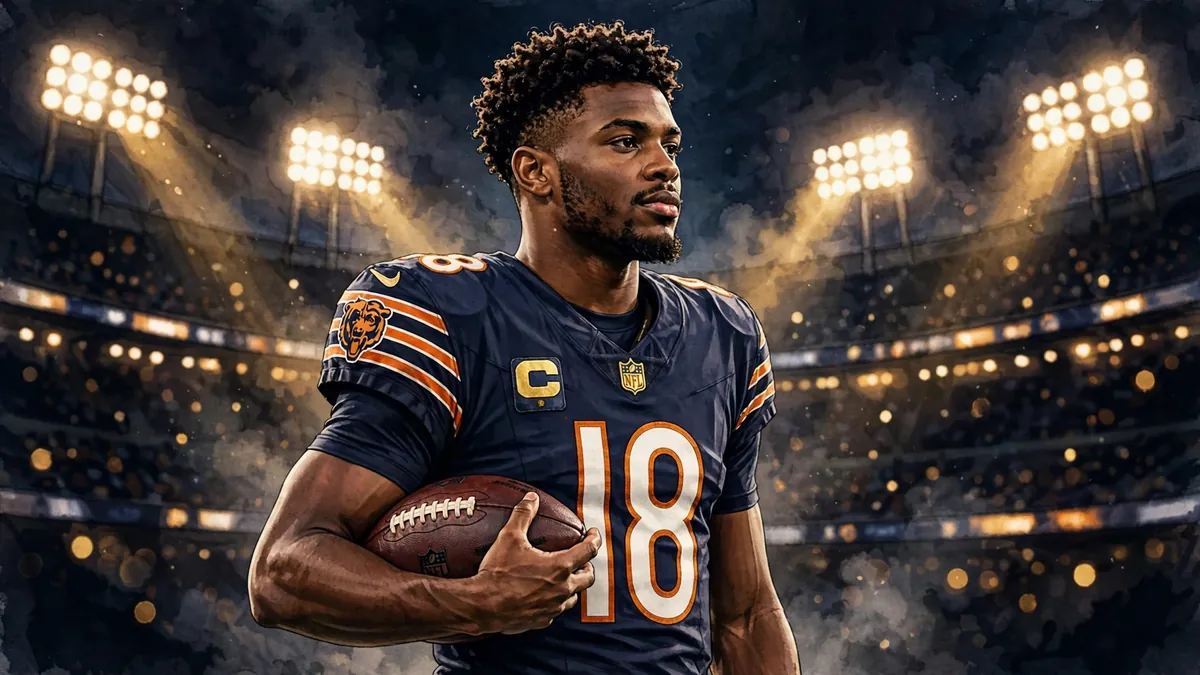
| Position / Team | Quarterback, Chicago Bears (No. 18) |
| Estimated Net Worth (2026) | $10 million – $14 million (anchored at $14 million by Celebrity Net Worth, January 2026) |
| Rookie Contract | 4 years, $39,486,058 — fully guaranteed, including a $25,537,132 signing bonus |
| College NIL Earnings (reported) | Around $10 million at USC, per The Athletic |
| Primary Income Sources | NFL salary, signing bonus, endorsements, NIL earnings, investments |
| Key Ventures | 888 Midas investment firm (founded 2024); Caleb Cares Foundation |
| Career Highlight | 2022 Heisman Trophy winner at USC; No. 1 overall pick, 2024 NFL Draft |
Table of Contents
- Caleb Williams Quick Facts
- Early Life and Background
- College Career: Oklahoma to USC and the Heisman
- The 2024 NFL Draft and the Chicago Bears
- The Rookie Contract: How the Money Is Structured
- Net Worth Breakdown: Where the Money Comes From
- NIL Earnings and Endorsement Deals
- 888 Midas and the Business Portfolio
- The 2025 Breakout Season Under Ben Johnson
- Assets, Lifestyle and Spending
- Personal Life and the Caleb Cares Foundation
- Controversies and the Pre-Draft Chicago Question
- How Caleb Williams Compares to Other Young Quarterbacks
- Net Worth Growth Timeline
- Frequently Asked Questions
- Final Thoughts
- Sources and Reporting
Early Life and Background
Caleb Sequan Williams was born on November 18, 2001, in Washington, D.C., the only child of Carl Williams and Dayna Price. His father worked in commercial real estate and gym ownership through a company called Athletic Republic Capitol Region, and that business background shaped Williams from an early age. In interviews since turning professional, Williams has repeatedly credited his father with showing him what hard work looks like and with teaching him to think about money as something to manage, not just spend. That lesson shows up everywhere in his financial story, from the way his rookie deal was negotiated to the investment firm he set up within months of entering the league.
Williams attended Gonzaga College High School in Washington, D.C., one of the strongest football programs in the region. By his senior year he was rated among the top quarterback recruits in the country, and his recruitment was a national story in itself. He chose Oklahoma, where head coach Lincoln Riley had built a reputation for developing quarterbacks — a decision that would define the next three years of his life, because when Riley moved, Williams moved with him.
The family setup around Williams has always been tight. His father Carl has acted as an adviser and advocate throughout his career, and both parents attend his games regularly. That closeness matters to the money story too: when Williams entered the NFL, he did not hire a traditional agent. He negotiated his rookie contract with his father and legal advisers at his side, a rare move for a No. 1 overall pick and one that saved him the standard agent fee on a $39.5 million deal — a saving worth roughly $1.2 million at the usual 3 percent rate, though the exact arrangement was never disclosed.
College Career: Oklahoma to USC and the Heisman
Williams arrived at Oklahoma in 2021 as a true freshman and took over as the starter midway through the season. He threw for 1,912 yards and 21 touchdowns against just four interceptions in seven starts, adding 442 rushing yards and six rushing touchdowns. The arm talent was obvious, but so was something rarer: a freshman quarterback who looked unbothered by pressure, extending plays with his legs and throwing accurately on the move. Oklahoma finished the season strongly, and Williams looked like the next great Riley quarterback.
Then Riley left for USC, and Williams followed him to Los Angeles for the 2022 season. The move changed everything. In his first year as a Trojan, Williams threw for 4,537 yards and 42 touchdowns with only five interceptions, completing 66.6 percent of his passes for a 168.5 passer rating. He added 382 rushing yards and 10 rushing touchdowns, giving him 52 total touchdowns — a USC single-season record. USC went 11-3, and Williams won the Heisman Trophy in decisive fashion, collecting 544 first-place votes and 2,031 total points, well ahead of runner-up Max Duggan. He also took home the Maxwell Award, the Walter Camp Player of the Year award, and AP Player of the Year honors, and was a unanimous first-team All-American.
The 2023 season was a different story. Williams’ individual numbers stayed elite — 3,633 passing yards, 30 touchdowns, five interceptions, a 68.6 percent completion rate and a 170.1 passer rating — but USC’s defense collapsed and the Trojans stumbled to an 8-5 finish. Williams still finished his college career with 10,082 passing yards, 93 touchdown passes and only 14 interceptions across three seasons, plus 960 rushing yards and 27 rushing touchdowns. He declared for the 2024 NFL Draft as the consensus No. 1 overall pick, a status he had held for more than a year.

| Season | School | Passing Yards | Passing TDs | Interceptions | Completion % |
|---|---|---|---|---|---|
| 2021 | Oklahoma | 1,912 | 21 | 4 | 64.5% |
| 2022 | USC | 4,537 | 42 | 5 | 66.6% |
| 2023 | USC | 3,633 | 30 | 5 | 68.6% |
| College total | — | 10,082 | 93 | 14 | 66.9% |
What the college years really built, though, was not just a draft stock — it was a bank balance. Williams played his entire college career after the NCAA’s NIL rules took effect in July 2021, and he was one of the first athletes positioned to profit at scale. The Heisman season turned him into one of the most marketable players in college football, and the money followed. We break down those earnings in the NIL section below, but the headline is that Williams was a millionaire several times over before he ever signed an NFL contract.
The 2024 NFL Draft and the Chicago Bears
The Chicago Bears selected Caleb Williams first overall in the 2024 NFL Draft, and the pick carried a weight no recent Bears quarterback had carried. Chicago had never drafted a quarterback first overall, and the franchise had never had a 4,000-yard passer in its century-long history. Williams arrived as the player meant to end both of those droughts, and as the centerpiece of a rebuild that had already added wide receivers D.J. Moore and Keenan Allen and tight end Cole Kmet around him.
He was not alone in a strong quarterback class. Jayden Daniels, the 2024 Heisman winner taken second overall by Washington, went on to win Offensive Rookie of the Year, while Drake Maye went third to New England. The class set up a natural rivalry that will follow all three quarterbacks for a decade, and it also set up the comparisons that still frame how Williams is judged: Daniels won more games as a rookie, Maye flashed just as much arm talent, and Williams took the most punishment behind the weakest line of the three.
Williams started all 17 games as a rookie, the first Bears quarterback to start every game of his rookie season in the modern era. The results were mixed in the way rookie seasons usually are. He set Bears rookie records with 351 completions, 3,541 passing yards and 20 touchdown passes, and he threw only six interceptions — the lowest interception rate of any qualifying rookie in years. But he was sacked 68 times, a league-high figure and a franchise record, and the Bears finished 5-12. Head coach Matt Eberflus was fired mid-season, offensive coordinator Shane Waldron was dismissed even earlier, and by January the organization was starting over around its young quarterback for the second time in twelve months.
The Rookie Contract: How the Money Is Structured
Williams signed his rookie deal with Chicago in July 2024: four years, $39,486,058, fully guaranteed in its entirety, including a signing bonus of $25,537,132. Celebrity Net Worth, which tracks the deal in its profile of Williams, notes that it was the richest fully guaranteed rookie quarterback contract in NFL history at the time it was signed. That last detail is the one that matters most for his net worth, because most rookie deals — even large ones — carry guarantees that are partial or conditional. Williams’ money is not conditional. Every dollar of the $39.49 million is his, barring the kind of off-field event that voids guarantees league-wide.
The structure of the deal explains why Williams received so much cash so fast. The $25.54 million signing bonus was paid up front, and when combined with his 2024 base salary and standard rookie compensation, his total cash payout in his first NFL season reached approximately $26.5 million, according to Celebrity Net Worth. That single year of cash is larger than the entire career earnings of most NFL players, and it is the main reason the $14 million net worth figure is credible: a large share of that first-year cash was banked or invested rather than spent, and the rest of the contract keeps paying through 2027.
| Contract Element | Figure | Notes |
|---|---|---|
| Total value | $39,486,058 | Four years, 2024–2027 |
| Guaranteed | $39,486,058 | Fully guaranteed — richest rookie QB deal of its kind at signing |
| Signing bonus | $25,537,132 | Paid up front in 2024 |
| First-season cash | ~$26.5 million | Signing bonus plus 2024 base salary and rookie compensation (Celebrity Net Worth) |
| 2025–26 compensation | ~$9.8 million | Celebrity Net Worth estimate for the season |
| 2026 cap hit | $10,768,925 | Per Spotrac and Over The Cap |
| 2026 cash earnings | $10,778,445 | Per Heavy’s reporting on his 2026 pay |
| Average annual value | ~$9.9 million | Total value divided across four years |
| Fifth-year option | 2028 | Bears hold the option, as with all first-round picks |
The deal runs through the 2027 season, with the Bears holding a fifth-year option for 2028. That option year is where the financial picture changes shape: fifth-year options for top-ten picks are set at a premium, and if Williams plays well enough the Bears will either pick it up or, more likely, sign him to a long-term extension before it ever comes into play. Established franchise quarterbacks on second contracts earn $50 million or more per season, which is why the rookie deal — generous as it is — is best understood as the opening chapter of Williams’ wealth, not the peak of it.
One more structural point is worth spelling out, because it is where the $30 million net worth claim goes wrong. A contract’s total value is not money in the bank. Williams’ $39.49 million is paid out across four seasons, taxed at the top federal and Illinois rates, reduced by the costs of his business operation, and spent on living costs along the way. SurpriseSports’ own career-earnings table puts his cumulative NFL cash at $33.49 million through 2026 — a figure that counts every dollar paid to him, before tax, before spending, before any of it was invested or lost. Treating that gross cash total as net worth is the error. Net worth is what remains after tax, spending and obligations, plus the value of investments and assets. On that honest basis, $10 million to $14 million is the defensible range, and $14 million is the most recent named-source anchor.
Net Worth Breakdown: Where the Money Comes From
So how do the pieces add up to $10 million to $14 million? Start with the NFL cash. Through the end of the 2025 season, Williams had earned over $26 million in NFL cash, not counting college earnings or endorsement income, according to NetWorthSpike’s breakdown of his contract. That figure combines the $25.54 million signing bonus with two seasons of base salary and roster money. Against that gross cash, apply the realities every high earner faces: federal tax at the top marginal rate, Illinois state tax, and the cost of running a professional life — housing in Chicago, training, travel, security, and the staff around a franchise quarterback. Even with disciplined spending, a realistic after-tax, after-spending residue from roughly $33 million in cumulative cash through 2026 lands in the low-to-mid eight figures, and that is before counting what his investments have returned.
The second pillar is the NIL money. The Athletic reported that Williams made somewhere near $10 million in endorsement deals during his two seasons at USC — a figure widely cited since, including by Business Insurance’s coverage of the report. That money arrived before the NFL deal, and because Williams was still a student living a college lifestyle when much of it was earned, a large share of it could be saved or invested rather than spent. It is also the reason the low-end $3.5 million estimates from 2023 look so stale now: they were written when his college earnings were the whole story, before the $25.5 million signing bonus landed.
The third pillar is endorsements as a professional. Williams’ NFL-era brand portfolio includes Fanatics, Beats by Dre and Wendy’s, among others, and his college deals with Dr Pepper, United Airlines and PlayStation carried over in brand value even after the contracts themselves ended. Exact per-deal values are not public, and this article does not guess at them — but a starting NFL quarterback with a national profile commands seven-figure annual endorsement income, and Williams’ portfolio is broad enough to support that range.
The fourth pillar is the investment portfolio, run through 888 Midas. The firm holds stakes in sports teams, tech companies and consumer brands, and at least one of them — the berry brand Fruitist — has grown sharply since 888 invested, with revenue rising from $50 million in 2021 to $400 million while expanding into more than 40 countries, according to a company representative quoted by Front Office Sports. Private-company stakes are hard to value from the outside, and this article does not assign them a number. What they represent is upside: if any of those stakes appreciate the way early sports-tech investments have for other athlete-investors, Williams’ net worth could grow well beyond the contract-driven range within a few years.
Why the range is $10M–$14M, not one number: Celebrity Net Worth (January 2026) puts Williams at $14 million, Pro Football Network splits the difference around $10 million, and BiographyWallah’s September 2026 figure is $10 million. Older $3.5 million figures count cash-only or NIL-era money and predate the signing bonus. The $30 million figure from SurpriseSports treats gross career cash as wealth. Our range honors the most recent named sources, and the $14 million anchor is the freshest.
| Income Stream | Scale | Status |
|---|---|---|
| NFL contract (4 years) | $39,486,058 total | Fully guaranteed; paid 2024–2027 |
| Signing bonus | $25,537,132 | Paid in 2024 |
| College NIL earnings | ~$10 million | Reported by The Athletic |
| Endorsements (NFL era) | Seven figures per year (estimated) | Fanatics, Beats by Dre, Wendy’s and others |
| 888 Midas investments | Undisclosed stakes | Sports, tech and wellness portfolio |
| Career NFL cash through 2025 | Over $26 million | Per NetWorthSpike’s contract breakdown |
NIL Earnings and Endorsement Deals
Caleb Williams was one of the biggest financial winners of the NIL era, and the timing could not have been better for him. The NCAA’s name, image and likeness rules took effect in July 2021, the same summer Williams arrived at Oklahoma. By the time he transferred to USC and won the Heisman, he was the most marketable player in college football — a quarterback in Los Angeles, with a highlight reel built for social media and a personality to match.
The Athletic reported that Williams made somewhere near $10 million in endorsement deals during his time at USC, a figure that has been cited across the sports business press ever since. His college deal sheet included Dr Pepper’s “Fansville” campaign, United Airlines, PlayStation, AT&T, Beats by Dre, Fanatics, Neutrogena, Athletic Brewing Company, Celsius and AC+ION Water, plus a Nissan Heisman House campaign appearance. On3’s NIL valuation — a different kind of number, measuring market value rather than money actually earned — at one point listed him at $3.2 million, which is a useful reminder that valuations and earnings are not the same thing. The $10 million figure is the earnings number, and it is the one that counts for net worth.
Williams also showed business instincts in college that went beyond taking checks. When he transferred from Oklahoma to USC, he entered an agreement with Hawkins Way Capital, a Beverly Hills-based real estate private equity fund — an early sign that he was thinking about wealth as something to build, not just collect. His father Carl’s background in commercial real estate is visible in that choice, and it foreshadowed the investment firm Williams would launch two years later.
As a professional, the endorsement portfolio has shifted toward NFL-scale brands. Fanatics, Beats by Dre and Wendy’s headline the current list, and he switched from New Balance to Nike cleats for the first week of the 2025 NFL season, a visible move for a player whose footwear choices are watched closely. The Dr Pepper relationship has also continued to pay dividends: Williams directed part of that deal’s value toward the Caleb Cares Foundation, tying a commercial partnership to his charitable work.
888 Midas and the Business Portfolio
In 2024, months after being drafted, Williams launched 888 Midas, an investment firm designed to manage his business ventures separately from his football career. Announcing it through Business Wire, he explained the reasoning directly: “To eliminate the potential for distraction, it was important to me to immediately set up a business operation with established, trusted partners and advisors I’ve known for years to strategically take advantage of ventures in the global marketplace.” The message was deliberate — football first, business handled by professionals, no distractions.
The partners behind 888 Midas are serious operators. They include Lew Wolff, the real estate investor and former Oakland Athletics owner; John Terzian, a former walk-on football player at USC who co-founded a hospitality firm; Ross Walker, another real estate investor who was also involved in Athletics ownership; and Sherif Guirgis, who worked in private equity at Apollo Global Management and Main Street Advisors. The group came together through the USC connection, with Terzian introducing Williams to the others. Williams has said the partners have been “monumental” to the firm’s moves, and he credits his father with sparking the business interest in the first place.
The portfolio is built around three buckets, in Williams’ own words to Front Office Sports: “Our main thing is no vices. So it’s wellness, it’s tech, and it’s sports. Those three buckets have been the heavy hitters for us.” The sports stakes include the NWSL expansion team Boston Legacy FC, the Monarch Collective investment firm — which holds stakes in three NWSL teams and a German Bundesliga women’s club — and the investment group for the WNBA’s upcoming Cleveland expansion team. The tech and wellness holdings include Elon Musk’s artificial intelligence company xAI, the robotics business Zipline, the berry brand Fruitist, and Gwyneth Paltrow’s clean-eating company Goop Kitchen.

Fruitist is the early proof point Williams points to most often. 888 invested late in the year before Williams spoke to Front Office Sports, and the berry brand has since grown from $50 million in revenue in 2021 to $400 million while expanding into more than 40 countries, according to a company representative. Williams declined to say how much 888 put in — “a good amount” — but confirmed the firm holds an equity stake. He has also said he would like to get into Formula One, a sport he has “become a really big fan of,” and that he has long envisioned himself as an owner rather than just a player, naming Michael Jordan, Magic Johnson, Kobe Bryant, Steph Curry, Saquon Barkley and Joe Montana as athlete-investors he studies.
None of this makes Williams a billionaire-in-waiting on paper today — private stakes are illiquid and hard to value, and this article does not pretend otherwise. What it does mean is that his wealth is no longer tied to a single paycheck. The contract pays him through 2027. The investments are built to pay him long after that.
The 2025 Breakout Season Under Ben Johnson
If the rookie year asked questions about Williams, the 2025 season answered most of them. The Bears hired Detroit offensive coordinator Ben Johnson as head coach on January 21, 2025 — the 19th head coach in franchise history — and Johnson immediately built the offense around his quarterback, publicly setting a goal for Williams to complete 70 percent of his passes. The completion rate did not reach that mark, but almost everything else moved in the right direction, and the leap showed up in the standings.
Williams set the Bears’ single-season passing record with 3,942 yards, passing Erik Kramer’s 1995 mark of 3,838 yards on the final day of the regular season, January 4, 2026, in a 19-16 loss to Detroit. He threw for 27 touchdowns against seven interceptions with a 90.1 passer rating, completing 330 of 568 passes. He added 388 rushing yards and three rushing touchdowns on the ground — and, in a quirk that sums up how Johnson used him, caught two passes for 22 yards and a receiving touchdown of his own. The sack total tells the story of the rebuilt line and the quicker decisions Johnson drilled into him: down from 68 as a rookie to 24 in 2025.
The team results followed. Chicago finished 11-6, won the NFC North, and scored 441 points — the third-highest total in franchise history — as the offense climbed from 32nd in total yards in 2024 to sixth in 2025. In the Wild Card round against Green Bay, Williams led one of the great comebacks in Bears history, rallying from a 21-3 halftime deficit to a 31-27 win and the franchise’s first playoff victory in 15 years. He threw for 361 yards in that game, including a 25-yard touchdown pass to D.J. Moore with 1:43 left. The run ended the next week in the Divisional Round against the Rams, where Williams threw for 257 yards and two touchdowns in a loss, but his 618 passing yards and four passing touchdowns across the two postseason games each ranked as the second-most in a single postseason in Bears history.
The 2026 season, his third, began with Williams building on that platform. Through early November 2026, the team’s official stats page listed him at 1,546 passing yards with eight touchdowns and five interceptions and a 95.37 passer rating — a small sample, but one that keeps the trajectory pointed upward. The franchise record that eluded him in 2025 — no Bears quarterback has ever thrown for 4,000 yards in a season; he finished 58 yards short — remains the most obvious next milestone, and the one Chicago fans will measure him against.
| Season | Record | Pass Yards | TDs | INTs | Rating | Sacks Taken |
|---|---|---|---|---|---|---|
| 2024 (rookie) | 5–12 | 3,541 | 20 | 6 | 87.8 | 68 |
| 2025 | 11–6 | 3,942 | 27 | 7 | 90.1 | 24 |
| 2026 (through early Nov) | — | 1,546 | 8 | 5 | 95.4 | — |
| First two full seasons | — | 7,483 | 47 | 13 | 89.0 | — |
Assets, Lifestyle and Spending
Public records offer only a thin picture of Williams’ personal assets, and this article does not fill the gaps with guesses. No confirmed purchase price for a home has been published in reliable reporting, and no verified car collection has been documented. What is known is that he has invested in real estate in Chicago and Los Angeles, and that his spending habits — at least as he describes them — are restrained for a player of his profile. Speaking to Front Office Sports about his investing approach, he summed up his philosophy in two words: “No vices.” The 888 Midas portfolio reflects it: wellness, tech and sports, with nothing in alcohol, gambling or tobacco.
That restraint is a financial fact in its own right. A $25.5 million signing bonus can vanish quickly in the hands of a 23-year-old with a new contract, a new city and an entourage — the league’s history is full of cautionary tales on exactly that point. Williams’ public approach has been the opposite: a business operation set up before his second season, professional advisers handling the portfolio, and a foundation as the visible outlet for his charitable spending. The $14 million net worth figure is, in part, a measure of that discipline. The money that arrived early was largely kept, not spent.
The one spending category that is visible is the foundation work. The Caleb Cares Foundation, which Williams founded, focuses on anti-bullying efforts, youth mental health awareness and youth empowerment in Chicago and Washington, D.C. — the two cities that shaped him. Charitable giving does not build net worth, but it is part of the financial picture all the same, and it is the spending Williams talks about most openly.
Personal Life and the Caleb Cares Foundation
Williams is not married and has no children, and he keeps his private life out of the headlines to a degree that is unusual for a starting NFL quarterback in a major market. His family remains his closest circle: his father Carl, who advised him through the draft process and the contract negotiation, and his mother Dayna Price, who attends his games alongside Carl. Williams has spoken about growing up as an only child in Washington, D.C., and about how the move to Los Angeles for college — and then to Chicago for the NFL — stretched that tight family unit across the country without loosening it.
The Caleb Cares Foundation is the public face of his off-field life. Founded before his NFL career began, it works on bullying prevention and youth mental health, with programs in Chicago and Washington, D.C. Williams has tied commercial partnerships to the foundation’s work — his Dr Pepper deal, for example, was structured so that part of its value benefited Caleb Cares — and he has used his platform to talk about mental health in sports, a subject few young quarterbacks address directly. The foundation is small next to the contract numbers, but it is the part of Williams’ story he chose to build first, before the money arrived at NFL scale.
Controversies and the Pre-Draft Chicago Question
The most reported controversy of Williams’ career came before he ever played a down in the NFL. In his 2025 book “American Kings,” ESPN’s Seth Wickersham reported that Williams and his father Carl had explored ways to avoid being drafted by the Chicago Bears, including considering the UFL as an alternative path, because of concerns about the franchise’s history of developing quarterbacks. The reporting, based on extensive sourcing inside the Williams camp, became one of the most discussed sports-book revelations of 2025.
Williams’ response was not to deny the concern outright but to move past it. He has said repeatedly since that he wanted to be in Chicago and that he embraced the challenge of turning the franchise around — and the 2025 season, with the division title and the playoff comeback win, gave him the results to back that up. The episode now reads less as a controversy and more as a window into how seriously the Williams family took the decision: a No. 1 pick with real leverage, weighing whether the team picking him could develop him properly, and ultimately betting that it could.
On the field, Williams has avoided the off-field trouble that derails young stars. There have been no arrests, no suspensions and no league discipline in his career to date. The closest thing to a recurring criticism is stylistic: his habit of holding the ball and hunting for the big play, which contributed to the 68 sacks of his rookie year, and the painted fingernails he has worn since high school — a personal style choice that draws commentary every season and that Williams has never apologized for. Neither has cost him money or playing time. The sack problem, at least, is one Johnson’s coaching has already cut by nearly two-thirds.
How Caleb Williams Compares to Other Young Quarterbacks
Williams’ $10 million to $14 million net worth sits exactly where it should for a quarterback two seasons into a rookie deal: well ahead of his draft classmates who have not yet signed second contracts, and far behind the established stars who have. The comparison that matters most is the 2024 draft class itself. Jayden Daniels, taken second overall by Washington, is estimated at $2 million to $10 million — a similar range built on a smaller rookie deal, since the No. 2 pick’s contract is worth less than the No. 1 pick’s. The gap between the two is mostly the gap between their draft slots and their signing bonuses.
The real jump comes with the second contract, and the numbers there show what Williams is playing for. Justin Herbert, the Chargers quarterback who signed a five-year, $262.5 million extension in 2023, plays on a deal worth more than six times Williams’ rookie contract. Joe Burrow’s $275 million extension with Cincinnati and Josh Allen’s $330 million extension with Buffalo sit in the same territory. Tom Brady, whose career earnings and business ventures put him in a different financial universe entirely, is the long-run model Williams himself has cited — an owner, not just a player. And Patrick Mahomes, the same age band as the league’s young stars but already on a $450 million deal, shows how quickly a quarterback’s wealth can compound once the second contract lands.
The honest version of the comparison is this: Williams is rich by any normal standard and early in his earning curve by NFL quarterback standards. His fully guaranteed rookie deal gave him more locked-in money than any rookie quarterback before him. His NIL earnings gave him a head start none of the older stars had. And his investment portfolio gives him a second engine that most of his peers have not built yet. If he signs a second contract at the current market rate — $50 million or more per season for a franchise quarterback — his net worth will not double. It will multiply.
| Quarterback | Contract Benchmark | Where He Stands |
|---|---|---|
| Caleb Williams | 4 years, $39.5M (fully guaranteed) | Rookie deal, through 2027 |
| Jayden Daniels | 4 years, ~$37.8M (rookie deal) | Draft classmate, No. 2 overall |
| Justin Herbert | 5 years, $262.5M extension | Second contract — the next tier |
| Joe Burrow | 5 years, $275M extension | Second contract — the next tier |
| Patrick Mahomes | 10 years, $450M | The benchmark for franchise QBs |
Net Worth Growth Timeline
| Year | Milestone | Estimated Net Worth |
|---|---|---|
| 2021 | True freshman season at Oklahoma; NIL era begins | Under $1 million |
| 2022 | Heisman Trophy at USC; NIL earnings accelerate | $2 million – $4 million |
| 2023 | Final USC season; NIL total reported near $10 million | ~$3.5 million (reported at the time) |
| 2024 | Drafted No. 1 overall; $25.5M signing bonus lands | $8 million – $12 million |
| 2025 | Breakout season; NFC North title; 888 Midas grows | $10 million – $14 million |
| 2026 | Third NFL season; Celebrity Net Worth anchor $14M | $10 million – $14 million |
| 2027–28 | Rookie deal ends; fifth-year option / extension talks | Second contract would multiply the figure |
The timeline shows the shape of the story. The college years built the base. The signing bonus built the fortune. The investment portfolio is built for what comes after the contract. And the second contract — still two seasons away — is the event that will decide whether Caleb Williams ends up a wealthy retired quarterback or one of the richest athletes of his generation.
Frequently Asked Questions
What is Caleb Williams’ net worth in 2026?
Caleb Williams’ net worth is estimated at $10 million to $14 million as of November 2026, anchored by Celebrity Net Worth’s $14 million figure published in January 2026. Lower figures around $3.5 million count cash-only or NIL-era money and predate his NFL signing bonus, while the $30 million figure from SurpriseSports counts gross career cash and contract value as if it were wealth already banked.
How much is Caleb Williams’ rookie contract worth?
Williams signed a four-year, $39,486,058 rookie contract with the Chicago Bears in 2024, fully guaranteed in its entirety, including a $25,537,132 signing bonus. It was the richest fully guaranteed rookie quarterback deal in NFL history at the time it was signed, and his first-season cash payout reached approximately $26.5 million.
How much did Caleb Williams make from NIL deals in college?
The Athletic reported that Williams made somewhere near $10 million in endorsement deals during his two seasons at USC. His college deal sheet included Dr Pepper, United Airlines, PlayStation, AT&T, Beats by Dre, Fanatics, Neutrogena, Athletic Brewing Company, Celsius and a Nissan Heisman House campaign appearance.
What is 888 Midas?
888 Midas is the investment firm Williams founded in 2024, months after being drafted, to manage his business ventures separately from football. It invests in three buckets — wellness, tech and sports — with stakes including NWSL team Boston Legacy FC, the Monarch Collective, Elon Musk’s AI company xAI, robotics business Zipline, berry brand Fruitist and Goop Kitchen.
How much does Caleb Williams earn per year with the Bears?
His rookie deal averages about $9.9 million per year across four seasons. His total compensation for the 2025–26 season was approximately $9.8 million, per Celebrity Net Worth, and his 2026 cash earnings were reported at $10,778,445, with a salary cap hit of $10,768,925 per Spotrac and Over The Cap.
Did Caleb Williams win the Heisman Trophy?
Yes. Williams won the 2022 Heisman Trophy at USC after throwing for 4,537 yards and 42 touchdowns with only five interceptions, adding 10 rushing touchdowns. He collected 544 first-place votes and 2,031 total points, and also won the Maxwell Award, the Walter Camp Player of the Year award and AP Player of the Year honors.
What are Caleb Williams’ career stats with the Chicago Bears?
Through his first two full seasons, Williams threw for 7,483 yards with 47 touchdowns and 13 interceptions and an 89.0 passer rating. His rookie year (2024) brought 3,541 yards, 20 touchdowns and 6 interceptions; his breakout 2025 season under Ben Johnson set a Bears single-season record with 3,942 passing yards, 27 touchdowns and 7 interceptions as Chicago went 11–6 and won the NFC North.
Is Caleb Williams married?
No. Caleb Williams is not married and has no children. He keeps his private life out of the headlines, and his closest circle remains his family — his father Carl, who advised him through the draft and contract negotiation, and his mother Dayna Price. Off the field, his most visible commitment is the Caleb Cares Foundation, focused on anti-bullying and youth mental health.
Final Thoughts
Caleb Williams is worth an estimated $10 million to $14 million in 2026, and the honest version of that number is more interesting than the number itself. He is one of the few athletes whose money was largely locked in before he proved anything as a professional — a fully guaranteed rookie deal, a reported $10 million in college earnings, and an investment firm built before his second season. The 2025 breakout under Ben Johnson turned the promise into production: a franchise passing record, a division title, and a playoff comeback that ended a 15-year drought.
The next chapter is the one that decides everything. If Williams keeps developing the way 2025 suggested, his second contract will be worth $50 million a season or more — and his net worth will multiply, not inch upward. Until then, the $14 million anchor from Celebrity Net Worth is the figure to trust, the $3.5 million and $30 million outliers are the ones to ignore, and the story to watch is not the money he has already made but the two engines — the arm and the portfolio — that are built to make much more. For more quarterback fortunes and NFL money stories, browse our Net Worth section.
Sources and Reporting
How we estimated: This figure is an estimate built from named public sources, not an audited statement of Williams’ private finances. We anchored on the most recent named-source figure — Celebrity Net Worth’s $14 million (January 2026) — and set the range at $10 million to $14 million to reflect Pro Football Network’s roughly $10 million midpoint and BiographyWallah’s September 2026 figure of $10 million. Older $3.5 million figures were treated as stale because they predate the $25.5 million signing bonus. The $30 million figure from SurpriseSports was rejected as a net worth estimate because its own table shows it is built from gross career cash, before tax and spending. Contract figures are from the deal terms as reported by Celebrity Net Worth and cross-checked against Spotrac and Over The Cap cap figures. NIL earnings are from The Athletic’s reporting. Season statistics are from the Chicago Bears’ official site, Sports Illustrated and EssentiallySports. Investment details are from Front Office Sports. Where sources disagreed, we published the range and named the disagreement rather than picking one number silently. Private finances may differ from every published estimate.
Sources consulted: Celebrity Net Worth · Spotrac · Over The Cap · ChicagoBears.com · Front Office Sports · Sports Illustrated · Heavy · ESPN · EssentiallySports · The Athletic (via Business Insurance) · Wortharo · NetWorthSpike
By Celebamerica Editorial Staff. This article is an original researched profile; figures are public estimates and may change as new contracts, endorsements and investment results are reported.