Last updated: 22 November 2026 | By Celebamerica Editorial Staff
This Bruno Fernandes biography traces the full arc of the Manchester United captain — from a boy in Maia, Portugal, who started out as a defender, through five grinding years in Italian football, to a record-breaking spell at Sporting CP and the armband at Old Trafford. As of November 2026, Fernandes is 32, still the engine of United’s attack, and his estimated net worth sits in a range of $40 million to $60 million, with Celebrity Net Worth anchoring the top of that range at $60 million. His Manchester United salary is reported at around £300,000 a week, roughly £15.6 million a year before bonuses, under a contract that runs to June 2027 with an option for a further season.
What makes his story different from most modern stars is the route he took. There was no academy fast track at a super-club, no teenage debut in front of 70,000 people. Fernandes learned his trade in Italy’s second tier with Novara, then spent three seasons at Udinese and one at Sampdoria before Portugal finally came calling. When Sporting CP signed him in 2017, he was 22 and still largely unknown outside Portugal and Italy. Within two seasons he had scored 33 goals from midfield in a single campaign, won the Primeira Liga Player of the Year award twice, and earned a €55 million move to Manchester United. This page covers every stage of that rise, the money behind it, his family life, and the transfer saga that dominated the summer of 2025.
Contents
- Quick Facts
- Early Life in Maia
- The Italian Years: Novara, Udinese and Sampdoria
- The Sporting CP Breakthrough
- Manchester United: The €55 Million Move
- Becoming Captain
- Portugal: Nations League Glory
- Playing Style: What Makes Him Different
- The Money: Salary, Contracts and Endorsements
- Net Worth Breakdown
- Houses, Cars and Lifestyle
- Personal Life and Family
- The Al-Hilal Saga and His Future
- Frequently Asked Questions
- Final Thoughts
- Sources and Reporting
Quick Facts
| Full Name | Bruno Miguel Borges Fernandes |
|---|---|
| Date of Birth | 8 September 1994 |
| Birthplace | Maia, Porto metropolitan area, Portugal |
| Age | 32 (as of November 2026) |
| Height | 1.79 m (5 ft 10 in) |
| Position | Attacking midfielder |
| Current Club | Manchester United (captain, shirt No. 8) |
| National Team | Portugal (senior debut 2017) |
| Estimated Net Worth | $40 million – $60 million (Celebrity Net Worth: $60 million) |
| Reported Salary | About £300,000 per week / £15.6 million per year at Manchester United |
| Transfer Fee to United | Initial €55 million (£47 million), rising to €80 million with add-ons |
| Wife | Ana Pinho |
| Children | Daughter Matilde and son Gonçalo |
| Major Honours | UEFA Nations League 2019 and 2025; EFL Cup 2023; FA Cup 2024; Taça de Portugal 2019 |
Early Life in Maia
Bruno Miguel Borges Fernandes was born on 8 September 1994 in Maia, a city in the Porto metropolitan area of northern Portugal. He grew up in a football-loving household, and like so many Portuguese boys of his generation he spent his childhood with a ball at his feet, playing in the streets and on the small pitches around Maia before organised football took over his life.
His first steps in the game came with local side Infesta, and he soon joined the youth ranks at Boavista, one of Porto’s historic clubs. There is a detail about those early years that tells you a lot about the player he became: Fernandes did not start out as an attacking midfielder at all. As a youngster he played as a defender, and it was only as he moved through the youth teams that coaches began pushing him further up the pitch. The passing range, the eye for a through ball and the shooting from distance that now define his game were first spotted when he was given more freedom to attack.
Maia is not a place that produces footballers by the dozen. Porto and Lisbon dominate Portuguese football, and a boy from Maia had to be noticed rather than handed a path. Fernandes was noticed. By his late teens he had outgrown what Portuguese youth football could offer him at that stage, and in 2012, at 17, he made a decision that would shape everything that followed: he left Portugal for Italy, joining Novara in Serie B. It was a brave move for a teenager who spoke little Italian, and it was the first sign of the stubbornness that has carried him through his whole career.
The Italian Years: Novara, Udinese and Sampdoria
Fernandes made his professional breakthrough with Novara during the 2012–13 season. Serie B is a hard school — physical, tactical, and unforgiving of young players who switch off — and he played 23 league games in his first season, enough to show Serie A clubs that a talented Portuguese midfielder was developing in Italy’s second tier. Udinese, a club with a long record of spotting young talent early, moved for him in the summer of 2013.
At Udinese he spent three seasons, playing 86 matches for the club and learning the defensive discipline that Italian football drills into its midfielders. This is the part of his education that often gets overlooked. The Fernandes who arrived at Manchester United in 2020 was famous for risk-taking — the defence-splitting pass, the shot from 30 yards — but the Udinese years taught him the other side of the game: positioning, tracking runners, and knowing when to keep the ball. Without those three seasons in Udine, the all-action midfielder he became would have been a far less complete player.
In 2016 he moved to Sampdoria, where he spent a single season in Genoa. It was a short stay but a useful one. Sampdoria played a more open, attacking brand of football than Udinese, and Fernandes began to show the goal threat that would later explode in Lisbon. By the end of the 2016–17 season, clubs back home in Portugal were paying attention. Sporting CP, one of the country’s big three, signed him in June 2017 for a reported fee of around €8.5 million. He was 22 years old, he had five years of Italian football behind him, and he was finally coming home.
The Sporting CP Breakthrough
What happened next was extraordinary. In his first season at Sporting, Fernandes scored 16 goals in all competitions and was named Primeira Liga Player of the Year. In his second season, 2018–19, he went further still: 33 goals in all competitions, a record for a midfielder in Europe in a single season and the highest total ever recorded by a Portuguese midfielder. He won the Primeira Liga Player of the Year award for a second straight season, was named in the league’s Team of the Year, and lifted the Taça da Liga in both seasons along with the Taça de Portugal in 2019.
To put the 33-goal season in context, midfielders simply do not score like that. The previous benchmarks for goalscoring midfielders in Europe belonged to players like Frank Lampard, and Fernandes passed them while also leading the league in chances created. He took penalties, he took free kicks, he arrived late in the box, and he shot from distance with a confidence that bordered on defiance. Sporting built their entire attack around him, and he repaid them with two of the most productive seasons any midfielder has produced in modern Portuguese football.
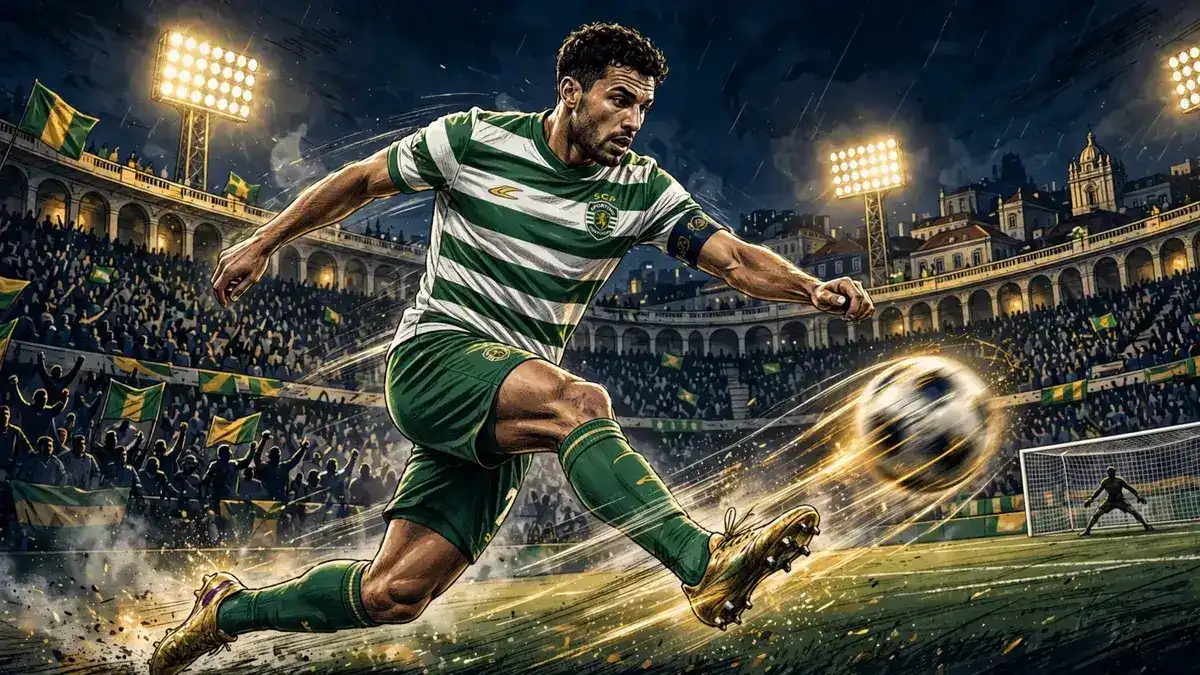
His time in Lisbon was not without its dark moments. In May 2018, at the end of his first season, a group of Sporting supporters invaded the club’s Alcochete training ground and attacked players and staff. Fernandes was among the players who terminated their contracts in protest in the weeks that followed. It was a traumatic episode, and for a short time it looked as if his Sporting career might end in chaos. Instead, he re-signed with the club in July 2018, was made captain, and produced the greatest season of his life. That response — staying, leading, and then playing the best football of his career — said more about his character than any trophy could.
By the winter of 2019–20, every major club in Europe knew his name. Tottenham Hotspur had tried to sign him the previous summer. Manchester United had watched him for more than a year. In January 2020, United finally moved, and after weeks of negotiation Sporting agreed to a deal worth an initial €55 million (£47 million), with performance-related add-ons that could take the total to €80 million. At the time it was the second-highest fee ever paid for a Portuguese player leaving the domestic league. It would turn out to be one of the best-value signings of the modern Premier League era.
Manchester United: The €55 Million Move
Fernandes signed for Manchester United on 30 January 2020 and made his debut two days later, on 1 February, in a goalless draw with Wolverhampton Wanderers at Old Trafford. Within weeks it was clear that United had signed something special. His first goal came against Watford later that month, a penalty in a 3–0 win, and from there he barely stopped. He scored 12 goals and provided 8 assists in his first 22 appearances, was named Premier League Player of the Month in February and again in June, and transformed a team that had looked stale and short of ideas into one that played with pace, risk and belief.
The numbers from his first full season, 2020–21, remain remarkable: 28 goals in all competitions, the most by a United midfielder in a single season since the great teams of the 2000s, and the top scorer in the UEFA Europa League as United reached the final, where they lost to Villarreal on penalties. He was named in the PFA Team of the Year and finished the season as the club’s most important player by a distance. In a side that was still searching for an identity after Sir Alex Ferguson’s retirement, Fernandes gave United a heartbeat.
There were leaner years too. The 2021–22 season brought a new manager, a new superstar in Cristiano Ronaldo, and a team that finished sixth. The 2022–23 season under Erik ten Hag brought the first trophy of the post-Ferguson era, the EFL Cup, and a third-place league finish. Through all of it — the managerial changes, the dressing-room churn, the seasons when United looked lost — Fernandes was the one constant. His output rarely dipped, his availability was almost total, and his standards never slipped. By November 2026 he had made 341 appearances for the club, scoring 113 goals and supplying 108 assists, a return that places him among the most productive players in Manchester United’s history.
The 2025–26 season was the finest of his United career. He was named Premier League Player of the Season, PFA Players’ Player of the Year and Football Writers’ Association Footballer of the Year, and won the Playmaker of the Season award with a league-record 21 assists, passing the previous mark of 20 shared by Thierry Henry and Kevin De Bruyne. United finished third and qualified for the Champions League. For a player who had spent years carrying a struggling team, it was the individual recognition his performances had long deserved.
The number that defines him: since his debut in February 2020, no Premier League player has been involved in more goals than Bruno Fernandes. Goals, assists, chances created, passes into the final third — by every creative measure, he has been the league’s most productive attacking midfielder of his era.
Becoming Captain
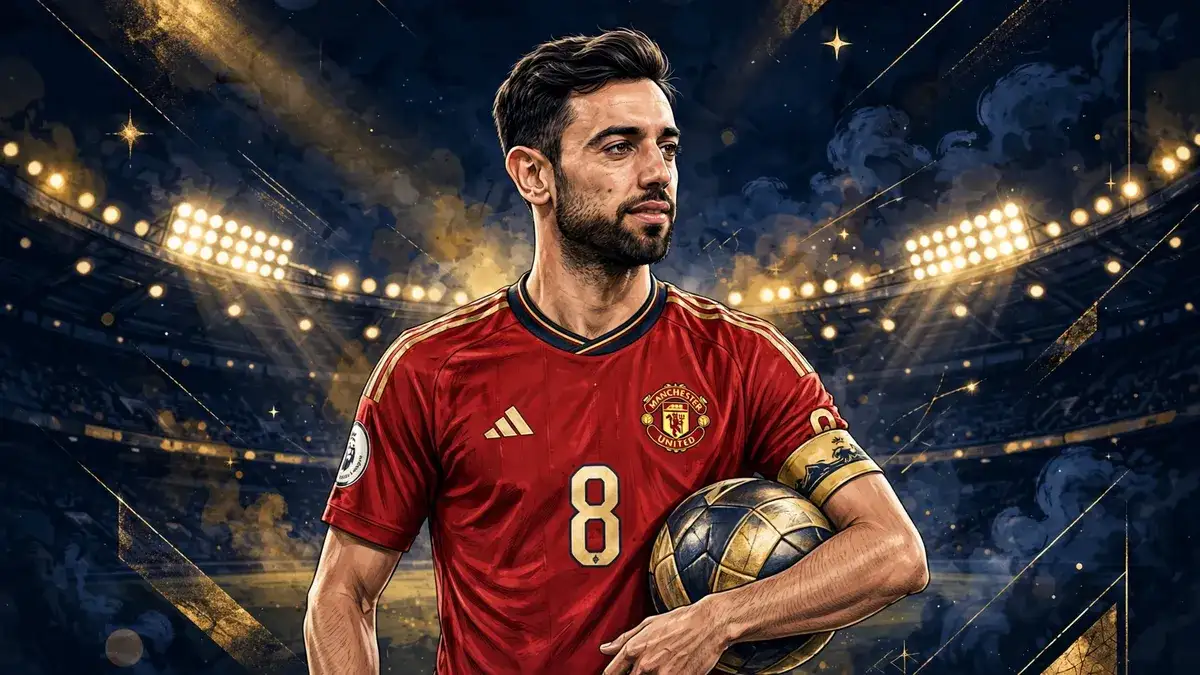
Fernandes became Manchester United’s permanent captain in July 2023, taking over after Harry Maguire was stripped of the armband. He had already worn it plenty of times as stand-in, and the appointment felt less like a change than a formality. He was the player his teammates looked to when games turned, the one who demanded the ball when others hid, and the one who spoke to the press after defeats. Erik ten Hag’s decision to hand him the armband permanently was an acknowledgement of what everyone inside the club already knew: Fernandes was the leader of that dressing room, title or no title.
His first trophy as captain came in May 2024, when United beat Manchester City 2–1 in the FA Cup final at Wembley. Fernandes created the decisive goal, floating a pass over the City defence for Kobbie Mainoo to score, and lifted the cup as captain. It was the second trophy of his United career after the EFL Cup win over Newcastle United in February 2023, and it mattered all the more because it came against the club’s neighbours and rivals, and because United had finished eighth in the league that season. The cup run, and the final in particular, was a reminder that on his day Fernandes can decide any game against any opponent.
Captaincy has also brought scrutiny. His on-pitch behaviour — the arms thrown wide, the complaints to referees, the visible frustration when teammates misplace a pass — has been picked apart by pundits and rival fans for years. Some see a captain who cares too much; others see a player who lets his emotions spill over. What is harder to argue with is the record: under his captaincy United have won two trophies, reached a European final, and returned to the Champions League. The armband has not changed him. It has simply given his intensity an official title.

Portugal: Nations League Glory
Fernandes made his senior international debut for Portugal in November 2017, in a friendly against Saudi Arabia, and has been capped more than 90 times since. He went to the 2018 World Cup in Russia, played at Euro 2020, and scored twice against Uruguay at the 2022 World Cup in Qatar, where Portugal reached the quarter-finals. But his defining international moments have come in the UEFA Nations League.
He was part of the Portugal squad that won the first Nations League in 2019, beating the Netherlands in the final in Porto, and he won it again in the summer of 2025, scoring in the penalty shoot-out as Portugal beat Spain in the final. Two Nations League titles, six years apart, bookend his international career so far. He has played alongside Cristiano Ronaldo for most of that time, and the partnership has worked precisely because their games are so different: Ronaldo the finisher, Fernandes the creator. Where Ronaldo’s Portugal story is one of longevity and goals, Fernandes’ is one of supply — the pass before the pass, the set piece, the shot from the edge of the box when a game needs opening up.
The 2026 World Cup, held in the United States, Canada and Mexico, looms as the next landmark. Fernandes will be 31 when the tournament begins, at the peak of his powers and almost certainly a starter in Roberto Martínez’s side. A deep run in North America would be the one achievement missing from a career that already includes league titles in Portugal, domestic cups in England, and two international trophies.
Playing Style: What Makes Him Different
Fernandes is an attacking midfielder in the classic number 10 mould, but with a goalscorer’s instincts and a work rate that would suit a box-to-box player. His game is built on risk. He attempts the pass other midfielders will not — the first-time ball over the top, the diagonal switch into the channel, the through ball threaded between two defenders. The trade-off is that he gives the ball away more than a safer midfielder would. The reward is that he creates more chances than almost anyone in world football.
The numbers back it up. Season after season, he leads the Premier League in chances created, passes into the penalty area and shots from outside the box. He is United’s penalty taker and their first-choice free-kick taker, and his set-piece delivery is among the best in the league. He presses relentlessly, covers more ground than most of his teammates, and rarely misses a game — a durability that has made him the first name on every United team sheet since 2020.
Comparisons help place him. Lionel Messi is a different kind of player entirely — a dribbler and finisher — but the two share a gift for seeing a pass a split second before anyone else. Erling Haaland, the Premier League’s great goalscorer of this era, is the player Fernandes most often supplies in the division’s great creative-versus-finishing contrast: Haaland finishes the chances that players like Fernandes create. What sets Fernandes apart from most modern number 10s is that he does both jobs — he creates at an elite rate and scores at a rate most strikers would accept.
The Money: Salary, Contracts and Endorsements
Money has followed Fernandes more slowly than fame. When he joined Manchester United in January 2020, his reported salary was around £100,000 a week — good money, but far from the top of the Premier League’s pay scale. His first new deal, signed in April 2022, roughly doubled that. Then, in August 2024, United rewarded him again with a contract running to June 2027, with the club holding an option for an additional season. That deal took his reported base salary to about £300,000 a week, or £15.6 million a year before bonuses, making him one of the highest-paid players at Old Trafford.
Not every source agrees on the exact figure. Celebrity Net Worth puts his salary at about £300,000 a week, and SportsDunia reports the same number. Other outlets, including Who Earns, have reported a lower figure of around £240,000 a week, closer to £12.5 million a year. The honest reading is that his base pay sits in the region of £240,000 to £300,000 a week, with bonuses for appearances, goals, assists and trophies on top. Either way, he is among the best-paid midfielders in the Premier League, and his salary alone accounts for the largest share of his wealth.
| Contract / Deal | Reported Terms |
|---|---|
| First United contract (Jan 2020) | Five-and-a-half-year deal; reported salary around £100,000 per week |
| Extension (Apr 2022) | New deal to 2026 with an option year; salary reported to have roughly doubled |
| Extension (Aug 2024) | Deal to June 2027 with a one-year club option; reported at about £300,000 per week |
| Transfer fee from Sporting (Jan 2020) | Initial €55 million (£47 million), rising to €80 million with add-ons |
| Transfer fee to Sporting (Jun 2017) | Reported at around €8.5 million from Sampdoria |
| Market value (2026) | About €40 million, per Transfermarkt via SportsDunia |
Endorsements add a second income stream. Fernandes is a Nike athlete and has worked with EA Sports and Gillette, among others. SportsDunia estimates his endorsement income at around £8 million a year, which would put him among the better-paid Premier League players off the pitch as well as on it. His image rights are managed through his own company, BF8 Sports Limited, which SportsDunia reports generates further income in the region of £7 million a year. Those figures are estimates from a single outlet and should be treated with care, but the direction is clear: Fernandes earns serious money beyond his club salary, and he has structured his affairs through a dedicated company rather than leaving image rights to chance.
Net Worth Breakdown
Estimates of Bruno Fernandes’ net worth vary widely, which is normal for a footballer whose wealth is mostly private. The figures below show the spread across the outlets that track him most closely, and the range we publish reflects that honest disagreement.
| Source | Estimate |
|---|---|
| Celebrity Net Worth | $60 million |
| SportsDunia | £60–70 million (about €70–75 million) |
| BetWright | £30–40 million |
| Who Earns | $40 million |
| CelebAmerica estimate (Nov 2026) | $40 million – $60 million, anchored on Celebrity Net Worth’s $60 million |
Why the gap? The higher estimates count his full contract value, endorsement income and image-rights earnings over several years; the lower ones lean more on salary alone and apply a heavier discount for tax and spending. Celebrity Net Worth, the most widely cited source in this space, puts him at $60 million, and that is the figure we anchor on. The $40 million floor comes from Who Earns, which uses a more conservative reading of the same contracts. The truth is almost certainly somewhere inside that range, and it is rising every year his £300,000-a-week deal runs.
A rough breakdown of where the money comes from looks like this. His Manchester United salary is the foundation — around £15.6 million a year at the top reported rate, or roughly £12.5 million at the lower reported rate. Over a six-and-a-half-year United career that alone accounts for the majority of his career earnings. Endorsements with Nike, EA Sports and Gillette add several million a year. Image-rights income through BF8 Sports Limited adds more. And his transfer history itself has been lucrative in the background: the €55 million move to United in 2020 came with a signing bonus and agent fees that are standard at that level, though the exact figures are private. Put together, a career that began on modest wages in Serie B has built a fortune in the tens of millions of dollars — and he is still only 32, with at least one more big contract ahead of him, whether at United or elsewhere.
How we estimated: we took Celebrity Net Worth’s $60 million as the anchor because it is the most widely cited and most recently updated figure, then set the floor at $40 million from Who Earns to reflect the more conservative reading. SportsDunia’s higher £60–70 million figure is noted above but not used as the anchor, because it appears to count gross contract value rather than accumulated wealth. Figures are estimates, not audited accounts, and the real number is private.
Houses, Cars and Lifestyle
Fernandes lives in Bowdon, in Cheshire, in a six-bedroom house reported by SportsDunia to be worth around £3.4 million, complete with a leisure suite, home cinema and gymnasium. Bowdon is the classic Manchester United captain’s address — quiet, leafy, and a short drive from the Carrington training ground — and it is where he and his family have put down roots since the move from Lisbon. He also owns property in his native Portugal, including reported commercial real-estate holdings that give him a base at home as well as in England.
His car collection is the part of his lifestyle that gets the most attention. SportsDunia’s rundown of his garage lists the kind of cars you would expect from a Premier League captain: high-end German and Italian machinery, with a taste for performance over show. He is not a player who courts attention with his spending — there are no fleets of gold-plated supercars, no watch collection paraded on social media. By the standards of modern footballers, Fernandes is notably low-key with his money. The house in Bowdon, the cars, the family holidays: it is a comfortable life, not a loud one.
That restraint fits with what people who know him say about his character. He is known inside United as a professional who looks after his body, studies the game, and spends his time off with his family rather than in the spotlight. The money is there, and it is substantial, but it has not changed the way he carries himself. If anything, the years in Italy — when he was earning a fraction of his current salary — seem to have left him with a sense of how quickly football can change, and how much a career like his is worth protecting.
Personal Life and Family
Fernandes is married to Ana Pinho, his long-time partner, whom he met while still at high school in Portugal. They married young, before the money and the fame, and she has been with him through every stage of the journey — the move to Italy as a teenager, the breakthrough at Sporting, and the move to Manchester. They have two children, daughter Matilde and son Gonçalo, and the family is based in Cheshire.
Those who cover United regularly describe Fernandes as one of the more grounded personalities in the Premier League. He is a family man first, and his social media reflects that: far more posts about his children and his wife than about cars, clothes or holidays. He speaks Portuguese, Italian and English, a product of his years abroad, and he is known for the close bond he keeps with his family back in Maia.
Faith and routine matter to him. He is a practising Catholic, and he has spoken in interviews about the importance of his family in keeping him steady through the highs and lows of life at a club like Manchester United, where a bad month can bring a storm of criticism. His father, José, played football at a lower level in Portugal, and the game has always been a family affair. When Fernandes lifts a trophy, the first people he looks for in the crowd are usually his own.
The Al-Hilal Saga and His Future
The biggest story of Fernandes’ summer in 2025 had nothing to do with football played on a pitch. In June 2025, Saudi Pro League club Al-Hilal made a huge approach for the United captain. Reporting by Fabrizio Romano, talkSPORT and Sky Germany’s Florian Plettenberg said Al-Hilal offered a three-year contract worth around £200 million, and were willing to pay United around £100 million in a transfer fee. Fernandes turned the move down. He wanted to keep playing at the top level in Europe, and he said so publicly, ending the speculation for that summer at least.
The story has not gone away. In November 2026, The People’s Person reported that contract talks between Fernandes and United had reached an impasse, with the captain turning down the club’s first two renewal proposals, although talks were continuing and the club were expected to trigger the one-year extension option in his current deal before January. The same report said Turkish club Galatasaray were preparing a January offer. Other reports in the same week said Al-Hilal had returned with a fresh proposal worth around €20 million a year, which Fernandes again rejected.
What happens next is genuinely open. His current deal runs to June 2027, with the club option taking it to 2028. He will be 33 when that deal expires, and a player of his quality and durability will have options: a new deal at United, a return to Portugal with Sporting or Porto, or one last enormous contract elsewhere. What is clear is that he holds the cards. United need him more than he needs them, and every club in Europe knows it. The next 18 months will decide whether he finishes his career as a one-club Premier League legend or adds one final chapter somewhere new. For a biography written in November 2026, the honest answer is that the story is still being written — and that, for a player who has made a career of proving people wrong, is exactly as it should be.
Frequently Asked Questions
How old is Bruno Fernandes?
Bruno Fernandes was born on 8 September 1994 in Maia, Portugal, which makes him 32 years old as of November 2026. He made his professional debut as a teenager with Novara in Italy and joined Manchester United in January 2020 at the age of 25.
What is Bruno Fernandes’ net worth in 2026?
Bruno Fernandes’ net worth is estimated at $40 million to $60 million as of November 2026. Celebrity Net Worth puts the figure at $60 million, while Who Earns estimates $40 million and SportsDunia reports £60–70 million. His wealth comes mainly from his Manchester United salary, reported at around £300,000 a week, plus endorsements with Nike, EA Sports and Gillette and image-rights income through his company BF8 Sports Limited.
What is Bruno Fernandes’ salary at Manchester United?
Fernandes is reported to earn around £300,000 a week at Manchester United, or about £15.6 million a year before bonuses, under the contract extension he signed in August 2024. Some outlets report a lower figure of around £240,000 a week, so the honest range is £240,000 to £300,000 a week. His contract runs to June 2027, with the club holding an option for a further season.
Which clubs has Bruno Fernandes played for?
Fernandes began his senior career with Novara in Italy in 2012, then played for Udinese (2013–2016) and Sampdoria (2016–2017). He joined Sporting CP in June 2017, where he became captain and won the Primeira Liga Player of the Year award twice, before moving to Manchester United in January 2020 for an initial fee of €55 million.
When did Bruno Fernandes become Manchester United captain?
Fernandes became Manchester United’s permanent captain in July 2023, taking over after Harry Maguire was stripped of the armband. He had already captained the side many times as stand-in. His first trophy as captain was the FA Cup in May 2024, when United beat Manchester City 2–1 at Wembley.
How many goals did Bruno Fernandes score for Sporting CP?
Fernandes scored 64 goals in 137 appearances for Sporting CP across all competitions. His best season was 2018–19, when he scored 33 goals in all competitions — a record for a midfielder in Europe in a single season — and won his second straight Primeira Liga Player of the Year award.
Is Bruno Fernandes married?
Yes. Fernandes is married to Ana Pinho, his long-time partner, whom he met while still at high school in Portugal. They have two children, daughter Matilde and son Gonçalo, and the family lives in Bowdon, Cheshire, near Manchester United’s Carrington training ground.
Did Bruno Fernandes reject Al-Hilal?
Yes. In June 2025 Fernandes rejected a huge offer from Saudi club Al-Hilal, which reports said was worth around £200 million over three years, with a transfer fee of about £100 million to Manchester United. He chose to stay in Europe and keep playing at the top level. Fresh reports in November 2026 said Al-Hilal had returned with another proposal, which he again turned down, while his contract talks with United continued.
Final Thoughts
Bruno Fernandes’ story is the story of a player who took the long way round and arrived anyway. He was not a teenage prodigy at a super-club. He was a boy from Maia who went to Italy at 17, learned his trade in Serie B and Serie A, came home to Portugal, scored 33 goals from midfield in a single season, and then walked into the biggest club in England and changed it from the inside. Six years later he is the captain, the club’s most productive player of his era, a two-time Nations League winner with Portugal, and a man whose name will be in the conversation whenever the best midfielders of the 2020s are discussed.
The money — the $40 million to $60 million net worth, the £300,000-a-week salary, the Nike and EA Sports deals — is the reward for that journey, not the reason for it. What will decide how his story ends is not a contract or a transfer fee. It is whether the next two years bring the trophies his talent deserves: a Premier League title challenge, a deep World Cup run with Portugal in 2026, and the chance to lift the biggest prizes as Manchester United captain. If he gets them, this biography will need a new final chapter. If he does not, it will still be the story of one of the great midfielders of his generation — and a reminder that the long way round is sometimes the best way there. For more football life stories, explore our Biography archive.
Sources and Reporting
Figures and career facts in this article were checked against reporting from Celebrity Net Worth, SportsDunia, Transfermarkt, Manchester United, The People’s Person, Sky Sports and BBC Sport. Net worth figures are estimates from named sources, not audited accounts; where sources disagree we publish a range and say which source anchors it. Transfer fees, salaries and endorsement values are reported figures and may differ from private reality. This article was researched and written as original work for CelebAmerica and was last updated on 22 November 2026.