Last updated: November 9, 2026 · By Celebamerica Editorial Staff
Tiger Woods’ net worth in 2026 is estimated at $1.3–$1.5 billion. Forbes puts the figure at $1.5 billion on its real-time billionaires list, while Celebrity Net Worth and TheRichest both publish $1.3 billion — so we report the honest range and anchor it on Forbes, the most widely cited source in current reporting. Either way, Woods is the richest golfer in history, and one of only a small handful of athletes ever to reach billionaire status while still active.
What makes the number so striking is how little of it came from actually winning golf tournaments. His PGA Tour-record prize money stands at about $121 million — a huge sum on its own, yet only around a tenth of the nearly $2 billion in pretax career earnings Forbes attributes to him. The rest came from endorsements, business ventures, course design, and equity stakes built over a professional career that began in 1996. He earned at his peak close to $100 million a year from sponsors alone, turned down a reported $700–$800 million offer to join LIV Golf, and in 2026 watched a golf-technology company he backed sell for about $530 million. This article breaks down every piece of that fortune — the prize money, the Nike years, the businesses, the property — and shows where the estimates agree and where they part ways.
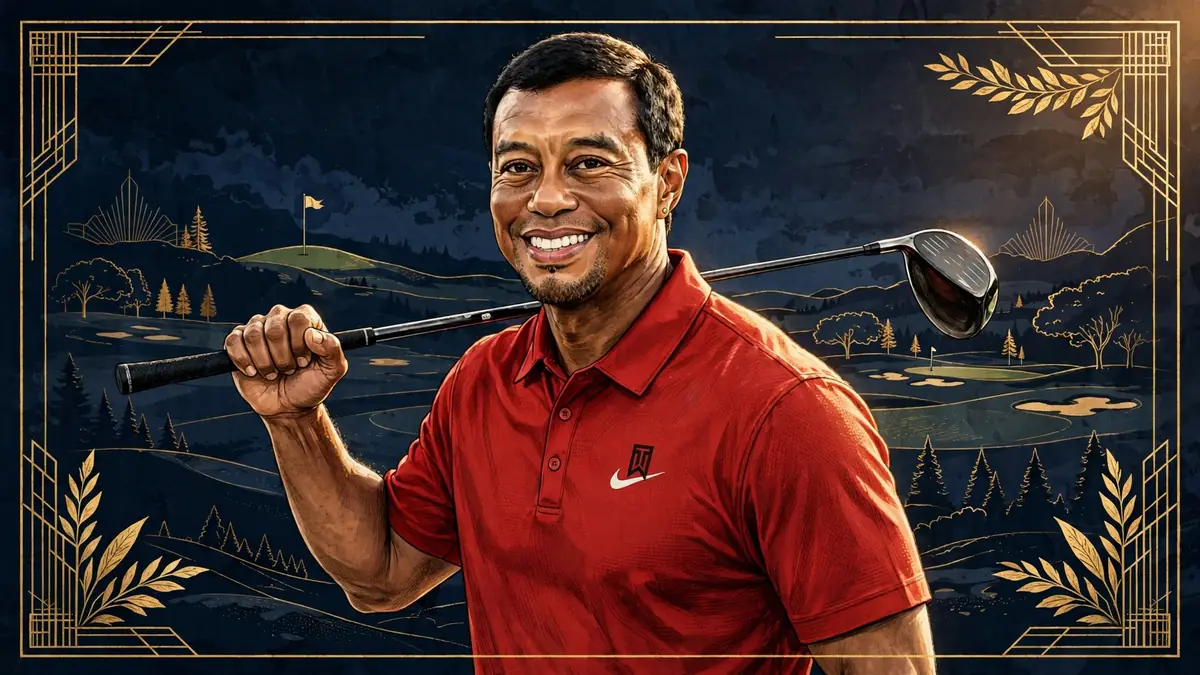
Quick Facts: Tiger Woods
| Full Name | Eldrick Tont Woods |
|---|---|
| Date of Birth | December 30, 1975 (Cypress, California, USA) |
| Birthplace | Cypress, California |
| Estimated Net Worth (2026) | $1.3–$1.5 billion (Forbes: $1.5 billion; Celebrity Net Worth / TheRichest: $1.3 billion) |
| Career Prize Money | About $121 million — a PGA Tour record |
| Total Pretax Career Earnings | Nearly $2 billion, per Forbes (TheRichest: about $1.8 billion) |
| Peak / Primary Income Sources | Endorsements (about 90% of career earnings), prize money, Player Impact Program bonuses, course design, business equity |
| Key Ventures | TMRW Sports / TGL, TGR Design, TGR Foundation, PopStroke, Sun Day Red, Full Swing (investor), The Woods Jupiter restaurant, Nexxus real estate |
| Career Highlights | 15 major championships, 82 PGA Tour wins (tied for the all-time record), 683 weeks as world No. 1 |
| Family | Two children, Sam Alexis (born 2007) and Charlie Axel (born 2009), with ex-wife Elin Nordegren |
Table of Contents
- Early Life and Background
- Career Rise: From Child Prodigy to the Tiger Slam
- The Money: How the Fortune Was Built
- Endorsements: The Nike Years and Beyond
- Business Ventures: TMRW Sports, TGL and Full Swing
- Net Worth Growth Timeline
- Assets: Real Estate, Cars and Investments
- Personal Life
- Controversies, Injuries and Comebacks
- How Tiger Woods Compares to Other Golf Legends
- Frequently Asked Questions
- Final Thoughts: The Bottom Line
- Sources and Reporting
Early Life and Background
Eldrick Tont Woods was born on December 30, 1975, in Cypress, California. His father, Earl Woods, was a US Army officer and Vietnam veteran who had played college baseball; his mother, Kultida Woods, was from Thailand. The nickname “Tiger” came from Earl’s friend and fellow soldier, South Vietnamese Colonel Vuong Dang Phong, who was also called Tiger. It stuck so firmly that most of the world has never known him by any other name.
Golf entered his life almost before he could walk. Earl put a cut-down club in his hands as a toddler, and by the age of two Woods was appearing on television — famously on The Mike Douglas Show in 1978, putting against comedian Bob Hope. At three, he shot 48 for nine holes at the Navy Golf Course in Cypress. The stories from those years sound like myth, but they are documented in contemporary television footage and in the record books: he won the Junior World Golf Championships six times between 1984 and 1991, then won the US Junior Amateur three years running (1991–1993) and the US Amateur three years running (1994–1996), a run no golfer before him had managed.
He spent two years at Stanford University, where he won the NCAA individual title in 1996, then turned professional in August 1996 at the age of 20. The timing was deliberate — he left college early because the professional game, and the money around it, was already waiting. Nike signed him to a five-year, $40 million deal the moment he turned pro, and Titleist signed him too. For a 20-year-old who had never played a professional tournament, it was an unheard-of welcome. It also set the pattern for everything that followed: Woods would never be paid like other golfers, because no other golfer moved the needle the way he did.
His background mattered to the business story as much as to the sporting one. Woods was the first golfer of Black and Asian heritage to dominate a sport that had been, for most of its history, white and country-club closed. His arrival changed who watched golf, who played it, and — most importantly for his bank balance — who wanted to sell things to the people watching. Television ratings for tournaments he played roughly doubled. Prize funds rose. Sponsors who had never touched golf suddenly wanted in. Woods did not just join the sport’s economy; he remade it, and he took a share of the new money at every step.
Career Rise: From Child Prodigy to the Tiger Slam
Woods won his first PGA Tour event in October 1996, less than two months after turning professional. Then came April 1997, and the Masters at Augusta National. He won by 12 strokes — still the largest margin in Masters history — at 21 years old, the youngest winner ever, and the first Black golfer to win a major championship. He finished at 18 under par, a tournament record at the time. The win was watched by a television audience far beyond golf’s usual reach, and it turned a promising young player into a global celebrity in a single weekend.
The years that followed are the most dominant stretch any golfer has ever produced. Between 1999 and 2002, Woods won seven majors. In 2000–2001 he completed the “Tiger Slam”: holding all four major titles at the same time after winning the 2000 US Open (by 15 strokes, a record), the 2000 Open Championship, the 2000 PGA Championship, and the 2001 Masters. Nobody had held all four since Bobby Jones in 1930, and nobody has done it since.
By the time he reached his thirties, the record book read like a list of things that would never be beaten: 15 major championships, second only to Jack Nicklaus’s 18; 82 PGA Tour victories, tied with Sam Snead for the most in history; 683 weeks ranked world No. 1, more than double the next-best total; and 11 PGA Tour Player of the Year awards. He won the Masters five times, the last in 2019, in one of the great comeback stories in sport — eleven years after his previous major, after four back surgeries and a public fall from grace that many assumed had ended his career.
The playing record matters to the money story because it is the foundation everything else was built on. The wins made him famous; the fame made him bankable; and the bankability, sustained over three decades, is what turned a golfer’s earnings into a billionaire’s fortune. But the record also explains why the fortune kept growing even as his body gave out. By 2024 he had not played a full competitive schedule in years, had not won since the 2019 Zozo Championship, and had not played a PGA Tour event since missing the cut at the 2024 Open Championship at Royal Troon. Yet Forbes still valued him at $1.5 billion in 2026, and reported 2026 earnings of about $46 million, almost all of it from off the course. The golf built the brand. The brand now pays for itself.
The Money: How the Fortune Was Built
The headline numbers tell the story in miniature. Forbes estimates Woods has earned nearly $2 billion pretax since turning professional in 1996, while TheRichest puts the pretax total at about $1.8 billion. His official PGA Tour prize money is about $121 million — $120,999,166, to be exact, per the tour’s own records as reported in 2026 — still the all-time record, about $13 million ahead of Rory McIlroy in official prize money. Broader tallies that add unofficial events and bonuses run higher: Athlon, citing Spotrac, puts his career earnings from golf at closer to $154 million, and adding Player Impact Program bonuses pushes the on-course total toward $200 million. Whichever tally you use, the same shape emerges: prize money is roughly a tenth of what he has earned. The other nine-tenths came from away from the ropes.
Forbes says about 90% of his career income has come from endorsements, business ventures, and equity. Parade, reporting Forbes’ figures, puts it the same way: at his peak, Woods earned as much as $100 million a year from endorsements alone. His single best year was 2007, when TheRichest reports he earned $115 million in total, winning seven PGA Tour events including the PGA Championship and the first FedEx Cup. Even in the lean years, the brand kept paying. In 2016, a season in which he barely played, Forbes still recorded about $5 million in earnings. In the six years to the end of 2025, injuries limited him to just 13 PGA Tour events and about $212,000 in prize money — yet he still collected the top $10 million bonus from the 2024 Player Impact Program, a payout based on fan awareness and search popularity, because he remained the most Googled golfer in the world. The program, which paid $50 million a year to the tour’s most popular players, awarded him $8 million for topping the list in 2021, $15 million for finishing first in 2022, and $12 million for second place in another year, before it was retired in 2025.
The split that explains everything: of the nearly $2 billion Woods has earned pretax, Forbes attributes only about $121 million to prize money. Roughly 90% — somewhere around $1.6–$1.8 billion — came from endorsements, royalties, appearance fees, course design, and business stakes. No other golfer in history has anything close to that off-course ratio, which is why no other golfer is a billionaire.
| Income stream | Estimated lifetime value |
|---|---|
| Official PGA Tour prize money | About $121 million (PGA Tour record) |
| Unofficial events, bonuses and Player Impact Program | Takes on-course earnings to roughly $154–$200 million (Spotrac / reported tallies) |
| Endorsements and sponsorships | Roughly 90% of career earnings — on the order of $1.5 billion-plus over his career, per Forbes-based reporting |
| Business ventures and equity (TMRW Sports, Full Swing, TGR, PopStroke) | Undisclosed stakes; TMRW Sports valued at about $500 million in 2024, with a reported near-$1 billion round in progress in 2026 |
| Total pretax career earnings | Nearly $2 billion (Forbes); about $1.8 billion (TheRichest) |
| Estimated net worth, 2026 | $1.3–$1.5 billion (Forbes $1.5 billion; Celebrity Net Worth $1.3 billion) |
Why do Forbes and Celebrity Net Worth disagree by $200 million? Because a net worth is not a bank balance — it is an estimate built from public information. Forbes tracks the real-time value of known stakes, property, and earnings, and it updates as markets move; its figure has hovered around $1.5 billion through 2025 and 2026. Celebrity Net Worth uses a more conservative model of the same public data and has held at $1.3 billion. Neither outlet has seen his tax returns, his private investment accounts, or the exact terms of his equity stakes. Taxes, agent fees, the reported $100–$110 million divorce settlement, and three decades of living costs all sit between gross earnings and net worth. We publish the range and say which source anchors it, because pretending to know the exact figure would be dishonest. What both sources agree on is the order of magnitude — and that he is, by a wide margin, the richest golfer who has ever lived.
Endorsements: The Nike Years and Beyond
The Nike deal is the single most valuable commercial relationship in golf history, and it began before Woods had won anything as a professional. The first contract, signed when he turned pro in 1996, was worth $40 million over five years — an astonishing sum for an unproven 20-year-old, and a bet Nike made on his fame as much as his golf. It paid off beyond anyone’s imagining. Nike built an entire golf division around him; its golf revenue peaked at $792 million in 2013, according to reporting on the partnership. Over the 27 years the relationship lasted, estimates of what Nike paid Woods range from over $500 million (Athlon) to about $700 million (TheRichest). We report that range because the full contract terms were never made public — but even the low end makes it one of the richest endorsement deals any athlete has ever signed.
At the peak, in the late 2000s, Woods was earning more than $100 million a year from endorsements, royalties, and appearance fees, per Forbes-based reporting. The portfolio at various points included Buick, American Express, Accenture, AT&T, Gillette, Electronic Arts — whose PGA Tour video games carried his name from 1999 until the two sides parted in 2013 — Rolex, Titleist, Upper Deck, and PepsiCo. The money was not just in the fees. Woods was so closely tied to Nike that his Sunday red shirt became a trademark, and the “TW” logo became one of the most recognisable marks in sport.
The 2009 scandal cost him sponsors — Accenture, AT&T, and Gillette all walked away — and it cost him, by some estimates, tens of millions a year in lost deals. But the core relationships held, and the money kept flowing. Nike stayed. Rolex stayed. And when Nike and Woods finally announced their split in January 2024, ending 27 years together, he was not left without a clothing deal: a month later he launched Sun Day Red, his own golf apparel brand, with TaylorMade. The name is a nod to the red shirt he has worn on Sundays since his mother suggested it as a boy — red being a colour of power and strength in Thai culture. It is a telling shift in the business model: from paid endorser to brand owner, keeping the equity instead of renting out his name.

His current sponsorship portfolio, as reported in 2026, includes Rolex, TaylorMade, Monster Energy, Bridgestone, Full Swing, Hero MotoCorp, Kowa, Upper Deck, and 2K Sports. Golf Digest put his annual income at about $73.5 million from golf and endorsements combined. The names change; the pattern does not. Even in a year when he does not compete, brands pay to be associated with Tiger Woods, because the association still moves product and still draws eyes. That is the difference between a sports star and a brand: the star gets paid to play, and the brand gets paid to exist.
One offer he did not take is worth mentioning, because it shows how he values the brand against cash. When LIV Golf was recruiting the biggest names in the sport, Woods reportedly turned down an offer in the $700–$800 million range to join the Saudi-backed tour, according to Athlon’s 2026 reporting. He stayed with the PGA Tour, where he has since taken a governance role. It was, on paper, the biggest single payday ever offered to a golfer — and he said no, because the price was his legacy, his relationships, and the tour he had spent his life building. Whether that was good business depends on how you count: the LIV money was certain and enormous, but the TMRW Sports and TGL venture he built instead is now valued in the same ballpark, and he owns a piece of it rather than renting himself out.
Business Ventures: TMRW Sports, TGL and Full Swing
If the Nike years made Woods rich, the business years are what made him a billionaire — and they are the reason his fortune keeps growing while his playing career winds down. The centrepiece is TMRW Sports, the sports and entertainment company he founded in 2022 with Rory McIlroy and former Golf Channel president Mike McCarley. Its first product is TGL, a technology-driven indoor golf league that plays at the SoFi Center in Palm Beach Gardens, Florida, on a 53-foot screen in front of a 1,500-seat arena. TGL launched in January 2025, finished its second season in March 2026, and in October 2026 renewed its deal with ESPN under a multi-year contract, according to EssentiallySports. The third season begins in December 2026.
TMRW Sports was valued at about $500 million in a June 2024 funding round led by Dynasty Equity Partners and Connect Ventures, according to Bloomberg. In September 2026, Front Office Sports reported, citing sources, that the company was finalising a further funding round at a valuation of more than $1 billion, with Dynasty Equity participating again and investors including Arthur Blank, David Blitzer, Steph Curry, Shaquille O’Neal, and Fenway Sports Group already on the cap table. That round has not been confirmed as closed, so we report it as a reported valuation in progress — but the direction is clear. TMRW has also been picked to operate the NFL’s new professional flag football league, and it is launching WTGL, a women’s indoor golf league whose debut season starts on November 8, 2026, on ESPN and Ion TV. Woods’s exact stake in TMRW has never been disclosed, which is why no outlet puts a precise number on what it is worth to him — but as a co-founder of a company valued around half a billion dollars and rising, it is now one of the largest single items in his portfolio.

The second 2026 headline came from Full Swing, the golf simulator and launch-monitor company Woods invested in back in 2015 and has served as an ambassador for ever since. In July 2026, Versant Media Group — the Comcast spin-off that owns the Golf Channel — agreed to buy Full Swing from Bruin Capital and a group of minority investors for approximately $530 million in cash. The acquisition was officially completed on August 3, 2026. Here is the part that most headlines get wrong: the $530 million is the price of the company, not a payday for Woods. His stake is reported at only about 1–2%, which at 2% would be worth roughly $10.6 million — a fine return on a decade-old investment, but a small slice of his fortune. Versant never disclosed what individual shareholders received, so the $10–$11 million figure is an estimate based on the reported stake, not a confirmed payout. Full Swing’s technology also powers TGL, which ties the two stories together: Woods backed the simulator company, then built a league that runs on it, then watched the broadcaster that shows the league buy the simulator company. It is the kind of vertical loop that turns a golfer into a media owner.
Around those two headline ventures sits a portfolio built through TGR Ventures, his holding company:
- TGR Design — his golf-course design business, behind courses including Bluejack National in Texas, and the new Bluejack Ranch, a 914-acre resort-style community near Fort Worth reported to be a $2.5 billion development. In November 2026 he unveiled plans with TGR Design and the Armchair Collective to redevelop the former Tam O’Shanter Country Club on Long Island into a private golf community, with construction starting in 2027.
- PopStroke — the golf entertainment and mini-golf concept he has invested in, which has been expanding across the United States.
- TGR Foundation — the charity he founded in 1996, which runs learning labs and education programmes; it is a cost, not an income stream, but it is part of how he has spent the fortune, and it matters to the picture.
- The Woods Jupiter — his flagship sports bar and restaurant in Jupiter, Florida, near his home.
- Nexxus — a luxury real-estate venture in which Forbes lists him as a partner alongside Justin Timberlake and British billionaire Joe Lewis.
- Sun Day Red — his apparel brand with TaylorMade, launched in February 2024 after the Nike split, where he owns the brand rather than endorsing someone else’s.
None of these stakes has a publicly confirmed value, and we will not invent one. What can be said with confidence is that the portfolio is deliberately built to outlast his playing career: course design, a league, a simulator company, restaurants, and entertainment venues all earn money whether or not he ever tees it up again. That is the real difference between Woods and the golfers who came before him. Jack Nicklaus built a course-design business too, and it made him very rich. Woods built a sports-media company, and it made him a billionaire.
Net Worth Growth Timeline
Because no outlet publishes a verified year-by-year balance sheet, the honest way to show the growth is as a timeline of the moments that moved the number — with the dated estimates that were actually published at the time.
| Year | Milestone |
|---|---|
| 1996 | Turns professional; signs a five-year, $40 million Nike deal and a Titleist deal before playing a single pro event. |
| 1997 | Wins the Masters by 12 strokes at 21 — the youngest winner ever — and becomes a global celebrity overnight. |
| 2000–2001 | Completes the Tiger Slam, holding all four majors at once; the most dominant stretch in modern golf. |
| 2007 | Peak earning year: $115 million in total earnings, per TheRichest, including seven PGA Tour wins and the first FedEx Cup. |
| 2008 | Wins the US Open on a broken leg and torn ACL, then has knee surgery; the first long injury layoff. |
| 2010 | Divorce from Elin Nordegren finalised in August; settlement reported at about $100–$110 million. |
| 2013 | Nike’s golf division peaks at $792 million in revenue, built around Woods. |
| 2019 | Wins the Masters for a fifth time — his 15th major, eleven years after his 14th — the great comeback win. |
| 2021 | Serious single-car crash in February causes major leg injuries; returns to competitive golf at the 2022 Masters. |
| 2022 | Forbes certifies him a billionaire — only the second active athlete to reach the mark, after LeBron James. |
| 2024 | Nike partnership ends after 27 years; launches Sun Day Red with TaylorMade; TMRW Sports valued at about $500 million. |
| 2025 | TGL launches in January; ruptures his Achilles in March and has surgery, missing the season; turns 50 in December with career earnings near $2 billion. |
| 2026 | Full Swing sells to Versant for about $530 million (deal completed August 3); TGL renews with ESPN; Forbes real-time estimate $1.5 billion; Celebrity Net Worth $1.3 billion. |
The shape of the timeline is the story. The fortune was made in the 2000s, when he was winning and the endorsement money was at its peak. It survived the scandal, the divorce, the injuries, and the surgeries because the income had already shifted from prize money to brand value. And it grew in the 2020s not from golf, but from ownership — TMRW Sports, Full Swing, and the rest of the portfolio. The 2026 Full Swing sale is a good example of how the new phase works: a decade-old investment, made when he was still playing, quietly maturing into a nine-figure company sale.
Assets: Real Estate, Cars and Investments
The centrepiece of Woods’s property portfolio is his Jupiter Island estate in Florida. He bought the 12-acre plot overlooking the Indian River for $40 million in 2006, knocked down the existing house, and built a custom home that was completed in 2010–2011. Reports on its current value differ — several outlets put it at about $54 million, while Realtor.com reported in 2026 that it is worth upward of $60 million — so we report the $54–$60 million range. The main house is about 9,700 square feet, with a second multi-purpose building of roughly 12,000–14,000 square feet joined by a glass-covered walkway, and the grounds include a private four-hole golf course and practice facility, a 100-foot swimming pool, a 60-foot diving pool, tennis and basketball courts, a running track, a gym, oxygen therapy rooms, a private cinema, a guesthouse, and two private docks. It is both a home and a training base — the course on the property is said to recreate shots from courses he has played around the world.
Beyond Jupiter Island, he has a stake in Albany, the 600-acre private resort on New Providence in the Bahamas, which he helped fund in 2010 with investors including Justin Timberlake. The resort has a golf course, an equestrian centre, tennis courts, and a large fitness centre. Forbes also lists two homes on Jupiter Island as part of his portfolio and names Jupiter Island as his residence. He has owned the yacht Privacy, and he has long travelled by private jet — the kind of assets that show up in lifestyle reporting but whose current values are not publicly confirmed, so we do not put numbers on them here.
His car collection is often written about, but a reliable, itemised inventory with values does not exist in public reporting, and this article will not invent one. What is documented is that cars have been part of both the luxury and the low points of his story — the Cadillac Escalade he crashed outside his home in November 2009, and the Genesis SUV he was driving in the February 2021 crash. The cars are a footnote to the fortune, not a pillar of it. The pillars are the house, the businesses, and the brand.
Personal Life
Woods was born on December 30, 1975, which made him 50 years old when he celebrated his birthday in December 2025 — and for the full breakdown of his age, birth date, and how his career maps against it, see our sister site’s profile of how old Tiger Woods is in 2026. He married Elin Nordegren, a Swedish former model he met in 2001, in Barbados in October 2004. Their daughter, Sam Alexis Woods, was born on June 18, 2007, and their son, Charlie Axel Woods, was born on February 8, 2009. Charlie has followed his father into junior golf and has played alongside him at the PNC Championship, the parent-child event where the two have become a popular pairing.
The marriage ended after revelations of infidelity in late 2009, and the divorce was finalised on August 23, 2010, with reports at the time estimating the settlement at close to $100 million — some reports put it at $100–$110 million. It was, by any measure, one of the most expensive divorces in sports history, and it came at the moment his on-course form and his sponsor income were both falling. That he is a billionaire today, sixteen years later, says a lot about how much money he was making before the split, and how durable the brand proved to be after it.
His father, Earl Woods, died in May 2006; his mother, Kultida Woods, died in February 2025, a loss he marked publicly and which kept him away from golf in the weeks that followed. He was in a relationship with restaurant manager Erica Herman from 2017 to 2022, which ended in a legal dispute over a non-disclosure agreement. In March 2025, Woods and Vanessa Trump publicly confirmed their relationship. The two families have known each other for years through their children’s golf and school circles in Florida, and they have been photographed together at junior golf events with their children. He has kept the details of his private life far more guarded since 2009 than he did before it, and this article respects that line: what is reported here is what has been publicly confirmed, and the rest is not our business.
Controversies, Injuries and Comebacks
No honest account of Woods’s fortune can skip the two episodes that nearly ended it. The first came in November 2009, when he crashed his car outside his Florida home, and the days that followed brought revelations of multiple extramarital affairs. Sponsors left — Accenture, AT&T, and Gillette ended their deals — and his public image, which had been built on discipline and family, collapsed in a matter of weeks. He took an indefinite break from golf, entered a treatment programme, and returned in 2010 to a sport that was still watching him with a different eye. The divorce that followed cost a reported $100–$110 million. The episode is part of the money story because it shows the risk of a fortune built on a personal brand: when the person stumbles, the brand pays. It is also part of the story because the brand recovered. By 2013 he was world No. 1 again, and by 2019 he had won another major.
The second episode was physical. In February 2021, Woods was in a serious single-car crash in California that caused severe injuries to his right leg, including compound fractures. Doctors worked to save the leg itself, and for a time it was unclear whether he would walk normally again, let alone play golf. He returned to competition at the 2022 Masters, fourteen months later, walking all four rounds on a leg held together with rods and screws. He made the cut. It was not a win, but it was one of the most remarkable returns in sports history, and it mattered commercially: the comeback story kept him at the centre of the sport’s attention even as his playing days wound down.
The injuries kept coming. He withdrew from the 2023 Masters with a foot injury, had ankle surgery, and played only a handful of events in 2023 and 2024. In March 2025, he announced that he had ruptured his left Achilles tendon and had surgery, ruling him out for the season. He also had back surgery in 2024. Through all of it, the business side of his life carried on — TGL launched, TMRW Sports raised money, and the Full Swing sale closed. That separation, between a body that can no longer play a full schedule and a portfolio that no longer needs him to, is the defining fact of his finances in 2026. He has not formally announced his retirement, and he has not played a PGA Tour event since July 2024, but his fortune no longer depends on the answer.
There was also a legal episode in 2017, when he was arrested in Florida after being found asleep at the wheel of his car; he later said the cause was a mix of prescribed pain medication, pleaded guilty to reckless driving, and completed a diversion programme. It is a matter of public record, and it belongs in a full account of his life — but it had little lasting effect on his earnings, and it is not where the money story lives.
How Tiger Woods Compares to Other Golf Legends
The gap between Woods and every other golfer is the simplest way to understand his wealth. Jack Nicklaus, the only golfer with more major titles, is worth about $400 million according to a 2026 Yardbarker comparison — a fortune built largely on his course-design business, and a very large one by any normal standard. Woods is worth more than three times that. No other golfer is close to a billion dollars. The reason is not the golf: Nicklaus won 18 majors and 73 PGA Tour events, and his prize money, earned in an era of far smaller purses, was a fraction of Woods’s. The reason is the era, and what Woods did with it. He arrived as television money, sponsor money, and global attention were all flooding into golf, and he captured a share of all three that no one before him could have imagined.
| Golfer | Estimated net worth (2026) | What built it |
|---|---|---|
| Tiger Woods | $1.3–$1.5 billion (Forbes / Celebrity Net Worth) | Endorsements (~90% of career earnings), TMRW Sports/TGL, Full Swing, TGR Design, prize money |
| Jack Nicklaus | About $400 million (Yardbarker, 2026) | Course design empire, endorsements, prize money from an earlier era |
| Rory McIlroy | Not published as a firm figure in the sources used here | Prize money (second to Woods on the all-time PGA Tour list, about $13 million behind in official earnings), endorsements, TMRW Sports co-founder |
The comparison with other athletes is just as telling. Woods was only the second active athlete to become a billionaire, after LeBron James, when Forbes certified him in 2022. Michael Jordan became a billionaire after retiring, on the back of the Jordan Brand. Woods did it while still playing — or at least, while still trying to. That is the measure of what he built: a fortune that does not depend on a golf swing that his body can no longer reliably produce, but on a name, a company, and a set of businesses that will keep earning long after the last tournament.
Frequently Asked Questions
What is Tiger Woods’ net worth in 2026?
Tiger Woods’ net worth in 2026 is estimated at $1.3–$1.5 billion. Forbes puts the figure at $1.5 billion on its real-time billionaires list, while Celebrity Net Worth and TheRichest both publish $1.3 billion. We report the range and anchor it on Forbes, the most widely cited source in current reporting. He is the richest golfer in history.
How much has Tiger Woods earned in his career?
Forbes estimates Woods has earned nearly $2 billion pretax since turning professional in 1996, while TheRichest puts the pretax total at about $1.8 billion. About 90% of that came from endorsements, business ventures, and equity rather than tournament golf. His official PGA Tour prize money is about $121 million, a tour record.
How much prize money has Tiger Woods won?
Woods has won about $121 million in official PGA Tour prize money ($120,999,166), still the all-time record — roughly $13 million ahead of Rory McIlroy in official earnings. Broader tallies that add unofficial events, FedEx Cup bonuses, and Player Impact Program payments put his total on-course earnings closer to $154–$200 million.
How did Tiger Woods become a billionaire?
Forbes certified Woods a billionaire in 2022, making him only the second active athlete to reach the milestone after LeBron James. Endorsements did most of the work — about 90% of his career earnings, including a Nike partnership worth a reported $500–$700 million over 27 years — and his business ventures (TMRW Sports, TGL, TGR Design, Full Swing) have added equity value on top.
How much did Tiger Woods make from Nike?
Estimates range from over $500 million (Athlon) to about $700 million (TheRichest) across the 27-year partnership, which began with a $40 million five-year deal when he turned professional in 1996 and ended in January 2024. At his peak in the late 2000s, he earned as much as $100 million a year from endorsements in total, per Forbes-based reporting.
What businesses does Tiger Woods own?
He co-founded TMRW Sports (the company behind the TGL indoor golf league) with Rory McIlroy in 2022, runs TGR Design and the TGR Foundation, has invested in PopStroke and Full Swing, launched the Sun Day Red apparel brand with TaylorMade in 2024, owns The Woods Jupiter restaurant, and is a partner in the Nexxus luxury real-estate venture. His exact stake in TMRW Sports has never been disclosed.
How much did Tiger Woods get from the Full Swing sale?
The $530 million figure is the price Versant Media Group agreed to pay for the whole of Full Swing in July 2026 — not a personal payday for Woods. He invested in the company in 2015 and holds a reported 1–2% stake, which at 2% would be worth roughly $10.6 million. Versant never disclosed what individual shareholders received, so the figure is an estimate, and the deal was completed on August 3, 2026.
Is Tiger Woods still playing golf in 2026?
He has not formally announced his retirement, but he has not played a PGA Tour event since missing the cut at the 2024 Open Championship at Royal Troon, and he ruptured his Achilles in March 2025, which required surgery and ruled him out for the season. His business ventures — TGL, TMRW Sports, and his other companies — now drive his income rather than tournament golf.
Final Thoughts: The Bottom Line
Tiger Woods’ net worth in 2026 is an estimated $1.3–$1.5 billion, anchored on Forbes’ $1.5 billion real-time figure, with Celebrity Net Worth at $1.3 billion. The fortune rests on three facts that no other golfer can match: a PGA Tour-record $121 million in prize money, endorsement earnings of roughly $100 million a year at his peak that account for about 90% of his nearly $2 billion in pretax career earnings, and a business portfolio — TMRW Sports, TGL, TGR Design, Full Swing — that keeps growing while his playing career winds down. He turned down a reported $700–$800 million from LIV Golf, survived a $100 million divorce and injuries that would have ended most careers, and still came out a billionaire. The golf made him famous. The business sense made him rich. And the fact that the money now arrives whether he plays or not is the final proof that Tiger Woods stopped being just a golfer a long time ago — he became an industry.
Sources and Reporting
All figures in this article come from named, published sources — not from private records, which Woods has never disclosed. The anchor figure is Forbes’ real-time billionaires list, which valued Woods at $1.5 billion in 2026 and certified him a billionaire in 2022; Celebrity Net Worth and TheRichest both publish $1.3 billion, which is why we report the $1.3–$1.5 billion range. Prize money figures come from PGA Tour records as reported by Sports Illustrated, Athlon, and EssentiallySports. Endorsement and career-earnings figures come from Forbes-based reporting in Parade, Sports Illustrated, and TheRichest, and from Athlon’s 2026 breakdown. Business details — TMRW Sports’ valuation, the Full Swing sale, and the TGL media deal — come from Bloomberg (via EssentiallySports), Front Office Sports, and Versant Media Group’s own announcement as reported by Sports Illustrated and EssentiallySports. Property figures come from Realtor.com and other real-estate reporting. Divorce and family details come from People, Heavy, and contemporary reporting.
How we estimated this: net worth figures for public personalities are estimates built from public reporting — not audited financial statements. Where sources disagree, we publish the full range and name the source behind each end of it, weighting Forbes most heavily because it tracks the value of known stakes in real time. Private taxes, fees, debts, and investment losses are not visible to any outside source, so the true figure may sit above or below the published range. Figures are as reported in November 2026 and will move as new deals close and valuations change.
Sources consulted: Forbes · Celebrity Net Worth · Sports Illustrated · Parade · TheRichest · Athlon Sports · EssentiallySports · PGA Tour · TigerWoods.com · Realtor.com