Virgil van Dijk’s net worth is estimated at $50 million as of November 2026, anchored on Celebrity Net Worth’s current figure. The Liverpool and Netherlands captain has built that fortune the old-fashioned way for a footballer: one enormous contract after another, topped up by endorsement deals with Nike, EA Sports and JBL. His gross career earnings from club salaries alone now sit above $100 million, according to Celebrity Net Worth, and he is still earning at his peak — his April 2025 contract extension pays a reported £350,000 to £400,000 a week through June 2027.
That headline number needs honest context, because published estimates for Van Dijk disagree more than most footballers’ do. Icon Polls puts him at $50–55 million, SportsDunia at around £50 million, FootballPickr at $35 million, NetWorthBreakdown at $25 million, and one smaller outlet at $80 million. This article lays out every one of those figures with its source and date, explains why the spread is so wide, and settles on a range of $35 million to $55 million — with $50 million as the anchor. Van Dijk has never published his finances, so every number here is an estimate built from public salary reporting, transfer fees and endorsement work, not a bank statement.
Last updated: November 19, 2026 | By Celebamerica Editorial Staff
Quick Facts: Virgil van Dijk
| Full Name | Virgil van Dijk |
|---|---|
| Date of Birth | July 8, 1991 (age 35 as of November 2026) |
| Birthplace | Breda, Netherlands |
| Height | 6 ft 5 in (1.95 m) |
| Position | Centre-back |
| Current Club | Liverpool FC (captain since July 2023) |
| National Team | Netherlands (captain since March 2018) |
| Estimated Net Worth | $50 million (Celebrity Net Worth, 2026); credible range $35–55 million |
| Weekly Salary | Reported £350,000–£400,000 per week under the April 2025 extension |
| Career Club Earnings | Above $100 million gross, per Celebrity Net Worth |
| Record Transfer | £75 million from Southampton to Liverpool, January 2018 — a world-record fee for a defender at the time |
| Endorsements | Nike, EA Sports, JBL (with IWC and Beats also reported) |
| Spouse | Rike Nooitgedagt (married summer 2017); four children |
| Major Honours | UEFA Champions League 2019, Premier League 2019–20 and 2024–25, FA Cup 2022, EFL Cup 2022 and 2024, FIFA Club World Cup 2019, UEFA Super Cup 2019, UEFA Men’s Player of the Year 2019 |
Table of Contents
- Quick Facts: Virgil van Dijk
- Early Life in Breda: Rejected, Then Rebuilt
- Groningen and Celtic: The Making of a Defender
- Southampton: The Premier League Shop Window
- The Record Move to Liverpool
- The Golden Era: Trophies and Individual Honours
- The Contract and the Salary: What Van Dijk Actually Earns
- Net Worth Breakdown: Where the Money Comes From
- Endorsements: Nike, EA Sports and JBL
- Assets and Lifestyle: What Is Actually Known
- Net Worth Growth: Year by Year
- Personal Life: Family Away From the Cameras
- Setbacks: The ACL Injury and the Transfer Saga
- Frequently Asked Questions
- Final Thoughts: The Bottom Line
- Sources and Reporting
Early Life in Breda: Rejected, Then Rebuilt
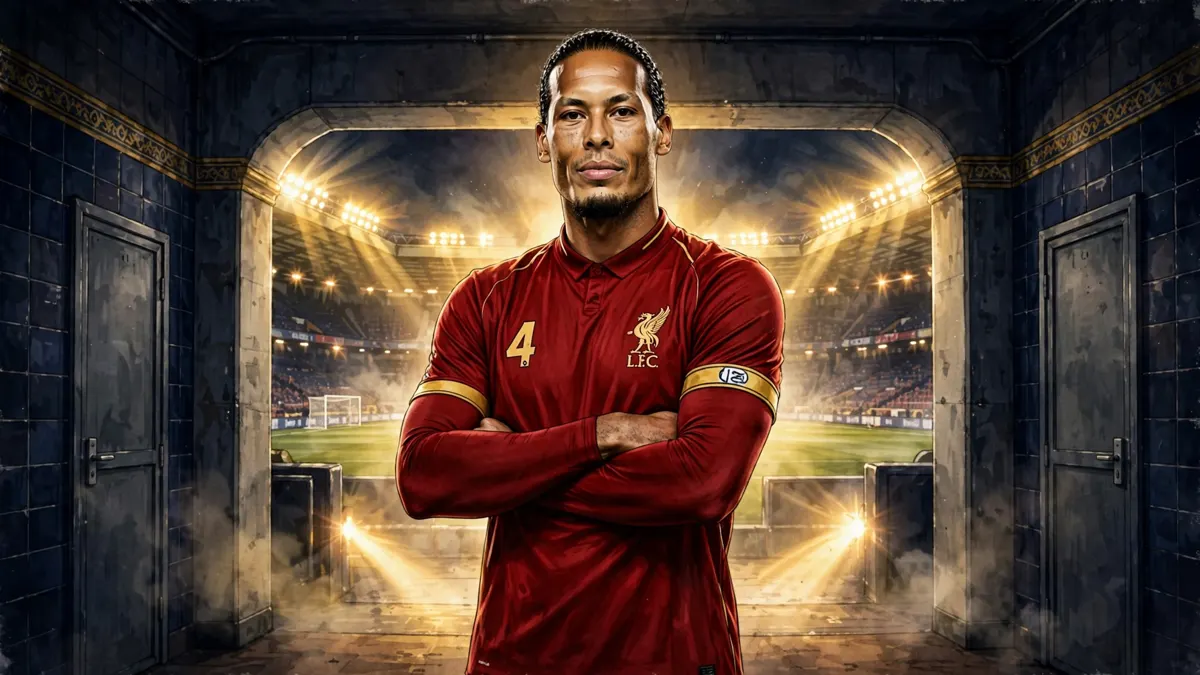
Virgil van Dijk was born on July 8, 1991, in Breda, a city in the south of the Netherlands. He came through the academy of Willem II, the club based in nearby Tilburg, and for a long time it looked like a standard Dutch academy story: a tall, composed kid moving up the age groups. Then the story broke. Willem II decided not to offer him a senior contract, and at 19 Van Dijk was effectively told he was not good enough for the club that had raised him.
That rejection is the first thing to understand about his money story, because it shaped the whole shape of his career. Players who come through a big academy on schedule sign their first professional deals early and climb a predictable salary ladder. Van Dijk had to start again. He joined FC Groningen in 2011, a smaller Eredivisie club, and signed his first professional contract there. The wages were modest by top-flight standards, and for the first two seasons of his professional life he was a long way from the money that would later define his career.
He has spoken in interviews over the years about how that early setback stayed with him, and it shows in the way he plays: unhurried, almost unbothered by pressure, a defender who treats a one-on-one with a striker the way most players treat a training drill. Groningen gave him first-team football, and first-team football gave him a shop window. In two seasons he made 66 appearances, scored seven goals — a healthy return for a centre-back — and started to attract attention from outside the Netherlands. The boy Willem II let go was becoming the most sought-after young defender in the Eredivisie.
There is also a family detail that matters to the later story. Van Dijk met Rike Nooitgedagt in 2011, when he was 20 and still finding his feet at Groningen. The two have been together since, married in the summer of 2017, and now have four children, the first born in 2014. She has stayed almost entirely out of the public eye, and Van Dijk guards his family’s privacy closely — a habit that also explains why so little is publicly known about his property and spending, a point we return to in the assets section below.
Groningen and Celtic: The Making of a Defender
In the summer of 2013, Celtic paid around £2.6 million to take Van Dijk to Glasgow. It was a small fee by the standards of what would follow, but it was the move that changed everything. Celtic played in the Champions League, won things every year, and gave a 22-year-old defender a stage where mistakes were punished and good performances were noticed across Europe. Van Dijk won the Scottish Premiership in both of his seasons in Glasgow, added the Scottish League Cup in the second, and was named in the PFA Scotland Team of the Year in both campaigns.
Financially, Celtic was a step up from Groningen but still a long way from Premier League money. Scottish football pays far less than England’s top flight, and Van Dijk’s wages in Glasgow would have been a fraction of what he later earned at Southampton and Liverpool. What Celtic gave him instead was value: two league titles, European nights, and a reputation. By the time he left Scotland in 2015, he was no longer a prospect. He was a proven winner with a highlight reel of goals from set pieces and a growing list of admirers in England.
The other thing Celtic gave him was a goalscoring habit that would become a real part of his value. Centre-backs who score win matches, and Van Dijk scored 15 goals in 115 games for Celtic. That threat from corners and free kicks followed him to England, where his headed goals — including the winner in the 2024 EFL Cup final — have decided finals and title races. A defender who scores is a defender clubs pay more for, and Van Dijk’s aerial ability has been priced into every contract he has signed since.
Southampton: The Premier League Shop Window
Southampton signed Van Dijk in September 2015 for a fee reported at around £13 million, and the move did exactly what both sides wanted. Southampton, a club with a sharp eye for undervalued talent, got one of the best defenders in the league for a modest fee. Van Dijk got the Premier League, the richest league in the world, and two and a half seasons to prove he belonged at the very top of it.
He did more than belong. By his second season at St Mary’s he was being talked about as the best centre-back in the division, and the biggest clubs in England were circling. In the summer of 2017 the situation turned messy: Liverpool’s interest became public, Southampton reported the approach, and Van Dijk handed in a transfer request in August 2017 asking to leave. Southampton held firm, he stayed for the first half of the 2017–18 season, and the saga dragged on for months. It was the one public falling-out of his career, and it ended the way these stories usually end when the player is good enough — with a record fee.
Southampton was also where Van Dijk’s salary first reached serious money. Premier League wages at a mid-table club in 2015 were already far beyond anything he had earned in Scotland, and his deal there set the base from which Liverpool would later negotiate. He left St Mary’s in January 2018 having made 80 appearances, and having turned a £13 million signing into a £75 million sale — one of the great pieces of business in Southampton’s history, and the deal that made Van Dijk a very wealthy man.
The Record Move to Liverpool
On January 1, 2018, Liverpool completed the signing of Virgil van Dijk from Southampton for £75 million. At the time it was a world-record fee for a defender, and plenty of people said Liverpool had overpaid. The fee was the story for about a week. Then Van Dijk started playing, and the conversation changed completely.
His debut said everything about what Liverpool had bought. On January 5, 2018, in an FA Cup tie against Everton at Anfield, Van Dijk scored the winning goal with a late header. It was the dream start, but the real change was quieter: Liverpool stopped conceding goals. Before his arrival the defence had been the obvious weakness of Jürgen Klopp’s side, a team that could score four and concede three. With Van Dijk at the back, the same team became hard to beat. He brought calm, pace, aerial dominance and an ability to organise the players around him, and the effect was immediate.
The money followed the performances. Liverpool reached the Champions League final in his first half-season, losing to Real Madrid in Kyiv, and then won the competition a year later. His first full season, 2018–19, ended with the Champions League trophy, the PFA Players’ Player of the Year award and the Premier League Player of the Season award. He finished runner-up to Lionel Messi in the 2019 Ballon d’Or — the highest a defender had placed in two decades — and became the only defender ever to win the UEFA Men’s Player of the Year award. For a player Willem II had once released, it was a remarkable climb, and it is worth remembering that every pound of his fortune traces back to that climb: the fee, the wages and the endorsements all rest on those three seasons when he was, by common consent, the best defender in the world.
He also became a leader quickly. Ronald Koeman made him captain of the Netherlands in March 2018, only two months after the Liverpool move, and in July 2023 he succeeded Jordan Henderson as Liverpool captain. His teammate Mohamed Salah has been the attacking face of that Liverpool side, but Van Dijk has been its spine — the player the whole team is built around. That status is worth money: captains of elite clubs are paid like franchise players, and Van Dijk’s 2025 contract reflects exactly that.
The Golden Era: Trophies and Individual Honours
Van Dijk’s trophy cabinet is the reason his name carries weight in contract talks. With Liverpool he has won the UEFA Champions League in 2019, the Premier League in 2019–20 and again in 2024–25, the FA Cup in 2022, the EFL Cup in 2022 and 2024, the FIFA Club World Cup in 2019 and the UEFA Super Cup in 2019. Add the two Scottish Premiership titles and the Scottish League Cup from Celtic, and the count runs to more than a dozen major honours. Different outlets count them differently — FootballPickr credits him with nine career trophies, while broader counts that include the Scottish titles and the Club World Cup run higher — but the point is the same either way: he has won at every club he has played for since leaving the Netherlands.

The 2024 EFL Cup final is a good example of how his value works. With Liverpool down to a threadbare side against Chelsea at Wembley, Van Dijk — by then captain — scored the only goal of the game, a header in extra time, to win the trophy. It was the first trophy of his captaincy, and it came in the season Klopp announced he was leaving. A year later, in April 2025, he lifted the Premier League trophy as captain after Liverpool sealed the title with a 5–1 win over Tottenham Hotspur, his first league title as the man wearing the armband. Trophy lifts like that are not just memories; they are leverage. A captain who has just lifted the league title signs his next contract from a position of strength, and Van Dijk’s April 2025 extension was signed in exactly those circumstances.
The individual honours matter for the money story too. The UEFA Men’s Player of the Year award in 2019 put him ahead of both Messi and Cristiano Ronaldo for a season — the only defender ever to win it — and the Ballon d’Or runner-up finish the same year made him a global name rather than a Premier League one. Global names get global endorsement deals, and that is where the Nike and EA Sports partnerships come in. He also passed milestones that keep his name in the news: his 250th Premier League appearance came in December 2025, and he reached 100 caps for the Netherlands in October 2026, only the 11th Dutch player ever to do so. He captained the Netherlands at the 2026 World Cup, scoring in the opening 2–2 draw with Japan. Longevity at this level is rare for a defender in his mid-thirties, and it is the reason Liverpool were willing to pay him top wages into 2027.
The 2019 peak: In a single calendar year Van Dijk won the Champions League, finished second in the Ballon d’Or to Lionel Messi, and became the only defender to be named UEFA Men’s Player of the Year. No defender since has matched that combination.
The Contract and the Salary: What Van Dijk Actually Earns
The single most important document in Van Dijk’s finances is the contract he signed in April 2025. On April 17, 2025, he agreed a two-year extension with Liverpool running through June 30, 2027. His previous deal paid £220,000 a week, around £11.4 million a year in base salary. The new deal was a big step up: British media reported his earnings at £350,000 a week, with performance-related bonuses that could push the figure as high as £400,000 a week — £20.8 million over a full year at the maximum rate, according to Celebrity Net Worth. Icon Polls, working from the £350,000 figure, puts his annual salary for 2025–26 at roughly £18.2 million, about $23 million.
Those numbers place him among the highest-paid defenders in world football, and among Liverpool’s top earners full stop. Only a handful of Premier League players earn more per week, and almost all of them are attackers. For comparison within the league, fellow high earners such as Kevin De Bruyne have commanded similar weekly figures, but defenders almost never do — Van Dijk’s wage is a statement about how Liverpool value a player who has been the foundation of their team for eight years.
| Period | Club | Reported Weekly Wage | Notes |
|---|---|---|---|
| 2011–2013 | FC Groningen | Modest Eredivisie wage | First professional contract; no public salary figure |
| 2013–2015 | Celtic | Scottish Premiership wage | Two league titles; fee around £2.6 million |
| 2015–2018 | Southampton | Premier League wage | Fee reported around £13 million; transfer request August 2017 |
| 2018–2021 | Liverpool | Rising to £220,000 a week | £75 million record fee; Champions League and Premier League winner |
| 2021–2025 | Liverpool | £220,000 a week | Previous deal; around £11.4 million a year in base salary |
| 2025–2027 | Liverpool | £350,000–£400,000 a week | Two-year extension signed April 17, 2025; runs to June 30, 2027 |
Two things are worth noting about that table. First, the early rows have no hard salary numbers because none have been reliably published — and this article will not invent them. Van Dijk’s earnings before Liverpool were real but modest by Premier League standards, and the fortune was built almost entirely after January 2018. Second, the headline weekly wage is not take-home pay. Gross career club earnings above $100 million, as Celebrity Net Worth reports them, are before tax, agent fees and expenses. The net worth figure is what is left after those deductions, plus endorsements and investments, minus spending — which is exactly why the estimate range is so wide.
Durability is part of the salary story as well. During the 2025–26 Premier League season, Van Dijk played every minute of Liverpool’s league campaign at age 34 — the only outfield player in the division to do so, according to Celebrity Net Worth. A player who never misses a game is a player whose contract carries no injury discount, and that durability helped him secure top wages at 34, an age when most defenders are winding down.
Net Worth Breakdown: Where the Money Comes From
Here is the honest picture. No two published sources agree on Van Dijk’s net worth, and the gap between the lowest and highest figures is $55 million. That is not a rounding error; it is a sign that different outlets are counting different things, using different exchange rates, and in some cases using old data. The table below lists every figure found in live research for this article, with the source and what it appears to be based on.
| Source | Estimate | What It Appears to Count |
|---|---|---|
| Celebrity Net Worth | $50 million | Career salaries, endorsements; updated with the 2025 contract |
| Icon Polls | $50–55 million | Career earnings above $100 million, endorsements, investments |
| SportsDunia | Around £50 million | Salaries, contracts and endorsements as of 2026 |
| FootballPickr | $35 million | Lower estimate; data verified April 2026 |
| AthleteWiki | Around $30 million | Lower-end estimate; no detailed breakdown given |
| NetWorthBreakdown | $25 million | Lowest figure; uses dated salary assumptions and an injury narrative |
| Surprise Sports | £42 million | 2024-based figure, updated March 2026; predates the new contract’s full effect |
| Velontia | $80 million | Highest figure; thin sourcing, appears to annualise peak earnings |
Reading that table with a clear eye: the credible cluster sits between $35 million and $55 million, and the two most detailed recent sources — Celebrity Net Worth and Icon Polls — both land on $50 million or just above it. SportsDunia’s £50 million is higher in dollars, but it is a sterling figure, and sterling estimates often look bigger once converted. The $25 million figure from NetWorthBreakdown leans on older salary data and a stale injury narrative, while the $80 million figure from Velontia is an outlier with thin sourcing that no other outlet supports. This article therefore anchors on $50 million, with a stated range of $35–55 million.
| Income Stream | Share of the Fortune | Notes |
|---|---|---|
| Liverpool salaries (2018–2027) | The bulk | Gross career club earnings above $100 million per Celebrity Net Worth; current deal £350,000–£400,000 a week |
| Earlier club salaries | Small share | Groningen, Celtic and Southampton wages; modest next to Liverpool money |
| Endorsements | Meaningful top-up | Nike, EA Sports, JBL; IWC and Beats also reported |
| Bonuses | Built into contracts | Title, Champions League and appearance bonuses; performance add-ons in the 2025 deal |
| Investments and property | Not publicly documented | No verified public record of a portfolio; not counted in the anchor figure |
One more check on the numbers: the $100 million-plus career earnings figure and the $50 million net worth figure are not in conflict. A footballer who earns $100 million gross over a career pays roughly half of it in tax across the Netherlands, Scotland and England, pays his agent, and lives — even modestly — for fifteen years. What remains is a net worth in the region of half his gross earnings, which is exactly where the $50 million anchor sits. That arithmetic is the strongest argument for the Celebrity Net Worth figure: it is the one that fits the salary history.
Endorsements: Nike, EA Sports and JBL
Van Dijk is not a billboard footballer. He does not chase the fashion and fragrance deals that fill other stars’ portfolios, and his endorsement income is smaller than that of attacking players with similar fame. What he does have is a small set of long-running partnerships with big brands that fit a defender’s image: calm, reliable, premium.
Nike is the main one. Van Dijk has been a Nike athlete throughout his Liverpool career, wearing the brand’s boots and appearing in its campaigns. EA Sports is the second pillar: as one of the highest-rated defenders in the EA Sports FC game series year after year, he is a natural fit for the franchise, and the partnership has run for years. JBL, the audio brand, is the third named partner in most profiles of him. NetWorthBreakdown also mentions IWC watches, and Velontia mentions Beats, though neither is as consistently reported as the big three. Taken together, the endorsement portfolio is probably worth a few million dollars a year — a useful top-up on a £350,000-a-week salary, but not the main engine of the fortune.
That restraint is a choice, and it fits the rest of his public image. Van Dijk rarely gives interviews about his money, does not flaunt purchases on social media, and has never been the subject of a splashy lifestyle profile. His marketability rests on performance and leadership rather than personality-driven branding, which is why the brands that do sign him tend to be performance and technology companies rather than luxury labels. For a player whose game is built on making the difficult look easy, the endorsement list reads the same way: short, steady and high quality.
The contrast with other Premier League stars is instructive. Son Heung-min has built a far larger commercial profile off the pitch, with a string of deals across Asia and Europe, while Van Dijk’s commercial footprint stays narrow and football-first. Both approaches pay; Van Dijk’s just pays through the wage bill rather than the billboard.
Assets and Lifestyle: What Is Actually Known
This is the section where most net worth articles start inventing things, so it will be short and honest. There is no reliable public record of Virgil van Dijk’s property portfolio, car collection or investment holdings. No reputable outlet has published a verified list of houses he owns, and he does not post his purchases online. Any article that tells you the exact value of his home or names his cars is guessing, and this one will not do that.
What can be said is what is visible. He has lived in the Liverpool area since 2018, as any Liverpool player does, and his life outside football is deliberately quiet: family time, training, recovery, and the occasional commercial commitment. He is not a regular on the celebrity circuit, does not court tabloid attention, and has kept his wife and children almost entirely out of the press. That low profile is itself a financial fact — a player who does not spend publicly is a player whose money stays in the bank, and the gap between his gross earnings and his net worth is smaller than it would be for a star with a public spending habit.
One thing that is documented is his charitable side, though it is modest and mostly local: he has supported community work in Liverpool and in the Netherlands without making a show of it. There is no Van Dijk foundation with a public balance sheet, and no reported business empire of restaurants or clothing lines. His wealth is, by the look of it, a footballer’s wealth in the classic sense: wages, bonuses and endorsements, saved rather than spent loudly.
Net Worth Growth: Year by Year
Van Dijk’s fortune was not built gradually. It was built in two jumps — the move to England in 2015, and the move to Liverpool in 2018 — with steady growth since. The timeline below uses the contract history and the published estimates to sketch that path. The early years are approximate because no public salary figures exist for Groningen or Celtic; the Liverpool years are anchored on the reported wages.
| Year | Career Moment | Estimated Net Worth |
|---|---|---|
| 2011 | First professional contract, FC Groningen | Under $1 million |
| 2013 | Moves to Celtic for around £2.6 million | Low single-digit millions |
| 2015 | Moves to Southampton for around £13 million | Single-digit millions |
| 2018 | Moves to Liverpool for £75 million; Champions League final | Approaching $10 million |
| 2019 | Champions League winner; UEFA Men’s Player of the Year; Ballon d’Or runner-up | Approaching $20 million |
| 2020 | Premier League winner; ACL injury in October | Low $20 millions |
| 2023 | Named Liverpool captain | Mid $30 millions |
| 2025 | Signs £350,000-a-week extension; lifts Premier League as captain | Approaching $50 million |
| 2026 | 100th Netherlands cap; still Liverpool captain at 35 | $50 million (anchor); range $35–55 million |
The shape of that curve tells its own story. A defender’s earning years are long — Van Dijk is still at his peak at 35, still captaining club and country, still on a contract that runs to 2027. If he sees out that deal, his gross career earnings will climb well past $120 million, and the net worth figure will climb with it. The next question for his finances is not whether the fortune grows, but what comes after 2027: a final playing contract elsewhere, a move into coaching, or retirement at the top. None of those paths has been announced, and any of them would keep the money coming in.
Personal Life: Family Away From the Cameras
Van Dijk met his wife, Rike Nooitgedagt, in 2011, when he was 20 and playing for Groningen. The two married in the summer of 2017, the same year his career took off at Southampton, and they now have four children, the first born in 2014. Rike has stayed out of the spotlight almost completely: she does not give interviews, has no public profile of her own, and is rarely photographed at matches. That privacy is a joint decision, and it has held for fifteen years.
The family moved with him at every step — Groningen, Glasgow, Southampton, Liverpool — and the stability of that home life is something people close to him credit for his consistency on the pitch. He is known as a calm, private character in the dressing room, a leader who talks on the pitch rather than in the press. His father left the family when Van Dijk was young, and he has spoken sparingly about a difficult relationship there; it is one of the few personal subjects he has ever addressed publicly, and he has kept the details private.
Off the pitch he is a keen follower of other sports and a regular at the golf course in his spare time, though even that is reported rather than paraded. The next generation of stars — players like Jude Bellingham, who is already carrying a national team in his early twenties — will have grown up watching Van Dijk, and that is the measure of how long he has been at the top: he is now the veteran other players name as their model.
Setbacks: The ACL Injury and the Transfer Saga
Two episodes in Van Dijk’s career are worth recording honestly, because both shaped the money story. The first was the transfer saga of 2017. Liverpool’s interest in him became public in the summer of 2017, Southampton believed an illegal approach had been made, and Van Dijk handed in a transfer request in August asking to leave. He stayed for five more months, training alone for part of that time, and the standoff cost him half a season of football. It also cost Liverpool nothing in the end — they paid the £75 million in January — but it was a reminder that even a player of his standing can spend months in limbo when a transfer goes wrong.
The second was the injury. In October 2020, during the Merseyside derby against Everton, Van Dijk suffered anterior cruciate ligament damage in a challenge with goalkeeper Jordan Pickford and missed almost the entire 2020–21 season. For a defender who relies on pace and power, an ACL injury at 29 could have been the beginning of the end. It was not. He returned for the 2021–22 season, played his way back to full fitness, and within two years was captaining the club. The injury cost him a season of football and, in the short term, a season of bonuses; it did not cost him his career, and it did not dent his long-term earnings. If anything, the comeback strengthened his standing: a player who returns from an ACL injury and wins a cup final as captain is a player clubs trust with a long contract.
There is nothing else of substance to record here. Van Dijk has no public legal troubles, no controversies beyond the 2017 transfer request, and no disciplinary record of note. That clean record is part of his commercial value — brands sign players they can trust — and it is one more reason the endorsement list, short as it is, has stayed stable for years.
Frequently Asked Questions
What is Virgil van Dijk’s net worth in 2026?
Virgil van Dijk’s net worth is estimated at $50 million in 2026, anchored on Celebrity Net Worth’s current figure. Credible published estimates range from $35 million (FootballPickr) to $55 million (Icon Polls), with SportsDunia putting him at around £50 million. Outlier figures of $25 million and $80 million exist but are not supported by the salary history. His gross career club earnings alone sit above $100 million, according to Celebrity Net Worth.
How much does Virgil van Dijk earn per week?
Van Dijk earns a reported £350,000 to £400,000 per week under the two-year Liverpool contract extension he signed in April 2025. His previous deal paid £220,000 a week. At the £350,000 figure his annual salary is roughly £18.2 million, about $23 million, and performance bonuses can push it toward £20.8 million a year.
How long is Van Dijk’s Liverpool contract?
His current Liverpool contract runs through June 30, 2027. He signed the two-year extension on April 17, 2025, when he was 33, and he remains Liverpool captain under the deal. No extension beyond 2027 has been announced.
What was Van Dijk’s transfer fee to Liverpool?
Liverpool paid £75 million to sign Van Dijk from Southampton on January 1, 2018. At the time it was a world-record fee for a defender. Southampton had signed him from Celtic in 2015 for a fee reported at around £13 million, and Celtic had paid around £2.6 million to sign him from Groningen in 2013.
How many trophies has Virgil van Dijk won?
With Liverpool he has won the UEFA Champions League (2019), the Premier League (2019–20 and 2024–25), the FA Cup (2022), the EFL Cup (2022 and 2024), the FIFA Club World Cup (2019) and the UEFA Super Cup (2019). He also won two Scottish Premiership titles and a Scottish League Cup with Celtic. Different outlets count between nine and a dozen-plus major honours depending on what they include.
Who is Virgil van Dijk’s wife?
Van Dijk is married to Rike Nooitgedagt. The two met in 2011, when he was 20 and playing for Groningen, and married in the summer of 2017. They have four children, the first born in 2014. Rike keeps a very low public profile and rarely appears in the press.
How old is Virgil van Dijk?
Virgil van Dijk was born on July 8, 1991, in Breda, Netherlands, which makes him 35 years old as of November 2026. He is 6 ft 5 in (1.95 m) tall and plays as a centre-back for Liverpool and the Netherlands, captaining both teams.
What endorsements does Virgil van Dijk have?
His main endorsement partners are Nike, EA Sports and JBL. IWC watches and Beats have also been reported in some profiles. His endorsement income is modest next to his salary — a few million dollars a year — because his commercial profile is deliberately narrow and football-first rather than built on fashion or lifestyle deals.
Final Thoughts: The Bottom Line
Virgil van Dijk’s net worth is estimated at $50 million as of November 2026, with a credible range of $35–55 million across the best-sourced estimates. It is a fortune built on football alone: a world-record transfer, eight years as the foundation of Liverpool’s defence, two Premier League titles, a Champions League, and a contract that still pays £350,000 a week at the age of 35. There is no business empire behind it and no public spending spree in front of it — just wages, bonuses and a handful of steady endorsements, saved by a player who keeps his life private.
What makes the number interesting is not its size but its shape. Van Dijk was released by Willem II as a teenager, earned his first real money in Scotland, and did not become wealthy until Liverpool paid £75 million for him at 26. From there the curve only went up, through a Ballon d’Or runner-up finish, a serious knee injury, a comeback, a captaincy and a second league title. If he sees out his contract to 2027, the fortune will keep growing — and the next chapter, whatever he chooses after playing, starts from a position of real financial strength. For more football wealth profiles, browse the Net Worth section on CelebAmerica.
Sources and Reporting
How we estimated: Van Dijk has never published his finances, so this article’s figure is an estimate. It is anchored on Celebrity Net Worth’s $50 million figure and cross-checked against Icon Polls ($50–55 million), SportsDunia (around £50 million), FootballPickr ($35 million), AthleteWiki (around $30 million), NetWorthBreakdown ($25 million), Surprise Sports (£42 million) and Velontia ($80 million). Salary figures come from Celebrity Net Worth and Icon Polls reporting on the April 2025 contract; transfer fees and career history are drawn from the outlets below. Where sources disagree, the article publishes the range and says which source anchors it. Estimates may differ from private reality.
- Celebrity Net Worth — net worth $50 million; 2025 contract terms; career earnings above $100 million
- Icon Polls — net worth $50–55 million; salary £350,000–£400,000 a week
- SportsDunia — net worth around £50 million; contract through June 2027
- FootballPickr — net worth $35 million; career trophies and wages
- NetWorthBreakdown — net worth $25 million; endorsement mentions including IWC
- Wikipedia — career history, honours, personal life, 100th cap
- Transfermarkt — contract dates and transfer history
By Celebamerica Editorial Staff. This article is an estimate based on publicly reported figures and is not a statement of Van Dijk’s private finances.