Tyson Fury stands 6 feet 9 inches tall (206 cm), with a reach of 85 inches (216 cm). That is the official figure listed by BoxRec, the record-keeping home of professional boxing, and repeated by Britannica in its profile of Fury, last updated on September 30, 2026. At that height, the man they call the Gypsy King towers over almost every heavyweight he has ever shared a ring with — and he has spent the whole of his career turning those extra inches into titles, purses and a fortune.
There is a catch, and any honest profile has to say it up front: plenty of fans and height-watchers think the real number is a touch lower, closer to 6 feet 7 or 8 inches in bare feet. The 6-foot-9 figure is the one printed on every official tale of the tape, from the Klitschko upset in 2015 to the two Usyk fights in 2024, and it is the number this article uses — with the debate laid out in full below, so you can judge the evidence yourself. As of November 5, 2026, Fury is 38 years old, back in active competition after a 16-month retirement, and six weeks away from the fight British boxing spent a decade trying to make: Anthony Joshua, on December 11, 2026, in Cardiff.
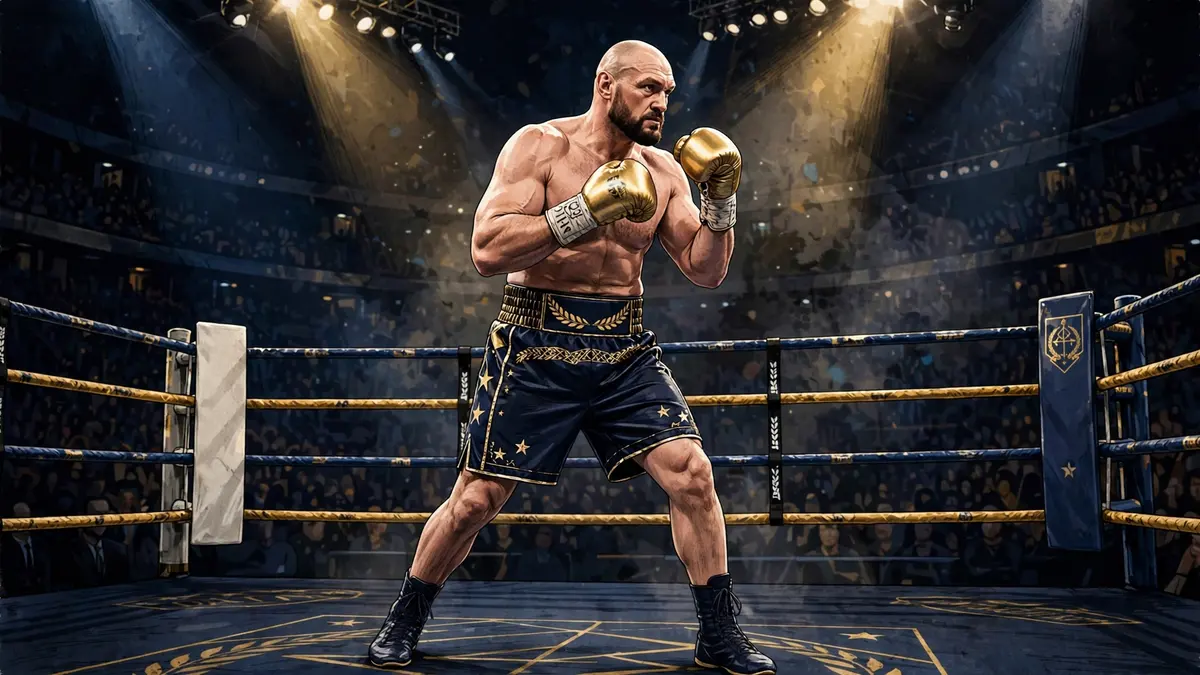
Tyson Fury Height at a Glance
| Detail | Fact |
|---|---|
| Full Name | Tyson Luke Fury — “The Gypsy King” |
| Date of Birth | August 12, 1988 (age 38 in 2026) |
| Birthplace | Wythenshawe, Manchester, England |
| Height | 6 ft 9 in (206 cm) — BoxRec and Britannica |
| Reach | 85 in (216 cm) — BoxRec |
| Stance | Orthodox |
| Weight | Around 18 stone 2 lbs (about 254 lbs) on recent tales of the tape — Sky Sports |
| Professional Record | 36 wins, 2 defeats, 1 draw — 25 wins by knockout (as of October 2026) |
| Estimated Net Worth | £120 million to £162 million (about $160 million–$210 million); Sunday Times Rich List 2026 puts it at £162 million |
| Primary Income Sources | Fight purses and pay-per-view shares, endorsements, Furocity energy drink brand, books and Netflix series |
| Key Ventures and Works | Two-time heavyweight world champion; “Behind the Mask” autobiography (2019); Netflix series “At Home With the Furys” (2023); Furocity |
| Next Fight | vs Anthony Joshua, December 11, 2026, Principality Stadium, Cardiff, live on Netflix |
Contents
- Tyson Fury Height at a Glance
- How Tall Is Tyson Fury?
- Tyson Fury Height in Feet, Inches and Centimetres
- The Height Debate: Is Fury Really 6 Feet 9 Inches?
- Tyson Fury Height Compared With Other Heavyweights
- How Fury Uses His Height in the Ring
- Tyson Fury Early Life: Born Small, Grew Into a Giant
- Career Rise: From Manchester Gyms to World Champion
- The Money Behind the Height
- Tyson Fury Assets: Homes, Cars and Business Ventures
- Tyson Fury Net Worth Growth Timeline
- Personal Life: Paris Fury and Seven Children
- Controversies and Setbacks
- Tyson Fury Next Fight: Anthony Joshua
- Tyson Fury Height FAQs
- Final Thoughts
- Sources and Reporting
How Tall Is Tyson Fury?
Tyson Fury is 6 feet 9 inches tall. That is the figure on his BoxRec profile — height 206 cm, reach 216 cm — and it is the figure Britannica gives in the opening lines of its Fury profile: “he is known for his well-rounded boxing skills and his towering height: 6 feet 9 inches (2.06 meters).” It is also the number that has followed him through every major fight of his career. When he dethroned Wladimir Klitschko in Düsseldorf on November 28, 2015, the tale of the tape read 6 feet 9 against Klitschko’s 6 feet 6. When he met Deontay Wilder three times between 2018 and 2021, it read 6 feet 9 against Wilder’s 6 feet 7. When he faced Oleksandr Usyk for the undisputed championship in 2024, it read 6 feet 9 against Usyk’s 6 feet 3.
The number matters because it has shaped how Fury fights and how he is sold. Promoters at Top Rank and Queensberry have built whole fight weeks around it: the giant who can box, the 6-foot-9 man with the footwork of a middleweight. Sky Sports, comparing the division’s elite heavyweights, calls Fury “the biggest of the big men — the giant Fury is the tallest, with the longest reach, and often the heaviest of his peers.” That size is not a garnish on his career; it is one of the two or three facts every opponent has had to plan around since his professional debut in December 2008.
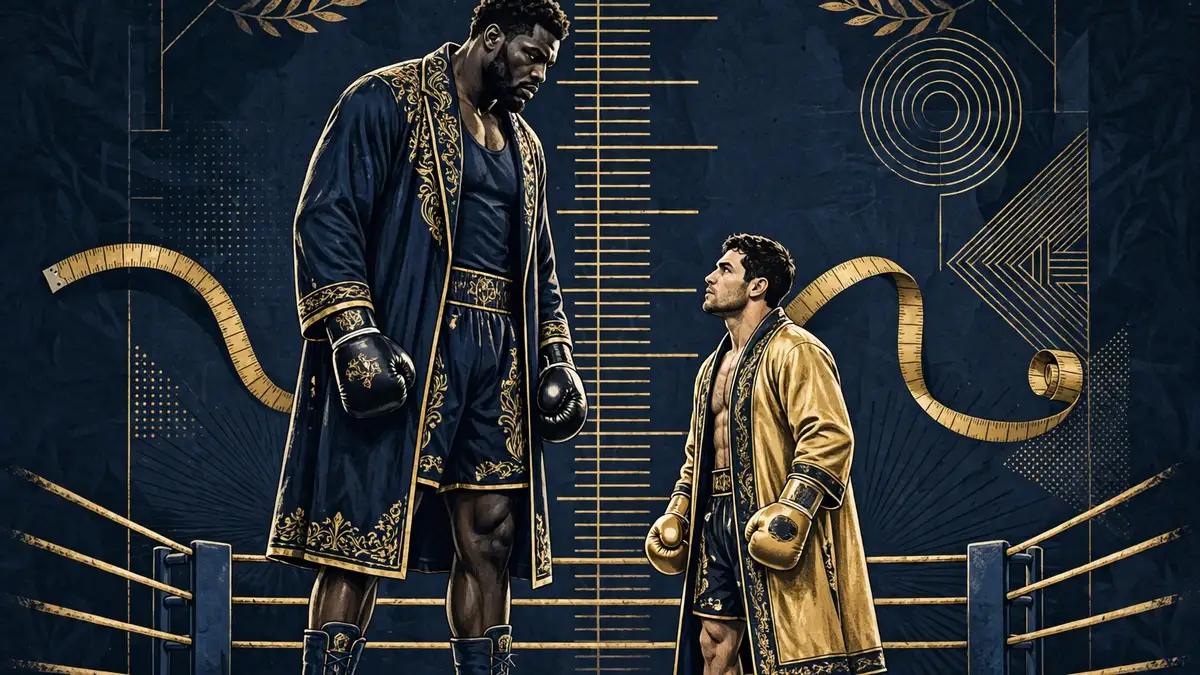
For scale, Fury stands about a full foot taller than the average British man, who measures roughly 5 feet 9 inches. He is three inches taller than Anthony Joshua, two inches taller than Deontay Wilder, three inches taller than Wladimir Klitschko, and six inches taller than Oleksandr Usyk, the only man to beat him. He is also 11 inches taller than the man he was named after: Mike Tyson, listed at 5 feet 10 inches. Fury’s father, John Fury, named his son after the then-undisputed heavyweight champion in the hope that some of that greatness would rub off. The height, at least, went far beyond the original.
Tyson Fury Height in Feet, Inches and Centimetres
Boxing fans in Britain talk in feet and inches; the rest of the world talks in centimetres. Here is Fury’s listed size in every unit that shows up on a tale of the tape, all taken from the same official listings:
| Measurement | Imperial | Metric |
|---|---|---|
| Height | 6 ft 9 in | 206 cm (2.06 m) |
| Reach (fingertip to fingertip) | 85 in | 216 cm |
| Height advantage over Anthony Joshua | 3 in | about 8 cm |
| Height advantage over Deontay Wilder | 2 in | about 5 cm |
| Height advantage over Wladimir Klitschko | 3 in | about 8 cm |
| Height advantage over Oleksandr Usyk | 6 in | about 15 cm |
| Reach advantage over Oleksandr Usyk | 7 in | about 18 cm |
The reach deserves its own line because it is the number that does the real work. At 85 inches, Fury’s reach is seven inches longer than Usyk’s 78 inches and three inches longer than Joshua’s 82 inches. In a sport where a jab thrown from six inches further away can decide a round, that gap is the difference between landing first and getting hit first. Fury’s long arms let him paw with the jab from a distance where most heavyweights cannot answer, then step in behind it when he chooses. It is the same tool Lennox Lewis, another tall heavyweight champion, used to control fights for a decade — and Lewis, at 6 feet 5 inches, was four inches shorter than Fury.
Weight moves with the training camp, so it is worth treating differently from height. Sky Sports’ comparison of the division’s elite lists Fury at 18 stone 2 lbs, about 254 lbs. He weighed 258 lbs for the Francesco Pianeta fight in August 2018, according to BoxingScene’s ringside report, and 247 lbs when he beat Klitschko in 2015. The number has swung widely across his career — he was reported to have carried close to 28 stone, around 390 lbs, during the darkest stretch of his time away from the ring in 2016 and 2017 — but in his fighting prime he has usually weighed in between 250 and 270 lbs. Height, unlike weight, does not change with a training camp. That is why it is the first number on every tale of the tape and the first question fans ask.
The Height Debate: Is Fury Really 6 Feet 9 Inches?
Ask a room full of boxing fans how tall Tyson Fury is and you will get two answers. The official answer is 6 feet 9 inches, printed on every tale of the tape since his debut. The sceptical answer is that he is closer to 6 feet 7 and a half inches, or 6 feet 8 at the most, and that the extra inch or two is the kind of rounding-up that has gone on in boxing and wrestling for as long as anyone can remember.
The sceptics have a case, and it is built on photographs. Fury standing next to Wladimir Klitschko, listed at 6 feet 6 inches, does not always look a full three inches taller; in some pictures the gap looks closer to one or two inches. Next to Deontay Wilder, listed at 6 feet 7 inches, the two men look close to the same height in face-offs, which is odd if Fury really holds a two-inch edge. Next to David Price, another British heavyweight listed at 6 feet 8 inches, Fury has looked the shorter man in some shots. The height-tracking site CelebHeights has run pages of debate on exactly this question, with regular posters settling on a barefoot figure somewhere between 6 feet 7 and 6 feet 7 and a half inches for Fury, and a similar small haircut for Wilder and Joshua. One widely shared write-up on the subject puts it plainly: the official answer is 6 feet 9, but the “real world” answer, judged from photographs and shared appearances, is probably a strong 6 feet 7 or 6 feet 8.
There are honest reasons the photographs can mislead, though. Fury rarely stands bolt upright. He slouches, he leans, he bends at the waist when he talks to shorter men, and he has a habit of standing with his feet wide apart in a fighting stance, which takes an inch or two off his measured height. Footwear matters as well: boxing boots, trainers and the thick soles fighters wear at weigh-ins and press conferences can add or hide an inch depending on who is wearing what. Camera angles do the rest — a man standing half a step closer to the lens looks taller than he is, and a man standing on a slightly raised platform looks taller still. None of that proves the official figure is exact, but it does explain why still photographs are a shaky way to measure a moving man.
What settles the question, as far as it can be settled, is that the number has never changed. Across 39 professional fights, four promoters, three broadcasters and two sanctioning eras, the tale of the tape has read 6 feet 9 inches every single time. BoxRec, which is the sport’s record book and not a promotional outlet, lists 206 cm. Britannica, which has no reason to flatter a boxer, lists 6 feet 9 inches. GiveMeSport’s tale-of-the-tape pieces for both the Usyk rematch and the Joshua fight use the same figure. If Fury were truly 6 feet 7, he would still be one of the tallest heavyweights of his generation — but the sources that count all agree on 6 feet 9, and this profile reports that figure while noting the doubt, rather than picking a side in silence.
One more point is worth making plainly: even at the sceptics’ lower estimate, Fury’s height advantage over his rivals barely changes. Shave two inches off Fury and you should shave an inch or two off most of his opponents as well, because the same generous measuring applies to them. The gap between Fury and Usyk stays around five or six inches. The gap over Joshua stays around two or three. The story of his career — a very tall man beating very good fighters — survives whichever ruler you use.
Tyson Fury Height Compared With Other Heavyweights
Fury’s height only means something next to the men he fights. Put him beside the heavyweight division’s recent champions and the picture is striking: he is the tallest of his era’s elite, and by a clear margin over the two men who have defined his career — Usyk, the only man to beat him, and Joshua, the rival he finally meets in December 2026.
| Boxer | Height | Reach | Gap to Fury |
|---|---|---|---|
| Tyson Fury | 6 ft 9 in (206 cm) | 85 in (216 cm) | — |
| Deontay Wilder | 6 ft 7 in (201 cm) | 83 in (211 cm) | 2 in shorter |
| Anthony Joshua | 6 ft 6 in (198 cm) | 82 in (208 cm) | 3 in shorter |
| Wladimir Klitschko | 6 ft 6 in (198 cm) | 81 in (206 cm) | 3 in shorter |
| David Price | 6 ft 8 in (203 cm) | — | 1 in shorter |
| Daniel Dubois | 6 ft 4 in (193 cm) | — | 5 in shorter |
| Oleksandr Usyk | 6 ft 3 in (191 cm) | 78 in (198 cm) | 6 in shorter |
| Mike Tyson | 5 ft 10 in (178 cm) | 71 in (180 cm) | 11 in shorter |
| Nikolai Valuev | 7 ft 0 in (213 cm) | 85 in (216 cm) | 3 in taller |
Two names on that table deserve a closer look. The first is Usyk. Six inches is a huge gap in a boxing ring — the height difference between Fury and Usyk is roughly the difference between a tall adult man and a teenager — and before their first fight in May 2024, plenty of people expected it to decide the contest. It did not. Usyk, a former cruiserweight who gives away height and reach to almost every heavyweight he faces, beat Fury by split decision in Riyadh, then beat him again by unanimous decision that December. Fury’s height won him plenty of rounds in both fights, but it could not win him the fights. That is the honest limit of the advantage, and it is worth saying out loud in an article about how tall he is: size helps, but it does not box for you.
The second name is Nikolai Valuev. Fury is often described as one of the tallest heavyweight champions ever, and he is — but he is not the tallest. Valuev, the Russian giant who held the WBA title in the 2000s, was listed at 7 feet tall, three inches above Fury, with the same 85-inch reach. Valuev’s size made him a curiosity; Fury’s size, paired with movement and boxing skill that Valuev never had, made him a champion. The comparison is a useful reminder that height alone has never been enough at the top of the division.
Against Joshua, the gap tells a different story. Joshua is a big, athletic heavyweight at 6 feet 6 inches, and he has spent his career being the taller man in almost every fight he has taken. Against Fury in Cardiff, for the first time in his career, he will be the smaller man by three inches in height and three inches in reach, giving up the jab range he normally owns. GiveMeSport’s tale of the tape for the fight puts it bluntly: “Fury has the edge in both. Whilst his 6ft 9in height is regularly contested by fans, he officially stands three inches taller than Joshua, and his 85-inch reach is three inches longer.” That is the physical frame of the December fight, before a single punch is thrown.
How Fury Uses His Height in the Ring
Fury’s height works for him in three ways, and each one showed up in a different famous fight. First, the jab. From 6 feet 9 inches with an 85-inch reach, Fury can touch an opponent’s face while standing far enough away that the opponent cannot touch his. Against Klitschko in 2015, he spent twelve rounds pawing with that jab, switching stances, feinting, and refusing to let the older champion set his feet. Klitschko, who had built a decade of dominance on exactly that jab, could not reach Fury to answer it. BoxRec’s ringside account of the night notes Fury “pawing with his jab using an 85 inch reach” while Klitschko, with an 81-inch reach of his own, “couldn’t” get close enough to work. The jab is not a punch so much as a fence, and Fury’s fence is longer than anyone else’s in the division.
Second, the upper-body movement. Tall heavyweights are supposed to be stiff. Fury is not. He slips punches by bending at the waist, rolls under hooks, and switches from orthodox to southpaw in the middle of exchanges — the kind of movement you expect from a man a foot shorter. Against Wilder, a puncher who had knocked out almost everyone he had faced, Fury used that movement to survive the twelfth round of their first fight in December 2018, climbing off the canvas after a right hand that looked like it had ended the night, and then to take Wilder apart in the rematch fourteen months later. Being tall usually means being a target. Fury’s footwork turns his height into a puzzle instead: he is long, but he is rarely where the punch lands.
Third, the weight behind the punches. At roughly 18 stone, Fury carries around 30 lbs more than Usyk and a similar margin over most of his rivals. When he leans on an opponent in the clinch, ties their arms up and lets his full weight rest on them, it drains their legs round by round. Against Wilder in the second and third fights, he walked the American backwards, leaned on him, hit him to the body, and wore him down before the stoppages came. It is not pretty, and purists sometimes grumble about it, but it is legal, it is smart, and it only works because Fury is big enough to do it to men who are themselves enormous.
The height has a cost, and Fury has paid it. A tall man is easier to hit to the body, and Usyk spent long stretches of both 2024 fights digging hooks into Fury’s ribs and stomach, where the reach advantage counts for nothing. Tall men also take longer to recover their balance when they are hurt, and Fury has been dropped hard — by Wilder in 2018 and again in 2021, by Steve Cunningham back in 2013 — before getting up and winning. His chin, not his height, is what saved him on those nights. The height gives him the range and the leverage; the recovery and the nerve are his own.
Tyson Fury Early Life: Born Small, Grew Into a Giant
The joke writes itself, and Fury has told it a hundred times: the tallest heavyweight champion of his generation started life as the smallest baby in the ward. Tyson Luke Fury was born on August 12, 1988, in Wythenshawe, Manchester, three months premature and weighing just one pound. Doctors told his parents, John Fury and Amber Fury, that he might not survive the night. His father, an Irish Traveller and former bare-knuckle and professional boxer, named him after Mike Tyson, the undisputed heavyweight champion of the day, and the name stuck — along with the nickname that would follow him for life, the Gypsy King, a nod to his Traveller heritage and to the fighting tradition his family had carried for generations.
For the full story of his life and career beyond the height question, our sister site’s Tyson Fury biography walks through all four acts of it — from that one-pound birth, through two title reigns, into his 2026 comeback and the Joshua fight. What matters here is how a child who nearly died at birth grew into a man who stands 6 feet 9 inches. The Furys are a tall family by Traveller standards — his younger brother Tommy Fury, the boxer and reality television star, is listed at 6 feet tall, and his cousin Hughie Fury, also a professional heavyweight, is listed around 6 feet 5 or 6 inches — but Tyson outgrew them all by several inches, and he did it early. By the time he was a teenager in Manchester, he was already the tallest boy in every room he walked into.
He started boxing at ten years old, training in the gyms around Manchester under the eye of his father and his uncle, the trainer Hughie Fury Sr. The amateur career that followed was long and decorated: he won the ABA super-heavyweight title in 2008, the same year he turned professional, and he represented both England and Ireland at junior level before the politics of amateur selection pushed him towards the paid ranks. As an amateur he was already using the height the way he uses it now — long jab, lots of movement, awkward angles — but he was also raw, wild and easy to hit, and the early professional years were spent teaching a very tall young man how to defend himself. He was not a prodigy in the usual sense. He was a giant who had to learn to box like a giant, which is a slower education than learning to box like everyone else.
The family stayed close through it all. Fury married Paris Fury, his childhood sweetheart, in 2008, the same year he turned professional, and the couple went on to have seven children. His father John, a huge presence in his corner and in the press conferences that became part of the Fury show, trained him in his early years and remains the loudest voice in the family. The Traveller background is not a footnote in Fury’s story; it is the thread that runs through it, from the nickname to the bare-knuckle tradition his father came from, to the way Fury talks about his people whenever a microphone is put in front of him.
Career Rise: From Manchester Gyms to World Champion
Fury turned professional on December 6, 2008, stopping Bela Gyongyosi in the first round in Nottingham. The first seven years of his career were a steady climb through the domestic ranks: English, British and Commonwealth titles, a win over Dereck Chisora in 2011, and a long, noisy build-up to the night that changed everything. On November 28, 2015, at the ESPRIT Arena in Düsseldorf, he outpointed Wladimir Klitschko over twelve rounds to win the WBA, IBF, WBO and IBO heavyweight titles, ending Klitschko’s nine-and-a-half-year reign. He was 27 years old, 6 feet 9 inches tall, and three inches taller and twelve years younger than the champion he had just beaten. Britannica’s profile of Fury calls it the moment he “became the world heavyweight champion in 2015,” and it remains the single best win of his career — a tall, awkward, switch-hitting challenger outboxing a champion who had not lost in eleven years.
What followed was the first of several falls. Fury vacated his titles, battled depression and substance problems, failed a drugs test that led to a backdated two-year ban from UK Anti-Doping, and ballooned in weight to a reported 28 stone. He spent the best part of three years out of the ring, and plenty of people in boxing assumed he was finished. The comeback, when it came in 2018, was one of the great second acts in the sport’s recent history: a draw with Deontay Wilder in Los Angeles in December 2018, in a fight most observers thought Fury had won, followed by a seventh-round stoppage of Wilder in the February 2020 rematch to win the WBC title, and an eleventh-round knockout in their third meeting in October 2021, a fight that is already talked about as one of the best heavyweight trilogies ever staged.
The WBC title defences that followed — Dillian Whyte, knocked out in front of 94,000 people at Wembley in April 2022, and Derek Chisora, stopped that December — kept Fury at the top of the division while the undisputed fight with Usyk took years to make. When it finally happened, in Riyadh on May 18, 2024, Usyk won a split decision and took Fury’s unbeaten record. The rematch on December 21, 2024, went to Usyk by unanimous decision. Fury announced his fifth retirement in January 2025. Sixteen months later, he was back: a wide points win over Arslanbek Makhmudov at Tottenham Hotspur Stadium on April 11, 2026, then a seventh-round stoppage of Mariusz Wach in Pattaya, Thailand, on July 24, 2026. Through all of it — the titles, the retirements, the comebacks — the tale of the tape never changed. Six feet nine inches, 85-inch reach, every time.

The Money Behind the Height
A 6-foot-9 heavyweight who can sell out stadiums is a valuable thing, and Fury’s height has been part of the sales pitch for every big purse of his career. The numbers are estimates — Fury has never published an audited fortune, and purses are reported gross, before tax, trainers’ cuts and team costs — but the named sources now cluster around a clear range. GuideNetWorth’s biography of Fury, updated October 31, 2026, puts his estimated net worth in 2026 at between £120 million and £162 million, about $160 million to $210 million, with the freshest figure the Sunday Times Rich List’s £162 million, reported by Sun Sport on October 1, 2026. Other 2026 outlets have put the number lower — around $160 million in several round-ups — and older estimates, from before the Usyk fights, ran as low as $65 million. The honest answer is the range, and the top of the range is the one with the freshest named source behind it.
The fight purses are where the money was made. Fury’s two fights with Oleksandr Usyk in 2024 were reported to have earned him between $100 million and $115 million combined, with the first fight carrying a reported $100 million guarantee. The Dillian Whyte fight at Wembley in 2022 was reported to be worth at least $33 million (£25 million) to Fury, and the Francis Ngannou crossover fight in 2023 at least $87 million (£65 million), according to reporting summarised by The Cinemaholic in April 2026. Forbes put Fury third on its ranking of the world’s highest-paid athletes in 2024, with estimated total earnings of $146 million that year alone — a figure that covers purses, pay-per-view shares and endorsements together. The December 2026 fight with Anthony Joshua is reported to carry a combined purse of about $200 million, split close to evenly between the two men, according to the BBC’s reporting cited by Athlon Sports — though neither camp has published the figures, so they should be read as reported rather than confirmed.
Outside the ring, Fury has built the usual champion’s portfolio, with a few twists of his own. His autobiography, “Behind the Mask,” published in 2019, was a bestseller. His Netflix series, “At Home With the Furys,” which premiered in 2023, took cameras into his family life in Morecambe and turned his wife Paris and their seven children into television names in their own right. His energy drink brand, Furocity, is the centrepiece of his business interests, and reporting in 2026 has put the value of his business investments at a possible $170 million, alongside real estate worth more than $10 million. He has also earned from endorsements, public appearances and a brief, well-paid detour into professional wrestling with WWE in 2019. None of those ventures would exist without the boxing career, and the boxing career would not have been the same without the frame: a 6-foot-9 heavyweight who talks like a showman and fights like a technician is a promoter’s dream, and Fury has been paid like one for a decade.
Tyson Fury Assets: Homes, Cars and Business Ventures
Fury has never been a collector in the style of some sports stars — no fleet of supercars paraded on social media, no property empire photographed for magazines — but the assets that are on the public record are substantial. The family home is in Morecambe, Lancashire, the seaside town Fury has lived in for years and where much of “At Home With the Furys” was filmed. Reporting in 2026 has put his real estate holdings at more than $10 million in value, though the details of individual properties are private, and this profile does not guess at addresses or prices that have not been reported.
Cars have featured less in Fury’s public life than in the lives of many of his rivals. He has been photographed with high-end vehicles, including a Rolls-Royce and a Ferrari in years past, but he has also made a point of driving ordinary cars and talking down the flashy side of the sport. The contrast is part of his image: a man who earned nine-figure purses and still talks about himself as a Traveller from Manchester who got lucky. Whether that modesty is entirely real or partly performance, the public record supports the shape of it — the big money in Fury’s life has gone into his business interests and his family, not into a garage built for display.
The business to watch is Furocity, the energy drink brand Fury launched and has promoted heavily since 2023. It is the venture he talks about most, and the one most often cited when outlets try to value his wealth beyond fight purses. Alongside it sit the book, the Netflix series and the endorsements, plus a company, Tyson Fury Limited, whose filings have drawn attention in 2026: reporting by Unifresher in May 2026 noted that the company’s assets effectively doubled in a single year, reaching more than £161 million by September 2024, a period that included the first Usyk fight. Company filings are not the same as personal net worth — they show what a business holds, not what its owner can spend — but they are a useful check on the scale of the money involved, and they point in the same direction as the Sunday Times figure.
Tyson Fury Net Worth Growth Timeline
| Year | Career moment | Money picture |
|---|---|---|
| 2008 | Turns professional in December | Small-hall purses; no significant fortune yet |
| 2011 | Beats Dereck Chisora; wins British and Commonwealth titles | Domestic-level purses, rising steadily |
| 2015 | Beats Wladimir Klitschko to become unified world champion | First multi-million-pound purse; wealth begins in earnest |
| 2016–2017 | Out of the ring; titles vacated; UKAD case | Earnings stall; reported weight gain and personal struggles |
| 2018 | Comeback; draws with Deontay Wilder in Los Angeles | Pay-per-view money returns; Wilder rematch set up |
| 2020 | Stops Wilder to win the WBC title | Championship purses; global profile secured |
| 2022 | Knocks out Dillian Whyte at Wembley | Reported $33 million (£25 million) for the Whyte fight alone |
| 2023 | Beats Francis Ngannou; Netflix series premieres | Reported $87 million (£65 million) for Ngannou; TV and brand income grows |
| 2024 | Two fights with Oleksandr Usyk; loses both | Reported $100–115 million combined; Forbes lists $146 million earned in the year, third among all athletes |
| 2025 | Retires in January; out of the ring for 16 months | No fight income; business and media work continues |
| 2026 | Comeback wins over Makhmudov and Wach; Joshua fight booked | Net worth estimated £120m–£162m; Sunday Times Rich List figure £162 million; Joshua fight purse reported near $200 million combined |
The shape of that timeline is worth noting: Fury made most of his money late, in his thirties, and in a handful of huge fights. The Klitschko win in 2015 made him a champion, but the Wilder trilogy and the two Usyk fights made him rich. That is the usual pattern for heavyweights — the purses grow with the pay-per-view audience, and the audience grows with the rivalries — but Fury’s case is extreme, because he spent three of his prime years out of the ring entirely. Had he fought through 2016 and 2017, the fortune would almost certainly be larger. As it is, the Sunday Times figure of £162 million, reported in October 2026, puts him among the richest British sportsmen alive, and the Joshua fight in December could add substantially to it.
Personal Life: Paris Fury and Seven Children
Fury married Paris Fury in 2008, the year he turned professional, and the couple have seven children together. Paris, who met Tyson when they were teenagers, has become a public figure in her own right through the Netflix series and her own book and television work, and the family — based in Morecambe, Lancashire — is the centre of Fury’s life outside boxing. He talks about his children constantly in interviews, credits Paris with holding the family together through his years of depression and his time away from the ring, and has said more than once that the reason he came back to boxing was to give his children a father they could be proud of.
The children have grown up in the public eye, which is a mixed blessing Fury himself has acknowledged. The Netflix series showed the family at home — school runs, birthday parties, arguments about training camps — and turned the Furys into one of Britain’s best-known sporting families. The youngest children were born during Fury’s championship years, and he has spoken about wanting to be present for them in a way his own father, who spent time in prison during Tyson’s youth, could not always be. It is the softer side of a man whose public image is built on trash talk and mind games, and it is the side his fans seem to love most.
Faith and family run through his public statements. Fury is open about his Christian faith and about the Traveller community he comes from, and he has spoken about both as anchors during the periods when his career looked finished. He is also close to his father John, whose ringside presence and press-conference outbursts have become part of the Fury show, and to his younger brother Tommy, whose own boxing career and reality television fame have made him a star in a different world. The Fury family is, in the end, a boxing family — and Tyson, the tallest of them by several inches, is the one who took the family trade further than anyone thought possible.
Controversies and Setbacks
No honest profile of Fury can skip the difficult chapters, and there are several. The most serious, in sporting terms, came after the Klitschko win. In 2016 Fury tested positive for the banned steroid nandrolone, a result that dated back to a sample taken in February 2015. He denied knowingly taking the substance, and after a long legal process UK Anti-Doping imposed a backdated two-year ban in December 2017, which meant he was free to fight again immediately, having already served the time while out of the ring. His licence was restored by the British Boxing Board of Control in January 2018, and he returned to the ring that June. The case remains contested — Fury has always maintained his innocence of deliberate wrongdoing — but the ban is a matter of public record, and it cost him three years of his prime.
The same period brought his public struggles with mental health into the open. Fury has spoken at length about depression, anxiety and substance abuse during 2016 and 2017, about drinking heavily, taking cocaine, and gaining an enormous amount of weight — reported at the time as close to 28 stone — and about thinking of taking his own life. He has since become one of the most prominent voices in British sport on mental health, and his openness on the subject has won him praise far beyond boxing. It is also, by his own account, the reason he came back: he has said that boxing saved his life, and that the discipline of training camp is what keeps him steady.
Other controversies have followed him in smaller ways — comments made in interviews that drew criticism, the usual noise of a man who says what he thinks into a microphone — but none of them has matched the UKAD case or the mental health crisis for seriousness. What is striking, looking back over a decade, is how often Fury has turned a setback into the next chapter of the story: the ban led to the comeback, the comeback led to the Wilder trilogy, the defeats to Usyk led to another retirement and then another return. The height has stayed the same through all of it. The man standing 6 feet 9 inches tall in the ring in Cardiff on December 11, 2026, will be the same man who stood in Düsseldorf in 2015 — older, richer, twice beaten, and still the tallest heavyweight of his generation.
Tyson Fury Next Fight: Anthony Joshua
On December 11, 2026, at the Principality Stadium in Cardiff, Tyson Fury finally fights Anthony Joshua. The bout, announced in September 2026 and confirmed for the vacant WBA “Super” heavyweight title, streams live on Netflix, and the 80,000 tickets sold out within an hour of going on sale on October 9, according to GuideNetWorth’s reporting of the announcement. It is the fight British boxing spent a decade failing to make, and it arrives with both men in their late thirties — Fury 38, Joshua 36, turning 37 on the night — and both coming off defeats to the same man, Oleksandr Usyk.
The tale of the tape is the frame of the fight. Fury enters at 36 wins, 2 defeats and 1 draw, with 25 knockouts; Joshua at 30 wins and 4 defeats, with 27 knockouts. Fury is three inches taller and holds a three-inch reach advantage. Joshua, the former unified champion, has the heavier one-punch power and the fresher legs — he knocked out Jake Paul on Netflix in December 2025 and stopped Kristian Prenga in July 2026, while Fury’s 2026 wins came over Makhmudov on points and Wach by stoppage. The combined purse is reported at about $200 million, split close to evenly. Whatever happens in Cardiff, the fight will be the richest of Fury’s career, and it will be decided, in part, by whether the 6-foot-9 man can keep the 6-foot-6 man at the end of his jab for twelve rounds — the same question that has followed Fury into every big fight he has ever taken.
Tyson Fury Height FAQs
How tall is Tyson Fury?
Tyson Fury is 6 feet 9 inches tall (206 cm), according to BoxRec and Britannica, whose profile of Fury was last updated on September 30, 2026. It is the official figure printed on the tale of the tape for every major fight of his career, from the Klitschko win in 2015 to the Usyk fights in 2024.
What is Tyson Fury’s reach?
Tyson Fury’s reach is 85 inches (216 cm), as listed by BoxRec. It is seven inches longer than Oleksandr Usyk’s 78-inch reach and three inches longer than Anthony Joshua’s 82-inch reach, and it is the physical tool Fury relies on most — a long jab thrown from a distance where most heavyweights cannot answer.
Is Tyson Fury really 6 feet 9 inches, or is he shorter?
The official figure is 6 feet 9 inches, and it has never changed across 39 professional fights. Some fans and height-watchers argue from photographs that his barefoot height is closer to 6 feet 7 and a half inches or 6 feet 8 inches, pointing to face-offs with Wladimir Klitschko and Deontay Wilder where the gap looks smaller than the listed figures suggest. Fury also slouches and stands wide, which costs him an inch or two in photographs. This profile reports the official 6-foot-9 figure and notes the debate, because the sources that count — BoxRec, Britannica, and every tale of the tape — all agree on it.
Who is taller, Tyson Fury or Anthony Joshua?
Tyson Fury is taller than Anthony Joshua by three inches. Fury is listed at 6 feet 9 inches (206 cm) and Joshua at 6 feet 6 inches (198 cm), with Fury also holding a three-inch reach advantage, 85 inches to 82 inches. The two men meet on December 11, 2026, in Cardiff, where Joshua will be the smaller man for the first time in his career.
How tall is Tyson Fury compared to Oleksandr Usyk?
Tyson Fury is six inches taller than Oleksandr Usyk. Fury stands 6 feet 9 inches (206 cm) and Usyk 6 feet 3 inches (191 cm), with Fury’s reach seven inches longer. The gap was the biggest talking point before their first fight in May 2024 — and Usyk won anyway, by split decision, then again by unanimous decision that December, proving that height alone does not win fights.
How much does Tyson Fury weigh?
Tyson Fury’s weight changes with each training camp, but recent tales of the tape list him at around 18 stone 2 lbs, about 254 lbs, according to Sky Sports. He weighed 258 lbs for the Francesco Pianeta fight in August 2018 and 247 lbs when he beat Wladimir Klitschko in 2015. During his time away from the ring in 2016 and 2017 he was reported to have carried close to 28 stone, around 390 lbs.
How old is Tyson Fury?
Tyson Fury is 38 years old in 2026. He was born on August 12, 1988, in Wythenshawe, Manchester, England, and he turned 38 on August 12, 2026. He will be 38 when he fights Anthony Joshua on December 11, 2026.
What is Tyson Fury’s net worth in 2026?
Tyson Fury’s estimated net worth in 2026 is between £120 million and £162 million, about $160 million to $210 million. The freshest named-source figure is the Sunday Times Rich List’s £162 million, reported by Sun Sport on October 1, 2026. His fortune comes mainly from fight purses — including a reported $100–115 million from the two Usyk fights — plus endorsements, his Furocity energy drink brand, books and the Netflix series “At Home With the Furys.”
Final Thoughts
Tyson Fury is 6 feet 9 inches tall, with an 85-inch reach, and those two numbers explain more about his career than almost anything else you could print about him. They explain the jab that beat Klitschko, the range that frustrated Wilder, and the size advantage that made the Usyk fights such a puzzle. They also explain the money: a heavyweight that tall, who can move like a middleweight and talk like a showman, is the rarest thing in boxing, and promoters have paid accordingly — a fortune the Sunday Times put at £162 million in 2026, built on purses that run into nine figures.
The honest footnote is that the number might be an inch or two generous, and that even if it is, nothing much changes. Fury would still be the tallest heavyweight of his era, still three inches taller than Joshua, still six inches taller than the only man who has beaten him. And the Usyk fights are the proof that height, for all it gives a fighter, has a limit: the smaller man won twice. Fury goes into Cardiff on December 11, 2026, knowing that better than anyone. His height will be there, as it always is. Whether it is enough, this time, is the question the whole of British boxing is waiting to have answered.
Sources and Reporting
This profile was researched from live sources in November 2026. The height and reach figures come from BoxRec (height 206 cm, reach 216 cm) and Britannica (6 feet 9 inches, 2.06 meters; profile last updated September 30, 2026). Tale-of-the-tape comparisons come from Sky Sports and GiveMeSport. Career facts, fight dates and records are drawn from BoxRec, Britannica, Fightful and BBC Sport reporting on the Joshua fight. Net worth figures come from the Sunday Times Rich List 2026 as reported by Sun Sport on October 1, 2026, with the range across 2026 outlets as summarised in GuideNetWorth’s Tyson Fury biography of October 31, 2026; Forbes’ 2024 athlete earnings ranking is cited for the $146 million earnings figure. All figures are estimates or reported purses unless stated otherwise.
How we estimated: Height is taken from the official listings that have appeared on every tale of the tape of Fury’s career — BoxRec and Britannica agree on 6 feet 9 inches (206 cm) — with the fan-led debate over a lower barefoot figure reported alongside, not hidden. Net worth is published as a range (£120 million–£162 million) because named sources disagree, and the figure at the top of the range is the one with the freshest named source behind it. Fight purses are reported gross figures from named outlets, before tax and team costs, and private wealth is never visible in full — estimates may differ from the private reality.