Sha’Carri Richardson is 26 years old in 2026. She was born on March 25, 2000, in Dallas, Texas, which means she turned 26 on March 25, 2026, and she will turn 27 on March 25, 2027. World Athletics lists her date of birth as 25 March 2000 and her age as 26, and her Wikipedia profile records the same birth date, so the number is settled beyond doubt.
That simple answer hides a remarkable story. At 26, Richardson is already a world champion, an Olympic gold medallist in the 4x100m relay, an Olympic silver medallist in the 100m, and one of the most recognisable faces in track and field. She broke a collegiate record at 19, lost an Olympic place at 21, won a world title at 23, stood on the Olympic podium at 24, anchored the United States to relay gold at the Tokyo World Championships at 25, and opened her age-26 season by winning the historic Stawell Gift in Australia in April 2026. This page answers the age question in full, then works through what she has done at every age, how much she is worth at 26, and what the 2026 season holds for her.
By Celebamerica Editorial Staff | Last updated: November 15, 2026
Quick Facts: Sha’Carri Richardson at a Glance
| Full Name | Sha’Carri LaNay Richardson |
|---|---|
| Date of Birth | March 25, 2000 |
| Birthplace | Dallas, Texas, United States |
| Age in 2026 | 26 years old (turns 27 on March 25, 2027) |
| Zodiac Sign | Aries |
| Height | 5 ft 1 in (155 cm) |
| Sport | Track and field — 100m and 200m sprints |
| Estimated Net Worth (2026) | $4 million, per Celebrity Net Worth via Parade; published estimates range from $3 million to $5 million |
| Primary Income Sources | Nike endorsement deal, brand partnerships (Beats by Dre, Oikos, Olay, Sprite, Android, Apple Music), appearance fees, prize money and performance bonuses |
| Key Career Works | 2023 World Championships 100m gold, 2024 Paris Olympics 4x100m relay gold and 100m silver, 2025 World Championships 4x100m relay gold, 2019 NCAA 100m collegiate record (10.75 seconds) |
| Personal Best | 100m: 10.65 seconds (Budapest, 2023); 200m: 21.92 seconds |
| Relationship Status | Not married as of 2026; in a relationship with fellow sprinter Christian Coleman |
Table of Contents
- How Old Is Sha’Carri Richardson in 2026?
- Sha’Carri Richardson’s Age at Every Career Milestone
- Early Life and Background in Dallas
- LSU and the Breakthrough at 19
- The 2021 Suspension and the Long Road Back
- World Champion at 23: Budapest 2023
- Paris 2024: Olympic Silver and Relay Gold at 24
- Tokyo 2025 and the 2026 Season at 26
- What Sha’Carri Richardson Is Worth at 26
- How She Earns Her Money
- Home, Cars and Lifestyle
- How Her Age Compares With Other Sprint Greats
- Personal Life and Relationships
- Legal Troubles in 2025 and 2026
- Frequently Asked Questions
- Final Thoughts
- Sources and Reporting
How Old Is Sha’Carri Richardson in 2026?
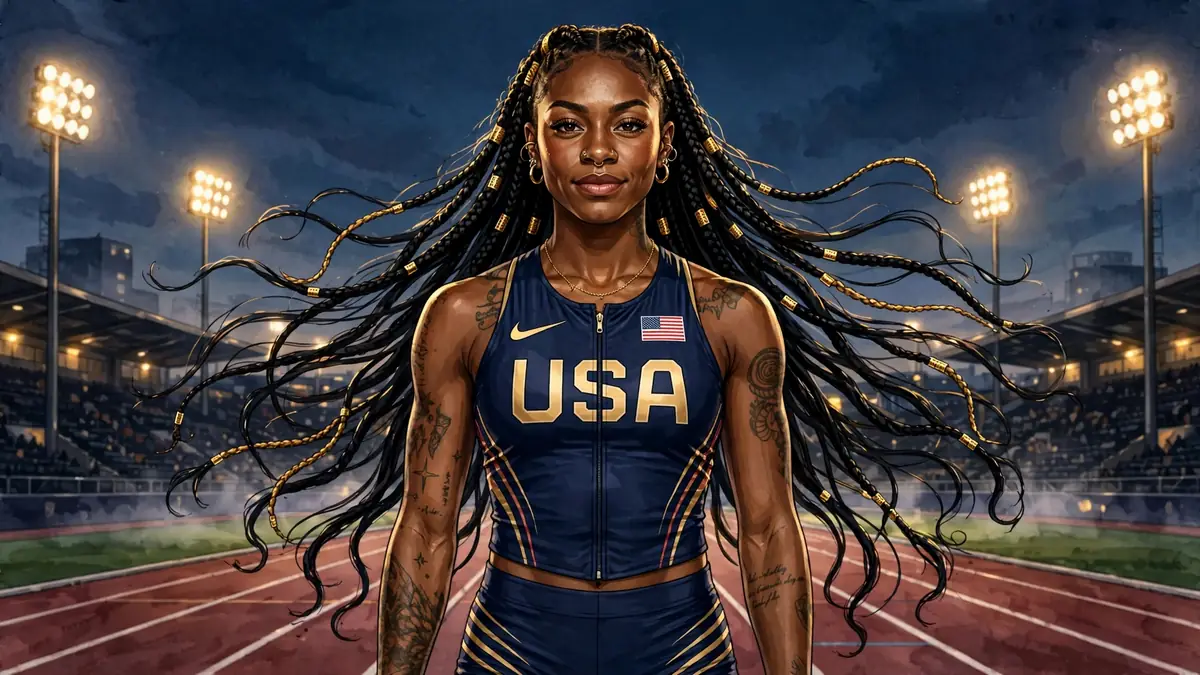
Sha’Carri Richardson is 26 years old. She was born on March 25, 2000, in Dallas, Texas, and her 26th birthday fell on March 25, 2026. Count it out and the maths is plain: 2026 minus 2000 is 26, and because her birthday comes in March, she has been 26 for most of the calendar year. As of November 15, 2026, she is 26 years and about seven and a half months old, with her 27th birthday coming on March 25, 2027.
Some older web pages still list her as 25. Those pages were written in 2025, before her March 2026 birthday, and their figures have simply gone stale. A few low-quality biography sites even carry conflicting numbers on the same page, calling her 25 in one paragraph and 26 in another. The primary sources agree with each other: World Athletics, the sport’s global governing body, lists her birth date as 25 March 2000 and her current age as 26, and her Wikipedia profile records the same date of birth. When a reader sees 25 on a page that has not been updated since early 2026, the page is out of date, not the birth certificate.
Her age also explains a detail fans notice every time she lines up. At 5 ft 1 in (155 cm), Richardson is one of the shortest elite sprinters in the world, and her stride pattern and start have always looked different from the long-limbed sprinters around her. Sha’Carri Richardson’s height of 5 ft 1 in has never held her back: her 10.65-second personal best, set when she won the 2023 world title, is the joint fifth-fastest time ever run by a woman over 100 metres. Short sprinters with fast turnover have a long history in the event, and Richardson is the latest proof that top-end speed is about power and rhythm, not height.
She belongs to Generation Z, and she is an Aries by zodiac sign, born in the first days of spring. That generational tag matters to her public image. Richardson came of age on social media, built a following of millions before she won a global title, and speaks to her audience directly on Instagram, where she posts under the handle @itsshacarri. Her fame has never been only about times on a clock. The coloured hair, the long nails, the tattoos and the unfiltered interviews are part of why a 26-year-old track athlete is one of the most talked-about sportspeople in America.
The short answer: Sha’Carri Richardson was born March 25, 2000. She is 26 years old in 2026 and turns 27 on March 25, 2027.
Sha’Carri Richardson’s Age at Every Career Milestone
One of the best ways to understand an athlete is to line up her age against her results. Richardson’s career has moved fast, and almost every chapter of it arrived earlier than it does for most sprinters. The table below sets out what she did at each age, from a teenage record-breaker to a 26-year-old world-class veteran of three global championships.
| Age | Year | Milestone |
|---|---|---|
| 15–16 | 2015–2016 | Emerges as a youth sprint talent in Texas; wins age-group honours while at David W. Carter High School in Dallas. |
| 17 | 2017 | Wins the 100m at the Pan American U20 Championships in Peru. |
| 18 | 2018–2019 | Joins Louisiana State University (LSU) and begins competing in the NCAA. |
| 19 | 2019 | Breaks the 100m collegiate record with 10.75 seconds at the NCAA Championships in Austin; also wins the 200m. Turns professional and signs with Nike days later. |
| 20 | 2020 | First full professional season, disrupted by the COVID-19 pandemic; runs 10.95 seconds in her early races as a pro. |
| 21 | 2021 | Wins the US Olympic Trials 100m in 10.86 seconds, then receives a 30-day suspension after a positive test for marijuana and misses the Tokyo Olympics. |
| 22 | 2022 | Returns to competition; reaches the US Championships 100m final but misses the World Championships team. |
| 23 | 2023 | Wins the World Championships 100m gold in Budapest in a championship-record 10.65 seconds, takes 200m bronze and anchors the 4x100m relay to gold. |
| 24 | 2024 | Wins Olympic silver in the 100m and anchors the United States to 4x100m relay gold at the Paris Olympics. |
| 25 | 2025 | Finishes fifth in the 100m at the Tokyo World Championships, then anchors the US 4x100m relay team to gold in 41.75 seconds in the rain. |
| 26 | 2026 | Opens the season by winning the Stawell Gift 120m handicap in Australia in April, becoming only the third woman to win the race from scratch. |
Two things stand out from that timeline. First, her peak arrived at 23 and 24, which is right in the normal prime window for a female sprinter. Most women run their fastest 100m times between 23 and 28, and Richardson’s personal best of 10.65 seconds came at 23. Second, her career has never followed a smooth line. The suspension at 21 cost her an Olympic cycle, and the injury-hit season at 25 cost her an individual medal at the Tokyo World Championships. Yet she has answered every setback with a relay gold, which is why her medal record reads far better than her individual results alone suggest.
Age also frames the road ahead. At 26, she is younger than Shelly-Ann Fraser-Pryce was when the Jamaican great won her last world title, and younger than Florence Griffith Joyner was when she set the still-standing world record of 10.49 seconds at 28 in 1988. The 2027 World Championships in Beijing and the 2028 Los Angeles Olympics sit directly in front of her: she will be 27 in Beijing and 28 in Los Angeles, which is historically the age at which elite women sprinters post some of their best times. If her body holds up, the age-26 season now under way could be the start of a second peak rather than the tail of the first.
Early Life and Background in Dallas
Sha’Carri LaNay Richardson was born on March 25, 2000, in Dallas, Texas, and raised in the city by her grandmother, Betty Harp, and her aunt, Shayaria Richardson. Her grandmother was the steady centre of her childhood. Richardson has spoken often about how Betty Harp raised her, drove her to practice, and kept her grounded while the talent around her became obvious to everyone else. The family story is complicated: her biological mother, also named Shayaria Richardson, was largely absent from her daily life, and Richardson grew up calling her grandmother and her aunt her mothers in every way that counted.
Dallas shaped her as a sprinter. Texas high-school track is one of the toughest proving grounds in American sport, and Richardson ran for David W. Carter High School, where her speed marked her out early. She won state honours as a teenager and earned a place on the United States team for the 2017 Pan American U20 Championships in Trujillo, Peru, where she won the 100m at 17. By the time she finished high school, college recruiters across the country wanted her, and she chose Louisiana State University in Baton Rouge, a school with one of the deepest sprint traditions in the NCAA.
Her childhood was not easy, and she has never hidden that. She has talked about growing up without her biological mother close by, about the pressure of being the fastest girl in every race she entered, and about learning to carry attention that arrived long before she was ready for it. That background is part of why her public story reads as a comeback tale as much as a sports story. The girl from Dallas who was raised by her grandmother became, within a few years, the most famous sprinter in America, and the road between those two points ran through loss, discipline and a suspension that could have ended her career.
Education stayed part of the plan even as her running took over. She enrolled at LSU in 2018, and her single year there produced one of the most famous days in college sprinting history. She left the university after her freshman year to turn professional, a decision that made sense given the Nike contract waiting for her, but the LSU chapter is the foundation of everything that followed: it was there, under coach Dennis Shaver, that she learned to run rounds, handle championship pressure and produce her best when the season was on the line.
LSU and the Breakthrough at 19
On June 8, 2019, at the NCAA Division I Outdoor Championships in Austin, Texas, a 19-year-old freshman did something no college woman had ever done. Richardson ran 10.75 seconds in the 100m final, breaking the collegiate record and completing a sprint double by winning the 200m in 22.17 seconds later the same day. Her 10.75 made her one of the ten fastest women in history at 19 years old, and it was the fastest time ever run by anyone under the age of 20. The performance announced her to the world in a single afternoon.
The double was remarkable for more than the times. Running two finals on the same day at a championship, against older athletes, demands recovery and nerve as well as speed. Richardson had both. She beat a field that included future Olympians, and she did it with the long hair, long nails and loud confidence that would become her signature. Television cameras loved her, and within days she was the most talked-about new name in American track.

Days after the NCAA Championships, she turned professional and signed with Nike. The deal made her one of the most marketable young athletes in the sport before she had run a single race as a professional. Nike saw what the times said: a 19-year-old who could already run 10.75 seconds, with a look and a voice that cut through on social media. The reported value of that first professional contract has never been confirmed by either side, and later reports of a much larger Nike deal, said to be worth 20 million dollars over five years, remain unconfirmed too. What is certain is that Nike has been her main sponsor from the start of her professional career to the present day.
Her first professional season in 2020 was cut short by the COVID-19 pandemic, which cancelled most of the year’s meetings. She still ran 10.95 seconds in her early races as a pro, showing that the college times were no one-off. By 2021, at 21, she was ready for the Olympic Trials, and the year that followed would define her public image for the next four years.
The 2021 Suspension and the Long Road Back
The 2021 season began with triumph and ended with the lowest point of Richardson’s career. In June 2021, at 21, she won the US Olympic Trials 100m in Eugene, Oregon, in 10.86 seconds, and she did it with a flair that lit up the sport: she pointed at the clock, celebrated before the line, and spoke openly in interviews about running for her family. A week before the trials, she had learned that her biological mother had died, and she has said since that she used marijuana to cope with the grief. The news reached her from a reporter, days before the biggest race of her life.
After the trials, her urine sample tested positive for THC, the active compound in marijuana. The United States Anti-Doping Agency handed her a 30-day suspension, and because the suspension covered the Olympic Games, she missed the Tokyo Olympics entirely. Her trials win was wiped from the books, and the American team went to Tokyo without its fastest woman. Richardson accepted the suspension and took responsibility in public, saying she was human and that she had made a mistake while grieving.
The reaction split the sport. Some argued the marijuana rule was outdated and that a 30-day ban for a substance that does not improve sprinting was harsh. Others said the rules were the rules and every athlete knew them. President Joe Biden commented on the case, and the debate reached well beyond track and field. For Richardson, the practical effect was simple and brutal: at 21, the age when most sprinters make their Olympic debut, she watched the Games from home.
The comeback took two full years. In 2022, at 22, she returned to racing but struggled for consistency, reaching the US Championships 100m final without making the World Championships team. Her times were good but not at her 2019 level, and critics wondered whether the 10.75 freshman had been a peak rather than a beginning. She changed parts of her training setup, kept working with her team, and kept her head down through a season that offered little public reward. The patience paid off in 2023, when she arrived at the World Championships in Budapest as a genuine contender rather than a curiosity.
World Champion at 23: Budapest 2023
August 2023, in Budapest, was the month Richardson became the fastest woman in the world. At 23, she won the World Championships 100m final in 10.65 seconds, a championship record and a personal best by a full tenth of a second. She beat a field that included Jamaica’s Shericka Jackson and Shelly-Ann Fraser-Pryce, the two women who had dominated the event for years, and she did it from lane nine, the outside lane, after a slow start that left her chasing the field for the first 40 metres. Her closing speed over the final stretch was the fastest of the night, and she leaned at the line to take gold by a margin so small the photo finish was needed.
The win was the centrepiece of a three-medal championships. She took bronze in the 200m in 21.94 seconds, behind Jackson’s championship-record run, and then anchored the United States 4x100m relay team to gold in 41.03 seconds. Three medals at a single World Championships is a rare haul for a sprinter, and it made her the star of the American team in Budapest. Her full career story, from the Dallas schoolgirl to the world champion, is set out in detail in Sha’Carri Richardson’s biography on GuideNetWorth, which covers the comeback years and the Budapest breakthrough in full.
Budapest changed her earning power as well as her reputation. World champions command higher appearance fees on the Diamond League circuit, bigger bonuses from sponsors and more commercial work. World Athletics pays a 50,000-dollar bonus for an individual world title, and the relay gold added to that. More valuable than the prize money was the shift in how brands saw her: she was no longer the athlete famous for a suspension, but the reigning world 100m champion, and the endorsement work that followed reflected that change.
She was 23 when she won in Budapest, which is worth remembering when people ask how old she is now. The world title came three years ago, and she has been at or near the top of the sport ever since. Sprinters who win a world title at 23 usually have several more years at the top, and Richardson’s age in 2026, 26, still sits inside the prime window for the women’s 100m.
Paris 2024: Olympic Silver and Relay Gold at 24
The Paris Olympics in August 2024 gave Richardson, at 24, the Olympic medals that had eluded her three years earlier. In the 100m final at the Stade de France, she took silver in 10.87 seconds behind Julien Alfred of Saint Lucia, who won in 10.72 seconds. Richardson’s start was slow, as it often is, and Alfred’s lead was too big to close over the final 30 metres. Silver was still a major result: it made her an Olympic medallist at her first Games, and it came against a field that included the fastest women of the season.
The relay, four days later, was the race that defined her Olympics. Running the anchor leg for the United States, Richardson took the baton and powered down the home straight to win gold for the American team in 41.78 seconds, ahead of Great Britain and Germany. It was the first Olympic gold of her career, and it arrived in the role she has made her own: the anchor, the closer, the runner a team trusts when the race is on the line. The United States has a long history of relay success, and Richardson’s leg in Paris was one of the fastest anchor runs of the night.
Olympic medals carry money as well as prestige. Team USA pays standard bonuses to its medallists, 37,500 dollars for a gold medal and 22,500 dollars for a silver, so her Paris haul was worth 60,000 dollars in bonuses alone. The real value of an Olympic medal is commercial: a gold medallist can ask for more in every negotiation that follows, from shoe contracts to television work. Richardson’s profile rose sharply after Paris, and her social media following grew past the point where she was a track star and into the space where she is a mainstream celebrity.
Paris also settled the question of whether she could perform on the biggest stage. The 2021 suspension had left a gap in her record: a world champion who had never run at an Olympics. At 24, she filled that gap with two medals, and she did it in the same stadium where she had watched the 2023 world title race from the stands as a spectator years earlier. The arc from the missed Tokyo Games to the Paris podium took three years, and it is the spine of her career story.
Tokyo 2025 and the 2026 Season at 26
The 2025 season, Richardson’s age-25 year, was the hardest of her career since the suspension. An injury-hit build-up left her short of races, and she finished fifth in the 100m final at the World Championships in Tokyo in September 2025, well behind the winner, Melissa Jefferson-Wooden. She also withdrew from the 100m semi-finals at the US Championships earlier that summer, a decision that drew attention because it came days before her arrest at Seattle-Tacoma International Airport, covered in detail below.
Yet the Tokyo World Championships still ended in gold. On the final night, September 21, 2025, Richardson anchored the United States women’s 4x100m relay team to victory in 41.75 seconds in pouring rain, holding off Jamaica’s Jonielle Smith down the home straight by four hundredths of a second. She took the baton from Kayla White trailing by a hundredth of a second and built a lead of her own over the final 60 metres. It was her third consecutive global relay gold as anchor, after Budapest 2023 and Paris 2024, and it closed a championships that had been, in her own words reported by the Associated Press, “far from perfect”. Her relay teammates that night were Melissa Jefferson-Wooden, Twanisha Terry and Kayla White, and the win came on the same evening that Noah Lyles anchored the American men to relay gold. Noah Lyles’ height of 5 ft 11 in makes him a full ten inches taller than Richardson, yet the two of them closed out the same championships with the same job: bring the baton home first.
The 2026 season opened with a surprise. In April 2026, at 26, Richardson travelled to Australia and won the Stawell Gift, the famous 120-metre handicap race run on grass in the town of Stawell, Victoria. She won from scratch, meaning she started level with the back marker and gave every other runner a head start, becoming only the third woman in the race’s 144-year history to win it that way. The win, reported in April 2026, was her first race of the season and a statement that the injury troubles of 2025 were behind her. It also showed her range: the Stawell Gift is run over 120 metres on grass, a very different test from a championship 100m on a synthetic track.
What comes next at 26 is the question that will shape her legacy. The 2026 season has no Olympic Games and no outdoor World Championships, which makes it a building year: Diamond League meetings, the US Championships and the chance to post fast times without championship pressure. The real targets are 2027, when the World Championships go to Beijing and she will be 27, and 2028, when the Olympics come to Los Angeles and she will be 28, running a home Games in the prime of her career. Sprinters rarely get a home Olympics at their peak. Richardson will.

What Sha’Carri Richardson Is Worth at 26
Sha’Carri Richardson’s net worth in 2026 is estimated at 4 million dollars, according to Celebrity Net Worth as reported by Parade in its January 2026 profile of her finances. Other published estimates put the figure lower or higher: some outlets list 3 million dollars, while a few list 5 million dollars. The honest reading of the sources is a range of 3 million to 5 million dollars, anchored at 4 million by Celebrity Net Worth, which is the most widely cited tracker of celebrity wealth and the source Parade relied on for its 2026 figure.
That number surprises people who assume an Olympic champion must be far richer. Track and field pays far less than football, basketball or tennis, and Richardson’s wealth comes almost entirely from endorsements rather than from racing itself. Parade reported that her earnings from sprinting alone are typically 45,000 to 55,000 dollars a year, a modest sum for an athlete of her standing. The money that built her net worth came from Nike and the brand deals that followed her fame, not from prize money at meets.
Her wealth has grown steadily rather than in jumps. At 19, she had a first Nike contract and little else. At 23, after the Budapest world title, her market value rose sharply. At 24, the Paris Olympic medals pushed it higher again. At 26, with three global relay golds, an individual world title and an Olympic silver on her record, the 4-million-dollar estimate reflects a career that has earned its money through sustained excellence and a public profile that reaches well beyond athletics. The range matters: net worth figures for private individuals are estimates built from public deals, prize money and property records, and the true number is known only to Richardson and her advisers.
| Year | Age | Estimated Net Worth | What Drove It |
|---|---|---|---|
| 2019 | 19 | Under 1 million dollars | First Nike contract after the NCAA record; no major titles yet. |
| 2021 | 21 | About 1 million dollars | Trials win raised her profile, but the suspension froze her earnings. |
| 2023 | 23 | About 2–3 million dollars | Budapest world title, three medals, new endorsement work. |
| 2024 | 24 | About 3–4 million dollars | Paris Olympic silver and relay gold; Olympic bonuses and bigger deals. |
| 2025 | 25 | About 4 million dollars | Tokyo relay gold; endorsement portfolio holds despite an injury-hit year. |
| 2026 | 26 | About 4 million dollars | Stawell Gift win; portfolio stable; range across sources 3–5 million dollars. |
The table above is an estimate built from the published figures, not a set of audited accounts. Richardson has never disclosed her finances, and no outlet has seen her contracts. The pattern, though, is consistent across every source that tracks her: slow growth through her teens, a sharp rise after Budapest, and a plateau around 4 million dollars in 2025 and 2026. If she wins an individual global title again at 27 or 28, the number should climb. If she does not, her endorsement income is likely to hold her near the current level for several more years.
How She Earns Her Money
Endorsements are the engine of Richardson’s income, and Nike is the biggest part of it. She has been a Nike athlete since she turned professional in 2019, and she is the face of the brand’s collaboration with French fashion designer Simon Porte Jacquemus, the Nike x Jacquemus Spring 2024 collection. Parade reported that her Nike deal is rumoured to be worth 20 million dollars over five years, while stressing that the figure has never been confirmed by Nike or by Richardson. Treat that number with care: it is a widely repeated report, not a verified contract value. Even if the true figure is far lower, a multi-year Nike deal is the single largest source of her income, and it is the deal every other brand partnership sits alongside.
The rest of her portfolio is broad. Parade lists endorsements with Android, Beats by Dre, Oikos, Olay and Sprite, and other outlets add Apple Music and Danone to the list. These are the kind of deals that pay a sprinter far more than racing does: a headphones campaign, a yoghurt advert, a skincare partnership and a soft-drink deal each pay a fee that dwarfs a season of prize money. Her image is the product in these deals. The coloured hair, the nails and the confidence that made her famous at 19 are exactly what brands pay for, and she has kept that image consistent through every phase of her career.
Racing income is real but smaller. Diamond League meetings pay appearance fees to star athletes and prize money to winners, and World Athletics pays a 50,000-dollar bonus for an individual world title. Team USA’s standard Olympic bonuses added 60,000 dollars for her Paris medals. Appearance fees for a world champion at a big meeting can run into five figures per race, and a full Diamond League season of six to eight meetings can add up to a solid six-figure sum. None of that matches the endorsement money, which is why her net worth tracks her fame more closely than her times.
Media and public appearances add a further stream. She has appeared in campaigns, interviews and television features that pay appearance fees, and her social media presence, with millions of followers, has commercial value of its own. She has not launched a business of her own in the way some athletes do, and there is no public record of her investing in startups or property beyond her home. Her income, in short, is the classic modern sprinter’s mix: one big shoe deal, a spread of brand partnerships, and race earnings that reward performance without ever matching the endorsement money.
Home, Cars and Lifestyle
Richardson lives in Clermont, Florida, in a home that MansionsRadar reported in September 2026 to be worth about 605,000 dollars, having earlier put the figure at 580,000 dollars. The house is in Central Florida, close to the training facilities that drew her to the state, and it is a modest home by celebrity standards: a comfortable family house rather than a mansion. That fits the rest of her financial picture. Her net worth is built on endorsements, not property, and her home is the only major asset that has been publicly reported.
Her cars have drawn more attention than her house. In January 2026 she was stopped in Orange County, Florida, while driving at more than 100 miles per hour in a 65 mph zone, an incident covered in the legal section below. Reports of the stop described her car as a luxury vehicle, and she has been photographed with high-end cars before. Beyond that, there is no reliable public record of a car collection or of other major purchases, and this article does not guess at them. What is known is that she spends visibly on her image: the hair, the nails and the outfits that are part of her brand are a working cost for an athlete whose look is part of her income.
Her lifestyle is public in a way few athletes’ lives are. She posts training clips, fashion shots and personal reflections on Instagram, and she has spoken openly about therapy, growth and accountability after the incidents of 2025 and 2026. She does not present herself as a private person who happens to run fast. She is a public figure who runs fast, and her lifestyle, her style and her words are part of the package her sponsors pay for. At 26, she is old enough to have learned what that attention costs and young enough to still be building the career that pays for it.
How Her Age Compares With Other Sprint Greats
Age means more in sprinting than in almost any other sport, because the window for peak speed is narrow. Richardson’s age of 26 puts her in the middle of that window, and a look at the ages of other greats shows how much road she still has. The table below compares her with the athletes whose careers frame her own: a fellow American star, the fastest man who ever lived, and the most decorated swimmer in Olympic history.
| Athlete | Born | Age in 2026 | Peak-Age Note |
|---|---|---|---|
| Sha’Carri Richardson | March 25, 2000 | 26 | World 100m champion at 23; Olympic medals at 24. |
| Simone Biles | March 14, 1997 | 29 | Won three Olympic golds in Paris at 27, after a comeback many thought impossible. |
| Usain Bolt | August 21, 1986 | 40 | Won his last Olympic golds at 29 in Rio 2016 and retired at 30. |
| Michael Phelps | June 30, 1985 | 41 | Won his last Olympic gold at 31 in Rio 2016 and retired after 28 Olympic medals. |
| Noah Lyles | July 18, 1997 | 29 | Won Olympic 100m gold at 27 in Paris 2024. |
Simone Biles’ age is the most encouraging comparison for Richardson. Biles, born March 14, 1997, is 29 in 2026, and she won three gold medals at the Paris Olympics at 27 after stepping away from the sport for two years. Her comeback showed that an athlete can return from a public struggle, at an age when many assume the best years are gone, and perform better than ever. Richardson’s own story has the same shape: a public fall, a return, and medals won after it. Biles did it at 27. Richardson, at 26, has time to do the same.
Usain Bolt’s age tells a different story. Bolt, born August 21, 1986, is 40 in 2026, and he won his last Olympic golds at 29 in Rio de Janeiro before retiring at 30. His peak ran from 22 to 29, and he was still the fastest man alive at 29. The lesson for Richardson is that sprinters can stay at the top into their late twenties, but the decline, when it comes, is usually quick. She has perhaps three or four seasons left at her very best, and the 2027 and 2028 championships are the ones that will define her career.
Michael Phelps’ age offers the longevity extreme. Phelps, born June 30, 1985, is 41 in 2026, and he won his final Olympic gold at 31, in Rio 2016, before retiring with 28 Olympic medals. Swimming and sprinting reward different things, and Phelps’s career lasted longer than any sprinter’s can, but the point stands: the greatest athletes in speed sports tend to peak in their mid-to-late twenties and then choose their exit. Richardson, at 26, is at the age when the greats start counting down to their final championships rather than counting up from their first.
Within her own event, the comparisons are just as instructive. Florence Griffith Joyner set the world record of 10.49 seconds at 28 in 1988. Shelly-Ann Fraser-Pryce won her first world 100m title at 22 in 2009 and her last at 35 in 2022, a span of 13 years that no other woman sprinter has matched. Elaine Thompson-Herah won Olympic 100m gold at 24 in Rio 2016 and again at 29 in Tokyo 2021. Richardson’s 10.65 at 23 puts her in that company, and her age in 2026 leaves room for a second act that could match any of them.
Personal Life and Relationships
Richardson’s personal life has been public since she was a teenager, and she has spoken about it with unusual openness for an athlete. She was raised by her grandmother Betty Harp and her aunt Shayaria Richardson in Dallas, and she has described her grandmother as the person who made her career possible. Her biological mother, Shayaria Richardson, died in 2021, a week before the Olympic Trials, and Richardson has said the loss shaped everything that followed that summer. She has also spoken about her sexuality, saying in interviews that she is open about who she is, and about the importance of family, faith and therapy in her life.
Her best-known relationship is with fellow American sprinter Christian Coleman, the 2019 world 100m champion and the world record holder over 60 metres indoors. The two have been together since 2023, and their relationship has been covered widely, from joint appearances at fashion events to the difficult episode at Seattle airport in July 2025. They are not married, and as of 2026 there is no public record of an engagement. Reports in early 2026 described them as still together and working on their relationship after the events of 2025, and Richardson has posted publicly about accountability and growth in the months since. More stories about athletes’ lives off the track can be found in our Personal Life section.
Off the track, Richardson’s interests are fashion, music and social media. She has walked in fashion-week events, worked with designers through her Nike partnerships, and built an Instagram following that runs into the millions. She is known for her ever-changing hair colours, her long nails and her tattoos, all of which are part of a look she has cultivated since high school. The look is deliberate: in a sport where athletes are often hard to tell apart, Richardson is instantly recognisable, and that recognition is worth money.
She has also used her platform to talk about mental health. After the 2021 suspension she spoke about grief and coping, and after the 2025 airport incident she posted about taking responsibility and doing the work to grow. She has mentioned therapy and self-reflection in her public posts, and she has framed her comeback not only as a sporting story but as a personal one. At 26, she presents herself as someone still learning, and her audience, much of it young, responds to that honesty as much as to the medals.
Legal Troubles in 2025 and 2026
Any honest account of Richardson’s age-25 and age-26 years has to include her legal troubles, because they are part of the public record and they shaped her 2025 and 2026 seasons. This section reports what happened, as documented by police reports and court records cited by major outlets, without taking sides and without repeating rumour.
On July 27, 2025, Richardson was arrested at Seattle-Tacoma International Airport after an altercation with her boyfriend, Christian Coleman, at a security checkpoint. Port of Seattle police charged her with fourth-degree domestic violence assault, a misdemeanour in Washington state, and she was held for about 19 hours at the South Correctional Entity jail in Des Moines, Washington, before being released the next day. Coleman declined to press charges and told police he did not want to be considered a victim, and early reports said the case had been cleared. Richardson later addressed the incident on social media, taking responsibility for her part in it.
The case did not end there. In December 2025, Richardson and the City of SeaTac agreed to a two-year stipulated order of continuance, a legal arrangement under which the prosecution is postponed and the charge is dropped if the defendant meets agreed conditions over two years. The conditions reported by LetsRun, which obtained the court order, were: commit no new criminal law violations, complete 20 hours of community service, undergo domestic violence moral reconation therapy, and have no hostile contact with Coleman. The agreement was dated December 23, 2025, when Richardson was 25.
On January 29, 2026, 37 days after that agreement, Richardson was arrested again, this time in Orange County, Florida, and charged with dangerous excessive speeding after being clocked at more than 100 miles per hour in a 65 mph zone. She was held on 500 dollars bail and later pleaded not guilty, with a pre-trial hearing scheduled for April 16, 2026, in Orlando. Reporting in 2026 noted that a new criminal charge could put the SeaTac agreement at risk, since its first condition is to commit no new violations. As of the date this article was written, the Florida case had not been finally resolved in the public record, and this article will not guess at its outcome.
These episodes matter to the age story because they arrived at the exact moment her career should have been consolidating. She was 25 at the Seattle arrest and 25, weeks from 26, at the Florida arrest. She still won relay gold in Tokyo between the two incidents and won the Stawell Gift weeks after the Florida arrest, which says something about her ability to perform under pressure. But the legal record is now part of her biography, and any reader who searches her name will find it. This article reports it plainly, with dates, charges and outcomes as documented, and leaves judgement to the courts.
Frequently Asked Questions
How old is Sha’Carri Richardson?
Sha’Carri Richardson is 26 years old in 2026. She was born on March 25, 2000, in Dallas, Texas, and turned 26 on March 25, 2026. World Athletics lists her birth date as 25 March 2000 and her age as 26.
When is Sha’Carri Richardson’s birthday?
Sha’Carri Richardson’s birthday is March 25, 2000. She celebrates it on March 25 each year and will turn 27 on March 25, 2027. Her zodiac sign is Aries, and she was born in Dallas, Texas.
How old was Sha’Carri Richardson when she won the world championship?
Sha’Carri Richardson was 23 years old when she won the World Championships 100m gold in Budapest in August 2023. She ran 10.65 seconds, a championship record, and also won 200m bronze and 4x100m relay gold at the same championships.
How old was Sha’Carri Richardson at the Paris Olympics?
Sha’Carri Richardson was 24 years old at the Paris Olympics in August 2024. She won silver in the 100m in 10.87 seconds and anchored the United States to gold in the 4x100m relay in 41.78 seconds.
How tall is Sha’Carri Richardson?
Sha’Carri Richardson is 5 ft 1 in tall (155 cm). She is one of the shortest elite sprinters in the world, and her height has never stopped her from running 10.65 seconds over 100 metres.
What is Sha’Carri Richardson’s net worth in 2026?
Sha’Carri Richardson’s net worth in 2026 is estimated at 4 million dollars, according to Celebrity Net Worth as reported by Parade. Published estimates range from 3 million to 5 million dollars. Her income comes mainly from her Nike deal and brand partnerships, with prize money and appearance fees adding to it.
Is Sha’Carri Richardson married?
No, Sha’Carri Richardson is not married as of 2026. She is in a relationship with fellow American sprinter Christian Coleman, the 2019 world 100m champion. There is no public record of an engagement.
What is Sha’Carri Richardson doing in 2026?
At 26, Sha’Carri Richardson opened her 2026 season by winning the Stawell Gift 120m handicap in Australia in April 2026, becoming only the third woman to win the race from scratch. She is building toward the 2027 World Championships in Beijing, where she will be 27, and the 2028 Los Angeles Olympics, where she will be 28.
Final Thoughts
Sha’Carri Richardson is 26 years old, born March 25, 2000, in Dallas, Texas, and at 26 she has already lived several sporting lives. She was a teenage record-breaker at 19, a suspended star at 21, a world champion at 23, an Olympic medallist at 24, a relay anchor who saved her country’s championships at 25, and a winner of one of the oldest races in the sport at 26. Few athletes pack that much into seven years, and fewer still do it in public, with every setback and every comeback playing out in front of millions of people.
Her age is the key to what comes next. At 26 she sits inside the prime window for a woman sprinter, with a home Olympics in Los Angeles waiting at 28 and a World Championships in Beijing at 27. The 4-million-dollar net worth, the Nike deal and the fame are all built on what she does on the track, and the track still has room for her to add the one thing missing from her record: an individual Olympic gold. If she wins it in Los Angeles, the story that began in Dallas in 2000 will have its perfect ending. If she does not, she will still retire as one of the fastest women who ever lived, and one of the most talked-about athletes of her generation.
Sources and Reporting
How we estimated: Richardson’s age is a matter of public record. Her date of birth, March 25, 2000, is listed by World Athletics and on her Wikipedia profile, and her age in 2026 follows from simple arithmetic. Her net worth is an estimate, not a disclosed figure: Celebrity Net Worth puts it at 4 million dollars, as reported by Parade in January 2026, while other outlets publish figures from 3 million to 5 million dollars, so this article anchors at 4 million and states the range. The reported Nike deal value of 20 million dollars over five years is unconfirmed and is presented as a report, not a fact. Prize money, bonuses and property values are taken from the outlets named below. Where sources disagreed, this article says so rather than picking the most flattering number.
Named sources consulted for this article include World Athletics, Olympics.com, Wikipedia, Parade, Celebrity Net Worth, ESPN, Associated Press, Team USA and USA Track and Field. Specific reporting relied on includes Parade’s January 2026 net worth profile, the Associated Press report on the Tokyo 2025 World Championships relay finals, LetsRun’s reporting on the December 2025 stipulated order of continuance, and the International Business Times report on the April 2026 Stawell Gift win. Figures are dated where known; estimates may differ from private reality, and this page will be updated as new verified information appears.