Last updated: November 13, 2026. By Celebamerica Editorial Staff.
Michael Phelps is 41 years old in 2026. He was born Michael Fred Phelps II on June 30, 1985, in Baltimore, Maryland, and he turned 41 on June 30, 2026. His next birthday falls on June 30, 2027, when he will turn 42. That single date explains a career that still has no equal in Olympic history: Phelps made his first Olympic team at 15, won his first gold medals at 19, swept eight golds at 23, and closed his competitive career at 31 in Rio de Janeiro with 28 Olympic medals, 23 of them gold.
The age question keeps coming up because Phelps packed five Olympic Games into 16 years, retired twice, and stayed famous for a full decade after his last race. Fans who watched him as a teenager in Sydney now watch him as a father of four, a broadcaster, and a mental-health advocate. This page answers the age question in full: his exact birthdate, his age at every Olympic Games, a year-by-year timeline, what his life looks like at 41, and how his age compares with the other great Olympians of his era.
| Full Name | Michael Fred Phelps II |
|---|---|
| Date of Birth | June 30, 1985 |
| Age in 2026 | 41 years old (turned 41 on June 30, 2026) |
| Birthplace | Baltimore, Maryland, United States |
| Height | 6 feet 4 inches (193 cm) |
| Estimated Net Worth | About $100 million in 2026, per Celebrity Net Worth; some outlets put the figure closer to $80 million, so a fair range is $80 million to $100 million |
| Olympic Record | 28 medals — 23 gold, 3 silver, 2 bronze — across five Games, 2000 to 2016 |
| Primary Income Sources | Endorsements, his MP swimwear brand, media and broadcasting work, speaking, and business investments |
| Spouse | Nicole Johnson Phelps (married 2016) |
| Children | Four sons: Boomer, Beckett, Maverick, and Nico |
| Retired | After the Rio 2016 Olympics, aged 31 |
Contents
- How Old Is Michael Phelps in 2026?
- Michael Phelps Birthday and Birthplace
- Michael Phelps Age at Every Olympics
- Growing Up in Baltimore
- The Teenage Prodigy Years
- Beijing 2008: Age 23, Eight Gold Medals
- London 2012 and the First Retirement
- Rio 2016: Age 31, the Final Games
- Life After Swimming at 41
- Michael Phelps Family and Children
- Michael Phelps Net Worth at 41
- How Michael Phelps Age Compares to Other Olympians
- Michael Phelps in 2026
- Michael Phelps Age FAQs
- The Bottom Line on Michael Phelps Age
- Sources and Reporting
How Old Is Michael Phelps in 2026?
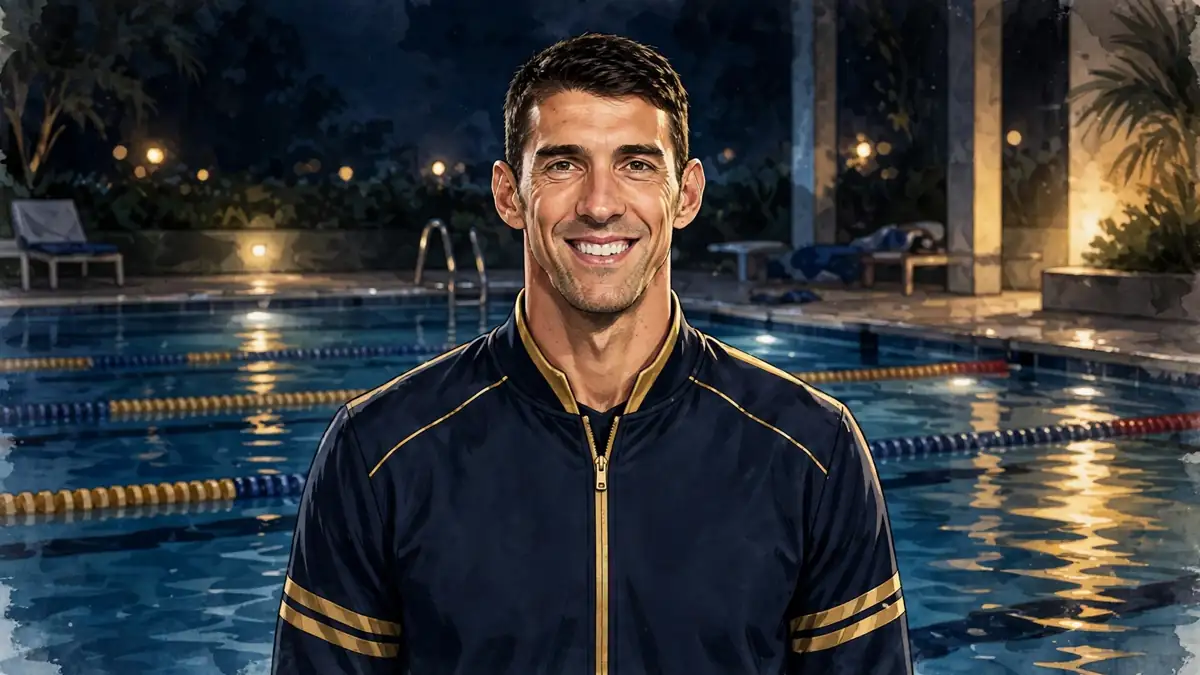
Michael Phelps is 41 years old in 2026. The maths is simple and it never changes: born June 30, 1985, he turned 40 in June 2025 and 41 in June 2026. Anyone searching for his age in November 2026 gets the same answer, because his birthday has already passed for the year. He will stay 41 until June 30, 2027, when he turns 42.
That puts him ten years past his last Olympic race. Phelps retired after Rio 2016 at 31, so by 2026 he has spent almost a third of his life as a retired athlete. The gap matters for how people read his age. A 41-year-old former swimmer is not an old man by any normal measure, yet in Olympic swimming, where most male stars peak in their early twenties and retire before 30, 41 feels like a different lifetime. Phelps himself has leaned into that gap. In a May 2026 CNN interview he talked about water safety and mental health as the two causes that now define him, and he described his post-swimming life as a second career built on the same discipline that carried him through five Games.
His zodiac sign is Cancer, for readers who track that detail, and his birthstone is the pearl. Neither fact changes the record, but both show up often enough in age searches that they are worth a line. What changes the record is the span: 15 when he first stood on an Olympic pool deck, 19 when he first stood on top of the podium, 23 when he did something no Olympian had ever done, 27 when he became the most decorated Olympian ever, and 31 when he walked away with the record sealed at 28 medals.
Age at a glance: Born June 30, 1985 — 41 in 2026, 42 on June 30, 2027. First Olympics at 15 (Sydney 2000), last Olympics at 31 (Rio 2016), retired for ten years by the end of 2026.
Michael Phelps Birthday and Birthplace
Michael Fred Phelps II was born on June 30, 1985, in Baltimore, Maryland. He grew up in Rodgers Forge, a neighbourhood in Towson, just north of the city, as the youngest of three children of Fred Phelps, a Maryland state trooper, and Debbie Phelps, a middle-school principal. His older sisters, Whitney and Hilary, both swam competitively, and the family pool was a normal part of childhood long before anyone talked about world records.
Baltimore shaped him in ways that still show in his adult life. He learned to swim at the North Baltimore Aquatic Club, trained under coach Bob Bowman from the age of 11, and stayed loyal to that club and that coach through his whole career. Bowman coached him at every Olympic Games, and the two later worked together again in Arizona after Phelps moved his training base there. When Phelps talks about home now, he talks about Baltimore with the same warmth he brings to his foundation work, and his water-safety programmes have always carried a strong Baltimore thread.
His birthday, June 30, sits in the middle of the summer swimming season, which meant that for most of his career his birthday fell during heavy training or competition. In June 2026 he marked his 41st birthday with a round of golf and dinner with friends, including the late NBC broadcaster Dan Hicks, a close friend whose calls had soundtracked Phelps’s Olympic races. Hicks died in November 2026 at 64, and Phelps spoke publicly about the friendship, describing Hicks, his wife Hannah Storm, and their three daughters as family. It was a reminder that the boy who met Hicks at 15 had grown into a 41-year-old man with a long memory and a wide circle.
Michael Phelps Age at Every Olympics
No other swimmer has stretched an Olympic career across five Games the way Phelps did, and the age table is the clearest way to see it. He went from the youngest American male swimmer to make an Olympic team in 68 years to the oldest swimmer on the 2016 United States team, and he won medals at every Games in between.
| Olympic Games | Year | Age | Medals | Gold |
|---|---|---|---|---|
| Sydney | 2000 | 15 | 0 | 0 |
| Athens | 2004 | 19 | 8 | 6 |
| Beijing | 2008 | 23 | 8 | 8 |
| London | 2012 | 27 | 6 | 4 |
| Rio de Janeiro | 2016 | 31 | 6 | 5 |
| Career total | 2000–2016 | 15 to 31 | 28 | 23 |
The table hides the work behind it. Between Sydney and Athens he grew from a gangly teenager into a 6-foot-4 athlete with a 6-foot-7 wingspan and size-14 feet, a body that swimming coaches still cite as close to ideal for the sport. Between Athens and Beijing he added the butterfly and individual medley events that made eight golds possible. Between London and Rio he came out of retirement, rebuilt his body after a two-year break, and won five more golds as a 31-year-old father. Each age tells a different part of the story, and together they explain why the age question is really a career question.
For comparison, most Olympic swimmers peak once. Mark Spitz, whose seven golds in Munich 1972 stood as the record for 36 years, was 22 at his peak and retired at 22. Ian Thorpe, the Australian star Phelps chased as a teenager, won his last Olympic gold at 21 and retired at 24. Phelps won gold medals at 19, 23, 27, and 31 — four different Games, four different decades of his life in swimming terms. That spread is the record inside the record.
Growing Up in Baltimore
Phelps was seven when he first took swimming lessons, and the story of why he started is part of his public record. His sisters swam, his mother wanted him to learn water safety, and the pool gave a restless boy a place to burn off energy. He was diagnosed with attention deficit hyperactivity disorder (ADHD) at nine, and swimming became the structure that school struggled to give him. Teachers and coaches from those years describe a boy who could not sit still in class but could focus for hours in the water, and Phelps has spoken openly about that contrast throughout his adult life.
His parents divorced when he was nine, in 1994, and his father later remarried. Phelps has been candid that the split was hard on him and that his relationship with his father took years to repair. The detail matters for an age article because it frames the teenager who arrived in Sydney at 15: a boy from a broken home who had already learned to live by a training schedule, and who treated the pool as the steadiest place in his life.
By 11 he was training with Bob Bowman at the North Baltimore Aquatic Club, and Bowman quickly saw what others had missed. Phelps had the long torso, the short legs, and the huge hands and feet that coaches dream about, but he also had a work rate that Bowman described as relentless. At 13 he was setting national age-group records. At 14 he was the youngest swimmer to make the United States national team in years. At 15 he was an Olympian. The ages stack up fast because the talent showed early and the coaching was constant.
School ran alongside the pool. He attended Towson High School and later trained full-time, finishing his education around a schedule that most adults would find punishing. He has said that swimming gave him the focus his ADHD made hard to find elsewhere, and that lesson later became the core of his foundation work: water safety, healthy living, and the pursuit of dreams for children who need structure as much as they need sport.
The Teenage Prodigy Years
Sydney 2000 made Phelps famous before he had won anything. At 15 years and two months, he was the youngest male swimmer to represent the United States at the Olympics in 68 years, and he finished fifth in the 200-metre butterfly. Fifth sounds modest until you remember the field: he was racing men in their twenties who had been to Olympics before, and he was still a schoolboy. The result told the swimming world that the next star had arrived, and it told Phelps that he belonged.
The next four years were a sprint. In 2001, at 15, he broke the world record in the 200-metre butterfly, becoming the youngest male swimmer ever to set a world record. In 2003, at 17, he broke five world records in a single meet at the World Championships in Barcelona. By the time Athens arrived in 2004, the question was no longer whether Phelps would win, but how many golds he would take home.
Athens answered it: eight medals, six gold and two bronze, at 19. He won the 100-metre and 200-metre butterfly, the 200-metre and 400-metre individual medley, and two relays, with bronze in the 200-metre freestyle and the 4×100-metre freestyle relay. He fell one gold short of Mark Spitz’s record of seven in a single Games, and that single missing gold became the target for the next four years. The 2004 Games also made him a commercial star. Endorsement deals with Speedo, Visa, Omega, and Kellogg’s followed, and the teenager from Baltimore became one of the best-paid swimmers in history before his twentieth birthday.
Those teenage years also set the pattern for the rest of his career: huge training loads, a tight circle of family and coaches, and a public image built on results rather than noise. He turned professional in his late teens, signed with Octagon for representation in July 2002 at 16, and stayed with that agency for more than two decades. That relationship only ended in November 2026, when he signed with The Familie, a Los Angeles and Nashville talent management firm — a move reported by Sports Business Journal on November 2, 2026, and a sign that at 41 he still treats his name as a working asset.
Beijing 2008: Age 23, Eight Gold Medals
Beijing 2008 is the peak of the Phelps story, and it happened at 23, an age when most swimmers are just entering their prime. Over nine days in August 2008 he won eight gold medals in eight events, breaking Mark Spitz’s 36-year-old record of seven golds at a single Games. The haul included the 200-metre freestyle, the 100-metre and 200-metre butterfly, the 200-metre and 400-metre individual medley, and three relays. Seven of the eight wins set world records, and the eighth, the 100-metre butterfly, was won by one hundredth of a second over Milorad Cavic of Serbia — a finish so close that Cavic’s team filed a protest and video review confirmed the result.
The 4×100-metre freestyle relay in Beijing deserves its own paragraph, because it shows what 23-year-old Phelps could do under pressure. The United States team was behind France going into the final leg, and Jason Lezak, swimming the anchor, chased down Alain Bernard in the last metres to win by eight hundredths of a second. Phelps, who had swum the lead leg, watched from the deck as Lezak delivered the gold that kept the eight-gold dream alive. Dan Hicks, the NBC broadcaster who called that race, later became one of Phelps’s closest friends, and Phelps’s tribute to Hicks in November 2026 traced their friendship back to those Beijing nights.
Beijing changed Phelps’s finances as well as his record. Speedo paid him a $1 million bonus for the eight golds, and he used that money to start the Michael Phelps Foundation, which promotes water safety, healthy living, and the pursuit of dreams for young people. The foundation, founded in 2008, remains his main charitable vehicle at 41. Endorsement income rose sharply after Beijing, and by the time he retired for the first time in 2012, his net worth was already reported in the tens of millions. The money story is covered in full in the net-worth section below, and readers who want the figures in detail can read Michael Phelps net worth on NetWorthCraft, which tracks the estimate year by year.
Beijing also brought the first real test of his public image. In early 2009, at 23, he was photographed with a water pipe at a party, and Kellogg’s ended its endorsement deal. Phelps apologised publicly, USA Swimming suspended him for three months, and he returned to training with a clearer sense of how closely his behaviour was watched. The episode is worth including in an age article because it marks the end of his early-twenties innocence: after Beijing, every choice he made was a public one.
London 2012 and the First Retirement
London 2012 arrived when Phelps was 27, and it was supposed to be the end. He won six medals — four gold and two silver — including the 100-metre butterfly and the 200-metre individual medley, and his final medal, gold in the 4×100-metre medley relay, took his career total to 22, passing the Soviet gymnast Larisa Latynina as the most decorated Olympian of all time. He announced his retirement after the Games, saying he was done with competitive swimming and wanted a normal life.
The retirement lasted two years. Phelps has been open about the fact that the years after London were the hardest of his life. Without the structure of training, he struggled with depression, and in September 2014, at 29, he was arrested for driving under the influence in Baltimore. He pleaded guilty, received a suspended sentence and probation, and USA Swimming suspended him for six months. He later described the arrest as a turning point, saying it forced him to seek help and to talk openly about mental health for the first time. That honesty became a defining part of his post-swimming identity, and it is why his mental-health advocacy at 41 carries weight: he speaks from experience, not from a script.
He returned to training in 2014 and to competition in 2015, with Rio 2016 as the target. The comeback was not a victory lap. He was 29 when he restarted, 30 when he qualified for his fifth Olympic team, and 31 when he raced in Rio. He had to rebuild his body, relearn race pace, and earn his place on a team full of swimmers a decade younger. The fact that he did it at all is a measure of the same discipline that carried him through his teens.
For readers following his full story on this site, the career arc is told in more detail in Michael Phelps biography on CelebAmerica, which covers his early life, his rise, and his retirements in sequence. This age article focuses on the dates, but the biography fills in the people and the decisions behind them.
Rio 2016: Age 31, the Final Games
Rio 2016 was Phelps’s fifth and final Olympic Games, and he was 31 — the oldest swimmer on the United States team and a father by then, with his first son, Boomer, born in May 2016, three months before the Games. He won six medals in Rio: five gold and one silver. The golds came in the 200-metre butterfly, the 200-metre individual medley, and three relays. The silver came in the 100-metre butterfly, where he finished in a three-way tie for second behind Singapore’s Joseph Schooling, a swimmer who had grown up idolising him.
The 200-metre individual medley in Rio was his signature race, and it showed what a 31-year-old Phelps could still do. He led from the start and won by nearly two seconds, a margin that in elite swimming counts as a rout. The relay golds, including the 4×100-metre medley relay on the final night, brought his career total to 28 medals — 23 gold, 3 silver, 2 bronze — a record that no Olympian has come close to since. The second-most decorated Olympian, Latynina, finished her career with 18 medals, ten fewer than Phelps.
He retired for good after Rio, this time for real, and he has not raced competitively since. He was 31 when he stopped, which makes him unusual twice over: he started younger than almost anyone, and he finished older than almost any male swimmer who ever won Olympic gold. The ten years since Rio have been the longest stretch of his adult life without a race to train for, and they are the subject of the next section.
His height is often asked about alongside his age, because his build was part of his advantage. At 6 feet 4 inches, with a wingspan of 6 feet 7 inches, he had the reach of a man several inches taller. Readers who want the full breakdown of his measurements can read Michael Phelps height on GuideNetWorth, which covers his height, wingspan, and how his frame compared with his rivals.
Life After Swimming at 41
Retirement at 31 left Phelps with a problem most athletes face and few solve well: what to do with the rest of a long life. He has spent the decade since Rio building an answer, and by 41 the shape of it is clear. He works as a broadcaster, he runs his foundation, he invests, he speaks about mental health, and he stays close to the sport without competing in it.
Broadcasting has been the most visible part. He joined NBC’s broadcast team for the Paris 2024 Olympics, working as an analyst and commentator, and his poolside presence in Paris reminded viewers that the man who once owned those races now explains them. He has also appeared at golf events, including the WM Phoenix Open Annexus Pro-Am in February 2026, his eleventh appearance at that event, and he has spoken to Team USA baseball and other groups about performance under pressure.
His business life is quieter but steady. The MP swimwear brand, launched with Aqua Sphere, continues to sell swim gear under his name. He holds an equity stake in Talkspace, the mental-health platform, and he has worked as an ambassador for the company, linking his business interests to the cause he talks about most. He is also a global ambassador for Colgate, among other long-running endorsement relationships, and his move to The Familie in November 2026 suggests he plans to manage his name and image more actively in his forties, with licensing and media work rather than new competitive goals.
Recognition has kept coming. In December 2025 he was named the Sports Illustrated Muhammad Ali Legacy Award winner, an honour that recognises athletes whose influence extends beyond their sport. In May 2026 he received an honorary Doctor of Laws degree from the University of Michigan, where he trained for part of his career. Neither award changes his age, but both show that at 41 he is still being honoured for work done years ago and for work he is doing now.
His daily life at 41 is built around family and routine. He has spoken about therapy, exercise, and time with his sons as the anchors of his post-swimming life, and he has been candid that the discipline of training never really left him — it just found new outlets. He swims for fitness, plays golf, and spends much of his time on foundation work, including the IM programme, which teaches water safety and healthy living to children.
Michael Phelps Family and Children
Phelps married Nicole Johnson, a former Miss California USA (2010), in 2016. The couple had a small ceremony in February 2016 and a larger wedding in June 2016, the same summer he raced in Rio. Their family has grown steadily since, and by 2026 they have four sons, whose ages are often asked about alongside his own.
| Son | Born | Age in 2026 |
|---|---|---|
| Boomer Robert Phelps | May 5, 2016 | 10 |
| Beckett Richard Phelps | February 2018 | 8 |
| Maverick Nicolas Phelps | September 2019 | 7 |
| Nico Michael Phelps | January 2024 | 2 |
Boomer, the eldest, was three months old when Phelps raced in Rio, and Phelps has said that becoming a father changed how he approached those Games. He was no longer swimming only for himself, and the pressure felt different — heavier in some ways, lighter in others, because the result no longer defined his whole life. The younger boys have grown up with a father who is famous but retired, and Phelps has talked about teaching them to swim as a safety skill first and a sport second, which fits the foundation’s message.
Nicole Johnson Phelps has her own public profile as a former pageant winner and as a mother of four, and the couple share family life openly on social media, including the boys’ birthdays and milestones. The family lives in Arizona, where Phelps trained for much of his later career, and where the warm climate suits a life built around pools, golf, and outdoor time with the children.

His mother, Debbie, remains a visible figure in his life, and his sisters, Whitney and Hilary, both swam competitively before moving into other careers. The family thread runs through every stage of his story: the sisters who got him into the pool, the mother who drove him to practice, the coach who became a second father figure, and now the wife and sons who shape his forties. Readers interested in the personal-life side of the site can browse the Personal Life category on CelebAmerica for more profiles built the same way.
Michael Phelps Net Worth at 41
Age articles about Phelps almost always lead to the money question, because his fortune grew in step with his age. Celebrity Net Worth estimates his net worth at about $100 million in 2026, a figure echoed by most outlets that have updated their estimates in 2026. Some sources, including FamousIntel, put the figure closer to $80 million, and an older range of $80 million to $87 million still circulates on biography sites that have not updated since 2024. The honest answer is a range: $80 million to $100 million, anchored at $100 million by Celebrity Net Worth, the source most outlets cite. Forbes and Bloomberg do not publish a figure for him, so there is no audited number to settle the question, and any site that states a single figure as fact without naming a source is overstating what is known.
How did a swimmer build that kind of fortune? Olympic prize money was only a small slice. The United States Olympic and Paralympic Committee paid modest bonuses per medal during his career, and even 28 medals add up to a fraction of his wealth. The real money came from endorsements. At his peak he earned a reported $5 million to $7 million a year from deals with Speedo, Omega, Visa, Kellogg’s, Subway, Under Armour, and others, and the Beijing eight-gold sweep lifted those rates further. After retirement, the income shifted from race-day deals to long-term partnerships, speaking fees, media work, and his own brand.
The MP swimwear line, built with Aqua Sphere, gives him product income tied directly to his name and his sport. His Talkspace stake ties his money to his advocacy, and his broadcasting work for NBC adds a steady media salary. Speaking engagements, where he talks about performance, pressure, and mental health, command fees that reflect his record and his candour. None of these streams is public in detail, which is why the net-worth figure stays an estimate, and why this article reports a range rather than a single number.
The growth timeline shows the pattern clearly. In 2012, when he first retired, The Fiscal Times put his net worth at about $40 million. By 2016, as he prepared for Rio, reports put him near $44 million. By 2025, several outlets reported that he had reached the $100 million mark, and in 2026 that figure has held. The jump from $44 million to $100 million in a decade after retirement is the part of the story that surprises readers: Phelps earned more after he stopped swimming than he did while he was winning medals, because his name, his story, and his business deals kept working while his body rested.
That trajectory also explains why the age question and the money question travel together. At 41, Phelps is young enough to work for decades, famous enough to command premium fees, and disciplined enough, by his own account, to treat his post-swimming career with the same structure he brought to training. His November 2026 signing with The Familie, after more than two decades with Octagon, fits that picture: a 41-year-old athlete managing his name as a long-term asset, not cashing out a short career.
How Michael Phelps Age Compares to Other Olympians
Putting Phelps at 41 next to his peers shows how unusual his career span was. Most Olympic swimmers are done by 30. Most gymnasts are done by 25. Most sprinters peak in their late twenties. Phelps won Olympic gold in four different Games spread over 12 years, and he was still winning at 31, an age when most of his rivals had been retired for years.
Simone Biles, the gymnast who dominates the modern era the way Phelps dominated swimming, was born in 1997 and is 29 in 2026. She competed in Paris 2024 at 27, an age that already made her a veteran in gymnastics, and her longevity is often compared with Phelps’s because both athletes returned after breaks and both won medals well past the usual retirement age for their sports. Readers can see how her age story is told on this site in Simone Biles age on CelebAmerica.
Usain Bolt, the sprinter whose eight Olympic golds make him the closest parallel to Phelps in track and field, was born in August 1986 and is 40 in 2026, a year younger than Phelps. Bolt retired in 2017 at 30, a year younger than Phelps was at his final Games, and his post-retirement life has followed a similar path of business, media, and music. The comparison is covered in Usain Bolt age on CelebAmerica.
Noah Lyles, the American sprinter who carried the torch in Paris 2024, was born in 1997 and is 29 in 2026, twelve years younger than Phelps. The gap shows how quickly Olympic generations turn over: Lyles was a child when Phelps won in Beijing, and he is now the face of American sprinting. His physical profile is covered in Noah Lyles height on CelebAmerica.
Suni Lee, the gymnast who won the all-around gold in Tokyo 2020, was born in 2003 and is 23 in 2026 — the same age Phelps was in Beijing, but at the start of her senior career rather than its peak. Her story, including her comeback from kidney disease to win medals in Paris 2024, is told in Suni Lee biography on CelebAmerica. The contrast with Phelps is sharp: at 23 he had already won 14 Olympic golds, while Lee at 23 is still building her legacy.
The peer table makes the point in numbers. Phelps won his last Olympic gold at 31. Bolt won his last at 29. Biles won gold in Paris at 27. Lee won gold in Tokyo at 18 and medalled in Paris at 21. Phelps’s 16-year Olympic span, from 15 to 31, remains the longest of any swimmer who ever won gold, and it is one of the longest of any athlete in any sport who stayed at the top throughout.
Michael Phelps in 2026
So what does 41 look like for Michael Phelps, in concrete terms, in November 2026? He is a retired swimmer, a broadcaster, a foundation founder, a father of four, and a man who has been open about therapy and mental health for a decade. He is not training for a comeback, and he has said more than once that his competitive days are over. He is not part of the 2026 Winter Olympics team, and no deal for the Los Angeles 2028 Olympics has been announced, though he has said he is excited about the Games returning to home soil and about reuniting with the broadcast team that called his races.
His 2026 calendar, as reported across the year, included the WM Phoenix Open in February, a CNN interview in May about mental health and water safety, an honorary doctorate from the University of Michigan in May, a birthday golf round in June with Dan Hicks, and the agency move to The Familie in November. The pattern is steady rather than frantic: a few high-profile appearances, a lot of foundation work, and family time in Arizona. He has also used 2026 to speak about the state of American swimming, including criticism of USA Swimming’s leadership and funding, a topic he has returned to since Paris 2024.
His health at 41 is a frequent search topic, and the public record is reassuring. He swims for fitness, plays golf, and has talked about managing the wear and tear of a career that included thousands of hours in the pool. He has been open about depression and about the therapy that helped him after his 2014 arrest, and he has said that talking about mental health is now as important to him as any medal. That candour is part of why his age matters to readers: they are not just asking how old he is, they are asking how a man who was famous at 15 has handled the decades since.
Looking ahead, the next milestone is simple: he turns 42 on June 30, 2027. The Los Angeles Olympics follow in 2028, when he will be 43, and it is reasonable to expect him to be involved as a broadcaster, an ambassador, or both, given his history with NBC and his public excitement about a home Games. Whether he takes a formal role remains to be seen, and this article will not guess at announcements that have not been made. What is certain is that the record he set between the ages of 15 and 31 — 28 medals, 23 golds, 39 world records — will still stand when he turns 42, 43, and beyond.
What competitors miss: most age pages give you a birthdate and stop. This page adds the age at every Games, the year-by-year timeline, the net-worth range with named sources, the family ages, and the 2026 calendar — so a reader who finishes here does not need to search the same question again.
Michael Phelps Age FAQs
How old is Michael Phelps in 2026?
Michael Phelps is 41 years old in 2026. He was born on June 30, 1985, in Baltimore, Maryland, and he turned 41 on June 30, 2026. He will turn 42 on June 30, 2027.
When is Michael Phelps birthday?
Michael Phelps birthday is June 30. He was born on June 30, 1985, so his next birthday is June 30, 2027, when he will turn 42. His zodiac sign is Cancer.
How old was Michael Phelps at his first Olympics?
Michael Phelps was 15 years old at his first Olympics, Sydney 2000. He was the youngest male swimmer to represent the United States at the Olympics in 68 years, and he finished fifth in the 200-metre butterfly.
How old was Michael Phelps when he retired?
Michael Phelps was 31 when he retired for good after the Rio 2016 Olympics. He had first retired at 27 after London 2012, then came back for Rio, where he won five more gold medals before stopping for the final time.
How many Olympic medals did Michael Phelps win?
Michael Phelps won 28 Olympic medals in total: 23 gold, 3 silver, and 2 bronze, across five Olympic Games from 2000 to 2016. He is the most decorated Olympian of all time, ten medals ahead of the next athlete on the list.
What is Michael Phelps net worth in 2026?
Michael Phelps net worth is estimated at about $100 million in 2026, per Celebrity Net Worth. Some outlets put the figure closer to $80 million, so a fair range is $80 million to $100 million. Forbes and Bloomberg do not publish a figure for him.
Who is Michael Phelps wife and how many children does he have?
Michael Phelps is married to Nicole Johnson Phelps, a former Miss California USA (2010). They married in 2016 and have four sons: Boomer (born 2016), Beckett (born 2018), Maverick (born 2019), and Nico (born 2024).
Is Michael Phelps still swimming in 2026?
No, Michael Phelps is not competing in 2026. He retired after the Rio 2016 Olympics at 31 and has not raced competitively since. He swims for fitness, works as an NBC broadcaster, runs the Michael Phelps Foundation, and speaks about mental health and water safety.
The Bottom Line on Michael Phelps Age
Michael Phelps is 41 years old in 2026, born June 30, 1985, in Baltimore, Maryland. He turned 41 on June 30, 2026, and he turns 42 on June 30, 2027. His age is the key to his record: first Olympics at 15, first golds at 19, eight golds at 23, most decorated Olympian ever at 27, and a final five golds at 31 in Rio. Ten years after retirement, he is a father of four, a broadcaster, a foundation founder, and a mental-health advocate, with an estimated net worth of $80 million to $100 million anchored at $100 million by Celebrity Net Worth. The number 41 tells you how long he has been gone from the pool — and how large the career he left behind still looks.
Sources and Reporting
Figures in this article are estimates where they are estimates, and facts where they are facts. The birthdate, Olympic medal counts, and Games-by-Games results are a matter of public record, confirmed by the International Olympic Committee and by contemporary reporting from the BBC, CNN, NBC Sports, and Sports Illustrated. The net-worth range of $80 million to $100 million is anchored by Celebrity Net Worth at $100 million in 2026, with the lower end supported by outlets that report $80 million; Forbes and Bloomberg do not publish a figure for Phelps. The November 2026 agency move to The Familie was reported by Sports Business Journal on November 2, 2026. The May 2026 CNN interview, the University of Michigan honorary doctorate, and the December 2025 Sports Illustrated Muhammad Ali Legacy Award are all reported in 2025–2026 coverage. Family birth dates are drawn from public announcements and interviews.
How we estimated: net worth is not a bank balance. It is an estimate built from reported endorsement income, business stakes, media work, and public records, and different outlets reach different numbers because they weigh those streams differently. We report the range where sources disagree, name the source that anchors the top of the range, and note where no authoritative figure exists. Age, by contrast, is exact: a birthdate and a calendar give one answer, and this article states it in the first paragraph.
Sources consulted: Celebrity Net Worth, Olympics.com, CNN, NBC Sports, Sports Illustrated, BBC Sport, Sports Business Journal, Team USA. For more profiles in this series, browse the Celebrity category on CelebAmerica.