Last updated: 22 November 2026 | By Celebamerica Editorial Staff
Phil Mickelson is 6 ft 3 in tall (1.91 m, or 191 cm). That is the figure printed in his Wikipedia profile, in Golf Monthly’s fact file and in Bolavip’s career profile, and it has stayed the same across his whole professional career. At 56 years old, born 16 June 1970 in San Diego, California, the six-time major champion known as “Lefty” stands three to four inches taller than the average male tour professional, and two inches taller than his great rival Tiger Woods.
One source disagrees by an inch. CelebHeights, a site that estimates celebrity heights from photographs, lists Mickelson at 6 ft 2 in (188 cm). Every major profile, though, says 6 ft 3 in, and the tour data collected by GolfWRX from official measurements also records 1.91 m. This article gives you the number, the disagreement behind it, the height in every unit, how Mickelson measures up against every rival who matters, and whether those three extra inches ever helped his golf — plus the full story of the career, the money and the strange, quiet year of 2026 that the number sits inside.
Phil Mickelson Quick Facts
| Full Name | Philip Alfred Mickelson |
|---|---|
| Height | 6 ft 3 in (1.91 m / 191 cm) — CelebHeights lists 6 ft 2 in (188 cm) |
| Weight | 200 lb (91 kg) |
| Date of Birth | 16 June 1970 |
| Age (November 2026) | 56 |
| Birthplace | San Diego, California, USA |
| Nickname | Lefty |
| Estimated Net Worth (2026) | $300 million – $440 million (Celebrity Net Worth: $300 million; Alux: $440 million, October 2026) |
| Peak / Primary Income Sources | Tournament prize money (about $96.7 million on the PGA Tour), reported $200 million LIV Golf deal, endorsements, appearance fees |
| Key Ventures / Works | LIV Golf / HyFlyers GC captain (since 2022); The Match series; Phil and Amy Mickelson Foundation (founded 2004); 45 PGA Tour wins, six major championships |
| Spouse | Amy McBride Mickelson (married November 1996) |
| Children | Amanda Brynn (born 1999), Sophia Isabel (born 2001), Evan Samuel (born 2003) |
Table of Contents
- Phil Mickelson Quick Facts
- How Tall Is Phil Mickelson?
- The Height, Source by Source
- Phil Mickelson’s Height in Every Unit
- How Tall Is Phil Mickelson Compared to Other Golfers?
- Does Height Help or Hurt in Golf?
- Early Life and Background
- Career Rise: From Amateur Star to Six Majors
- The Money: Prize Money, Endorsements and the LIV Deal
- Assets, Homes and Business Ventures
- Personal Life and Family
- 2026: The Year Everything Went Quiet
- Controversies and Setbacks
- FAQs About Phil Mickelson’s Height
- Final Thoughts
- Sources and Reporting
How Tall Is Phil Mickelson?
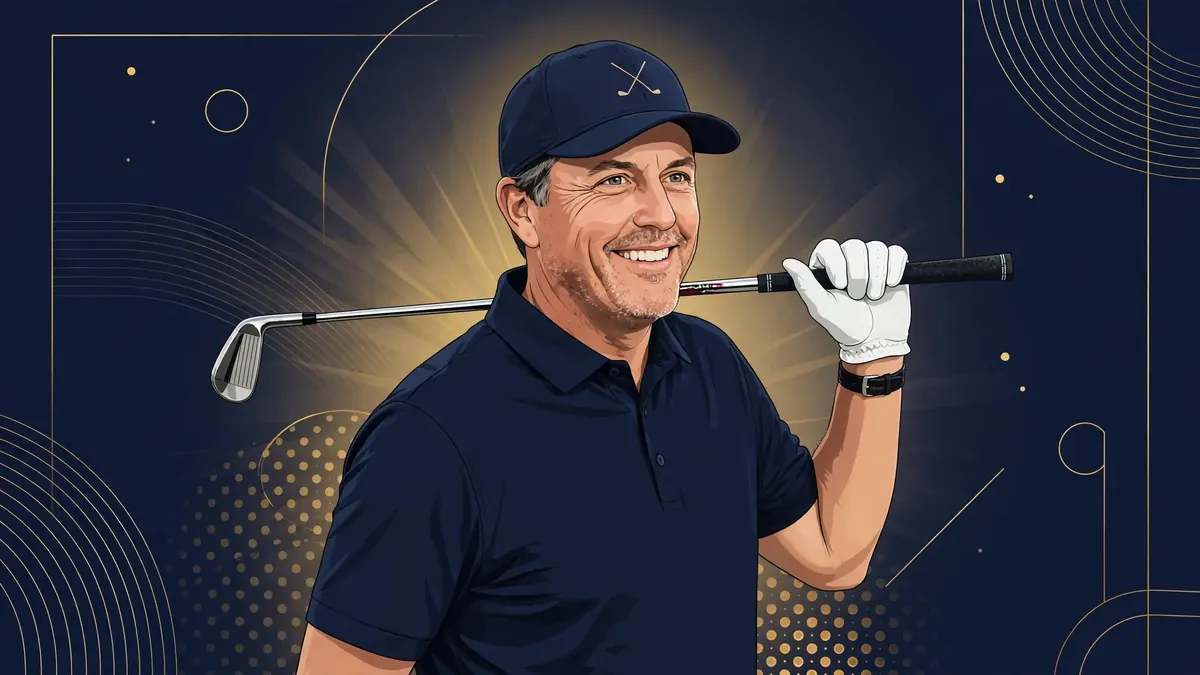
Phil Mickelson stands 6 ft 3 in tall. In metric terms that is 1.91 metres, or 191 centimetres. His listed weight is 200 lb (91 kg), which puts him at the tall, lean end of the professional game — a long frame carrying a famously loose, wristy swing that has produced some of the most creative recovery shots golf has ever seen.
The number is not a guess and it is not new. It has appeared in Mickelson’s player profiles since the early 1990s, when he turned professional out of Arizona State University, and it has never been revised. Wikipedia’s infobox lists “Height: 6 ft 3 in (191 cm)”. Bolavip’s profile of the golfer states plainly: “Standing at 6 feet 3 inches (1.91 meters), Phil Mickelson’s height has been an asset in his golfing career.” Golf Monthly’s “30 Things To Know” fact file gives the same figure, and TNT Sports’ player profile records “Height / Weight: 6ft 3in / 14 stone”. Fourteen stone is 196 lb, close to the 200 lb most American profiles print — the small gap is the usual difference between a rounded British listing and an American one, not a dispute about his height.
Why does the question keep getting asked? Partly because Mickelson does not look 6 ft 3 in on television. Golf is a sport of wide fairways and distant cameras, and a tall golfer standing alone on a tee gives the eye nothing to measure him against. Partly because his game never looked like a tall man’s game: the flop shots, the short-game touch, the putter that won him the 2021 PGA Championship at 50. People expect a 6 ft 3 in golfer to overpower courses. Mickelson did overpower them, at times — he was one of the longest hitters of his generation — but the shots people remember are the delicate ones, and delicate does not read as tall. The tape measure says otherwise.
The short answer: Phil Mickelson’s height is 6 ft 3 in (1.91 m / 191 cm), listed at 200 lb (91 kg). One photographic-estimate site, CelebHeights, puts him an inch shorter at 6 ft 2 in (188 cm). No major profile, tour record or reference source agrees with the shorter figure.
The Height, Source by Source
A height figure is only as good as the sources behind it, so here they are, lined up. Every entry below was checked live in November 2026, and the table is the core evidence of this article: no source in it is hidden, and no source is treated as final on its own.
| Source | Height Listed | Weight Listed | What It Is |
|---|---|---|---|
| Wikipedia | 6 ft 3 in (191 cm) | 200 lb (91 kg) | Reference profile, infobox figure |
| Bolavip | 6 ft 3 in (1.91 m) | — | Career profile, updated 2025 |
| Golf Monthly | 6 ft 3 in | — | “30 Things To Know” fact file |
| TNT Sports | 6 ft 3 in | 14 stone (196 lb) | Player profile |
| GolfWRX tour data | 6 ft 3 in (1.91 m) | — | Compiled tour measurements, 2017 |
| The Brassie | 6 ft 3 in (1.91 m) | — | Height-focused profile |
| CelebHeights | 6 ft 2 in (188 cm) | — | Photographic estimate; the only dissenting figure |
The pattern is about as clear as these disputes ever get. Six independent listings say 6 ft 3 in. One says 6 ft 2 in, and that one is an estimate made from photographs, not a measurement. CelebHeights’ own page carries a long discussion thread in which readers argue about the listing, with several noting that Mickelson looks a full head taller than 5 ft 11 in players standing next to him — which is exactly what a 6 ft 3 in man looks like. The site’s “average guess” from its readers lands at 6 ft 1.92 in, almost exactly between the two figures, which tells you the photographs are genuinely hard to read and the official listing is the safer anchor.
There is also a second, quieter source of confusion. A few low-quality content sites have printed 5 ft 9 in or 5 ft 10 in for Mickelson — figures that actually belong to Rory McIlroy, whose height is listed at 5 ft 9 in to 5 ft 10 in. The two men are often discussed together, and sloppy pages mix them up. The GolfWRX compilation of tour heights settles it in one line: “Phil Mickelson … 1.91 6’3” next to “Rory McIlroy … 1.75 5’9” and “Tiger Woods … 1.85 6’1”. When the same dataset measures all three men on the same scale, Mickelson is six inches taller than McIlroy and two inches taller than Woods. That matches what you see when the three stand together on a practice range.
One more point matters for honesty. Mickelson has never published a measured height, and no dated medical or combine-style measurement exists in the public record. The number comes from player profiles, and the profiles — with the single photographic exception above — agree. So the honest way to state it is this: Phil Mickelson is listed at 6 ft 3 in (1.91 m), with one photographic estimate at 6 ft 2 in. The range is 6 ft 2 in to 6 ft 3 in if you want every source counted, and 6 ft 3 in if you want the figure every major profile prints. This article uses 6 ft 3 in as the headline number and flags the one-inch dissent wherever it matters.
Phil Mickelson’s Height in Every Unit
Searchers ask the question in different units, so here is the full conversion table. All figures follow from 6 ft 3 in (191 cm) unless the CelebHeights figure is noted.
| Unit | Phil Mickelson |
|---|---|
| Feet and inches | 6 ft 3 in |
| Inches | 75 inches |
| Centimetres | 191 cm (188 cm on the CelebHeights estimate) |
| Metres | 1.91 m (1.88 m on the CelebHeights estimate) |
| Weight | 200 lb / 91 kg / 14 stone 4 lb |
| vs average American man | About 5–6 inches taller (average US man: roughly 5 ft 9 in / 175 cm) |
| vs average male tour professional | About 3–4 inches taller (average male pro: roughly 5 ft 11 in / 180 cm) |
That last comparison is worth pausing on. Professional golfers are, on average, a little taller than the general population — the game selects for long levers and long swings — and Mickelson still clears the tour average by several inches. He is not the tallest man ever to win a major, and he is not the tallest player of his era, but he has spent his whole career looking down the fairway from above most of the field. Only a handful of elite players of his generation stood taller, and the comparison table in the next section names them.
How Tall Is Phil Mickelson Compared to Other Golfers?
Put Mickelson on a tee with the players he has competed against for three decades and the gaps are visible. He gives away an inch to Dustin Johnson, stands level with Scottie Scheffler, and towers over Rory McIlroy by five or six inches. The table uses each player’s tour-listed height, with Mickelson carried at his listed 6 ft 3 in.
| Golfer | Listed Height | Difference vs Mickelson | Majors |
|---|---|---|---|
| Dustin Johnson | 6 ft 4 in (193 cm) | 1 in taller | 2 |
| Phil Mickelson | 6 ft 3 in (191 cm) | — | 6 |
| Scottie Scheffler | 6 ft 3 in (191 cm) | Same height | 4 |
| Jon Rahm | 6 ft 2 in (188 cm) | 1 in shorter | 2 |
| Tiger Woods | 6 ft 1 in (185 cm) | 2 in shorter | 15 |
| Brooks Koepka | 6 ft 0 in (183 cm) | 3 in shorter | 5 |
| Rory McIlroy | 5 ft 9 in – 5 ft 10 in (175–178 cm) | 5–6 in shorter | 6 |
| Jack Nicklaus | 6 ft 0 in (183 cm) | 3 in shorter | 18 |
| Arnold Palmer | 5 ft 11 in (180 cm) | 4 in shorter | 7 |
The comparison with Tiger Woods is the one readers ask about most, and it is also the one that has defined Mickelson’s career. Woods, at 6 ft 1 in tall, is two inches shorter than Mickelson, and the two men spent the best part of twenty years as the sport’s defining rivalry — Woods the disciplined power player, Mickelson the swashbuckling left-hander who could lose a tournament with one wild swing and win the next with a flop shot nobody else would attempt. Their height gap is easy to see in old photographs of the two walking a fairway together, and it is a useful reminder that golf’s greatest rivalry was never a contest of size. Woods won 15 majors to Mickelson’s six, and the two inches had nothing to do with it.
The Rory McIlroy gap is bigger and more surprising to most fans. McIlroy, whose height we cover in our Rory McIlroy height profile, is listed at 5 ft 9 in to 5 ft 10 in — five to six inches shorter than Mickelson — yet he is one of the longest hitters in the modern game. If height alone decided driving distance, McIlroy would be an average hitter and Mickelson would have out-driven everyone for thirty years. Neither is true, which leads directly to the next question.
Jon Rahm, at 6 ft 2 in tall, is the nearest of Mickelson’s LIV-era rivals in stature — one inch shorter — and the two men were teammates of a kind in the breakaway league’s early years, both big, powerful players who had carried the European and American games respectively. Dustin Johnson, at 6 ft 4 in, is the only elite player of Mickelson’s era who clearly stands above him, and even Johnson’s single inch is barely visible without a tape measure. Scottie Scheffler, the world No. 1 of the mid-2020s, is exactly Mickelson’s height — 6 ft 3 in — which makes the comparison a neat one: same frame, different generation, different swing, and Scheffler’s four majors by 2026 already closing in on Mickelson’s six.
Does Height Help or Hurt in Golf?
The honest answer is: it helps a little, it hurts a little, and it decides almost nothing on its own. Mickelson himself has said as much — “Height doesn’t really matter much if you have skills,” he has told interviewers, pointing to shorter players with remarkable talent. The evidence of his own career backs him up.
On the plus side, a taller golfer has longer levers. A longer arm swing traces a wider arc, and a wider arc, all else equal, produces more clubhead speed — the raw ingredient of driving distance. Mickelson was one of the longest hitters of his generation, and his height is part of that story. Height also helps with vision: a taller player sees more of a green’s contours standing over a putt, and reads wind and trouble more easily from an elevated eye line. And on long par fives, the tall player’s high ball flight can carry hazards that a lower, flatter hitter must play around.
On the minus side, height makes the short game harder. A taller player must bend further over the ball on putts and chips, and the long levers that generate speed also generate inconsistency — a fraction of a degree off at the top of a long swing becomes inches off at impact. The putting stroke, which rewards a compact, repeatable motion, is where tall golfers most often struggle. Mickelson’s career is the perfect case study in both directions: the same long swing that produced towering drives also produced the wild misses that cost him the 2006 U.S. Open at Winged Foot, where a double bogey on the final hole handed the title to Geoff Ogilvy. And the same hands that looked too big for delicate work produced the flop shots and the 2021 PGA Championship win — the oldest major victory in history — that no textbook would predict from a 6 ft 3 in man.
The leaderboard settles the argument. The tallest elite players — Johnson at 6 ft 4 in, Mickelson and Scheffler at 6 ft 3 in — have won majors. So have McIlroy at 5 ft 9 in, Justin Thomas at 5 ft 10 in and Collin Morikawa at 5 ft 9 in. The average male tour professional stands around 5 ft 11 in, and the spread of major winners runs from 5 ft 4 in Ian Woosnam to 6 ft 4 in Johnson. Height is an ingredient, not a verdict. Mickelson’s 6 ft 3 in frame gave him the tools; his hands, his imagination and his nerve did the rest.
Early Life and Background
Philip Alfred Mickelson was born on 16 June 1970 in San Diego, California, to Philip Mickelson Sr., an airline pilot and former naval aviator, and Mary Santos Mickelson. He was raised in San Diego and Scottsdale, Arizona, and his golf education started almost as soon as he could walk. His maternal grandfather, Alfred Santos — the source of Mickelson’s middle name — was a caddie at Pebble Beach Golf Links and took the young Phil to play as a child. His father built a practice area in the family backyard, and Phil learned the game by mirroring his father’s right-handed swing from the opposite side — the origin of the left-handed game that would define him, even though he is right-handed in everything else.
He was a prodigy in the full sense of the word. At Arizona State University he won three NCAA individual championships and three Haskins Awards as the outstanding collegiate golfer, and in 1991, while still an amateur, he won the Northern Telecom Open on the PGA Tour — only the fourth amateur ever to win a tour event, and a feat that announced him to the wider sporting public two years before he turned professional. He turned pro in 1992, and the early years of his career are covered in more detail in our Phil Mickelson age profile, which traces the timeline from his 1970 birth through each decade of his career.
The height was already there by the time he reached Arizona State: a tall, rangy teenager whose swing looked loose and long even then. Coaches who watched him as a junior noted the same thing commentators would note for thirty years — the levers were long, the arc was wide, and the hands were quicker than a frame that size had any right to produce. It is a combination that has never really been repeated: tall golfers usually hit the ball a long way and chip it badly; Mickelson hit it a long way and chipped it better than anyone.
Career Rise: From Amateur Star to Six Majors
Mickelson’s professional career falls into three acts, and his full story — the wait for a first major, the green jackets, the Ryder Cup battles, the gambling admission and the LIV breakaway — is told at length in our Phil Mickelson biography. The short version is a career of extraordinary longevity and even more extraordinary drama.
Act one ran from his 1992 professional debut to his first major victory at the 2004 Masters, twelve years later. He won early and often — 45 PGA Tour victories in total, a figure only a handful of players in history have reached — but the majors would not come, and the label “the best player never to win a major” stuck to him through his twenties and thirties. He finished second or third in majors again and again, and the near-misses became part of his identity: the 1999 U.S. Open, lost by a stroke to Payne Stewart days before the birth of his first child; the 2001 PGA Championship; the 2004 U.S. Open.
Act two began at Augusta in April 2004, when an 18-foot birdie putt on the 72nd hole finally made him a major champion, and he jumped in the air in a celebration that became one of golf’s iconic images. Two more green jackets followed, in 2006 and 2010, along with the PGA Championship in 2005 and the Open Championship at Muirfield in 2013, where a closing 66 on the final day — one of the great final rounds in major history — completed his set of six majors across three different championships. The only major he never won was the U.S. Open, where he finished runner-up a record six times.
Act three, the most unlikely of all, arrived in May 2021 at Kiawah Island. At 50 years, 11 months and 7 days old, Mickelson won the PGA Championship, becoming the oldest player ever to win a men’s major — breaking a record held by Julius Boros, who had won the 1968 PGA at 48. He did it with a game built on the same ingredients as always: towering drives for a man his age, a short game that younger players could not match, and a nerve that had survived three decades of heartbreak. It was, by common consent, one of the great sporting achievements of the decade, and it came from a 50-year-old frame that still stood 6 ft 3 in tall.
The Money: Prize Money, Endorsements and the LIV Deal
A height profile is not a net-worth profile, but readers asking how tall Mickelson is almost always ask what he is worth next, and the money is part of the story of the man. The short version: Mickelson’s estimated net worth in 2026 sits in a range of $300 million to $440 million. Celebrity Net Worth puts the figure at $300 million. Alux, in an October 2026 update, puts it at about $440 million. The honest range covers both, and the gap between them is the LIV Golf deal — nobody outside his camp knows exactly how much of the reported $200 million he has actually banked, or how much went to taxes, fees and three decades of expensive living.
The building blocks are well documented. His official PGA Tour career prize money totals about $96.7 million, one of the highest figures in tour history. Celebrity Net Worth notes that his earnings reached $50 million in particularly lucrative years, combining tournament prizes, sponsorships and other compensation. Off the course, his endorsement income across three decades has been reported at around $750 million in total, according to a MyGolfSpy analysis cited by the Women’s Golf Journal — the product of long relationships with brands including Callaway, KPMG, Amstel Light, ExxonMobil and Rolex, several of which ended when he joined LIV Golf in 2022.
The LIV deal itself remains the largest single item in the story. In June 2022 Mickelson joined the Saudi-backed breakaway league, leaving a PGA Tour membership of thirty years, and reporting at the time placed the overall value of his agreement at $200 million — among the largest athlete-contract commitments of the period. The exact payment schedule and conditions have never been published, and the headline figure is a reported overall contract value rather than a single payment. He became captain of HyFlyers GC, the league’s team identity giving him an ownership-style role as well as a playing one. For the full breakdown of the fortune — the prize money tables, the endorsement years, the LIV contract and the gambling losses that cut into it — our sister site GuideNetWorth’s Phil Mickelson net worth profile works through the numbers in detail.
What the range means in practice is simple. Even at the bottom of it, Mickelson is one of the richest golfers ever — fourth on the all-time list by most counts, behind only Tiger Woods and a couple of others. At the top of it, he is within touching distance of half a billion dollars. Either way, the fortune was built the old-fashioned way for a golfer: thirty years of winning, thirty years of selling, and one enormous late-career cheque that changed the maths for everyone.
Assets, Homes and Business Ventures
Mickelson’s best-known home is in Rancho Santa Fe, the wealthy enclave north of San Diego where he has lived for most of his adult life. The property — a large estate with its own practice facilities, as befits a man who learned the game in his father’s backyard — has been his base through the PGA Tour years and the LIV years alike, and it is where he and Amy raised their three children. He has owned other property over the years, including a home in the desert near Scottsdale, but Rancho Santa Fe is the address most associated with him, and it is where he retreated during his long absence from the game in 2026.
His business life beyond prize money has been varied. The Phil and Amy Mickelson Foundation, founded in 2004, has supported youth and education causes, and the couple have been among golf’s most visible charitable givers. He was an early investor in businesses around the game, including a stake in the San Diego Padres — he became a minority owner of the baseball team in 2012 — and he has been a central figure in The Match, the made-for-television exhibition series in which he has played alongside Tiger Woods, Tom Brady, Peyton Manning and others. The Match made him a television personality as well as a golfer, and it paid him accordingly.
His golf-course design work is less known but real: Mickelson has been involved in course design projects under his own name, and his knowledge of architecture — the angles, the risk-reward choices, the short-game demands — is the same knowledge that made him a great player. It is also, incidentally, a line of work where being 6 ft 3 in helps: walking a site, reading slopes and sightlines from a taller eye line is a small, genuine advantage that shorter designers do not have.

Personal Life and Family
Mickelson married Amy McBride in November 1996, and she has been the constant presence of his adult life — at his side for the first Masters win, for the birth of their three children, and for the hardest year of his career in 2026. They have three children: Amanda Brynn, born in 1999; Sophia Isabel, born in 2001; and Evan Samuel, born in 2003. Amy’s own health battles have shaped the family deeply: she was diagnosed with breast cancer in 2009, and Mickelson stepped away from the tour for a period that summer to be with her. She recovered, and the family has spoken openly since about the experience. More of the family story sits in our Personal Life coverage of celebrity families, where Mickelson’s story is one of the longer-running ones.
His younger brother Tim was his caddie for many years, carrying the bag through some of the biggest wins of his career, and the Mickelson family remains close-knit: his father Philip Sr. and his grandfather Alfred Santos, the Pebble Beach caddie, are the two men who built the golfer. He is right-handed in daily life — he writes, throws and eats right-handed — and plays golf left-handed only because he learned by mirroring his father’s swing. It is one of the most famous quirks in sport, and it is the reason for the nickname “Lefty” that has followed him since childhood.
For all the fame and the fortune, Mickelson has always been an unusually accessible star: the thumbs-up to the crowd, the long autograph sessions, the willingness to talk to anyone after a round. That accessibility is part of why the events of 2026 — the silence, the absence, the treatment — landed so heavily on the sport. Golf had never seen him go quiet before.
2026: The Year Everything Went Quiet
For a man who has spent 34 years in the public eye, 2026 has been the strangest year of Phil Mickelson’s career — because for most of it, he has not been there at all. The year began with an announcement. In February 2026 Mickelson said he would miss LIV Golf’s first two events of the season, explaining that he and his wife Amy needed to attend to a family health matter. He returned for one event, LIV Golf South Africa in March, and finished tied for 48th. It would be his only competitive appearance of the year. In April he announced an extended break, and in May he withdrew from the PGA Championship. By the end of the season he had missed all four majors in a calendar year for the first time since 1990 — a run of 36 years broken in a single season.
In June, his representatives issued a statement that set the tone for everything that followed: “Mr. Mickelson’s priority is to become the husband, father, and man his family deserves. Right now, that means giving his full attention to a private family health matter. He understands that parts of his life are public, but his family’s private matters are not.” No return date was given, and none has been given since.
On 30 September 2026 his representative confirmed to TMZ Sports that Mickelson had sought treatment for “family trauma and addiction” and had since left the facility. Athlon Sports independently confirmed the account the same day. Neither the timing nor the length of his stay was disclosed, and the representative did not identify the addiction for which he sought treatment. What is confirmed is limited to that: he sought treatment voluntarily, and he has left the facility. Everything else — when he entered, how long he stayed, where he received treatment and what his next competitive step will be — has not been disclosed, and this article will not speculate about it.
The wider context is that LIV Golf itself has been in turmoil. In September 2026 the league filed for Chapter 11 bankruptcy protection after Saudi Arabia’s Public Investment Fund withdrew its financial backing, and LIV has asked the bankruptcy court for permission to terminate existing player contracts, including Mickelson’s, as part of its restructuring. Whether he returns to competitive golf, and under which banner, remains unanswered as of November 2026. He has made no announcement about his future plans, and his caddie Jon Yarbrough has already moved on, returning to the PGA Tour carrying the bag for Ben Griffin.
Controversies and Setbacks
Mickelson’s career has never been free of controversy, and an honest profile records it. The best-known episode is his gambling, which he has acknowledged publicly. Alan Shipnuck’s 2022 book “Phil: The Rip-Roaring (and Unauthorized!) Biography of Golf’s Most Colorful Superstar” reported extensive betting over many years, and Mickelson has said he sought help for the habit. The sums reported — tens of millions in losses over the years, by various accounts — are part of why his net worth, enormous as it is, is lower than his career earnings would suggest.
The second episode came in early 2022, when comments he made to Shipnuck about Saudi Arabia’s human-rights record and the PGA Tour — made while he was helping to organise the breakaway league — were published and triggered intense criticism. He lost sponsors Amstel Light and KPMG within days, stepped away from golf, and missed the 2022 Masters and the PGA Championship he had won the year before. He apologised, returned, and then joined LIV Golf that June — the move that completed his break with the tour he had played on for thirty years.
A third episode arrived in 2026. In June, Golf Digest reported that a female employee at The Farms Golf Club in Rancho Santa Fe had accused Mickelson of non-consensual and inappropriate physical contact before a round that spring, and that the club had investigated and Mickelson had left the property. Mickelson and his lawyers strongly denied the account, and his representatives confirmed that he had resigned his membership while disputing aspects of the reporting. The allegation has not been tested in court, and this article records it as reported and denied — nothing more.
None of this changes the height. But it changes the frame around it: the 6 ft 3 in golfer who spent thirty years as one of the most popular figures in sport has spent 2026 out of sight, and the sport is still waiting to see whether he comes back, and in what form.
FAQs About Phil Mickelson’s Height
How tall is Phil Mickelson?
Phil Mickelson is 6 ft 3 in tall (1.91 m / 191 cm). The figure is printed in his Wikipedia profile, in Golf Monthly’s fact file and in Bolavip’s career profile, and it has been the same throughout his professional career. One photographic-estimate site, CelebHeights, lists him an inch shorter at 6 ft 2 in (188 cm).
How tall is Phil Mickelson in cm and metres?
Phil Mickelson is 191 cm tall, or 1.91 metres. On the single dissenting estimate from CelebHeights, the figure would be 188 cm (1.88 m). In inches he is 75 inches tall.
How much does Phil Mickelson weigh?
Phil Mickelson’s listed weight is 200 lb (91 kg), or 14 stone 4 lb. TNT Sports lists his weight at 14 stone. At 6 ft 3 in and 200 lb, he is a tall, lean golfer — long-framed rather than heavily built.
Is Phil Mickelson taller than Tiger Woods?
Yes. Phil Mickelson is 6 ft 3 in tall and Tiger Woods is 6 ft 1 in tall, so Mickelson is two inches taller than his great rival. The gap is visible in photographs of the two walking a fairway together, but it never decided their rivalry — Woods won 15 majors to Mickelson’s six.
Is Phil Mickelson taller than Rory McIlroy?
Yes, by five to six inches. Rory McIlroy is listed at 5 ft 9 in to 5 ft 10 in (175–178 cm), while Mickelson is 6 ft 3 in (191 cm). McIlroy is nevertheless one of the longest hitters in the modern game, which shows that height alone does not decide driving distance.
Who is the tallest golfer on tour?
Among the elite players of Mickelson’s era, Dustin Johnson is the tallest at 6 ft 4 in (193 cm) — one inch above Mickelson and Scottie Scheffler, who are both 6 ft 3 in. Taller players exist further down the rankings, but among major winners and world No. 1s, Johnson is the tallest of the modern era.
How old is Phil Mickelson?
Phil Mickelson is 56 years old as of November 2026. He was born on 16 June 1970 in San Diego, California. He turned professional in 1992 and won his sixth major, the 2021 PGA Championship, at 50 years, 11 months and 7 days old — the oldest major winner in history.
What is Phil Mickelson’s net worth in 2026?
Phil Mickelson’s estimated net worth in 2026 is $300 million to $440 million. Celebrity Net Worth puts the figure at $300 million, while Alux put it at about $440 million in October 2026. The range reflects uncertainty over how much of his reported $200 million LIV Golf deal he has actually banked. His official PGA Tour career prize money is about $96.7 million.
Final Thoughts
Phil Mickelson is 6 ft 3 in tall — 1.91 metres, 191 centimetres, 75 inches — and the figure has survived thirty years of scrutiny with only a single photographic estimate dissenting by one inch. He is taller than Tiger Woods by two inches, taller than Rory McIlroy by five or six, level with Scottie Scheffler and one inch short of Dustin Johnson. He is three to four inches taller than the average tour professional, and five to six inches taller than the average American man.
What the number never explains is the career. A 6 ft 3 in frame gave Mickelson the long levers and the high ball flight, but the flop shots, the putting and the nerve came from somewhere else — from a backyard in San Diego, a grandfather who caddied at Pebble Beach, and a left-handed swing learned by mirroring his father. Six majors, 45 tour wins, the oldest major champion in history, and a fortune in the $300 million to $440 million range: that is what the height carried, and it is a career no tape measure could have predicted.
Whether he adds to it is the open question of 2026. He has played once this year, missed all four majors for the first time since 1990, and sought treatment for what his representative called “family trauma and addiction”. The game is waiting — for news, for a return, for the next chapter of a golfer who has never done anything quietly. For more on the golfers of his generation, browse our celebrity profiles.
Sources and Reporting
How we estimated: Phil Mickelson’s height is a listed figure, not a measured one — no dated medical or combine-style measurement exists in the public record. We anchored on the figure printed by the most widely used reference profiles (Wikipedia: 6 ft 3 in / 191 cm; Bolavip: 6 ft 3 in / 1.91 m; Golf Monthly: 6 ft 3 in; TNT Sports: 6 ft 3 in) and cross-checked it against compiled tour data (GolfWRX: 1.91 m) and the height-focused profile The Brassie (6 ft 3 in / 1.91 m). The one dissenting source, CelebHeights (6 ft 2 in / 188 cm), is a photographic estimate and is reported in the article rather than hidden. Where sources disagreed on money, we published a range: net worth $300 million (Celebrity Net Worth) to $440 million (Alux, October 2026); PGA Tour career prize money about $96.7 million; LIV Golf deal reported at $200 million (unconfirmed payment schedule). Estimates may differ from private reality, and figures are as reported by the named sources as of November 2026.
Named sources consulted for this article: Wikipedia, Bolavip, Golf Monthly, TNT Sports, Celebrity Net Worth, Alux, CelebHeights, The Brassie, Athlon Sports, GolfMagic, EssentiallySports. Peer heights are tour-listed figures as compiled by GolfWRX and by GuideNetWorth’s Rory McIlroy height profile. All links point to the sources’ homepages or the cited article pages as listed; no URL was invented.