Last updated: 17 November 2026 | By Celebamerica Editorial Staff
Phil Mickelson is one of the most recognisable golfers ever to pick up a club. Born on 16 June 1970 in San Diego, California, the man they call “Lefty” built a career that ran for more than three decades at the top of the game: 45 PGA Tour wins, six major championships, a place in the World Golf Hall of Fame, and then — at an age when most golfers are winding down — the most famous win of his life at the 2021 PGA Championship, aged 50. His estimated net worth sits in the range of $300 million to $400 million as of November 2026, anchored by Celebrity Net Worth’s figure of around $400 million, a number built on roughly $96.7 million in official PGA Tour prize money, a reported $200 million LIV Golf deal, and decades of endorsement income.
This Phil Mickelson biography follows the full arc: the San Diego kid who learned the game by mirroring his father, the Arizona State star who beat professionals while still an amateur, the long wait for a first major, the green jackets, the Ryder Cup battles with Tiger Woods, the money, the gambling admission, the LIV Golf breakaway — and the quiet, difficult year of 2026, when a family health matter kept him away from the game almost entirely.
Phil Mickelson Quick Facts
| Full Name | Philip Alfred Mickelson |
|---|---|
| Date of Birth | 16 June 1970 |
| Birthplace | San Diego, California, United States |
| Age (November 2026) | 56 |
| Height | 6 ft 3 in (1.91 m) |
| Nickname | Lefty |
| College | Arizona State University (graduated 1992) |
| Turned Professional | 1992 |
| PGA Tour Wins | 45 (eighth all-time) |
| Major Championships | 6 — Masters 2004, 2006, 2010; PGA Championship 2005, 2021; The Open Championship 2013 |
| Estimated Net Worth (2026) | $300 million – $400 million (Celebrity Net Worth: ~$400 million) |
| Career PGA Tour Prize Money | About $96.7 million |
| Peak / Primary Income Sources | Tournament prize money, LIV Golf contract, endorsements, appearance fees, business ventures |
| Key Ventures / Works | LIV Golf / HyFlyers GC captain (since 2022); The Match series; Phil and Amy Mickelson Foundation (founded 2004) |
| Spouse | Amy McBride Mickelson (married November 1996) |
| Children | Amanda Brynn (born 1999), Sophia Isabel (born 2001), Evan Samuel (born 2003) |
| Hall of Fame | World Golf Hall of Fame, inducted 2012 |
Table of Contents
- Phil Mickelson Quick Facts
- Early Life: A San Diego Kid Who Swung Left
- Arizona State: The Amateur Who Beat the Pros
- Turning Pro and the Long Road to a First Major
- Six Majors and the Record at Fifty
- Ryder Cup Heart and the Team-Event Legacy
- The Money: Prize Winnings, Endorsements and the LIV Deal
- Net Worth Breakdown: Where the Fortune Sits
- Homes, Jets and the Rancho Santa Fe Estate
- Family Life: Amy and the Three Kids
- Gambling, the Saudi Comments and the Sponsor Exodus
- 2026: The Year Everything Went Quiet
- Legacy: What Lefty Leaves Behind
- Phil Mickelson FAQs
- Final Thoughts
- Sources and How We Estimated
Early Life: A San Diego Kid Who Swung Left
Philip Alfred Mickelson was born on 16 June 1970 in San Diego, California, to Philip Mickelson Sr., a naval aviator who went on to fly commercial airliners, and Mary Mickelson. Golf was in the house from the start. His father was a skilled player, and the young Phil learned the game by standing opposite him and mirroring his swing — which is how a naturally right-handed boy ended up playing golf left-handed for the rest of his life. The quirk gave him his nickname, “Lefty”, and it gave golf one of its most distinctive swings.
The family later spent time in Scottsdale, Arizona, and Mickelson grew up between the two states, playing junior golf in San Diego and learning to shape shots on desert courses. He was not a child prodigy in the Tiger Woods sense — there were no television appearances at age two — but by his teens he was one of the best junior players in America, with a short game that coaches already talked about in hushed tones. His feel around the greens, the flop shots and the soft hands, became his trademark, and it stayed that way for 30 years.
That short game was not an accident. Mickelson has always said he learned to play the creative shots because his father encouraged him to try things other juniors would not: hitting from awkward lies, inventing shots around the practice green, treating the game as a puzzle rather than a test of power. It is the same instinct that later made him one of the most entertaining players to watch — and, at times, one of the most exasperating for his own fans, because the same boldness that produced miracles also produced the occasional spectacular miss.
Arizona State: The Amateur Who Beat the Pros
Mickelson went to Arizona State University on a golf scholarship and turned into the most decorated amateur of his generation. He won three NCAA individual titles — in 1989, 1990 and 1991 — and 16 collegiate events in total, a haul that put him alongside the greats of the college game. In 1990 he won the U.S. Amateur, and in 1991 he played on the winning American Walker Cup team.
Then came the result that made the wider golf world sit up. In January 1991, still an amateur, Mickelson won the Northern Telecom Open on the PGA Tour — one of only a handful of amateurs ever to win a professional tour event. He beat a field of seasoned professionals while still a student, and the win earned him a PGA Tour exemption. It was the clearest possible signal: this was not just a good college player. This was a future star.
It was at Arizona State that he met Amy McBride, a fellow student who was also a cheerleader for the Phoenix Suns. They met in 1992, and their relationship would become one of the most durable partnerships in sport. Mickelson graduated from ASU in 1992 with a degree in psychology, and turned professional the same year.
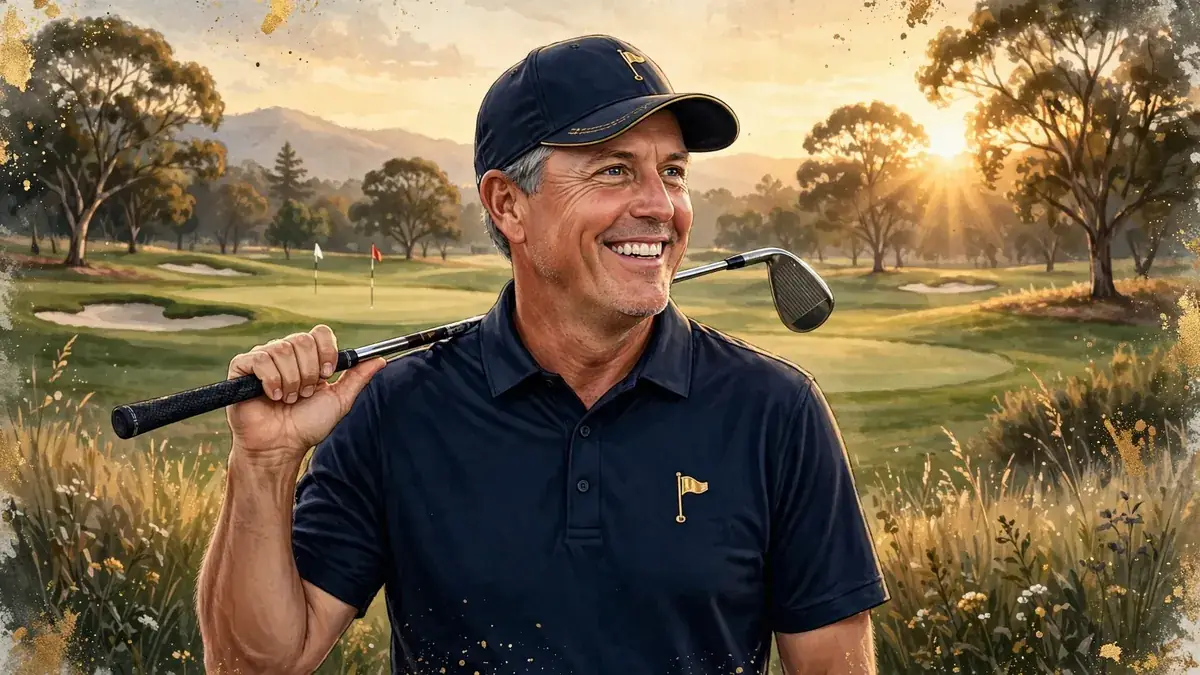
Turning Pro and the Long Road to a First Major
Mickelson turned professional in 1992 and won his first PGA Tour event as a pro the following year, at the 1993 Buick Invitational in San Diego — a home-town win that felt like a statement. The wins kept coming through the 1990s: the 1994 and 1997 Byron Nelson, the 1996 Phoenix Open, the 1998 AT&T Pebble Beach. By the end of the decade he was a fixture in the world’s top ten, a Ryder Cup regular, and one of the most popular players on tour.
But the majors would not come. Year after year, Mickelson finished close — second at the 1999 U.S. Open at Pinehurst, where he famously carried a pager so he could be told if his wife Amy, pregnant with their first child, went into labour; third at the 2001 Masters; a string of near-misses that earned him a label he hated: the best player never to win a major. The label followed him into his early thirties, and every missed chance added weight to it.
The breakthrough finally arrived at the 2004 Masters. Mickelson birdied the 18th hole at Augusta National on Sunday to beat Ernie Els by a shot, and the release of emotion — the leap, the hug with his caddie Jim “Bones” Mackay — became one of the most replayed moments in golf. He was 33 years old, and the monkey was off his back. What followed was the most productive stretch of his career: a second Masters in 2006, the PGA Championship in 2005, and a third green jacket in 2010, won weeks after his wife Amy and his mother Mary were both diagnosed with breast cancer.
Through it all, his rivalry with Tiger Woods defined the era. Woods was the dominant force, and Mickelson was the people’s alternative — the left-handed showman with the big smile and the risky shots. Their head-to-head battles, above all at the 2004 and 2006 Masters and in the Ryder Cup, gave golf its defining storyline for a decade. Woods won more, but Mickelson’s wins mattered more to the galleries, and the two men pushed each other in ways neither would ever quite admit.
Six Majors and the Record at Fifty
Mickelson’s six major championships span 17 years, from his first Masters in 2004 to his last — and most unlikely — at the 2021 PGA Championship. The list reads like a tour of golf’s great stages:
- The Masters, 2004 — the breakthrough, an 18th-hole birdie to beat Ernie Els by one.
- PGA Championship, 2005 — a win at Baltusrol in the rain, sealed with a flop shot from deep rough on the 72nd hole that only Mickelson would have tried.
- The Masters, 2006 — a two-shot win over Tim Clark, confirming he was no one-major wonder.
- The Masters, 2010 — won in the shadow of his wife’s and mother’s cancer diagnoses, with Amy waiting behind the 18th green.
- The Open Championship, 2013 — a final-round 66 at Muirfield in wind and rain, one of the great closing rounds in major history, beating Henrik Stenson by three.
- PGA Championship, 2021 — the record-breaker, at Kiawah Island, aged 50.
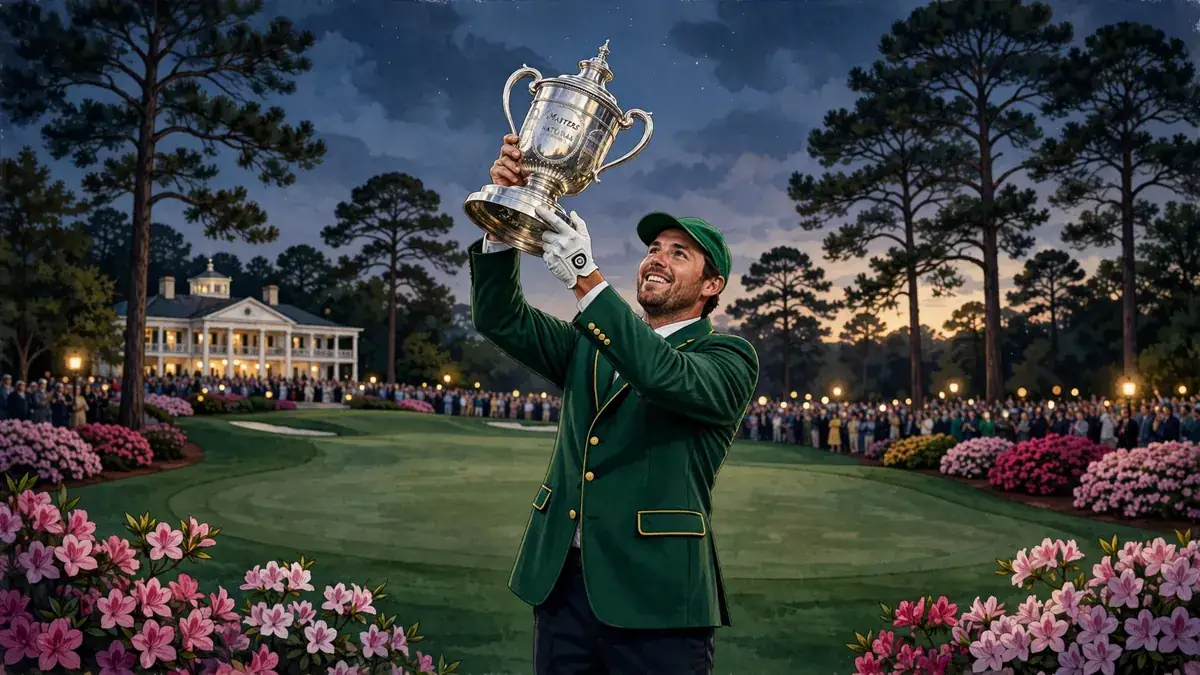
The 2021 PGA Championship deserves its own paragraph, because it was genuinely historic. At 50 years and 11 months, Mickelson became the oldest player ever to win a major championship, breaking the record held by Julius Boros, who was 48 when he won the 1968 PGA. He held off Brooks Koepka — a player 20 years younger — down the stretch, and the walk up the 18th fairway, with fans spilling onto the course around him, became an instant classic. It was his first win in more than two years, and it came at an age when almost every expert had written him off. Nobody has won a major older, and nobody is likely to soon.
For all the triumphs, the U.S. Open remained the one that got away. Mickelson finished second a record six times — in 1999, 2002, 2004, 2006, 2009 and 2013 — without ever winning it. The 2006 defeat at Winged Foot still hurts his fans most: leading by one on the 72nd hole, he hit his drive into a hospitality tent, then a tree, then made double bogey to lose by one. He later called it the biggest disappointment of his career, and said he still thinks about that hole. The career Grand Slam — all four majors — was never completed, and the U.S. Open is the reason.
He also reached world No. 2 in the rankings and spent long stretches there, but never held the No. 1 spot — a quirk of timing, since his peak years overlapped with Tiger Woods at his most dominant. Woods’s own biography on this site tells the other side of that story: two generational talents, one era, and a rivalry that lifted both men.
Ryder Cup Heart and the Team-Event Legacy
If the majors are Mickelson’s headline, the Ryder Cup is his heartbeat. He played in 12 Ryder Cups between 1995 and 2018 — more than any other American in history — and his record of 18 wins, 22 losses and 7 halves reflects both the length of his service and the lean years of the American team in the late 1990s and 2000s. He was on the winning side in 1999, when the Americans staged the famous comeback at Brookline, and again in 2016 at Hazeltine, after he had helped drive the reforms that followed the 2014 defeat at Gleneagles.
That 2014 aftermath matters to his story. After the loss in Scotland, Mickelson publicly criticised the American team’s preparation and captaincy in a press conference that stunned the golf world — and then he helped build the task force that reshaped how the U.S. picks its captains and vice-captains. The 2016 win at Hazeltine, with Mickelson halving a memorable singles match against Sergio Garcia in which both men made nine birdies, was the payoff. It was the most complete team performance of his career, and it came because he had been willing to say uncomfortable things in public.
He also played in 12 Presidents Cups, another American record, and was on the winning side in all but one of them. In team golf, nobody in American history has shown up more often, for longer, than Phil Mickelson.
The Money: Prize Winnings, Endorsements and the LIV Deal
Mickelson’s money story has three acts: the long PGA Tour career, the endorsement empire, and the LIV Golf deal that changed his finances — and his reputation — in a single summer.
Act one: prize money. Across his PGA Tour career, Mickelson banked about $96.7 million in official prize money, a total that sat among the top three in tour history as of 2025 — behind only Tiger Woods, and recently passed by Scottie Scheffler, whose hot streak carried him past the old guard. That figure counts only official tour earnings. It does not include the millions he won in unofficial events, in the team competitions, or in the made-for-television matches that became a second career of their own. His best single season on tour was 2005, when he won four times including the PGA Championship.
Act two: endorsements. For most of his career, Mickelson was one of the best-paid endorsers in golf. Forbes put his annual endorsement income at around $40 million in 2019–20, built on long partnerships: Callaway, his equipment sponsor since 2004; KPMG, with him since 2008; Workday, since 2017; Amstel Light; and Amgen, for whom he spoke publicly about living with psoriatic arthritis, a condition diagnosed in 2010 that he manages with treatment. The arthritis story mattered — it showed a side of Mickelson that fans had not seen, a player dealing with a chronic condition while still competing at the highest level, and it gave his later career a different kind of respect.
That endorsement empire collapsed in a matter of weeks in February 2022. Comments Mickelson made to his biographer, Alan Shipnuck, about Saudi Arabia and the proposed breakaway league — remarks in which he acknowledged the Saudi government’s human rights record while saying the new league could be used as leverage against the PGA Tour — were published, and the fallout was immediate. KPMG, Workday and Amstel Light ended their deals outright. Callaway paused its partnership. Mickelson lost his role as host of The American Express tournament in La Quinta, and he took a four-month break from golf, apologising for what he called reckless comments. It was the biggest reputational hit of his career, and the sponsors never came back in the same way.
Act three: LIV Golf. In June 2022, Mickelson joined the Saudi-backed LIV Golf league as its most famous signing and the captain of the HyFlyers GC team. Reports put his guaranteed deal at around $200 million — the largest signing fee of any LIV player — and Forbes calculated that he likely received about half of it up front, putting his 2022 earnings at $138 million: $102 million on the course and $36 million off it. That made him, by Forbes’s count, the highest-paid athlete in the world in 2022, ahead of Lionel Messi’s $130 million, and it pushed his all-time career earnings past $1 billion. For the full money picture, including the year-by-year figures, see our detailed look at Phil Mickelson’s net worth on GuideNetWorth.
The LIV move also cost him. He was suspended by the PGA Tour, lost the remaining sponsors, and became the most divisive figure in the sport’s civil war. He has never apologised for joining LIV — he has said the money was life-changing for his family and that the league’s team format and shorter schedule suited a player in his fifties. His supporters point to the $200 million; his critics point to the source of it. Both sides are still arguing, and the argument is part of his story now.
There was also the television money. Mickelson beat Tiger Woods in the first edition of “The Match” in 2018, a winner-take-all exhibition worth $9 million, and he played in several more editions against the likes of Tom Brady, Peyton Manning, Charles Barkley and Stephen Curry. Those events paid appearance fees on top of the prize money, and they kept him in the public eye through his fifties.
Net Worth Breakdown: Where the Fortune Sits
Estimates of Phil Mickelson’s net worth in 2026 vary more than for most golfers, and the reason is simple: the LIV Golf deal changed the maths, and nobody outside his camp knows exactly how much of the reported $200 million he has actually banked, or how much of it went to taxes, fees and the lifestyle of a man who has lived expensively for three decades. Here is what the published sources say, and where they disagree:
| Source | Figure (2026) |
|---|---|
| Celebrity Net Worth | About $400 million — the most widely cited figure, repeated by multiple outlets in 2026 |
| Glimmer Sports | $300 million – $400 million range |
| Alux | About $440 million (October 2026) |
| GuideNetWorth (sister site) | $200 million — a more cautious anchor, built mainly on the LIV deal and prize money |
| Surprise Sports | $875 million — an outlier far above every other published estimate; we do not use it |
Our anchor for this biography is $300 million to $400 million, with Celebrity Net Worth’s figure of about $400 million as the headline number. That range respects the disagreement instead of pretending it does not exist, and it sits in the middle of the credible estimates. The $200 million GuideNetWorth figure is best read as a floor — it leans on the documented money — while the $440 million Alux figure is the top of the credible range.
What is not in dispute is the scale of the gross earnings. Forbes’s 2022 calculation put his career earnings past $1 billion once the LIV deal landed. MyGolfSpy has put his off-course earnings — endorsements, appearance fees, business deals — at around $750 million across three decades, a figure that explains why his net worth runs far ahead of his $96.7 million in official prize money. The gap between gross earnings and net worth is also well documented in his own words: Mickelson has spoken openly about California’s high state taxes and about his gambling, both of which took large bites out of what he earned. In 2013 he said publicly that his tax rate, including California state tax, left him paying more than 60 percent of his income — a remark that drew headlines at the time and that he later walked back in tone, though not in substance.
A rough build-up of the fortune, on the published figures, looks like this:
- PGA Tour prize money: about $96.7 million over 30 years.
- LIV Golf deal: reported at around $200 million guaranteed, with Forbes estimating about half paid up front in 2022, plus LIV prize money since.
- Endorsements and appearance fees: roughly $40 million a year at his peak, and hundreds of millions across the career — Callaway, KPMG, Workday, Amstel Light and Amgen among them.
- Exhibitions and “The Match”: $9 million for the 2018 win over Woods, plus appearance fees for the later editions.
- Investments and business: private equity and property holdings, including the Rancho Santa Fe estate and the Jupiter, Florida, home he built after buying land there in 2020. Details are private, and we do not guess at values.
Peer comparison puts the number in context. Tiger Woods, whose biography we also carry, is the only golfer clearly ahead of him on wealth, with a fortune past $1 billion. Rory McIlroy, who has earned more than $100 million in PGA Tour prize money himself, sits in a similar band to Mickelson on career earnings but without a LIV signing fee. Among the LIV generation, Brooks Koepka and Bryson DeChambeau both took nine-figure deals of their own, and their stories are covered in our biographies of both men. The golf rich list has changed shape since 2022, and Mickelson’s deal is the reason why.
Homes, Jets and the Rancho Santa Fe Estate
Mickelson’s property history is a story of California real estate — bought high, held long, and sold, in the end, for less than he hoped. The best-documented case is the Rancho Santa Fe estate, the 4.55-acre property in San Diego County he and Amy bought in 2001 for about $5.95 million. The 9,176-square-foot main house came with two guesthouses, a swimming pool and a private putting green, and for years it was the family base. They listed it in April 2008 for nearly $12.23 million, just months before the housing market crash, and it sat on and off the market for more than six years. It finally sold in January 2015 for $5.7 million — about $250,000 less than they had paid, before taxes and upkeep, a loss Golf Digest noted at the time. The family had already bought another home in Rancho Santa Fe by then.
Earlier, the couple had bought a home in La Jolla, California, for $1.65 million in 1999 and sold it in 2012 for $2.745 million — a rare property win. In January 2020 they bought an undeveloped lot in Jupiter, Florida, the South Florida enclave that has become home to a string of top golfers, and built a house there. Jupiter is now widely reported as the family’s main base, though they have kept ties to Rancho Santa Fe for decades.
For about 20 years Mickelson also owned a Gulfstream V private jet, reported to be worth around $40 million. He sold it in 2021, saying the stress and cost of ownership no longer made sense, and switched to a flight subscription service instead. The jet sale was a small symbol of a larger shift: the Mickelsons were simplifying, and the days of the biggest spending were behind them.
Family Life: Amy and the Three Kids
The centre of Mickelson’s life off the course has always been his wife, Amy McBride. They met in 1992 at Arizona State, married in November 1996, and have three children: Amanda Brynn, born 21 June 1999; Sophia Isabel, born 23 October 2001; and Evan Samuel, born 23 March 2003. Evan’s birth was frightening — Amy suffered a ruptured artery in her uterus during delivery, and both mother and baby were in danger — but both recovered, and the family has talked about the experience only rarely since.
Amy’s breast cancer diagnosis in May 2009 was the family’s hardest year. Mickelson stepped away from golf for weeks to be with her through treatment, and he has said since that the experience changed how he thought about the game — it stopped being the most important thing in his life, and it never became that again. Amy recovered, and in 2010 Mickelson won the Masters with her waiting behind the 18th green, a moment that still ranks among the most emotional in the tournament’s history. For the basics of his age and family timeline, see our piece on how old Phil Mickelson is in 2026.
The couple set up the Phil and Amy Mickelson Foundation in 2004, which supports youth and family causes, and for years they were regulars at the charity events around San Diego. Their children have mostly stayed out of the public eye: Amanda studied at Brown University, Sophia has pursued acting and dance, and Evan has attended Orange Coast College. The family has guarded its privacy, and that privacy is part of why the events of 2026 — a year in which the family’s health became the story — were handled the way they were.
Mickelson is also a famously keen coffee drinker, with a morning routine he has described in interviews in loving detail, and a gambler — a subject that deserves its own section, because it shaped both his finances and his public image.
Gambling, the Saudi Comments and the Sponsor Exodus
Mickelson has never hidden his love of gambling. He has talked for years about betting on football, on golf, on almost anything, and in 2023 he said publicly that his gambling had crossed the line from moderation into addiction and that he had received professional help for it. His biographer, Alan Shipnuck, reported claims that Mickelson’s lifetime wagering ran past $1 billion, a figure Mickelson has not confirmed and that should be treated as a claim, not a fact. What is on the record is Mickelson’s own admission: the gambling was real, it was large, and at some point it stopped being fun.
The second controversy was the Saudi comments. In late 2021, Mickelson spoke to Shipnuck about the proposed Saudi-backed breakaway league, and in February 2022 Shipnuck published remarks in which Mickelson acknowledged the Saudi government’s human rights record — including the execution of people for being gay, in his words — while saying the new league could be used as leverage to force change on the PGA Tour. The reaction was swift and severe. KPMG, Workday and Amstel Light ended their sponsorships within days. Callaway paused its deal. The PGA Tour removed him as host of The American Express. Mickelson apologised, called his comments reckless, and took four months away from the game.
He returned at the 2022 U.S. Open, to a mixed reception, and then signed with LIV Golf that same month. The sponsor exodus was permanent: the big corporate deals never returned, and his income now comes chiefly from LIV itself. Whether the trade was worth it is a question golf is still debating. What is clear is that the February 2022 episode was the hinge of his career — everything before it was the story of a beloved champion, and everything after it has been the story of a divisive one.
2026: The Year Everything Went Quiet
For a man who has spent 34 years in the public eye, 2026 has been the strangest year of Phil Mickelson’s career — because for most of it, he has not been there at all.
The year began with an announcement. In February 2026, Mickelson said he would miss LIV Golf’s first two events of the season, explaining that he and his wife Amy needed to attend to a family health matter. He returned for one event, LIV Golf South Africa in March, and finished tied for 48th. It would be his only competitive appearance of the year. In April he announced an extended break, and in May he withdrew from the PGA Championship. By the end of the season he had missed all four majors in a calendar year for the first time since 1990 — a run of 36 years broken in a single season.
In June, his representatives issued a statement that set the tone for everything that followed: “Mr. Mickelson’s priority is to become the husband, father, and man his family deserves. Right now, that means giving his full attention to a private family health matter. He understands that parts of his life are public, but his family’s private matters are not.” No return date was given, and none has been given since.
On 30 September 2026, a representative told TMZ Sports that Mickelson had sought treatment for “family trauma and addiction” and had already left the facility. PEOPLE independently confirmed the account with a Mickelson representative, and Athlon Sports reported the same confirmation. The representative did not say when the treatment began, how long it lasted, where it took place, or which addiction was treated — and those details have not been disclosed. What is confirmed is limited to the representative’s own words, and it should not be stretched further. Mickelson has spoken before about his gambling, writing in 2023 that it had crossed into addiction and that he had received professional help for years, but his representatives have not said the recent treatment was for gambling, and there is no basis for making that connection ourselves.
Separately, Golf Digest reported in 2026 that Mickelson is no longer a member at The Farms Golf Club in Rancho Santa Fe, the private club that served as one of his longtime practice bases. The club said it had investigated a staff member’s report of misconduct and taken decisive action. A spokesperson for Mickelson told Golf Digest that any misunderstanding had been cleared up, and his representatives have disputed aspects of the reporting; his attorney, Tom Clare, cited misinformation in circulation and said Mickelson had retained defamation counsel. The episode remains contested, and it is reported here only in the terms the outlets themselves used.
Meanwhile, the league he helped launch was itself in trouble. By the autumn of 2026, reporting on LIV Golf’s future had turned bleak, with outlets reporting a Chapter 11 filing in September and, in November, an orderly wind-down after Saudi Arabia’s Public Investment Fund ended its financial backing. Mickelson’s fellow LIV captains — Bryson DeChambeau, Brooks Koepka and Jon Rahm among them — face the same uncertainty, and the tour that paid him $200 million may not exist in its current form by the time he is ready to return. Whether he plays again, and where, is unknown. He has announced no timeline, and his representatives have said only that family comes first.
What can be said, without speculation, is this: at 56, with six majors, 45 tour wins and a fortune in the hundreds of millions, Mickelson has nothing left to prove on a golf course. The question now is not whether he can still compete. It is whether he wants to — and what the game looks like when he decides.
Legacy: What Lefty Leaves Behind
Mickelson’s legacy rests on three things that no controversy can take away. The first is the golf: 45 wins, six majors, the oldest major champion in history, 12 Ryder Cups and 12 Presidents Cups. Only a handful of players in the history of the sport have done more, and none of them did it left-handed, with a flop shot, at 50 years old, in front of a crowd that had spilled onto the fairway.
The second is the entertainment. Mickelson was never the most efficient golfer, and he was never the most disciplined one, but he was the most watchable. The risky shots, the big smile, the willingness to try the shot nobody else would try — that is what filled galleries for three decades, and it is why his biography still draws readers who never watched a full round of golf in their lives. Golf’s next generation learned from him: Jordan Spieth‘s short-game imagination, Justin Thomas‘s aggression, Xander Schauffele‘s polish — all of them grew up watching Lefty, and all of them have said so.
The third is the money story, because Mickelson changed what a golfer could earn. Before 2022, the idea that a golfer could be the highest-paid athlete on earth was absurd; after the LIV deal, it was a fact, and every player who signed after him — from Brooks Koepka to Jon Rahm — owes the size of his cheque to the fact that Mickelson went first. For more on the generation he helped enrich, see our profiles of Scottie Scheffler, Rory McIlroy, Bryson DeChambeau and Brooks Koepka, and our biography archive for more golfer life stories.
The 2026 chapter is still being written, and it may yet have a happier ending than it looks today. But even if Mickelson never plays another competitive round, the record is already complete enough to judge: a great golfer, a flawed man, and a career that bent the sport around it twice — once with a putter at Augusta in 2004, and once with a signature on a LIV contract in 2022.
Phil Mickelson FAQs
How old is Phil Mickelson in 2026?
Phil Mickelson was born on 16 June 1970 in San Diego, California, so he is 56 years old as of November 2026. He turned 50 in June 2020, and won the PGA Championship the following May, becoming the oldest major champion in golf history.
What is Phil Mickelson’s net worth in 2026?
Phil Mickelson’s estimated net worth in 2026 is $300 million to $400 million, anchored by Celebrity Net Worth’s figure of about $400 million. The range reflects real disagreement: Alux puts it near $440 million, while our sister site GuideNetWorth anchors it at $200 million, and one outlier estimate of $875 million sits far above every other published figure.
How many majors has Phil Mickelson won?
Phil Mickelson has won six major championships: the Masters in 2004, 2006 and 2010, the PGA Championship in 2005 and 2021, and The Open Championship in 2013. His 2021 PGA win at Kiawah Island, aged 50, made him the oldest major winner in history.
Why is Phil Mickelson called Lefty?
Mickelson is called “Lefty” because he plays golf left-handed, even though he is naturally right-handed in everyday life. As a boy he learned the game by standing opposite his father and mirroring his swing, and the left-handed swing stuck for his whole career.
What happened to Phil Mickelson in 2026?
In 2026 Mickelson stepped away from golf to attend to a private family health matter. He missed LIV Golf’s first two events in February, played once — LIV Golf South Africa in March, finishing tied for 48th — then took an extended break and withdrew from the PGA Championship, missing all four majors for the first time since 1990. On 30 September 2026 his representative confirmed to TMZ Sports that he had sought treatment for “family trauma and addiction” and had left the facility; PEOPLE independently confirmed the account. No return date has been announced.
Is Phil Mickelson still playing in LIV Golf?
Mickelson joined LIV Golf in June 2022 and captains the HyFlyers GC team, but he has played only once in 2026 and has announced no return date. By late 2026, reporting on LIV Golf’s future had also turned uncertain, with outlets reporting a Chapter 11 filing and an orderly wind-down after Saudi Arabia’s Public Investment Fund ended its backing.
Who is Phil Mickelson’s wife?
Phil Mickelson’s wife is Amy McBride Mickelson. They met in 1992 while both were students at Arizona State University and married in November 1996. They have three children: Amanda Brynn (born 1999), Sophia Isabel (born 2001) and Evan Samuel (born 2003).
How much did LIV Golf pay Phil Mickelson?
Reports put Phil Mickelson’s LIV Golf signing deal at around $200 million, the largest of any LIV player. Forbes calculated that he likely received about half of it up front, putting his total 2022 earnings at $138 million — $102 million on the course and $36 million off it — which made him the highest-paid athlete in the world in 2022, ahead of Lionel Messi.
Final Thoughts
Phil Mickelson’s story is the story of modern golf itself: a small-town kid with a borrowed swing who became a six-time major champion, the oldest major winner ever, and then the most controversial figure in the sport’s money war. His estimated net worth of $300 million to $400 million, anchored by Celebrity Net Worth’s figure of about $400 million, was built on $96.7 million in PGA Tour prize money, a reported $200 million LIV Golf deal, and three decades of endorsements — and it was dented, by his own admission, by taxes and gambling along the way.
What happens next is genuinely unknown. At 56, after a year away from the game and a confirmed treatment stay, his competitive future is an open question, and so is the future of the league that made him the world’s highest-paid athlete. But whatever the next chapter holds, the record already stands: 45 wins, six majors, 12 Ryder Cups, and a career that changed golf twice. That is a legacy no single season — even one as difficult as 2026 — can take away.
Sources and How We Estimated
How we estimated: Phil Mickelson’s net worth is an estimate, not a verified fact — his private finances are not public. We anchored our $300 million–$400 million range on Celebrity Net Worth’s widely cited figure of about $400 million, checked against Glimmer Sports ($300 million–$400 million), Alux (about $440 million, October 2026) and our sister site GuideNetWorth ($200 million). Where sources disagreed, we published the range and named the outlier we did not use (Surprise Sports, $875 million). Prize money comes from official PGA Tour career earnings of about $96.7 million; the LIV Golf figures come from Forbes’s 2022 reporting (about $200 million guaranteed, $138 million earned in 2022) as reported by Golf Digest and Golf Monthly. Career facts (45 wins, six majors, 2021 PGA record) are a matter of public tournament record. The 2026 events are reported only as confirmed by named outlets — TMZ Sports and PEOPLE for the treatment confirmation, Golf Digest for The Farms Golf Club reporting — with the limits of what was confirmed stated in the text.
Sources: PGA Tour · Golf Digest · Forbes · Celebrity Net Worth · Golf Monthly · Athlon Sports · TMZ Sports · PEOPLE · ESPN · MoneyMade · Alux · Heavy