Sir Lewis Hamilton is the most successful driver in Formula 1 history by the numbers that matter most: seven world championships, a record 106 Grand Prix wins, 105 pole positions and 209 podium finishes as of November 2026. Born on 7 January 1985 in Stevenage, England, the boy who started out in a second-hand go-kart now races for Ferrari, the team he dreamed about as a child, and chases the one record still left to take — an eighth world title that would move him clear of Michael Schumacher.
As of November 2026, Hamilton’s net worth is estimated at $450 million to $580 million. Celebrity Net Worth puts the figure at $550 million, while The Sunday Times Rich List 2026 lists him at £435 million, roughly $580 million. Smaller outlets publish lower numbers, but the two most established trackers agree on the top end of the range, and Forbes counted about $100 million in earnings for Hamilton in the twelve months to May 2026 alone. The fortune comes from twenty seasons of Formula 1 salaries, long-running endorsement deals, a Ferrari contract worth around $60 million a year in base salary, and a business portfolio that now stretches from a stake in the Denver Broncos to a Hollywood production company.
This biography covers the full story: the Stevenage childhood and the father who worked four jobs to keep his son racing, the McLaren debut that nearly won a title in year one, six championships with Mercedes, the heartbreak of Abu Dhabi 2021, the shock move to Ferrari, a painful first season in red, and the 2026 revival that delivered his first Ferrari win and his 400th Grand Prix start.
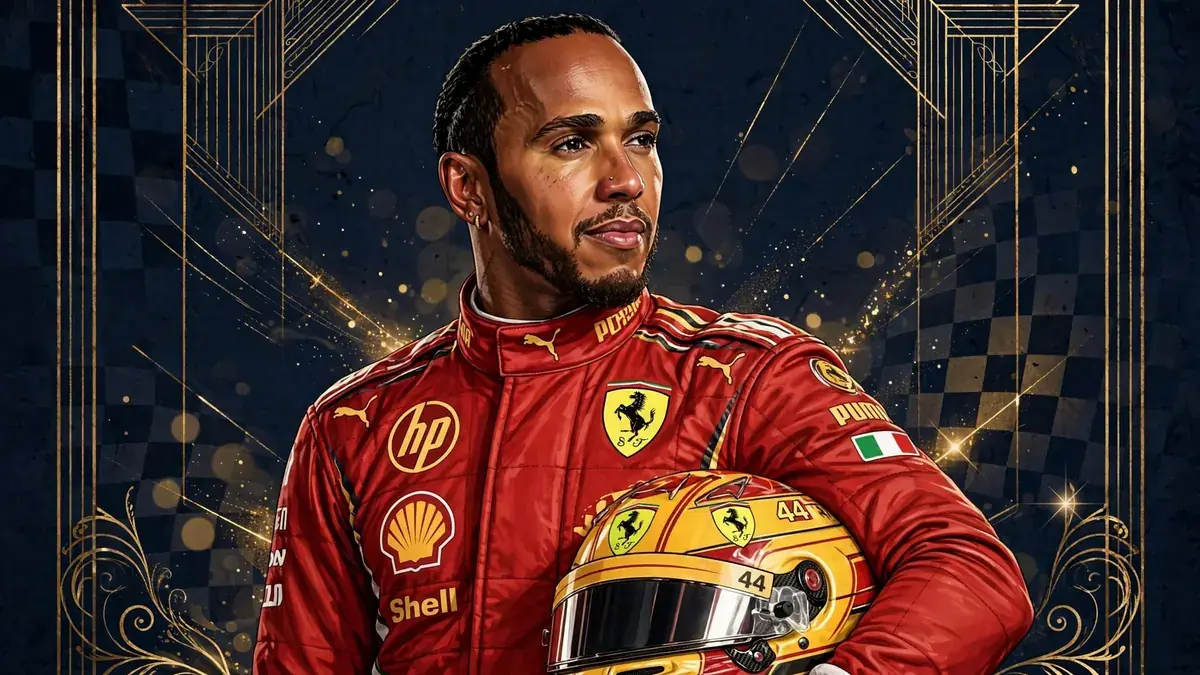
Contents
- From Stevenage to the Karting Tracks
- McLaren: The Rookie Who Nearly Won It All
- Mercedes and the Six Titles That Built a Legend
- Abu Dhabi 2021: The Eighth Title That Got Away
- The Ferrari Move: Betting Everything on Red
- Ferrari 2025: A Brutal First Season in Red
- Ferrari 2026: First Win in Red and the 400th Grand Prix
- The Money: Salary, Endorsements and Business Empire
- Net Worth Breakdown: Where the Fortune Sits
- Homes, Cars and the Collection
- Personal Life: Family, Relationships and Life Off Track
- Activism, Fashion and Hollywood
- Records and Legacy: The Numbers That Define Him
- Frequently Asked Questions
- Final Thoughts
- Sources and Reporting
| Full Name | Sir Lewis Carl Davidson Hamilton |
|---|---|
| Date of Birth | 7 January 1985 (41 years old as of November 2026) |
| Birthplace | Stevenage, Hertfordshire, England |
| Current Team | Scuderia Ferrari (since 2025; car number 44) |
| World Championships | 7 — 2008, 2014, 2015, 2017, 2018, 2019, 2020 (joint record with Michael Schumacher) |
| Career Wins / Poles / Podiums | 106 wins, 105 pole positions, 209 podiums (as of November 2026, per Formula1.com) |
| Estimated Net Worth | $450 million – $580 million (Celebrity Net Worth: $550 million; Sunday Times Rich List 2026: £435 million) |
| Primary Income Sources | Ferrari salary (about $60 million base per year), endorsements, business ventures and investments |
| Key Ventures | Mission 44, Dawn Apollo Films, Almave, Plus 44, X44, Denver Broncos minority stake, Card Culture |
| Honours | Knight Bachelor (2021), MBE (2009), honorary citizen of Brazil (2022) |
Last updated: 13 November 2026. By Celebamerica Editorial Staff.
From Stevenage to the Karting Tracks
Lewis Carl Davidson Hamilton was born on 7 January 1985 in Stevenage, a post-war new town in Hertfordshire, about 30 miles north of London. His father, Anthony Hamilton, is Black British with Grenadian roots. His mother, Carmen Larbalestier, is white British. His parents separated when Lewis was two years old. He lived with his mother and two half-sisters until he was twelve, then moved in with his father, his stepmother Linda and his half-brother Nicolas, who was born with cerebral palsy and would go on to become a racing driver himself.
The family had no money to spare and no connection to motorsport. Anthony worked in IT and took on extra jobs — at one point four at once — and remortgaged the family home to pay for his son’s karting. Lewis got his first taste of speed at six, when his father bought him a radio-controlled car. He finished runner-up in the British national radio-controlled car championship that year. Two years later, at eight, he sat in a go-kart for the first time, and the shape of his life was set.
Karting in Britain in the 1990s was a world of wealthy families and expensive machinery, and Hamilton was often the only Black driver on the grid. He has spoken since about the racial abuse he faced as a child on the karting circuits, and about how his father taught him to answer it on the track rather than off it. The results did the talking. Hamilton won the British cadet karting championship, then the Super One series, and by his early teens he was beating drivers with far bigger budgets.
The most famous story from those years is also the one that changed his life. At ten years old, dressed in a suit and bow tie, Hamilton walked up to McLaren team principal Ron Dennis at the Autosport Awards and asked for his autograph. He told Dennis that one day he wanted to race for his team. Dennis wrote in the autograph book, “Phone me in nine years,” and then signed him to McLaren’s young driver programme in 1998, when Hamilton was thirteen. It was the start of a relationship that would carry him all the way to Formula 1.
The junior formula ladder came next, and Hamilton climbed it without a wasted step. He won the Formula Renault UK championship in 2003, taking ten wins from fifteen races. He won the Formula 3 Euroseries in 2005. In 2006 he won the GP2 Series — the final step before Formula 1 — with ART Grand Prix, beating Nelson Piquet Jr. to the title. In four seasons of junior racing he had shown the same pattern every time: learn the category, then dominate it. McLaren had no reason left to wait.
McLaren: The Rookie Who Nearly Won It All
Hamilton made his Formula 1 debut for McLaren at the 2007 Australian Grand Prix, alongside the reigning double world champion Fernando Alonso. No rookie in the modern era had arrived with more expectation, and no rookie had ever started a career the way Hamilton did. He finished on the podium in each of his first nine races, a record that still stands, and won his first Grand Prix in Canada in only his sixth start. By mid-season he was leading the championship.
The year was not all smooth running. His relationship with Alonso turned sour as the two men fought over equal treatment inside the team, and McLaren became caught up in the “Spygate” affair, in which the team was found to hold confidential Ferrari technical information and was fined $100 million and thrown out of the constructors’ championship. Hamilton himself was not accused of wrongdoing, but the tension inside the garage was plain to see. At the final race in Brazil, a gearbox glitch dropped him to seventh, and Kimi Raikkonen took the title by a single point. Hamilton had come within one point of winning the world championship in his first season — something no driver had ever done before.
He made up for it a year later. The 2008 season went down to the final corner of the final lap of the final race, again at Interlagos. Felipe Massa won the race and, for about thirty seconds, believed he was world champion. Then Hamilton passed Timo Glock’s Toyota on the last corner to take the fifth place he needed, winning the title by a single point and becoming, at 23, the youngest world champion the sport had seen at that time. It was the most dramatic championship finish in Formula 1 history, and it announced Hamilton as the sport’s new standard-bearer.
The seasons that followed were leaner. McLaren slipped behind Red Bull, and Sebastian Vettel won four titles in a row from 2010 to 2013. Hamilton still won races every year — he has won at least one Grand Prix in sixteen different seasons, another record — but the car was rarely good enough to fight for a championship. There were low points too, including the 2009 “Liargate” affair in Australia, where Hamilton and the team misled the race stewards over a passing move under the safety car. He apologised publicly, and the episode remains the one real stain on his early career. By the end of 2012, with McLaren unable to give him a title-winning car and Mercedes offering a new project built around the coming hybrid engine rules, Hamilton made the decision that would define his career: he left the team that had raised him.
Mercedes and the Six Titles That Built a Legend
When Hamilton joined Mercedes for 2013, plenty of people in the paddock thought he had made a mistake. Mercedes had won a single race in three seasons since returning as a works team, and the driver he replaced was Michael Schumacher. Hamilton’s answer came in Hungary that July, when he won his first race for the team. Then came 2014, the first year of the turbo-hybrid engine rules, and everything changed.
Mercedes had built the best engine and the best car, and Hamilton spent the next seven seasons turning that advantage into the most dominant run in the sport’s history. He won the title in 2014 after a season-long fight with his teammate Nico Rosberg, a childhood friend who had become his fiercest rival. He won again in 2015. Rosberg hit back in 2016, winning the title by five points and then retiring five days later, a move that stunned the sport. Hamilton responded by winning four titles in a row from 2017 to 2020, a run that included his record-breaking 92nd win at Portimao in 2020, passing Schumacher’s long-standing mark of 91.
The numbers from those years are hard to take in all at once. Between 2014 and 2020, Hamilton won 74 of 133 races. He took 68 pole positions in the same span. Mercedes won eight consecutive constructors’ championships from 2014 to 2021. Hamilton’s seventh drivers’ title, sealed with a masterful drive in the wet at the 2020 Turkish Grand Prix, drew him level with Schumacher on seven championships — a record many believed would never be matched, let alone equalled by a driver still in his thirties.
It is worth saying plainly that Hamilton did not do this in an average car. The Mercedes of the hybrid era was the strongest package on the grid, and his teammates — Rosberg and then Valtteri Bottas — drove the same machinery. But the gap between Hamilton and his teammates was the story of those years. Rosberg needed the best season of his life to beat him once. Bottas, a fine driver, won ten races in five seasons as Hamilton’s teammate; Hamilton won 56 in the same period. The car gave him the chance. The driving turned it into history.
Off the track, those were also the years Hamilton became something larger than a racing driver. He used his platform to speak about racial diversity in motorsport, knelt before races in support of the Black Lives Matter movement, and pushed Formula 1 to confront the fact that the sport’s engineering ranks were overwhelmingly white and male. In 2020 he set up the Hamilton Commission with the Royal Academy of Engineering to study why so few Black people worked in British motorsport. The report’s findings led to real programmes, including his Mission 44 foundation. Plenty of athletes talk about change. Hamilton paid for it and kept showing up for it.
Abu Dhabi 2021: The Eighth Title That Got Away
Every great career has a wound that never fully closes, and for Hamilton it is the 2021 Abu Dhabi Grand Prix. He arrived at the season finale level on points with Max Verstappen after one of the best championship fights the sport has ever seen — 22 races, wheel-to-wheel racing, collisions at Silverstone, Monza and Jeddah, and two drivers separated by nothing. Hamilton led the race comfortably for 57 of its 58 laps and was eleven seconds clear with five laps to go, an eighth world title in his hands. Then Nicholas Latifi crashed, the safety car came out, and race director Michael Masi made a series of decisions about lapped cars and the restart that the FIA itself later admitted were wrong.
Verstappen, on fresh soft tyres, passed Hamilton on the final lap and took the title. Hamilton said nothing on the radio and nothing in the press conference afterwards that his critics could use against him. He congratulated Verstappen in the cool-down room, then disappeared from public view for two months. Mercedes protested the result, then withdrew the protest. The FIA removed Masi from his role and rewrote the safety car rules. None of it gave Hamilton the title back, and he has never publicly complained about the outcome since. Those who know him say the way he handled that night — no outburst, no blame, back to work — told you as much about the man as any of his wins.
The title fight itself deserves its place in the record. Hamilton won eight races that year, including a remarkable comeback drive in Brazil where he went from disqualification in qualifying and a sprint-race penalty to winning the Grand Prix from tenth on the grid. Verstappen won ten. The two men finished first and second in the championship, and the season is now remembered as one of the finest in the sport’s history. For the full story of the other side of that rivalry, read our Max Verstappen biography.
The Ferrari Move: Betting Everything on Red
On 1 February 2024, Formula 1 woke up to the biggest driver transfer in its history. Hamilton would leave Mercedes at the end of the season and join Ferrari on a multi-year deal from 2025. He was 39 years old, twelve seasons into a partnership that had delivered six world titles, and he was walking away from the only team he had known as a champion to join the sport’s most famous, most demanding and most political outfit. Ferrari had not won a drivers’ championship since Kimi Raikkonen in 2007.
Hamilton has said since that the decision was about more than racing. He grew up idolising Ayrton Senna, who never drove for Ferrari but spoke about the team with awe, and Michael Schumacher, whose five straight titles in red defined an era. Hamilton called it a childhood dream and said he needed a new challenge after more than a decade in silver. There was also a practical side. Mercedes had gone two seasons without a win, and the new car rules coming in 2026 offered Ferrari a fresh start. If he was going to win an eighth title anywhere, the reasoning went, it might as well be in the red car.
The announcement itself moved markets. Ferrari’s share price jumped the day the news broke, and the first photographs of Hamilton in red, taken outside Enzo Ferrari’s old house in Maranello in January 2025, became some of the most shared images in the sport’s history. Expectations were sky-high, and so was the pressure. Hamilton would be racing alongside Charles Leclerc, a driver fourteen years his junior who had spent his whole career at Ferrari and knew the team inside out. The whole paddock waited to see whether the sport’s greatest driver could make the sport’s greatest team his own.
Ferrari 2025: A Brutal First Season in Red
The first season did not go to plan. It started with a flash of what might have been: in only his second race for Ferrari, Hamilton took pole and won the Sprint race at the Chinese Grand Prix in March 2025, his first victory of any kind in red. Then the main race the next day delivered a warning. Both Ferraris were disqualified from the Chinese Grand Prix — Hamilton’s car for excessive skid-block wear — and the season fell apart from there.
Hamilton never stood on a Grand Prix podium in 2025, the first podiumless season of his career. His best results were a handful of fourth places. Qualifying, the skill that had made him the sport’s greatest one-lap driver, became his biggest weakness: he was eliminated in the first qualifying session in each of the final three races of the year, and failed to reach the top ten in four straight races. Leclerc, meanwhile, dragged the difficult SF-25 to seven podium finishes and finished fifth in the championship, 86 points ahead of his teammate. Hamilton ended the year sixth with 156 points.
The criticism was loud, and some of it was fair. The car did not suit him, the team’s communication frustrated him, and at 40 he was learning a completely new machine and a completely new way of working after twelve years at Mercedes. Former Alpine executive Marcin Budkowski called the season “painful to watch”. Hamilton himself was blunt about it, saying he had struggled to get the most from the car and that the year had tested him more than any other. But he also said he had no regrets about the move, and that he was already working with the team on the 2026 car and the new rules. The honest reading of 2025 is that it was a write-off on the track — and the foundation for what came next.
Ferrari 2026: First Win in Red and the 400th Grand Prix
The revival came in 2026, and it came in style. In June, Hamilton won the Barcelona Grand Prix — his first Grand Prix victory for Ferrari, the 106th win of his career, and his first win in almost five years of trying. The victory mattered beyond the result. It proved that the 2025 season had been about the car and not the driver, and it put Hamilton back in the championship fight in his twentieth season in the sport.
The season kept building. At the Mexico City Grand Prix in late October, Hamilton took his 105th career pole position and finished second, his 209th podium finish. After the United States Grand Prix in Austin he sat third in the drivers’ championship on 241 points, one point behind George Russell. Then came Sao Paulo, where Hamilton made his 400th Grand Prix start — a milestone only Fernando Alonso had reached before him, and one no other driver has ever reached without taking a break from the sport. Formula1.com marked the occasion with a full rundown of his records, noting that he now held the marks for most wins, most poles and most podiums in the sport’s history.
The numbers, updated after Mexico, tell the story of a career that refuses to end: seven world championships, 106 Grand Prix wins, 105 pole positions, 209 podiums, and 400 Grand Prix starts across twenty seasons with three teams. Hamilton turned 41 in January 2026. Nobody in the history of Formula 1 has won races across three decades, and nobody has stayed at the front for as long. Whether an eighth title comes in 2026 or beyond, the 2026 season already answered the only question that mattered after 2025: Lewis Hamilton can still win in a Ferrari.
The Money: Salary, Endorsements and Business Empire
Hamilton’s wealth was built the old-fashioned way for a racing driver: a very large salary, paid for a very long time, on top of endorsement income that has run into the tens of millions a year. His Ferrari deal pays a reported base salary of around $60 million a year, according to RacingNews365, before performance bonuses and personal sponsorships. Forbes estimated that Hamilton earned about $100 million in the twelve months ending 1 May 2026, a figure that put him among the ten highest-paid athletes in the world, and counted his career earnings at roughly $940 million through May 2026. For the full money story, our sister site GuideNetWorth breaks down Lewis Hamilton’s net worth in detail.
The salary history is just as striking. His last Mercedes deal, signed in 2023, paid about $60 million a year for the 2024 and 2025 seasons before he left a year early for Ferrari. Across his Mercedes years he was routinely the highest-paid driver on the grid, and his career earnings from salary alone run into the hundreds of millions. Endorsements have added a second fortune on top. His long partnership with Tommy Hilfiger, which began in 2018 and included his own TOMMYXLEWIS collections, made him one of the few athletes with a genuine fashion line rather than a logo deal. Monster Energy, Puma, IWC watches, Sony and Mercedes-Benz have all paid him over the years, and in 2025 he added Dior, as a menswear ambassador and guest designer, and lululemon, as the brand’s first motorsport ambassador.
The business portfolio is where Hamilton differs from most athletes his age. He co-founded Almave, an alcohol-free agave spirit backed by Pernod Ricard. He runs Plus 44, his own fashion label. He founded X44, an Extreme E off-road racing team. In 2022 he joined the Walton-Penner ownership group that bought the Denver Broncos for a record $4.65 billion, giving him a minority stake in an NFL franchise that Sportico has since valued at more than $9 billion. In 2026 he opened Card Culture, a chain of trading card stores built with Dave & Adam’s Card World, turning a childhood hobby into a retail business. And through Dawn Apollo Films, his production company, he has a producer credit on F1, the 2025 Brad Pitt racing film that grossed more than $600 million and became the highest-grossing sports film ever made.
Then there is the charity work, which Hamilton funds rather than just fronts. Mission 44, his social impact foundation, was launched in 2021 with a £20 million commitment of his own money, and funds programmes that help young people from underrepresented backgrounds into science, technology, engineering and maths careers. He also co-founded Ignite, a diversity and inclusion initiative inside Formula 1 itself. The Hamilton Commission, set up with the Royal Academy of Engineering, produced the research that underpins much of this work. It is the least commercial part of his empire and the part he talks about most.
Net Worth Breakdown: Where the Fortune Sits
Putting a number on Hamilton’s wealth is harder than it looks, because the public sources disagree by hundreds of millions. The table below shows the published estimates and what sits behind them. NetWorthCraft’s Lewis Hamilton net worth breakdown reaches a similar conclusion from the same public record.
| Source | Estimate (2026) | Basis |
|---|---|---|
| Celebrity Net Worth | $550 million | Career salary, endorsements and assets, updated 2026 |
| Sunday Times Rich List | £435 million (about $580 million) | UK rich list methodology, assets minus liabilities |
| Forbes (earnings) | About $100 million in the year to May 2026; about $940 million career earnings | Salary, bonuses, endorsements and business income before tax |
| Smaller outlets | $280 million – $350 million | Lower-end estimates, often using older salary data |
Our estimate, as of November 2026, is $450 million to $580 million. We anchor the range on Celebrity Net Worth at $550 million and The Sunday Times Rich List at £435 million, the two most established trackers, and we treat the lower figures from smaller sites as outdated rather than wrong — they lean on older salary data and miss the Ferrari deal, the F1 film income and the growth of the Broncos stake. The honest truth is that nobody outside Hamilton’s own accountants knows the exact number. He has never sold a company, never taken one public, and his private investments are not disclosed. What the public record supports is a fortune in the region of half a billion dollars, built over twenty seasons at the top of the best-paid sport in the world.
The range, in plain terms: take the $550 million Celebrity Net Worth figure and the £435 million Sunday Times figure as the two anchors, and the $280–350 million numbers from smaller sites as the floor. Our $450–580 million range sits where the serious reporting sits. If the Broncos stake keeps growing at its recent pace, the top of the range will look low within a few years.
Homes, Cars and the Collection
Hamilton’s property portfolio matches his life: spread across the three cities he calls home. He owns a mansion in Kensington, west London, reported by Celebrity Net Worth to be worth around $25 million. He keeps an apartment in Monaco, where he has lived for tax purposes since 2012, and property in New York, where he has bought and sold in Tribeca over the years. Reports also place property in his name in Geneva and Colorado, the latter fitting neatly with the Denver Broncos connection. He has never published a list of his homes, and the values attached to them in the press are estimates, not sale prices.
The car collection is the part fans ask about most, and it is genuinely remarkable. Hamilton has owned some of the most sought-after machines ever built: a McLaren P1, a Ferrari LaFerrari, a Mercedes-AMG One — the road car built around his championship-winning Formula 1 engine — and a string of classic Ferraris and Mercedes. Estimates of the collection’s value run from more than $20 million to around $40 million depending on the source, with Celebrity Net Worth at the top end of that range. There is a twist that surprises people: Hamilton has said he rarely drives most of them any more. He sold several cars in recent years, says he prefers electric vehicles for daily driving, and has described himself as moving away from collecting for its own sake. The garage is an asset, not a hobby, and he treats it that way.
Beyond property and cars, the assets that matter most to his net worth are the ones that do not photograph well: the Broncos stake, the equity in Almave and Dawn Apollo Films, and the fashion and retail businesses. These are the holdings that can grow while he sleeps, and they are the reason his fortune is likely to keep rising after he stops racing. A driver’s salary ends the day he retires. Equity does not.
Personal Life: Family, Relationships and Life Off Track
Hamilton has never married and has no children, as far as public information shows — a fact that surprises people given how famous he is, and one he has never treated as anyone’s business but his own. His best-known relationship was with the singer Nicole Scherzinger, which ran on and off from 2007 to 2015. Since then he has kept his romantic life almost entirely private, confirming nothing and letting the rumour mill spin without him. He splits his time between Monaco, London and New York, and his closest family remains central to his life: his father Anthony, who managed his early career and still attends races, his mother Carmen, his stepmother Linda, and his half-brother Nicolas, whose own racing career Hamilton has supported publicly.
He stands 1.74 metres tall — 5 feet 9 inches — which makes him one of the taller drivers on the grid in a sport where every centimetre of height costs speed. For the full details, see our Lewis Hamilton height page. He has been vegan since 2017, a choice he links to animal welfare and the environment, and he has invested in plant-based food businesses alongside it. His English bulldog Roscoe has been a paddock celebrity in his own right for years, with millions of followers and his own modelling career. Hamilton’s faith matters to him too; he has spoken about prayer and gratitude in interviews, and the words “Still We Rise” — the title of a Maya Angelou poem — have appeared on his helmets for years.
The private side of Hamilton is easy to miss because the public side is so loud: the fashion week front rows, the music studio sessions, the celebrity friendships. He recorded vocals under the pseudonym XNDA on Christina Aguilera’s 2018 track “Pipe”, has a playable skin in Fortnite, and has appeared in the Cars films. But those who work with him describe a man who is private, disciplined and, by the standards of his fame, remarkably grounded. Twenty seasons at the top of a sport that eats people alive tends to do that to a person — or it breaks them. Hamilton is still standing.
Activism, Fashion and Hollywood
There is a version of Lewis Hamilton’s story that ends at the chequered flag, and it would already be one of the great sporting biographies. But the second half of his public life — the part that will probably matter more in the long run — happens away from the track. He is the only Black driver in Formula 1 history, and he has used that position deliberately: kneeling before races, speaking about diversity in engineering, and funding the programmes that might change who gets to work in the sport.
Fashion is the most visible part of that second life. His Tommy Hilfiger collections sold around the world. In May 2025 he co-chaired the Met Gala alongside Colman Domingo, A$AP Rocky, Pharrell Williams and Anna Wintour, a role that placed him at the centre of the fashion world’s biggest night. His Dior menswear work and his lululemon ambassadorship followed the same pattern: not a sportsman lending his name to a brand, but a creative partner with opinions about the clothes. His own label, Plus 44, takes its name from his race number.
Hollywood came calling in the form of F1, the 2025 film starring Brad Pitt as a veteran driver returning to the sport. Hamilton produced the film through Dawn Apollo Films, worked as a consultant on the racing scenes, and helped make it the most realistic motorsport film ever shot — the production used real Formula 1 cars, real circuits and real race weekends. The film grossed more than $600 million worldwide, becoming the highest-grossing sports film ever made, and it turned a racing driver into a film producer with a genuine box-office hit. A deal with Skydance Sports followed. Whatever happens in the final years of his driving career, Hamilton already has a second career waiting.
Records and Legacy: The Numbers That Define Him
Records are the cleanest way to measure Hamilton, because the numbers are not a matter of opinion. As of November 2026, after his 400th Grand Prix start at Sao Paulo, he holds the all-time records for Grand Prix wins, pole positions and podium finishes, and shares the record of seven world championships with Michael Schumacher. The table below sets out the career in figures.

| Record | Figure (as of November 2026) |
|---|---|
| World Championships | 7 (2008, 2014, 2015, 2017, 2018, 2019, 2020) — joint record |
| Grand Prix Wins | 106 — all-time record |
| Pole Positions | 105 — all-time record |
| Podium Finishes | 209 — all-time record |
| Grand Prix Starts | 400 |
| Seasons With a Win | 16 |
| Wins at a Single Grand Prix | 9 at Silverstone (British GP) — record |
| Career Points | More than 5,200 |
| Teams | McLaren (2007–2012), Mercedes (2013–2024), Ferrari (2025–) |
The comparisons write themselves. Sebastian Vettel, the only other active-era driver with four or more titles, won 53 races and four championships before retiring in 2022 — a great career that still sits far behind Hamilton’s numbers. For the money side of that comparison, see our Sebastian Vettel net worth page. Fernando Alonso, Hamilton’s first teammate and the man who pushed him hardest as a rookie, is still racing at 45 and holds the record for most Grand Prix starts; read our Fernando Alonso age page for his story. And the new generation Hamilton now races against — men like Lando Norris, who leads McLaren’s revival — grew up watching him. Read our Lando Norris biography for the driver Hamilton’s career helped inspire.
Legacy is a word that gets thrown around too easily, but in Hamilton’s case it has three clear parts. The first is the record book: the wins, the poles, the podiums, the seven titles, and the fact that he did it with three different teams across three decades. The second is the door he opened. Before Hamilton, Formula 1 had never had a Black driver, and the sport’s engineering and leadership ranks remain overwhelmingly white. Mission 44 and the Hamilton Commission are his attempt to make sure the next Hamilton does not have to fight the same battles. The third is the eighth title he has not won yet. If it comes, he stands alone. If it does not, the argument about the greatest driver of all time will run for decades — and Hamilton will still be at the centre of it.
Frequently Asked Questions
What is Lewis Hamilton’s net worth in 2026?
As of November 2026, Lewis Hamilton’s net worth is estimated at $450 million to $580 million. Celebrity Net Worth puts the figure at $550 million, while The Sunday Times Rich List 2026 lists him at £435 million, roughly $580 million. Smaller outlets publish lower estimates of $280–350 million, but those rely on older salary data and miss his Ferrari deal and business income.
How many F1 world championships has Lewis Hamilton won?
Seven, in 2008 with McLaren and in 2014, 2015, 2017, 2018, 2019 and 2020 with Mercedes. That ties Michael Schumacher’s record of seven drivers’ titles. Hamilton is still chasing a record-breaking eighth championship with Ferrari.
How many Grand Prix wins does Lewis Hamilton have?
106 Grand Prix wins as of November 2026, the most in Formula 1 history. His first Ferrari win came at the 2026 Barcelona Grand Prix. He also holds the records for most pole positions (105) and most podium finishes (209).
Why did Lewis Hamilton leave Mercedes for Ferrari?
Hamilton announced the move on 1 February 2024, calling it a childhood dream and saying he needed a new challenge after twelve seasons and six titles with Mercedes. Ferrari offered a multi-year deal from 2025, a fresh start under the new 2026 rules, and the chance to win a record eighth title in the sport’s most famous red car.
How old is Lewis Hamilton?
Lewis Hamilton was born on 7 January 1985 in Stevenage, England, which makes him 41 years old as of November 2026. He made his Formula 1 debut in 2007 at 22 and is now in his twentieth season in the sport.
Is Lewis Hamilton married?
No. Lewis Hamilton has never married and has no children, as far as public information shows. His best-known relationship was with singer Nicole Scherzinger, which lasted on and off from 2007 to 2015. He keeps his romantic life private.
What is Lewis Hamilton’s salary at Ferrari?
Hamilton’s Ferrari deal pays a reported base salary of around $60 million a year, according to RacingNews365, before bonuses and personal sponsorships. Forbes estimated his total earnings at about $100 million in the twelve months to May 2026, making him one of the world’s ten highest-paid athletes.
What businesses does Lewis Hamilton own?
His main ventures are Mission 44 (his charity foundation), Dawn Apollo Films (producer of the F1 movie), Almave (an alcohol-free agave spirit), the Plus 44 fashion label, the X44 racing team, a minority stake in the Denver Broncos, and Card Culture trading card stores. He also has long-running endorsement deals with Tommy Hilfiger, Dior and lululemon.
Final Thoughts
Lewis Hamilton’s biography is not finished, and that is what makes it worth reading now. At 41, in his twentieth season, he has already done what no driver in the history of Formula 1 has done: 106 wins, 105 poles, 209 podiums, seven titles, 400 starts. He has also done what very few athletes manage at all — built a second career, in business, film and fashion, that will outlast the first, and used his fame to fund real change through Mission 44.
The Ferrari chapter will decide how the story ends. If the eighth title comes, he stands alone at the top of the sport, and the gamble of leaving Mercedes at 39 becomes the defining move of his career. If it does not, he still leaves behind a record book nobody has matched and a legacy that reaches far beyond the track. Either way, the boy from Stevenage who asked Ron Dennis for an autograph at ten years old has already won. For more stories in this series, browse our celebrity biographies.
Sources and Reporting
This biography was researched from live reporting and official sources in November 2026. Career statistics (106 wins, 105 poles, 209 podiums, 400 starts) are from Formula1.com (5 November 2026) and Wikipedia. Net worth figures are from Celebrity Net Worth ($550 million, 2026) and The Sunday Times Rich List 2026 (£435 million), with earnings data from Forbes (about $100 million in the year to May 2026; about $940 million career earnings). Salary reporting is from RacingNews365. The 2025 Ferrari season account draws on Associated Press reporting (December 2025) and PlanetF1. Business and personal-life details are from Formula1.com’s off-track reporting and contemporary news coverage.
How we estimated: net worth figures are estimates built from publicly reported salaries, endorsement deals, property records and business holdings, checked against named sources. Where sources disagree we publish a range and say which source anchors it. Private investments, taxes and personal spending are not public, so the true figure may sit above or below our range. Figures are dated November 2026 and will change as new reporting appears.