Kimi Raikkonen is 47 years old in 2026. Born Kimi-Matias Räikkönen on October 17, 1979, in Espoo, Finland, the man known to every Formula 1 fan as “the Iceman” turned 47 on October 17, 2026 — five years after he walked away from Formula 1 as the sport’s most experienced driver ever, and weeks after his 11-year-old son Robin was signed to Red Bull’s junior driver programme. He turns 48 on October 17, 2027.
That birthday matters because Raikkonen’s age has always been part of his story. He was 21 when Sauber handed him a Formula 1 seat with almost no junior racing on his CV. He was 28 when he won the 2007 world championship with Ferrari by a single point. He was 39 when he won his last Grand Prix, the 2018 United States Grand Prix. And he was 42, the oldest driver on the grid by years, when he retired after the 2021 Abu Dhabi Grand Prix with a record 349 Grand Prix starts. This page answers the age question in full: his exact birth date, his age at every milestone, how his longevity stacks up against the other greats, and what life looks like for the Iceman at 47. Last updated: November 2026.
| Full Name | Kimi-Matias Räikkönen |
|---|---|
| Date of Birth | October 17, 1979 |
| Birthplace | Espoo, Finland |
| Age in 2026 | 47 (turned 47 on October 17, 2026; turns 48 on October 17, 2027) |
| Nickname | “The Iceman” |
| Height | 5 ft 9 in (175 cm) |
| Formula 1 Career | 2001–2021 (Sauber, McLaren, Ferrari, Lotus, Alfa Romeo) |
| Career Highlights | 2007 World Champion; 21 Grand Prix wins; 103 podiums; 349 starts |
| Estimated Net Worth | About $250 million (widely reported estimate; Celebrity Net Worth, GQ Sports) |
| Primary Income Sources | Formula 1 salaries (notably the Ferrari contracts), endorsements, rally and NASCAR outings |
| Current Role | Team principal of Kawasaki’s factory motocross team (since 2022); father of karting prospect Robin Räikkönen |
| Spouse | Minttu Virtanen (married 2016) |
Contents
- How Old Is Kimi Raikkonen in 2026?
- Kimi Raikkonen’s Age at Every Career Milestone
- Early Life in Espoo: Karting at Ten
- The Fast-Track to Formula 1: An F1 Driver at 21
- The McLaren Years: Runner-Up at 24 and 26
- Ferrari and the 2007 World Title at 28
- The Rally Years and the Lotus Comeback
- The Long Goodbye: Last Win at 39, Retirement at 42
- Life After F1 at 47
- Kimi Raikkonen’s Net Worth and Career Earnings
- How His Age Compares to Other F1 Greats
- Personal Life: Minttu, Family and Height
- The Iceman: Personality, Quotes and Legacy
- Frequently Asked Questions
- Final Thoughts
- Sources and Reporting
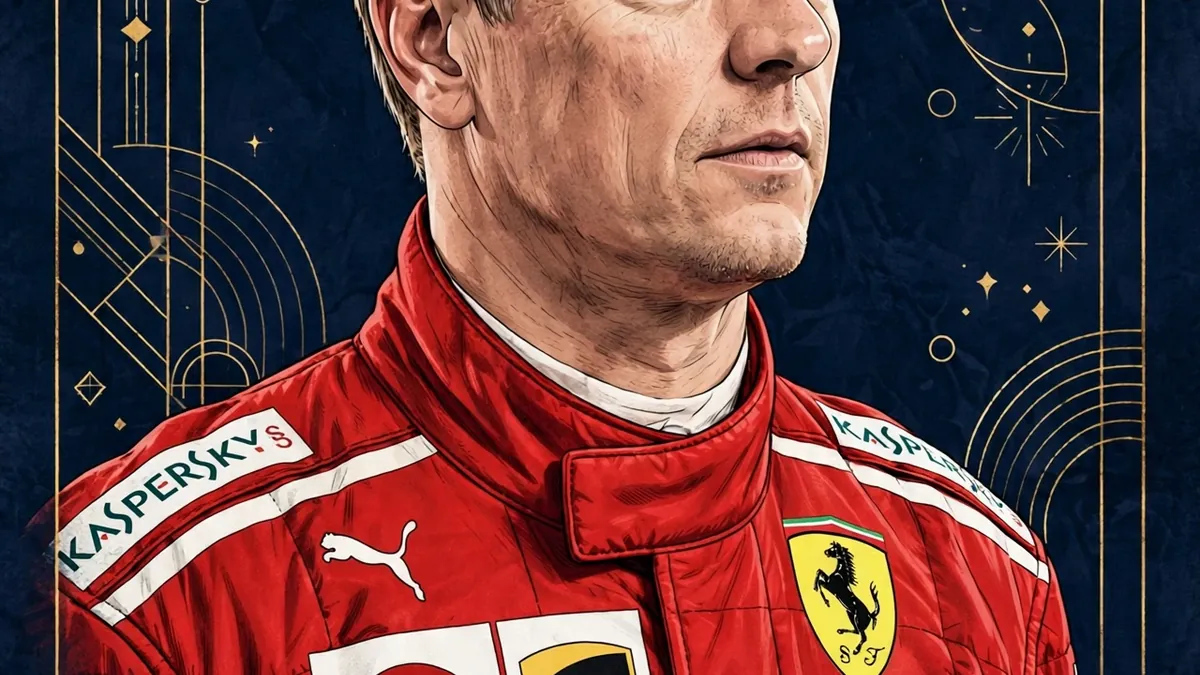
How Old Is Kimi Raikkonen in 2026?
Kimi Raikkonen is 47 years old. He was born on October 17, 1979, which means he spent most of 2026 aged 46 before his birthday in October moved him to 47. Anyone checking his age in the first nine months of the year would have found 46; from October 17, 2026 onward, the answer is 47. He will turn 48 on October 17, 2027.
The date is one of the most solidly documented facts in motorsport. Formula 1’s own hall-of-fame profile lists his birth as October 17, 1979, in Espoo, a suburb of Helsinki, and the same date appears across his Wikipedia entry, Autosport’s driver profile and every major net-worth and biography outlet that tracks him. There is no dispute about it, which is more than can be said for some of the money figures attached to his name — those we treat as estimates, and we say so plainly in the earnings section below.
Why do so many people keep asking? Partly because Raikkonen’s age became a running storyline in the second half of his career. From 2019 onward he was the oldest driver on the Formula 1 grid, and the paddock kept asking whether the veteran of nearly 300 Grands Prix would finally call it a day. He kept answering on track instead: in 2019, the year he turned 40, he scored 43 of Alfa Romeo’s 57 points and outscored a team-mate 15 years his junior, Antonio Giovinazzi. Age, for Raikkonen, was a talking point other people worried about. He simply kept driving fast.
The question has picked up fresh steam in 2026 for a reason that has nothing to do with Kimi himself. On September 9, 2026, Red Bull announced that his 11-year-old son Robin — nicknamed “Ace” — had signed for its junior driver programme, starting work with the team from 2027. The news made the rounds under headlines like “a new Iceman cometh,” and it sent a wave of fans back to the basic facts: if his son is 11 and already signed to Red Bull, how old is Kimi now? The answer, 47, still surprises people who remember him as the silent 21-year-old who showed up at Sauber in 2001 with 23 car races behind him.
Kimi Raikkonen’s Age at Every Career Milestone
No driver in Formula 1 history has stretched a career across so many birthdays while staying competitive. Raikkonen raced in four different decades of his own life — his twenties, thirties and forties — and the age column tells the story better than any paragraph. Here is the full timeline, with his age at each turning point.
| Age | Date | Milestone |
|---|---|---|
| 10 | 1989–1990 | Starts karting in Finland |
| 20 | 2000 | Wins the British Formula Renault championship (13 wins from 23 races) |
| 21 | March 4, 2001 | Formula 1 debut with Sauber at the Australian Grand Prix; scores a point on debut |
| 23 | March 23, 2003 | First Grand Prix win, Malaysian Grand Prix with McLaren |
| 24 | 2003 | World championship runner-up to Michael Schumacher, by 2 points |
| 26 | 2005 | World championship runner-up to Fernando Alonso; wins 7 races, the most that season |
| 27 | 2007 (season start) | Joins Ferrari on a reported three-year deal worth about $153 million |
| 28 | October 21, 2007 | Wins the World Drivers’ Championship with Ferrari, by 1 point |
| 30 | 2009–2010 | Leaves F1; competes in the World Rally Championship (2009–2011) |
| 32 | 2012 | Returns to F1 with Lotus; wins the Abu Dhabi Grand Prix |
| 34 | 2014 | Rejoins Ferrari for a second stint |
| 39 | October 21, 2018 | Last Grand Prix win, United States Grand Prix at Austin — 113 races after his previous win |
| 40 | 2019 | Becomes the oldest driver on the grid; joins Alfa Romeo and outscores his team-mate |
| 42 | December 12, 2021 | Retires after the Abu Dhabi Grand Prix, with a record 349 Grand Prix starts |
| 42 | 2022 | Becomes team principal of Kawasaki’s factory motocross team |
| 47 | September 9, 2026 | Son Robin, 11, signs for Red Bull’s junior driver programme |
| 47 | October 17, 2026 | Turns 47 |
Read the table from top to bottom and one thing stands out: the gaps. Eleven years passed between his first win and his championship, and another eleven between the championship and his final win. Most drivers get one peak; Raikkonen had three — the McLaren speed of his mid-twenties, the Ferrari title at 28, and the stubborn, late-career win at Austin at 39 that ended a winless run of 113 races, the longest gap between victories in the sport’s history at the time.
Early Life in Espoo: Karting at Ten
Kimi-Matias Räikkönen was born on October 17, 1979, in Espoo, Finland, and grew up in a house his great-grandfather had built in the suburb outside Helsinki. His parents, Matti and Paula, worked as a road builder and an office clerk, and the family had no racing money to speak of. The karting career that made him began the way Finnish racing careers often begin: with parents who were willing to drive long distances, work long hours, and spend what little spare money there was on tyres and fuel.
He started karting at ten, and the early stories have become part of his legend. He was a reluctant student who, as Formula 1’s own profile of him records, used his schoolbag as a sled to slide down snow-covered hills. He liked winter sports, especially ice hockey, but gave it up because he hated getting up for early-morning practice — a small detail that tells you a lot about the adult Raikkonen, who built a whole career on doing the driving and skipping the noise around it.
Finland has a habit of producing fast, quiet racing drivers — Mika Häkkinen, Keke Rosberg and his son Nico, Valtteri Bottas — and the reasons are usually given as the country’s karting culture, its long winters, and its gravel roads. Raikkonen’s path ran through the usual Finnish ladder: karts, then Formula Renault in Britain, where in 2000 he won 13 of 23 races in the British Formula Renault championship at the age of 20. That title was the whole of his junior single-seater record. He had contested 23 car races in total when Sauber signed him. By the standards of modern Formula 1, where drivers arrive with a decade of junior formulae behind them, it was almost nothing.
The move drew complaints. Rival team bosses pointed out that Raikkonen held only a provisional superlicence and had barely raced a car. Sauber’s answer was to put him in the car and let the stopwatch settle it. At his first test, and then at his debut, the stopwatch agreed with Sauber. The fuss about his inexperience is worth remembering now, because the same paddock that questioned whether a 21-year-old with 23 races was ready would spend the next twenty years asking whether a 40-year-old with 300 races was too old. Raikkonen’s answer was the same both times: he drove, and the questions went away.
The Fast-Track to Formula 1: An F1 Driver at 21
Raikkonen made his Formula 1 debut at the Australian Grand Prix on March 4, 2001, aged 21, driving for Sauber. He finished sixth and scored a point on his debut — a result that looks modest on paper and was anything but. A rookie with 23 car races scoring points in his first Grand Prix, in a midfield car, was the kind of debut that makes team principals reach for their chequebooks.
He scored points in four of his first five races that season and finished tenth in the championship with nine points. It was enough for McLaren, then one of the sport’s two great teams, to sign him for 2002 as the replacement for the retiring double world champion Mika Häkkinen. Raikkonen was 22 years old and, after a single season, was driving for a team that expected to win championships. The step up was enormous, and it is worth pausing on how young he was: at the same age, most current Formula 1 drivers are still working through their second or third season in the junior categories.
His first seasons at McLaren were a study in speed held back by machinery. The cars were quick and fragile in roughly equal measure. He took his first pole position and his first podium in 2002, and his first win came at the Malaysian Grand Prix on March 23, 2003, when he was 23. That year he finished runner-up in the world championship to Michael Schumacher by just two points, despite driving a car that was a year old for much of the season. He was 24 years old and one small swing away from being world champion.
What people noticed, even then, was not just the speed but the silence. Raikkonen gave the shortest answers in the paddock, showed nothing on his face, and treated the media duties of a McLaren driver as a chore to be endured. The nickname “the Iceman” stuck, and it would follow him for the rest of his career — past the title, past the rally years, past retirement, and now, at 47, into his son’s career too.
The McLaren Years: Runner-Up at 24 and 26
Between 2002 and 2006, Raikkonen drove for McLaren-Mercedes. The record of those five seasons reads like a list of what might have been: 9 wins, 26 podiums, and two championship runner-up finishes, in 2003 and 2005, both lost to drivers in more reliable cars. In 2005, aged 26, he won seven Grands Prix — more than anyone else that season, including the eventual champion Fernando Alonso — but lost the title by 21 points because his McLaren kept breaking. The car’s engine failures that year became a standing joke with a sharp edge: Raikkonen was the fastest driver on the grid in a car that could not be trusted to finish.
Those McLaren years also fixed the shape of his public image. He won the 2005 Japanese Grand Prix from 17th on the grid, one of the great drives of the modern era, and then answered questions about it in monosyllables. He was photographed asleep on a yacht, falling off a table at a party, and turning up to sponsor events in a gorilla suit. The contrast between the driving — precise, fearless, and fast — and the personality — laconic to the point of parody — made him the most popular driver in the sport. Fans who could not warm to the polished corporate stars of the era loved a driver who plainly did not care about being loved.
By the end of 2006, McLaren had gone a full season without a win, and Raikkonen had a decision to make. Ferrari, the team of Michael Schumacher, had a seat open because Schumacher was retiring. Raikkonen took it. He was 27 years old, and about to sign the contract that would make him the highest-paid driver in Formula 1.
Ferrari and the 2007 World Title at 28
Raikkonen joined Ferrari for the 2007 season, hired, as Formula 1’s own history puts it, for a reported $41 million a year to fill the void left by the departing seven-time world champion Michael Schumacher. The full three-year deal was reported at about $153 million, or roughly $51 million a season before bonuses — the richest driver contract in the sport at the time. Forbes ranked him the fifth highest-paid athlete in the world in 2008, with about $44 million earned in a single year.
The money was a burden as much as a reward. Schumacher’s shadow covered the team, the car, and the garage, and Raikkonen’s first months in red were uneven. He won the season opener in Australia from pole position, then drifted. Going into the final race of the season in Brazil, he sat third in the championship, seven points behind the rookie Lewis Hamilton and three behind the two-time champion Fernando Alonso. He had won more races than either of them — five to their four apiece — but the arithmetic said he was the long shot.
What happened at Interlagos on October 21, 2007, four days after Raikkonen’s 28th birthday, is one of the great finales in the sport’s history. He won the race. Hamilton, who had led the championship all season, finished seventh after a gearbox problem. Alonso finished third. Raikkonen took the title by a single point — 110 to 109 to 109 — becoming the first Ferrari driver to win the championship in his debut season with the team since Juan Manuel Fangio in 1956. On the podium, the Iceman finally broke his silence: he swigged champagne, sprayed it, and grinned. It remains the defining image of his career.
He was 28 years old, a world champion, and the best-paid driver in Formula 1. It was also, in hindsight, the peak. He stayed at Ferrari for two more seasons, winning five more races, but the team lost its way, and at the end of 2009 Ferrari paid him to leave a year early to make room for Fernando Alonso. Raikkonen, who had never hidden his dislike of the political side of Formula 1, did not argue. He left the sport entirely, at 30, and went rallying.
The one-point title: Raikkonen’s 2007 championship is still the closest three-way finish in Formula 1 history. He won it with six victories to Hamilton’s and Alonso’s four each, and the margin — one point — has never been matched in a three-way fight. He was 28 years and four days old when the flag fell in Brazil.
The Rally Years and the Lotus Comeback
Most world champions who leave Formula 1 at 30 never come back. Raikkonen spent 2010 and 2011 in the World Rally Championship, driving a Citroën for his own junior team, and in 2011 he also tried NASCAR, running a handful of Truck Series and Nationwide Series races in the United States. The rally results were modest — a best finish of fifth — but that was never really the point. He was driving because he wanted to drive, on his own terms, without the sponsor dinners and the politics. He also won a snowmobile race in Finland under the alias “James Hunt,” a story that still gets told in the paddock because it is so perfectly, stupidly Raikkonen.
The comeback began in late 2011, when Lotus — the team that had been Renault — offered him a return for 2012. He was 32, two years out of the sport, and the paddock wondered whether the speed would still be there. It was. He finished on the podium in his third race back, won the Abu Dhabi Grand Prix that November, and finished third in the championship. Over two seasons with Lotus he scored two wins and 15 podiums, and he did it while the team was falling apart financially around him. The most famous episode came at the 2013 Abu Dhabi Grand Prix, when his race engineer told him over the radio to keep his tyres warm and he replied with the line that became a T-shirt: “Leave me alone, I know what I’m doing.” He was 34, and he had become a folk hero for saying out loud what every driver thinks.
The money at Lotus was also a story in itself. His contract paid him a reported 50,000 euros per championship point, and because he scored so many points, the team owed him a fortune it could not pay. Reports at the time put the unpaid sum at several million euros, and it was one of the reasons he left. The episode is a useful reminder of how Raikkonen’s career worked: the driving was always world-class; the business around it was sometimes chaos.
The Long Goodbye: Last Win at 39, Retirement at 42
Raikkonen returned to Ferrari in 2014, aged 34, for a second stint that lasted five seasons. The first three were spent as the clear second driver to Sebastian Vettel, and the results were solid rather than spectacular: podiums, poles, and the loyalty of a team-mate who never caused trouble. Then came Austin, Texas, on October 21, 2018 — his 39th birthday, to the day — when he won the United States Grand Prix. It was his first victory in 113 races, a gap of five and a half years since his previous win, and the longest wait between wins the sport had ever seen. He was 39 years old, a multimillionaire, a veteran of 294 Grands Prix, and he could easily have retired that night. He did not. He signed for Alfa Romeo instead.
From 2019, driving for the newly renamed Alfa Romeo team, Raikkonen was the oldest driver on the grid, and he wore the fact lightly. In 2019, the year he turned 40, he scored 43 of the team’s 57 points and finished ahead of Antonio Giovinazzi, a team-mate 15 years younger. He kept going through 2020 and into 2021, when the pandemic season forced him to miss two races after a positive Covid test, and still scored 10 of his team’s 13 points that year.
He announced his retirement on September 1, 2021, with a short social-media post — no farewell tour, no press conference, no tears. His final race was the Abu Dhabi Grand Prix on December 12, 2021. He was 42 years old. His car broke down after 25 laps, which felt, to everyone watching, like a final joke from a career that had always mixed brilliance with breakdowns. He left with 349 Grand Prix starts — 353 entries, 349 starts, the difference being races he entered but did not start — then the most in Formula 1 history, along with 21 wins, 103 podiums, 18 pole positions and 46 fastest laps, the third-most fastest laps of all time. The starts record has since been passed by Fernando Alonso, but at the moment Raikkonen walked away, nobody had started more Grands Prix than the Iceman.
His age at retirement invites a comparison with the present grid. Lewis Hamilton, born in 1985, was still racing and winning into his late thirties. Fernando Alonso, born in 1981, was still on the grid in his mid-forties. Raikkonen retired at 42, younger than Alonso is now — but he had been racing at the top for twenty years, across two stints, and he had a family waiting at home. The decision was his, it was final, and he has never shown a flicker of interest in coming back.
Life After F1 at 47
Retirement has suited Raikkonen. In 2022, at 42, he became team principal of Kawasaki’s factory motocross team, a role he still holds in 2026, with riders including Romain Febvre, Pauls Jonass and Mathis Valin on the roster. It is a job that uses everything he learned in two decades of factory racing — the engineering judgement, the calm under pressure, the understanding of what a rider needs from a team — without asking him to sit in a cockpit himself.
He has also stayed close to racing in other ways. He made two NASCAR Cup Series outings, in 2022 and 2023, driving for Trackhouse Racing’s Project 91 entry at Watkins Glen and at the Circuit of the Americas, and he has been a regular presence at karting events, usually standing at the side of the track watching his son. In a December 2026 interview with Motor Sport, he described himself as his son’s mechanic and said the boy was “almost as quick” as he was — a line that reads as a joke until you remember that Raikkonen does not joke about driving.
Then came September 9, 2026. Red Bull announced that Robin Räikkönen, 11 years old, had signed for its junior driver programme and would start working with the team from 2027. The announcement was made at Monza, on the weekend of the Italian Grand Prix, and the paddock reaction was a mix of delight and disbelief: the Iceman’s son, signed by Red Bull at eleven. Max Verstappen, the four-time world champion, said he had met Kimi and Robin at Monza and already knew the signing was done. Red Bull team principal Laurent Mekies said Robin had “already demonstrated exceptional ability in karting,” and pointed to the programme’s record — it had produced Sebastian Vettel and Verstappen. Kimi’s own comment was short, even by his standards: “We are all thrilled and excited that Robin has been chosen to further his racing path as a member of the Red Bull Junior Team.” The signing was confirmed by Formula 1 itself, by ESPN, by Crash.net and by PlanetF1, all on the same day.
For a man who spent twenty years dodging the spotlight, the irony is plain: at 47, Kimi Raikkonen is back in the Formula 1 conversation because of his son. He turns 48 in October 2027, and by then Robin will be working inside the Red Bull system, the same system that made Verstappen. Whether the boy follows his father all the way to Formula 1 is a question for the 2030s. What is certain is that the Raikkonen name is not finished with racing yet.
Kimi Raikkonen’s Net Worth and Career Earnings
An age profile is not a money profile, but the two questions travel together: people who ask how old Raikkonen is usually want to know what twenty years at the top of Formula 1 was worth. The short answer is that his net worth is widely reported at about $250 million. Celebrity Net Worth lists the figure at $250 million, updated in April 2026, and networth.com’s 2026 profile puts it at “about $250 million,” noting that GQ Sports put the figure at about $254 million in its December 2025 ranking of the richest Formula 1 drivers of all time. Other outlets land lower — SillySeason, for example, lists $200 million — so a fair range is $200 million to $254 million, with $250 million as the anchor most sources agree on. There is no Forbes valuation and no national rich-list entry for him, so the number should be read as a well-sourced estimate, not an audited fact.
For the full breakdown of his fortune — the Ferrari contracts, the Forbes years, the Lotus points deal, and the endorsement income — our sister site’s money profile covers it in depth: Kimi Raikkonen’s net worth on GuideNetWorth. The headline numbers behind that figure are worth setting out here, because they explain how a driver who won a single world championship ended up with a quarter of a billion dollars.
The foundation was the first Ferrari contract. The three-year deal he signed for 2007–2009 was reported at about $153 million, or roughly $51 million a season before bonuses, and it made him the highest-paid driver in the sport. Forbes put his earnings at about $44 million for the year to June 2008 — fifth among all athletes in the world that year — and about $45 million the following year. Networth.com’s analysis estimates that his Formula 1 salaries across 19 seasons came to well over $200 million in total, with the peak years at Ferrari in 2007–2009 and again in 2014–2015, when the Business Book GP estimated his pay at about 18 million euros.
The later years paid less but still handsomely. His Lotus deal famously paid per point — a reported 50,000 euros per championship point — and his strong results there earned him a large sum the team struggled to pay. His final contract, at Alfa Romeo in 2021, was estimated by RaceFans at about $10 million. Endorsements added to the total: he was ranked 32nd on Forbes’ highest-paid athletes list in 2015 with about $27 million for the year, including about $2 million from endorsements, and his long association with sponsors through Ferrari and McLaren kept the commercial income flowing long after his peak salary years.
What he did with the money is less documented than the money itself. He owns property in Switzerland and Finland, and he has spoken about the estates he built during his career, but the details of his real estate and investments are private — and Raikkonen has always been more private than most drivers about his life off track. We do not invent property lists. What is certain is that the fortune was built on salary, not on business ventures: unlike some of his rivals, Raikkonen never built a fashion label, a drinks brand, or a team of his own. He drove, he got paid extremely well for driving, and he kept the money.
| Period | Team / Source | Reported Pay |
|---|---|---|
| 2001 | Sauber | Modest rookie salary (not publicly reported) |
| 2002–2006 | McLaren | Rising to a reported $10 million+ a year by 2005–2006 |
| 2007–2009 | Ferrari | Three-year deal reported at about $153 million (about $51 million a year) |
| June 2007–June 2008 | Ferrari | About $44 million total earnings; 5th among all athletes (Forbes, 2008) |
| 2008–2009 | Ferrari | About $45 million total earnings (Forbes, 2009) |
| 2012–2013 | Lotus | Reported 50,000 euros per championship point; large unpaid balance reported |
| 2014–2015 | Ferrari | About 18 million euros in 2015 (Business Book GP estimate) |
| 2019–2021 | Alfa Romeo | About $10 million in 2021 (RaceFans estimate) |
| Career total | F1 salaries | Well over $200 million (networth.com estimate) |
One caution: the $250 million figure is an estimate built from reported salaries, and it does not account for taxes, management fees, or spending. Raikkonen’s own lifestyle was never extravagant by the standards of the sport — he was famous for driving an old car, wearing the same clothes, and treating a private jet as a waste of money. The fortune is real, but the man who earned it never looked like he was trying to spend it.
How His Age Compares to Other F1 Greats
Raikkonen’s longevity only makes sense against the drivers he raced with — and against the ones who came after him. He shared the grid with three of the four most successful drivers in the sport’s history, and he outlasted two of them. The comparison below uses the ages at which each driver won, peaked, and left, because that is where Raikkonen’s career looks most unusual.
Michael Schumacher, the man Raikkonen replaced at Ferrari, was 37 when he retired the first time in 2006, came back at 41, and retired for good at 43 — almost exactly Raikkonen’s retirement age. But Schumacher’s comeback was three quiet seasons at Mercedes; Raikkonen’s final act included a race win at 39 and a season at 40 in which he carried his team. Sebastian Vettel, Raikkonen’s Ferrari team-mate from 2015 to 2018, retired at 35 after winning four titles before he turned 27 — the opposite arc, a driver who peaked early and left while still quick. Sebastian Vettel’s age at retirement tells the same story from the other side: he was seven years younger than Raikkonen when he stopped.
Fernando Alonso’s age is the closest parallel. Alonso, born in July 1981, is two years younger than Raikkonen, and the two men fought each other for championships in 2003, 2005 and 2007. Alonso is still racing in his mid-forties, which has finally taken the “oldest driver” label that Raikkonen wore from 2019 to 2021. The difference is that Alonso never left the sport for two years to go rallying; Raikkonen did, and still came back to win again. Lewis Hamilton’s biography covers the third man in the 2007 title fight — the rookie who lost that championship by a point at 22 and went on to win seven titles. Hamilton was still winning races in his late thirties, and his longevity owes something to the example Raikkonen set: a driver who proved that a 39-year-old could still win a Grand Prix in the modern era.
The generational handover is now visible in the other direction. Max Verstappen’s biography tells the story of the driver who arrived at 17 — four years younger than Raikkonen was at his debut — and won four championships before turning 28. Verstappen is the same age now that Raikkonen was when he won his title, and the symmetry is neat: the youngest winner of a Red Bull junior programme that has now signed Raikkonen’s 11-year-old son. The sport moves on, and the names change, but the ages keep rhyming. For more on how the sport’s stars spend their later years, see our Personal Life category, which follows drivers and celebrities beyond their competitive careers.
| Driver | Born | Age at First Title | Age at Last Win | Age at Retirement |
|---|---|---|---|---|
| Kimi Raikkonen | 1979 | 28 (2007) | 39 (2018) | 42 (2021) |
| Michael Schumacher | 1969 | 25 (1994) | 37 (2006) | 43 (2012) |
| Fernando Alonso | 1981 | 24 (2005) | 32 (2013) | Still racing at 45 |
| Lewis Hamilton | 1985 | 23 (2008) | 39 (2024) | Still racing at 41 |
| Sebastian Vettel | 1987 | 23 (2010) | 32 (2019) | 35 (2022) |
| Max Verstappen | 1997 | 24 (2021) | 28 and counting | Still racing |
Two things stand out from that table. First, Raikkonen’s 11-year gap between his first and last wins is unmatched among the group — nobody else on the list won races across three different decades of their life. Second, his retirement age of 42 sits in the middle of the range, which is the point: he did not retire because he was old. He retired because he had done it for twenty years, and he had a family and a life waiting. The age was a number. The decision was his.
Personal Life: Minttu, Family and Height
Raikkonen has been married to Minttu Virtanen since 2016. Minttu, a former air hostess and fitness model, had been his partner for several years before the wedding, and the couple have two children: a son, Robin, born in 2015, and a daughter, Rianna, born in 2017. Robin is the 11-year-old who signed for Red Bull’s junior programme in September 2026; Rianna, nine, keeps a lower profile, and the family guards the children’s privacy closely.
The family lives between Switzerland and Finland, and Raikkonen’s home life has always been kept separate from the sport. He has never sold a reality show, never written a tell-all, and never turned his family into content. The few glimpses the public gets come from Minttu’s social media and from the occasional paddock appearance — Robin in the Red Bull garage at Monza in September 2026, sitting in the team’s car, with his father beside him. It was the first time many fans had seen the two of them together at a race, and it was, by Raikkonen’s standards, a public moment.
His height is 5 feet 9 inches (175 cm) — about average for a Formula 1 driver, and an inch or two taller than some of his rivals. In a sport where cockpit space is measured in millimetres and every kilo of driver weight is a performance penalty, his height was never an advantage or a problem; it was simply part of the package. For readers comparing him with other drivers, the physical facts are straightforward: average height, compact build, and a driving style that relied on feel and precision rather than strength.
Before Minttu, Raikkonen was married to Jenni Dahlman, a former Miss Scandinavia, from 2004 to 2014. The marriage ended in divorce, and Raikkonen has never spoken about it publicly. That silence is characteristic: his private life has always been private, and the rare occasions when it surfaces in the press are usually because someone else put it there. The rule he has kept for twenty-five years is simple — the driving is public, the rest is not — and it has held through a world championship, a retirement, and now his son’s first steps in the sport.
The Iceman: Personality, Quotes and Legacy
Every profile of Kimi Raikkonen eventually reaches the same place: the personality. He is the most famously laconic driver in Formula 1 history, and the stories are endless. Asked what he would do with a new baby, he said he would “change the nappies.” Asked about his helmet design, he said he did not care what it looked like. Told by his race engineer at the 2012 Abu Dhabi Grand Prix to keep his tyres warm, he replied, “Leave me alone, I know what I’m doing” — and then won the race. At the 2013 Indian Grand Prix, when the team tried to give him instructions mid-race, he answered, “Yes, yes, yes, I’m doing all the time what you ask.” The lines are funny because they are true: Raikkonen treated the radio, the press conference and the sponsor dinner as interruptions to the job, which was driving.
The nickname “the Iceman” was given to him early and it stuck because it fit. On track he was cold, precise, and unbothered by pressure; off track he showed so little emotion that the contrast became a joke in itself. But the nickname hides as much as it reveals. Team-mates and engineers who worked with him describe a driver who was warm and loyal in private, who remembered the mechanics’ names and their families, and who was generous with his time when the cameras were off. The ice was for the public. The warmth was for the people who earned it.
His legacy is easier to state than to measure. He won one world championship, which puts him behind the greats of the sport, but he did it in a season when he was the third man in a three-way fight, and he did it by a single point, which puts him in a smaller group: drivers who won a title they were not supposed to win. He holds the record for the most fastest laps by a Finn, the most starts by a Finn, and the most wins by a Finn — 21, ahead of Mika Häkkinen’s 20. He raced in Formula 1 for 19 seasons across two stints, and he is the only driver in history to have won races in three different decades of his life: his twenties, his thirties, and at 39.
Perhaps the most lasting part of his legacy is the example he set for longevity. Before Raikkonen, a driver who left Formula 1 at 30 did not come back. Before Raikkonen, a 39-year-old did not win a Grand Prix in the modern era. Before Raikkonen, the oldest driver on the grid was a curiosity; after him, Alonso and Hamilton raced into their forties without anyone treating it as strange. He did not set out to prove anything about age. He just kept driving fast, and the sport adjusted its ideas about what was possible.
Frequently Asked Questions
How old is Kimi Raikkonen in 2026?
Kimi Raikkonen is 47 years old in 2026. He was born on October 17, 1979, in Espoo, Finland, and turned 47 on October 17, 2026. He will turn 48 on October 17, 2027.
When was Kimi Raikkonen born?
Kimi-Matias Räikkönen was born on October 17, 1979, in Espoo, Finland. The date is confirmed by Formula 1’s own driver profile, his Wikipedia entry, and Autosport’s driver records.
How old was Kimi Raikkonen when he won the F1 world championship?
He was 28. Raikkonen won the 2007 World Drivers’ Championship with Ferrari on October 21, 2007 — four days after his 28th birthday — beating Lewis Hamilton and Fernando Alonso by a single point.
How old was Kimi Raikkonen when he retired from Formula 1?
He was 42. Raikkonen retired after the Abu Dhabi Grand Prix on December 12, 2021, ending a career of 349 Grand Prix starts — then the most in Formula 1 history — with 21 wins and 103 podiums.
How old was Kimi Raikkonen at his last Grand Prix win?
He was 39. Raikkonen won the United States Grand Prix at Austin on October 21, 2018 — his 39th birthday — ending a winless run of 113 races, the longest gap between wins in Formula 1 history at the time.
What is Kimi Raikkonen’s net worth in 2026?
His net worth is widely reported at about $250 million, with estimates ranging from $200 million to $254 million. Celebrity Net Worth and networth.com both put the figure at about $250 million, while GQ Sports reported about $254 million in December 2025. The figure is an estimate built from reported salaries, not an audited valuation.
How old is Kimi Raikkonen’s son Robin, and what happened in 2026?
Robin Räikkönen is 11 years old. On September 9, 2026, Red Bull announced that Robin had signed for its junior driver programme and will start working with the team from 2027. He is a karting prospect nicknamed “Ace” and has already won national and international Rotax and WSK karting titles.
What does Kimi Raikkonen do now?
Since 2022 he has been team principal of Kawasaki’s factory motocross team, a role he still holds in 2026. He has also made NASCAR Cup Series outings and now supports his son Robin’s karting career, describing himself as his son’s mechanic.
Final Thoughts
Kimi Raikkonen is 47 years old in 2026 — born October 17, 1979, in Espoo, Finland — and the number only matters because of what he packed into the years behind it: a Formula 1 debut at 21, a world championship at 28, a last win at 39, and a retirement at 42 with a record 349 Grand Prix starts and a fortune widely estimated at about $250 million. He is the driver who proved that age in Formula 1 is a talking point, not a limit: he won races in his twenties, his thirties, and at 39, across two stints separated by two years in rallying, and he left the sport on his own terms, without a farewell tour. At 47 he is team principal of Kawasaki’s motocross team, a husband and father, and — since September 2026 — the father of an 11-year-old Red Bull junior driver. The Iceman has not really left racing at all. He has just moved to the other side of the pit wall, where the next Raikkonen is getting ready.
Sources and Reporting
Byline: Celebamerica Editorial Staff. This article was researched from live sources in November 2026. Key sources: Formula 1 (driver hall-of-fame profile and September 9, 2026 report on Robin Räikkönen’s Red Bull signing); Wikipedia (career statistics: 353 entries, 349 starts, 21 wins, 103 podiums); Celebrity Net Worth ($250 million estimate, updated April 2026); networth.com (2026 profile: $250 million estimate, GQ Sports $254 million, Ferrari contract and Forbes figures); Autosport (driver profile: born October 17, 1979, age 47); ESPN (September 9, 2026: Robin Räikkönen joins Red Bull’s junior programme); Crash.net and PlanetF1 (September 2026 Red Bull junior signing); Skiddmark (Kawasaki team-principal role since 2022, son’s September 2026 signing).
How we estimated: Kimi Raikkonen’s net worth is an estimate, not a published fact. No Forbes valuation or national rich-list entry exists for him, so the figure rests on reported career salaries — principally the Ferrari contracts reported by Forbes and GrandPrix247 — and on widely repeated estimates from Celebrity Net Worth ($250 million) and GQ Sports ($254 million, December 2025), against a lower $200 million estimate from SillySeason. We publish the $200 million–$254 million range with $250 million as the anchor most sources agree on. His age, birth date, race results and career statistics are documented facts drawn from Formula 1’s own records and Wikipedia’s career tables; where the two differ (353 entries vs 349 starts), we explain the difference. Private finances, property holdings and investment details are not public, and we do not guess at them.