Last updated: November 8, 2026 · By Celebamerica Editorial Staff
Bill Burr’s net worth is estimated at $35 million as of November 2026, according to Celebrity Net Worth, which revised its figure upward in late 2026 after a run of hard box-office numbers: a Broadway debut, another year of arena-sized touring, and a streaming special that picked up Grammy and Emmy nominations. Burr did not get rich on one payday. He built the fortune the slow way, over more than three decades of stand-up, one sold-out room at a time, then layered acting, podcasting, producing, and directing on top of it.
The number still depends on who you ask. Parade, writing in January 2026, put Burr at around $25 million, citing Celebrity Net Worth’s older figure. Other outlets publishing in 2026 land between $20 million and $30 million. The honest range is $20 million to $35 million, and this article anchors at $35 million because Celebrity Net Worth’s most recent update — refreshed around October 30, 2026 — is the freshest figure from the most-cited source, and it is the only one that folds in the 2024 touring grosses and the 2025 Broadway run. Every figure below is tied to the outlet that reported it, and where the sources split, the split is shown rather than smoothed over.
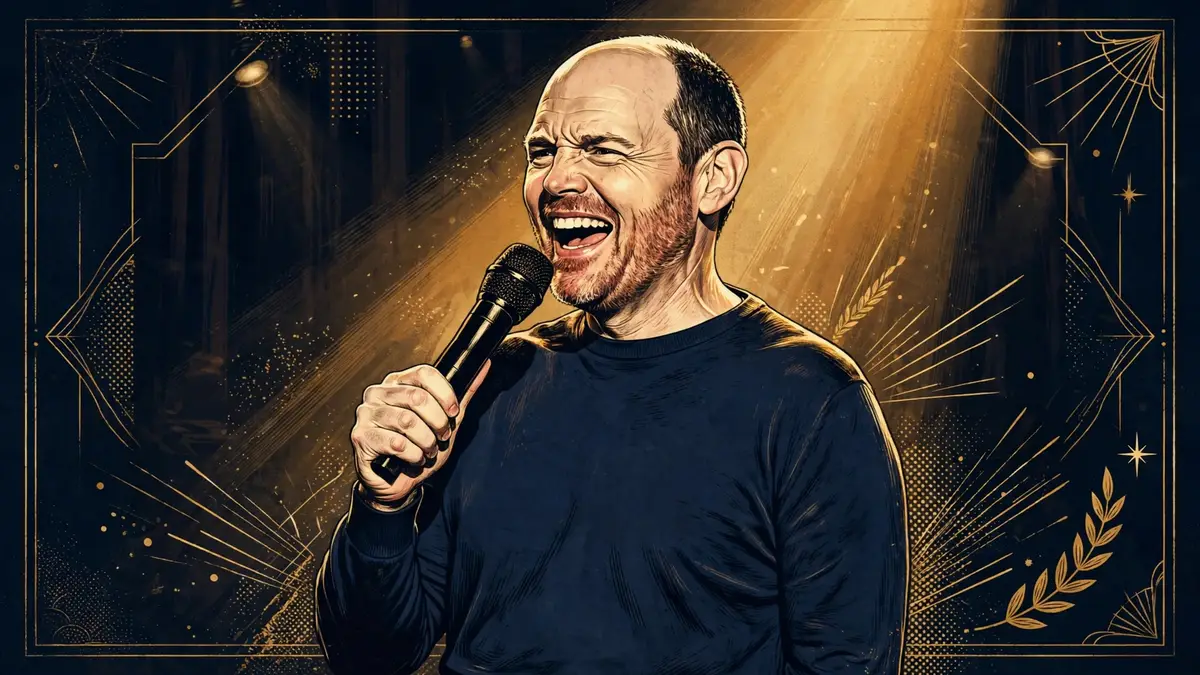
Quick Facts: Bill Burr at a Glance
| Full name | William Frederick Burr |
|---|---|
| Date of birth | June 10, 1968 (age 58 as of November 2026) |
| Birthplace | Canton, Massachusetts, United States |
| Estimated net worth | $35 million (range: $20 million–$35 million; anchored on Celebrity Net Worth, updated late October 2026) |
| Primary income sources | Stand-up touring, streaming specials, acting (TV and film), podcasting, producing and directing |
| Key works | Monday Morning Podcast (2007–present), F Is for Family (Netflix, 2015–2021), Breaking Bad, The Mandalorian, Paper Tiger (2019), Drop Dead Years (2025), Old Dads (2023), Glengarry Glen Ross on Broadway (2025) |
| Business ventures | All Things Comedy network (co-founder, 2012); North Hill Productions (first-look deal with Fox Entertainment Studios, August 2025) |
| Spouse | Nia Renée Hill (married 2013) |
| Children | Two — a daughter (born 2017) and a son (born 2020) |
| Height | 5 feet 10 inches (1.78 m) |
| Notable real estate | Spanish-style home in Los Feliz, Los Angeles, bought in 2017 for $4.7 million (Celebrity Net Worth) |
Table of Contents
- How Much Is Bill Burr Worth in 2026?
- Where the Money Comes From: The Estimate Breakdown
- Early Life: A Boston Kid With a Short Fuse
- The Long Climb: Stand-Up, Boston to the World
- Touring: The Engine of the Fortune
- Acting: Breaking Bad, The Mandalorian and the Big Screen
- Broadway: Glengarry Glen Ross and a New Stage
- The Monday Morning Podcast and All Things Comedy
- Specials and Streaming Deals
- Directing and Producing: Old Dads and North Hill
- Real Estate and Assets
- Net Worth Growth: Year by Year
- How Burr Stacks Up Against Other Comics
- Personal Life: Nia Renée Hill and Family
- Controversies and Public Flashpoints
- Frequently Asked Questions
- Final Thoughts: The Bottom Line
- Sources and Reporting
How Much Is Bill Burr Worth in 2026?
Bill Burr is worth an estimated $35 million in 2026. That is Celebrity Net Worth’s current figure, updated in late October 2026, and it marks a clear jump from the $25 million the same outlet carried through most of 2025 and into early 2026 — the number Parade quoted on January 2, 2026, when it put Burr at “around $25 million, according to Celebrity Net Worth.” A $10 million revision in under a year is a big move for a celebrity estimate, so it is worth asking what changed.
Three things changed. First, Pollstar’s year-end 2024 reporting gave the touring business a hard, public number: 30 reported North American shows grossing $14,101,432 from 157,852 tickets sold. Those are gross ticket sales, not Burr’s personal take-home, but they let estimators size a touring operation that used to be guesswork. Second, Burr spent the spring of 2025 on Broadway in Glengarry Glen Ross, a production that grossed roughly $35.85 million across its run and broke the Palace Theatre’s weekly box-office record. Third, his 2025 Hulu special Drop Dead Years earned a Grammy nomination for Best Comedy Album in 2026 — his second in that category — and two Emmy nominations, keeping his streaming value high at the exact moment he signed a first-look development deal with Fox Entertainment Studios through his North Hill Productions banner.
Not every outlet has caught up. Comedyville, publishing in August 2026, still lists $25 million and cites Celebrity Net Worth’s older figure. The Bridal Box, updated in February 2026, lists $20 million. Clive Health, updated in June 2026, lists $30 million. Older pages still floating around the search results are further out: FamousPeopleToday lists $12 million, a number that traces back to estimates from several years ago, and TheMost10 also carries $12 million for 2026. At the other extreme, LiveRoger claims $65 million to $70 million without showing its working — a figure no other outlet supports and one this article does not treat as credible.
The picture that holds together is a range of $20 million to $35 million, with $35 million as the anchor because it is the newest number from the source the whole field cites, and because it is the only one that reflects the 2024–25 earnings evidence. Burr’s actual finances are private — he has never published his income, his contracts, or his tax returns — so every number here, including the anchor, is an estimate built from public reporting. The sections below show the pieces it is built from.
Why the range matters: celebrity net worth figures are educated estimates, not bank statements. When one outlet says $20 million and another says $35 million, the gap usually comes down to how much of a tour’s gross ticket sales they credit to the performer, and whether they count a production company’s development deals at all. This article shows both ends of the range and names the source behind each one, so readers can weigh the numbers themselves.
Where the Money Comes From: The Estimate Breakdown
Burr’s fortune is not a single windfall. It is five income streams stacked over thirty-plus years, with touring doing the heavy lifting and everything else adding layers. No outlet publishes a verified split of his earnings, so the table below is this site’s reasoned breakdown based on the reported grosses, the known shape of his career, and how comedians at his level are typically paid. It is an illustration of where the money comes from, not an audited balance sheet.
| Income stream | What the reporting shows |
|---|---|
| Stand-up touring | The largest stream by a wide margin. Pollstar’s 2024 year-end data: 30 reported shows, $14,101,432 in gross ticket sales, 157,852 tickets. Burr headlines arenas and theatres, including Fenway Park in 2022, and tours most years. |
| Streaming specials | Fourteen stand-up specials and albums in total, per Wikipedia, including Netflix’s Paper Tiger (2019) and Hulu’s Drop Dead Years (2025). Specials pay a license fee plus long-tail residuals and keep ticket demand high. |
| Acting — TV and film | Recurring roles on Breaking Bad (Patrick Kuby) and The Mandalorian (Migs Mayfeld), plus film roles in Daddy’s Home, The King of Staten Island, Unfrosted, and The Social Reckoning (2026). Acting fees at his level run into six figures per project, with residuals on hit shows. |
| Podcasting and network | The Monday Morning Podcast has run since 2007 — one of the longest-running comedy podcasts — and the All Things Comedy network, co-founded in 2012, hosts dozens of shows. Podcast ad revenue and network shares add steady, recurring income. |
| Producing, directing, deals | Old Dads (Netflix, 2023) as co-writer, director, and star; F Is for Family as co-creator and executive producer; North Hill Productions’ first-look deal with Fox Entertainment Studios (August 2025). Development deals pay fees whether or not a project reaches the screen. |
| Real estate | Los Feliz home bought in 2017 for $4.7 million (Celebrity Net Worth). Los Angeles property bought at that price point has typically appreciated since, adding to net worth on paper. |
Two things stand out about this mix. The first is how little of it depends on any single gatekeeper. Burr owns his podcast, co-owns his comedy network, and runs his own production company, which means a large share of what he earns is not a salary negotiated with a studio but revenue from businesses he controls. The second is how late the big money arrived. Burr spent the 1990s and most of the 2000s as a working club comic. The arena grosses, the Broadway run, and the Fox deal all came after he turned 50. His fortune is a compounding story, not a breakout story.
Early Life: A Boston Kid With a Short Fuse
William Frederick Burr was born on June 10, 1968, in Canton, Massachusetts, a suburb south of Boston, and he grew up there in a household that could hardly have been more ordinary: his father was a dentist, his mother a nurse. For readers keeping track of Bill Burr’s age and birthday, he turned 58 in June 2026. Canton gave him the accent, the chip on the shoulder, and the worldview that still shapes his act — a working-class Boston kid who never quite trusted authority, institutions, or anyone telling him how to feel.
Burr has talked often on his podcast about a childhood spent getting in trouble, mouthing off, and testing every boundary put in front of him. He was not a star student. He went to Emerson College in Boston and graduated in 1993 with a bachelor’s degree in radio — a choice that looks prophetic now, given that his voice would eventually become his whole business, but at the time it was simply what interested him. After college he worked warehouse jobs to pay the bills, the kind of unglamorous work he still jokes about on stage, while he figured out what he actually wanted to do.
The answer arrived in 1992, when Burr did his first stand-up set at age 24. Boston had one of the toughest comedy scenes in America — crowds that would heckle a comic off the stage for a weak minute — and it shaped him. Comics who survive Boston learn to write tight, punch hard, and never plead with a room. Burr spent the next few years grinding through clubs in Boston and New York, moved to New York City in 1994, and slowly built a reputation as a comic’s comic: the guy other comedians went to watch.
None of this looked like a path to a $35 million net worth at the time. Burr has said the early years paid almost nothing, and he kept the warehouse jobs longer than he would have liked. The point of the early-life story is not that he was destined for wealth. It is that the act audiences pay arena prices to see in 2026 — the rants, the Boston bluntness, the refusal to soften a punchline — was forged in rooms where nobody was paying him much at all.
The Long Climb: Stand-Up, Boston to the World
Burr’s rise was slow by modern standards, and that slowness is the whole story. He did not go viral. He did not win a reality show. He spent the 1990s and 2000s doing sets in clubs, appearing on late-night shows, and building a following one room at a time. His first television break of real note came through Chappelle’s Show, where his appearances put him in front of a national audience, and through regular spots on Late Show with David Letterman and Conan, where his tight five-minute sets made him a booker’s favorite.
His first specials came steadily rather than spectacularly: Why Do I Do This? in 2008, Let It Go in 2010, You People Are All the Same in 2012, I’m Sorry You Feel That Way in 2014, and Walk Your Way Out in 2017. Each one widened the audience a little. The real inflection point was Paper Tiger, released on Netflix in 2019, which earned him a Grammy nomination for Best Comedy Album and put his name in front of the streaming audience that now drives ticket sales for every comic. The special’s most talked-about bit — a rant about outrage culture that split audiences down the middle — did what controversy does for a comic with a thick skin: it made people who had never heard of him go and watch.
By the early 2020s Burr had crossed the line from club headliner to arena act. The clearest marker came in August 2022, when he headlined Fenway Park in Boston — the first comedian ever to headline the ballpark — playing to a hometown crowd in a venue that holds more than 35,000 people. A comic who can fill Fenway is a comic whose touring business runs on a different scale from the club circuit, and the Pollstar numbers from 2024 confirm it: 30 reported shows, more than $14 million in gross ticket sales, an average of roughly 5,260 tickets per reported show.
What makes Burr’s climb unusual is that he never changed the act to get there. The material stayed confrontational, the persona stayed prickly, and the audience grew anyway. In an industry where comics often sand down their edges to reach a bigger room, Burr reached the biggest rooms with his edges intact — and that refusal to soften is now part of the brand that sells the tickets.
Touring: The Engine of the Fortune
If one number explains Bill Burr’s net worth, it is $14,101,432. That is what Pollstar recorded Burr grossing from 30 reported North American shows in its 2024 year-end reporting, selling 157,852 tickets. Celebrity Net Worth cites the same Pollstar data in its updated profile, and it is the hardest, most verifiable earnings number attached to Burr’s name. It also needs careful reading: $14.1 million is gross ticket revenue, not profit and not Burr’s pay. Venues, promoters, agents, managers, travel, and crew all take their share before the headliner sees a dollar. Even so, a headliner of Burr’s stature typically keeps a large slice of the gross, and 30 reported shows are only part of a touring year — Pollstar counts reported shows, not every date played.
Touring is the engine because it is the one stream Burr controls end to end. He picks the rooms, sets the prices, and keeps the relationship with the audience direct. A sold-out theatre tour at arena ticket prices, repeated year after year, compounds in a way a single acting fee cannot. His 2026 touring calendar stayed full, with dates including a January 2026 run at the 5th Avenue Theatre in Seattle, and the tour listings for those shows bill him as an Emmy and Grammy nominee coming off a Broadway debut — a reminder that each new credit feeds the next tour’s ticket sales.
The economics also explain why the net worth estimates moved up in 2026. Older estimates, including the $12 million figures still carried by some sites, were built when Burr was a theatre comic playing rooms a fraction of this size. The Pollstar grosses show a different business: an average of about $470,000 in gross ticket sales per reported 2024 show. Multiply that kind of per-show gross across a full touring schedule, subtract the costs, and the $35 million anchor starts to look less like a leap and more like arithmetic.
There is a risk in the touring model too, and 2025 showed it. Burr’s appearance at the Riyadh Comedy Festival in Saudi Arabia in the fall of 2025 drew heavy criticism from fans and commentators who saw it as at odds with his long history of railing against billionaires and corporations. Parade reported in its January 2026 profile that his podcast listener numbers dropped sharply in October 2025, possibly reflecting that backlash. Touring grosses have not shown the same dip — the 2026 dates kept selling — but the episode is a reminder that a fortune built on a live audience is only as steady as that audience’s goodwill.
Acting: Breaking Bad, The Mandalorian and the Big Screen
Acting was never Burr’s main job, but it gave him two things stand-up could not: a global audience and residual income from shows people rewatch forever. His best-known role is Patrick Kuby, the fixer and henchman in Breaking Bad, which he played across the show’s final seasons in 2011 and 2013. Kuby is a small part — five episodes — but Breaking Bad is one of the most rewatched dramas ever made, and a recurring role on a show of that stature pays residuals for years. Burr has joked on his podcast about fans recognizing him as Kuby more than as a comic, which is its own kind of proof of the role’s reach.
His second signature role is Migs Mayfeld in The Mandalorian, the ex-Imperial sharpshooter he played in 2019 and again in a widely praised 2020 episode that gave the character a real arc. The Star Wars audience is enormous, and the role put Burr in front of viewers who had never bought a comedy ticket. Parade’s 2026 profile singles out The Mandalorian alongside his specials as a core pillar of his wealth, and it is easy to see why: a recurring part in a Disney+ flagship is both a fee and a permanent advertisement for the tour.
Film work has filled out the résumé without ever taking over: Daddy’s Home (2015) and Daddy’s Home 2 (2017) opposite Will Ferrell and Mark Wahlberg, The King of Staten Island (2020), the Jerry Seinfeld comedy Unfrosted (2024), and, in 2026, Aaron Sorkin’s The Social Reckoning, the sequel to The Social Network, which opened in theatres on October 9, 2026, with Burr in the cast alongside Jeremy Strong, Mikey Madison, and Jeremy Allen White. Burr joined that cast in September 2025, and the film’s release is one of the freshest credits on his record.
Acting fees for a supporting player of Burr’s standing are not public, and this article will not invent them. What is fair to say is that a working actor with recurring roles on two of the biggest television franchises of the last fifteen years, plus a steady film slate, earns a meaningful second income — and that the residuals from Breaking Bad and The Mandalorian keep paying long after the shoot wraps.

Broadway: Glengarry Glen Ross and a New Stage
The most surprising line on Burr’s recent résumé is also one of the most lucrative for his profile: in 2025, at 56, he made his Broadway debut. Burr played Dave Moss in the revival of David Mamet’s Pulitzer Prize-winning play Glengarry Glen Ross at the Palace Theatre, acting opposite Kieran Culkin and Bob Odenkirk, with Michael McKean also in the cast. The production was directed by Patrick Marber, with previews from March 10, 2025, an opening on March 31, and a closing on June 28, 2025.
The run was a commercial hit. Celebrity Net Worth reports the production grossed approximately $35.85 million by the time it closed. BroadwayWorld’s reporting adds detail: the show recouped its investment by May 2025, broke the Palace Theatre’s weekly box-office record with a $2.4 million week ending May 11, 2025, and peaked at $2,750,608 for the week ending May 25, 2025. Broadway salaries are modest next to arena touring — a featured actor in a hit play earns a weekly salary, not a share of the gross — so the Broadway run did not add $35 million to Burr’s bank account. What it added was something touring cannot buy: a new audience, glowing reviews, and a line on the résumé that changes how the industry sees him.
The reviews mattered. The Hollywood Reporter‘s David Rooney praised Burr’s performance, and the production’s success made the “comedian tries Broadway” story into a genuine acting credential. Burr was not nominated for a Tony — a snub that drew some public comment — but he was nominated for a Broadway.com Audience Award as Favorite Featured Actor in a Play. He has since spoken warmly about the experience, including the terror of performing a Mamet play eight times a week to audiences who paid top prices. For a comic whose whole act is about control of a room, sharing a stage with actors of Culkin’s and Odenkirk’s calibre was a different kind of test, and he passed it in public.
The Monday Morning Podcast and All Things Comedy
Burr started Bill Burr’s Monday Morning Podcast in May 2007, back when podcasting was a hobbyist medium and almost nobody made money from it. Nineteen years later it is one of the longest-running comedy podcasts in existence, and it is the most personal part of his business: two episodes most weeks, recorded largely alone, in which Burr rants about the news, answers listener emails, and talks about his family. FamousPeopleToday once estimated the show’s early audience at tens of thousands of plays per episode; the modern audience is far larger, though Burr has never published listener numbers.
The podcast pays in three ways. First, advertising: a show with a loyal weekly audience in the hundreds of thousands commands premium ad rates, and Burr reads many of the ads himself, which advertisers pay extra for. Second, it sells tour tickets: every episode is a free advertisement for the next live date, delivered to the exact people most likely to buy. Third, it is the raw material for his act — the rants that start on the podcast often become the bits that fill arenas.
In 2012, Burr and fellow comic Al Madrigal co-founded the All Things Comedy network, which hosts dozens of comedy podcasts and gives Burr an ownership stake in other comics’ audiences. The network model is the same playbook as the podcast, scaled up: instead of renting attention from a platform, Burr owns a piece of the platform. Comedy networks do not publish their revenue, so no figure is attached here, but the structure is a real asset — and a reason Burr’s income is steadier than that of a comic who depends on a single special or tour.

Specials and Streaming Deals
Burr has released fourteen stand-up specials and albums, a total Wikipedia records and his own tour listings confirm. The streaming era turned that catalogue into real money. Netflix paid for Paper Tiger (2019), which earned him his first Grammy nomination for Best Comedy Album and an Emmy nomination, and Hulu paid for Drop Dead Years, which premiered on March 14, 2025, and earned him his second Grammy nomination in that category in 2026, plus two Emmy nominations.
Streaming license fees for a comic of Burr’s stature are not public, and this article does not guess at them. What is public is the pattern: each special lifts ticket sales for the tour that follows it, and the specials themselves keep earning through residuals and re-licensing. Paper Tiger is still quoted and clipped years later; Drop Dead Years arrived at the peak of Burr’s touring power and was marketed as his eighth hour-long special. The specials are also the reason his name travels: a fan in a country Burr has never toured can watch him on Netflix or Hulu and become a ticket buyer the next time he plays their city.
The streaming money is smaller than the touring money, and it would be wrong to pretend otherwise. But it is the marketing engine that makes the touring money possible, and the Grammy and Emmy nominations that came with the last two specials are the kind of credentials that let a comic raise ticket prices and play bigger rooms. In Burr’s case the two streams feed each other, which is exactly how a durable comedy fortune is built.
Directing and Producing: Old Dads and North Hill
Burr’s move behind the camera started with F Is for Family, the animated Netflix series he co-created and starred in as Frank Murphy, which ran for five seasons from 2015 to 2021. As co-creator, voice lead, and executive producer, Burr earned more than an acting fee — he owned a piece of a show that Netflix kept on its platform for six years. Animated series are a quiet earner in Hollywood: the voice work is steady, the production schedule is forgiving, and a creator credit pays long after the final season.
The bigger step came in 2023 with Old Dads, Burr’s feature-length directorial debut for Netflix, which he co-wrote, directed, and starred in. The film — about three middle-aged fathers clashing with a younger, more sensitive world — was a direct translation of his stage persona to the screen, and directing it meant Burr was paid as a filmmaker, not just a performer. Reviews were mixed, but the film did what a directorial debut is supposed to do: it proved he could run a set, and it set up the next deal.
That deal arrived in August 2025, when Burr’s North Hill Productions signed a first-look development agreement with Fox Entertainment Studios to bring original scripted and unscripted comedy to Fox. First-look deals pay a production company to develop projects with a studio getting the first chance to buy them; they are a standard way for an established talent to turn a reputation into recurring income. The financial terms were not disclosed, and this article will not invent them. What the deal signals is that the industry now values Burr as a producer and developer, not only as a performer — and that is the kind of income that can keep growing after a comic stops touring every year.
Looking ahead, Burr is set to direct, co-write, produce, and star in Born Losers, a film he is scheduled to shoot in 2026. If it lands, it will be the second feature from North Hill and another asset in a production business that is still young.
Real Estate and Assets
The one property deal attached to Burr’s name with a solid source is his Los Feliz home. Celebrity Net Worth reports that Burr and his wife, Nia Renée Hill, bought a large Spanish-style mansion in the Los Feliz neighborhood of Los Angeles in 2017 for $4.7 million. Los Feliz is one of the city’s most desirable hillside neighborhoods, and a house bought there in 2017 has almost certainly appreciated since — Los Angeles home prices in that bracket rose sharply through the late 2010s and early 2020s — though no sale price or current valuation is public, so this article claims no figure beyond the purchase price.
Beyond the house, Burr’s assets are the businesses: his stake in All Things Comedy, his North Hill Productions company, and the rights and residuals attached to his specials, his podcast archive, and his creator share of F Is for Family. He is not known as a car collector or a public investor, and he does not flaunt luxury purchases on social media. His public spending habits run the other way — he has joked for years about flying commercial, hating waste, and keeping his life deliberately unglamorous for a man with his income. The fortune, such as it is, appears to sit in property, in businesses he controls, and in the earning power of his name, rather than in a garage full of cars.
One honest caveat: net worth estimates for entertainers routinely count the paper value of a home at its purchase price or at a guessed current value, and different outlets guess differently. That is part of why the range in this article runs from $20 million to $35 million. The Los Feliz purchase is a fact; what the house is worth today is an estimate, and it is folded into the anchor figure rather than added on top of it.
Net Worth Growth: Year by Year
Burr’s wealth arrived late and then accelerated. The timeline below uses the figures outlets actually published, with the source and year for each one, so readers can see how the estimates moved — and how much of the recent jump is a revision of old numbers rather than new money.
| Period | Estimate and source |
|---|---|
| Early 2010s | Single-digit millions in most outlet estimates. Burr was a working headliner with club and theatre dates, a podcast, and small acting roles. FamousPeopleToday’s $12 million figure traces to this era’s estimates and is still carried on some pages today. |
| Mid-2010s | Estimates in the $10 million–$12 million range as F Is for Family (2015) and the Netflix specials widened his audience. Touring moved from clubs to theatres. |
| 2019–2021 | Paper Tiger (2019) and the Mandalorian role pushed estimates toward $14 million–$20 million in several outlets. The Bridal Box’s $20 million figure comes from this period’s reporting, updated in February 2026. |
| 2022–2024 | Fenway Park headline (2022) and arena touring lifted the ceiling. Pollstar’s 2024 year-end data — $14.1 million grossed from 30 reported shows — gave estimators their first hard touring number. |
| Early 2026 | Parade (January 2, 2026) lists around $25 million, citing Celebrity Net Worth’s figure at the time. Comedyville (August 2026) and Clive Health (June 2026) list $25 million and $30 million respectively. |
| Late 2026 | Celebrity Net Worth revises its figure to $35 million (updated around October 30, 2026), folding in the 2024 touring grosses, the Broadway run, and the Fox development deal. This article anchors here. |
The pattern is worth naming: Burr’s estimated net worth roughly tripled between the early 2010s and 2026, and most of that growth came after he turned 50. It is the opposite of the child-star story — a fortune built by a man who kept working after the industry had stopped expecting him to break out.
How Burr Stacks Up Against Other Comics
Context helps. Celebrity Net Worth’s figures for Burr’s peers show where $35 million sits in the comedy economy — and how far touring scale, film careers, and business empires can push the number past it.
| Comedian | Celebrity Net Worth estimate |
|---|---|
| Kevin Hart | Around $450 million — film franchises, a production company, endorsements, and a touring machine far larger than Burr’s. |
| Joe Rogan | Around $200 million — a Spotify podcast deal reported in the hundreds of millions, plus stand-up and UFC commentary. |
| Dave Chappelle | Around $75 million — landmark Netflix special deals and arena touring. |
| Chris Rock | Around $60 million — decades of specials, film, and touring at the top of the field. |
| Bill Burr | $35 million — touring-led, with acting, podcasting, and producing layered on. |
| Louis C.K. | Around $35 million — a comparable touring-led career at a similar scale. |
Burr sits in the middle of this group, and the comparison explains why. He has no nine-figure podcast deal like Rogan, no film-franchise paydays like Hart, and no landmark streaming contract like Chappelle’s. What he has is a touring business as strong as anyone’s outside the very top tier, plus ownership stakes — a podcast, a network, a production company — that pay him as an owner rather than only as a performer. The gap between Burr and the top of the list is mostly a gap in deals, not in ticket sales.
Personal Life: Nia Renée Hill and Family
Burr married actress and writer Nia Renée Hill in 2013. Hill is a performer in her own right — she has appeared in film and television and writes about race, relationships, and Hollywood — and the two of them have built a life that Burr talks about constantly on his podcast, usually by complaining about it in the affectionate way that is his trademark. They have two children: a daughter born in January 2017 and a son born in June 2020.
Family changed the act. Burr’s older material was the voice of a single man with no responsibilities and a long list of grievances. His newer material — on Paper Tiger and especially on Drop Dead Years — is the voice of a father in his fifties trying to make sense of a world that changed faster than he did, and the jokes about parenting, marriage, and getting older are the ones that land hardest with the arena crowds now. He has said on the podcast that having kids made him think about money differently, not because he suddenly wanted luxury, but because the touring schedule that built the fortune keeps him away from home.
The family lives in Los Angeles, in the Los Feliz home bought in 2017. Burr keeps his children out of the public eye — no names in interviews, no photos on his feeds — and this article follows that lead. What is public is the shape of the life: a Boston comic who moved to Los Angeles, married an actress, had two kids late by Hollywood standards, and built a career that lets him work from a home studio most weeks of the year.
Controversies and Public Flashpoints
A net worth profile that skipped Burr’s controversies would be dishonest, because the controversies are part of why his audience is as loyal — and as divided — as it is. Three episodes matter, and each one is documented in mainstream reporting.
The first is the Paper Tiger backlash in 2019. Burr’s riff on outrage culture, feminism, and “woke” politics split critics and audiences: some called it the sharpest hour of his career, others called it a tired rant from a man punching down. The special’s notoriety drove views rather than hurting them, and Burr treated the whole episode as proof that his audience would follow him wherever the material went.
The second is the 2020 Saturday Night Live monologue. Burr hosted the show and used the opening minutes to mock white women, cancel culture, and the audience itself, live on network television. The monologue drew complaints and praise in roughly equal measure, and Burr later said on his podcast that he had expected the reaction and did not regret a word of it.
The third, and the one with the clearest financial echo, is the Riyadh Comedy Festival in the fall of 2025. Burr performed in Saudi Arabia alongside a lineup of major American comics, and the appearance drew sharp criticism from fans who saw it as inconsistent with his long record of attacking billionaires and corporate power. Parade’s January 2026 profile reported that his podcast listener numbers fell sharply in October 2025, possibly reflecting that backlash, while noting that his net worth appeared to have risen in the short term, possibly reflecting his payment for the festival. The episode captures the tension at the heart of Burr’s brand: an audience that loves him for saying what others will not, and that holds him to the standard his own material sets.
None of these episodes has cost Burr his career, his tour, or his audience in any lasting way. Each one produced a round of headlines, a dip in goodwill among some fans, and a rally among others. For a net worth profile, the honest conclusion is that controversy has been neutral to positive for Burr’s earnings so far — it keeps him in the news, it sells tickets to people who want to hear what he will say next, and the only measurable cost so far has been a short-term dip in podcast listening, not in live grosses.
Frequently Asked Questions
What is Bill Burr’s net worth in 2026?
Bill Burr’s net worth is estimated at $35 million as of November 2026, according to Celebrity Net Worth, which updated its figure in late October 2026. Other outlets publishing in 2026 range from $20 million to $30 million, so the honest range is $20 million to $35 million, anchored at $35 million on the freshest figure from the most-cited source.
How old is Bill Burr?
Bill Burr was born on June 10, 1968, in Canton, Massachusetts, which makes him 58 years old as of November 2026. He started stand-up in 1992 at age 24 and headlined his first arena-sized rooms in his fifties.
How much does Bill Burr make from touring?
Pollstar’s 2024 year-end reporting shows Burr grossing $14,101,432 from 30 reported North American shows, selling 157,852 tickets — an average of roughly $470,000 in gross ticket sales per reported show. That is gross revenue, not his personal take-home: venues, promoters, agents, managers, and crew are paid from it first. Even so, touring is by far his biggest income stream.
What is Bill Burr’s biggest income source?
Stand-up touring. His arena and theatre dates gross millions per year, and the Pollstar figures from 2024 are the hardest evidence of it. Acting, streaming specials, podcasting, and his production company add meaningful income on top, but none of them comes close to what the live shows bring in.
Is Bill Burr married? Who is his wife?
Yes. Bill Burr married actress and writer Nia Renée Hill in 2013. The couple lives in Los Angeles and has two children — a daughter born in 2017 and a son born in 2020. Burr talks about his family often on the Monday Morning Podcast.
What movies and TV shows has Bill Burr been in?
His best-known TV roles are Patrick Kuby on Breaking Bad and Migs Mayfeld on The Mandalorian. He co-created and starred in the Netflix animated series F Is for Family (2015–2021). His films include Daddy’s Home, The King of Staten Island, Unfrosted, Old Dads — which he also directed — and Aaron Sorkin’s The Social Reckoning, released in October 2026.
Did Bill Burr perform on Broadway?
Yes. Burr made his Broadway debut as Dave Moss in the 2025 revival of David Mamet’s Glengarry Glen Ross at the Palace Theatre, alongside Kieran Culkin and Bob Odenkirk. The production ran from March 31 to June 28, 2025, recouped its investment, and grossed roughly $35.85 million, according to Celebrity Net Worth.
How did Bill Burr build his fortune?
Slowly, then all at once. He spent the 1990s and 2000s as a club comic, built a loyal audience through his Monday Morning Podcast (running since 2007) and a run of specials, then scaled up to arena touring in the 2020s. Acting roles on Breaking Bad and The Mandalorian, the F Is for Family creator credit, the All Things Comedy network, and the North Hill Productions deal with Fox all added layers — but the foundation is thirty years of stand-up.
Final Thoughts: The Bottom Line
Bill Burr’s $35 million net worth is the payoff for a career that refused to hurry. He spent fifteen years as a working comic before most people knew his name, and another fifteen turning that name into a touring business, a podcast, a network, and a production company. The estimate jumped in 2026 because the evidence finally caught up with the scale of the business: $14.1 million in reported 2024 ticket grosses, a Broadway run that took in roughly $35.85 million, a Grammy-nominated special, and a Fox development deal.
The range matters as much as the anchor. At $20 million, Burr is a very successful comic. At $35 million, he is one of the richest stand-ups working today. The truth sits somewhere in that band, and it will keep moving: if the 2026 tour grosses match 2024, if Born Losers lands, and if the Fox deal produces a hit, the next revision will be upward. If the touring slows, it will not. Either way, Burr built the fortune the same way he built the act — by showing up, saying what he thinks, and letting the room decide. The room has decided, and it keeps buying tickets.
Sources and Reporting
How we estimated: the anchor figure is Celebrity Net Worth’s Bill Burr profile, updated in late October 2026, which lists $35 million and cites Pollstar’s 2024 year-end touring data (30 shows, $14,101,432 gross, 157,852 tickets) and the Broadway gross for Glengarry Glen Ross (about $35.85 million). Parade’s January 2026 profile records the older $25 million Celebrity Net Worth figure. Comedyville (August 2026), The Bridal Box (February 2026), and Clive Health (June 2026) list $25 million, $20 million, and $30 million respectively, which sets the low end of the range. Figures of $12 million on older pages are stale and were not used. A $65 million–$70 million claim on one low-quality site is unsupported by any other outlet and was not used. Net worth figures for public personalities are estimates built from public reporting, not audited financial statements, and the real number may differ.
Named sources consulted (homepages linked; article-level URLs were verified in live search results dated November 8, 2026): Celebrity Net Worth, Parade, Pollstar, BroadwayWorld, Wikipedia, Comedyville, The Bridal Box. Career facts (birth date and place, specials, awards, Broadway dates, cast lists, Fox deal, film slate) were cross-checked against Wikipedia’s Bill Burr profile and BroadwayWorld’s production pages, both updated within the last month.
By Celebamerica Editorial Staff. Corrections or updates: contact the editorial team through the site’s contact page.