Jay Shetty’s net worth is estimated at $40 million as of November 2026, according to Celebrity Net Worth, which updated its figure on October 27, 2026. That number is the highest headline estimate in circulation, and it is also the most recent one from a major outlet — but it is not the only number out there, and it is not a verified fact. Other published estimates for the same man in the same year run from $8 million to $50 million, a spread wide enough to make any single figure misleading on its own.
What is solid, and what changed everything in 2026, is the money coming in. Forbes ranked Shetty among the world’s highest-paid podcasters in 2026, calculating that he earned $21 million from podcast distribution and advertising in the preceding 12 months, before taxes and representation fees. Then, in May 2026, Netflix and Spotify announced a partnership for video episodes of his show On Purpose, an agreement Forbes and Variety valued at about $100 million over three years. The deal’s terms were never disclosed by the companies, so the $100 million is a reported valuation, not a paycheck — but it is the clearest sign yet of how far a former monk from Barnet has travelled in the attention economy.
Shetty, born September 6, 1987, in London, is a British author, podcaster, motivational speaker and entrepreneur. He spent three years in monastic training after business school, built a viral-video career at HuffPost, launched On Purpose in 2019, and wrote two New York Times bestselling books, Think Like a Monk (2020) and 8 Rules of Love (2023). This article works through every published estimate, line by line, and shows exactly where the money comes from — podcasting, books, speaking, brand work, a tea company and a coaching school — so you can judge the $40 million figure for yourself.
By Celebamerica Editorial Staff | Last updated: November 16, 2026
Quick Facts: Jay Shetty at a Glance
| Full Name | Jay Shetty |
|---|---|
| Date of Birth | September 6, 1987 |
| Birthplace | London, England (raised in Barnet, North London) |
| Estimated Net Worth | $40 million (Celebrity Net Worth, October 27, 2026); published estimates range from $8 million to $50 million |
| Primary Income Sources | On Purpose podcast (distribution, advertising, licensing), bestselling books, speaking engagements, brand partnerships |
| Key Ventures and Works | On Purpose podcast (2019–present); Think Like a Monk (2020); 8 Rules of Love (2023); JUNI adaptogenic tea (co-founder); Jay Shetty Certification School (2020) |
| Spouse | Radhi Devlukia Shetty |
| Notable Recognition | Forbes 30 Under 30 (2017); Forbes highest-paid podcasters ranking (2026) |
Table of Contents
- Quick Facts: Jay Shetty at a Glance
- Early Life and Education in North London
- Three Years as a Monk — and the Questions That Followed
- From HuffPost to Viral Video Stardom
- On Purpose: Building the Number One Wellness Podcast
- The Books: Think Like a Monk and 8 Rules of Love
- Jay Shetty Net Worth in 2026: What the Sources Actually Say
- The Netflix and Spotify Deal
- Where the Money Comes From: Income Streams
- JUNI, the Certification School and Other Ventures
- Homes, Cars and Assets
- Net Worth Growth Timeline
- How He Compares With Other Top Podcasters
- Personal Life: Wife, Family and Life in Los Angeles
- Controversies and Public Scrutiny
- Frequently Asked Questions
- Final Thoughts
- Sources and Reporting
Early Life and Education in North London
Jay Shetty was born on September 6, 1987, in London, England, to a Hindu family of Indian origin. His mother is Gujarati; his father is a Tulu Bunt from Mangalore. He grew up in Barnet, North London, with a sister, and has said he was a member of the International Society for Krishna Consciousness (ISKCON), the Hare Krishna movement, from childhood. By his own account, he was an overweight teenager who was bullied at school — a detail he has returned to often in his talks, because the boy who felt like an outsider later built a career out of belonging.
At school he was bright and restless rather than bookish in the usual sense. He went on to study Management Science at Bayes Business School, City, University of London, and graduated in 2010. The plan, at that point, was conventional: a good degree, a good job. He had an offer in hand from the consulting firm Accenture. What happened instead is the hinge of his whole story, and it began three years earlier, in a lecture hall.
In 2007, while still a student, Shetty attended a talk by the Hindu monk Gauranga Das. He has described the lecture as a turning point, the moment a different way of living stopped being abstract and started looking like a real choice. He began spending his summers in India, interning at corporations and training with ISKCON, trying to work out whether the monk’s life was something he admired from a distance or something he was meant to live. A full timeline of his life story, from Barnet to the monastery and back, is covered in our sister site’s Jay Shetty biography on GuideNetWorth.
Three Years as a Monk — and the Questions That Followed
After graduating in 2010, Shetty turned down the Accenture job and entered monastic training. By his own account, he spent three years, from 2010 to 2013, living a monastic life — up at 4 a.m., cold showers, hours of meditation a day, few possessions, study of breath, philosophy and ancient texts. The story, as he has told it for years, is that he lived at an ashram in India. It is the founding story of his brand: the monk who came back to the modern world carrying something worth hearing.
The details of those three years have been disputed. In February 2024, The Guardian published an extensive investigation questioning elements of Shetty’s public account of his monastic background. The Guardian’s reporting found that, while Shetty has said he spent three years living as a monk in India, blog posts and people familiar with his movements during that period indicated he spent much of the time at Bhaktivedanta Manor in Watford, England, making promotional videos — and that he had arrived in India in October 2010 and spent less than four months in the country before leaving. Shetty’s representatives maintained that his monastic training lasted from 2010 to 2013, included time in both countries, and that he had not been dishonest about his background.
For a net worth article, the dispute matters for two reasons. First, it is a reminder that the personal story at the heart of a personal brand is also a commercial asset, and claims about it deserve the same checking as claims about money. Second, it has not slowed the business down. The Guardian investigation landed in February 2024; two years later, Shetty signed the biggest podcast deal of his career. Whatever readers make of the monastery story, the market has kept buying what he sells.
What is not in dispute is that the monastic period ended in 2013, and that Shetty came out of it with a skill set nobody in the wellness world had at the time: he could talk about ancient ideas in plain, modern language, and he had learned to make videos. That combination — old wisdom, new media — is the whole business.
From HuffPost to Viral Video Stardom
After leaving monastic life, Shetty needed a living, and he found it in the place his training had least prepared him for: social media. He joined HuffPost, where he worked as a video producer and content creator, learning how short-form video works — the hook in the first three seconds, the story arc in ninety, the shareable line at the end. He has said he made videos for years with little reward, posting daily and watching the numbers crawl.
Then the format clicked. His short motivational videos — a monk’s lesson told in a London accent, filmed simply, cut tightly — began to travel. By the mid-2010s he was one of the most-watched wellness voices on Facebook and YouTube, and the work brought him to the attention of the industry: in 2017, Forbes named him to its 30 Under 30 list in the media category, calling him a game-changer in media. He was thirty, and he had gone from a monastery to a Forbes list in four years.
The HuffPost years did two things that still shape his income today. They taught him production — he arrived at podcasting already knowing how to record, edit and package a show — and they taught him distribution. Shetty understood early that the audience is not found, it is built, one clip at a time, across every platform at once. When On Purpose launched, it did not start from zero. It started from millions of followers who already knew the voice.
On Purpose: Building the Number One Wellness Podcast
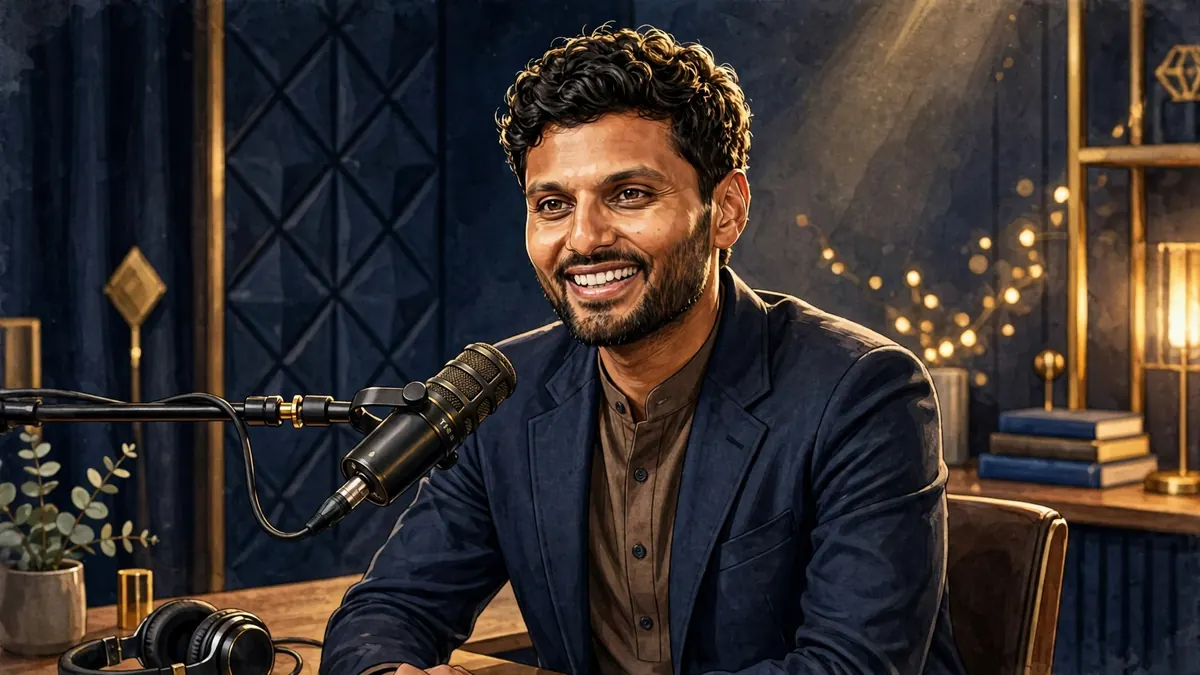
Shetty launched On Purpose with Jay Shetty in 2019. The format was simple and, at the time, unfashionable: long, calm, unhurried interviews, mostly with celebrities, about mental health, purpose, relationships and the inner life. Where other shows chased hot takes, Shetty asked his guests how they handled grief, failure and fame. The show grew steadily, then fast. It has been described as the world’s number one health and wellness podcast, and reporting in 2026 put its total listens past one billion.
The guest list is the show’s engine. Shetty has sat down with actors, musicians, athletes and business figures, and the interviews routinely run long enough for a guest to say something they have not said elsewhere. The clips then travel: a two-minute moment from a two-hour conversation becomes a reel, a short, a TikTok, and the funnel points back to the full episode. It is a machine he built deliberately, and it is the reason the podcast earns what it earns.
Distribution changed over the years. For a long stretch, the show’s distribution and advertising sales ran through iHeartMedia, an arrangement Forbes later said brought Shetty around $21 million in the twelve months before it ended, before taxes and payments to agents and managers. That figure, from Forbes’ 2026 reporting, is the hardest earnings number ever published about him — an estimate, but an estimate from Forbes, built on industry reporting rather than a guess. It is also the number that makes the rest of the net worth maths work: a man earning that much from one show, year after year, with books, speaking and business on top, is a man whose wealth is measured in tens of millions, whatever the exact figure.

By 2026 the show was seven years old, and Shetty told Forbes it had grown beyond anything he imagined when he started it. He had also spent around half a million dollars renovating the studio where the show is recorded, according to Forbes — a detail that says something about how he thinks about the product. The studio is not a room. It is the factory.
The Books: Think Like a Monk and 8 Rules of Love
Shetty’s first book, Think Like a Monk: Train Your Mind for Peace and Purpose Every Day, was published by Simon & Schuster in 2020. It took the three years of monastic training and turned them into a system — detachment, purpose, routine, service — written for people with jobs, phones and commutes. It debuted as a number one New York Times bestseller and became a global bestseller, the kind of book that stays on shelves for years rather than weeks. For a first-time author, it was a remarkable result, and it gave him a second income stream that does not depend on recording a new episode every week: backlist royalties.
His second book, 8 Rules of Love: How to Find It, Keep It, and Let It Go, followed in 2023, also from Simon & Schuster, and also became a New York Times and international bestseller. Where the first book was about the self, the second was about relationships — how to find love, keep it, and let it go when it ends. It drew heavily on his own marriage, and it landed in a market that was already primed: the podcast audience that had spent years hearing him talk about love in interviews now had a book to buy.
Book money is hard to pin down from the outside. Advances for a number one bestselling author with a platform of Shetty’s size run into seven figures, and royalties continue for years, but neither Simon & Schuster nor Shetty has disclosed his advances or his royalty earnings. What can be said with confidence is that the books did three things money alone cannot measure: they made him an author rather than only a podcaster, they put him on the shelves of every airport and supermarket, and they gave his speaking career a credential that corporate bookers pay for. A number one New York Times bestseller on the poster is worth real money on the speaking fee.
Estimates from lower-tier net worth sites have tried to put a number on the book income — one breakdown credited book deals with around $1 million of his wealth — but those allocations are guesswork, and this article does not treat them as fact. The honest statement is simpler: two bestselling books, both still selling, both published by a major house, are a meaningful and durable part of his fortune.
Jay Shetty Net Worth in 2026: What the Sources Actually Say
There is no publicly verified figure for Jay Shetty’s net worth. He has never disclosed his finances, no audited statement exists, and Forbes — which has reported his earnings in detail — has not published a net worth figure for him. Everything below is a published estimate, and the honest way to read them is together, as a range, with the date and the source attached to each one.
Celebrity Net Worth, the most widely cited source in this niche, updated its Jay Shetty page on October 27, 2026, and put his net worth at $40 million. That is the figure this article leads with, because it is the freshest estimate from a major outlet, and because it was published after the Netflix and Spotify deal — the first big estimate to take the new deal into account. Celebrity Net Worth says its figures are calculated from public sources, with private tips and feedback from celebrities or their representatives where provided, and it labels them estimates.
The honest range: $8 million to $50 million. Published estimates for Jay Shetty in 2026 run from $8 million (NetWorthBreakdown) to $50 million (PowerNetWorth), with $20 million (Famous People Today), $27 million (The STRIVE) and $30 million (TrendzEcho and others) in between. Celebrity Net Worth’s $40 million, dated October 27, 2026, is the anchor figure because it is the most recent from a major outlet. No figure in this range is audited or confirmed by Shetty himself.
| Source | Estimate | Date / Notes |
|---|---|---|
| Celebrity Net Worth | $40 million | Published October 27, 2026; the freshest major-outlet figure, after the Netflix–Spotify deal |
| PowerNetWorth | $50 million | 2026 estimate; top of the published range |
| TrendzEcho / NetWorthGyaan | $30 million | 2026 estimates; the middle of the range |
| The STRIVE | $27 million | 2026 estimate |
| Famous People Today | $20 million | Updated January 2026 |
| NetWorthBreakdown | $8 million | 2026 estimate; bottom of the published range |
| Forbes | No net worth figure published | Forbes reported $21 million in podcast earnings over 12 months (2026) and a $100 million deal valuation; it has not published a net worth total |
Why do the numbers disagree by a factor of six? Because the sites are measuring different things with different methods. The low-end figures, like NetWorthBreakdown’s $8 million, appear to be built bottom-up from visible income — podcast ads, book sales, speaking fees — and they ignore the value of the business itself. The high-end figures, like Celebrity Net Worth’s $40 million and PowerNetWorth’s $50 million, appear to give weight to the value of On Purpose as an asset: a show with a billion listens, a global audience and a nine-figure licensing deal attached to it is worth a great deal more than one year’s advertising revenue.
The second reason is timing. Most of the lower estimates were written before May 2026, when the Netflix and Spotify deal was announced. A valuation made before that deal cannot include it. Celebrity Net Worth’s October 2026 update is the only major estimate that could, and it is the highest of the mainstream figures. That pattern — newer estimates higher than older ones — is exactly what you would expect if the deal genuinely moved his wealth.
There is also a trap in the numbers that readers should know about. Older pages still floating around the web quote Celebrity Net Worth’s previous figure of $4 million — a number that appeared in articles from 2021 and earlier, including a WSJ Magazine profile of that era. That figure is years out of date, from before the podcast became a global business, and it should not be used in 2026. If you see $4 million attached to Jay Shetty, you are reading a stale page.
Our own judgement, after weighing the sources: a range of $27 million to $50 million is the most defensible reading of the published evidence, with Celebrity Net Worth’s $40 million as the anchor. The $8 million figure looks too low against Forbes’ own earnings reporting — a man who earned $21 million from one show in one year, before tax, is unlikely to be worth only $8 million in total. And the $50 million top end is plausible only if the On Purpose brand and its licensing value are counted in full, which no outside observer can verify. The truth is probably somewhere in the middle of that range, and it will move again when the Netflix and Spotify money starts landing in full.
The Netflix and Spotify Deal
In May 2026, Netflix, Spotify and Shetty announced a partnership bringing full-length video episodes of On Purpose to both platforms. The deal, as Forbes and Variety valued it, is worth an estimated $100 million over three years. The companies did not publicly disclose the financial terms, so the $100 million figure comes from reporting — Variety cited a source familiar with the agreement, and Forbes described it as an estimated $100 million over three years. Four different bidders wanted the show, according to Forbes, which tells you how competitive the market for proven podcast audiences has become.
The structure matters as much as the size. Video episodes began appearing on Netflix and Spotify in July 2026, while audio remained available on other podcast platforms, and Spotify took over global advertising sales. Shetty kept ownership of the show’s underlying intellectual property — a point Forbes made a note of, because it is the difference between selling a show and licensing one. He is renting out distribution for three years, not handing over the asset. When the deal ends, the show, the archive and the audience come back to him, and can be licensed again.
It is also worth saying plainly what the deal is not. A $100 million agreement over three years is not a $100 million payment to Jay Shetty. It is a commercial valuation of a licensing and distribution arrangement, spread over three years, before tax, before the cut taken by agents and managers, and before the costs of producing the show — including that half-million-dollar studio renovation. It will make him a great deal of money, and Forbes expects it to push him higher in its highest-paid podcasters ranking in the coming years, but the $100 million is a deal value, not a net worth figure. Anyone who adds it straight onto a net worth total is double-counting.
What the deal does prove is scale. Netflix does not put a wellness podcast on its platform as an experiment. Spotify does not take over global ad sales for a show it doubts. The two companies together decided that Shetty’s audience — millions of people who watch or listen to long interviews about how to live — was worth a nine-figure bet. That is the single most important fact about his finances in 2026, and it is the reason the newer net worth estimates are higher than the older ones.
Where the Money Comes From: Income Streams
Shetty’s income is spread across at least six streams, and the mix has shifted over time. In the early years, speaking and brand work carried the business. Today, the podcast dominates, with books, speaking, brands, a tea company and a coaching school around it. The table below sets out each stream, what is known about it, and how solid the evidence is.
| Income Stream | What Is Known | Evidence Strength |
|---|---|---|
| Podcast distribution and advertising | Forbes: $21 million earned in the 12 months before the Netflix–Spotify deal, from the iHeartMedia distribution and advertising arrangement, before tax and fees | Strong — Forbes, 2026 |
| Podcast licensing (Netflix + Spotify) | Agreement valued at about $100 million over three years (Forbes, Variety, May 2026); terms not disclosed; video from July 2026 | Strong on the valuation, weak on the exact payment terms |
| Books | Two New York Times bestsellers (2020, 2023), Simon & Schuster; advances and royalties not disclosed | Strong that the income exists; no public figure |
| Speaking engagements | Reported at $50,000 or more per engagement; corporate and live events, plus tours | Moderate — trade reporting, not confirmed |
| Brand partnerships | Forbes’ 2026 reporting identifies relationships with brands including Calm and BIOptimizers | Moderate — Forbes, no values disclosed |
| Businesses (JUNI, Certification School) | JUNI co-founder; Certification School founded 2020; revenues not disclosed | Weak on figures; the businesses are real and growing |
Speaking deserves a closer look, because it is the stream most people underestimate. Shetty is a fixture on the corporate speaking circuit, where a well-known author with a big audience can command $50,000 or more for a single keynote, according to trade reporting. He also tours live, performing to paying audiences. A dozen such engagements a year is a seven-figure income on its own, before a single podcast ad is sold — and it is income that rises with fame, because the fee follows the profile.
Brand work is the quietest stream, and the hardest to measure. Forbes’ 2026 reporting identifies relationships with brands including Calm, the meditation app, and BIOptimizers, the supplement company. These are the kind of partnerships that fit his audience — wellness products sold to people who listen to a wellness podcast — and they typically pay a mix of flat fees and revenue shares. No values have been disclosed, and this article does not guess at them. What matters is the pattern: the brands come to him because the audience trusts him, and that trust is the asset everything else is built on.
YouTube and social media advertising add a further layer. Shetty’s clips reach hundreds of millions of views, and the channels are monetised, but the revenue is small next to the podcast deals, and the real value of the clips is not the ad money — it is the funnel. Every viral clip is an advertisement for the show, the books and the tour, and it costs him nothing to distribute.
JUNI, the Certification School and Other Ventures
In 2020, the same year his first book came out, Shetty founded the Jay Shetty Certification School, an online platform offering training for aspiring life coaches. The school sells courses and certification, and it has drawn scrutiny as well as customers — The Guardian’s 2024 investigation raised questions about the credentials advertised by the school, and about claims made in its marketing. The school remains in business, and it is a logical extension of the brand: people who listen to Shetty talk about purpose want to learn how to do what he does, and the school sells them the first step.
JUNI, the adaptogenic sparkling tea brand, is the more interesting business. Shetty co-founded it with his wife Radhi Devlukia Shetty and the entrepreneur Kim Perell, and it has grown fast. By October 2026, reporting on the company said it had grown more than 1,800 percent over three years, ranked number 187 on the 2026 Inc. 5000 list of fast-growing private companies, and rolled out into Walmart stores. Those figures come from company statements and should be treated as reported business claims rather than audited results, but the Walmart rollout is a matter of public record, and it is the kind of distribution that turns a niche drink into a real business.
Shetty is also identified by Forbes as an investor in Function Health, the health-testing company. Investments like that are a small part of the story for now — there is no public record of the size of his stake — but they point to where his money is going: into the wellness economy he already dominates as a creator. The pattern is familiar from other creator fortunes. First the audience, then the products, then the equity.
None of these ventures has disclosed revenue, and this article does not invent figures for them. Their importance is structural: they turn Shetty from a man who sells his time into a man who owns assets that earn while he sleeps. A podcast episode pays once; a tea brand in Walmart pays every week. That shift, from labour to ownership, is the difference between a high income and a lasting fortune, and it is the reason the high-end net worth estimates give his businesses real weight.

Homes, Cars and Assets
The most concrete asset in Shetty’s name is his home. He lives in the Hollywood Hills, in the Beachwood Canyon area of Los Angeles, in a house he paid $8.4 million for, according to property reporting cited by Famous People Today. Forbes, in its 2026 reporting, valued the same house at $8 million. The small gap between the purchase price and the Forbes valuation is normal — purchase prices and valuations are measured at different times, in different ways — and either way, the house is a substantial asset, worth roughly a fifth of the low-end net worth estimates and a far smaller share of the high-end ones.
Beyond the house, the public record goes quiet. There is no reliable reporting on a car collection, no disclosed investment portfolio, no second property on the record. That is not unusual for a creator whose wealth is mostly in a business rather than in things: the valuable asset is On Purpose itself, and the companies around it, and those do not show up in paparazzi photographs. This article does not fill the gap with speculation. What can be said is that the visible lifestyle — a Hollywood Hills home, a half-million-dollar studio, a tea company in Walmart — is consistent with a fortune in the tens of millions, not with the single-digit figures at the bottom of the range.
Net Worth Growth Timeline
Shetty’s wealth was built in stages, and the stages track the platforms. Each step added a new income stream rather than replacing the last one, which is why the growth looks like a staircase rather than a slope.
| Year | Milestone | Financial Significance |
|---|---|---|
| 2010 | Graduates from Bayes Business School; enters monastic training | No income; the investment is in the story itself |
| 2013 | Leaves monastic life; moves into media | Starting from zero in commercial terms |
| 2016–2017 | HuffPost video work; viral videos take off; Forbes 30 Under 30 (2017) | First real income from content and speaking |
| 2019 | On Purpose launches | The asset that changes everything is created |
| 2020 | Think Like a Monk becomes a number one bestseller; Certification School founded | Book royalties and course income begin |
| 2021 | Stale estimates put his net worth around $4 million | A snapshot from before the podcast became a global business |
| 2023 | 8 Rules of Love becomes a bestseller; JUNI grows | Second book plus a consumer brand |
| 2024 | Guardian investigation into the monk story | Reputational hit; no visible commercial damage |
| 2026 | Forbes reports $21 million in podcast earnings over 12 months; Netflix–Spotify deal valued at $100 million over three years | The year the fortune jumps a level; Celebrity Net Worth updates to $40 million (October 27, 2026) |
The timeline also explains why the estimates disagree so sharply. A valuation made in 2021, when the $4 million figure was current, was measuring a viral video creator with one bestselling book. A valuation made in late 2026 is measuring a media company with a nine-figure licensing deal. Both can be honest. Only one is current.
How He Compares With Other Top Podcasters
Forbes’ 2026 ranking of the highest-paid podcasters is the best available yardstick, because it measures the same thing — podcast earnings over twelve months — for everyone on the list. Shetty ranked 14th, with an estimated $21 million. At the top of the same ranking, Joe Rogan earned an estimated $82 million over the same period. The gap is real, and it is also the point: Shetty is earning about a quarter of what the biggest podcaster on earth earns from podcasting, in a market where Rogan’s deal is the outlier. You can read more about Rogan’s own numbers in our profile of Joe Rogan’s age and career on CelebAmerica.
The licensing deals tell a similar story. Rogan’s arrangement with Spotify has been reported at up to $250 million, and Alex Cooper’s deal at $125 million — both larger than Shetty’s reported $100 million valuation, and both for shows with bigger audiences. Shetty sits in the second tier of podcast money, behind the two giants, but ahead of almost everyone else. For a closer look at how Cooper’s deal stacks up, see our profile of Alex Cooper’s net worth on CelebAmerica.
The comparison that matters most, though, is with his peers in the wellness and interview space. Andrew Huberman, another long-form interviewer who built a huge audience talking about health and the mind, operates at a similar scale, and the two shows are often mentioned in the same breath by listeners. You can compare the numbers in our profile of Andrew Huberman’s net worth on CelebAmerica. What sets Shetty apart from Huberman is the book business and the consumer brand: Huberman sells knowledge, Shetty sells a way of life, and a way of life comes with products.
Put together, the peer comparison supports the middle of the net worth range. Shetty earns less than Rogan and Cooper, more than almost every other podcaster, and his wealth is built on the same model as theirs — a show, a brand, and licensing deals — at a slightly smaller scale. A fortune of $27 million to $50 million, anchored at $40 million, fits that picture. A fortune of $8 million does not.
Personal Life: Wife, Family and Life in Los Angeles
Shetty is married to Radhi Devlukia Shetty, a plant-based cook, recipe creator and wellness influencer in her own right, who co-founded JUNI with him. The two married in 2016, and Radhi is a regular presence in his work — in the books, on the podcast, and in the business. She is also a business partner, not only a spouse: JUNI is a joint venture, and her food and wellness audience overlaps heavily with his. The marriage is, in commercial terms, a partnership as well as a relationship, and it is one of the reasons the brand feels coherent. The food, the tea, the books and the podcast all point at the same life.
He stands at a height that readers often ask about — the full details are in our profile of Jay Shetty’s height on CelebAmerica, and our sister site GuideNetWorth also covers Jay Shetty’s height in its own profile. The couple live in Los Angeles, in the Hollywood Hills home discussed above, a long way from Barnet — and a long way, too, from the monastery. Shetty has a sister, and his parents remain part of the story he tells about himself: the son of Indian immigrants, raised in the Hare Krishna movement, who left home to become a monk and came back to become a media figure.
He is active across every major platform — Instagram, YouTube, TikTok, Facebook — with audiences in the tens of millions, and the social following is not a side project. It is the distribution network for everything else. A clip posted in the morning can sell books by the afternoon and fill a speaking venue by the weekend. That is the economics of the modern creator: the audience is the business, and the business is the audience.
Controversies and Public Scrutiny
No honest profile of Jay Shetty can skip the scrutiny, because it is part of the public record and it bears on the credibility of the story he sells. The Guardian’s February 2024 investigation is the main item. It questioned elements of his account of the three years as a monk — in particular, the claim that he spent those years living at an ashram in India — and it reported that associates and his own blog posts placed him for much of the period at Bhaktivedanta Manor in Watford, making videos. The Guardian also reported allegations that some of Shetty’s social media posts drew on the work of others without credit. Shetty’s representatives denied dishonesty, and maintained that the monastic training ran from 2010 to 2013 across both countries.
There is a second, quieter strand of criticism, from inside the coaching and wellness world, about the Certification School: whether a short online course can credibly certify someone as a life coach, and whether the marketing overstates what the qualification means. Those are fair questions about an industry that is lightly regulated everywhere, and they apply to many schools, not only his.
What the controversies have not done, so far, is dent the commercial machine. The Guardian investigation was published in February 2024. The Netflix and Spotify deal was announced in May 2026. In between, the podcast kept growing, the second book kept selling, and JUNI kept expanding. Readers can draw their own conclusions about the monk story — this article has laid out both sides with their sources — but the market’s verdict, measured in dollars, is that the audience does not care, or does not care enough to leave.
Frequently Asked Questions
What is Jay Shetty’s net worth in 2026?
Jay Shetty’s net worth is estimated at $40 million as of November 2026, according to Celebrity Net Worth, which updated its figure on October 27, 2026. Published estimates range widely, from $8 million to $50 million, and no audited or confirmed figure exists. The most defensible reading of the evidence is a range of $27 million to $50 million, anchored at $40 million.
How much does Jay Shetty earn from his podcast?
Forbes reported in 2026 that Shetty earned $21 million from podcast distribution and advertising in the preceding 12 months, before taxes and representation fees, under his iHeartMedia arrangement. That put him 14th on Forbes’ ranking of the world’s highest-paid podcasters. His new Netflix and Spotify deal is valued at about $100 million over three years, though the companies did not disclose the terms.
What is the Netflix and Spotify deal worth?
The May 2026 agreement bringing video episodes of On Purpose to Netflix and Spotify is valued at an estimated $100 million over three years, according to Forbes and Variety. The figure is a reported valuation, not a disclosed payment: the companies never published the financial terms, and the money is spread over three years, before tax and fees, while Shetty keeps ownership of the show itself.
How did Jay Shetty become famous?
Shetty became known through short motivational videos he made while working at HuffPost in the mid-2010s, after three years of monastic training following business school. He launched the On Purpose podcast in 2019, which became the world’s leading health and wellness podcast, and his 2020 book Think Like a Monk became a number one New York Times bestseller.
Was Jay Shetty really a monk for three years?
Shetty says he spent three years, from 2010 to 2013, in monastic training. A February 2024 investigation by The Guardian questioned elements of that account, reporting that he spent much of the period at Bhaktivedanta Manor in Watford, England, rather than at an ashram in India. His representatives maintained that the training lasted from 2010 to 2013 and included time in both countries, and denied dishonesty.
Who is Jay Shetty’s wife?
Jay Shetty is married to Radhi Devlukia Shetty, a plant-based cook and wellness creator. They married in 2016, and she co-founded the adaptogenic tea brand JUNI with him and entrepreneur Kim Perell. She appears regularly in his books, on his podcast and in the JUNI business.
What books has Jay Shetty written?
Shetty has written two books, both published by Simon & Schuster: Think Like a Monk (2020), which debuted as a number one New York Times bestseller, and 8 Rules of Love: How to Find It, Keep It, and Let It Go (2023), which also became a New York Times and international bestseller.
Where does Jay Shetty live?
Shetty lives in Los Angeles, in a home in the Hollywood Hills’ Beachwood Canyon area. He paid $8.4 million for the house, according to property reporting, while Forbes valued it at $8 million in 2026. He was born and raised in Barnet, North London.
Final Thoughts
Jay Shetty’s net worth is best stated as a range, not a number: $27 million to $50 million, anchored at Celebrity Net Worth’s $40 million from October 2026. The range is honest because the evidence is incomplete — no audited figure exists, and the published estimates were made at different times, before and after the deal that changed his finances. What is not in doubt is the direction. A man who earned $21 million from one podcast in one year, and then signed a licensing deal valued at $100 million over three years, is a man whose wealth is still rising, and whose next estimate will almost certainly be higher than this one.
The story behind the money is the real subject. Shetty took three years of monastic training, a skill nobody else in media had, and turned it into a podcast, two bestselling books, a tea brand and a coaching school. The monastery story has been questioned, fairly, by The Guardian, and readers should know that. But the business he built on it is real, measured in Forbes’ reporting and in a nine-figure deal with two of the biggest media companies on earth. That is a fortune built on attention, trust and ownership — and in 2026, it is worth somewhere around $40 million.
For more celebrity wealth profiles in the same series, browse our net worth archive on CelebAmerica.
Sources and Reporting
This article was researched from live reporting in November 2026. The net worth estimates and the figures attached to them come from the outlets named in the text: Celebrity Net Worth ($40 million, published October 27, 2026); Forbes ($21 million in podcast earnings over 12 months; the $100 million Netflix–Spotify valuation; the 14th-place ranking among highest-paid podcasters; the $8 million home valuation); Variety (the $100 million deal valuation); The Guardian (the February 2024 investigation into the monastic background and the Certification School); NetWorthBreakdown ($8 million estimate; $50,000-plus speaking fees); Famous People Today ($20 million estimate; the $8.4 million home purchase); and Wikipedia for biographical dates cross-checked against the reporting above. Other published estimates cited — The STRIVE ($27 million), TrendzEcho ($30 million), PowerNetWorth ($50 million) — are third-party estimates, not verified valuations.
How we estimated: no public figure for Jay Shetty’s net worth is audited or confirmed by Shetty himself. We lead with Celebrity Net Worth’s $40 million because it is the freshest estimate from a major outlet, published after the May 2026 Netflix and Spotify deal, and we publish the full published range ($8 million to $50 million) alongside it, with each figure dated and sourced. Earnings figures from Forbes are estimates of income, not wealth, and a multi-year deal valuation is not a lump-sum payment — this article keeps those three things separate. Where sources conflict, we say so. Estimates may differ from private reality, and the true figure is known only to Shetty and his advisers.