Last updated: 10 November 2026 | By Celebamerica Editorial Staff
Faker is 5 feet 9 inches tall (176 cm). That is the figure most reliable sources agree on for Lee Sang-hyeok, the T1 mid laner known to the world as Faker, and it is the number this article uses as its anchor as of November 2026. He turned 30 on May 7, 2026, and he is still starting at mid lane for the same team he joined as a 17-year-old in 2013 — a run no other player in League of Legends history has matched.
The short answer hides a messier story. Search for Faker’s height and you will find 5 feet 7 inches on some pages, 6 feet on others, and 177 cm on the official roster sheet from the Asian Games. Those numbers cannot all be right, and the gap between them is wider than a rounding error. This article sorts them out source by source: where the 176 cm figure comes from, why the Asian Games sheet said 177 cm, why the 5-foot-7 and 6-foot claims keep circulating, how Faker measures up next to his own teammates and rivals, and what his height does — and does not — mean for a career built entirely on hands, eyes, and decisions made in fractions of a second.
Faker is not a basketball player or a footballer. Nobody drafts a mid laner for his reach. Yet the question keeps getting asked, millions of times a year, because Faker is one of the few esports players who has crossed over into mainstream celebrity: six World Championship titles, a part-ownership stake in T1, a national medal from South Korea, and a commemorative postage stamp issued in his honour in October 2026. When a player becomes that famous, fans want the ordinary details too — how tall he stands when he walks onto a stage in front of 20,000 people.
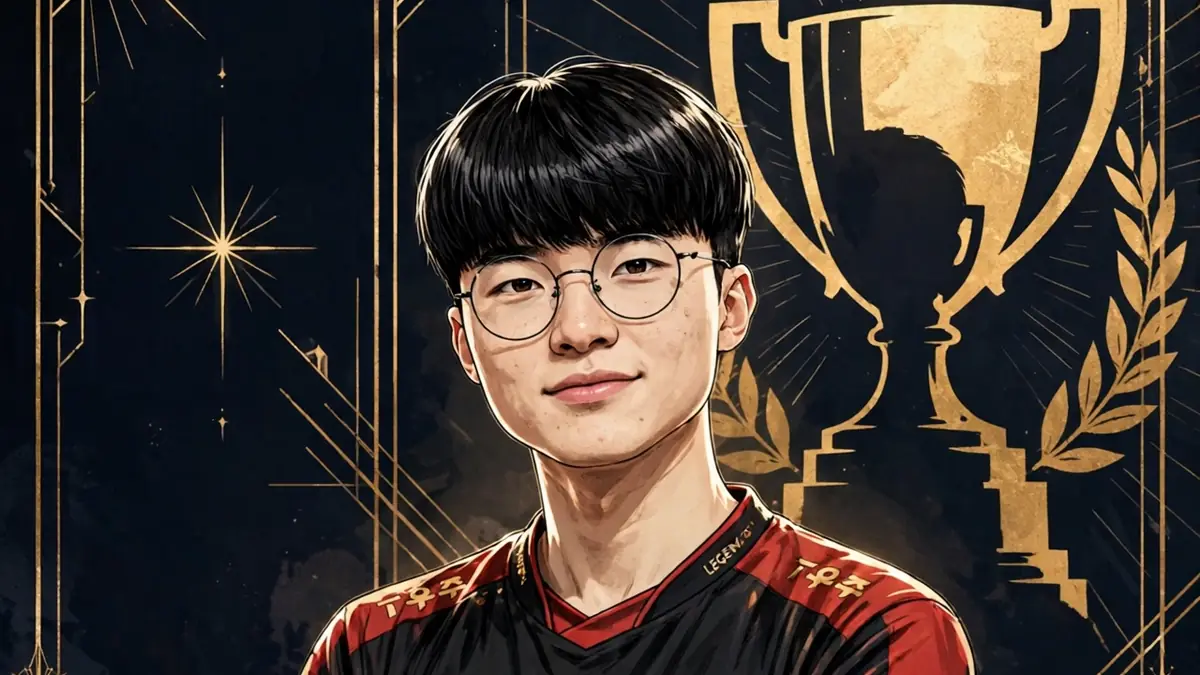
Faker Quick Facts
| Full Name | Lee Sang-hyeok (이상혁) |
|---|---|
| Known As | Faker — also called the “Unkillable Demon King” |
| Date of Birth | May 7, 1996 |
| Age | 30 years old (as of November 2026) |
| Birthplace | Gangseo District, Seoul, South Korea |
| Height | 5 feet 9 inches (176 cm) — anchored figure; official Asian Games roster listed 177 cm |
| Weight | Approximately 56–60 kg (123–132 lbs); sources disagree, see the weight section below |
| Team / Role | T1, mid laner — with the same organisation since 2013 |
| World Championships | 6 titles (2013, 2015, 2016, 2023, 2024, 2025) — a record |
| Other Major Titles | 2× Mid-Season Invitational (2016, 2017); 10× LCK champion; Esports World Cup 2024; Asian Games gold 2022 |
| Contract | With T1 through the 2029 season (four-year extension signed July 2025) |
| Estimated Net Worth | About $25 million in 2026, inside a $20–40 million evidence range (Guide Net Worth anchor; T1 has never confirmed his salary) |
| Primary Income Sources | T1 salary (reported at roughly $6 million a year), 5.66% T1 stock option, tournament prize money, sponsorships |
| Nationality | South Korean |
Table of Contents
- Faker Quick Facts
- How Tall Is Faker?
- Faker’s Height in Every Unit
- Where the 176 cm Figure Comes From
- Why Some Sites Say 5 Feet 7 or 6 Feet
- Faker vs. Other LoL Pros: A Height Comparison
- Does Height Matter in Esports?
- Early Life in Seoul
- Career Rise With T1: From 17-Year-Old Debut to Six Worlds Titles
- The Money Behind the Height: Salary, Equity and Net Worth
- Weight and Physical Profile
- Personal Life
- Injuries and Setbacks
- Faker Height FAQs
- Final Thoughts
- Sources and Reporting
How Tall Is Faker?
Faker stands 5 feet 9 inches tall, which is 176 centimetres. That is the number carried by the bulk of the biography sources that have tracked him for years — Healthy Celeb lists him at 5 feet 9¼ inches or 176 cm, TheCityCeleb and DailyWikiBio both give 5 feet 9 inches (176 cm), and SportsDNA lists 176 cm (5 ft 9 in). The figure has been stable across a decade of profiles, from his early twenties to his thirtieth birthday, which is itself a useful check: a grown man’s height does not drift by two inches between profiles unless somebody is guessing.
There is one respectable challenge to the number. The player data released for the South Korean national team ahead of the 2022 Asian Games (played in 2023) listed Faker at 177 cm, one centimetre taller, and 56 kg. That sheet was an official tournament roster, not a fan wiki, so it deserves weight. The honest reading is that Faker’s height sits at 176–177 cm, or 5 feet 9 inches to 5 feet 9¾ inches, with 176 cm the figure most sources print and the one Faker himself has been associated with in interviews. A single centimetre is the difference between measuring in the morning and the evening, in shoes and out of them, or rounding to the nearest whole number on a form. It is not a real dispute.
What is a real dispute is the pair of outlier numbers that dominate the lower end of search results. Several low-quality biography mills list Faker at 5 feet 7 inches (170 cm), and at least one puts him at 6 feet (183 cm). Neither number has a named source behind it, neither appears in any Korean reporting, and neither matches the photos. The 5-foot-7 figure appears to have been copied from site to site for years — the same pages also carry stale net worth figures from 2019 and 2021 and wrong ages — while the 6-foot figure looks like a simple error that was never corrected. This article treats both as wrong and says so plainly, because repeating them as “some say” without judgement would leave a reader no better off than before.
The bottom line on the number: use 5 feet 9 inches (176 cm). If you see 177 cm, that is the Asian Games roster measurement of the same man, not a different height. If you see 5 feet 7 inches or 6 feet, the page you are reading copied its facts from another page that copied them from another page — and none of them checked.
Height also puts Faker in useful context. At 176 cm he is a little above the reported average for South Korean men, which sits at about 174 cm, and a little below the average for American men, about 175–176 cm depending on the survey. In plain terms, he is an average-height man who happens to be the most famous League of Legends player who has ever lived. The contrast is part of why the question fascinates people: on stage, under arena lights, with a trophy in his hands, he looks larger than life. Off stage, in a team photo, he is the same height as the person standing next to him in the queue at a coffee shop.
Faker’s Height in Every Unit
Different countries search the question in different units, and the conversions are where small errors creep in. Here is the anchored figure, converted cleanly, so there is no need to trust a converter site.
| Unit | Faker’s Height |
|---|---|
| Centimetres | 176 cm (177 cm on the Asian Games roster sheet) |
| Metres | 1.76 m |
| Feet and inches | 5 feet 9 inches (5 feet 9¼ inches on Healthy Celeb’s listing) |
| Inches only | 69.3 inches |
| Millimetres | 1,760 mm |
The arithmetic is simple: 176 cm divided by 2.54 cm per inch gives 69.29 inches, which is 5 feet (60 inches) plus 9.29 inches. That is why some sources write 5 feet 9 inches and one careful source writes 5 feet 9¼ inches — both are the same measurement, rounded differently. The Asian Games figure of 177 cm converts to 69.69 inches, or 5 feet 9.7 inches, which rounds to 5 feet 10 inches on a careless page. That rounding chain is probably how at least one of the wilder numbers got loose: 177 cm becomes 5 feet 10 inches, and a reader misremembers it as 6 feet.
For readers who think in comparisons rather than numbers: 176 cm is about the height of a standard interior doorway minus a few inches, about 10 cm shorter than a regulation basketball hoop’s rim is high above a player’s outstretched hand — no, simpler than that. It is the height of Tom Cruise, give or take a centimetre, and a couple of centimetres taller than Lionel Messi. It is ordinary. And ordinary is the point: nothing about Faker’s body explains his career. His hands are quick, his memory for game states is famously deep, and his calm under pressure is what teammates talk about. His height is a footnote that fans ask about because they want to picture him, not because it decided a single game.
Where the 176 cm Figure Comes From
No single official document settles a celebrity’s height, and Faker has never stood against a wall on camera for a measurement. What exists instead is a pile of sources of very different quality, and the job is to weigh them. Here is how the main ones stack up.
| Source | Figure Given |
|---|---|
| Healthy Celeb | 5 ft 9¼ in / 176 cm; weight 60 kg; last updated December 2022 |
| TheCityCeleb | 5 ft 9 in (176 cm); weight about 56 kg |
| DailyWikiBio | 1.76 m (5 ft 9 in) |
| SportsDNA | 176 cm (5 ft 9 in) |
| Asian Games roster data (2023) | 177 cm; weight 56 kg — official tournament player data |
| IBollyNews | 176 cm (5 ft 9 in) |
| SuperstarsBiography | 1.76 m; weight 56 kg |
| FamousPeopleToday / SuperstarsCulture | 5 ft 7 in (170 cm) — no named source, stale companion facts |
| NetworthAges | 6 ft 0 in (183 cm) — no named source, page also misstates his real name |
The pattern is clear. The sources that agree on 176 cm are also the ones whose other facts check out: the right birth date, the right team, the right titles. The sources that disagree are the ones whose pages are full of other errors. FamousPeopleToday, which lists 5 feet 7 inches, also repeats the claim that Faker has never dated — a line lifted from a 2020 radio appearance — and its page reads as a patchwork of old material. NetworthAges, the source of the 6-foot claim, introduces Faker with the wrong real name (“Lee Hook”) in its own text, which tells you everything about how carefully that page was put together. When a page cannot get a man’s name right, its height figure is not worth quoting.
There is also the interview record. Faker has said in interviews that he is 176 cm tall, a line reported by Inven Global, the Korean esports outlet that has covered him since his debut. A player’s own statement is not proof on its own — people round up, and athletes are no exception — but when the player’s own words match the majority of independent profiles and sit within a centimetre of an official tournament roster, the case is closed for practical purposes. The convergence of three different kinds of evidence — the player, the profile sites, and the tournament sheet — is what makes 176 cm an anchor rather than a guess.
One more check comes from photographs. Faker has stood next to teammates and rivals for thirteen years, on stages and in team photos where footwear is flat and posture is natural. Next to Chovy, who is listed at 185 cm on the same Asian Games roster data, Faker is visibly shorter by roughly a head’s width at the crown — about 9 cm, which matches the 176 vs. 185 gap exactly. Next to players listed around 175–178 cm, he is level. Photos are not measurements, but they are a useful lie detector, and they back the 176 cm figure rather than the outliers.
Why Some Sites Say 5 Feet 7 or 6 Feet
Bad numbers survive on the internet because copying is cheaper than checking. The 5-foot-7 figure is the older of the two errors, and its trail is easy to follow: a cluster of biography sites that share the same template, the same phrasing, and the same stale facts all print 5 feet 7 inches alongside a weight of 72 kg — a weight no other source gives Faker, and one that would make him stocky rather than the lean figure everyone who has seen him play knows he is. The same pages list his net worth at figures from 2019 and 2021, years out of date, and one of them calls him an “American streamer,” which he plainly is not. These pages were written once, probably by scraping each other, and then left to age. Search engines keep serving them because they are old, keyword-heavy, and linked to, not because they are right.
The 6-foot figure is rarer and easier to explain. NetworthAges lists Faker at 6 feet 0 inches (183 cm) and a weight of 68 kg, in a table that also gives his net worth as $10 million “as of 2025” — a figure that was already out of date when it was published, since better-sourced estimates had moved well past it. A single wrong cell in a table like that, copied once by another site, becomes a “source” for the next copier. There is no interview, no roster sheet, and no Korean report behind 183 cm. It is a typo with a long afterlife.
There is also a subtler mechanism at work: unit confusion. Some international pages list heights in centimetres and convert badly, or list a height in feet and inches and then convert back. A 176 cm man is 5 feet 9 inches; a careless conversion of 176 cm using 30 cm per foot gives 5 feet 10 inches; a reader rounding that up gets 6 feet. None of this requires bad faith. It requires only that nobody checks, and in the biography-mill economy, nobody does. The lesson for readers is a general one: when a celebrity fact appears only on pages that also get the easy facts wrong, treat it as noise.
Fans sometimes ask whether Faker himself has ever corrected the record. He has not made a point of it, and there is no reason he would. Height is not a sensitive subject for him, and he has spent his public life answering questions about game strategy, not his body. The 176 cm line from his interviews stands as the closest thing to a personal confirmation, and it is enough.
Faker vs. Other LoL Pros: A Height Comparison
Height comparisons are where a bare number turns into something a reader can picture. The table below uses only heights that come from a named, checkable place — the Asian Games roster data for Faker’s fellow Korean internationals, and the profile consensus for the rest. Where a figure is uncertain, the table says so rather than printing a guess as fact.
| Player | Height |
|---|---|
| Faker (Lee Sang-hyeok, T1 mid) | 176 cm (5 ft 9 in) |
| Chovy (Jeong Ji-hun, Gen.G mid) | 185 cm (6 ft 1 in) — Asian Games roster data |
| Ruler (Park Jae-hyuk, ADC) | Listed shorter and heavier than Faker on the same roster sheet; exact figure varies by source, so it is not printed here as fact |
| Average South Korean man | About 174 cm |
| Average American man | About 175–176 cm |
The Chovy comparison is the telling one. Chovy is Faker’s great mid-lane rival of the last several years, the player most often named as the best mid laner in the world when Faker is not, and he stands about 9 cm taller. On stage, in the pre-game handshake line, the difference is visible: Chovy’s shoulders clear Faker’s by a clear margin. It has never mattered. Their rivalry is decided by wave management, roams, and team fights, and Faker has won the titles that count — including the 2023, 2024, and 2025 World Championships, all three against fields that included Chovy’s Gen.G.

Step back from League of Legends and the picture widens. Esports is one of the few elite competitions where body size is close to irrelevant. A 176 cm mid laner and a 185 cm mid laner sit in the same chair, use the same mouse, and see the same screen. Reaction time, game knowledge, and nerve decide matches. That is why the height question is a curiosity rather than an analysis: fans ask it the way they ask a film star’s height, because they want to complete the picture in their heads, not because it predicts anything. The peer table above is the most useful form of the answer, because it replaces an abstract number with faces a fan already knows.
There is one more comparison worth making, and it is with Faker himself over time. He debuted at 17, still growing, and the earliest profiles of him list the same 176 cm figure that current profiles do. That stability is reassuring: it means the number was not invented for a single article and then frozen, but carried forward because it kept matching what people saw. A player who grew two inches after his debut would have left a trail of conflicting numbers. Faker did not.
Does Height Matter in Esports?
Short answer: no, not in any way that decides games. League of Legends is played sitting down, with a mouse and keyboard, at a fixed distance from a monitor. Reach, jump height, and stride length — the things that make height decisive in basketball or football — have no role. The physical demands of professional play are real, but they are different: wrist and hand health, posture over ten-hour practice days, eye strain, and sleep. Faker’s own career proves the point from both directions. He has played at the top for thirteen years, and the one injury that genuinely threatened his career was a wrist injury in 2023, not anything to do with his frame.
What height does affect is the stage picture. Esports arenas are built for spectacle: players walk out through tunnels, stand for introductions, and lift trophies above their heads. A taller player photographs larger in those moments, and broadcast cameras, which shoot from fixed angles, can exaggerate small differences. Faker at 176 cm photographs as a normal-sized man among normal-sized men, which is exactly what he is. The trophy lifts are the great leveller — when T1 lifted the Summoner’s Cup in 2023, 2024, and 2025, nobody in the arena was measuring the man holding it.
There is a health angle that matters more than height, and it is the one Faker’s own story raises. At 56 kg on the Asian Games roster, Faker’s body mass index sits at about 18.1, below the usual healthy range, and Korean reporting around the Asian Games noted that he was the lightest player on the national team. He has spoken in the past about eating irregularly during heavy practice periods, and the wrist injury that cost him part of 2023 was linked by team staff to the sheer volume of practice hours. The honest health story of a 176 cm, 56 kg player who practices ten hours a day is not about height at all. It is about whether a lean frame holds up under a workload that would strain anyone, and Faker’s answer — thirteen years, six world titles, still starting at 30 — is that it has, with care and with at least one serious scare along the way.
For young players who look up to Faker, the message is a useful one. There is no body type for a mid laner. The game’s greats come in every size: tall, short, heavy, lean. What they share is not a physique but a practice history — thousands of hours of solo queue, review, and stage games. A 15-year-old who is 176 cm and a 15-year-old who is 160 cm have the same shot, and the same obstacles, which are patience, study, and the willingness to lose a thousand games in public before winning the ones that matter.
Early Life in Seoul
Lee Sang-hyeok was born on May 7, 1996, in Gangseo District, Seoul, South Korea, and grew up there under the care of his grandparents and his father, Lee Kyung-joon, with a younger brother. His mother is not a public figure and the family has kept that part of his life private, which is worth respecting rather than filling in. What is on the record is a childhood that looked ordinary from the outside: school in Seoul, a home where games were part of life, and a boy who was good at the things that do not show up on a report card — pattern recognition, patience, and a memory for detail.
He found League of Legends as a teenager, and the story of how quickly he rose has become part of the game’s folklore. He was not a child prodigy pushed by coaches or parents. He was a solo queue player — the ranked ladder where anyone can play anyone — who climbed so fast and so visibly that professional teams noticed him before he had played a single organised match. The nickname he used, GoJeonPa, was known on the Korean ladder before the name Faker meant anything to anyone. SK Telecom T1 signed him in 2013, when he was 17, and he debuted professionally on April 6, 2013.
That debut is worth pausing on, because it explains the rest of his career. Most players spend years in academy teams and second divisions. Faker went from solo queue to the starting mid lane of Korea’s biggest team in months, and then to a World Championship in his first season. The speed of it has never really been repeated. It also set the pattern for how he has been treated ever since: not as a player who earned his place slowly, but as a standard other players are measured against. The nickname “Unkillable Demon King” dates from those early years, when opponents found that killing his champion in lane did not stop him from winning the game.
Seoul shaped him in a second way too. Korean esports in the 2010s was a disciplined, team-house world: shared housing, fixed practice schedules, coaches who treated the game like a sport rather than a hobby. Faker grew up inside that system and, as he got older, became one of the people who defined it. Younger T1 players now talk about his habits — the review sessions, the calm in losing streaks, the refusal to blame teammates in public — as the model they were given on arrival. The boy from Gangseo District became, without ever leaving his team, the elder statesman of the whole league.
Career Rise With T1: From 17-Year-Old Debut to Six Worlds Titles
Faker’s career is the longest unbroken run at the top of any esport, and it belongs to a single team. He has played as the mid laner for T1 — formerly SK Telecom T1 — for his entire career, from his debut in 2013 to the present day. In an industry where players change teams every year and rosters turn over completely between seasons, that loyalty is itself a record, and it is the frame for everything else.
The titles, in order, tell the story. His first World Championship came in his debut year, 2013, when SKT beat Royal Club in the final. Two more followed in 2015 and 2016, the second of those with a Finals MVP award for Faker himself. Then came the long middle of his career: years when T1 stayed competitive but did not win Worlds, when Faker was written off more than once as a fading star, and when the game changed around him — new champions, new metas, new generations of mid laners who had grown up watching him. He answered the way he always has, by staying, by practising, and by winning again.
The second peak is the more remarkable one. T1 won the World Championship in 2023, then again in 2024 — with Faker named Finals MVP for the second time — and then again in 2025, beating KT Rolster 3–2 in the final on November 9, 2025, in Chengdu. That made three in a row, the first three-peat in Worlds history, and six titles in total for Faker, the most by any player. He was 29 when the sixth title arrived and 30 when the 2026 season began, an age at which almost every other great player has retired, moved to coaching, or faded into streaming. He is still starting.
The rest of the trophy cabinet fills out the picture: ten League of Legends Champions Korea (LCK) titles, a record; two Mid-Season Invitational titles in 2016 and 2017, with the 2016 Finals MVP; the Esports World Cup in 2024, again with Finals MVP honours; and, for his country, a silver medal at the 2018 Asian Games and a gold at the 2022 Asian Games in Hangzhou. The gold mattered beyond sport: it earned Faker and his teammates an exemption from South Korea’s mandatory military service, which would otherwise have interrupted his career at its peak. He also holds the records for the most kills and assists in World Championship matches, and he was the first player to pass 100 World Championship wins, reaching his eighth Worlds final in 2025.
Individual honours have followed the team ones. He was the first inductee into Riot Games’ Hall of Legends in 2024, the game’s own hall of fame, with a commemorative Ahri skin marking the occasion. In January 2026 he became the first esports player to receive South Korea’s Cheongnyong Medal, one of the country’s highest sporting honours. And in October 2026, Korea Post issued commemorative stamp sheets honouring him — 140,000 sheets in two designs, tracing his career from his 2013 debut through the 2023–2025 three-peat — making him the first esports player to receive an individual commemorative stamp issue. A postage stamp is a strange honour for a video game player, and that is exactly why it matters: it says the country sees him as a national figure, not a niche celebrity.
What ties the thirteen years together is not any single title but the way Faker plays. He is known for a deep champion pool — the Zed, Ryze, Syndra, Orianna, Yone, and Galio skins that Riot has made for his Worlds wins trace his career champion by champion — and for a style that puts team fights and map control ahead of personal statistics. Teammates past and present describe the same thing: a mid laner who stays calm when a game is lost on paper, who finds the one fight that turns it, and who never panics. At 176 cm, he is not the biggest man on the stage. He has never needed to be.
The Money Behind the Height: Salary, Equity and Net Worth
A height article still owes readers the money picture, because it is the question most of them ask next — and because Faker’s finances are unusually well documented for a player whose team has never confirmed a single salary figure. The honest summary is that nobody outside T1 knows his exact net worth, and every number in circulation is an estimate built from the same three public pillars: a reported salary, a stock option, and prize money.
The salary pillar is the biggest and the least confirmed. Korean press reporting has put Faker’s pay at roughly $6 million a year, a figure Naver reporting framed as a rough estimate, and some outlets have reported $7–8 million a year under the four-year extension he signed in July 2025. T1 has never published his salary, and Faker has never stated it. What is on the record is the shape of the deals: a three-year contract in February 2020 that made him a part-owner of T1 and guaranteed him a leadership role after retirement, reported by ESPN at the time, and the July 27, 2025 extension that keeps him at T1 through the 2029 season, when he will be 33. T1 chief executive Joe Marsh has said publicly that a Chinese team once offered Faker about $20 million a year, and he stayed.
The equity pillar is the most concrete. In February 2020 Faker became a part-owner of T1 Entertainment & Sports, and in January 2023 T1’s shareholders approved a stock option letting him buy 6,156 newly issued shares at 2,097,419 KRW each — about $1,700 at the time — which would give him 5.66% of the company if he exercises all of it. The filing was reported by Inven Global. The value of that stake depends entirely on what T1 is worth, a number the company has never published, which is why estimates of his net worth swing so widely.
The prize money pillar is the only one with hard data. Esports Earnings tracks Faker at $1,922,085 across 74 tournaments, all of it from League of Legends, while Liquidpedia’s count, reported by Esports Insider, put his tournament earnings at about $2,136,648 across 98 events by January 2026, with 20 titles. Prize money is the smallest of the three pillars — a reminder that even the greatest player in the game’s history made most of his money from salary, ownership, and sponsorships, not from winning cheques.
Pulling the pillars together, the best-anchored estimate for 2026 is about $25 million, inside a $20–40 million evidence range — the figure used by our sister site Guide Net Worth, whose full breakdown of Faker’s net worth in 2026 works through the salary, the 5.66% stake, and the prize money line by line. Other outlets range from about $10 million on the low end (Esports Insider) to $25–50 million on the high end (Aussyelo), and Esports.gg puts the public range at $10–30 million. The spread is the story: without a confirmed salary or a published T1 valuation, no estimate can be better than a range, and any site that prints a single precise number without saying so is overselling its certainty.
One detail from the money story belongs in a height article too, because it explains why Faker’s height is asked about at all. Sponsorships — Razer, with its Faker Edition mice, and Secretlab, among others — have made his face one of the most recognisable in Korean advertising, and his image appears in commercials and on television far beyond the esports audience. A player whose face sells products gets asked the same questions a film star gets asked, height among them. The money and the fame are not separate stories. They are the same story, told in different units.
Weight and Physical Profile
Height without weight is half a physical profile, and Faker’s weight is the one number in this article where the sources genuinely disagree — so the disagreement is printed rather than hidden. The Asian Games roster data listed him at 56 kg (about 123 lbs). Healthy Celeb lists 60 kg (132 lbs). Other profile pages give 63 kg or 65 kg, and one outlier page lists 72 kg, a figure that matches no other source and no photograph. The most repeated figures cluster at 56–60 kg, and this article uses that range, with 56 kg as the figure from the most official source available.
At 176 cm and 56 kg, Faker’s body mass index is about 18.1, below the 18.5 threshold that marks the start of the usual healthy range. At 60 kg it is about 19.4, inside the range. Either way, he is a lean man, and Korean reporting around the Asian Games in 2023 noted that he was the lightest player on the South Korean national team — lighter than Ruler, his teammate, by a reported 30 kg on the same sheet, and lighter than every other player on the roster. The coverage at the time was concerned rather than admiring: a player carrying a national team’s hopes while eating irregularly and practising through a wrist injury.
None of this is a diagnosis, and this article does not offer one. Weight fluctuates, roster sheets are snapshots, and a single BMI number says nothing about a person’s health on its own. What can be said is that Faker’s build has been consistent across his career — lean at 20, lean at 30 — and that it has never limited him. He has played more high-stakes games than anyone in his sport, and he is still playing. Readers looking for a single weight number should take 56–60 kg and treat the wider figures as the same copying problem that produced the wrong heights.
The rest of the physical profile is simple and well agreed: black hair, dark brown eyes, and the round glasses that have become part of his public image. He is right-handed, like most players, and his setup — mouse, keyboard, monitor height — is adjusted to him the way every professional’s is. There is no reliably sourced shoe size, chest measurement, or other body statistic in the public record, and this article does not invent one. The pages that print those numbers are the same pages that print the wrong height, and they are not worth repeating.
Personal Life
Faker keeps his private life private, and the public record reflects that choice. He has said in interviews that he had never dated, a line from a 2020 appearance on the MBC show Radio Star that biography pages have repeated ever since, and there is no reliable report of a girlfriend, wife, or children as of November 2026. He is single as far as the public record shows, and this article does not speculate beyond that. The pages that print detailed relationship histories for him are inventing them; the honest answer is that he does not talk about it, and the press has respected that.
What he does talk about is family, in the limited way he talks about anything personal. He has credited his father and grandparents with supporting a career path that, in 2013, looked like a gamble — professional gaming was not yet the established industry it is now, and a 17-year-old leaving school for a team house was a leap for any family. His younger brother has stayed out of the public eye. Faker’s own public image is built on the opposite of celebrity excess: he is known for a modest lifestyle, for donating to charity — including a well-reported donation of 30 million KRW (about $25,000) to a South Korean charity in 2021, and further donations since — and for a routine that revolves around practice, review, and rest.
His interests outside the game are the ordinary ones of a man who has spent his adult life in one building with one team: he reads, he watches football, and he has appeared on Korean television and in advertising campaigns that have nothing to do with gaming. He is active on social media under the handle @faker, though the account is managed with T1, and his YouTube presence runs through T1’s channels. He does not court controversy, and he does not feed the rumour cycle. In thirteen years at the top of a sport that runs on drama, that restraint is itself a kind of achievement.
Injuries and Setbacks
The one serious threat to Faker’s career came in 2023, and it had nothing to do with his height or his frame. Midway through the year he developed a wrist injury — the occupational hazard of a player who practises for hours a day, every day, for a decade — and missed part of the LCK Summer split while T1 played with a substitute. At the time, Korean coverage openly wondered whether the greatest career in the game’s history was ending, not with a defeat but with a medical report. He returned for the World Championship that autumn and won it, his fourth title, and then won two more. The injury is now part of the legend rather than the end of it, but it was a genuine scare, and it is the reason T1 now manages his practice load more carefully.
The other setbacks were sporting, not medical. Between the 2016 and 2023 World Championships, Faker went six years without a Worlds title, and in that stretch T1 lost finals, missed tournaments, and rebuilt its roster around him more than once. The 2017 final, lost to Samsung Galaxy, is still cited as one of the great upsets in the game’s history, and the years that followed brought the first real questions about whether a player who had won everything at 20 could still win at 27. His answer was not a speech. It was three straight World Championships from the age of 27 to 29, a run no player has matched at any age.
There are no legal controversies or scandals attached to his name, and this article does not manufacture any. He has never been suspended, fined, or investigated by Riot Games or by T1, and his record with the game’s authorities is clean. In a sport where bans and disputes are common, a thirteen-year career without a disciplinary blemish is worth stating plainly, because it is part of why sponsors trust him and why his country honoured him with a medal and a stamp.
Faker Height FAQs
How tall is Faker?
Faker is 5 feet 9 inches tall (176 cm). That is the figure most reliable profile sources agree on, and it matches what Faker himself has said in interviews. The official Asian Games roster listed him at 177 cm, one centimetre taller — the same man, measured on a different day, not a different height.
How tall is Faker in feet and inches?
5 feet 9 inches, or 5 feet 9¼ inches if you use Healthy Celeb’s more precise listing. In inches alone that is 69.3 inches. The ¼-inch difference is rounding: 176 cm converts to 69.29 inches, so some sources round to 9 inches and one rounds to 9¼ inches.
How tall is Faker in cm?
176 cm, or 1.76 metres. The Asian Games player data released in 2023 listed 177 cm. Either figure rounds to the same height in feet and inches, and this article anchors on 176 cm because it is the figure the majority of sources print and the one Faker has stated himself.
Is Faker 5 feet 7 inches or 6 feet tall?
Neither. The 5-foot-7 figure (170 cm) comes from low-quality biography pages whose other facts are also wrong — stale net worth figures, wrong ages, and in one case the wrong real name. The 6-foot figure (183 cm) comes from a single page that also misstates his name. No interview, roster sheet, or Korean report supports either number, and photographs next to teammates of known height back the 176 cm figure instead.
How much does Faker weigh?
About 56–60 kg (123–132 lbs), with the sources disagreeing inside that range. The Asian Games roster listed 56 kg, Healthy Celeb lists 60 kg, and a few pages give 63–65 kg. The 72 kg figure on some biography sites has no support anywhere else. At 176 cm and 56 kg, his body mass index is about 18.1 — a lean build that has stayed consistent across his whole career.
Who is taller, Faker or Chovy?
Chovy is taller. Chovy, Faker’s great mid-lane rival at Gen.G, is listed at 185 cm (6 ft 1 in) on the same Asian Games roster data that lists Faker at 177 cm — a gap of about 8–9 cm. It has never decided their rivalry: Faker has won six World Championships, and Chovy has won none, despite the height advantage.
How old is Faker and how tall is he compared to other LoL pros?
Faker was born on May 7, 1996, and turned 30 in May 2026. At 176 cm he sits just above the reported average for South Korean men (about 174 cm) and is a typical height for a professional League of Legends player — the game is played sitting down, so height varies widely across the pro scene and predicts nothing about results.
What is Faker’s net worth in 2026?
About $25 million, inside a $20–40 million evidence range, according to Guide Net Worth’s 2026 estimate. The figure is built from a reported T1 salary of roughly $6 million a year (never confirmed by T1), a 5.66% stock option in T1, and about $1.92 million in career prize money. T1 has never published his salary or a company valuation, so every net worth figure for Faker is an estimate, not a disclosure.
Final Thoughts
Faker is 5 feet 9 inches tall (176 cm), and that number is now settled as far as public evidence can settle it: the player’s own words, the majority of profile sources, and an official tournament roster all land within a centimetre of each other. The outliers — 5 feet 7 inches and 6 feet — belong to pages that copy each other without checking, and they should be left there.
The number itself is the least interesting thing about him. A man of ordinary height has had the most extraordinary career in his sport’s history: thirteen years with one team, six World Championships, ten domestic titles, a part-ownership stake in the club he plays for, a national medal, and a postage stamp. Height never won him a game, and it never lost him one. What won them was the work nobody sees — the hours of practice, the review sessions, the calm in a losing game — and that is the part of Faker that no measurement can capture. He stands 176 cm tall. He stands alone in the record books.
Sources and Reporting
How we estimated: Faker’s height is anchored on the convergence of three kinds of evidence — the player’s own statement of 176 cm, reported by Inven Global; the majority of independent profile sources (Healthy Celeb, TheCityCeleb, DailyWikiBio, SportsDNA, IBollyNews), which agree on 176 cm / 5 feet 9 inches; and the official Asian Games roster data, which listed 177 cm. Where sources conflict, this article prints the range and names the outlier pages rather than hiding the disagreement. His net worth is an estimate, not a disclosure: T1 has never confirmed his salary or published a company valuation, so the $25 million anchor (inside a $20–40 million range) is presented as an estimate with its pillars — reported salary, the 5.66% T1 stock option, and Esports Earnings prize money — shown separately so readers can judge each one. Figures are estimates before tax, fees, and expenses, and private finances may differ from every published number.
Named sources consulted for this article: Wikipedia (career record, titles, birth details); Inven Global (Faker’s 176 cm statement; T1 stock option filing); Healthy Celeb (height 5 ft 9¼ in / 176 cm, weight 60 kg); TheCityCeleb (height, weight, Asian Games gold); Esports Insider (net worth, salary, prize money); Esports.gg (net worth range, salary, equity); LoLTheory (salary, equity, prize money breakdown); ESPN (2020 part-ownership deal; Worlds winners list); Dot Esports (Worlds history, 2025 final); KCurrent (six titles, age 30); Asia Daily (commemorative stamps, October 2026; Cheongnyong Medal, January 2026). Sister-site coverage: Guide Net Worth — Faker net worth 2026. Outlets whose figures were examined and rejected, with reasons given in the text: FamousPeopleToday, SuperstarsCulture, NetworthAges, MarriedBiography.
Byline: Celebamerica Editorial Staff. Corrections: if you spot an error in this article, contact the editorial team and it will be checked against the named sources above.