Last updated: 19 November 2026 · By Celebamerica Editorial Staff
Elena Rybakina is the world No. 1 in women’s tennis. She reached the top of the WTA rankings on 14 September 2026, at 27 years and 89 days old, after winning the US Open — her third Grand Slam singles title and her second major of a season that turned her from a respected champion into the player everyone else had to chase. She is the first player from Kazakhstan, man or woman, to win a major and to reach world No. 1, and she will finish 2026 as the year-end No. 1.
The numbers behind that rise are just as striking. Rybakina owns 15 WTA singles titles, including three majors, two WTA 1000 crowns and the 2025 WTA Finals, and her career prize money had passed $30 million by September 2026. Her estimated net worth sits in a range of $12 million to $20 million as of 2026, with Celebrity Net Worth anchoring the top of that range at $20 million. This biography follows the whole arc: a tall Moscow schoolgirl told she was too tall for gymnastics, a teenager who switched countries at 19, a Wimbledon champion who won a major and gained no ranking points for it, and a 27-year-old who finally took the No. 1 ranking from Aryna Sabalenka after 99 weeks.
On this page
- Quick Facts: Elena Rybakina at a Glance
- Early Life and Family in Moscow
- Switching Flags: From Russia to Kazakhstan
- Juniors and the ITF Grind
- The 2020 Breakthrough: Five Finals
- Wimbledon 2022: The First Kazakhstani Major Champion
- Australian Open 2023 and the Top 10
- Indian Wells and Rome: Two WTA 1000 Crowns
- 2024 and 2025: Titles, Setbacks and the WTA Finals Record
- The 2026 Season: Two Majors and World No. 1
- Playing Style: The Serve That Sets the Tone
- Coaches and the Vukov Story
- The Money: Prize Money, Endorsements and Net Worth
- Net Worth Growth: Year by Year
- Personal Life, Home and Life Away From Tennis
- The Sabalenka Rivalry
- Records, Awards and What Comes Next
- Frequently Asked Questions
- Final Thoughts: The Bottom Line
- Sources and Reporting
Quick Facts: Elena Rybakina at a Glance
| Full name | Elena Andreyevna Rybakina |
|---|---|
| Date of birth | 17 June 1999 (age 27 as of November 2026) |
| Birthplace | Moscow, Russia |
| Represents | Kazakhstan (since June 2018; previously Russia, 2014–2018) |
| Height | 1.84 m (6 ft 0 in) |
| Turned pro | 2014 |
| Plays | Right-handed, two-handed backhand |
| Coach | Stefano Vukov (2019–2024, 2025–) |
| Career-high ranking | World No. 1 (14 September 2026) |
| Grand Slam titles | 3 — Wimbledon 2022, Australian Open 2026, US Open 2026 |
| WTA singles titles | 15, including two WTA 1000 titles and the 2025 WTA Finals |
| Career prize money | More than $30 million (as of September 2026) |
| Estimated net worth | $12 million to $20 million (2026 range; Celebrity Net Worth: $20 million) |
| Primary income sources | Tournament prize money, Yonex and other endorsements, appearance fees |
| Residence | Dubai, United Arab Emirates |
Early Life and Family in Moscow
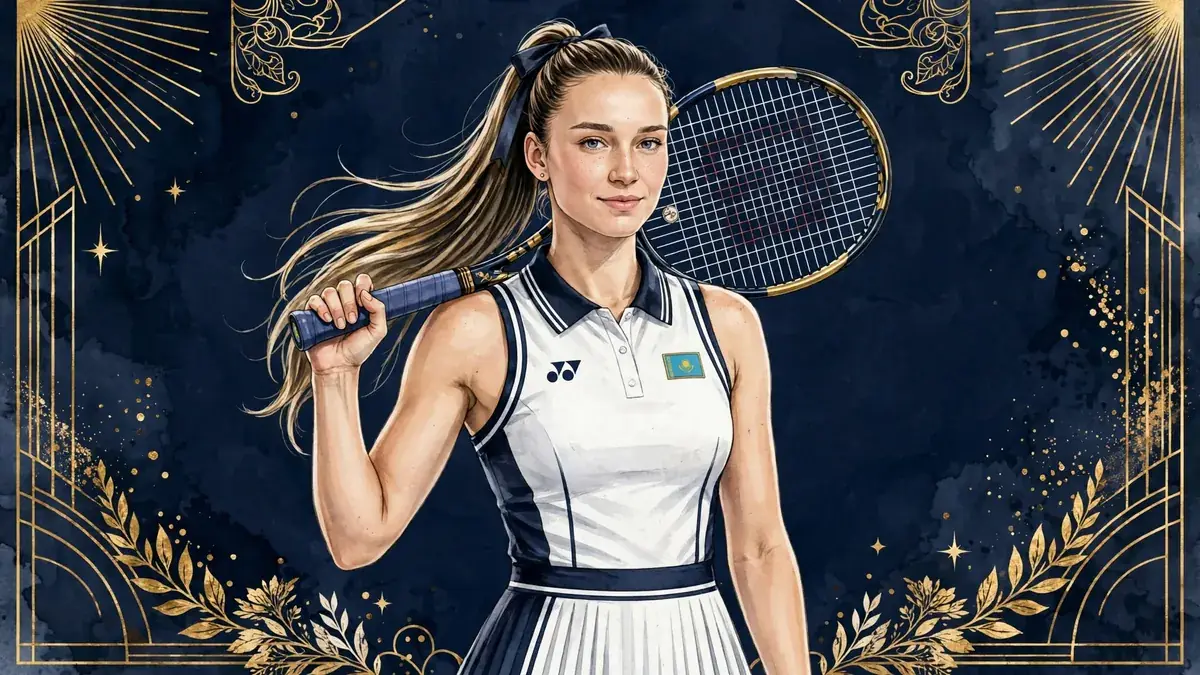
Elena Andreyevna Rybakina was born on 17 June 1999 in Moscow, to Andrey Rybakin and Ekaterina. Her father was born in Almaty, in Kazakhstan, and worked as a producer for the television channel NTV Plus. That detail matters more than it first looks: the family tie to Almaty would later make the switch to Kazakhstan feel less like a cold career calculation and more like a return to a family root.
Rybakina did not start out as a tennis player. She and her older sister Anna began with gymnastics and ice skating, the two sports Moscow children of her generation were most often steered toward. Both girls were tall, and Rybakina was told she was too tall to make a professional career in either discipline. Her father, who followed tennis closely, suggested she try the sport instead. She picked up a racket at the age of six.
Anna Rybakina also played tennis, and the sisters practised together from a young age. Elena’s height, the very thing that had closed the door on gymnastics and skating, became her greatest asset on a tennis court. At 1.84 m (6 ft 0 in) she would grow into one of the tallest players at the top of the women’s game, with a serve that could win her free points on every surface.
School came first for a long time. Rybakina has spoken about finishing her education before committing fully to tennis, and that unhurried start is part of why her rise looks different from the prodigies who were winning junior Slams at 15. She was a late developer by tennis standards, and the patience of that path shows in her game now: she rarely looks rushed, even when a match is slipping away from her.
Switching Flags: From Russia to Kazakhstan
Rybakina represented Russia as a junior and in the first years of her professional career, reaching a junior world ranking of No. 3. But by 2018, at 19, her career had reached a fork. She was a talented player outside the top 100 with limited financial backing, and the cost of travelling the tour — flights, hotels, coaching, physio — was outpacing what her family could carry alone.
In May 2018, just after turning 19, she acquired Kazakhstani citizenship, and in June 2018 she formally switched federations from Russia to Kazakhstan. The Kazakhstan Tennis Federation offered the kind of structured support she had not been getting: funding for travel and coaching, and a federation that treated her as a central part of its programme rather than one of many hopefuls. Her father’s Almaty roots gave the move a personal logic as well.
The switch changed the shape of her career within months. With backing in place, she could plan a full season, keep a coach on the road with her, and play the events that would lift her ranking instead of the ones she could afford. Within a year she had won her first WTA title, and within four years she was a Wimbledon champion. It is one of the clearest examples in modern tennis of how federation support, timed at the right moment, can alter a career.
The move also set the terms of her public identity. She plays for Kazakhstan, lives in Dubai, and was born in Moscow — a combination that has drawn questions at press conferences for years. Rybakina has handled those questions the way she handles most things off court: briefly, politely, and with a clear wish to be judged on tennis. What is not in doubt is the record she built under the Kazakh flag: every one of her 15 WTA titles, all three of her major titles, and the world No. 1 ranking all came after the switch.
Juniors and the ITF Grind
Rybakina began playing on the ITF Women’s Circuit in December 2014, at the age of 15. The ITF years are the part of a tennis biography that rarely makes the highlight reels, and they are the part that explains the player. She travelled to small events across Europe, playing for a few thousand dollars at a time, learning to win matches on unfamiliar courts against older, stronger opponents.
As a junior she climbed to world No. 3, a ranking that marked her out as a genuine prospect without putting her under the spotlight that follows junior Grand Slam winners. She turned professional in 2014 and spent the next four years building a ranking the slow way: ITF titles, qualifying draws at WTA events, and the occasional main-draw win that kept the ranking inching upward.
Her first WTA title arrived in Bucharest in 2019, on clay, and it was the first public sign that the patient build was paying off. She was 20, ranked outside the top 100 not long before, and suddenly she had a trophy and the ranking points to enter bigger events directly. The Bucharest win also brought her to the attention of Stefano Vukov, the Croatian former player who would become her coach in February 2019 and the central coaching figure of her career.
The 2020 Breakthrough: Five Finals
If 2019 was the first knock on the door, 2020 was the year Rybakina kicked it open. She reached five finals in a single season — the most of any player on tour that year — and won her second title at Hobart, in Australia, to start the year. The finals came on different surfaces and in different conditions: Shenzhen, St. Petersburg, Dubai and Strasbourg as well as Hobart. That spread mattered. It showed she was not a one-surface player, and it showed the tour’s best that a new power player had arrived.
The 2020 season was also cut short by the pandemic, which makes the five-final tally even more striking: she did it in a shortened calendar. Her ranking climbed into the top 20, and the conversation around her changed from “promising youngster” to “player you do not want in your half of the draw”. Her serve was already one of the biggest on tour, and her flat, deep groundstrokes gave opponents almost no time to set up.
There was a cost to that fast rise. Playing five finals in a few months, deep into tournaments week after week, is physically demanding for any player, and Rybakina’s body would later become a recurring theme of her career, with withdrawals and retirements in 2024 and 2025. But in 2020 the story was simple: a 20-year-old with a huge serve and a calm head had arrived at the top of the game, and she was not going away.
Wimbledon 2022: The First Kazakhstani Major Champion
Wimbledon 2022 is the tournament that made Elena Rybakina a household name. She entered as the 17th seed, a respected player but not one of the favourites, and she worked through the draw with a calm that stood out even by her standards. In the semi-final she beat former champion Simona Halep in straight sets. In the final, on 9 July 2022, she beat Ons Jabeur 3–6, 6–2, 6–2, coming back from a set down to lift the Venus Rosewater Dish.
She became the first player from Kazakhstan, man or woman, to win a Grand Slam singles title. It was also the first time a Kazakhstani player had even reached a major singles final. The win was historic in a second, stranger way: because of Wimbledon’s ban on Russian and Belarusian players that year, the tournament awarded no ranking points, and Rybakina — the champion — gained nothing in the rankings for winning the sport’s most famous title. She was the player most affected by that decision, and her climb into the top 10 was delayed by months because of it.
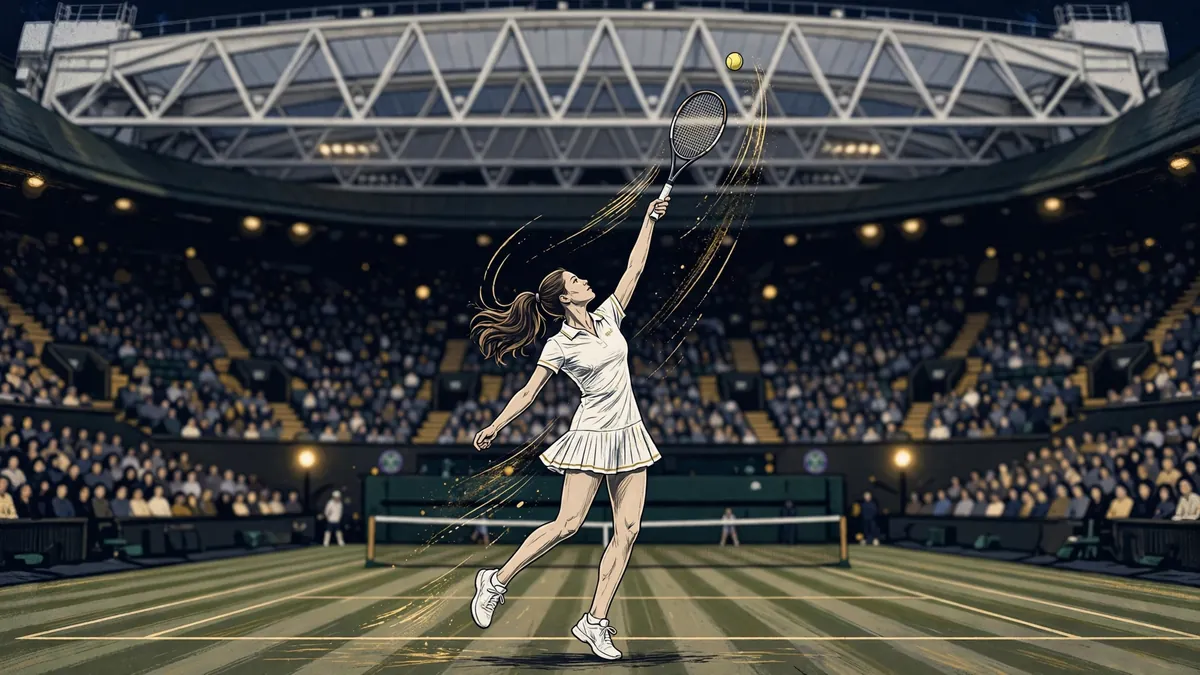
After Wimbledon she spoke honestly about how strange the aftermath felt: she had won the biggest title in tennis and yet, without the points, she did not feel she was being treated like a top player. That honesty is characteristic. Rybakina rarely performs emotion for the cameras, but when she does speak about her career, she is direct about what it cost and what it gave back.
The Wimbledon title also changed her commercial standing overnight. Before it, she was a promising player with modest backing. After it, she was a Grand Slam champion and the first major winner in her country’s history — a status that brought endorsement interest, appearance fees and a level of attention in Kazakhstan that she had never known. The prize money for the title was about $2.35 million, nearly doubling her career earnings to that point in a single fortnight.
Australian Open 2023 and the Top 10
Six months after Wimbledon, Rybakina proved the title was no one-off. At the 2023 Australian Open she beat reigning world No. 1 Iga Swiatek in straight sets in the fourth round, then worked through Jelena Ostapenko and Victoria Azarenka to reach her second Grand Slam final. There she met Aryna Sabalenka, and the two played a three-set match that announced a rivalry: Sabalenka won 4–6, 6–3, 6–4.
The runner-up finish still moved Rybakina into the top 10 for the first time, with her debut coming on 30 January 2023. She would climb further that spring, reaching a career-high of world No. 3 on 12 June 2023. The Australian Open run also settled the question that follows every surprise major winner: could she do it again, on a different surface, against the best players in the world? The answer, delivered in Melbourne, was yes.
That tournament also set the pattern of her rivalry with Sabalenka. The two are near-contemporaries, both built around power, and their matches have a particular rhythm: long rallies decided by a handful of huge serves and one loose service game. Sabalenka won the first of their major finals. Rybakina would wait three years to settle the score — and when she did, she settled it twice in one season.
Indian Wells and Rome: Two WTA 1000 Crowns
The spring of 2023 was the best stretch of Rybakina’s career to that point. In March she won the BNP Paribas Open at Indian Wells, beating Sabalenka in straight sets in the final — a direct answer to the Melbourne loss. Two months later she won the Italian Open in Rome, her first WTA 1000 title on clay, when Anhelina Kalinina retired in the final. She also reached the Miami final that spring, losing there, and became only the third woman in the Open Era to reach the finals of Rome, Miami, Indian Wells and the Australian Open in the same season.
Those two WTA 1000 titles remain her only titles at that level, which says something about how hard the tier is to win — and about how high her ceiling was in 2023. Indian Wells and Rome are the events just below the majors in prestige, and winning both in one season put her in the company of the tour’s true elite. She finished 2023 having qualified for her first WTA Finals, going 1–2 in the group stage in Cancun.
The 2023 season also gave her a statistical calling card: she led the WTA Tour with 455 aces in 60 matches, with a serve regularly clocked above 120 mph (193 km/h). For a player of her height, the serve is not a surprise. What made it special was the placement — wide on the deuce court, into the body on the ad court — and the way it set up her forehand. Opponents knew what was coming and still could not stop it.
2024 and 2025: Titles, Setbacks and the WTA Finals Record
Rybakina’s 2024 season began as well as any season of her career. She won three WTA 500 titles — Brisbane, Abu Dhabi and Stuttgart — and reached the finals in Doha and Miami. She reached the Wimbledon semi-final, where she lost to Barbora Krejcikova, the eventual champion. But the year also brought the first serious interruption to her momentum: a run of health problems and withdrawals that kept her off court for stretches and cost her ranking points she could not win back.
The coaching picture changed, too. Shortly before the 2024 US Open, Rybakina announced that Vukov would no longer coach her, ending a partnership of more than five years. She hired former Wimbledon champion Goran Ivanisevic, but that partnership lasted only through the 2025 Australian Open. Vukov rejoined her team in early 2025, and the story of that reunion — and the WTA’s response to it — is told in full in the coaching section below.
On court, 2025 was a year of two halves. The first half was quiet by her standards, with her first title in 13 months coming at Strasbourg, where she beat Liudmila Samsonova 6–1, 6–7(2), 6–1 in the final. The second half was a surge. She won the Ningbo Open for her 10th career title, and then she went to the WTA Finals in Riyadh and did something no woman had done before: she went 5–0, unbeaten through the group stage and the knockouts, beating Jessica Pegula in the semi-final and Sabalenka in a tight two-set final.
The Riyadh title came with a cheque for $5.235 million, the largest single-tournament payday in women’s tennis history — a record recognised by Guinness World Records. It was the perfect way to close a difficult year: the player who had spent months answering questions about her coaching team and her health finished the season as the champion of the tour’s biggest event, with the biggest prize the women’s game had ever paid.
The 2026 Season: Two Majors and World No. 1
The 2026 season is the one this biography will be remembered for. Rybakina opened the year by winning the Australian Open, beating Sabalenka 6–4, 4–6, 6–4 in the final — erasing a 3–0 deficit in the third set in Melbourne to claim her second major. She added a clay-court title in Stuttgart, reached the finals at Indian Wells and Toronto, and arrived at the US Open as the second seed, needing a semi-final run to take the No. 1 ranking from Sabalenka.
Flushing Meadows gave her the hardest possible route. She beat two-time champion Naomi Osaka 6–1, 6–4 to reach the quarter-finals, completing her set of quarter-final appearances at all four majors for the first time. In the quarter-final she beat Zheng Qinwen 3–6, 6–1, 6–4 — the win that guaranteed she would become the 30th woman to hold the world No. 1 ranking. In the semi-final she needed three sets to get past Coco Gauff, who had beaten her in the draw before and who had the New York crowd behind her.
The final, on 12 September 2026, was the match of the year. Rybakina beat Sabalenka 6–4, 5–7, 6–2 in two hours and 21 minutes, ending Sabalenka’s 19-match winning streak at the US Open and her bid for a third straight title in New York. She finished the match with her 12th ace. It was her third Grand Slam title, her second major of the year, and both of them had come against the same opponent. Maria Sharapova, a career Grand Slam winner, presented her with the trophy.
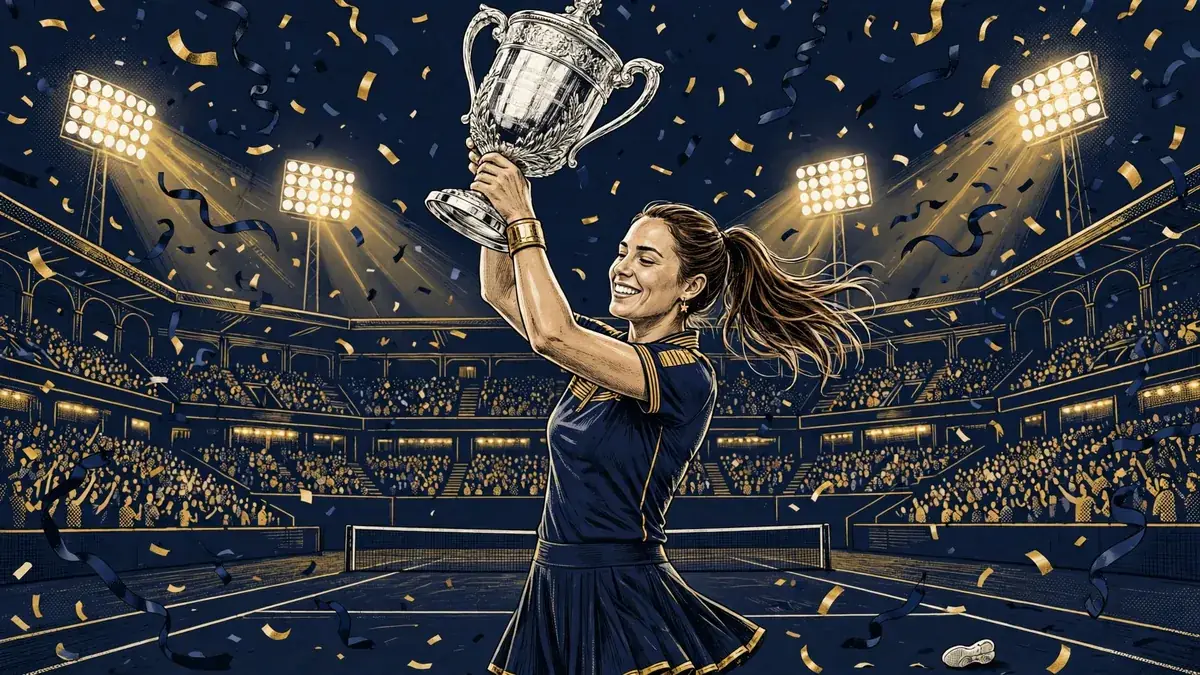
The rankings published on 14 September 2026 made it official: Elena Rybakina, world No. 1, at 27 years and 89 days — the second-oldest player to reach the top for the first time, behind only Angelique Kerber — and the first from Kazakhstan. Sabalenka’s run of 99 consecutive weeks at No. 1 was over. The WTA’s own season review put her at 54–14 with four titles heading into the WTA Finals, the four titles being the Australian Open, Stuttgart, the US Open and Ningbo.
There was more to come after New York. She lost her opening match in Beijing in her first tournament as world No. 1, then bounced back to win Ningbo, and then in Tokyo she beat Yulia Putintseva in the second round on 29 October to secure the year-end No. 1 ranking — only the 17th woman to finish a season at the top since the rankings began in 1975. She withdrew from her Tokyo quarter-final with neck inflammation, and on 7 November she withdrew from the WTA Finals in Indian Wells, where she was the defending champion, because of a viral illness. She will still finish 2026 as world No. 1. In late September she was also honoured by Kazakhstan’s President Kassym-Jomart Tokayev, who awarded her the Order of Barys, III Degree, at a meeting in Astana.
Playing Style: The Serve That Sets the Tone
Rybakina plays tennis the way a tall player should, and the way very few tall players actually manage. Her game is built on her serve: flat, fast, and placed with a precision that makes it hard to read. In 2023 she led the WTA with 455 aces, and her first serve regularly travels above 120 mph. But the serve is only the start. Behind it sits a forehand hit flat and deep, a two-handed backhand she can drive down the line, and a willingness to step inside the baseline and take the ball early.
Her height helps in obvious ways — reach at the net, angle on the serve, power on the overhead — and it once hurt her in one specific way: movement. Early in her career, opponents tried to drag her wide and make her change direction, betting that a 1.84 m player would struggle to recover. She answered that by improving her footwork year after year, and by shortening points: if the rally ends in four shots, her movement is never tested.
What separates her from other big servers is her temperament. Rybakina is famously calm on court, almost unreadable, and that calm is a weapon in finals. She has won 15 titles from a relatively small number of finals, and her record in the biggest matches — Wimbledon 2022, the 2025 WTA Finals, both 2026 major finals — shows a player who plays her best tennis when the most is at stake. Her weakness, when it shows, is the second serve under pressure and the occasional dip in focus in the middle of a match she is expected to win comfortably.
On grass she is at her most dangerous: the low bounce suits her flat strokes, and her serve is almost unplayable on a fast court. On hard courts she has now won two majors. Clay is the surface where she has had to work hardest — her Rome title in 2023 proved she can win there, but the French Open remains the one major missing from her collection, and the one title that would complete a career Grand Slam.
Coaches and the Vukov Story
No account of Rybakina’s career can skip Stefano Vukov, and no honest account can reduce him to a single line. Vukov, a Croatian former professional player, began coaching Rybakina in February 2019, when she was ranked outside the top 100. Under his guidance she climbed to world No. 3, won Wimbledon, reached the Australian Open final, and won two WTA 1000 titles. Rybakina has credited his intense coaching style with suiting her reserved personality: where she is quiet, he is demanding, and the combination worked.
The partnership ended shortly before the 2024 US Open, when Rybakina announced Vukov would no longer coach her. She worked briefly with Goran Ivanisevic, the 2001 Wimbledon champion, but that arrangement ended after the 2025 Australian Open. On 1 January 2025 Rybakina announced she intended to bring Vukov back — and the WTA intervened. The tour provisionally suspended Vukov in January 2025 while it investigated a potential breach of its code of conduct, and in February 2025, after an independent investigation, the suspension was confirmed as a one-year ban.
The WTA did not make the specific behaviour in question or the name of any complainant public, and Vukov has denied wrongdoing. Rybakina defended him in public throughout, saying: “I have never made any complaints or any of these things. I always said that he never mistreated me.” Reporting by The New York Times described a confidential WTA letter alleging that Vukov had called Rybakina demeaning names and cultivated a relationship of dependence, and that members of her team had raised concerns with WTA officials. Those allegations were never tested in public, and they remain allegations — not findings of a court, and not statements Rybakina herself has ever endorsed.
In August 2025 the suspension was lifted after an appeal, clearing Vukov to receive credentials at WTA tournaments again, and he returned to Rybakina’s team. The WTA’s official player profile now lists him as her coach, with the dates 2019–2024 and 2025–. Her team also includes Stanislav Khmarskyi as a secondary coach, longtime physiotherapist Stefan Duell, and strength and conditioning coach Aldo Chiari. The episode remains the most discussed off-court story of her career, and it followed her into the 2026 US Open final, where questions about it were still being asked. Rybakina’s answer has stayed the same: she is an adult, she chose her coach, and she wants to be judged on tennis.
The Money: Prize Money, Endorsements and Net Worth
Rybakina’s wealth is built on the most reliable foundation in tennis: winning matches. Her career prize money had passed $30 million by September 2026, according to EssentiallySports’ tally of WTA records, and the two 2026 major titles pushed it higher still. The single biggest cheque of her career remains the $5.235 million she earned for going unbeaten at the 2025 WTA Finals in Riyadh. Her Wimbledon title in 2022 paid about $2.35 million, and her deep runs at every major since have kept the prize money flowing at a rate of several million dollars a year.
Off court, her endorsement income is estimated at $3 million to $4 million a year by EssentiallySports. Her main sponsor is Yonex, which supplies her VCore 100 racket and, since the 2023 French Open, her clothing and shoes as well. Before Yonex she was with Adidas from the start of 2020, and before that with Nike. She was sponsored by Red Bull from 2023 through 2025, and she has been partnered with the Swiss luxury watch maker Vanguart since the start of 2026. In Kazakhstan she has deals with KAZ Minerals and Bank RBK, and she has been associated with Lexus Kazakhstan since September 2024.
Putting those streams together, published estimates of her net worth disagree by a wide margin — which is normal for an athlete whose contracts are private. Celebrity Net Worth puts the figure at $20 million as of 2026, while Surprise Sports estimates $12 million and Bet365 puts it at $12 million to $15 million. Our honest reading of that spread is a range of $12 million to $20 million, anchored at the top by Celebrity Net Worth. For the full year-by-year breakdown of that figure, including the prize money behind it, see our companion piece on Elena Rybakina’s net worth on NetWorthCraft.
How we estimated this: the $12 million to $20 million range is not a single source’s number. Celebrity Net Worth anchors the top at $20 million (September 2026), Surprise Sports anchors the bottom at $12 million, and Bet365 sits in the middle at $12 million to $15 million. Career prize money above $30 million is the hard, checkable core of the figure; endorsement income of $3 million to $4 million a year comes from EssentiallySports’ reporting. Taxes, management fees and private spending are not public, so any single figure would be false precision.
Her commercial profile is still growing into her ranking. As world No. 1 and the first Kazakhstani major winner, she is the most marketable athlete in her country’s history, and the 2026 season — two majors, the No. 1 ranking, the Order of Barys — gives her agents a stronger story to sell than at any point in her career. Appearance fees at the biggest non-mandatory events, which industry reporting puts in the low seven figures a year for a player of her standing, add a further stream that prize money tables never show.
Net Worth Growth: Year by Year
Rybakina’s financial story is a story of a late, steep climb. She earned modest money on the ITF circuit as a teenager, and even at the end of 2021 her career prize money was only a few million dollars. The table below uses the published estimates and prize-money milestones reported by the sources named in the money section, and it shows how quickly the picture changed once the major titles arrived.
| Year | What happened | Money signal |
|---|---|---|
| 2019 | First WTA title, Bucharest; Vukov becomes coach | Career prize money under $1 million |
| 2020 | Five finals, Hobart title, top-20 debut | Prize money climbing past $2 million |
| 2022 | Wimbledon champion, first Kazakhstani major winner | Wimbledon cheque about $2.35 million; career earnings roughly doubled in a fortnight |
| 2023 | Australian Open final, Indian Wells and Rome titles, world No. 3 | 455 aces, two WTA 1000 crowns; endorsement deals with Yonex and Red Bull signed |
| 2025 | Strasbourg and Ningbo titles, unbeaten WTA Finals champion | Record $5.235 million Riyadh payday; career prize money past $20 million |
| 2026 | Australian Open and US Open champion, world No. 1, year-end No. 1 | Career prize money past $30 million; net worth range $12 million to $20 million |
Two things stand out in that timeline. First, the money follows the majors with almost no lag: Wimbledon in 2022, the WTA Finals in 2025 and the two 2026 majors each produced a step-change in her earnings. Second, she is still only 27, with her peak earning years — the years when a world No. 1 commands the highest appearance fees and the biggest endorsement renewals — likely still ahead of her. If she adds the French Open and a second stint at No. 1, the top of that net-worth range will look conservative within a few years.
Personal Life, Home and Life Away From Tennis
Rybakina lives in Dubai, in the United Arab Emirates, a base she shares with many tour players who value the training facilities, the climate and the short flights to events in the Middle East and Asia. She keeps her private life out of the press to a degree that is unusual even for a tennis star: she gives few interviews about anything other than tennis, she rarely posts about her personal life, and she has never confirmed a relationship in public.
That privacy has invited speculation, most of it centred on Vukov. Reports have repeated claims that the two are romantically involved — a claim that surfaced again in 2025 reporting — but neither Rybakina nor Vukov has ever confirmed it, and it should be treated as unconfirmed. What is on the record is her repeated public defence of him as a coach and her insistence that she has never complained about his treatment of her. Beyond that, her personal life is her own, and this biography does not repeat rumours as fact.
Her family remains close. Her father Andrey’s roots in Almaty connect her to Kazakhstan in a personal way, and her older sister Anna, who played tennis with her as a child, remains part of her story even though she did not pursue a professional career. Rybakina’s public appearances in Kazakhstan — including the September 2026 meeting with President Tokayev, at which she received the Order of Barys — show a player who takes her role as her adopted country’s first tennis superstar seriously, without making a performance of it.
Off the court she is known for a dry sense of humour that rarely makes it into match coverage, and for a calm that her opponents have learned to respect. She reads, she rests, and she trains — and, by every account from her team, she would rather be doing any of those things than talking about herself. That reluctance is part of her appeal: in a sport full of big personalities, the quietest player on tour became its No. 1.
The Sabalenka Rivalry
Every great tennis career needs a rival, and Rybakina’s is Aryna Sabalenka. The two have met in the finals of the biggest hard-court events of the last two years, and their matches have decided the No. 1 ranking, two major titles and the 2025 WTA Finals. Sabalenka leads their overall head-to-head, but Rybakina has won the matches that mattered most in 2026: the Australian Open final and the US Open final, both in three sets, both against the defending champion of the event in question.
The rivalry works because the players are so similar and so different at once. Both are tall, powerful, flat-hitting players who win points with their serve. Sabalenka is the louder presence, emotional on court, feeding off the crowd. Rybakina is the quiet one, giving nothing away, winning points in silence. Their 2026 US Open final — 6–4, 5–7, 6–2, two hours and 21 minutes, decided by Rybakina’s 12th ace — was the best match of the women’s season, and the first US Open final between the top two ranked women since 2013.
For the full picture of the other side of this rivalry, see our profile of Aryna Sabalenka’s net worth — the player whose 99 weeks at No. 1 Rybakina ended — and our look at how tall Aryna Sabalenka is, a comparison Rybakina’s 1.84 m frame wins. The rivalry is still young: both players are in their late twenties, both are healthy, and the 2027 season will almost certainly add new chapters.
Records, Awards and What Comes Next
Rybakina’s record book already reads like a career summary, and she is only 27. She is the first Kazakhstani player to win a Grand Slam singles title, to reach the top 10, and to reach world No. 1. She is the 30th woman to hold the No. 1 ranking since the WTA rankings began in 1975, and the 17th to finish a season as year-end No. 1. She is the second-oldest first-time No. 1, behind Angelique Kerber. Her $5.235 million payday at the 2025 WTA Finals is the largest single-tournament prize in women’s tennis history.
Her title list, per the WTA’s official profile, now stands at 15: Bucharest 2019, Hobart 2020, Wimbledon 2022, Indian Wells and Rome 2023, Brisbane, Abu Dhabi and Stuttgart 2024, Strasbourg, Ningbo and the WTA Finals 2025, and the Australian Open, Stuttgart, the US Open and Ningbo 2026. She has reached 13 further finals, including the 2023 Australian Open, Miami 2023, Doha and Miami 2024, and Indian Wells and Toronto 2026.
What comes next is the question that will define the second half of her career. The French Open is the one major she has not won, and the one title that would complete a career Grand Slam — only the second Kazakhstani milestone left to claim, after the ones she has already taken. A longer stay at No. 1 would also change her standing: Sabalenka’s 99 weeks set a modern benchmark, and Rybakina’s hold on the top spot will be tested from the first tournament of 2027. For context on the generation she is now leading, see our biographies of Coco Gauff, who lost to Rybakina in the 2026 US Open semi-final, and Naomi Osaka, who fell to her in the fourth round in New York — and browse more profiles in our Biography category.
Frequently Asked Questions
How old is Elena Rybakina?
Elena Rybakina was born on 17 June 1999 in Moscow, Russia, which makes her 27 years old as of November 2026. She became world No. 1 on 14 September 2026 at 27 years and 89 days, the second-oldest player to reach the top ranking for the first time.
Is Elena Rybakina the world No. 1?
Yes. Rybakina reached world No. 1 on 14 September 2026 after winning the US Open, becoming the 30th woman to hold the ranking and the first player from Kazakhstan, man or woman, to do so. She secured the year-end No. 1 ranking on 29 October 2026 by beating Yulia Putintseva in Tokyo, and she will finish 2026 at the top even though she withdrew from the WTA Finals with a viral illness.
How many Grand Slam titles has Elena Rybakina won?
Three. She won Wimbledon in 2022, beating Ons Jabeur 3–6, 6–2, 6–2 in the final, then added the Australian Open in 2026 and the US Open in 2026, beating Aryna Sabalenka in both finals. She also reached the 2023 Australian Open final, losing to Sabalenka in three sets. The French Open is the only major she has not yet won.
What is Elena Rybakina’s net worth?
Published estimates put Elena Rybakina’s net worth at $12 million to $20 million as of 2026. Celebrity Net Worth anchors the top of the range at $20 million, while Surprise Sports estimates $12 million and Bet365 puts it at $12 million to $15 million. Her career prize money had passed $30 million by September 2026, and her endorsement income is estimated at $3 million to $4 million a year.
How tall is Elena Rybakina?
Elena Rybakina is 1.84 m tall, which is 6 ft 0 in. Her height is central to her game: it powers a serve that led the WTA with 455 aces in 2023 and regularly tops 120 mph. As a child she was told she was too tall for gymnastics and ice skating, which is what led her father to suggest tennis when she was six.
Who is Elena Rybakina’s coach?
Stefano Vukov, a Croatian former player, has coached Rybakina since February 2019. They split shortly before the 2024 US Open, she worked briefly with Goran Ivanisevic through the 2025 Australian Open, and Vukov rejoined her team in early 2025. The WTA provisionally suspended Vukov in January 2025 and imposed a one-year ban after an investigation, but the suspension was lifted on appeal in August 2025 and he is her coach again. Rybakina has always defended him in public and said he never mistreated her.
Why did Elena Rybakina switch from Russia to Kazakhstan?
Rybakina acquired Kazakhstani citizenship in May 2018 and switched federations from Russia to Kazakhstan in June 2018, at the age of 19. The Kazakhstan Tennis Federation offered funding and structured support for travel and coaching that she had not been getting, and her father was born in Almaty, Kazakhstan, which gave the move a family connection. Every one of her 15 WTA titles and all three of her major titles have come since the switch.
Did Elena Rybakina beat Aryna Sabalenka in the 2026 US Open final?
Yes. Elena Rybakina beat Aryna Sabalenka 6–4, 5–7, 6–2 in the US Open final on 12 September 2026, winning her first US Open title and her third Grand Slam. The win ended Sabalenka’s 19-match winning streak at the US Open and her bid for a third straight title there, and it came two days before Rybakina officially took over the world No. 1 ranking from her, ending Sabalenka’s run of 99 consecutive weeks at the top.
Final Thoughts: The Bottom Line
Elena Rybakina’s biography is not a story of overnight fame. It is a story of a tall Moscow schoolgirl who was told she was too tall for the sports she started in, a teenager who changed countries at 19 to keep her career alive, and a champion who won Wimbledon and gained nothing in the rankings for it — and kept going anyway. The 2026 season repaid that patience in full: two major titles, both against the same rival, the world No. 1 ranking, the year-end No. 1, and a place in history as Kazakhstan’s first tennis superstar.
At 27, with 15 titles, three majors and more than $30 million in prize money, she is not at the end of her story but at the start of its second half. The French Open is still missing, a longer run at No. 1 is still to be earned, and her net worth — $12 million to $20 million today — has room to grow with every title she adds. If the quiet champion from Moscow keeps playing the way she played in New York in September 2026, the next chapter will be worth waiting for.
Sources and Reporting
This biography was researched from live reporting and official records in November 2026. The ranking dates, title counts and match scores come from the WTA’s official player profile and season reviews, and from match reporting of the 2026 US Open final. Career details, including her birth date, family background and the 2018 federation switch, follow the biographical record as published by Wikipedia and the WTA. Net-worth figures are attributed in the text: Celebrity Net Worth for the $20 million anchor, Surprise Sports and Bet365 for the lower end of the range, and EssentiallySports for the prize-money total above $30 million and the endorsement estimate of $3 million to $4 million a year. The Vukov suspension timeline follows reporting by Sports Illustrated, Athlon Sports and The New York Times, with Rybakina’s own public defence quoted from her statements during the suspension.
Named sources consulted: WTA Tennis, Wimbledon, US Open, Celebrity Net Worth, Forbes.
How we estimated: net worth figures for public personalities are estimates built from public reporting, not audited financial statements. We publish a range where named sources disagree, anchor that range to the source that states its figure most clearly, and separate hard, checkable numbers — prize money from WTA records, and the $5.235 million WTA Finals cheque — from softer ones, like endorsement income, which is always an industry estimate. Figures will move as new tournaments are played and new contracts are reported.
By Celebamerica Editorial Staff · Last updated 19 November 2026