By Celebamerica Editorial Staff | Last updated: November 6, 2026
Coco Gauff is 22 years old, a two-time Grand Slam singles champion, and the highest-paid female athlete in the world for two straight years. Her estimated net worth in 2026 is $35 million, according to Celebrity Net Worth, a figure echoed by Parade and a string of 2026 profiles. A handful of outlets float higher numbers — up to $45 million or $50 million — but none of them names a primary source for the bigger figure, so the honest range is $35 million to $50 million, anchored at $35 million.
Born Cori Dionne Gauff on March 13, 2004, she went from a 15-year-old qualifier beating Venus Williams at Wimbledon to the face of American tennis in the space of seven seasons. Forbes put her annual earnings at $34.4 million in 2024 and $33 million in 2025, and roughly $35.5 million in the 12 months leading up to August 2026 — about $28 million of that last figure coming from off-court deals. She has banked more than $36 million in official career prize money, per WTA records, and her endorsement roster runs to more than a dozen brands, from New Balance and Rolex to Mercedes-Benz and Barilla. This biography traces the whole story: the family that gave up two careers to back her, the Wimbledon night that changed everything, the two Grand Slam titles, the record WTA Finals payday, and the business she is now building in her own name.
| Full Name | Cori Dionne “Coco” Gauff |
|---|---|
| Date of Birth | March 13, 2004 (age 22 as of November 2026) |
| Birthplace | Atlanta, Georgia, USA (raised in Delray Beach, Florida) |
| Height | 5 ft 9 in (1.75 m) |
| Turned Pro | 2018 |
| Estimated Net Worth (2026) | $35 million (Celebrity Net Worth); range $35M–$50M across outlets |
| Career Prize Money | More than $36 million (WTA official records, late 2026) |
| Grand Slam Singles Titles | 2 — 2023 US Open, 2025 French Open (both vs. Aryna Sabalenka) |
| Career-High Rankings | Singles world No. 2; doubles world No. 1 (August 2022) |
| Primary Income Sources | Tournament prize money; endorsements (New Balance, Rolex, Head, Barilla, Bose, Mercedes-Benz, Chase, UPS, L’Oréal, Fanatics, Baker Tilly) |
| Key Ventures | Coco Gauff Enterprises (launched 2025 with WME); New Balance signature shoe line — Coco CG1, CG2 and Coco Delray |
| Parents | Corey Gauff (Georgia State basketball) and Candi Gauff (Florida State track and field, educator) |
| Coach | Jean-Christophe Faurel, with biomechanics specialist Gavin MacMillan |
Table of Contents
- Early Life: A Family That Bet Everything on Tennis
- Junior Years and the Road to the Pros
- Wimbledon 2019: The Night a 15-Year-Old Shook Tennis
- From Teen Prospect to Top 10: 2020–2022
- US Open 2023: First Grand Slam Title at 19
- French Open 2025: A Second Major on Clay
- Doubles, the Olympics and the WTA Finals
- The Money: Prize Money, Endorsements and Business
- Net Worth Breakdown and Growth Over Time
- Endorsements and the Coco CG1 Shoe Line
- Playing Style, Coaches and Team
- Personal Life: Family, Faith and Life Off Court
- Voice Beyond Tennis: Activism and Public Stance
- Setbacks, Scrutiny and How She Answered Them
- How Gauff Compares With Her Peers
- Frequently Asked Questions
- Final Thoughts: The Bottom Line
- Sources and Reporting
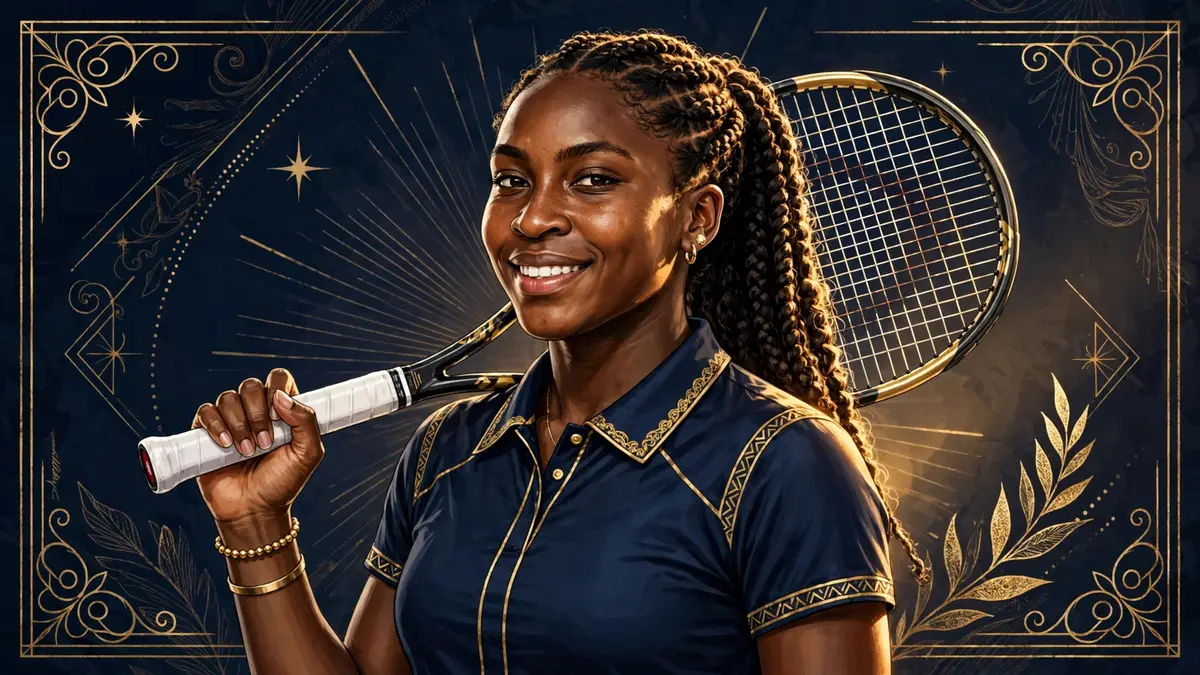
Early Life: A Family That Bet Everything on Tennis
Cori Dionne Gauff was born on March 13, 2004. Most profiles, including Wikipedia and NBC Olympics, list Atlanta, Georgia, as her birthplace, while a few outlets cite the Boca Raton area of Florida — the part of the state where she grew up. The family home that shaped her was Delray Beach, Florida, and that is the town she still calls home. She is the oldest of three children. Her two younger brothers are Codey, born in 2007, and Cameron, born in 2013. One small family tradition ties them together: every member of the household shares the initials C.D.G.
Both of her parents were college athletes, and that is where the story really starts. Her father, Corey Gauff, played Division I basketball at Georgia State University and later worked as a healthcare executive. Her mother, Candi Gauff (née Odom), was a gymnast and a track-and-field athlete — a heptathlete — at Florida State University, and later worked as an educator. Candi was a two-time South Florida Sun-Sentinel Athlete of the Year as a schoolgirl before Florida State. Sport was not a hobby in the Gauff house. It was the family trade.
Coco first picked up a racket at six years old. She tried other sports as a child, as most athletic kids do, but tennis stuck fast. Her earliest tennis memory, she has said, was watching Serena Williams play at Wimbledon. The Williams sisters were not distant idols for her. They were the standard she measured herself against from the start, and the reason she wanted to play on grass at the All England Club one day.
When Coco was eight, the family made the first of several moves built around her talent. They left Atlanta for Florida so she could train in Delray Beach, where the tennis community was deep and the public courts at Pompey Park became her second home. At ten, she joined the Mouratoglou Academy in France, the academy founded by Patrick Mouratoglou, Serena Williams’s long-time coach. When the academy moved from Paris to the French Riviera in 2016, the Gauffs followed. She was a child living between two continents before she was a teenager, training with adults, travelling to junior events, and doing schoolwork on the road.
Her mother took over her schooling, homeschooling Coco so training could come first. Her father became her primary coach, the man who set her schedule, drilled her forehand, and guarded her from the parts of the sport that chew young players up. It was a family operation in the fullest sense, and it came at a price her parents have spoken about openly since. In a Forbes interview retold in September 2026, Coco said her parents went from “a two-income household to a no-income household” to back her career — Corey leaving his job to coach her full-time, Candi leaving hers to teach her. They even gave up the dream house they had planned, she said, to keep the tennis dream funded. That sacrifice is the first thing to understand about her. The money she earns now is the return on a bet her parents made when she was still a child.
There was structure around the sacrifice. From the age of eight she trained under Gerard Loglo at the New Generation Tennis Academy in Delray Beach, and Jean-Christophe Faurel, a former French professional, spotted her potential when she was ten. Faurel later said that when he first saw her at ten, he knew she would be an outstanding athlete. The adults around her were not guessing. They were building a player with a ten-year plan, and the plan held.
Junior Years and the Road to the Pros
Gauff’s junior career gave the first hard evidence that the plan was working. She was a former world No. 1 junior, winning one junior Grand Slam singles title and another in doubles. The junior results mattered because they put her on the radar of sponsors before she had played a single professional main draw — and sponsors, as the money section below shows, would become the bigger half of her income.
She turned professional in 2018, at 14. That same year, New Balance reached out. The brand signed her when she was 14 years old, years before most companies would take a chance on a junior player nobody outside the sport had heard of. Her father negotiated the deal. Coco later admitted she did not even know how much the contract was worth until she read about it in an article. It was the first of the two decisions that shaped her career off the court. The second came seven years later, when she took control of her own business affairs.
The professional results arrived quickly. In October 2019, still 15, she won her first WTA singles title at Linz in Austria, coming through as a lucky loser — a player who loses in qualifying but gets into the main draw when someone withdraws — and taking the title anyway. It was the kind of win that tells you a player is not waiting for permission. She was the youngest WTA title winner in years, and she did it in her first season as a professional.
By the end of 2019 she was no longer a junior prospect. She was a ranked professional with a title, a shoe deal, and a growing list of sponsors. The ranking that had sat at No. 301 when Wimbledon qualifying began that summer was climbing fast, and the tennis world had already learned her name.
Wimbledon 2019: The Night a 15-Year-Old Shook Tennis
Every biography of Coco Gauff has a before and after, and the line between them is drawn on a Monday afternoon in July 2019, on Court One at Wimbledon. She was 15 years and 122 days old, the youngest player to qualify for the Wimbledon main draw in the Open Era, which began in 1968. Guinness World Records puts her age at 15 years and 106 days when she came through the final round of qualifying on June 27, 2019 — the small gap is the difference between the qualifying date and the first-round match. Either way, no one that young had done it before.
Getting there was already a story. Her ranking of 301 was not high enough to earn a qualifying place outright, and she found out she had received a wild card into qualifying while she was shopping online. She won her three qualifying matches without dropping a set, beating Belgium’s Greet Minnen 6-1, 6-1 in the final round. The night before that match, she sat a science test online at 11 p.m. for her school back in Florida. Her teachers had only just found out she was a professional tennis player — they had seen her on television the day before.
Then came the draw. Her first-round opponent was Venus Williams, five-time Wimbledon champion, 39 years old, and one of the two sisters Coco had grown up watching. Venus had won four Grand Slam singles titles, six doubles titles, two mixed doubles titles and two Olympic gold medals before Coco was born. Coco beat her 6-4, 6-4 in 79 minutes, on her first Grand Slam appearance, in front of her parents and a packed Court One. She broke into tears at the end. She became the youngest player to win a match at Wimbledon since Jennifer Capriati in 1991.
She did not stop there. She beat Magdalena Rybarikova and Polona Hercog to reach the fourth round, where the run ended against Simona Halep, who went on to win the title. Four matches, three of them wins, and a tournament that turned a schoolgirl into a global name in a single week. The win over Venus was the most-watched moment of that Wimbledon for many viewers, and it set the pattern for everything that followed: Gauff plays her best tennis when the stage is biggest and the opponent is the most decorated player in the draw.

From Teen Prospect to Top 10: 2020–2022
The years after Wimbledon were about proving the breakthrough was not a one-week story. In January 2020, at the Australian Open, she beat defending champion Naomi Osaka in the third round and reached the fourth round, where she lost to Sofia Kenin, the eventual champion. Beating the world No. 1 at 15, six months after beating Venus, ended any talk of a fluke. She was 15 and she had already beaten two of the biggest names in the sport on the biggest stages.
The pandemic season of 2020 slowed everyone down, but Gauff kept climbing. She won her first WTA 1000-level matches, kept adding titles — Parma in 2021, her first clay title — and kept rising in the rankings. In 2022, the rise became a surge. She reached her first Grand Slam singles final at the French Open in Paris, losing to Iga Swiatek, and reached the doubles final there too. She finished that season inside the top 10 in singles, and in August 2022 she reached world No. 1 in doubles, playing alongside Jessica Pegula. She was 18, a Grand Slam finalist in singles and doubles, and the top-ranked doubles player on the planet.
There was also a quieter milestone in those years: the money started to match the ranking. Forbes estimated she earned about $11 million in 2022, most of it from endorsements rather than prize money. The pattern was already set. Her on-court earnings were real and growing, but the brands were paying more, and paying earlier, than the prize money ever would.
By the end of 2022 she had the game, the ranking and the commercial profile of a star. What she did not have yet was a Grand Slam singles title. That arrived the following summer, and it arrived with a coaching change that is now part of tennis history.
US Open 2023: First Grand Slam Title at 19
The summer of 2023 changed Gauff’s career twice over. First came the coaching change. After a first-round loss at Wimbledon that July, she brought in Brad Gilbert, the veteran American coach who had guided Andre Agassi and Andy Roddick. Gilbert joined a team that already included her father and, from April 2024, would again include Jean-Christophe Faurel. The effect was immediate.
She won Washington, then won Cincinnati — her first WTA 1000 title — beating Swiatek in the semi-final, her first win over the Pole in eight attempts. Then she arrived at the US Open in New York as one of the favourites, and played like it. In the final she met Aryna Sabalenka, the world No. 1 in waiting, and dropped the first set 2-6. Then she took the next two, 6-3, 6-2, in front of a roaring Arthur Ashe Stadium crowd that included former President Barack Obama and a long list of celebrities who had come to watch the 19-year-old American win her home major.
She was the first American teenager to win the US Open since Serena Williams in 1999. The winner’s cheque was $3 million. The title also carried something no cheque measures: it made her the player the sport would build its next decade around. She had beaten the best player in the world, from a set down, in a Grand Slam final, at 19, at home.
The 2023 season also settled her earning power. Forbes estimated she earned more than $20 million that year, and she was named the highest-paid female athlete in the world for 2023. The US Open title did not just add prize money. It raised the price of everything with her name on it.
French Open 2025: A Second Major on Clay
If the US Open proved she could win a major, the French Open in June 2025 proved she could win one on the surface that had once been her weakest. Clay had been the scene of her first Grand Slam final defeat, against Swiatek in 2022. Three years later she returned to Court Philippe-Chatrier and faced Sabalenka again in the final — the same opponent, the same stakes, a different surface.
She lost the first set in a tiebreak, then took the next two 6-2, 6-4. It was her second Grand Slam singles title, and her first on clay. The winner’s prize was €2,550,000 — roughly $2.9 million — her biggest on-court payday of the year. The 2025 season brought her almost $8 million in prize money in total: $7,969,845, with $7,780,905 of it in singles, per WTA figures. She added a third WTA 1000 title at Wuhan later that season, won the United Cup with the United States at the start of the year, and reached the finals in Madrid and Rome.
The French Open win also settled an old question. Gauff had lost her first two Grand Slam finals on clay and hard court before winning in New York. Now she had won on both. She was 21, a two-time major champion, and the only active player besides Swiatek and Sabalenka with multiple Grand Slam singles titles and a world No. 1 doubles ranking on her record.
Her 2026 season kept the run going. WTA listings credited her with a semi-final run at Wimbledon in 2026 and a semi-final at the US Open, where reaching the last four carried a guaranteed $1.45 million. Through the first eight months of 2026 she had added more than $5.5 million in prize money, and her ranking sat at No. 4 in the world in March and again in August 2026. The second major had not been a peak. It had been a platform.
Doubles, the Olympics and the WTA Finals
Gauff’s singles titles get the headlines, but her doubles record is just as strong, and it is where some of her biggest paydays and proudest moments sit. She reached world No. 1 in doubles in August 2022, playing mostly with Jessica Pegula, and she has won Grand Slam doubles titles too. In June 2024 she won the French Open women’s doubles title with Katerina Siniakova, adding a third Grand Slam trophy of any kind to her collection.
The Paris Olympics in the summer of 2024 gave her a different kind of honour. She carried the United States flag at the opening ceremony alongside basketball star LeBron James — one of the most visible roles in American sport, given to a 20-year-old. She played singles, doubles and mixed doubles in Paris, a full schedule that showed how much the team valued her across every format.
Then came the biggest single payday of her career. In November 2024, at the WTA Finals in Riyadh, she won the season-ending championship, beating Zheng Qinwen in the final. The winner’s cheque was $4,805,000 — the largest single-event payout in women’s tennis history at the time. It was also her best year for prize money: $9.35 million in 2024, nearly all of it earned in the biggest events. The WTA Finals win is the clearest example of how the modern tour pays its stars. One week, one title, almost five million dollars — more than most players earn in a career.
Her full title count tells the story of a player who wins at every level: Grand Slam singles titles at the US Open and the French Open, a Grand Slam doubles title in Paris, a WTA Finals crown, WTA 1000 titles at Cincinnati, Beijing and Wuhan, and a United Cup team title with the United States in 2025. She has also been a Grand Slam finalist in singles at the French Open in 2022 and a runner-up at the WTA Finals in 2025, where she collected a further $2.6 million.
The Money: Prize Money, Endorsements and Business
To understand Gauff’s wealth, you have to understand one split: prize money is the smaller half of her income. Forbes reported that of the roughly $33 million she earned in 2025, about $8 million came from prize money and about $25 million from sponsorships, appearances, exhibitions and other business activity. The same split held in 2024, when she earned an estimated $34.4 million in total, and in the 12 months to August 2026, when Forbes put her earnings at $35.5 million with about $28 million from off-court deals. She has been Forbes’s highest-paid female athlete in both 2024 and 2025 — the first American tennis player to top that list since Serena Williams.
Her official career prize money has passed $36 million, according to WTA records cited in late 2026, which puts her ninth on the WTA’s all-time prize-money list. At the end of 2025 the figure stood at $29,759,121, 11th on the all-time list. The jump in 2026 came from deep runs at the majors and the big WTA 1000 events. Her biggest single paydays, ranked, are the 2024 WTA Finals at $4,805,000, the 2023 US Open at $3,000,000, and the 2025 French Open at €2,550,000. The 2022 French Open final, which she lost, still paid about $1.15 million.
For a fuller look at how the numbers add up, her Coco Gauff net worth profile on GuideNetWorth breaks down the same $35 million estimate from the earnings side — prize money, endorsements and annual income — and it is a useful second view of the figures set out here.
The endorsement side is where her fortune is really made. Her portfolio, as reported by Forbes and Celebrity Net Worth in 2026, runs to more than a dozen brands: New Balance, Rolex, Head, Barilla, Bose, Chase, Mercedes-Benz, UPS, L’Oréal, Fanatics, Baker Tilly, Carol’s Daughter, Microsoft and American Eagle, with a Meta and Ray-Ban smart-glasses partnership added along the way. Oura joined the roster in 2026. The deals are not small logo placements. Several are multi-year partnerships with the biggest brands in their categories, and the two that matter most — New Balance and Rolex — are the kind of deals that define a career.
In April 2025 she took the next step and launched Coco Gauff Enterprises, a joint venture with the talent agency WME, ending a relationship with Team8 — the boutique agency launched by Roger Federer and his long-time agent Tony Godsick — that had run for the entirety of her career until then. Sports Business Journal called the WME partnership a major coup for the agency. The point of the new company was control: her own deals, her own investments, her own philanthropy, run through a business she owns rather than an agency that represents her. Forbes also reported in 2026 that she had executive-produced two short documentaries for the Tennis Channel over the summer — an early sign of where the new company is heading.
The split that matters: in 2025, Gauff earned about $8 million on court and about $25 million off it, per Forbes. Any estimate of her wealth that counts only prize money misses roughly three-quarters of her income.
Net Worth Breakdown and Growth Over Time
Celebrity Net Worth puts Gauff’s net worth at $35 million as of September 2026, and Parade reported the same figure in its 2026 profile. That is the anchor for this article. A few outlets — including one October 2026 report — put the figure at $50 million, and another at $45 million heading into 2027, but neither names a primary source for the higher number, and the $35 million figure is the one tied to named reporting across Forbes, Parade and Celebrity Net Worth. The honest range, then, is $35 million to $50 million, with $35 million as the figure the evidence supports.
| Year | Forbes estimated total earnings | Prize money (WTA) | Notes |
|---|---|---|---|
| 2022 | About $11 million | — | First French Open final; doubles world No. 1 |
| 2023 | More than $20 million | — | US Open title; highest-paid female athlete |
| 2024 | $34.4 million | $9.35 million | WTA Finals win ($4.805M); French Open doubles title; Olympics flag bearer |
| 2025 | $33 million | $7,969,845 | French Open title; Wuhan title; United Cup win |
| 2026 (to Aug) | $35.5 million (12 months to Aug 2026) | More than $5.5 million (first 8 months) | Wimbledon and US Open semi-finals; about $28M of the total from off-court deals |
What the table shows is a player whose income tripled in two years and then stayed at the top. The jump from 2023 to 2024 — from roughly $20 million to $34.4 million — tracks the US Open title and the WTA Finals win, and the endorsement deals that followed them. The 2025 figure held near the same level even though her prize money dipped slightly, because the endorsement income kept growing. That is the shape of a modern tennis fortune: the titles set the price, and the brands pay it for years after.
There are limits to what can be said about her assets. No reliable source has published verified details of her property portfolio or her car collection, and several outlets note plainly that details circulating about her house and cars are rumour only. Reports in October 2026 said she had bought her own home at 20 but still trained at her parents’ Florida base — a claim reported by one outlet and not confirmed by a second named source, so it is noted here as reported, not established. Her parents’ own net worth is not publicly available, and any figure circulating for it is unverified. What is established is the income: more than $36 million in career prize money, about $25 million a year from endorsements, and a business of her own to manage both.
Taxes, agent fees and expenses take a real share of those gross figures, which is why net worth estimates sit below cumulative earnings. A player who has earned roughly $35 million a year for three straight years does not keep all of it, and the $35 million net worth figure reflects that — it is a retained-wealth estimate, not a lifetime earnings total.
Endorsements and the Coco CG1 Shoe Line
The New Balance deal is the foundation of Gauff’s commercial career, and it is also one of the best-told stories in modern tennis. The brand signed her at 14, before she had played a professional main draw. Her father negotiated the contract. Seven years later she was still with the brand, and she had something almost no other tennis player has: her own signature shoe.
The Coco CG1 launched on August 26, 2022, at $170, a mid-cut silhouette inspired by 1990s basketball shoes, and one of the first retail tennis shoes to feature a carbon fibre plate. Her father had a quote stitched into the toe of the debut shoe. The CG2 followed on August 21, 2024, at $159.99. Then, on her 21st birthday — March 13, 2025 — New Balance launched the Coco Delray, named after Delray Beach, where she grew up training on the public courts at Pompey Park. At $110, it was the most accessible shoe in the line, built for everyday players rather than only competitive ones. The three shoes together — CG1, CG2 and Delray — are now a full line, and Gauff is the only tennis player outside Roger Federer with a signature shoe deal of this kind.
In 2025 the partnership moved into fashion. New Balance began a collaboration with Miu Miu, the Italian luxury house founded by Miuccia Prada, dressing Gauff on court at the Rome Masters that spring, then in Berlin and Cincinnati, and returning for a second campaign at Wimbledon in June 2026. The collaboration won a Footwear News Achievement Award. It is the clearest sign of where her brand sits now: not just sport, but fashion, and not just America, but the luxury houses of Europe.
The rest of the roster fills in the picture. Head has supplied her rackets since the start of her career — the equipment deal that touches the game itself. Rolex put her on a roster the Swiss watchmaker reserves for a small group of athletes it considers exceptional. Barilla, the pasta brand, has used her in campaigns that lean on her family story and her Italian Open appearances. Bose, Chase, UPS, L’Oréal, Fanatics, Baker Tilly, Carol’s Daughter, Microsoft and American Eagle round out a portfolio that covers finance, beauty, food, technology and retail. Mercedes-Benz named her a global brand ambassador in December 2025, a category of partnership the carmaker has historically reserved for legends of the sport. One estimate in the trade press put her New Balance income alone at around $1 million a year, but the brand has never confirmed a figure, and the real value of the deal is the signature line itself — a product that carries her name into shops around the world.

Playing Style, Coaches and Team
Gauff plays a game built on movement and defence, with a forehand that has been both her biggest weapon and her most-discussed weakness. She is 5 ft 9 in, quick across the baseline, and one of the best movers in the women’s game. Her backhand is a clean, two-handed shot she can hit flat down the line or loop cross-court. Her serve, when it is working, is a weapon — she has one of the fastest serves on tour — and when it is not, it has cost her matches. The double faults that dogged her in 2024 and 2025 were the most-analysed part of her game, and the reason she brought in specialists to rebuild parts of her technique.
Her coaching history is a family story first and a professional one second. Her father, Corey, was her primary coach from the start, the man who drilled her as a child and negotiated her first deals. Jean-Christophe Faurel, who first spotted her at ten, coached her in 2019, the year of the Wimbledon breakthrough and the Linz title. They went their separate ways in 2020, when Gauff decided to work full-time with her father, and Faurel went on to coach other players, including Mirra Andreeva. In April 2024, French outlet L’Équipe reported that Gauff had re-hired Faurel, and he has been part of her team since, working alongside the rest of her staff.
Brad Gilbert joined in the summer of 2023, after the first-round Wimbledon loss, and the partnership produced the US Open title, the Cincinnati title and the WTA Finals crown. They split in September 2024, shortly after the US Open. Matt Daly, a grip and technique specialist, joined the same month to work on her serve and forehand. By the 2026 season, reports listed her team as Faurel and biomechanics specialist Gavin MacMillan, with both men travelling with her through the year.
The pattern is worth noting. Gauff has never been afraid to change her team when the results demand it, and she has never been afraid to go back to a coach who knows her game from childhood. Faurel’s return is the clearest example. He saw her at ten and said she would be outstanding. Twelve years later, he is still in her corner.
Personal Life: Family, Faith and Life Off Court
Gauff’s personal life is guarded, and that is a choice. She is 22, she has spoken in interviews about having a boyfriend, and she has kept his identity out of the public record. No reliable outlet has published a confirmed name, and this article does not repeat the names that circulate on gossip sites without a source. What she has said publicly is that she values a private life away from the tour, and that her family remains the centre of it.
Her brothers are part of that centre. Codey, four years younger than her, and Cameron, nine years younger, grew up in the same tennis-mad household, and Coco has spoken about wanting to be a role model for them as much as for the young players who write to her. Her mother, Candi, still travels with her at times, and her father remains close to the team even though he is no longer her day-to-day coach. The family that gave up two incomes for her career is still the first audience she plays for.
She is open about her faith, and she has spoken about prayer and gratitude in post-match interviews since she was a teenager. She has also spoken about the pressure of growing up in public — the expectations that followed her from Wimbledon 2019, the comparisons to Serena Williams, and the weight of being called the future of American tennis before she could legally vote. Her answer to that pressure has been consistent: she plays for herself and her family, and she measures herself against her own goals rather than other people’s timelines.
Off the court, her interests run to fashion, music and reading. The New Balance and Miu Miu work is not a side project for her — she is involved in the design of her shoe line, and the family has been part of that process since the CG1. She has also used her platform for the causes below, and she has done it in her own voice rather than through a publicist’s statement.
Voice Beyond Tennis: Activism and Public Stance
In June 2020, at 16 years old, Gauff stood in front of a crowd at a Black Lives Matter rally in her hometown of Delray Beach, Florida, and gave a speech that was filmed, shared and quoted around the world. She spoke about the killing of George Floyd, about her own experience as a young Black woman in America, and about the responsibility of athletes to speak. She was 16, she had been a professional for two years, and she was already using a microphone for something bigger than tennis.
It was not a one-off. She has spoken since about racial justice, about representation in tennis, and about the importance of young people voting. She was named to the TIME100 Next list in 2019, the year of her Wimbledon breakthrough, and to the Forbes 30 Under 30 list. The activism is part of why brands want her: she is not only a champion, she is a voice, and the two reinforce each other. A sponsor signing Gauff is signing a player who will say something when it matters, and who has the audience to make it heard.
She has also been careful about where she draws the line. She speaks on the issues she knows and cares about, and she does not pretend to be an expert on everything. That restraint is part of why her public voice carries weight. When she speaks, people listen, because she does not speak about everything.
Setbacks, Scrutiny and How She Answered Them
Gauff’s career has not been a straight line, and the setbacks are as well documented as the titles. The first came early: after the Wimbledon breakthrough in 2019, she had to live with being called the next Serena Williams at 15, a comparison no teenager can carry without strain. She has said herself that the expectations were heavy, and that she had to learn to play for herself rather than for the narrative around her.
The on-court setbacks have been technical as much as mental. Her forehand and her serve have both gone through long rough patches, most visibly in 2024 and 2025, when double faults cost her matches at big events and the tennis press picked her technique apart in public. The response was practical rather than emotional: she changed coaches, brought in a biomechanics specialist, and rebuilt the parts of her game that were failing. The French Open title in 2025, won on the surface where her forehand had once been exposed, was the answer to two years of criticism.
There have also been early exits that stung — the first-round loss at Wimbledon in 2023 that led to the Gilbert hire, and the defeats at majors where she arrived as favourite and left early. None of them has ever become a scandal, and there is no controversy in her record of the kind that ends careers. The scrutiny she faces is the ordinary scrutiny of a star: every loss is analysed, every technical flaw is televised, and every coaching change is reported as a crisis. Her answer has been the same each time — keep working, keep changing what needs changing, and let the next title do the talking.
How Gauff Compares With Her Peers
Gauff’s generation is one of the strongest in women’s tennis history, and the comparison with her two great rivals — Aryna Sabalenka and Iga Swiatek — is the frame every profile uses. Sabalenka has earned more career prize money than Gauff, with a career total above $45 million placing her first among active players, but Gauff’s estimated net worth is higher: Celebrity Net Worth puts Gauff at $35 million and Sabalenka at $22 million in 2026, a gap of $13 million that comes from endorsements rather than prize money. Forbes ranked Sabalenka second among female athletes in 2025 at $30 million, behind Gauff’s $33 million. The two have met in two Grand Slam finals, and Gauff has won both.
| Player | Estimated net worth (2026) | Grand Slam singles titles | Forbes 2025 earnings |
|---|---|---|---|
| Coco Gauff | $35 million (Celebrity Net Worth) | 2 | $33 million (No. 1 female athlete) |
| Aryna Sabalenka | $22 million (Celebrity Net Worth) | 4 | $30 million (No. 2) |
| Jessica Pegula | $20 million (Celebrity Net Worth) | 0 | — |
The comparison with Swiatek runs the other way on court. Swiatek has more Grand Slam titles and has beaten Gauff more often than not in their meetings, but Gauff’s commercial profile is bigger: she has topped the Forbes highest-paid female athlete list twice, and her endorsement income is the largest in the women’s game. Pegula, her former doubles partner and a fellow American, sits at an estimated $20 million per Celebrity Net Worth — a reminder of how far ahead of the field Gauff’s brand already is at 22.
What sets Gauff apart from both rivals is not the trophy count. It is the combination: two Grand Slam singles titles, a doubles world No. 1 ranking, a WTA Finals crown, an Olympic flag-bearer role, a signature shoe line, and her own company — all before her 23rd birthday. Sabalenka has more majors. Swiatek has more majors. Neither has Gauff’s business portfolio, and neither has been the highest-paid female athlete in the world two years running.
Frequently Asked Questions
How old is Coco Gauff?
Coco Gauff is 22 years old. She was born on March 13, 2004, which makes her one of the youngest multiple Grand Slam champions in the modern game — she won her first major at 19 and her second at 21.
What is Coco Gauff’s net worth in 2026?
Coco Gauff’s estimated net worth in 2026 is $35 million, according to Celebrity Net Worth, a figure also reported by Parade. A few outlets float higher numbers, up to $45 million or $50 million, without naming a primary source, so the honest range is $35 million to $50 million, anchored at $35 million. Forbes estimated she earned $33 million in 2025 alone, about $25 million of it from endorsements.
How many Grand Slam titles has Coco Gauff won?
Gauff has won two Grand Slam singles titles: the 2023 US Open and the 2025 French Open, beating Aryna Sabalenka in both finals. She has also won one Grand Slam doubles title, the 2024 French Open with Katerina Siniakova, and the 2024 WTA Finals singles crown.
Who are Coco Gauff’s parents?
Her parents are Corey and Candi Gauff. Her father played Division I basketball at Georgia State University and later worked as a healthcare executive before becoming her coach. Her mother was a gymnast and track-and-field athlete at Florida State University and later worked as an educator. Both gave up their careers to back Coco’s tennis, and her mother homeschooled her.
Who is Coco Gauff’s coach?
As of the 2026 season, her team is led by Jean-Christophe Faurel, the French coach who first spotted her at age ten and coached her during the 2019 Wimbledon breakthrough, working with biomechanics specialist Gavin MacMillan. Brad Gilbert coached her from mid-2023 to September 2024, guiding her to the US Open title, and her father Corey was her primary coach through her junior years.
How tall is Coco Gauff?
Coco Gauff is 5 feet 9 inches tall (1.75 metres). Her height, combined with her speed around the court, is one of the foundations of her game — it gives her reach on defence and power on serve when her technique is sound.
What is Coco Gauff’s signature shoe?
Gauff has her own signature line with New Balance, which signed her at 14. The Coco CG1 launched in August 2022 at $170, the CG2 followed in August 2024 at $159.99, and the Coco Delray launched on her 21st birthday in March 2025 at $110. She is the only tennis player outside Roger Federer with a signature shoe deal of this kind.
How much career prize money has Coco Gauff earned?
More than $36 million in official career prize money, according to WTA records cited in late 2026, placing her ninth on the WTA’s all-time prize-money list. Her biggest single payday was $4,805,000 for winning the 2024 WTA Finals, followed by $3,000,000 for the 2023 US Open and €2,550,000 for the 2025 French Open.
Final Thoughts: The Bottom Line
Coco Gauff’s biography is not a story about a prodigy who got lucky once. It is a story about a family that bet everything on a child, a teenager who beat her idol on the biggest stage in the sport, and a young woman who turned two Grand Slam titles into the biggest commercial profile in women’s tennis. At 22 she has already been the highest-paid female athlete in the world twice, she owns her own company, she has a signature shoe line, and she has won majors on hard court and clay.
The numbers tell the same story as the trophies. An estimated net worth of $35 million, anchored by Celebrity Net Worth and supported by Forbes’s earnings reporting. More than $36 million in career prize money. About $25 million a year from endorsements. And a career that, by every measure that matters, is still in its early chapters. The next Grand Slam, the next shoe, the next business — all of them are still to come. If the first seven seasons are any guide, she will win them the same way she won the first ones: by playing her best tennis when the stage is biggest.
Sources and Reporting
How we estimated: the $35 million net worth figure is anchored to Celebrity Net Worth’s September 2026 estimate and supported by Parade’s 2026 profile. Forbes’s annual earnings figures ($34.4 million in 2024, $33 million in 2025, $35.5 million in the 12 months to August 2026) are used for income, not net worth. Career prize money comes from official WTA records as cited in late 2026 reporting. Where outlets disagree — most notably the $45 million and $50 million net worth figures carried by a small number of outlets without a named primary source — this article publishes the range and names the anchor. Net worth figures are estimates, not audited accounts, and private taxes, fees and expenses mean retained wealth is lower than lifetime gross earnings. No figure in this article was invented. Details about her home and cars are not verified by a named source and are noted as such rather than stated as fact.
Sources consulted: Forbes, Celebrity Net Worth, WTA, Parade, NBC Olympics, Guinness World Records, Sports Business Journal, Wikipedia, ESPN, Ebony.