By Celebamerica Editorial Staff | Last updated: 18 November 2026
Aryna Sabalenka stands 1.82 metres tall — 5 feet 11 inches — according to the WTA, the tour that runs her sport. That is the number on her official player profile, and it is the figure this article uses as its anchor. But if you have seen her listed at 6 feet even, you are not imagining things: the US Open’s own player profile gives her height as 6 ft 0 in (1.83 metres). The gap between the two listings is a single centimetre, and it comes down to rounding, not a real disagreement about how tall she is.
Born on 5 May 1998 in Minsk, Belarus, Sabalenka is 28 years old as of November 2026, a four-time Grand Slam singles champion, a former world No. 1 who held the top ranking for 107 weeks, and the owner of an estimated $22 million fortune. Her height sits right at the heart of how she plays: it powers one of the heaviest serves in women’s tennis, stretches her reach across the baseline, and makes her one of the tallest players near the top of the game. This article settles the height question with dated sources, measures her against her rivals, and traces how those 182 centimetres helped build one of the biggest careers — and bank balances — in the sport.
| Full Name | Aryna Siarhiejeŭna Sabalenka |
|---|---|
| Date of Birth | 5 May 1998 (age 28 as of November 2026) |
| Birthplace | Minsk, Belarus |
| Height | 1.82 m / 5 ft 11 in (WTA official profile); 1.83 m / 6 ft 0 in (US Open profile) — range 1.82–1.83 m |
| Weight | Listed at around 80 kg (176 lb) by data providers; the WTA does not publish a weight |
| Plays | Right-handed, two-handed backhand |
| Career Singles Titles | 24, including 4 Grand Slams and 11 WTA 1000 events |
| Grand Slam Singles Titles | Australian Open 2023, 2024; US Open 2024, 2025 |
| Highest Ranking | World No. 1 (first reached 11 September 2023; 107 weeks in total) |
| Career Prize Money | $53,222,999 (Wikipedia player profile, updated 13 September 2026) |
| Estimated Net Worth (2026) | $22 million (anchored at Celebrity Net Worth; full published range $20–$30 million) |
| Primary Income Sources | Tournament prize money, endorsements (Nike, Wilson, Audemars Piguet, Electrolit, Whoop, Oakberry), appearance fees |
| Coach | Anton Dubrov |
Table of Contents
- How Tall Is Aryna Sabalenka? The Answer in Full
- Why Two Reputable Sources Give Two Different Numbers
- How Sabalenka Measures Up Against Her Rivals
- What Her Height Does for Her Game
- Early Life in Minsk
- The Climb to World No. 1
- The Fortune Her Height Helped Build
- Personal Life and Life Off Court
- Sabalenka by the Numbers
- Frequently Asked Questions About Aryna Sabalenka’s Height
- Final Thoughts
- Sources and Reporting

How Tall Is Aryna Sabalenka? The Answer in Full
The short answer is 1.82 metres, or 5 feet 11 inches. That is the height the WTA — the governing body of the women’s tour — prints on Sabalenka’s official player profile, and it is the number repeated by most data providers that track the tour. Sportradar, one of the big sports-data firms, also lists her at 182 cm, and the tennis stats site Tennis Companion records the same figure.
The longer answer is that you will also see 6 feet 0 inches, or 1.83 metres, attached to her name by sources that are just as serious. The US Open’s official player profile lists her height as 6 ft 0 in (1.83 metres). Tennis.com, one of the sport’s long-running outlets, lists her at 6’0″ alongside 182 cm on the same page — a small internal mismatch that shows how casually the two units get swapped around. A handful of fan-run height guides split the same way: some say 5 ft 11 in, others round up to 6 ft 0 in.
So which one is right? Both, within a centimetre. Here is the honest position this article takes: Aryna Sabalenka is 1.82–1.83 metres tall (5 ft 11 in to 6 ft 0 in), with 1.82 m as the anchored figure because the WTA is the tour’s own record-keeper and the most widely repeated listing. The one-centimetre spread is a rounding artefact, not a dispute. A player measured at 182.5 cm can be listed either way depending on whether the source rounds down in centimetres or up in feet and inches. Anyone who tells you the answer with more precision than that is pretending to know more than the record shows.
| Source | Listed Height | Date Checked |
|---|---|---|
| WTA official player profile (anchor) | 5 ft 11 in (1.82 m) | November 2026 |
| US Open official player profile | 6 ft 0 in (1.83 m) | November 2026 |
| Sportradar player profile | 182 cm | November 2026 |
| Tennis.com player profile | 6 ft 0 in (182 cm) | November 2026 |
| Tennis Companion WTA height guide | 1.82 m (5 ft 11 in) | November 2026 |
One thing the numbers make plain: Sabalenka is tall for a tennis player, and tall by any everyday measure too. The average height of a woman in the United States is around 5 ft 4 in. The average height of a female player on the professional tour is roughly 5 ft 9 in (1.74 m), according to Tennis Companion’s survey of the top 100. Sabalenka clears both by a clear margin, and she clears most of her direct rivals as well — which is where the comparisons get interesting.
The one-line answer: Aryna Sabalenka is 1.82 m (5 ft 11 in) tall per the WTA, with the US Open listing her a centimetre taller at 1.83 m (6 ft 0 in). Call her 5 ft 11 in and you are using the tour’s own number; call her 6 ft and you are using the US Open’s. Neither is wrong.
Why Two Reputable Sources Give Two Different Numbers
It feels strange that two official sources can disagree about something as simple as a person’s height. It happens all the time in sport, and the reasons are mundane rather than suspicious. No one is lying, and no one has grown a centimetre between tournaments.
First, rounding. Height in centimetres converts awkwardly into feet and inches: 182 cm is 5 ft 11.65 in, which rounds to 5 ft 11 in or 6 ft 0 in depending on the house style. The WTA prints both units and lands on 5 ft 11 in; the US Open prints both units and lands on 6 ft 0 in. The underlying measurement is the same within half a centimetre — only the rounding rule changes.
Second, timing. Players are usually measured when they are teenagers, when they first register with the tour, and the number can sit unchanged for years. Sabalenka turned professional as a teenager and was still growing into her adult frame during her first seasons on tour. A measurement taken at 18 and a measurement taken at 24 can easily differ by a centimetre, and different databases update at different speeds.
Third, shoes and posture. Official heights are meant to be barefoot measurements, but tournament profiles are compiled from many feeds, and a player photographed or measured in trainers can pick up an extra centimetre or two. Add the fact that posture shifts through a long season — a player who spends hours a day coiled over a racquet does not stand at parade rest — and a one-centimetre wobble is exactly what you would expect.
Fourth, the women’s tour does not publish weight, which tells you something about how these profiles are built. Tennis Companion notes openly that weight data is not made public for WTA players, so data providers fill the gap themselves: Sportradar lists Sabalenka at 80 kg, Tennis Up To Date at 176 lb (the same 80 kg), and the MEAWW height guide at around 79 kg. The spread is small, but it is a reminder that even the numbers that look exact carry a margin of error. This article gives her weight as around 80 kg and flags it as a data-provider listing, not a WTA figure, because the WTA does not publish one.
The practical takeaway for anyone searching the question is simple: if a site tells you Sabalenka is 5 ft 11 in, it is using the WTA number. If it tells you she is 6 ft tall, it is using the US Open number. The two agree to within a centimetre, and the honest answer carries both.
How Sabalenka Measures Up Against Her Rivals
Height only means something in comparison, and in Sabalenka’s case the comparisons flatter her. She is taller than almost every woman she has fought for the No. 1 ranking against, and the gap shows up on court in ways you can watch: the extra reach on the stretch, the steeper angle on the serve, the way she hits down on the ball from a higher contact point.
Her great rival of the last three years is Iga Swiatek, the Polish star who has traded the top ranking with her since 2023. Swiatek is listed at 1.76 m (5 ft 9 in) — six centimetres shorter than Sabalenka. That gap has been a quiet subplot of their rivalry: Swiatek wins with movement, spin and court craft, while Sabalenka wins with raw power and reach. Our own profile of Iga Swiatek’s height sets out her numbers in full.
Coco Gauff, the American who beat Sabalenka in the 2023 US Open final and has been the third corner of the tour’s leading trio, is listed at 1.75 m (5 ft 9 in) — seven centimetres shorter. Gauff’s game is built on speed and defence, and the height gap is one reason Sabalenka’s first-strike tennis has troubled her: the ball comes at Gauff from higher up and heavier. Readers who want the full picture of the American can read Coco Gauff’s biography on this site.
Elena Rybakina is the one direct rival who stands taller. The Kazakh is listed at 1.84 m (6 ft 0 in), two centimetres above Sabalenka, and their meetings have a particular flavour because of it: two of the biggest servers and hardest hitters in the women’s game, both hitting from a height that lets them strike down into the court. Rybakina beat Sabalenka in the 2023 Australian Open final before Sabalenka turned the rivalry around; when they meet now, it is the tallest heavyweight clash the women’s tour can offer.
Naomi Osaka, the four-time Grand Slam champion whose comeback has been one of the tour’s stories since 2024, is listed at 1.80 m (5 ft 11 in) — two centimetres shorter than Sabalenka, and near enough that they look level on court. Our Naomi Osaka biography covers her four majors and her return to the tour.
The historical comparison puts Sabalenka’s height in perspective. Maria Sharapova, the tallest of the modern greats, stood 1.88 m (6 ft 2 in); Lindsay Davenport was listed at 1.89 m. Serena Williams, the player Sabalenka is most often measured against as a power player, was 1.75 m (5 ft 9 in) — seven centimetres shorter, and still the most dominant server of her generation, which is a useful reminder that height helps but never decides anything on its own.
| Player | Listed Height | Grand Slam Singles Titles |
|---|---|---|
| Elena Rybakina | 1.84 m (6 ft 0 in) | 3 (Wimbledon 2022, Australian Open 2026, US Open 2026) |
| Aryna Sabalenka | 1.82 m (5 ft 11 in) | 4 (Australian Open 2023, 2024; US Open 2024, 2025) |
| Naomi Osaka | 1.80 m (5 ft 11 in) | 4 (Australian Open 2019, 2021; US Open 2018, 2020) |
| Iga Swiatek | 1.76 m (5 ft 9 in) | 6 (four French Opens, Wimbledon, US Open) |
| Coco Gauff | 1.75 m (5 ft 9 in) | 2 (US Open 2023, French Open 2025) |
| Serena Williams | 1.75 m (5 ft 9 in) | 23 |
| Maria Sharapova | 1.88 m (6 ft 2 in) | 5 |
The table carries a point worth spelling out. The tallest player on it, Sharapova at 1.88 m, won five majors. The shortest, Serena Williams at 1.75 m, won twenty-three. Height is an edge, not a verdict — and Sabalenka’s career shows both sides of that truth, because the same frame that gives her power has also demanded years of work on movement and balance.
What Her Height Does for Her Game
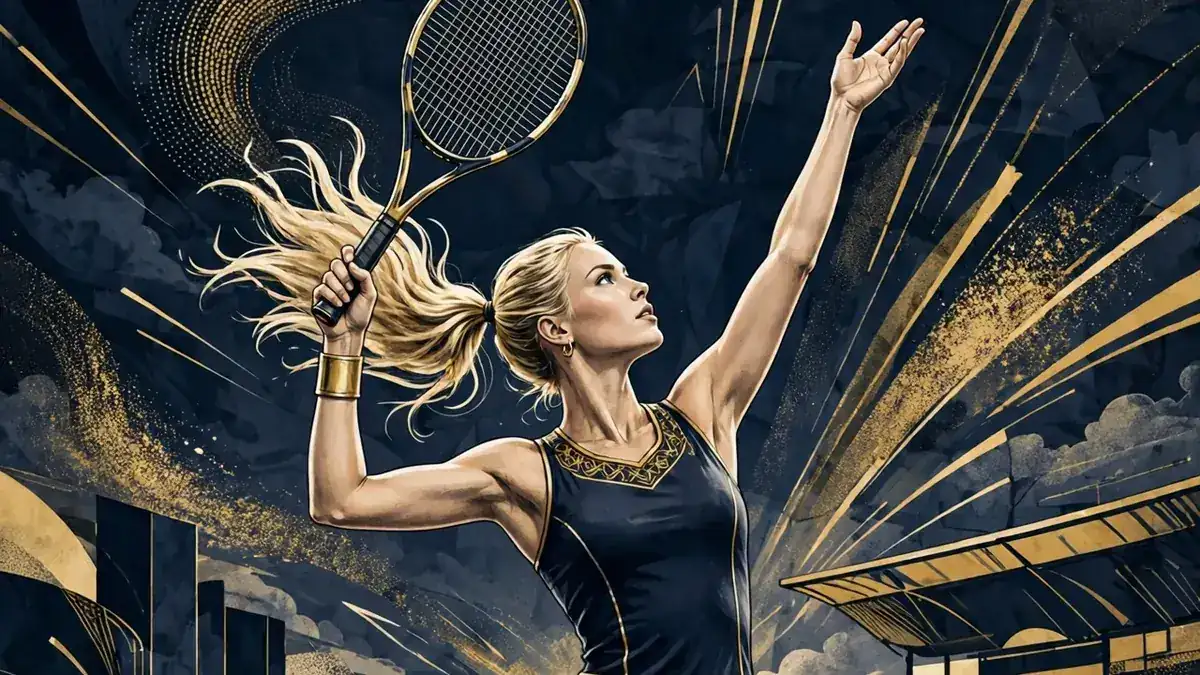
Watch Sabalenka serve and you are watching her height at work. A taller server strikes the ball from a higher contact point, which means the ball can be hit down into the service box at a steeper angle and still clear the net. That geometry is the reason her serve is one of the heaviest on the women’s tour: the ball arrives faster, bounces higher, and gives the returner less time and less room to work with. Her toss goes high — she is reaching up with a long arm from a tall frame — and the delivery that follows has been the foundation of her game since her breakthrough.
The same reach pays off everywhere else. At the net, her wingspan lets her cover passing shots that would beat a shorter player. On the stretch, she can reach balls wide to her forehand and still get enough racquet on them to hit through the court. On the overhead, she takes balls out of the air that other players have to let bounce. And because she hits from higher up, her groundstrokes naturally carry more weight: the ball leaves her strings with a flatter, heavier trajectory that pushes opponents back behind the baseline.
None of that comes free. Height is a trade-off in tennis, and Sabalenka’s career has been a long negotiation with the other side of it. Tall players change direction more slowly, and low balls — the skidding slice, the drop shot, the ball that stays ankle-high on grass — ask more of long legs and a high centre of gravity. Early in her career, that showed up in her results: she could blow almost anyone off a hard court, but her movement on clay and grass lagged behind her power, and her serve could desert her under pressure. The double-fault counts in her early seasons were among the highest on tour, and her 2022 season in particular was marked by a serving crisis that cost her matches she should have won.
What changed was the work around the height rather than the height itself. Under her long-time coach Anton Dubrov, Sabalenka rebuilt her service motion into something more repeatable, shortened her backswing on the return, and put years into footwork drills built for a tall frame — the split-step timing, the low defensive crouch, the first three steps after the serve. The payoff arrived in 2023, when she won her first Grand Slam in Melbourne and reached world No. 1, and it has held since: by 2025 she was finishing the year at No. 1 for a second straight season, with a tour-leading 63 match wins and a single-season prize-money record of $15,008,519, per the WTA’s own season review.
There is also a quieter advantage that rarely gets mentioned: presence. Opponents have said, on the record and off it, that standing across the net from Sabalenka feels different — she fills the court, her shadow falls long at the baseline, and the ball comes at you from a height that makes your usual return positions feel wrong. Marta Kostyuk put it plainly in an interview at the 2025 Wuhan Open, saying of Sabalenka and Swiatek that “they are all much bigger than me, much taller than me, much stronger than me” and that she felt smaller than them. It was an honest admission from a fellow professional, and it captures something real about what 1.82 m does before a ball is even struck.
Early Life in Minsk
Aryna Siarhiejeŭna Sabalenka was born on 5 May 1998 in Minsk, the capital of Belarus. Her father, Sergey, had played ice hockey; her mother, Yulia, worked in administration. Sport was the family language, but tennis arrived almost by accident: as a child she was taken to a tennis court in Minsk largely by chance, and the game stuck. She was tall early, strong early, and stubborn early — the three qualities that still define her.
Minsk in the late 1990s and 2000s was not an obvious launchpad for a tennis champion. Belarus had no deep tradition in the sport, and the indoor courts where Sabalenka learned the game were a long way from the academies of Florida and Barcelona where most future stars were being groomed. What she had instead was a work ethic that coaches noticed fast, and a family willing to back it. She played through the Belarusian junior system, then began travelling to ITF events as a teenager, learning her trade in the small tournaments where future professionals either harden or fade.
The first time the wider tennis world really noticed her was in 2017, when she was 19 and ranked outside the top 75. Picked for the Belarus Fed Cup team alongside Aliaksandra Sasnovich, she helped carry Belarus to the final of the competition — the Fed Cup is the women’s team event now called the Billie Jean King Cup — beating higher-ranked players along the way. It was a coming-out party of the old-fashioned kind: no hype, no junior Grand Slam title behind it, just a tall teenager hitting the ball harder than anyone expected and refusing to back down. The tennis world learned her name that autumn, and it has not forgotten it since.
Her father’s death in 2019, when Sergey Sabalenka died suddenly at 43, is the hardest fact in her story, and the one she has spoken about most sparingly. She has said in interviews since that losing him reshaped her sense of what the sport was for — that she plays, in part, to honour a father who never saw her win a Grand Slam. It is worth recording here because it explains something about her on-court demeanour: the roar after a big point, the visible emotion, the sense that every match carries weight beyond the ranking points. She does not hide what tennis costs her, and that candour has made her one of the most popular players on tour.
For readers who want her whole story in one place, the full year-by-year account sits in Aryna Sabalenka’s biography on GuideNetWorth, our sister site — four Slams, 107 weeks at No. 1, and the $22 million fortune, told from the beginning.
The Climb to World No. 1
Sabalenka’s rise did not follow the smooth path of a junior prodigy. She never won a junior Grand Slam, and her first seasons on the main tour were uneven: huge wins mixed with heavy defeats, and a game that could look unbeatable for a set and unravelling the next. Her first WTA singles titles came in 2018, at New Haven and Wuhan, and they announced a player whose ceiling was plainly very high. The floor took longer to raise.
The doubles court helped. Partnering Elise Mertens, Sabalenka won the 2019 US Open doubles title and the 2021 Australian Open doubles title, and reached world No. 1 in doubles as well — one of the few players of her generation to top both rankings. The doubles years taught her things the singles court had not: patience at the net, the value of a well-placed ball over a hard-hit one, and how to win ugly when the big shots were not landing. She still credits that period with rounding out a game that had been all power.
The breakthrough came in 2023. She won her first Grand Slam singles title at the Australian Open, beating Elena Rybakina in the final, then reached the US Open final in the same season and took the world No. 1 ranking for the first time on 11 September 2023. She was named the ITF World Champion for the season. In 2024 she defended her Australian Open crown and won her first US Open, finishing the year at No. 1 for the first time. In 2025 she defended the US Open title, reached the finals of the Australian Open and the French Open, held the No. 1 ranking for the entire calendar year, and set the WTA’s single-season prize-money record.
The 2026 season, still in progress at the time of writing, has shown both her staying power and the depth of the field chasing her. She reached the finals of the Australian Open and the US Open, completed the Sunshine Double by winning Indian Wells and Miami back to back, and added the Laureus World Sports Award for Sportswoman of the Year — the first time a tennis player had taken that honour in some years. Her ranking slipped from the top spot during the year, and by mid-September 2026 she was listed at No. 2, but the Grand Slam finals kept coming, and so did the titles: 24 singles titles in total by the autumn of 2026, including eleven WTA 1000 events.
Through all of it, the height has been a constant — not the story itself, but the frame the story is built in. She is not the tallest player on tour, and she is not the tallest champion of her era. She is, though, the tallest of the three women who have owned the top of the game since 2023, and the way she uses those 182 centimetres — the serve, the reach, the weight of shot — is a large part of why the other two have spent three years trying to solve her.
The Fortune Her Height Helped Build
A height article still has to answer the money question, because it is the question most readers arrive with next: what has all that power been worth? The short version is that Aryna Sabalenka’s net worth in 2026 is an estimated $22 million, according to Celebrity Net Worth, inside a wider published range of $20 million to $30 million once every dated 2026 estimate is laid side by side. Tatler Asia put the same $22 million figure in September 2026, EssentiallySports agreed on 12 September 2026, and the specialist outlet Tennis Net Worth gave a slightly higher $25–30 million range in August 2026. The full money story — the prize-money maths, the endorsement portfolio, and why the estimates differ — is told in detail in Aryna Sabalenka’s net worth profile on CelebAmerica.
The hardest number in her finances is the prize money. Her career prize money stood at $53,222,999 on Wikipedia’s player profile, last updated 13 September 2026 — the second-highest total any woman has ever earned on a tennis court. The WTA’s own career prize-money leaders list gave a lower total, $50,422,999, in September 2026, and a WTA document dated 3 August 2026 listed $50,259,447. The gap comes from timing and from which events each count includes; the direction of travel is the same in every count, and it is steeply upward. Her 2025 season alone set the WTA’s single-season prize-money record at $15,008,519.
| Season | The Money Milestone | Source |
|---|---|---|
| 2023 | First Grand Slam title at the Australian Open; winner’s cheque of $2.975 million, the biggest single payday of her career to that point | Tennis Net Worth, August 2026 |
| 2024 | Defended the Australian Open title (winner’s cheque $3.15 million) and won the US Open | Tennis Net Worth, August 2026 |
| 2025 | Record single-season prize money of $15,008,519; Forbes put her 2025 earnings at $30 million, the second-highest-paid female athlete of the year | WTA season review; Forbes |
| 2026 | Forbes ranked her at $36.1 million in the 12 months to August 2026; career prize money passed $53 million | Forbes, August 2026; Wikipedia, September 2026 |
Prize money is only part of the picture. Her endorsement income is estimated at around $9 million a year by EssentiallySports, and the portfolio reads like a list of brands that pay for global reach: Nike supplies her clothing and shoes, Wilson supplies her Blade 98 racquets, and the luxury Swiss watchmaker Audemars Piguet counts her as an ambassador. The list runs on through Electrolit, the sports hydration brand, the recovery-tech firm Whoop, and Oakberry, the açaí brand behind her own signature bowl — plus Gucci and Emirates, which appear in her wider commercial work. One specialist outlet estimated the Nike deal alone at $5–7 million a year, though that figure is an industry estimate rather than a confirmed contract value, and this article reports it as such.
None of that income exists without the height. It is not that sponsors pay for centimetres — it is that the centimetres built the game, the game built the ranking, and the ranking built the audience. A 1.82 m world No. 1 with four Grand Slams and the heaviest serve in the women’s game is a marketable figure in a way a 1.82 m journeywoman never would be. The frame is the foundation, not the product, but without the foundation there is no product.
What about assets — houses, cars, investments? Here the record goes quiet, and this article says so rather than filling the gap. No verified public list of Sabalenka’s property exists, and no reliable outlet has published a confirmed real-estate portfolio for her. She has been reported to have made her base in Florida, where many tour players live for the training weather, but the details of any home purchase are not on the public record, and this article will not invent them. The $22 million estimate is best read as career prize money after tax, endorsement income after fees and agent commission, and whatever assets she holds, minus spending and liabilities — an estimate of net wealth, not a confirmed balance sheet.
Personal Life and Life Off Court
Off the court, Sabalenka’s life in 2026 is steadier than the headlines of her early twenties suggested it would be. She is engaged to Georgios Frangulis, the Brazilian businessman behind the Oakberry açaí brand — a relationship that also ties, neatly, into her endorsement portfolio, since Oakberry is one of her commercial partners. The engagement was widely reported in 2025 and 2026, and the couple have kept the details largely private, which is in keeping with how Sabalenka handles her personal life these days: open about the big facts, quiet about the rest. Readers can find more of our coverage of players’ lives away from the court in CelebAmerica’s Personal Life section.
She has a famous sense of humour for a player of her intensity. Her social media is full of the lighter side — dancing videos, impressions of fellow players, jokes at her own expense — and it has made her one of the most followed and liked players on the tour. That warmth sits alongside a competitive streak that is just as public: she roars, she pumps her fist, she wears her feelings where everyone can see them. Fans tend to love one side or the other; very few are neutral about her.
The harder chapters are part of the record too, and they belong in an honest profile. As a Belarusian player competing after 2022, she played through a period when Russian and Belarusian players were barred from Wimbledon and questioned relentlessly about the politics of the region. In 2023 she skipped a French Open press conference after a run of political questions, saying she did not feel safe there — a decision the tournament accepted and the press largely respected. She has spoken since about the strain of that period, including hostility from some corners of the locker room, and about learning to protect her headspace while still doing her job. None of it is dwelled on here, because it is not the subject of this article, but a profile that left it out would be incomplete.
What remains, through all of it, is the tennis: a tall, powerful, emotional player who hits the ball as hard as anyone alive and keeps coming back for more. At 28, with four Slams and 107 weeks at No. 1 behind her, she is no longer the future of the women’s game. She is its present, and its recent past — and the height that shaped her game is still the first thing you notice when she walks onto a court.

Sabalenka by the Numbers
| Measure | Value |
|---|---|
| Height (WTA anchor) | 1.82 m / 5 ft 11 in |
| Height (US Open listing) | 1.83 m / 6 ft 0 in |
| Weight (data providers) | Around 80 kg / 176 lb |
| Age | 28 (born 5 May 1998) |
| Singles titles | 24, including 11 WTA 1000 events |
| Grand Slam singles titles | 4 |
| Doubles titles | 6, including the 2019 US Open and 2021 Australian Open (both with Elise Mertens) |
| Weeks at world No. 1 | 107 (tenth-most of all time) |
| Year-end No. 1 finishes | 2024, 2025 |
| Career prize money | $53,222,999 (Wikipedia, 13 September 2026) |
| Estimated net worth (2026) | $22 million (Celebrity Net Worth anchor; range $20–$30 million) |
| Height vs WTA average | About 8 cm above the tour average of roughly 1.74 m |
Frequently Asked Questions About Aryna Sabalenka’s Height
How tall is Aryna Sabalenka?
Aryna Sabalenka is 1.82 metres tall, or 5 feet 11 inches, according to the WTA’s official player profile. That is the anchored figure used across this article. The US Open lists her a centimetre taller at 1.83 m (6 ft 0 in), so the honest range is 1.82–1.83 m.
Is Aryna Sabalenka 6 feet tall?
Nearly. The US Open’s official profile lists her at 6 ft 0 in (1.83 m), while the WTA lists her at 5 ft 11 in (1.82 m). The one-centimetre gap comes from rounding — 182 cm converts to 5 ft 11.65 in, which different sources round in different directions. In shoes, she stands at 6 feet comfortably.
How much does Aryna Sabalenka weigh?
Data providers list her at around 80 kg (176 lb), with some guides giving 79 kg. The WTA does not publish a weight for its players, so the figure comes from sports-data firms such as Sportradar rather than the tour itself, and it should be read as approximate.
How old is Aryna Sabalenka?
Aryna Sabalenka was born on 5 May 1998 in Minsk, Belarus, which makes her 28 years old as of November 2026. She won her first Grand Slam at 24, reached world No. 1 at 25, and finished as the year-end No. 1 at 26 and 27.
Is Aryna Sabalenka taller than Iga Swiatek?
Yes. Sabalenka is listed at 1.82 m (5 ft 11 in) and Swiatek at 1.76 m (5 ft 9 in), a gap of six centimetres. It is one of the visible differences in their rivalry: Swiatek wins with movement and spin, while Sabalenka wins with power and reach.
Is Aryna Sabalenka taller than Coco Gauff?
Yes. Sabalenka stands 1.82 m (5 ft 11 in) against Gauff’s 1.75 m (5 ft 9 in) — seven centimetres taller. Gauff’s game is built on speed and defence, and the height gap is part of why Sabalenka’s heavy first-strike tennis has troubled her.
Is Aryna Sabalenka the tallest player on the WTA Tour?
No. Among her direct rivals, Elena Rybakina stands taller at 1.84 m (6 ft 0 in), and several retired greats were taller still — Maria Sharapova at 1.88 m and Lindsay Davenport at 1.89 m. Sabalenka is one of the tallest players near the top of the game, but not the tallest on tour.
What is Aryna Sabalenka’s net worth in 2026?
Aryna Sabalenka’s net worth in 2026 is an estimated $22 million, according to Celebrity Net Worth, inside a published range of $20–30 million. She has earned $53,222,999 in career prize money, the second-highest total in women’s tennis history, and Forbes put her earnings at $36.1 million in the 12 months to August 2026.
Final Thoughts
Aryna Sabalenka is 1.82 metres tall — 5 feet 11 inches on the WTA’s books, 6 feet even on the US Open’s — and the honest answer carries both numbers, because the gap between them is a single centimetre of rounding. That frame has shaped everything about her career: the serve that starts points on her terms, the reach that covers a court built for smaller players, and the weight of shot that has carried her to four Grand Slam titles, 107 weeks at world No. 1, and an estimated $22 million fortune. She is not the tallest player in tennis history, and height alone never won anyone a major — Serena Williams won twenty-three of them at 1.75 m. But Sabalenka has spent a decade turning a physical gift into a complete game, doing the unglamorous work on movement and balance that lets a tall player win on every surface. The number on the profile is 1.82 m. The story behind it is a lot bigger than that.
Sources and Reporting
How we estimated: no audited balance sheet exists for Aryna Sabalenka, so no single published number can be treated as a fact. This article publishes ranges and names the outlet behind every figure in it. The height anchor is the WTA’s official player profile (1.82 m), checked against the US Open profile (1.83 m), Sportradar (182 cm) and Tennis.com. The net-worth anchor is the $22 million figure Celebrity Net Worth publishes, confirmed independently by Tatler Asia (September 2026) and EssentiallySports (12 September 2026), inside a $20–30 million range once every dated 2026 source is counted. Career prize money of $53,222,999 comes from Wikipedia’s player profile, last updated 13 September 2026; the WTA’s own leaders list gave $50,422,999 in September 2026, and the difference is explained in the money section. Forbes supplied the earnings figures ($30 million in 2025; $36.1 million in the 12 months to August 2026). Estimates may differ from private reality, and figures will move as the 2026 season closes.
Sources consulted: WTA, US Open, Tennis.com, Wikipedia, Forbes, Celebrity Net Worth, Tatler Asia, EssentiallySports, Sportradar, Tennis Companion. All source links above point to the outlets’ homepages; specific player profiles were checked live in November 2026.