Last updated: 22 November 2026
Carlos Sainz stands 1.78 metres tall — 5 feet 10 inches — and weighs around 66 kilograms. That puts the Williams driver almost exactly on the average height of the 2026 Formula 1 grid, neither tall enough to fight for cockpit space nor short enough to gain a weight advantage. Every major F1 reference agrees on the number: PlanetF1’s 2026 grid guide, RacingNews365, F1-Fansite, F1 Chronicle and F1Oversteer all list Sainz at 1.78m, and none of the sources we checked during research for this article gave a different figure.
The height number only tells part of the story. Sainz has spent twelve seasons in Formula 1, won four Grands Prix with Ferrari, and now leads the rebuild at Williams on a reported base salary of $13 million a year. This article settles the height question with per-source detail, places Sainz against every driver on the 2026 grid, explains why height still matters inside a Formula 1 cockpit, and then covers the career, the money and the personal life behind the number.
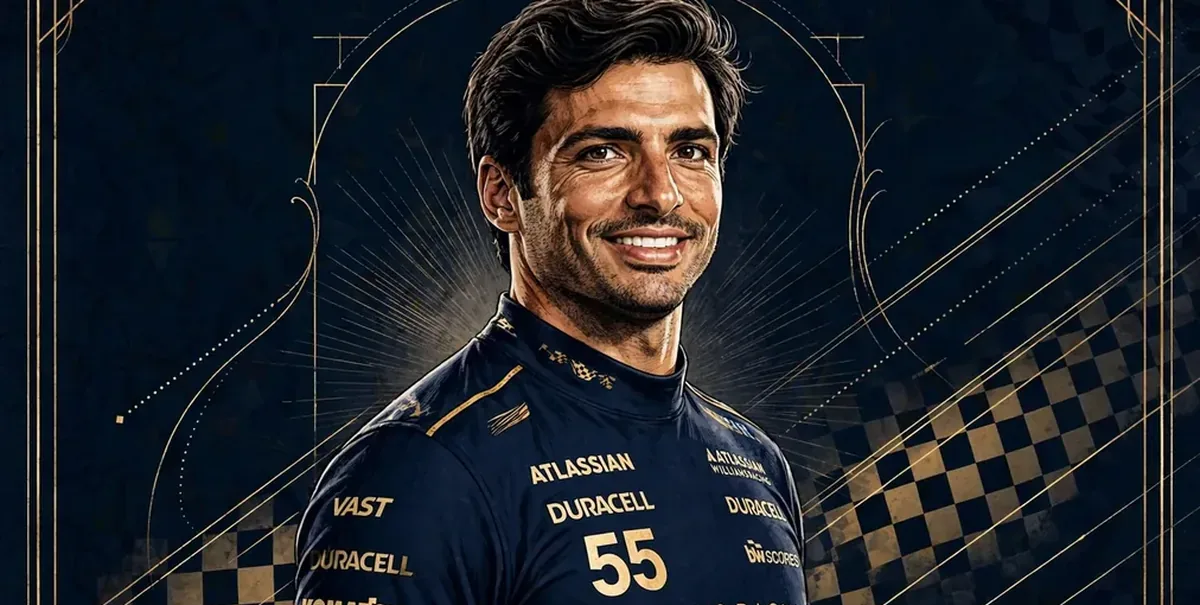
| Full Name | Carlos Sainz Vázquez de Castro |
|---|---|
| Date of Birth | 1 September 1994 (age 32 in November 2026) |
| Birthplace | Madrid, Spain |
| Height | 1.78m / 5 ft 10 in (178 cm) |
| Weight | 66 kg (RacingNews365, PlanetF1; one outlet, Grixme, lists 64 kg) |
| Current Team | Williams Racing (since 2025), car number 55 |
| Formula 1 Debut | 2015 Australian Grand Prix, Toro Rosso |
| Career Record | 4 Grand Prix wins, 6 pole positions, 4 fastest laps, 29 podiums (as of November 2026) |
| Estimated Net Worth | About $50 million (Celebrity Net Worth; reported range $45–$55 million) |
| Reported 2026 Salary | $13 million base salary at Williams (Forbes, via multiple outlets) |
| Key Teams | Toro Rosso, Renault, McLaren, Ferrari, Williams |
| Father | Carlos Sainz Sr., two-time World Rally Champion (1990, 1992) |
Table of Contents
- How Tall Is Carlos Sainz?
- Carlos Sainz’s Height Against the 2026 F1 Grid
- Does Height Matter in Formula 1?
- Early Life: Growing Up in a Rally Legend’s Shadow
- Karting and the Junior Formulae
- Formula 1 Debut: Toro Rosso and Renault
- McLaren: First Podiums and the Breakthrough
- Ferrari: Four Wins in Four Seasons
- Williams: The 2025 Move and the 2026 Rebuild
- Net Worth and Salary at Williams
- Endorsements, Cars and Lifestyle
- Weight, Fitness and Training
- Personal Life: Family and Relationships
- Carlos Sainz Height: Frequently Asked Questions
- The Bottom Line
- Sources and How We Estimated
How Tall Is Carlos Sainz?
Carlos Sainz is 1.78 metres tall, which converts to 5 feet 10 inches (178 centimetres). The figure is one of the most consistent physical stats on the Formula 1 grid — unusually so for a sport where driver heights are often rounded, estimated from old profiles, or quietly revised from season to season.
Here is how the sources line up, each checked during the research for this article in November 2026:
- PlanetF1, in its F1 2026 driver heights guide, lists Sainz at 1.78m with Williams. The same outlet’s 2023 and 2024 grid rundowns also gave 1.78m and 66kg, so the figure has not moved in years.
- RacingNews365 gives his full profile as 178cm and 66kg, alongside his date of birth (1 September 1994), birthplace (Madrid) and race number (55).
- F1-Fansite, whose driver stats page was current as of 10 November 2026, lists his height as “1.78 meter / 5 feet 10 inch”.
- F1 Chronicle, in its 2026 tallest-driver rundown, records Sainz at 178cm (5ft 10in) and notes he is identical in height to McLaren’s Oscar Piastri.
- FormulaOneHistory lists him at 5 ft 10 in / 1.78m.
- F1Oversteer puts it plainly: “Measuring in at 1.78m tall, Carlos Sainz Jr stands at a height of 5 ft 10 in.”
There is no real dispute to settle here. When six independent outlets, working from team data and paddock records across several seasons, all land on the same number, that number can be treated as settled. No source we found lists Sainz at 1.77m or 1.79m, and there is no “official” figure from the FIA or Williams that differs — Formula 1 does not publish certified driver heights the way it publishes weights and car dimensions.
For readers converting on the fly: 1.78m is 178cm, 5 feet 10 inches, and 70.1 inches. In Spain, where Sainz was born and raised, the metric figure is the one fans use. In the United States and Britain, 5’10” is the shorthand that appears on driver cards and broadcast graphics.
The headline figure, settled: Carlos Sainz is 1.78m (5 ft 10 in) tall and weighs about 66kg, per RacingNews365 and PlanetF1. One outlet, Grixme, lists his weight at 64kg rather than 66kg — a small gap that likely reflects different weighing dates across a season, since a driver’s weight moves a kilo or two with training blocks and race-week routines. The height figure carries no such disagreement anywhere.
Carlos Sainz’s Height Against the 2026 F1 Grid
Sainz sits almost dead centre on the 2026 grid. FormulaOneHistory puts the average Formula 1 driver height in 2026 at around 1.78m — exactly Sainz’s height — while Grixme’s full-grid table gives a 1.77m average. Either way, he is the grid’s middle man: 10 centimetres shorter than the tallest driver and 11 centimetres taller than the shortest.
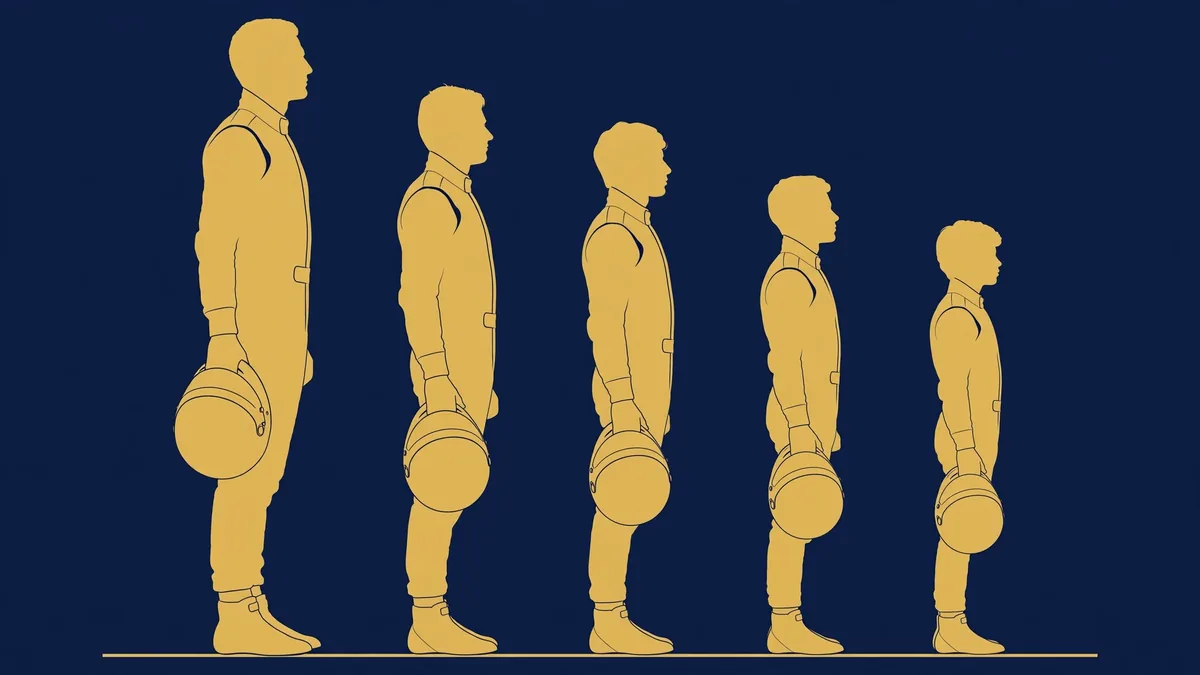
The full spread, per PlanetF1’s 2026 grid guide and F1 Chronicle’s cross-verified rundown:
| Driver | Team | Height | Gap to Sainz |
|---|---|---|---|
| Oliver Bearman | Haas | 1.88m (6 ft 2 in) | +10 cm |
| Alex Albon | Williams | 1.86m (6 ft 1 in) | +8 cm |
| Esteban Ocon | Haas | 1.86m (6 ft 1 in) | +8 cm |
| George Russell | Mercedes | 1.85m (6 ft 1 in) | +7 cm |
| Gabriel Bortoleto | Audi | 1.84m (6 ft 0 in) | +6 cm |
| Nico Hülkenberg | Audi | 1.84m (6 ft 0 in) | +6 cm |
| Lance Stroll | Aston Martin | 1.82m (5 ft 11 in) | +4 cm |
| Max Verstappen | Red Bull | 1.81m (5 ft 11 in) | +3 cm |
| Charles Leclerc | Ferrari | 1.80m (5 ft 11 in) | +2 cm |
| Carlos Sainz | Williams | 1.78m (5 ft 10 in) | — |
| Oscar Piastri | McLaren | 1.78m (5 ft 10 in) | 0 cm |
| Lando Norris | McLaren | 1.77m (5 ft 10 in) | −1 cm |
| Lewis Hamilton | Ferrari | 1.74m (5 ft 8 in) | −4 cm |
| Fernando Alonso | Aston Martin | 1.71m (5 ft 7 in) | −7 cm |
| Isack Hadjar | Red Bull | 1.67m (5 ft 6 in) | −11 cm |
A few comparisons stand out. Sainz is exactly the same height as Oscar Piastri’s height — 1.78m each — despite the two belonging to different generations of junior racing. He is a single centimetre taller than his former McLaren teammate Lando Norris’s height of 1.77m, and two centimetres shorter than his former Ferrari teammate Charles Leclerc’s height of 1.80m. His Williams teammate Alex Albon, at 1.86m, is one of the tallest men on the grid, which means Williams has had to plan cockpit packaging around two of the larger drivers in the field rather than one — a point F1 Chronicle makes explicitly in its 2026 guide.
At the top of the chart, Haas rookie Oliver Bearman is the tallest driver on the 2026 grid at 1.88m, two centimetres clear of Albon and Ocon. At the bottom, Red Bull’s Isack Hadjar is the shortest at 1.67m, a full 21 centimetres shorter than Bearman. Sainz’s 1.78m sits almost precisely between the two extremes — 10cm below the tallest, 11cm above the shortest.
For historical scale: the tallest driver in Formula 1 history is widely regarded to be Hans-Joachim Stuck at 1.94m, with the late Justin Wilson the tallest of the 21st century at 1.93m. The shortest on record is Andrea Montermini at a reported 1.57m. Sainz, at 1.78m, is comfortably clear of both extremes and has never needed the bespoke cockpit work that drivers at either end of the range sometimes require.
Does Height Matter in Formula 1?
Height matters in Formula 1, but far less than it used to — and Sainz’s position in the middle of the grid is part of why it has never been a talking point in his career. The sport’s rules have spent the last decade sanding down the advantage of being small and light.
The core issue is weight. A taller driver is usually a heavier driver, and in a formula where every kilogram costs lap time, a heavier driver used to be a slower driver. The FIA answered that in 2019 by introducing a minimum cockpit weight of 80kg — driver plus helmet, race suit, shoes and seat — and raised it to 82kg in 2025 in the name of driver welfare. If a driver and his kit weigh less than the limit, the team adds ballast to make up the difference, which removes the advantage of being a smaller, lighter driver. At 66kg, Sainz sits well under the 82kg cockpit figure once his kit is counted, so Williams runs ballast for him like every other team does for its drivers — and the team gets to place that ballast low in the car, where it helps handling.
Height also shapes cockpit fit. The FIA’s technical regulations do not set any minimum or maximum height for a driver — Article 12.1.1 only requires that the cockpit is “a volume that accommodates the driver” — but the survival cell, pedal box, steering clearance and helmet space are all fixed by regulation. Cockpit dimensions are standardised, with a minimum internal size of 850mm in length and 450mm in width. A driver of Sainz’s height fits that volume with room to spare. A driver at 1.88m, like Bearman, needs the seat, pedals and steering column arranged with much less margin; a driver at 1.67m, like Hadjar, needs pedal extenders and a seating position pushed further forward. Sainz has never needed either fix.
There is one more subtle effect: weight distribution. A taller driver’s mass sits higher and further back, which changes the car’s centre of gravity. Engineers manage it with seat design and ballast placement, and the effect at 1.78m is small. The 2026 regulations, which introduced new chassis and engine rules, kept the 82kg cockpit reference mass, so the picture is unchanged for this season.
The honest answer to the question fans actually ask — would Sainz be faster if he were shorter? — is that the rules have made the answer close to no. With ballast equalising weight and standardised cockpit dimensions, height is a packaging problem for the team, not a performance ceiling for the driver. Sainz’s four Grand Prix wins and 29 podiums were earned at 1.78m, and nothing in his record suggests the number held him back.
Early Life: Growing Up in a Rally Legend’s Shadow
Carlos Sainz Vázquez de Castro was born on 1 September 1994 in Madrid, Spain, to Reyes Vázquez de Castro and Carlos Sainz Sr. His father is one of the most decorated rally drivers in history: a two-time World Rally Champion (1990 and 1992), winner of 26 world rallies, and a four-time Dakar Rally winner. Growing up, the younger Sainz was surrounded by motorsport at its highest level, and his father mentored him through every step of the journey to Formula 1. For the full picture of his age through the years, see how old Carlos Sainz is in 2026 on our sister site GuideNetWorth.
The Sainz household was a racing household in the most literal sense. Carlos Sr. was still competing at the top of rallying while his son was a child, and the boy’s earliest memories of the sport are of service parks, gravel stages and a father who treated preparation as a profession in itself. That upbringing gave him two things that still define him as a driver: an engineer’s way of thinking about a car, and a work ethic his father drilled into him from karting onwards.
He is not an only child — his sister Ana is part of a close family unit that still travels to Grands Prix — and the family connection runs through his career off the track as well. His cousin Carlos Oñoro manages him, and his father remains a regular presence in the paddock, often seen in the Williams garage during race weekends.
Madrid shaped him in a quieter way too. He grew up speaking Spanish at home, learned English through the international junior formulae, and has always carried himself as a Madrid native first — the city is where he returns between races, and where his earliest karting tracks were. Unlike drivers who left home as teenagers for British or Italian academies, Sainz’s route ran through Spanish karting and then the European junior ladder, with his father’s name opening doors but also raising expectations he has spent his whole career answering.
Karting and the Junior Formulae
Sainz moved from karting into junior single-seaters in 2010, and the climb was fast. He won his first championship at the Formula Renault NEC in 2011 with Koiranen, finishing runner-up to Robin Frijns in the Eurocup the same year. The results marked him out early as a Red Bull Junior Team prospect, and the energy drink company’s backing carried him through the next steps.
The defining junior season came in 2014, when he won the Formula Renault 3.5 Series championship with DAMS. That title was the one that mattered: Formula Renault 3.5 was the recognised final step before Formula 1, and winning it put him directly in line for a seat. Red Bull promoted him to Toro Rosso for 2015, alongside another teenage prodigy, Max Verstappen — a pairing that would define the early years of both careers.
What the junior record shows, looking back, is consistency rather than fireworks. Sainz did not arrive in Formula 1 as a teenage sensation with a highlight reel of impossible overtakes. He arrived as a complete driver: quick, technically sharp, and unusually good at giving engineers the feedback they need to develop a car. Those qualities have been the through-line of his whole career, from Toro Rosso to Williams.
Formula 1 Debut: Toro Rosso and Renault
Sainz made his Formula 1 debut at the 2015 Australian Grand Prix for Toro Rosso, aged 20, alongside the 17-year-old Verstappen. The two rookies shared a garage for a season and a half, and while Verstappen’s raw speed grabbed the headlines, Sainz’s steadiness kept him in the points and kept him employed. Max Verstappen’s height — 1.81m — made him three centimetres taller than his rookie teammate, a difference nobody noticed at the time and nobody has mentioned since.
Verstappen’s promotion to Red Bull in mid-2016 left Sainz as Toro Rosso’s lead driver, and he spent the next year and a half proving he could carry a team. His chance at a bigger seat came in late 2017, when Renault signed him for the final races of the season and then for 2018. The Renault year was solid rather than spectacular — points in most races, a best finish of fifth — but it put him on the radar of the teams that mattered.
Renault’s decision to sign Daniel Ricciardo for 2019 could have ended Sainz’s upward climb. Instead it opened the door that changed his career: McLaren, rebuilding after its divorce from Honda, needed a reliable lead driver, and Sainz was available. He signed for 2019, and the move turned out to be the making of him.
McLaren: First Podiums and the Breakthrough
McLaren in 2019 was a team on the way back, and Sainz was the driver who carried it there. He finished sixth in the championship in his first season — McLaren’s best result in years — and took his maiden podium at the Brazilian Grand Prix, a chaotic race in which he started last, drove through the field, and finished third after a post-race penalty for Lewis Hamilton. It was the first podium of his career, in his 101st Grand Prix start, and it announced him as a driver who could deliver when a race fell apart around him.
He went one better in 2020, finishing second at the Italian Grand Prix at Monza — McLaren’s best result in six years — and ending the season sixth in the standings again. His teammate through both seasons was Lando Norris, a driver one centimetre shorter than him at 1.77m, and the two formed one of the most popular pairings on the grid. For the full profile of his old teammate, see Lando Norris’s height.
By the end of 2020, Ferrari had come calling. Sebastian Vettel was leaving Maranello, and the Scuderia wanted a proven, dependable partner for Charles Leclerc. Sainz signed for 2021, and the move to the most famous team in the sport was the biggest step of his career.
Ferrari: Four Wins in Four Seasons
Sainz raced for Ferrari from 2021 through 2024, making 88 Grand Prix starts for the Scuderia and collecting four victories, 25 podiums, six pole positions, three fastest laps and 900.5 championship points. He outscored his teammate Charles Leclerc in their first season together — a result few had predicted — even though Charles Leclerc’s height of 1.80m makes him two centimetres taller than Sainz.
The wins tell the story of his Ferrari years better than any points table:
- British Grand Prix, 2022 — his first pole position and his first Grand Prix win, in his 150th race, at Silverstone.
- Singapore Grand Prix, 2023 — the only race Red Bull did not win all season, a defensive masterclass in which Sainz managed his tyres and used a slower rival as a shield against faster cars behind him.
- Australian Grand Prix, 2024 — won two weeks after having his appendix removed, having missed the Saudi Arabian Grand Prix for the surgery.
- Mexico City Grand Prix, 2024 — won from pole, his final victory for Ferrari.
The 2024 season was his best statistically: two wins, nine podiums, one pole, one fastest lap and 290 points for fifth in the championship — his third fifth-place finish, after 2021 and 2022. It was also his last year in red. In February 2024, before the season had even begun, Ferrari announced that Lewis Hamilton would take his seat for 2025. Sainz answered the news the only way he could: by winning in Australia a month later, days after surgery, and then winning again in Mexico. For the man who replaced him, see Lewis Hamilton’s height — 1.74m, four centimetres shorter than the driver he displaced.
He left Ferrari after the 2024 Abu Dhabi Grand Prix having helped the team to second in the constructors’ championship. Four wins from 88 starts, a reputation as the most complete driver on the grid, and a free-agent status that made him the most wanted driver of the 2025 silly season.
Williams: The 2025 Move and the 2026 Rebuild
Sainz chose Williams on 29 July 2024, signing a multi-year deal starting in 2025. He had other offers — Sauber/Audi and Alpine both wanted him — but team principal James Vowles’s rebuilding plan, and the promise of the 2026 regulation change, persuaded him. The deal was for two seasons, 2025 and 2026, with options beyond.
The first season delivered. After a difficult opening half, Sainz finished third at the 2025 Azerbaijan Grand Prix — Williams’ first Grand Prix podium since 2021 — and third again in Qatar. He ended the year ninth in the championship with 64 points, and Williams had its best season in years. His teammate through it all was Alexander Albon, the 1.86m Thai-British driver whose height makes him one of the tallest on the grid. For the full profile of his garage-mate, see how old Alex Albon is.
The second season has been much harder. Williams’ 2026 car, the FW48, arrived late — the team was the only one to miss the pre-season shakedown in Barcelona — and started the year overweight. Vowles said publicly it would take about six races to get the car down to the minimum weight, and Sainz said the drop in competitiveness was bigger than he had expected. Through the first 20 rounds of 2026 he sits 18th in the standings with seven points, per ScuderiaFans’ season tracker updated in November 2026, and has scored seven of the team’s twelve points. Retirements, including an electrical fault in Austria, have cost him more.
Williams still backed him for the long term. On 19 August 2026 the team announced a new multi-year contract keeping Sainz beyond his original deal, and on 16 September 2026 it confirmed both Sainz and Albon for 2027. Spanish newspaper AS reported the new agreement runs through 2027 with an option for 2028, and other reports put his pay from 2027 at around €30 million (about $34.2 million) a season — though, as Celebrity Net Worth notes, the financial terms were not officially disclosed. Either way, the message from Grove is clear: Sainz is the driver the rebuild is built around, and he will be there when the 2026 regulations bed in.
Net Worth and Salary at Williams
Carlos Sainz’s net worth is estimated at about $50 million, according to Celebrity Net Worth, which updated its profile of him in 2026. The same figure appears across the specialist outlets: networth.com puts him at $50 million in its August 2026 rankings, and F1Headline gives a reported range of $45 million to $55 million, with some deeper financial models suggesting $55 million to $60 million. The $50 million midpoint is the figure the reporting converges on, and it is the one we anchor this article to.
The money is built on twelve seasons of Formula 1 salary, and the curve has risen steeply. His first Toro Rosso deal paid a reported $277,000 — a rookie wage — and his pay climbed with every move: Renault, then McLaren, then an eight-million-dollar-a-year Ferrari contract for 2021. Forbes estimated he earned $19 million on track in his final Ferrari season in 2024, made up of a $10 million salary and $9 million in bonuses. His first Williams season, 2025, brought a reported $13 million on track per Forbes — a $10 million base plus about $3 million in performance bonuses.
For 2026 his base salary at Williams is reported at $13 million, with performance bonuses that could lift his total on-track income to around $16 million, per the salary trackers F1Salaries and F1Decipher. The F1Headline and F1Salaries reports of a roughly €30 million annual figure from 2027 would more than double his current base if confirmed, and would make the 2027–28 extension worth around $68.4 million across its two years. Those numbers are reported rather than announced — Williams has not disclosed terms — so treat them as the market’s reading of the deal, not the team’s word.
| Season | Team | Reported base salary | Reported on-track total | Source |
|---|---|---|---|---|
| 2021 | Ferrari | About $8 million | — | Celebrity Net Worth |
| 2024 | Ferrari | $10 million | $19 million | Forbes |
| 2025 | Williams | $10 million | $13 million | Forbes |
| 2026 | Williams | $13 million | Up to $16 million | F1Salaries, F1Decipher |
| 2027–28 | Williams | About $34.2 million (reported) | — | F1Headline, F1Salaries |
F1Salaries puts his career on-track earnings at roughly $99.5 million across twelve seasons — the figure that sits behind the $50 million net worth estimate once tax, agent fees, property and spending are accounted for. The gap between gross career earnings and net worth is normal for a driver at his level: Formula 1 salaries are public estimates, and the private reality of tax residency, investments and lifestyle never appears in a press release.
Endorsements, Cars and Lifestyle
Salary is only part of the income. Sainz’s personal sponsorship portfolio adds several million dollars a year on top of his team pay — F1Decipher puts the figure at about $7 million a year for 2026 — built around long-term partnerships rather than one-off deals. The anchor is Estrella Galicia, the Spanish beer brand that has backed him since his junior career and follows him from team to team. It is the longest-running commercial relationship of his career, and the one most visible on his helmet and personal branding.
His car collection reflects the Ferrari years. F1-Fansite notes that he owns four limited-edition Ferraris, with a fifth on order as of November 2026 — the kind of collection a driver accumulates only after four seasons in Maranello. He is not known as a flamboyant spender: the Madrid base, the family-centred life, and the absence of the supercar-flexing social media presence that other drivers cultivate all point to a driver who treats money as a tool rather than a display.
What he does spend on is the career itself. The physical preparation, the simulator work, the engineering relationships — Sainz’s reputation in the paddock is of a driver who out-prepares his rivals, and that preparation costs money and time in equal measure. It is also, by most accounts, why Williams wanted him: not just for the lap time, but for the technical feedback that drags a whole team forward.
Weight, Fitness and Training
At 66kg, Sainz is one of the lighter drivers on the 2026 grid, though not the lightest — that distinction belongs to Sergio Pérez at 63kg, per Grixme’s grid table, while the heaviest is Nico Hülkenberg at 78kg. His weight matters more than his height in the modern formula, because the 82kg cockpit minimum means his team adds ballast to reach the limit, and ballast placed low in the car is free performance.
The training that keeps him at 66kg is built around the neck. A Formula 1 driver’s head and helmet weigh around 7kg, and cornering forces of up to 5G multiply that load five times over — the neck must hold roughly 35kg sideways, lap after lap, for up to two hours. Sainz’s programme, like every driver’s, centres on neck strength, core stability and cardiovascular endurance, with heat acclimatisation before races like Singapore and Qatar. He has spoken in the past about training in the Madrid summer heat to prepare for the most demanding races of the season.
His weight has been stable across his career — PlanetF1’s 2023 and 2024 grid rundowns both gave 66kg, and RacingNews365’s current profile agrees. The only dissenting figure is Grixme’s 64kg, which likely reflects a different weighing date rather than a real change. Drivers’ weights move a kilo or two across a season with training blocks and race-week routines, and no outlet has ever suggested Sainz has deliberately changed his racing weight.
Personal Life: Family and Relationships
Sainz keeps his private life quieter than most drivers at his level, but the broad strokes are well documented. He is not married and has no children. From 2017 to 2023 he was in a long-term relationship with Spanish journalist and stylist Isabel Hernáez. Since mid-2023 he has been dating Scottish model and entrepreneur Rebecca Donaldson, who runs the activewear brand Muse Activewear and is a regular presence in the Formula 1 paddock. The relationship has been reported by multiple outlets, including Harper’s Bazaar Australia and The SportsRush, though neither Sainz nor Donaldson has publicly confirmed an exact start date. For more on his life away from the track, see Carlos Sainz’s age in 2026 and the rest of our Personal Life coverage.
Family remains the centre of his life outside racing. His father, Carlos Sainz Sr., is a frequent presence at Grands Prix and has spoken publicly about his son’s career with a mixture of pride and restraint — telling Spanish publication Hola that he would not pressure his son about marriage, and that settling down is a decision for Sainz himself. His mother Reyes and sister Ana are also seen in the paddock, and the family unit is close enough that Donaldson has been photographed arriving at races with Sainz Sr. himself.
Off the track he is known for a dry sense of humour and a habit of engaging with fans in Spanish and English on social media, where his following runs into the millions. He has also kept a foot in his father’s world: he joined Sainz Sr. for a Ford Dakar Rally test session, with Donaldson riding along, and has said more than once that rallying is something he would like to try when his Formula 1 career ends. For now, though, the focus is the Williams rebuild and the 2027 contract that will take him into his fourteenth season.
Carlos Sainz Height: Frequently Asked Questions
How tall is Carlos Sainz?
Carlos Sainz is 1.78 metres tall, which is 5 feet 10 inches (178 cm). The figure is confirmed by PlanetF1, RacingNews365, F1-Fansite, F1 Chronicle, FormulaOneHistory and F1Oversteer, all of which list him at 1.78m with Williams for the 2026 season.
How much does Carlos Sainz weigh?
Carlos Sainz weighs about 66 kilograms, per RacingNews365 and PlanetF1. One outlet, Grixme, lists him at 64kg instead — a small gap that likely reflects different weighing dates across a season, since a driver’s weight moves a kilo or two with training blocks and race-week routines.
Is Carlos Sainz taller than Oscar Piastri?
No — they are exactly the same height. Both Carlos Sainz and McLaren’s Oscar Piastri stand 1.78m (5 ft 10 in) tall, per PlanetF1’s 2026 grid guide and F1 Chronicle’s cross-verified rundown, which notes the two are identical in height despite belonging to different generations of junior racing.
Who is the tallest driver on the 2026 F1 grid?
Oliver Bearman of Haas is the tallest driver on the 2026 Formula 1 grid at 1.88m (6 ft 2 in). He stands two centimetres clear of Alex Albon and Esteban Ocon, who are tied for second at 1.86m each, per PlanetF1 and F1 Chronicle.
Who is the shortest driver on the 2026 F1 grid?
Isack Hadjar of Red Bull is the shortest driver on the 2026 grid at 1.67m (5 ft 6 in), a full 21 centimetres shorter than the tallest driver, Oliver Bearman, at 1.88m.
Does height affect performance in Formula 1?
Height affects cockpit fit and weight distribution, but the rules have largely removed any performance penalty. The FIA sets no minimum or maximum driver height, and since 2019 a minimum cockpit weight — 82kg from 2025, covering driver plus helmet, suit, shoes and seat — means teams add ballast for lighter drivers, removing the advantage of being small. At 1.78m, Sainz fits the standardised cockpit with room to spare and has never needed the bespoke seat or pedal work that drivers at either end of the height range sometimes require.
How old is Carlos Sainz?
Carlos Sainz was born on 1 September 1994 in Madrid, Spain, which makes him 32 years old as of November 2026. He made his Formula 1 debut at the 2015 Australian Grand Prix, aged 20, and is now in his twelfth season on the grid.
What team does Carlos Sainz drive for in 2026?
Carlos Sainz drives for Williams Racing in 2026, in car number 55, alongside teammate Alex Albon. He joined Williams in 2025 after four seasons with Ferrari, and in August 2026 the team announced a new multi-year contract keeping him beyond his original two-year deal.
The Bottom Line
Carlos Sainz is 1.78m (5 ft 10 in) tall and weighs about 66kg — a figure every major F1 reference agrees on, and one that places him almost exactly on the 2026 grid average. He is the same height as Oscar Piastri, a centimetre taller than Lando Norris, two centimetres shorter than Charles Leclerc, and eight centimetres shorter than his own Williams teammate Alex Albon.
The number itself is the least interesting thing about him. Twelve seasons, four Grand Prix wins, 29 podiums and a $50 million estimated net worth say more about Carlos Sainz than any tape measure can. His height has never been a talking point in his career precisely because it has never needed to be one: the rules equalise weight, the cockpit fits, and the results speak for themselves. At Williams, where he is the driver the rebuild is built around through at least 2027, the only measurement that matters now is the points column — and on that count, the second half of the 2026 story is still to be written.
Sources and How We Estimated
How we estimated: the headline height figure (1.78m / 5 ft 10 in) is taken from six independent outlets — PlanetF1, RacingNews365, F1-Fansite, F1 Chronicle, FormulaOneHistory and F1Oversteer — which all agree, so no range was needed. The weight figure (66kg) is anchored to RacingNews365 and PlanetF1, with Grixme’s 64kg noted as the single dissenting figure. The net worth figure (about $50 million) is anchored to Celebrity Net Worth, with networth.com and F1Headline’s $45–$55 million range reported alongside it. Salary figures are reported estimates from Forbes, F1Salaries and F1Decipher, not confirmed team figures — Williams has not disclosed contract terms, including the 2027 extension announced in August 2026. Career statistics are drawn from Formula1.com-derived trackers current to November 2026 (ScuderiaFans, F1Live365, F1-Fansite) and cross-checked against Wikipedia’s driver record. Estimates may differ from private reality; all figures are reported estimates, not verified personal finances.
Sources consulted: Formula1.com · PlanetF1 · RacingNews365 · F1-Fansite · F1 Chronicle · FormulaOneHistory · F1Oversteer · Celebrity Net Worth · Forbes · F1Salaries · ScuderiaFans · Wikipedia · Grixme · FastestLap · PoleCircuit