Andrew Schulz is an American stand-up comedian, actor and podcaster who turned a New York club career into one of the most independent media businesses in comedy. Born Andrew Cameron Schulz on October 30, 1983, in New York City, he first reached a national audience on MTV2’s Guy Code, then built his name on two long-running podcasts — The Brilliant Idiots with Charlamagne tha God and Flagrant — and on stand-up specials he released on his own terms, including the Netflix hours Schulz Saves America (2020) and Life (2025).
As of November 2026, Schulz’s estimated net worth sits in a $4 million to $12 million range, with the most recent dated estimate — Alux, October 2026 — anchoring it at about $10 million. Celebrity Net Worth lists him at $4 million, while other 2026 estimates run to $12 million. No figure is official: Schulz has never disclosed his finances, his Netflix fees are private, and his podcast and touring income is split with partners. This biography lays out the career that produced that money, the business model behind it, and the personal life — wife Emma Turner, daughter Shiloh and son Lincoln — that his latest work is built around. Last updated: November 24, 2026.
| Full Name | Andrew Cameron Schulz |
|---|---|
| Date of Birth | October 30, 1983 (age 43 as of November 2026) |
| Birthplace | New York City, New York, USA |
| Education | University of California, Santa Barbara — BA in Psychology |
| Occupation | Stand-up comedian, actor, podcaster, writer, producer |
| Estimated Net Worth | $4 million–$12 million (anchored at about $10 million per Alux, October 2026) |
| Primary Income Sources | Stand-up touring, Flagrant podcast and Patreon, Netflix specials, YouTube, acting roles |
| Key Works | Guy Code (MTV2), The Brilliant Idiots, Flagrant, 4:4:1, Schulz Saves America, Infamous, Life |
| Spouse | Emma Turner (married December 18, 2021, Montecito, California) |
| Children | Daughter Shiloh Jean (born February 2024); son Lincoln Lawrence (born January 2026) |
| Height | 6 feet 0 inches (183 cm) |
Table of Contents
- Early Life and Family in New York
- Education and First Steps in Stand-Up
- The New York Grind and Edinburgh Debut
- MTV Breakthrough: Guy Code and Television Work
- Acting Roles: Benders, Sneaky Pete and Film
- The Brilliant Idiots with Charlamagne tha God
- Flagrant and the Podcast Empire
- The Self-Release Gamble: 4:4:1 to Infamous
- Netflix: Schulz Saves America and Life
- The Life Tour, Madison Square Garden and Radio City
- The Money: Income Streams and Net Worth
- Net Worth Growth Timeline
- Assets, Homes and Lifestyle
- Personal Life: Emma Turner, Marriage and Children
- Controversies and Public Pushback
- How Schulz Compares to His Comedy Peers
- Frequently Asked Questions
- Bottom Line
- Sources and Reporting
Early Life and Family in New York
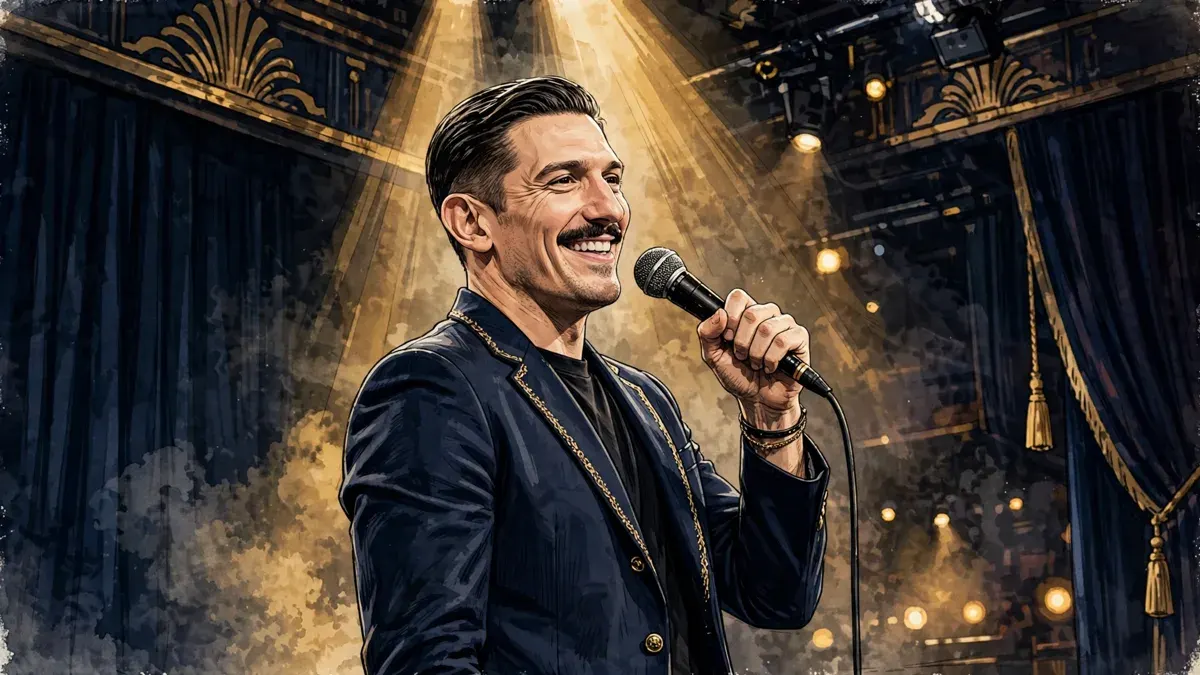
Andrew Cameron Schulz was born on October 30, 1983, in New York City, and grew up in Manhattan’s East Village. His household was unusual in a way that shaped almost everything about his comedy: his mother, Sandra Cameron, is a Scottish immigrant and professional ballroom dancer who founded the Sandra Cameron Dance Center in Lower Manhattan, a studio the family ran for more than three decades. His father, Larry Schulz, was a New Yorker of German and Irish descent who served in the military and worked as a reporter, producing stories for NBC and crossing paths with figures including Muhammad Ali.
That combination — a dance-studio mother who understood performance and discipline, and a journalist father who understood stories and deadlines — gave Schulz an early education in both show business and the news cycle. He has said his comedy education came less from formal training than from watching the Black comedians he grew up admiring, including Patrice O’Neal, Bernie Mac and Eddie Murphy, and from hip-hop radio. The East Village of the 1990s, raw and mixed and loud, shows up constantly in his material: the accents, the street arguments, the neighbourhood characters.
Schulz attended New York City public schools, including Lillie Devereaux Blake Primary School and Robert F. Wagner Middle School on the Upper East Side, before graduating from Baruch College Campus High School in Kips Bay. He was not a child star and did not come from entertainment money. The dance studio was a working family business, not a fortune, and his route into comedy was the slow one — open mics, club sets, and years of television bit parts before anything paid well.
Education and First Steps in Stand-Up
After high school, Schulz headed west to the University of California, Santa Barbara, where he earned a Bachelor of Arts degree in psychology, graduating in 2005. The degree has become a running thread in his own telling of his career: he credits the psychology training with teaching him to read a room, to understand why an audience reacts the way it does, and to build crowd-work sets that feel like a conversation rather than a lecture. Whether or not the degree deserves that much credit, the skill it describes is real — crowd work is the part of Schulz’s act that clips travel furthest online.
He began performing stand-up while still a student in California, almost by accident. While managing a restaurant in Santa Barbara that held a comedy night, he tried stand-up for the first time and kept going. The early sets were rough, in the way every comic’s early sets are rough, but he stuck with it after graduation instead of treating it as a college phase. He has never practised psychology. The degree went into a drawer; the microphone stayed out.
One detail worth noting for anyone reading older profiles: a handful of low-quality biography sites list the wrong birth date (August 26, 1983), the wrong spouse, or the wrong degree subject for Schulz. Wikipedia, which cites his own interviews and contemporary reporting, confirms October 30, 1983, a BA in psychology from UC Santa Barbara, and his marriage to Emma Turner. Those are the facts this article uses throughout.
The New York Grind and Edinburgh Debut
Schulz returned to New York in the mid-2000s and went straight into the city’s club circuit, becoming a regular at the Comedy Village and working every open mic and late set he could get. New York in that era was a hard place to learn comedy: the rooms were small, the audiences were sharp, and the competition for stage time was fierce. Schulz has described those years as a long apprenticeship — learning timing, learning how to lose a room and win it back, and learning that a joke that works in a bar in Santa Barbara might die in a basement on MacDougal Street.
In 2008 he made his international debut at the Edinburgh Comedy Festival in Scotland. It was an early sign of the international audience he would later build online, and it gave him a credential that mattered on the club circuit: a comic who could hold a room outside his home city. He kept grinding through the late 2000s and early 2010s, picking up television appearances while the stand-up remained the core of the act.
The grind years matter because they explain the business decision that later defined him. Schulz spent roughly a decade doing things the traditional way — television, clubs, waiting for a gatekeeper to hand him a special — and watched the economics from the inside. When he finally got the chance to release a special, he already knew what he was giving up by handing it to a network, and what he could keep by releasing it himself.
MTV Breakthrough: Guy Code and Television Work
Schulz’s first big break came in 2011, when he joined the cast of MTV2’s Guy Code as a main cast member, staying with the show through 2015. The series — a panel show built around blunt, funny advice about dating, friendship and everyday life — was a natural fit for his style, and it put him in front of a young audience that would follow him to podcasts and YouTube years later. He appeared alongside fellow cast members including Charlamagne tha God, a connection that would become one of the most important professional relationships of his life.
The MTV years filled out his television résumé. He appeared on Guy Court and Girl Code, hosted Jobs That Don’t Suck in 2014, and hosted or featured on The Hook Up. He was a recurring guest on Big Morning Buzz Live in 2012–13 and appeared in MTV’s New Year’s Eve programming in 2015. The work paid, it built name recognition, and it taught him how television production works — but it did not make him rich, and it did not give him control over his own material.
By the middle of the decade, the pattern was clear: television was a shop window, not a home. Schulz’s audience was increasingly finding him online, in clips and podcasts, rather than on a scheduled broadcast. The move that followed — into podcasting, and then into self-released specials — was a response to that shift, not a rejection of television for its own sake.
Acting Roles: Benders, Sneaky Pete and Film
Alongside the stand-up and the MTV work, Schulz built a steady acting résumé. In 2015 he starred in the IFC series Benders, a comedy about a group of friends and their hockey team, and appeared in Amazon’s Sneaky Pete. He later appeared in HBO’s Crashing (2017), a show about the New York comedy scene itself, which suited him exactly. Film and television roles followed in smaller parts, including the Netflix film You People (2023), where he played a supporting role in an ensemble led by Jonah Hill and Eddie Murphy — a neat full circle, given how often Schulz names Murphy as an influence.
Acting has never been Schulz’s main income stream, and he has never positioned himself as a movie star. The roles function the way television did in the MTV years: they keep him visible to audiences who might never buy a stand-up ticket, they add a line to the résumé that helps with bookings, and they occasionally pay well for a short shoot. His most talked-about screen project of 2026 is the live-action Street Fighter film, in which entertainment outlets reported he plays the comic fighter Dan Hibiki, with the film dated for release on October 16, 2026. It is his biggest film role to date, and a test of whether his audience follows him from the stage to the multiplex.
He also appeared in Netflix’s The Roast of Tom Brady in May 2024, a live event that drew a large mainstream audience and put Schulz in front of viewers who knew Brady far better than they knew him. It was the kind of booking that a decade earlier would have been the goal; by 2024 it was a side project next to a podcast empire and a touring schedule that sold out arenas.
The Brilliant Idiots with Charlamagne tha God
Schulz met Charlamagne tha God when both were on Guy Code, and in 2013 the two launched The Brilliant Idiots, a podcast that is still running more than a decade later. The show’s premise was simple — two very different personalities, one white comic from downtown Manhattan and one Black radio host from South Carolina, arguing about hip-hop, culture, relationships and the news — and its chemistry carried it. Episodes run long, the conversation wanders, and the disagreements are the point.
The Brilliant Idiots did two things for Schulz that television never had. First, it gave him a weekly, unfiltered platform where he could develop material and opinions without a network standards department. Second, it plugged him into hip-hop culture and its audience, a crossover that shaped his fan base and his comedy. The show’s newest episodes were still appearing in November 2026, a run of more than thirteen years that few podcasts of its era have matched.
The partnership also matters for the money story. A long-running podcast with a loyal audience is a durable asset: it generates advertising revenue, it sells live shows, and it keeps the host’s name in circulation between tours and specials. The Brilliant Idiots was the proof of concept. Flagrant was the business built on top of it.
Flagrant and the Podcast Empire
In 2017 Schulz launched Flagrant — originally Flagrant 2 — with his close friends and fellow comics Akaash Singh and Mark Gagnon, along with video editor and on-camera personality AlexxMedia. What began as a sports podcast widened into a twice-weekly discussion of news, culture and politics, taped at the show’s Nolita studio, and it grew into one of the most-watched comedy podcasts in the United States. Promotional material for his 2026 tour dates puts the numbers at about 5 million weekly viewers and more than 1.4 billion total views on YouTube, with his stand-up and podcast content reaching a reported 30 million viewers weekly across YouTube, Instagram and TikTok.
Those numbers should be read with care — they come from tour and venue promotion, not an audited statement — but the scale is not in doubt. Flagrant is a top-tier comedy podcast by any measure that counts: audience size, episode frequency, live-show demand and sponsor interest. Its guests have included Joe Rogan, 50 Cent, Shane Gillis and Jelly Roll, and in October 2024, with 29 days left in the presidential campaign, Schulz interviewed Donald Trump on the show, a booking that drew national political coverage and a new wave of listeners.
The show has also had its share of change. Co-host Akaash Singh announced his departure from Flagrant in 2026, a significant shift for a show built on its core group’s chemistry. As of November 2026 the hosts were Schulz, AlexxMedia and Mark Gagnon. The departure is a reminder that a podcast built on friendship is also a business, and that the business has to survive its personnel changes. Schulz’s response, so far, has been to keep the show running on its established rhythm rather than reinvent it.
For readers who follow the wider podcast world, the model will look familiar: a long-form show, a clip channel that feeds the algorithm, a paid membership tier, and live recordings that double as tour dates. What sets Schulz apart is how early he committed to it, and how much of the revenue he kept. He owns the show with his partners rather than renting his talent to a network, which is the same logic that governs his specials — and the reason his net worth estimates, modest as they look next to a movie star’s, are built on assets he controls.
The Self-Release Gamble: 4:4:1 to Infamous
Schulz self-released his first comedy special, 4:4:1, on YouTube in September 2017. The title referred to its structure — four shows, four nights, one venue — and the release was a statement: rather than wait for a network to buy a special and lock it behind a subscription, he would put it where his audience already was and let the clips do the marketing. His debut comedy album, 5:5:1, followed in June 2018 and topped the iTunes comedy album chart, reaching number one on Apple Music, Google Play and Amazon and hitting number one on the Billboard comedy albums chart for the week of June 23, 2018.
He followed with Views from the Cis and The Crowd Work Special, both in 2019, each released directly to his audience. The crowd-work special was particularly well suited to the format: short, self-contained clips of Schulz riffing with audience members travel far better on social media than a polished hour does, and the clips became a recruiting tool for the tours. By the end of 2019, Schulz had a catalogue, an audience, and a distribution channel he owned outright.
The defining gamble came with Infamous. The special was finished in 2022 and no platform was willing to release it as Schulz wanted it released, reportedly over content concerns. Rather than edit it down or shelve it, Schulz bought it back and sold it directly to fans for $20, then released it on YouTube in July 2022, where it passed 20 million views. The episode became the centrepiece of his reputation as comedy’s independent operator: the comic who would rather sell a special himself than cut it to fit a buyer’s taste. It also became a business lesson that other comics copied — own the master, sell it direct, and let the platform come to you.
The Infamous lesson: when no platform would release Infamous on his terms in 2022, Schulz bought the special back, sold it directly to fans for $20, and then put it on YouTube, where it passed 20 million views. The direct sale mattered as much as the views — it proved he could monetise an audience without a middleman.
Netflix: Schulz Saves America and Life
Schulz’s first Netflix project, the four-part Schulz Saves America, premiered on December 17, 2020. It arrived at a moment when stand-up specials were becoming Netflix’s signature comedy product, and it gave Schulz the mainstream credential his independent releases could not: a Netflix credit, a global platform, and a place in the recommendation engine. The special’s four-part structure was unusual, and it suited a comic whose material was topical enough to date quickly — short, sharp segments rather than a single hour built to last for years.
His first full Netflix stand-up hour, Life, arrived in March 2025, taped at New York’s Beacon Theatre and released on March 4, 2025. The special spent 15 consecutive days in the US Top 10 and appeared in the Top 10 across 13 countries, according to tour and venue promotion — a strong result for a stand-up hour, and a sign that the Netflix audience and the YouTube audience had converged around him. The material was personal in a way his earlier work had not been: Life is built around his and Emma Turner’s experience of in vitro fertilisation, the process of conceiving their daughter Shiloh, and the chaos that came with it.
That turn toward the personal is worth pausing on. Schulz’s early reputation rested on crowd work, topical jokes and a willingness to say the unsayable. Life keeps the edge but adds something his earlier specials did not have: a story about wanting a child, failing to conceive easily, and going through IVF. He promoted the special with a sketch alongside Matt Damon, and the Los Angeles Times interviewed him about fatherhood, the special and his podcasts. The interview, and the special, showed a comic in his early forties writing about the thing that was actually happening in his life, rather than recycling the material that had made him famous in his twenties.
The Netflix relationship is a two-way street. Netflix gets a proven draw with a built-in audience; Schulz gets the platform’s reach and a fee whose terms are not public. The fees for specials like Schulz Saves America and Life are routinely described as a meaningful part of his income, but no reliable source has published a number, and this article does not invent one. What can be said is that the Netflix cheques sit alongside touring, podcasting and direct sales in a mix that no single deal dominates — which is exactly the point of the model.
The Life Tour, Madison Square Garden and Radio City
Touring is the engine of Schulz’s business, and the numbers from the Life tour show how large that engine has become. The tour played about 60 cities, including two sold-out nights at Madison Square Garden on May 3 and 4, 2024. He has also sold out Radio City Music Hall twice in a single night, a feat that puts him in a small group of comics who can fill New York’s biggest rooms on their own name.
Arena comedy is a different business from club comedy. A club set pays a few hundred dollars and builds a following; an arena night pays many times that, but it requires an audience that already knows the act, a marketing machine that can fill ten thousand seats, and a show that works at a distance of a hundred feet. Schulz’s YouTube clips and podcast audience do the marketing for him — a fan who has watched a hundred crowd-work clips already knows what the night will feel like before buying a ticket. That is why the touring grosses, rather than the Netflix fees, are usually cited as the largest single contributor to his wealth.
The 2026 calendar kept the pace up. Tour dates were listed across the United States through the year, with the Life material still the core of the show and the Street Fighter release adding a new talking point. For a comic who started out managing a restaurant comedy night in Santa Barbara, the distance travelled is the story: from a room that held a few dozen people to a room that held twenty thousand, in under two decades.
The Money: Income Streams and Net Worth
Schulz’s money comes from five streams that reinforce each other, and understanding the mix matters more than any single estimate. Touring is the largest: arena and theatre dates across roughly 60 cities on the Life tour, with ticket prices for a headliner of his standing and merchandise sold at the venue. The exact grosses are not public — promoters do not publish per-comic figures — but a sold-out Madison Square Garden weekend alone represents a substantial payday before costs are split with the venue, the promoter and the tour team.
The second stream is Flagrant and its paid membership tier, together with The Brilliant Idiots. Podcast income comes from sponsorships, advertising and Patreon-style memberships, and one 2026 estimate put the Flagrant podcast at around $1 million a year — a figure that should be treated as an informed guess rather than a fact, since podcast revenue is private and shared among the hosts. What is not in doubt is that the podcast is a year-round, recurring business rather than a one-off payday, which makes it more valuable than a single special’s fee.
The third stream is the specials themselves: Netflix fees for Schulz Saves America and Life, and direct sales and YouTube advertising from the self-released catalogue, including the $20 direct sale of Infamous and its 20 million-plus YouTube views. YouTube advertising on his own channel is a fourth stream — Net Worth Spot, analysing his channel data, estimated the channel at about $500,000 a year in advertising revenue, with an optimistic ceiling near $900,000. That analysis covers only one channel and only advertising, not sponsorships or memberships, so it understates the total; it is useful as a floor, not a total.
Acting is the fifth stream, and the smallest of the five. Roles in Benders, Sneaky Pete, Crashing and You People paid acting fees, and the Street Fighter role is his largest screen paycheque to date — but no source has published a figure, and acting has never been the centre of his business. It is a complement to the touring and podcasting, not a replacement for them.
For a fuller treatment of the figures, including the competing estimates and how they were weighed, our sister site’s money-focused profile covers Andrew Schulz’s net worth in detail. The short version is this: the low end of the published range, $4 million from Celebrity Net Worth, looks stale against the arena touring and podcast scale of 2024–2026, while the high end — $18 million to $20 million on some fan-run pages, and $40 million on one contradictory site that also published a $5 million figure for the same person — has no sourcing behind it. The honest middle, and the figure this biography anchors on, is about $10 million as of October 2026, per Alux, inside a $4 million to $12 million range.
| Income Stream | What it is |
|---|---|
| Stand-up touring | Arena and theatre dates, about 60 cities on the Life Tour; two sold-out Madison Square Garden nights in May 2024; merchandise at venues |
| Podcasts | Flagrant and The Brilliant Idiots — sponsorships, advertising, paid memberships; Flagrant estimated at around $1 million a year (unverified industry guess) |
| Specials | Netflix fees for Schulz Saves America (2020) and Life (2025); direct $20 sale and YouTube revenue for Infamous (20M+ views) |
| YouTube | Channel advertising estimated at about $500,000 a year by Net Worth Spot, with an optimistic ceiling near $900,000 |
| Acting | Television and film fees — Benders, Sneaky Pete, Crashing, You People, Street Fighter (2026); smallest of the five streams |
Net Worth Growth Timeline
Schulz’s wealth grew in steps that track his career, not in a single windfall. The table below is an honest reconstruction from the public record: the figures are ranges drawn from the dated estimates discussed above, and the early years are described in words rather than numbers because no reliable estimate exists for a club comic in 2010.
| Period | What happened |
|---|---|
| 2005–2010 | Club circuit and Edinburgh debut; income from small rooms and restaurant work — a working comic’s living, not wealth |
| 2011–2015 | Guy Code and MTV work; first steady television pay, plus The Brilliant Idiots launches in 2013 |
| 2017–2019 | Self-released specials 4:4:1, 5:5:1 (Billboard comedy No. 1), Views from the Cis; Flagrant launches in 2017; direct-to-fan revenue begins |
| 2020–2022 | Schulz Saves America on Netflix (December 2020); Infamous bought back and sold direct in 2022; podcast audience passes a billion YouTube views |
| 2023–2024 | Arena touring scales up — Radio City sellouts, two Madison Square Garden nights in May 2024; Roast of Tom Brady (May 2024); Trump interview on Flagrant (October 2024) |
| 2025–2026 | Life on Netflix (March 2025), 15 days in the US Top 10; Life Tour plays about 60 cities; Street Fighter role (October 2026); estimated net worth $4M–$12M, anchored near $10M (Alux, October 2026) |
Two things stand out in that timeline. The first is how late the money arrived relative to the fame: Schulz was on national television in 2011, but the wealth-building phase did not begin in earnest until the self-released specials and the podcast took off six years later. The second is how little of the wealth depends on any single deal. A comic whose income is one Netflix contract is one cancelled contract away from trouble; a comic whose income is touring, two podcasts, a catalogue of self-owned specials and a YouTube channel can lose any one stream and keep going. That diversification is the real story of the net worth figure, and it is the part of the story that other comics have copied most.

Assets, Homes and Lifestyle
There is less to say here than the tabloids would like, and that is itself a fact worth reporting. Unlike celebrities whose property purchases are routinely covered, Schulz has no widely reported real-estate portfolio in the public record: no sourced mansion purchase, no reported car collection, no investment portfolio discussed in interviews. He has spoken about his work and his family at length; he has not spoken about his house, his cars or his investments, and no reputable outlet has published a sourced account of them.
What can be said with confidence is what the business itself is worth as an asset. Schulz owns, with his partners, the Flagrant show and its catalogue; he owns the self-released specials outright, including Infamous; and he owns the audience relationship — the YouTube channels, the mailing lists, the ticket buyers — that makes the touring work. In the economics of modern comedy, those are the assets that matter most, because they generate income every year without a new negotiation. A house is a place to live; a catalogue that pays every month is a business.
His lifestyle, as it appears in public, is consistent with that picture: a working comic who tours hard, records podcasts twice a week, and spends the time between tours with his family. He is not a fixture of the luxury-brand circuit, and his social media is dominated by clips and podcast segments rather than displays of wealth. That is a choice as much as a temperament — the brand is the work, not the things the work bought.
Personal Life: Emma Turner, Marriage and Children
Schulz married Emma Turner on December 18, 2021, in Montecito, California. Turner, a Pilates instructor who has also worked in the fashion industry, met Schulz in 2015 at a mutual friend’s birthday party in New York’s West Village; the couple dated for several years, got engaged in 2020, and married the following winter. The wedding was small and private, in keeping with how both of them have handled the relationship in public ever since.
The couple’s path to parenthood became the subject of Schulz’s most personal work. Their daughter, Shiloh Jean Schulz, was born in February 2024 after the couple went through in vitro fertilisation, an experience Schulz has discussed openly on his podcasts and built his 2025 Netflix special Life around. The decision to talk about IVF on stage — a subject most comics would avoid — was a deliberate one: Schulz has said he wanted to take the shame out of a process that many couples go through in silence, and the material landed because the audience could tell it was real.
Their second child, a son named Lincoln Lawrence Schulz, was born in January 2026, according to Wikipedia’s biography, which cites contemporary reporting. That makes Schulz, at 43, the father of two young children, and it explains the direction of his recent material: the Life special is, at its core, a show about becoming a father later than he expected, and about what changes when the person heckling you from the front row is replaced by a baby monitor at home.
Schulz’s own account of his age and stage of life puts the biography in context — for the quick numbers, see how old Andrew Schulz is and the timeline of his career there. He keeps the family largely out of the spotlight: Turner does not co-host his shows, the children do not appear in his clips, and the home life stays in the background of a public career that is, by design, very loud. That boundary is part of the story. A comic whose act is built on saying the unsayable has drawn a clear line around the two people who matter most to him, and he has held it.
Schulz has also spoken about fatherhood in long-form conversation — including a wide-ranging appearance on Armchair Expert, where he discussed the Life special, his upbringing and the fertility journey with Dax Shepard and Monica Padman. The conversation is a useful companion to the special itself: where the special tells the story as jokes, the interview tells it as a person talking about his family.
Controversies and Public Pushback
Schulz’s comedy has always courted controversy, and the pushback has followed the same pattern for years: a joke or a podcast segment travels beyond his audience, the context drops away, and the reaction arrives in force. The most widely reported episode of recent years came in July 2024, when an episode of Flagrant featuring British podcasters Shxt N Gigs included jokes about Black women that drew sustained criticism online. Schulz has addressed the criticism in his usual way — by arguing that context matters, that a joke told in a room full of people who know the comic is different from the same words clipped and circulated without it, and that comedy’s job is to go where the conversation is uncomfortable.
That argument has not satisfied his critics, and it is not this article’s job to settle the question. What can be reported is the pattern: Schulz has built his career on material that a network would have cut — which is precisely why he stopped handing his specials to networks — and the cost of that independence is that there is no standards department to absorb the blow when a bit lands badly. The Infamous episode and the July 2024 episode are the same story told twice: a comic choosing control over safety, and living with the consequences of the choice.
There is also a quieter controversy that follows Schulz wherever he goes, and it is about the business model itself. Some comics and critics argue that the direct-to-fan model rewards provocation — that a clip of an edgy joke travels further than a thoughtful hour, and that the algorithm therefore pays comics to be outrageous. Schulz’s answer, implicit in the Life special, is that the same model also lets him release an hour about IVF and fatherhood to an audience that trusts him enough to listen. Both things can be true at once, and the next few years will show which one the audience rewards more.
How Schulz Compares to His Comedy Peers
Schulz’s career invites comparison with two groups of comics: the podcast-era peers who built audiences the same way, and the traditional stand-ups who took the network route he declined. The comparisons are instructive because they show what the independent model gains and what it gives up.
Against the podcast-era peers, Schulz sits near the top of the field. His combination — two long-running podcasts, a self-owned special catalogue, arena touring and a Netflix relationship — is matched by very few comics. Fellow podcasters like Andrew Huberman, whose long-form show built a different kind of audience in the science and health space, show how durable a weekly podcast can be as a business; Schulz’s version of the same model is louder, funnier and more dependent on the live room, but the underlying economics are the same. And Lex Fridman, another long-form host whose show trades on deep conversation rather than punchlines, is a useful contrast: where Fridman’s show is built on patience, Schulz’s is built on pace, and both have found audiences of millions.
Against the traditional route, the trade is clearer. A comic who takes the network deal gets a bigger cheque up front, a marketing budget and a prestige credit. Schulz got smaller cheques, paid for his own marketing with clips, and kept the rights. Fifteen years into the experiment, the rights look like the better asset: the specials still earn, the podcasts still run, and no executive can pull the catalogue. The cost was the decade of grinding that the network route would have shortened — the club years, the MTV years, the long wait for a special that he eventually had to release himself.
The honest verdict is that Schulz’s model works best for a comic with his specific skills: a strong live act, a gift for crowd work that clips well, a willingness to be a businessman as well as a performer, and an audience that follows him across platforms. It is not a template every comic can copy, and Schulz himself has never claimed it is. It is a biography of one career, not a manual.
Frequently Asked Questions
Who is Andrew Schulz?
Andrew Cameron Schulz is an American stand-up comedian, actor and podcaster, born October 30, 1983, in New York City. He first became known on MTV2’s Guy Code, co-hosts The Brilliant Idiots with Charlamagne tha God and Flagrant, and released the Netflix specials Schulz Saves America (2020) and Life (2025).
What is Andrew Schulz’s net worth in 2026?
His estimated net worth is $4 million to $12 million as of November 2026, anchored at about $10 million per Alux’s October 2026 estimate. Celebrity Net Worth lists $4 million, while other 2026 estimates run to $12 million. The money comes mainly from touring, the Flagrant podcast, Netflix specials and YouTube.
How old is Andrew Schulz?
Andrew Schulz was born on October 30, 1983, which makes him 43 years old as of November 2026. He grew up in Manhattan’s East Village, attended public schools in New York City, and graduated from the University of California, Santa Barbara with a BA in psychology in 2005.
Who is Andrew Schulz’s wife?
Andrew Schulz is married to Emma Turner, a Pilates instructor who has also worked in the fashion industry. They met in 2015 at a mutual friend’s birthday party in New York, got engaged in 2020, and married on December 18, 2021, in Montecito, California.
Does Andrew Schulz have children?
Yes, two. His daughter Shiloh Jean Schulz was born in February 2024 after the couple went through IVF, an experience that became the subject of his 2025 Netflix special Life. His son Lincoln Lawrence Schulz was born in January 2026.
What is Andrew Schulz’s most famous stand-up special?
His most talked-about special is Infamous (2022), which he bought back and self-released after no platform would release it on his terms, selling it directly to fans for $20 before putting it on YouTube, where it passed 20 million views. His best-known Netflix work is Life (2025), which spent 15 days in the US Top 10.
What podcasts does Andrew Schulz host?
He co-hosts The Brilliant Idiots with Charlamagne tha God, launched in 2013, and Flagrant (originally Flagrant 2) with Mark Gagnon and AlexxMedia, launched in 2017. Flagrant began as a sports podcast and grew into a twice-weekly show about news, culture and politics with millions of weekly viewers.
How tall is Andrew Schulz?
Andrew Schulz is 6 feet 0 inches tall (183 cm). His height is often listed in celebrity profiles alongside his other physical details, and it has come up in his own crowd work over the years.
Bottom Line
Andrew Schulz’s biography is the story of a comic who spent a decade learning the traditional business, then walked away from it and built a better one for himself. Born in New York City in 1983, raised in the East Village by a ballroom dancer and a journalist, educated in psychology at UC Santa Barbara, he came up through the clubs, broke through on MTV2’s Guy Code, and then bet everything on the idea that a comedian could own his audience directly. The bet paid: two long-running podcasts, a catalogue of specials he controls, a Netflix relationship on his terms, arena tours that sell out Madison Square Garden, and an estimated net worth of about $10 million inside a $4 million to $12 million range as of November 2026.
The next chapter is the one he is writing now, as a father of two. The Life special showed that the comic who built his name on crowd work and provocation can also make an hour about IVF, fatherhood and growing up — and that his audience will follow him there. If the first half of his career was about independence, the second half looks like it will be about what independence is for. Readers who want to explore more long-form celebrity stories can browse the rest of our celebrity biographies on CelebAmerica.
Sources and Reporting
This biography was researched from live reporting and reference sources in November 2026. Core biographical facts — birth date and place, parents, schooling, degree, marriage date, children, specials and podcast launches — follow Wikipedia, which cites Schulz’s own interviews and contemporary reporting, cross-checked against Celeb Investigator (profile reviewed October 17, 2026) and Disciples of Comedy. Net worth figures are an adjudicated range: Alux ($10 million, October 2026), Celebrity Net Worth ($4 million), Net Worth Breakdown ($12 million) and Net Worth Spot (YouTube channel estimates, updated November 1, 2026). Touring and audience figures follow venue and tour promotion for his 2026 dates (Zanies Nashville). Where sources disagreed — most sharply on net worth, where published figures run from $2 million to $40 million — this article publishes the range, names the anchor, and says plainly which figures were set aside and why.
How we estimated: Schulz has never disclosed his finances, and his Netflix fees, podcast revenue and touring grosses are private. We weighed the dated estimates from the named sources above, gave the most weight to the most recent dated estimate (Alux, October 2026, $10 million), and set the range at $4 million to $12 million to reflect the credible spread. We discarded a $40 million figure published by a site that also published a $5 million figure for the same person, and YouTube-only estimates that ignore touring and podcasting. All estimates are approximations; the private reality may differ. By Celebamerica Editorial Staff. Last updated November 24, 2026.