By Celebamerica Editorial Staff | Last updated: 15 November 2026
Akshay Kumar — born Rajiv Hari Om Bhatia on 9 September 1967 — is one of Hindi cinema’s most durable stars: an action hero turned comic lead turned producer, with more than 150 films across a career that began in 1991 and is still running in 2026. As of November 2026, his net worth is estimated at $300–330 million (roughly ₹2,500–2,700 crore), anchored on the freshest reporting from Asianet Newsable in September 2026 and Filmibeat citing Forbes in September 2025, both of which put the figure at ₹2,500 crore or above.
That headline number needs its honest caveat up front. Published estimates for Kumar swing widely — from about $132 million at the low end (StarsUnfolded, at ₹980 crore) to $340 million at the high end (JustRichest, 2026) — because no audited balance sheet exists and different outlets count different things. This biography works from the range, names the sources behind each figure, and shows how the money was actually built: three decades of film fees, a production house he owns outright, more than 30 brand endorsements, and a string of startup bets. The life story underneath the fortune is just as striking — a Delhi boy who cooked in Bangkok kitchens, taught martial arts in Mumbai, and rebuilt his career twice when the box office turned against him.
| Full Name | Akshay Hari Om Bhatia (born Rajiv Hari Om Bhatia) |
|---|---|
| Date of Birth | 9 September 1967 (age 59 as of November 2026) |
| Birthplace | Amritsar, Punjab, India (per Britannica and BookMyShow; Wikipedia lists Delhi — he grew up in Chandni Chowk, Old Delhi) |
| Occupation | Actor, film producer, television host |
| Years Active | 1991–present |
| Estimated Net Worth (2026) | $300–330 million (₹2,500–2,700 crore) — see the range and sources below |
| Primary Income Sources | Film fees, profit-share deals, production (Cape of Good Films), brand endorsements |
| Key Ventures | Cape of Good Films (founded 2008), Grazing Goat Pictures (2011), Force IX clothing, GOQii, Good Glamm Group |
| Spouse | Twinkle Khanna (married January 2001) |
| Children | Aarav Kumar and Nitara Kumar |
| Height | Listed at 6 ft 1 in (185 cm) |
| Major Honours | Padma Shri (2009), National Film Award for Best Actor for Rustom (2017), two Filmfare Awards |
Table of Contents
- Early Life and Family
- Bangkok Years: Martial Arts, Kitchens and the Road to Mumbai
- Breakthrough: Saugandh, Khiladi and the Action Star Years
- Reinvention: Comedy, Romance and the Hera Pheri Turn
- The Second Peak: Patriotic Films and Social Dramas
- The Money: Fees, Endorsements and Production
- Business Ventures Beyond the Screen
- Assets: Homes, Cars and Investments
- Net Worth Growth Timeline
- Personal Life: Twinkle Khanna, Children and Family
- Citizenship and Public Image
- Controversies and Setbacks
- Philanthropy and Public Work
- Recent Work and the 2025 Comeback
- Awards and Honours
- Frequently Asked Questions
- Final Thoughts: The Bottom Line
- Sources and Reporting
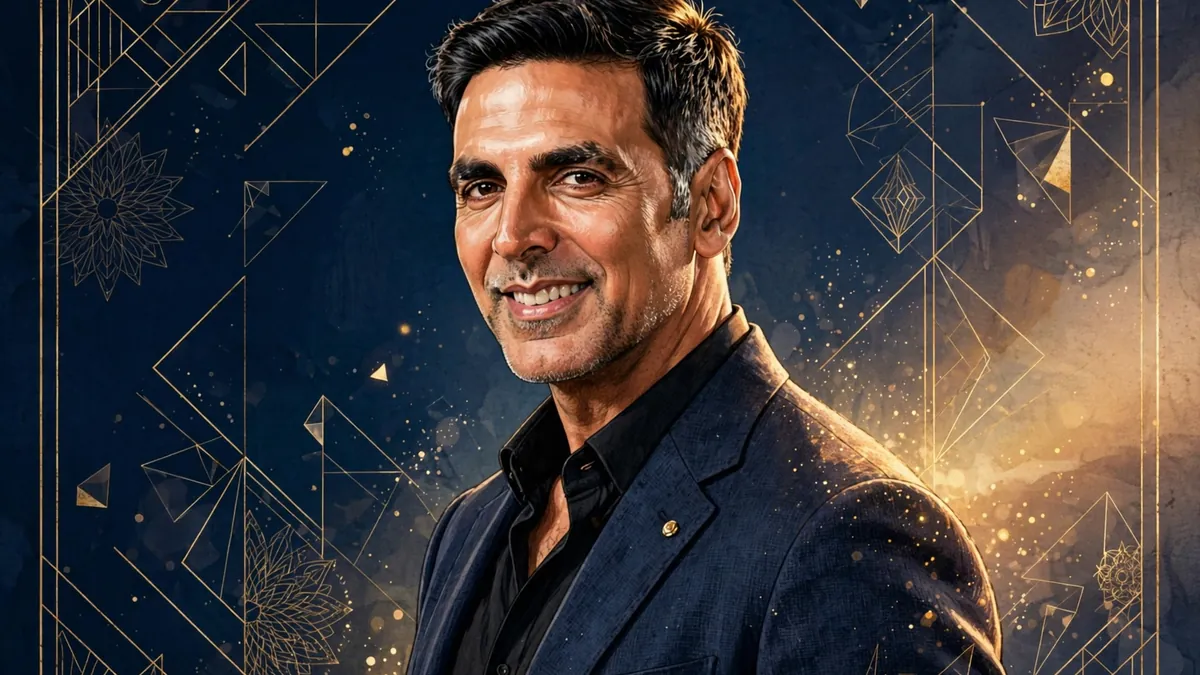
Early Life and Family
Akshay Kumar was born Rajiv Hari Om Bhatia on 9 September 1967. The exact birthplace is one of the small details on which the record differs: Britannica and BookMyShow place his birth in Amritsar, Punjab, while Wikipedia lists Delhi. What every account agrees on is the childhood that followed. He grew up in Chandni Chowk, in Old Delhi, in a Punjabi Hindu family. His father, Hari Om Bhatia, was an army man who later became an accountant; his mother, Aruna Bhatia, kept the home. His father came from Amritsar and his mother had roots in Kashmir. He has a younger sister, Alka Bhatia.
The Chandni Chowk years shaped the work ethic that later became his calling card. Kumar has often described a disciplined, early-rising household and a childhood spent in crowded lanes where sport and physical training were daily habits rather than hobbies. He studied at Don Bosco School in Delhi and later at Guru Nanak Khalsa College in Mumbai, but formal education never held him the way physical training did. By his late teens he was drawn to martial arts with a seriousness that would decide the whole direction of his life.
There was nothing in that background that pointed toward the movies. His family had no film connections, no money to buy a way in, and no map for how a boy from Chandni Chowk becomes a movie star. The route he took instead — Bangkok, kitchens, martial-arts classes, modelling — reads like a string of accidents. Put together, it was the training ground for the screen persona that would make him famous: a man who did his own stunts because he had spent years learning how bodies move.
Bangkok Years: Martial Arts, Kitchens and the Road to Mumbai
As a young man, Kumar travelled to Bangkok to train in Muay Thai. The trip was not a holiday. He worked as a chef and waiter in Bangkok restaurants to pay his way while he trained, a stretch of life he still talks about when interviewers ask where his discipline comes from. The kitchen work taught him timing, stamina and how to take orders without complaint; the martial arts training gave him the physical vocabulary — kicks, falls, balance, control — that later let him perform action scenes other stars handed to stunt doubles.
Back in Mumbai, he turned the training into a living by teaching martial arts. His students included young people from film families, and it was through one of those connections that modelling work came his way. A portfolio shoot led to modelling assignments, and modelling led to the edge of the film industry. His first screen appearance was a tiny, uncredited part in the 1987 film Aaj. It paid almost nothing and proved nothing — except that he wanted more of it.
The first paycheque story has become part of his own telling of the journey. According to Asianet Newsable’s September 2026 birthday reporting, his first paycheque was ₹5,000. It is a small number that matters because of the distance it measures: from ₹5,000 to a reported fortune in the hundreds of millions of dollars, earned across 35 years without a family name to open doors.
The long game: Kumar’s career is unusual in Bollywood for its sheer volume. He has appeared in more than 150 films, and as of April 2026 he held the record for the most films to cross ₹100 crore net in India — 20 of them, per Sacnilk. Volume was always part of the business model: more films a year than any peer, each one adding a fee, and a reputation for finishing on schedule that kept producers coming back.
Breakthrough: Saugandh, Khiladi and the Action Star Years
The leading-man break came with Saugandh in 1991, opposite Raakhee and Shantipriya. The film did not set the box office alight, but it put Kumar in front of audiences as a hero rather than a background fighter. A year later came the film that named him for life: Khiladi (1992), an action thriller in which his martial-arts training was the whole selling point. The film worked, the nickname stuck, and producers spent the next several years putting the word “Khiladi” into titles — eight films in total carried it, from Main Khiladi Tu Anari (1994) to Khiladiyon Ka Khiladi (1996).
Through the 1990s, Kumar built his name almost entirely on action. Mohra (1994), Suhaag (1994), Sabse Bada Khiladi (1995) and Angaaray (1998) kept him in the top tier of action stars, and his willingness to do his own stunts gave the films a physical charge that audiences could feel. The trade press of the time noted something else too: he was reliable. He turned up, finished on time, and worked across several films at once — a habit that would later let him release three or four films in a single year while his peers managed one.
There were limits to the action-only image, though. By the late 1990s, the Khiladi tag had become a box as much as a brand. Romantic leads and comic parts went to other actors, and Kumar’s films began to repeat themselves. The reinvention that followed — into comedy — is the first of two great pivots in his career, and it is the one that turned a fading action star into one of the most bankable names in Indian cinema.
Reinvention: Comedy, Romance and the Hera Pheri Turn
The turn began with Hera Pheri in 2000, a comedy in which Kumar played Raju, a fast-talking schemer, opposite Paresh Rawal and Suniel Shetty. The film was a hit, and it showed audiences a Kumar they had not seen: funny, loose, and quick with a line. Mujhse Shaadi Karogi (2004), with Salman Khan and Priyanka Chopra, and Garam Masala (2005) confirmed the range, and Bhool Bhulaiyaa (2007), Welcome (2007) and Singh Is Kinng (2008) made him one of the biggest comedy draws in the country. The Filmfare Award for Best Comedian for Garam Masala put a formal stamp on the change.
Comedy also changed the economics of his career. Action films were expensive and slow; comedies were quicker to shoot, cheaper to make, and easier to repeat. Kumar settled into a rhythm of three to four releases a year — a pace no other star of his standing attempted — and the fees stacked up. The Housefull franchise, which began in 2010, became the commercial spine of this phase: broad ensemble comedies that reliably opened big and kept his name in front of audiences even when individual films underperformed.
Television added a second stage. In 2004 he presented the series Seven Deadly Arts with Akshay Kumar; in 2008 he became the original host of Fear Factor: Khatron Ke Khiladi, a stunt reality show that borrowed his screen title and fit him perfectly; and in 2010 he hosted MasterChef India. The TV work paid well and kept him visible to audiences who did not go to the cinema every week — a useful hedge as the film business began to fragment.

The Second Peak: Patriotic Films and Social Dramas
The second pivot came in the mid-2010s, when Kumar began choosing films built around real events and social subjects. OMG – Oh My God! (2012), in which he played a modern Krishna taking on organised religion, showed he could carry an idea-driven film. Special 26 (2013), Baby (2015) and Airlift (2016) — the last a dramatisation of the evacuation of Indians from Kuwait during the 1990 invasion — established a new screen identity: the competent, patriotic professional who gets the job done.
Rustom (2016) brought the biggest acting honour of his career. Playing a naval officer on trial for murder, Kumar won the National Film Award for Best Actor at the 64th National Film Awards, announced in 2017. The win drew some debate from critics who questioned the choice, but it also settled any lingering argument that he was only an action star or a comic. He followed it with two self-produced social dramas — Toilet: Ek Prem Katha (2017), about sanitation in rural India, and Pad Man (2018), about menstrual hygiene — both of which made money and carried a message, a combination that suited his public image.
2019 was the commercial peak. Kesari, Mission Mangal, Housefull 4 and Good Newwz all released in the same calendar year, and by the trade’s count his films had crossed ₹3,000 crore in lifetime collections by 2016 — the first Bollywood actor to reach that mark, after being the first to cross ₹2,000 crore in 2013, according to Box Office India figures cited on Wikipedia. Sooryavanshi (2021) kept the run going after the pandemic. Then the wheel turned again, and the years that followed tested everything he had built.
The Money: Fees, Endorsements and Production
The clearest way to understand Kumar’s fortune is to break it into its three engines: acting fees, endorsements, and production. His per-film fee is reported in a wide bracket of ₹60–145 crore (about $7.2–17.5 million), per Instant Bollywood’s April 2025 report citing Forbes — a range that reflects how his deals actually work. On films he also produces, he often takes little or no upfront fee and instead takes a share of the profits, a structure India Today has reported and StarsUnfolded has cited. When the film works, the profit share pays far more than a flat fee; when it fails, he shares the loss. That structure explains both the size of the fortune and its exposure to the box office.
Forbes tracked the peak years closely. In 2015, the magazine ranked Kumar ninth on its first global list of the world’s highest-paid actors. For the window from June 2018 to June 2019, Forbes credited him with $65 million in earnings, making him the only Indian actor on its Celebrity 100 that year. In 2020, Forbes placed him sixth on its highest-paid actors list with $48.5 million. Those are annual earnings figures, not net worth, but they show the scale of the machine at its height — and they are the reason the big net-worth estimates cluster where they do. For a full breakdown of the fortune figure by figure, see our sister site’s look at Akshay Kumar’s net worth, which puts the 2026 estimate at $300–330 million.
Endorsements are the second engine. Kumar has fronted more than 30 brands across his career, from automobiles (Honda Motorcycles, Tata Motors) to real estate (Lodha) and online services (CarDekho), according to brand-tracking listings compiled in 2026. Endorsement income is steadier than film income: it does not depend on Friday box-office numbers, and it kept flowing during the lean years when his films were struggling. The third engine, production, is the one he owns outright, and it is where the long-term value sits.
| Source | Reported figure | Reporting date |
|---|---|---|
| Asianet Newsable (via Inshorts) | ₹2,500–2,700 crore ($300–330 million) | September 2026 |
| Filmibeat (citing Forbes) | ₹2,500 crore | September 2025 |
| TechnoSports | $300–325 million | September 2026 |
| Business Outreach | ₹2,300 crore | November 2026 |
| Alux (richest Bollywood actors list) | $240 million | November 2026 |
| JustRichest | $340 million | 2026 |
| StarsUnfolded (low outlier) | $131.77 million (₹980 crore) | Undated listing |
Peer comparison puts the figure in context. On the same 2026 rich lists, Shah Rukh Khan sits at the top of Bollywood wealth at more than $1 billion, while Kumar’s $300–330 million places him in the cluster just behind the Khans — ahead of most of his generation on consistency, if not on a single blockbuster payday. The honest reading of the table above is that the middle of the range, around $300 million, is where the freshest reporting converges; the $132 million figure looks stale, and the $340 million figure looks generous. Neither is audited. All of them are estimates, and this article says so wherever the number appears.
Business Ventures Beyond the Screen
Kumar founded his first production company, Hari Om Entertainment, in 2008 — named after his father — and it was later renamed Cape of Good Films. The banner has produced National Award-winning films including Rustom (2016) and Pad Man (2018), along with commercially successful titles such as Singh Is Kinng, Holiday, Baby, Airlift, Toilet: Ek Prem Katha, Mission Mangal, Kesari, Good Newwz and Sooryavanshi. Owning the banner means he keeps the producer’s share as well as the actor’s fee on his own films, and it gives him control over which stories get made.
In 2011 he launched a second production house, Grazing Goat Pictures, with former television executive Ashvini Yardi. Its first film was OMG – Oh My God!, and it went on to produce films including Fugly and the Marathi film 72 Miles. His wife Twinkle Khanna runs her own banner, Mrs Funnybones Movies, and the couple’s production interests overlap without merging — a practical arrangement for two people with strong opinions about scripts.
Beyond film, Kumar has built a portfolio of startup and brand bets. He invested in the California-based health platform GOQii in 2019, according to The Economic Times. In 2023 he partnered with Myntra to launch his clothing brand Force IX, per CNBC TV18, and joined the Good Glamm Group to launch a men’s personal-care range, later investing in the Pune agritech startup Two Brothers Organic Farms. He co-founded the fan-engagement platform SocialSwag in 2021 with actor Rana Daggubati, co-owns the Khalsa Warriors kabaddi team in the World Kabaddi League, and has invested in the Fashion Entrepreneurs Fund, a platform that funds and mentors young fashion founders. None of these bets is individually large enough to explain the fortune, but together they spread his income beyond the Friday box office — which is exactly what they are for.
Assets: Homes, Cars and Investments
Kumar’s best-known property is his sea-facing bungalow in Juhu, Mumbai, reported in Indian media at a value of around ₹80 crore. He also holds an apartment in Khar West and a Portuguese-style villa in Goa, according to property reporting from 2024. The Juhu home doubles as his base of operations: the Grazing Goat Pictures office is in Juhu, and his production work is run from the neighbourhood he has lived in for decades rather than from a distant corporate address.
His car collection is reported to include a Rolls-Royce Phantom and a Bentley among other luxury vehicles, and his garage has been a regular feature of lifestyle coverage of the star. Some outlets have attached much larger numbers to the collection, and at least one 2024 lifestyle piece claimed a private jet valued at ₹260 crore — a claim this article does not repeat as fact, because it rests on a single low-authority source and no corroboration. The pattern with Kumar’s assets is the same as with his net worth: the homes are well documented, the cars are widely reported, and the wilder numbers should be read with care.
The investment side of the portfolio is quieter and arguably more telling. The GOQii stake, the Force IX brand, the Good Glamm partnership and the agritech investment all point the same way: toward consumer brands and health and wellness, the areas where his public image — fitness, discipline, early mornings — is itself the marketing. It is a coherent strategy, and it is one reason the fortune has held up through years when the films did not.

Net Worth Growth Timeline
No year-by-year balance sheet exists for Kumar, and any table that pretends otherwise would be invention. What follows is a timeline of the dated, sourced milestones that explain how the fortune grew — fees, rankings and reporting dates, not guesses.
| Year | Milestone |
|---|---|
| 1991–1992 | Leading debut in Saugandh; breakthrough with Khiladi. First paycheque reported at ₹5,000. |
| 2000–2008 | Comedy reinvention (Hera Pheri, Garam Masala, Bhool Bhulaiyaa, Welcome, Singh Is Kinng); Hari Om Entertainment founded 2008. |
| 2009 | Padma Shri awarded by the Government of India. |
| 2013 | First Bollywood actor whose films crossed ₹2,000 crore in cumulative net collections (Box Office India). |
| 2015 | Ranked 9th on Forbes’ first global highest-paid actors list. |
| 2016 | Films cross ₹3,000 crore cumulative; National Film Award for Best Actor for Rustom announced 2017. |
| 2018–2019 | Forbes credits $65 million for June 2018–June 2019; 2019 delivers four major releases (Kesari, Mission Mangal, Housefull 4, Good Newwz). |
| 2020 | Forbes ranks him 6th among the world’s highest-paid actors at $48.5 million. |
| 2021 | Sooryavanshi releases; SocialSwag co-founded. |
| 2023 | Force IX clothing brand launches with Myntra; regains Indian citizenship on 15 August 2023. |
| 2025 | Filmibeat citing Forbes puts the fortune at ₹2,500 crore (September 2025). |
| 2026 | Asianet Newsable (September 2026) reports ₹2,500–2,700 crore; 20th film crosses ₹100 crore net in India (Sacnilk, April 2026). |
Personal Life: Twinkle Khanna, Children and Family
Kumar married Twinkle Khanna in January 2001. Twinkle, an actress turned bestselling author and interior designer, is the daughter of two of Hindi cinema’s biggest names — Rajesh Khanna and Dimple Kapadia — which made the marriage one of the most watched unions in Bollywood. The couple have two children: a son, Aarav, born in 2002, and a daughter, Nitara, born in 2012. Aarav has largely stayed out of the public eye, and Nitara’s childhood has been kept similarly private, a deliberate choice in a family that understands the cost of constant attention.
Before the marriage, Kumar’s personal life was tabloid regular material, with reported relationships in the 1990s that the press covered heavily. Since 2001, the public story has been a stable one: a working marriage between two strong-minded people who run separate professional lives and appear together on their own terms. Twinkle’s writing career — her columns and books under the Mrs Funnybones name — has its own large audience, and the couple’s production banners work in parallel rather than as one company.
The daily routine is part of the public image and, by all accounts, real. Kumar is known for early mornings, a 4 a.m. start, regular workouts, and a disciplined diet — habits that date back to the martial-arts years and that he credits for a career that has lasted into his late fifties in an industry that discards most leading men by fifty. The fitness image is also a business asset: it is the reason health and wellness brands want him, and the reason the GOQii and Force IX bets fit his name.
Citizenship and Public Image
For more than a decade, Kumar’s citizenship was the most argued-about fact in his biography. He held Canadian citizenship from 2011 to 2023, a status that drew repeated criticism in India — particularly when he skipped voting in Indian elections or when his patriotic screen roles were set against a foreign passport. Kumar has said he took Canadian citizenship at a point when his career was struggling and he was considering a move, and that the decision was practical rather than political. On 15 August 2023, he announced that he had renounced Canadian citizenship and become an Indian citizen again, posting the news on Independence Day.
The episode says something about how Kumar is judged that goes beyond the usual celebrity gossip. Because so many of his biggest films — Airlift, Rustom, Kesari, Mission Mangal — are built on Indian pride and national service, audiences hold him to a standard his peers escape. The citizenship question followed him into interviews for years, and the 2023 announcement closed it in the most public way available to him. Whether it ends the argument entirely is another matter; in India, few celebrity stories ever truly close.
Controversies and Setbacks
The hardest stretch of Kumar’s career ran from 2022 into 2024, when a run of films failed at the box office one after another: Bachchhan Paandey, Samrat Prithviraj, Raksha Bandhan, Selfiee, Mission Raniganj, Bade Miyan Chote Miyan, Sarfira and Khel Khel Mein. Trade coverage counted the flops in double figures, and some reports in 2026 put the consecutive flop count at 14 across 2022–2024. The volume strategy that had built the fortune suddenly worked against him: four releases a year meant four chances to disappoint, and the profit-share deals that paid so well in good years meant he shared the losses in bad ones.
The most damaging single episode of that period had nothing to do with a film. In 2022, Kumar appeared in an advertisement for Vimal Elaichi, a pan masala brand, alongside Ajay Devgn and Shah Rukh Khan. The backlash was swift — Kumar had built a public image around health and discipline, and promoting a tobacco-adjacent product sat badly with it. He apologised publicly, said he would step away from the endorsement, and said the fee would go to a charitable cause. The apology was widely reported and largely accepted, but the episode is still raised whenever his brand choices are discussed, because it showed the gap between an image and a paycheque.
Two older controversies still surface in profiles. The first is the National Film Award for Rustom, which some critics and rival camps questioned at the time, arguing that other performances that year were stronger — a debate that says more about how awards are argued over in India than about the performance itself. The second is the citizenship question, covered above. Neither has left a lasting mark on his standing with audiences, which is the more useful measure: after the flop run, the 2025 films brought him back, and the record shows that audiences were willing to return.
One more honest note belongs here. Kumar’s pace — the four-films-a-year habit — has always had critics inside the industry who say it spreads him thin and leaves films under-rehearsed. There is truth in the charge some of the time: the 2022–2024 run included films that looked rushed. But the same pace produced the 2019 peak and the 2025 recovery, and it is the reason his lifetime box-office totals dwarf those of stars with far fewer films. The trade-off is the career.
Philanthropy and Public Work
Kumar’s best-known charitable act came in March 2020, when he donated ₹25 crore to the PM CARES Fund at the start of the COVID-19 pandemic — one of the largest single donations by any Indian film personality at the time, and widely reported across Indian media. He followed it with further donations to Mumbai’s municipal COVID efforts and to film workers hit by the shutdown. The gesture mattered partly because of the size and partly because of the timing: it came early, when the scale of the crisis was still sinking in, and it set a public example other stars followed.
His longer-running project is Bharat Ke Veer, an initiative he helped launch to raise money for the families of soldiers killed in the line of duty. The programme lets the public donate directly to bereaved families, and Kumar has promoted it consistently rather than as a one-off gesture. He has also donated to flood relief in Assam and to the families of police personnel, and he has supported martial-arts training for women as a self-defence measure — a cause that connects directly to his own training.
The philanthropy fits the same pattern as the film choices: patriotic, practical, and aimed at institutions (soldiers, police, disaster relief) rather than at glamour causes. It is also, plainly, good for the public image that underwrites the endorsements. Both things can be true at once, and the amounts — ₹25 crore to PM CARES is a matter of public record — are large enough that the motive question is secondary to the result.
Recent Work and the 2025 Comeback
After the lean years, 2025 brought a genuine recovery. Sky Force, released in January 2025 and based on India’s first airstrike during the 1965 war, took ₹113.6 crore net in India per Sacnilk. Kesari Chapter 2, in which Kumar played advocate C. Sankaran Nair against the backdrop of the Jallianwala Bagh massacre, earned strong reviews even though its high budget kept it from being fully profitable. Housefull 5, released in two versions with different climaxes, took ₹183.4 crore net in India. Jolly LLB 3, the courtroom comedy-drama with Arshad Warsi, added ₹117.5 crore. Trade writers noted that the last two films of the year performed decently and that the year marked a resurgence after the flop run — though some also pointed out that corporate bookings and high budgets muddied the picture on Sky Force in particular.
The recovery continued into 2026. Bhooth Bangla, his reunion with director Priyadarshan, took ₹113.4 crore net in India and passed ₹200 crore worldwide — his first film to do so since Sooryavanshi in 2021, according to Boxoffy. With it, he reached 20 films past ₹100 crore net in India, a record for an Indian actor, ahead of Salman Khan‘s 18, per Sacnilk’s April 2026 count. Welcome to the Jungle and Haiwaan followed in 2026, and he took on hosting duties for the Indian version of Wheel of Fortune. On the slate ahead are Hera Pheri 3, a project audiences have waited years for, and Kesari Chapter 3, in which he is set to play Hari Singh Nalwa.
The comeback is real but incomplete, and the honest version of the story says so. The 2025 films performed decently rather than spectacularly; two of the year’s first releases were not profitable despite good reviews, because their budgets were high. What changed was the direction of travel: after three years of decline, the numbers pointed up again, and the 2026 releases confirmed it. At 59, Kumar is working at a pace and with a hit rate that most of his contemporaries stopped attempting a decade ago.
Awards and Honours
| Year | Honour |
|---|---|
| 2002 | Filmfare Award for Best Villain — Ajnabee |
| 2004 | Rajiv Gandhi Award for contribution to Bollywood |
| 2006 | Filmfare Award for Best Comedian — Garam Masala |
| 2008 | Honorary Doctorate of Law, University of Windsor |
| 2009 | Padma Shri — Government of India, fourth-highest civilian honour |
| 2017 | National Film Award for Best Actor — Rustom (64th National Film Awards) |
| 2019 | Forbes Celebrity 100 — only Indian actor on the list ($65 million, June 2018–June 2019) |
Wikipedia credits him with two National Film Awards and two Filmfare Awards in total, alongside the Padma Shri. The Filmfare wins — Best Villain for Ajnabee and Best Comedian for Garam Masala — are worth noting together, because they capture the range in miniature: the same actor, honoured for menace and for comedy within four years of each other. Few stars in Hindi cinema have been formally recognised at both ends of that spectrum.
Frequently Asked Questions
What is Akshay Kumar’s real name?
Akshay Kumar was born Rajiv Hari Om Bhatia on 9 September 1967. He took the screen name Akshay Kumar when he entered films, and his full professional name is now given as Akshay Hari Om Bhatia — Hari Om was his father’s name.
How old is Akshay Kumar in 2026?
Akshay Kumar is 59 years old as of November 2026. He was born on 9 September 1967, so he turned 59 in September 2026.
How many movies has Akshay Kumar done?
Akshay Kumar has appeared in more than 150 films across a career that began with Saugandh in 1991. As of April 2026, 20 of his films had crossed ₹100 crore net in India — a record for an Indian actor, according to Sacnilk.
What is Akshay Kumar’s net worth in 2026?
Akshay Kumar’s net worth in 2026 is estimated at $300–330 million (roughly ₹2,500–2,700 crore), anchored on September 2026 reporting from Asianet Newsable and September 2025 reporting from Filmibeat citing Forbes. Published estimates vary widely, from about $132 million (StarsUnfolded) to $340 million (JustRichest), because no audited figures exist — so the range, not a single number, is the honest answer.
Who is Akshay Kumar married to?
Akshay Kumar has been married to Twinkle Khanna since January 2001. Twinkle is an actress turned bestselling author and interior designer, and the daughter of actors Rajesh Khanna and Dimple Kapadia. The couple have two children, Aarav and Nitara.
Why is Akshay Kumar called Khiladi Kumar?
The nickname comes from Khiladi (1992), the action thriller that made him a star. Eight films in his career carried the word “Khiladi” in the title, and his martial-arts training — including Muay Thai learned in Bangkok — let him perform his own stunts, which fixed the “Khiladi” (player/daredevil) image in the public mind.
Which awards has Akshay Kumar won?
His major honours include the Padma Shri in 2009, the National Film Award for Best Actor for Rustom (announced at the 64th National Film Awards in 2017), and two Filmfare Awards — Best Villain for Ajnabee and Best Comedian for Garam Masala. He also received an honorary doctorate from the University of Windsor in 2008.
What are Akshay Kumar’s latest movies in 2025 and 2026?
In 2025 he released Sky Force, Kesari Chapter 2, Housefull 5 and Jolly LLB 3, plus a role as Shiva in the Telugu film Kannappa. In 2026 he starred in Bhooth Bangla, Welcome to the Jungle and Haiwaan, and hosted the Indian version of Wheel of Fortune. Hera Pheri 3 and Kesari Chapter 3 are among his upcoming projects.
Final Thoughts: The Bottom Line
Akshay Kumar’s biography is the story of a career built on volume, discipline and reinvention — twice. The action star of the 1990s became the comic lead of the 2000s, then the patriotic everyman of the late 2010s, and each change arrived just as the previous identity was wearing thin. The fortune, estimated at $300–330 million in 2026, was built the same way the career was: not on one giant payday but on three decades of fees, a production house he owns, more than 30 endorsements, and business bets that spread the risk beyond the box office.
The 2022–2024 flop run showed the limits of the model, and the 2025–2026 recovery showed its strength. At 59, with 20 films past ₹100 crore and a slate that still includes the franchises audiences ask for by name, Kumar remains what he has been since 1992: the hardest-working star in Hindi cinema, and the one whose career is hardest to write off. Readers who want more stories from this era of Bollywood will find them in our Biography section, where the lives of his peers and co-stars are covered in the same detail.
Sources and Reporting
How we estimated: Akshay Kumar has never disclosed his finances publicly, so every net-worth figure in this article is an estimate drawn from published reporting, not from audited records. We anchor on the freshest sources — Asianet Newsable (September 2026, ₹2,500–2,700 crore) and Filmibeat citing Forbes (September 2025, ₹2,500 crore) — and we show the full spread of published estimates, from StarsUnfolded’s $132 million to JustRichest’s $340 million, so readers can see where the number is solid and where it is not. Fee figures come from Instant Bollywood’s April 2025 report citing Forbes; Forbes annual-earnings figures come from the magazine’s own published rankings. Where sources disagree — the birthplace, the exact fortune, the private-jet claim — we say so and name the source on each side.
Key sources consulted for this profile: Wikipedia, Britannica, Forbes, Filmibeat, Bollywood Hungama, Sacnilk, BookMyShow, CNBC TV18, The Economic Times, Alux and Business Outreach. Figures reflect reporting available through November 2026; box-office numbers are India net collections unless stated otherwise, and currency conversions use approximate prevailing rates.