By Celebamerica Editorial Staff | Last updated: November 7, 2026
Aaron Rodgers is a four-time NFL MVP, a Super Bowl champion, and one of the most gifted quarterbacks ever to play the position — and in 2026, he is writing the last chapter of that story himself. The Pittsburgh Steelers quarterback, born December 2, 1983, in Chico, California, signed a one-year deal in May 2026 and told reporters plainly that this season would be his final one in the NFL. After 22 seasons, three franchises, and roughly 395 million dollars in on-field pay, the ending is now on his terms.
His estimated net worth sits at 250 million dollars, according to Celebrity Net Worth, in an estimate updated in August 2026. Older figures near 200 million dollars still circulate online, but that older number predates the site’s latest update, and the 250 million dollar figure is the one tied to a named source and a date. This biography traces the full arc: the overlooked kid from Chico who was not heavily recruited out of high school, the draft-night slide, the long wait behind Brett Favre, the Super Bowl run, the four MVP seasons, the Jets detour, the Pittsburgh farewell, and the family reunion that arrived in the same year as his goodbye.
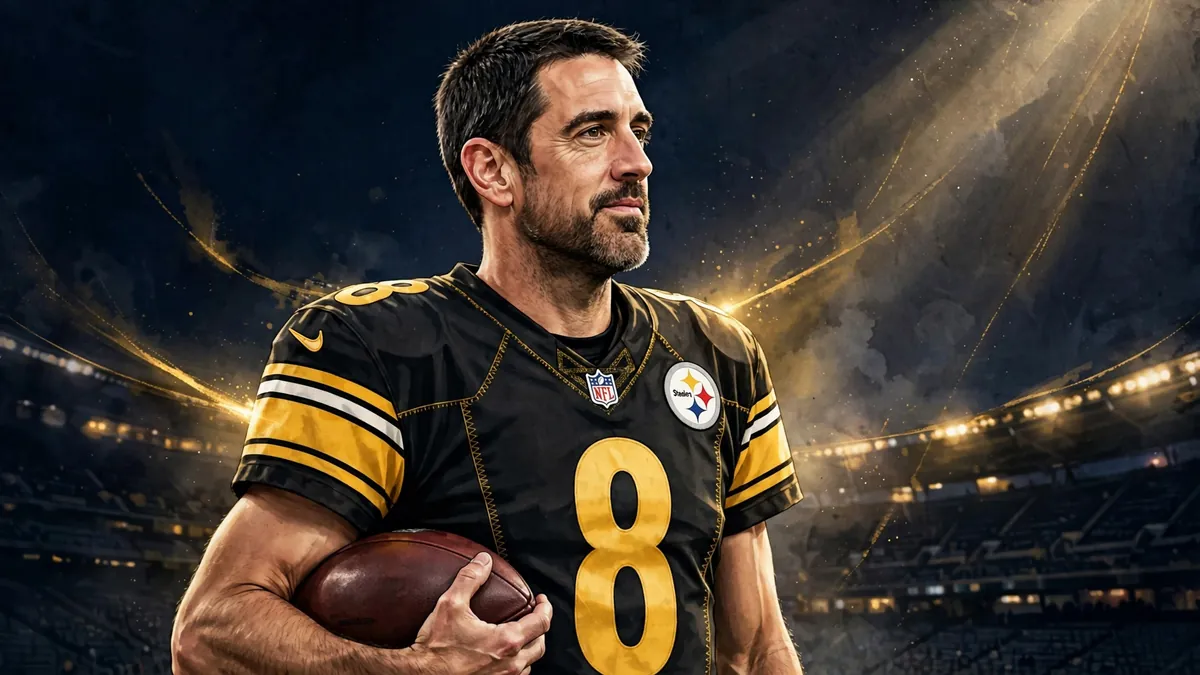
Quick Facts: Aaron Rodgers at a Glance
| Full Name | Aaron Charles Rodgers |
|---|---|
| Date of Birth | December 2, 1983 (age 42; turns 43 in December 2026) |
| Birthplace | Chico, California, United States |
| Height / Weight | 6 ft 2 in (1.88 m) / 225 lb (102 kg) |
| Position / Number | Quarterback / No. 8 (Pittsburgh Steelers); No. 12 in Green Bay |
| Estimated Net Worth | 250 million dollars (Celebrity Net Worth, August 2026); published estimates range from 200 million to 250 million dollars |
| Career NFL Earnings | About 394.8 million dollars through the 2025 season (Celebrity Net Worth / Spotrac); projected to reach roughly 417.3 million dollars with the 2026 Steelers deal |
| Teams | Green Bay Packers (2005–2022), New York Jets (2023–2024), Pittsburgh Steelers (2025–present) |
| College | Butte College (2002), University of California, Berkeley (2003–2004) |
| Draft | 2005 NFL Draft, 1st round, 24th overall (Green Bay Packers) |
| Major Honours | Super Bowl XLV champion and MVP; 4× NFL MVP (2011, 2014, 2020, 2021); 10× Pro Bowl; 4× First-team All-Pro |
| Spouse | Brittani (married June 2025; her identity is kept private) |
| Current Status | Active with the Pittsburgh Steelers; 2026 announced as his final NFL season |
Table of Contents
- Quick Facts: Aaron Rodgers at a Glance
- Early Life in Chico: The Overlooked Kid from Northern California
- Butte College to Cal: The Long Way to the Draft
- The 2005 Draft Slide and Three Years Behind Brett Favre
- Becoming the Packers Starter: 2008 to the Super Bowl
- Super Bowl XLV: The Night That Defined Him
- Four MVP Awards and the Peak Years in Green Bay
- The Jets Years: A Trade, Four Snaps, and a Torn Achilles
- Pittsburgh: The 2025 Arrival and the 2026 Farewell
- The Money: Contracts, Career Earnings, and Endorsements
- Beyond Football: RX3 Ventures and the Bucks Stake
- Real Estate: Selling Three Homes Before the Final Season
- Personal Life: Marriage to Brittani and a Family Reunion
- Controversies and Public Flashpoints
- Career Numbers and Where He Ranks All Time
- Aaron Rodgers Biography: Frequently Asked Questions
- Final Thoughts: The Last Chapter of a Complicated Great
- Sources and Reporting
Early Life in Chico: The Overlooked Kid from Northern California
Aaron Charles Rodgers was born on December 2, 1983, in Chico, California, the son of Darla Leigh (née Pittman) and Edward Wesley Rodgers. His father, a Texas-born chiropractor, played football as an offensive lineman for the Chico State Wildcats from 1973 to 1976. Rodgers is of English, Irish, and German ancestry. He grew up in Chico with two brothers: Luke, the eldest, and Jordan, the youngest. Football was part of the household from the start, but nothing about his early years suggested a future first-round pick. He was small for his age group, and the recruiting attention that follows most future NFL quarterbacks simply never came.
At Pleasant Valley High School in Chico, Rodgers started at quarterback for two years and threw for 4,421 passing yards. The numbers were strong, yet college programs passed him by. His grades were good — he finished high school with a strong academic record — but his frame, at around 5 ft 10 in and 165 pounds as a teenager, made scouts doubt whether he could hold up at the next level. The story has been told so often since that it risks sounding like a fable, but the facts are plain: the quarterback who would go on to win four MVP awards could not get a single Division I scholarship offer out of high school.
That rejection shaped him. Rodgers has spoken over the years about carrying a chip on his shoulder, and the chip was forged in Chico. Instead of a scholarship, he took the only route open to him: junior college, close to home, with a plan to prove himself all over again. The patience that defined his first three years in the NFL — sitting, watching, waiting — was first learned here, when the football world told him he was not quite enough and he decided to answer on the field rather than in an argument.
Butte College to Cal: The Long Way to the Draft
Rodgers enrolled at Butte College, a community college in nearby Oroville, for the 2002 season. One year was all it took. He threw for 2,466 yards and 19 touchdowns as a freshman, and suddenly the programs that had ignored him were paying attention. The University of California, Berkeley offered him a scholarship, and he transferred in 2003.
At Cal, Rodgers took over as the starter and set school records for the lowest single-season and career interception rates — a mark of the accuracy and decision-making that would become his signature in the pros. In 2004, his second season with the Golden Bears, he led Cal to a 10-2 record and a No. 9 finish in the national rankings, the program’s best season in years. The year ended with a loss to Texas Tech in the Holiday Bowl, but Rodgers had done enough: in two seasons at Berkeley he had gone from junior-college afterthought to a quarterback scouts were discussing as a possible No. 1 overall pick.
He gave up his senior year and declared for the 2005 NFL Draft. The decision was a gamble, but it was the right one — even if draft night itself would not go the way anyone expected.
The 2005 Draft Slide and Three Years Behind Brett Favre
Going into the 2005 draft, Rodgers was widely seen as one of the two best quarterbacks available, alongside Utah’s Alex Smith. The San Francisco 49ers held the first pick, and for weeks the debate was Smith versus Rodgers. San Francisco chose Smith. Then Rodgers waited. And waited. Pick after pick went by — 23 of them — while the cameras stayed fixed on his face in the green room. The Green Bay Packers finally ended the slide at No. 24.
The fall cost him money. A top-five pick in the pre-rookie-wage-scale era would have signed for far more than the five-year, 7.7 million dollar rookie deal he inked with Green Bay. But it also landed him in the best possible place to learn. The Packers had Brett Favre, a living legend, and Rodgers spent his first three seasons as Favre’s backup, throwing just 59 passes in that entire span.
Those three years were a slow education. Rodgers rebuilt his throwing mechanics, studied film, and waited for a job that might never open. When Favre announced his retirement in March 2008 — then returned, then was traded to the New York Jets — Rodgers finally got his chance. He became the Packers’ starting quarterback in 2008, eight years after high school recruiters had decided he was not worth a scholarship.
Becoming the Packers Starter: 2008 to the Super Bowl
Rodgers’ first season as a starter answered every doubt. He threw for more than 4,000 yards and 28 touchdowns, and he became the first quarterback in NFL history to throw for 4,000 yards in each of his first two seasons as a starter. The Packers missed the playoffs in 2008 at 6-10, but the quarterback question — the one that had hung over Green Bay since Favre’s departure — was settled.
The team improved fast. In 2009, Green Bay went 11-5 and Rodgers made his first Pro Bowl. The 2010 season brought the run that defines his career. The Packers entered the playoffs as a wild card, won three straight road games, and reached Super Bowl XLV against the Pittsburgh Steelers — the same franchise Rodgers would join fifteen years later, in the final act of his career.

Super Bowl XLV: The Night That Defined Him
Super Bowl XLV, played on February 6, 2011, at Cowboys Stadium in Arlington, Texas, was Rodgers’ arrival as a great rather than merely a good quarterback. Facing the Steelers’ feared defense, he completed 24 of 39 passes for 304 yards and three touchdowns, with no interceptions, in a 31-25 Green Bay win. He was named the game’s Most Valuable Player.
The performance mattered for more than the ring. Rodgers had spent three years in Favre’s shadow and three more proving he belonged. The Super Bowl MVP award closed that argument for good. He was 27 years old, a champion, and the face of one of the league’s proudest franchises. What followed was the most productive stretch of quarterback play the league had seen in years.
Four MVP Awards and the Peak Years in Green Bay
Rodgers won the first of his four NFL Most Valuable Player awards in 2011, the season after the Super Bowl. Green Bay went 15-1, and Rodgers threw 45 touchdowns against just six interceptions, posting a 122.5 passer rating — the highest single-season mark in league history at the time. He was named Associated Press Athlete of the Year and won the Bert Bell Award the same season.
The second MVP came in 2014, after a season in which he threw 38 touchdowns and five interceptions while leading the Packers to the NFC Championship Game. The third and fourth arrived back to back, in 2020 and 2021, when Rodgers threw 48 touchdowns against five interceptions in 2020 and followed it with 37 touchdowns and four interceptions in 2021. Only Peyton Manning, with five, has won more MVP awards than Rodgers’ four.
The peak years also brought the records that fill his résumé: four First-team All-Pro selections, ten Pro Bowl nods, and season after season of interception rates so low they looked like misprints. He set the standard for protecting the football. Across his Green Bay tenure he became the fastest quarterback to reach 300 career touchdown passes, and his career passer rating remains among the best in NFL history.
Yet the second Super Bowl never came. Green Bay reached the NFC Championship Game five times with Rodgers and lost four of them, including a painful overtime defeat at home to Tampa Bay in January 2021 and a loss to San Francisco the following year. The gap between his regular-season brilliance and the team’s postseason record became the central tension of his Packers years — and, eventually, one of the reasons the relationship between quarterback and franchise frayed.
The Jets Years: A Trade, Four Snaps, and a Torn Achilles
By early 2023, the relationship between Rodgers and the Packers had run its course. In April 2023, Green Bay traded him to the New York Jets, ending an 18-season run with the franchise. Rodgers reworked his contract on arrival, agreeing to a three-year, 112.5 million dollar deal with 75 million dollars guaranteed — a restructure that involved giving back roughly 35 million dollars from the guarantees left on his Green Bay deal, a rare concession designed to give the Jets room to build around him.
The Jets era lasted four snaps. On September 11, 2023, in his debut against the Buffalo Bills, Rodgers tore his left Achilles tendon and was lost for the season. The injury, at age 39, raised the obvious question of whether his career was over. He returned for the 2024 season and played all 17 games, but the Jets went 5-12, and the new regime released him after the season. Two years in New York produced one of the strangest footnotes in modern NFL history: a blockbuster trade, a franchise-altering injury, and a quiet exit.
What the Jets years did not do was end his career. Rodgers left New York with his health restored and his competitive appetite intact, and he spent the spring of 2025 weighing whether to play on — and, if so, where.
Pittsburgh: The 2025 Arrival and the 2026 Farewell
In June 2025, Rodgers signed a one-year deal with the Pittsburgh Steelers worth 13.65 million dollars, with 10 million dollars guaranteed and incentives that could lift it to 19.5 million dollars. It was, by his standards, a modest contract — a fraction of the 150.8 million dollar extension he had signed in Green Bay in 2022 — but it was the right fit: a stable franchise, a strong defense, and head coach Mike Tomlin.
The 2025 season worked. Rodgers went 10-6 as a starter, led the Steelers to a 10-7 record and the AFC North title, and took Pittsburgh to a wild-card playoff berth. At 42, he was no longer the quarterback who threw 48 touchdowns in a season, but he was still precise, still careful with the ball, and still capable of winning games late.
The farewell came together in the spring of 2026. Tomlin stepped away after the season, and Pittsburgh hired Mike McCarthy — Rodgers’ head coach for 13 seasons in Green Bay — as his replacement. The reunion tipped the balance. In May 2026, Rodgers signed another one-year contract with the Steelers, this time worth up to 25 million dollars, with a base salary reported between 22 and 22.5 million dollars. Two days later, he confirmed what everyone suspected: the 2026 season would be his last. “This is it,” he told reporters. At training camp, asked whether he might reconsider, he said there was “zero debate” that 2026 would be his final year.
Through seven games of the 2026 season, the farewell tour had gone well. Rodgers had thrown for 1,699 yards with 13 touchdowns and five interceptions, and the Steelers sat at 5-2 after a 16-10 win over the New Orleans Saints in Paris. Along the way he threw his 540th regular-season touchdown pass, moving past Peyton Manning on the all-time list. Some former players have predicted he will change his mind — Chad Johnson said publicly in late October 2026 that Rodgers would be back in 2027 — but Rodgers himself has not wavered in public. He turns 43 on December 2, 2026, and if he holds to his word, his 22nd season will also be his last.
The Money: Contracts, Career Earnings, and Endorsements
Rodgers’ fortune is one of the best-documented in football, because almost all of it came from contracts that are public record. Celebrity Net Worth puts his net worth at 250 million dollars as of August 2026, while noting that his NFL pay alone came to about 394.8 million dollars through the 2025 season. The gap between those two numbers is the difference between gross pay and wealth kept: taxes, agent fees, and spending take a large share of any athlete’s earnings, and Rodgers’ endorsements and investments had to add substantially to what remained for the 250 million dollar estimate to hold. A separate model published by Net Worth Radar in October 2026 landed at 235 million dollars, inside a range of 203.4 million to 265.8 million dollars — a useful reminder that no published figure is an audited balance sheet.
His contract history tells the story of the modern quarterback market. The rookie deal in 2005 was five years and 7.7 million dollars. The first extension, signed in October 2008 midway through his first season as a starter, was six years and 63.5 million dollars. A five-year, 110 million dollar extension followed in April 2013 and made him the league’s highest-paid player at the time. The four-year, 134 million dollar extension in 2018 reset the market again, and the March 2022 restructure was worth nearly 151 million dollars over three years. The Jets deal in 2023 was three years and 112.5 million dollars, with 75 million dollars guaranteed. Then came the two short Pittsburgh deals: 13.65 million dollars for 2025 and up to 25 million dollars for 2026.
Added up, his career on-field earnings come to about 394.8 million dollars through 2025, according to Celebrity Net Worth, or 395.8 million dollars according to Over The Cap. With the 2026 contract, the projected total reaches roughly 417.3 million dollars, which Celebrity Net Worth notes would make him the second-highest-paid player in NFL history by career salary, behind Matthew Stafford. For a fuller look at the numbers behind the headline figure, see this detailed Aaron Rodgers net worth breakdown, which tracks the contracts and the estimate side by side.
Off the field, Rodgers was one of the league’s most marketable players for more than a decade. His State Farm partnership, built around the “Discount Double Check” commercials, ran from 2011 until after the 2022 season and was worth about 3 million dollars a year, or roughly 36 million dollars in total, according to Celebrity Net Worth. He also held deals with Adidas, TaylorMade, Zenith watches — he became a Zenith ambassador in 2021 — Pizza Hut, Sharpie, IZOD, and Fanatics. Forbes reported that he was the 18th highest-paid athlete in the world in 2024, with an 80.8 million dollar haul that included 9 million dollars in endorsements. By 2026, the endorsement portfolio had thinned considerably from its peak, as his focus narrowed to the final seasons of his playing career.
| Contract | Team / Year | Value |
|---|---|---|
| Rookie deal | Packers, 2005 | 5 years, 7.7 million dollars |
| First extension | Packers, 2008 | 6 years, 63.5 million dollars |
| Second extension | Packers, 2013 | 5 years, 110 million dollars |
| Third extension | Packers, 2018 | 4 years, 134 million dollars |
| Restructure | Packers, 2022 | About 150.8 million dollars over 3 years |
| Jets deal | Jets, 2023 | 3 years, 112.5 million dollars (75 million guaranteed) |
| Steelers deal | Steelers, 2025 | 1 year, 13.65 million dollars (10 million guaranteed) |
| Steelers deal | Steelers, 2026 | 1 year, up to 25 million dollars (base 22 to 22.5 million) |
| Career on-field pay | Through 2025 | About 394.8 million dollars (projected 417.3 million with 2026) |
Beyond Football: RX3 Ventures and the Bucks Stake
Rodgers’ most serious business move came off the field. He co-founded RX3 Ventures, a consumer-focused private equity firm, with Nate Raabe and Byron Roth. The fund has backed brands including Therabody, Manscaped, and Hydrow, and it gave Rodgers a second career path that most athletes never build: a seat on the investment side of the table rather than just the endorsement side.
He also became, in 2018, the only active NFL player with an ownership stake in an NBA team, buying roughly one percent of the Milwaukee Bucks. The stake was small, but the signal was large: Rodgers was thinking about his money as an owner, not just an earner. The Bucks went on to win the NBA championship in 2021, and while a one-percent stake is not a fortune-maker on its own, it put Rodgers in rooms that most players never enter.
Television gave him another outlet. He won Celebrity Jeopardy! in 2015 and guest-hosted the show in 2021, a stint that briefly made him a candidate for the permanent job. The Jeopardy! appearances fit the public image he has cultivated for years: curious, well-read, and comfortable outside the narrow world of football.
Real Estate: Selling Three Homes Before the Final Season
As the 2026 season approached, Rodgers began selling off his property portfolio. In August 2026, he listed his oceanfront Malibu mansion for 39.5 million dollars. He had paid 28 million dollars for the compound in late 2019, while he was with the Packers and dating former racing driver Danica Patrick. The property sits on about 0.6 acres at 33360 Pacific Coast Highway, with a three-story, four-bedroom main house of 4,625 square feet and a separate two-bedroom guest house. A sale at full asking price would put him 11.5 million dollars, or about 41 percent, ahead of his purchase price — before renovation costs, taxes, and fees.
The Malibu listing was one of three. His New Jersey home, an eight-bedroom, 9,500-plus-square-foot modern mansion near Montclair that he bought for 9.5 million dollars in 2023 after the trade to the Jets, was listed in August 2026 for 15 million dollars. And his longtime Wisconsin estate in Hobart, about 20 minutes from Lambeau Field, which he bought for about 1.7 million dollars in March 2015, was listed in November 2025 for 3.7 million dollars. Combined, the three listings carry asking prices of 58.2 million dollars, according to Realtor.com. Asking prices are not sale prices, and years of taxes, insurance, maintenance, and renovations eat into any gain — but the sell-off is a clear sign of a man closing chapters. The property moves are one more piece of how Aaron Rodgers’ net worth was built over two decades at the top of the sport.

Personal Life: Marriage to Brittani and a Family Reunion
Rodgers has always guarded his private life, and 2025 and 2026 brought the two most personal developments of his public career. In June 2025, he revealed that he had married a woman named Brittani, after a private courtship. He was first spotted wearing a wedding ring at Steelers training camp that summer, and he confirmed the marriage in a press conference, saying it had happened “a couple months” earlier. Brittani’s identity has been kept out of the public eye, and Rodgers has not shared details about her. There are no publicly confirmed children. During the Steelers’ October 1, 2026, game broadcast, play-by-play announcer Al Michaels relayed a pregame conversation in which Rodgers said that a year from now he would be “either tending to my pregnant wife or taking care of my newborn” — a remark reported by NFL Network’s Mike Garafolo and Heavy, but not independently confirmed by Rodgers himself.
The second development was a family reconciliation years in the making. Rodgers had been estranged from his parents and brothers for the better part of a decade, a rift that became public in 2016 when Jordan appeared on The Bachelorette and said the brothers did not have much of a relationship. Rodgers skipped Jordan’s 2022 wedding to JoJo Fletcher in Mexico, and the distance looked permanent.
It was not. In July 2026, Rodgers posted photographs from a family bonding week with his parents and his brother Luke. In September, appearing on teammate Cam Heyward’s Not Just Football podcast, he confirmed the reconciliation in his own words: he had spent time with his parents in Chico, flown to Nashville to see Luke, and had a “tough conversation” with Jordan. “A year ago, even two years ago, five years ago for sure, I would have said, ‘Nah, I’m never going to reconcile,'” he said. “They’re back together. It’s amazing.” He credited his wife Brittani with helping him get there. On October 18, 2026, Luke shared photographs from the Steelers’ October 12 win over the Indianapolis Colts at Acrisure Stadium, showing Aaron with his parents, Luke, Luke’s wife Aimee, and their three children. Jordan was not in the photographs, though he liked the post — and Rodgers had already said the brothers had reconnected earlier in the year.
Controversies and Public Flashpoints
No honest biography of Rodgers skips the controversies, because they are part of why he is one of the most discussed athletes of his generation. The biggest came in November 2021, when he tested positive for COVID-19 after telling reporters in August that he had been “immunized.” It emerged that he was unvaccinated, and his explanations — delivered across a series of appearances on The Pat McAfee Show — drew sharp criticism from public-health officials and media outlets alike. The episode cost him standing with some sponsors; State Farm, his longest-running partner, scaled back his presence in its advertising, and the partnership ended after the 2022 season.
Other flashpoints followed the same pattern: Rodgers saying something unconventional in public, then defending it at length. He has spoken openly about using ayahuasca, the psychedelic plant brew, and about a darkness retreat he undertook in February 2023 — four days alone in a dark room in Oregon — while deciding his football future. His 2024 Netflix documentary series, Enigma, gave his own account of the family estrangement, the vaccine episode, and the Achilles injury. Supporters see a thoughtful independent thinker; critics see a star who enjoys the argument as much as the game. Either way, the controversies never dented his on-field standing: he won his third and fourth MVP awards in the two seasons after the vaccine episode, and he remains, by any statistical measure, one of the greatest quarterbacks ever to play.
Career Numbers and Where He Ranks All Time
At the end of the 2025 regular season, Rodgers had thrown for 66,274 career passing yards — the fifth most in NFL history — and 527 career touchdown passes, fourth on the all-time list, according to Britannica. His 540th touchdown pass in 2026 moved him past Peyton Manning. He owns four MVP awards, one Super Bowl ring, one Super Bowl MVP award, ten Pro Bowl selections, and four First-team All-Pro honours. His career passer rating and interception rate sit among the best the league has ever recorded.
The comparisons place him in rare company. Only Peyton Manning has more MVP awards. His touchdown total trails only Tom Brady, Drew Brees, and Peyton Manning. And his career earnings — projected at roughly 417.3 million dollars once the 2026 season is complete — would make him the second-highest-paid player in NFL history by on-field salary, behind Matthew Stafford. The one gap on the résumé is the second Super Bowl ring. Rodgers reached the NFC Championship Game five times with Green Bay and won it once. That is the honest shape of his career: a player of historic regular-season brilliance whose teams, more often than not, fell one game short of the sport’s biggest stage.
| Career Mark | Figure (as of late 2026) |
|---|---|
| Passing yards | 66,274 through the 2025 season (5th all-time); 1,699 more through seven games of 2026 |
| Touchdown passes | 527 through 2025 (4th all-time); 540th in 2026, passing Peyton Manning |
| NFL MVP awards | 4 (2011, 2014, 2020, 2021) — second only to Peyton Manning’s five |
| Super Bowls | 1 championship (XLV) and 1 Super Bowl MVP |
| Pro Bowls / All-Pro | 10 Pro Bowls; 4× First-team All-Pro |
| Career NFL earnings | About 394.8 million dollars through 2025; projected 417.3 million with the 2026 deal |
| Estimated net worth | 250 million dollars (Celebrity Net Worth, August 2026); published range 200 to 250 million |
Aaron Rodgers Biography: Frequently Asked Questions
How old is Aaron Rodgers in 2026?
Aaron Rodgers was born on December 2, 1983, in Chico, California, which makes him 42 years old for most of the 2026 season. He turns 43 on December 2, 2026, and he is playing his 22nd NFL season.
Is Aaron Rodgers retiring after the 2026 season?
Yes. Rodgers signed a one-year deal with the Pittsburgh Steelers in May 2026 and announced two days later that the 2026 season would be his last in the NFL, saying “This is it.” At training camp he added there was “zero debate” about it. Some former players, including Chad Johnson, have predicted he will return in 2027, but Rodgers himself has held firm in public.
What is Aaron Rodgers’ net worth in 2026?
Celebrity Net Worth estimates Aaron Rodgers’ net worth at 250 million dollars, in an estimate updated in August 2026. Older figures near 200 million dollars still circulate, and a separate model published in October 2026 put the figure at 235 million dollars, so the honest published range is roughly 200 million to 250 million dollars. His documented NFL pay alone comes to about 394.8 million dollars through the 2025 season.
Who is Aaron Rodgers’ wife?
Rodgers is married to a woman named Brittani. He revealed the marriage in June 2025, saying they had wed “a couple months” earlier, and he was first spotted wearing a wedding ring at Steelers training camp that summer. Her identity has been kept private, and there are no publicly confirmed children.
What teams has Aaron Rodgers played for?
Rodgers has played for three NFL teams: the Green Bay Packers (2005–2022), where he won a Super Bowl and four MVP awards; the New York Jets (2023–2024), where a torn Achilles ended his first season after four snaps; and the Pittsburgh Steelers (2025–present), where he is finishing his career.
How many MVP awards has Aaron Rodgers won?
Rodgers has won four NFL Most Valuable Player awards: in 2011, 2014, 2020, and 2021. Only Peyton Manning, with five, has won more. He also won Super Bowl XLV MVP in February 2011 after leading Green Bay to a 31-25 win over the Pittsburgh Steelers.
What happened to Aaron Rodgers with the Jets?
Rodgers was traded from Green Bay to the New York Jets in April 2023 and signed a reworked three-year, 112.5 million dollar deal. In his debut on September 11, 2023, he tore his left Achilles tendon after just four snaps and missed the rest of the season. He returned for 2024, played all 17 games, but the Jets went 5-12 and released him after the season.
What are Aaron Rodgers’ career passing numbers?
At the end of the 2025 regular season, Rodgers had 66,274 career passing yards, fifth most in NFL history, and 527 touchdown passes, fourth all-time. During the 2026 season he threw his 540th regular-season touchdown pass, moving past Peyton Manning. He has ten Pro Bowl selections and four First-team All-Pro honours.
Final Thoughts: The Last Chapter of a Complicated Great
Aaron Rodgers’ biography does not fit a simple arc. He was the overlooked kid who became the most accurate passer of his generation, the patient backup who became a Super Bowl MVP, and the franchise icon who left Green Bay in a trade, tore his Achilles four snaps into his next chapter, and then rebuilt his career in Pittsburgh at an age when most quarterbacks are long retired. The 2026 season, announced as his last, is the closing note he chose for himself — with the coach who knew him best back on his sideline and his family, after a decade apart, back in the stands.
The numbers will carry his case into the Hall of Fame: four MVP awards, a Super Bowl ring, 66,000-plus passing yards, and more than 400 million dollars in career pay. The rest — the controversies, the family rift and its repair, the marriage he kept private, the three homes on the market — is what makes the story human rather than just a stat sheet. Whatever happens in the final weeks of 2026, the career is already settled as one of the greatest, and one of the most argued-over, in NFL history.
Sources and Reporting
How we estimated: There is no public balance sheet for Aaron Rodgers, so his net worth is a published estimate, not an audited fact. We anchor on Celebrity Net Worth’s 250 million dollar estimate (updated August 2026) and show the honest range — 200 million to 250 million dollars — because older estimates and independent models disagree. Career pay figures come from Spotrac and Over The Cap via Celebrity Net Worth’s reporting (about 394.8 million dollars through 2025, projected 417.3 million with the 2026 deal). Contract details are drawn from Athlon Sports, Pro Football Network, and Sports Illustrated reporting. Career statistics and the 2026 retirement announcement are drawn from Britannica (last updated October 25, 2026), Wikipedia, and Sports Illustrated. Real estate figures come from Celebrity Net Worth and Realtor.com reporting. Family and marriage details are drawn from Britannica, Heavy, and reporting on the Not Just Football podcast and the October 2026 family photographs. Estimates may differ from private reality, and figures will change as the 2026 season and the property sales conclude.
Named sources: Celebrity Net Worth · Forbes · Britannica · Wikipedia · Sports Illustrated · Spotrac · Over The Cap · Realtor.com · ESPN · NFL.com · Athlon Sports · Heavy