Scottie Scheffler is 6 feet 3 inches tall (191 cm). That is the figure on his official PGA Tour player profile, and it matches the listings carried by Wikipedia, Team USA and the Ryder Cup and Presidents Cup player guides. At 200 pounds (91 kg), the world No. 1 stands six inches above the average American man and about four inches above the average PGA Tour professional. As of November 2026, Scheffler has held the No. 1 ranking for 215 weeks, won four major championships and 22 PGA Tour titles, and topped the tour’s all-time career money list with earnings past $130 million.
His height is not a piece of trivia sitting apart from his golf. It shaped his swing, his equipment choices and even the way fans first noticed him at the 2025 Ryder Cup, where he stood seven inches taller than playing partner J.J. Spaun. And the number itself has a backstory: Scheffler was barely five feet tall when he entered high school, then grew more than a foot in a few short years. This page gives you the verified measurement, the conversions, the growth-spurt story, how his 6-foot-3 frame works in his swing, and how he measures up against Rory McIlroy, Tiger Woods, Jon Rahm and the rest of golf’s biggest names.
Last updated: November 12, 2026 · By Celebamerica Editorial Staff
Scottie Scheffler: Quick Facts
| Full Name | Scott Alexander Scheffler |
|---|---|
| Height | 6 ft 3 in (191 cm) — PGA Tour official profile; Wikipedia and Team USA agree |
| Weight | 200 lb (91 kg) |
| Date of Birth | June 21, 1996 (age 30 as of November 2026) |
| Birthplace | Ridgewood, New Jersey, United States |
| Residence | Dallas, Texas |
| World Ranking | No. 1 (215 weeks at No. 1 as of October 25, 2026) |
| Major Championships | 4 — Masters 2022, Masters 2024, PGA Championship 2025, The Open 2025 |
| PGA Tour Wins | 22 (as of October 2026) |
| Career Earnings | More than $130 million — first on the PGA Tour all-time money list (Wikipedia, 2026) |
| Estimated Net Worth | $110 million (GuideNetWorth 2026 estimate — see the money section below) |
| Coach | Randy Smith (Royal Oaks Country Club, Dallas) |
| Caddie | Ted Scott |
| Spouse | Meredith Scudder Scheffler (married December 2020) |
Contents
- How Tall Is Scottie Scheffler?
- The Growth Spurt That Changed Everything
- How His Height Shapes His Swing
- Scottie Scheffler’s Height Compared With Other Golfers
- The Ryder Cup Photo That Made His Height Famous
- The 2026 Season: Still World Number One
- From New Jersey to Dallas: Early Life and Amateur Career
- The Money Behind the Height
- Personal Life: Family, Faith and Life Off the Course
- The Valhalla Morning: The One Off-Course Storm
- What His Height Means for Weekend Golfers
- Frequently Asked Questions
- Bottom Line
- Sources and Reporting
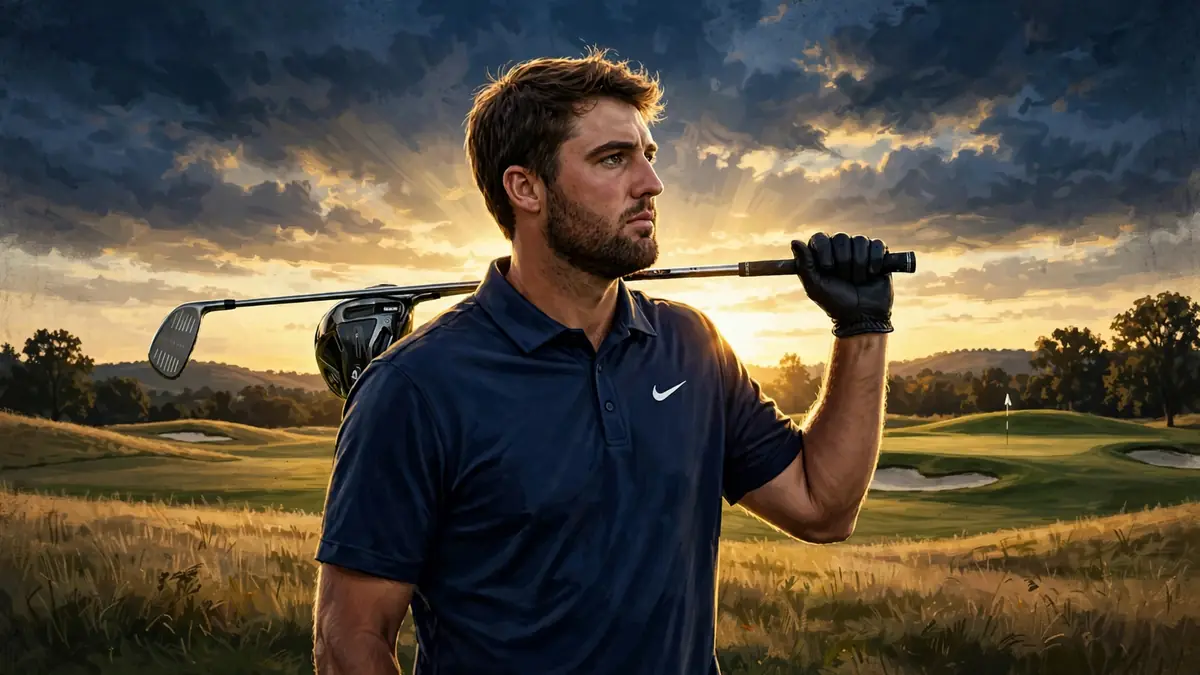
How Tall Is Scottie Scheffler?
Scottie Scheffler is 6 feet 3 inches tall, or 191 centimetres. The PGA Tour’s official player profile lists his height as 6’3″, and the same figure appears in his Wikipedia biography, on the Team USA roster and in the Ryder Cup and Presidents Cup player guides. When the sources a reader is most likely to check all print the same number, there is no real dispute to settle — 6’3″ is the anchored figure for this page, and it is the number used everywhere below.
For readers who think in other units, the conversions are simple. Six feet three inches is 75 inches in total, which works out to 1.91 metres. In the metric world he is usually listed as 191 cm, and in feet-and-inches shorthand he is 6’3″. His listed weight sits beside the height on every profile: 200 pounds, or 91 kilograms. Put the two together and you get the build of a modern power golfer — tall, broad across the shoulders, and heavy enough to stay planted through a full-speed swing.
| Measurement | Value |
|---|---|
| Height (feet and inches) | 6 ft 3 in |
| Height (inches) | 75 in |
| Height (centimetres) | 191 cm |
| Height (metres) | 1.91 m |
| Weight | 200 lb (91 kg) |
| Source | PGA Tour official player profile; Wikipedia; Team USA |
One wrinkle is worth naming honestly, because readers who dig into old profiles will find it. A magazine profile of the teenage Scheffler once described him as having gone “from 5-foot-2, 100 pounds in eighth grade to almost 6-foot-4, 200 pounds just six years later.” That “almost 6-foot-4″ line is a writer’s flourish from his late teens, not a measurement, and every official listing since — the tour, Wikipedia, the team events — has settled on 6’3”. Shoes add roughly an inch on the course, and morning measurements run a touch taller than evening ones, so a 6’3″ golfer can look 6’4″ in spikes on a leaderboard photo. The official number is 6’3″, and that is what we print.
It is also worth saying what his height is not. It is not the tallest frame on tour — Dustin Johnson is listed at 6’4″, and a handful of younger players are taller still. It is not freakish, and it is not the reason he wins golf tournaments on its own. What it is, is a real physical edge in a sport where leverage, arc width and balance decide how far the ball travels and how often it finds the fairway. The sections below take that edge apart piece by piece.
The Growth Spurt That Changed Everything
The most surprising thing about Scottie Scheffler’s height is not the final number. It is how late it arrived. Entering high school, Scheffler was barely five feet tall. A profile of his junior years records him at 5-foot-2 and 100 pounds in the eighth grade — a small kid carrying a golf bag that looked too big for him around the courses of Dallas. Then, in the space of a few years, he shot up past six feet. By the time he was finishing his teens he was the 6-foot-3, 200-pound athlete the tour lists today.

That kind of late surge is a gift and a problem in equal measure for a young golfer. The gift is obvious: longer levers, a wider swing arc, more clubhead speed for free. The problem is less obvious but every bit as real. A swing built by a five-foot-two boy does not fit a six-foot-three man. Posture, spine angle, distance from the ball, the plane the club travels on — all of it has to be rebuilt while the body is still changing underneath you. Junior coaches will tell you that the hardest players to coach are the ones growing an inch a month, because the swing they grooved on Monday can be gone by Friday.
Scheffler had one steady hand through all of it. Randy Smith, the long-time teaching professional at Royal Oaks Country Club in Dallas, has coached Scheffler since he was a child, and he stayed with him through the growth spurt and into the professional ranks. That continuity matters. Instead of rebuilding the swing from scratch every time Scheffler grew, Smith adjusted it in small steps — keeping the rhythm and the short-game feel that had made the small kid a junior star, while letting the new height add power around the edges. The result is the swing you see today: a full, free motion with a famous little slide of the feet through impact, built on a tempo that has barely changed since he was a boy.
The junior record shows that the transition worked. Scheffler won the U.S. Junior Amateur in 2013, played on the American team at the 2017 Walker Cup, and starred for the Texas Longhorns at the University of Texas from 2014 to 2018. He was not a player who had to wait for his body to catch up with his talent; the body caught up fast, and the talent was already there. By the time he turned professional in 2018, the 6-foot-3 frame and the junior swing had fused into one package — and the package has been winning ever since.
The number to remember: 5-foot-2 and 100 pounds in eighth grade; 6-foot-3 and 200 pounds as a professional. That is roughly 13 inches and 100 pounds gained in about six years — one of the biggest physical transformations of any player at the top of the modern game.
How His Height Shapes His Swing
Watch Scheffler hit a golf ball and the first thing you notice is how upright he stands. His swing plane — the tilted circle the clubhead travels on — runs steeper than the flatter, more rounded planes of shorter players. That is a direct product of his height. A taller golfer stands further from the ball with longer arms, and the natural geometry of that setup pulls the club up on a steeper path. His coach Randy Smith has talked about Scheffler using his height to make power through rotation rather than by dropping his spine angle, and the results back that up: Scheffler has led the tour in strokes gained tee-to-green and strokes gained on approach, the two statistics that measure pure ball-striking better than any other.

Here is the detail that surprises most golfers: despite standing 6’3″, Scheffler plays standard-length clubs. His driver carries a standard 45-inch shaft, and his irons are built to ordinary off-the-rack lengths and lie angles. Equipment writers who have covered his bag note the point again and again, because it runs against the fitting-chart logic most amateurs are taught — tall player, longer clubs. Scheffler’s answer is that his posture and his arm length do the work instead. He stands tall over the ball, keeps his spine angle steady, and lets his long arms create the arc. Adding length to the shafts would only move the clubhead further from his body and cost him the control that makes him the best iron player in the world.
That control shows up in the numbers. In 2023 his driving distance averaged a little over 305 yards — strong but not freakish, and only 87th on tour — while his strokes gained on approach ranked first. The height gives him the leverage; the technique decides what to do with it. His ball speed has sat among the tour’s better marks even when his clubhead speed has ranked in the middle of the field, which is the signature of a swing that transfers energy cleanly rather than swinging harder than everyone else.
Then there is the footwork. Scheffler’s feet slide and shuffle through impact in a way that television commentators point out almost every week. It looks untidy, and golf instructors who teach textbook positions sometimes wince at it. But it is part of the same story as his height. A tall player rotating hard through the ball needs somewhere for the force to go, and Scheffler’s lower body clears out of the way so his arms and the club can swing through. He has never tried to tidy it up, and with four majors and 22 tour wins, nobody is asking him to. The swing is not pretty by the book; it is repeatable under pressure, and repeatability is what wins majors.
Put it together and the honest verdict is this: Scheffler’s height helps him, but it helps him because of how he uses it. The upright plane, the standard-length clubs, the rotation-driven power and the famous footwork are all one system, built around a 6-foot-3 frame by a coach who has known him since childhood. A tall amateur who copies the clubs or the posture without the rest of the system will not get the same result — which is why the fitting lesson of Scheffler’s career is to fit the swing to the player, not the player to a chart.
Scottie Scheffler’s Height Compared With Other Golfers
Golf is one of the few sports where a five-inch height gap between two champions means almost nothing on the scorecard — and Scheffler’s career is the proof. He is taller than most of the players he competes against, but the gap is a matter of inches, not feet, and some of the greatest players in history were shorter than he is. The table below puts him next to the names that come up whenever golf fans argue about size.
| Golfer | Listed Height |
|---|---|
| Scottie Scheffler | 6 ft 3 in (191 cm) |
| Dustin Johnson | 6 ft 4 in (193 cm) — one inch taller |
| Phil Mickelson | 6 ft 3 in (191 cm) — the same height, per the PGA Tour media guide |
| Jon Rahm | 6 ft 2 in (188 cm) — one inch shorter |
| Tiger Woods | 6 ft 1 in (185 cm) — two inches shorter |
| Rory McIlroy | 5 ft 10 in (178 cm) on the PGA Tour listing; Wikipedia lists 5 ft 9 in |
| J.J. Spaun | 5 ft 8 in (173 cm) — seven inches shorter |
| Average PGA Tour professional | About 6 ft 0 in — Scheffler stands roughly four inches above it |
| Average American man | About 5 ft 9 in (175 cm) — Scheffler stands six inches above it |
The comparison with Rory McIlroy’s height is the one that tells the story best. McIlroy is listed at 5 feet 10 inches on the PGA Tour’s official profile — though Wikipedia gives 5 feet 9 inches, a one-inch disagreement our own McIlroy profile works through in full — which makes Scheffler five inches taller than the man ranked right behind him in the world. Five inches is a lot on a golf course. It is the difference between an upright plane and a flatter one, between long arms and quick hands. And yet McIlroy has won five majors and completed the career Grand Slam in 2025, while Scheffler has four majors and counting. Height is an edge, not a verdict.
The gap to Tiger Woods’ height runs the other way in the history books. Woods is listed at 6 feet 1 inch, two inches shorter than Scheffler, and the two sources most people check — the PGA Tour profile and Wikipedia — agree on the number exactly. Woods won 15 majors with that frame, which is the simplest possible answer to anyone who thinks two inches decides a golf career. Scheffler passed Woods on the PGA Tour’s career earnings list during the 2026 season, a milestone that says more about prize money in the modern era than about height, but it puts the two men in the same sentence for a reason: both built their games on ball-striking first and power second.
Jon Rahm, at 6 feet 2 inches, is the closest physical match among Scheffler’s regular rivals — one inch shorter, similarly broad, and a two-time major winner whose power comes from a compact, coiled swing rather than height alone. Jon Rahm’s age profile covers his rise in detail, and the comparison is a useful one: two big men with two very different swings, both at the top of the game. And then there is Phil Mickelson, listed at 6 feet 3 inches in the PGA Tour media guide — exactly Scheffler’s height — which makes the left-hander the best proof that the same measurement can produce a wildly different golfer. Phil Mickelson’s age profile traces a career that has now stretched across four decades, and his six major wins came with the same 191 centimetres Scheffler carries today.
Against the average man, though, the gap is plain. At 6’3″, Scheffler is six inches taller than the average American man and about four inches taller than the average tour professional. In a crowd he stands out. On a golf course, surrounded by other tall athletes, he looks like what he is: a big man who happens to be the best golfer alive.
The Ryder Cup Photo That Made His Height Famous
If one image fixed Scheffler’s height in the public mind, it was taken at Bethpage Black in September 2025. Scheffler and J.J. Spaun were paired together for the United States at the Ryder Cup, and as they walked to the first tee side by side, the cameras caught what the numbers had been saying all along: Scheffler, at 6’3″, towers over Spaun, at 5’8″. The seven-inch gap between the two men became one of the most shared sights of the week, with Sporting News running a piece on the “very different heights” that had caught Ryder Cup fans’ attention.
The golf that followed did not go the Americans’ way. Europe won the 45th Ryder Cup 15–13 at Bethpage Black, holding off a furious Sunday fightback after leading 11.5–4.5 through the first four sessions. Scheffler had a week to forget in the team formats, losing a match in each of the first four sessions — the first American ever to do so — and finishing 1–4 overall. But he saved his best for last, beating Rory McIlroy, the world No. 2, 1 up in the Sunday singles, in the first Ryder Cup singles match ever played between the top two players in the Official World Golf Ranking. It was a small piece of pride in a losing week, and it came against a man five inches shorter than him.
The Spaun pairing mattered beyond the photographs. In foursomes and four-ball, partners have to play off each other’s strengths, and a seven-inch height gap means two very different swings, two different ball flights and two different ways of reading the same wind. Scheffler and Spaun lost their Friday foursomes match 5&3 to Ludvig Åberg and Matt Fitzpatrick, and the pairing was not repeated. The lesson was not about height — plenty of mismatched pairs have won Ryder Cups — but the pictures made the point that in team golf, physical difference is visible in a way it never is in stroke play, where every man plays his own ball.
A year later, Scheffler’s team record looked very different. At the Presidents Cup at Medinah in September 2026, he went 3–1 and beat Nico Echavarría in the Sunday singles as the United States won 17–13. The contrast between the two team weeks — a rough Ryder Cup, a strong Presidents Cup — is a reminder that a golfer’s height never changes, but his form does, and the same 6-foot-3 frame can look unbeatable one year and ordinary the next.
The 2026 Season: Still World Number One
By the standards Scheffler set for himself, 2026 looked like a down year — and that is the most telling thing about where he stands. He won three times: The American Express in January, the FedEx St. Jude Championship in August, and the TOUR Championship at East Lake later that month, where he came from three shots behind Viktor Hovland with a final-round 66 to win by three and take the $10 million first prize. Three wins would be a career year for almost anyone else on tour. For Scheffler, it was less than half of what he won in 2024, when he took seven titles and an Olympic gold medal.
And yet by every measure except the win column, he was further ahead of the field than ever. He finished the 2026 season further in front of the second-best player in strokes gained: total than he had been in 2024. As of October 4, 2026, he averaged 17.21 world ranking points to Rory McIlroy’s 8.84 in second — nearly double. His 215 weeks at No. 1, counted as of October 25, 2026, put him in company only Woods has ever kept. He won his second FedExCup, joining Woods and McIlroy as the only players with multiple FedExCup titles, and he passed Woods on the PGA Tour’s official career earnings list, with career earnings past $130 million.
The honest exception was the majors. Scheffler won none of the four in 2026, after winning two in 2025. He came closest at Augusta, finishing second, one shot behind McIlroy, after a bogey-free weekend of 65–68 that made him the first player since 1942 to go without a bogey over the final two rounds at the Masters. He finished tied fourth at both the U.S. Open and The Open. McIlroy defended his Masters title that year, completing the second green jacket of a career that had already delivered the Grand Slam in 2025, and the two men spent the season trading the top of the leaderboard the way only the world’s best two players can.
None of it changed the ranking. Scheffler ended the season where he started it: No. 1, by a distance. His 22nd tour win, the one at East Lake, was also a statement about durability — a 30-year-old with four majors, two FedExCups and an Olympic gold, still adding to a record that already belongs in the history books. The height is part of that record, but only part. The rest is the iron play, the putting that finally caught up with the ball-striking, and a temperament that treats a three-shot deficit on Sunday as a problem to solve rather than a reason to hurry.
From New Jersey to Dallas: Early Life and Amateur Career
Scott Alexander Scheffler was born on June 21, 1996, in Ridgewood, New Jersey, and raised in Dallas, Texas, where his family moved while he was still a young boy. Dallas is where the golfer was made. He grew up playing at Royal Oaks Country Club under Randy Smith, attended Highland Park High School, and built a junior record that marked him early as a player to watch. For the full story of that rise, our Scottie Scheffler biography traces his path from junior star to world No. 1 in detail; the short version is that almost nothing about his progress surprised the people who saw him as a teenager.
The amateur highlights came thick and fast. He won the U.S. Junior Amateur in 2013, when he was 17. He played for the United States at the 2017 Walker Cup. At the University of Texas, where he played from 2014 to 2018, he was a three-time All-American and helped the Longhorns win the NCAA team title in 2016. Readers who want the age angle will find it in our sister site’s piece on how old Scottie Scheffler is, which sets his 30th birthday against the timeline of his titles.
He turned professional in 2018 and spent a year on the Korn Ferry Tour, where he won twice and was named Player of the Year for 2019. The PGA Tour card followed, and the first win came in February 2022 at the WM Phoenix Open, in a playoff against Patrick Cantlay. What happened next is the fastest climb to the top of the sport in a generation: a first Masters two months later, the world No. 1 ranking on March 27, 2022, and a grip on that ranking he has barely loosened since.
Through it all, the Dallas roots stayed put. Scheffler still lives in Dallas with his wife Meredith, still works with Randy Smith, and still plays out of Royal Oaks. The 6-foot-3 frame that draws the cameras was built on Texas driving ranges, and the swing that wins majors was grooved there too, one small adjustment at a time, through a growth spurt that could have broken a lesser player’s game.
The Money Behind the Height
Height does not pay a golfer. Winning does — and Scheffler has won more, and more lucratively, than any player in the history of the PGA Tour’s money list. His career earnings passed $130 million during the 2026 season, putting him first on the tour’s all-time list, ahead of Tiger Woods. The figure comes from the tour’s official records as summarised by Wikipedia, and it is a gross earnings number: prize money, before tax, expenses and the cost of running a professional golf operation. It is also a product of its era — purses in the 2020s are far larger than the ones Woods played for in his prime — but the ranking is the ranking, and Scheffler holds it at 30 years old with most of his career still ahead of him.
His net worth is a different number, and a softer one. GuideNetWorth, our sister site, puts Scottie Scheffler’s net worth at $110 million in its 2026 estimate, built from his career earnings, his FedExCup bonuses and his endorsement income. That is their estimate, not ours, and readers should treat it as one outlet’s reasoned guess at a private fortune rather than a bank statement. Other outlets will give you a different figure, and the honest range for a player at his level runs wide — which is exactly why this page anchors on the hard number, the $130 million-plus in official career earnings, and cites the net-worth figure as an attributed estimate.
The money arrives through four channels. First, tournament prize money: Scheffler has led the PGA Tour money list for four straight seasons, and his 2026 season alone included a $10 million first prize at the TOUR Championship. Second, the FedExCup bonuses that sit on top of the weekly purses — he has won the Cup twice, in 2024 and 2026. Third, endorsements: he plays TaylorMade clubs, wears Nike apparel and is one of the most marketable American athletes in golf, a clean-cut, family-first world No. 1 with no interest in controversy. Fourth, appearance and off-course income, which for a player of his standing is substantial but private, and which we do not guess at.
What is striking is how little of it shows. Scheffler lives in Dallas, drives himself to tournaments, and has talked openly about the fact that money has not changed his daily life much. The 6-foot-3 frame and the $130 million bank of earnings belong to the same person who still takes swing advice from the coach he has had since childhood and still lets his caddie, Ted Scott, do the reading on the greens. The height made the swing. The swing made the money. The money, so far, has not changed the man.
Personal Life: Family, Faith and Life Off the Course
Scheffler married his high-school sweetheart, Meredith Scudder, in December 2020. The two met at Highland Park High School in Dallas and dated through his years at the University of Texas, where Meredith also studied. She is a constant presence at his tournaments, and the most famous week of their family life came in May 2024, when their son Bennett was born — Scheffler left a tournament to be there, then returned to win the next one he played.
Faith is the other anchor. Scheffler speaks about his Christian faith openly and without show, crediting it with keeping the wins and the losses in proportion. It is part of why the golf world talks about him the way it does: the world No. 1 who treats a major championship as a job to do well rather than an identity to defend. His Dallas life is deliberately ordinary — church, family, practice at Royal Oaks, home for dinner — and the contrast with the money and the fame is the point.
That steadiness is also visible in his team. Ted Scott has caddied for him since late 2021, through all four majors and both FedExCups, and the two have the easy, low-drama working relationship that good caddie-player pairs share. Randy Smith remains his only swing coach. In a sport full of players who change coaches, caddies and equipment every season, Scheffler’s loyalty to the people who knew him when he was five foot two is one of the most consistent things about him.
The Valhalla Morning: The One Off-Course Storm
Every profile of a modern athlete has a difficult chapter, and Scheffler’s came on the morning of May 17, 2024, outside Valhalla Golf Club in Louisville, Kentucky, before the second round of the PGA Championship. A traffic incident near the course entrance, in the chaos following a fatal pedestrian accident, ended with Scheffler being arrested and briefly detained by Louisville police. He made his tee time, shot 66 that day, and the charges against him were dropped later that month, with the arresting officer’s account and the available video evidence failing to support the case.
It is worth recording because it is part of the public record, and because of how he handled it. Scheffler said little, complained less, and let the process run. The episode lasted a matter of weeks and left no mark on his record — but it did leave a mark on his reputation, in a good way. The golf world watched the world No. 1 get handcuffed on the way to work and respond with the same calm he shows on a Sunday back nine. He went on to win the PGA Championship the following year, at Quail Hollow, and nobody brings up Valhalla now except as a story about composure.
What His Height Means for Weekend Golfers
Most readers of this page are not 6’3″, and most will never be. But there are real lessons in Scheffler’s story for golfers of any size, and they run against a lot of the advice handed out in pro shops.
First, do not buy longer clubs just because you are tall. Scheffler is 6’3″ and plays standard-length clubs, because his posture and arm length make the standard lengths work. Get fitted on your swing, not on your height. A tall golfer with long arms may need standard or even shorter clubs; a shorter golfer with a wide stance may need longer ones. The tape measure that matters is wrist-to-floor, not head-to-toe.
Second, posture beats equipment. Scheffler’s power comes from standing tall, keeping his spine angle and rotating hard — not from longer shafts. If you are tall and you hunch over the ball to fit a club that is too short, you will lose more distance to bad posture than you would ever gain from the right length.
Third, expect your swing to change as your body changes. Young golfers growing fast should be refitted every season, and they should keep one coach through the growth years if they can. Scheffler’s swing survived a 13-inch growth spurt because one coach adjusted it in small steps instead of rebuilding it every spring.
Finally, remember what the comparisons prove. McIlroy is five inches shorter than Scheffler and has five majors. Woods is two inches shorter and has 15. Height is a lever, not a destiny. The best swing is the one you can repeat under pressure, at whatever height you happen to be.
Frequently Asked Questions
How tall is Scottie Scheffler?
Scottie Scheffler is 6 feet 3 inches tall (191 cm). The figure comes from his official PGA Tour player profile and is confirmed by Wikipedia, Team USA and the Ryder Cup and Presidents Cup player guides.
How tall is Scottie Scheffler in cm?
Scottie Scheffler is 191 cm tall. That is 6 feet 3 inches, or 75 inches in total — 1.91 metres. His listed weight is 200 pounds (91 kg).
How much does Scottie Scheffler weigh?
Scottie Scheffler weighs 200 pounds (91 kg), according to his PGA Tour player profile. Paired with his 6-foot-3 height, that gives him the tall, broad build of a modern power golfer.
How tall was Scottie Scheffler in high school?
He was barely five feet tall when he entered high school. A profile of his junior years records him at 5-foot-2 and 100 pounds in the eighth grade, before a growth spurt took him past six feet within a few years. He was 6-foot-3 and 200 pounds by the time he turned professional.
Is Scottie Scheffler taller than Rory McIlroy?
Yes. Scottie Scheffler is 6 feet 3 inches, while Rory McIlroy is listed at 5 feet 10 inches on the PGA Tour’s official profile — five inches shorter. Wikipedia lists McIlroy slightly shorter again, at 5 feet 9 inches, which would make the gap six inches.
Is Scottie Scheffler taller than Tiger Woods?
Yes, by two inches. Scottie Scheffler is 6 feet 3 inches and Tiger Woods is 6 feet 1 inch (185 cm). The PGA Tour profile and Wikipedia agree on Woods’ figure exactly.
Does Scottie Scheffler use longer clubs because he is tall?
No. Despite standing 6 feet 3 inches, Scottie Scheffler plays standard-length clubs, including a standard 45-inch driver shaft and standard-length irons. His posture and long arms create the swing arc, so longer shafts would cost him control without adding distance.
How old is Scottie Scheffler?
Scottie Scheffler was born on June 21, 1996, in Ridgewood, New Jersey, which makes him 30 years old as of November 2026. He first reached world No. 1 on March 27, 2022, and has held the ranking for 215 weeks as of October 25, 2026.
Bottom Line
Scottie Scheffler is 6 feet 3 inches tall (191 cm), a figure the PGA Tour, Wikipedia and Team USA all agree on — and it is only the start of the story. He was barely five feet tall entering high school, grew more than a foot in a few short years, and built a swing around that new frame with the same coach he has had since childhood. The height gives him an upright plane, long levers and easy power, but he still plays standard-length clubs, still wins with his irons rather than his driver, and still treats a Sunday lead as a problem to solve calmly. At 30, with four majors, 22 tour wins, two FedExCups and more than $130 million in career earnings, he is the best golfer in the world — and the tallest man at the top of the game since the giants of the last generation. For more profiles of golf’s biggest names, browse the Celebrity category on Celebamerica.
Sources and Reporting
How we estimated and verified: the headline height, 6 ft 3 in (191 cm), is taken from the PGA Tour’s official player profile and cross-checked against Wikipedia’s biography and the Team USA, Ryder Cup and Presidents Cup player guides, which all print the same figure. Where sources disagreed — the one-inch gap on Rory McIlroy’s height, and the “almost 6-foot-4” line in an old magazine profile — we named both figures and anchored on the official listing. Career earnings of more than $130 million come from the PGA Tour’s all-time money list as summarised by Wikipedia. The $110 million net-worth figure is GuideNetWorth’s own 2026 estimate, cited as theirs, not as a verified fact. Season results, the 2026 win count and the Presidents Cup record are drawn from PGA Tour and season reporting. Estimates of private wealth may differ from reality; listed heights are official measurements, not our own.
Sources consulted: PGA Tour (official player profile, season reporting) · Wikipedia (biography, career record, weeks at No. 1) · Sporting News (Ryder Cup height coverage) · Ryder Cup (2025 facts and figures) · Golfmode (2026 season review). Cross-site reading: GuideNetWorth — Scottie Scheffler Net Worth.