Romeo Santos net worth in 2026 is estimated at $30 million to $50 million, anchored at $40 million — the figure most often repeated by celebrity wealth trackers, including Celebrity Net Worth, Surprise Sports (updated May 20, 2026) and InfoSeeMedia (updated June 9, 2026). As of November 2026, the Bronx-born bachata star they call the King of Bachata is still adding to that fortune on the road, co-headlining the Mejor Tarde Que Nunca Tour with Prince Royce across North America, Europe and Latin America.
That range is wide on purpose, and this article explains why. Some trackers put Santos at $25 million or $30 million, while others stretch to $45–50 million and beyond. Nobody outside his inner circle has seen his bank statements, so the honest answer is a range with a clear anchor — and a full look at the touring, catalog, songwriting and business income that built it over three decades, from Aventura’s street-corner beginnings to sold-out stadiums.
By Celebamerica Editorial Staff | Last updated: November 19, 2026
Romeo Santos Quick Facts
| Full Name | Anthony Santos |
|---|---|
| Stage Name | Romeo Santos — the “King of Bachata” |
| Date of Birth | July 21, 1981 (45 years old as of November 2026) |
| Birthplace | The Bronx, New York City, USA |
| Height | 6 feet 1 inch (185 cm), per InfoSeeMedia |
| Estimated Net Worth (2026) | $30 million – $50 million, anchored at $40 million |
| Primary Income Sources | Touring and live shows, music royalties and streaming, songwriting and production, record label work |
| Key Ventures / Works | Aventura frontman; solo albums Formula, Vol. 1 (2011), Formula, Vol. 2 (2014), Golden (2017), Utopía (2019), Formula, Vol. 3 (2022); joint album Better Late Than Never with Prince Royce (2025); Roc Nation management partnership |
| Labels | Premium Latin Music, Sony Music Latin |
| Children | Four sons, including eldest Alex Damian (born 2000) |
In This Article
- Romeo Santos Quick Facts
- Early Life and Bronx Roots
- Aventura and the Rise of the King of Bachata
- Solo Career and the Formula Albums
- Net Worth Breakdown: Where the Money Comes From
- Touring: The Biggest Payday
- Business Ventures, Roc Nation and Songwriting
- Homes, Cars and Lifestyle
- Net Worth Growth Over the Years
- Personal Life and Family
- Controversies and Legal Questions
- How Romeo Santos Compares With Latin Music Peers
- Frequently Asked Questions
- Final Thoughts
- Sources and How We Estimated
Early Life and Bronx Roots
Anthony Santos was born on July 21, 1981, in the Bronx, New York City, to a Dominican father and a Puerto Rican mother. The household was bilingual and steeped in music: his father worked construction by day, and the sounds of traditional Dominican bachata, merengue and salsa filled the home. That blend — Dominican roots, Puerto Rican heritage, New York streets — became the raw material for everything Santos would later sell to the world.
Young Anthony sang in the church choir and wrote songs as a teenager, long before anyone called him a king of anything. He grew up in a working-class neighborhood where bachata was still treated as the music of the Dominican countryside, looked down on by the city’s Spanish-language radio gatekeepers. Santos has said in interviews over the years that he heard the snobbery aimed at the genre and decided, even as a kid, that it deserved a bigger stage. He started performing with his cousin Henry Santos and friends Lenny and Max Santos — the group that would first call itself Los Tinellers and later become Aventura.
The Bronx matters to the money story, not just the biography. Santos never left his New York identity behind when the fame came. He recorded in the city, filmed videos in its streets, and in 2014 became the first Latin artist to sell out Yankee Stadium on two consecutive nights — a homecoming that doubled as a business statement. The kid from the Bronx was no longer asking permission from the Latin music establishment. He was filling its biggest rooms on his own terms, and keeping the receipts.
His schooling and early jobs were ordinary. What was not ordinary was the songwriting habit: Santos wrote constantly, turning heartbreak and street life into the romantic, sometimes racy lyrics that would define bachata for a new generation. By his late teens he was the group’s lead singer and main songwriter, the voice and the pen at once. That double role — performer and writer — is the first key to his net worth. A singer gets paid to sing a song. A singer-songwriter gets paid every time the song is played, covered, streamed or licensed, for decades.
Aventura and the Rise of the King of Bachata
Aventura formed in the mid-1990s, when Santos was still a teenager, and spent years grinding through small venues in New York’s Dominican community. The breakthrough came in 2002 with “Obsesión,” a single built around a vocal feature from Judy Santos that turned a local bachata group into a global pop act. The song topped charts across Europe and Latin America, and suddenly a genre that New York radio had dismissed was selling out clubs from Madrid to Mexico City.
The group followed with a run of albums that built the catalog now paying Santos royalties year after year: We Broke the Rules (2002), Love & Hate (2003), God’s Project (2005) and The Last (2009). God’s Project earned Aventura a Grammy nomination, and the group’s blend of bachata with R&B, hip-hop and pop — English lyrics woven through Spanish verses, modern production under traditional guitar lines — pulled in listeners who had never heard bachata before. Santos wrote most of it, which meant the publishing money flowed to him as well as the performance fees.
Aventura’s live business grew just as fast. The group toured relentlessly through the 2000s, playing arenas across the United States, Latin America and Europe, and built one of the most loyal fan bases in Latin music — an audience that buys tickets in family groups and shows up for every reunion. That loyalty is a financial asset in itself: when Aventura announced its Cerrando Ciclos tour in 2024, billed as the group’s final tour, demand was immediate and enormous, because the fans had been waiting fifteen years for a proper goodbye.
The group never formally broke up in a blaze of public feuding, which also helped the money. Aventura went on hiatus in 2011 so Santos could go solo, reunited for one-off singles and shows in the years that followed — most notably the 2019 single “Inmortal,” which arrived with his Utopía album — and closed the circle with the 2024 farewell run. Each reunion refreshed the catalog’s value and reminded streaming audiences that the old songs still existed. A catalog that gets reintroduced to a new generation every few years is a catalog that keeps earning.
By the time the hiatus began, Santos was already the group’s unquestioned center: lead voice, chief songwriter, public face. The solo career that followed did not start from zero. It started from a decade of hits, a Grammy-nominated album, and a fan base that would follow him anywhere. That is why the solo numbers were so large, so fast.
Solo Career and the Formula Albums
Santos went solo in 2011 with Formula, Vol. 1, and the debut did what debuts almost never do: it became the best-selling Latin album of 2012, according to Ticketmaster’s artist profile of Santos. Singles “You” and “Promise,” the latter a duet with Usher, crossed over to English-language radio in a way few bachata records ever had. The album proved the central bet of his career — that bachata could be the foundation of a global pop career, not a ceiling on one.
The live album The King Stays King: Sold Out at Madison Square Garden followed in 2012, a title that was both a boast and a balance sheet. Madison Square Garden is the room that tells the music business who matters in New York, and Santos had filled it as a solo act within a year of leaving his group. Two years later, Formula, Vol. 2 (2014) went further, powered by “Propuesta Indecente,” “Eres Mía” and “Hilito.” That same year came the Yankee Stadium double — the first Latin artist to sell out the ballpark two nights running — and the moment his touring fees moved into a different bracket entirely.
Golden arrived in 2017, led by “Bella y Sensual,” a collaboration with Daddy Yankee and Nicky Jam that stitched bachata to reggaeton’s biggest names, and “Imitadora.” Then came Utopía in 2019, a record built around duets with the classic bachateros who had shaped the genre — a tribute that also served as a shrewd piece of catalog-building, tying Santos’s name to the genre’s history while the Aventura reunion single “Inmortal” brought the group back together on the same album. It was a reminder that Santos could honor tradition and still top the charts with it.
Formula, Vol. 3 landed in 2022, and the guest list read like a map of his reach: “Sin Fin” with Justin Timberlake, tracks with Rosalía and Christian Nodal, and a reunion with Bad Bunny on the Aventura track “Volví.” The album’s lead single “Sus Huellas” kept him on Latin radio through the year, and the supporting tour became one of the highest-grossing Latin runs of its era — more on that in the touring section below. For the money story, the point is simple: five solo studio albums across eleven years, each one a commercial event, each one adding songs to a catalog that pays him every time they are streamed.
The most recent chapter is a partnership, not a solo record. In 2025 Santos and Prince Royce released the joint album Better Late Than Never, pairing the two biggest modern bachata stars for the first time on a full record, and announced the joint Mejor Tarde Que Nunca Tour for 2026. The pairing makes commercial sense for both men: two catalogs, two fan bases, one stage, and ticket prices to match. It is also the latest example of a career-long pattern — Santos grows his audience by joining it to somebody else’s, then keeps the new listeners.
Net Worth Breakdown: Where the Money Comes From
So how does a bachata singer from the Bronx end up worth somewhere between $30 million and $50 million? The short answer is that Santos has four income engines, and they all run at once: the stage, the catalog, the pen, and the brand. The long answer is in the numbers below — and in why the trackers cannot agree on a single figure.
The headline figure, settled: Romeo Santos’s net worth in 2026 is best stated as $30 million to $50 million, anchored at $40 million. Celebrity Net Worth’s $40 million figure is the most repeated anchor, echoed by Wealth Rector, Surprise Sports (updated May 20, 2026) and InfoSeeMedia (updated June 9, 2026). NetWorthSpot, updated October 1, 2026, estimates about $44.4 million with some estimates up to $62.1 million. NetWorthExplore (published January 8, 2026, updated May 2, 2026) and romeosantos.org both put 2026 at $45–50 million. At the low end, NetWorthPost (June 17, 2026) and MetaUnfolded put it at $30 million, and NetWorthBreakdown models it at $25 million. Our range covers the credible middle of that spread; the $40 million anchor is the figure the most trackers agree on.
Why the $25 million spread between the lowest and highest credible estimates? Three reasons. First, nobody publishes Santos’s contracts, so every tracker is estimating from the outside — tour grosses, streaming counts, album sales and reported fees, all of them partial. Second, the trackers count different things: some count only liquid wealth and known assets, while others add the long-term value of his songwriting catalog and future touring income, which can add tens of millions on paper. Third, some trackers are simply out of date, still showing figures from before the Formula Vol. 3 tour and the 2026 arena run. A figure published in 2023 cannot describe a fortune that has had two more years of stadium touring added to it.
There are also figures to throw out. TheMost10 publishes $75 million, $90 million and $180 million for Santos on different pages of the same site, with no sourcing and numbers that contradict each other — those are not estimates, they are noise, and we do not use them. A reader who sees a $90 million or $180 million claim for Santos should treat it with the same doubt we did.
| Source | 2026 Estimate | Date |
|---|---|---|
| Celebrity Net Worth (via Wealth Rector) | $40 million | 2026 |
| Surprise Sports | $40 million | Updated May 20, 2026 |
| InfoSeeMedia | $40 million | Updated June 9, 2026 |
| NetWorthSpot | ~$44.4 million, up to $62.1 million | Updated October 1, 2026 |
| NetWorthExplore | $45–50 million | Updated May 2, 2026 |
| romeosantos.org | $45–50 million | 2026 |
| NetWorthPost | $30 million | June 17, 2026 |
| MetaUnfolded | $30 million | 2026 |
| NetWorthBreakdown | $25 million | 2026 |
NetWorthPost also reports that Santos earns more than $3.6 million per year — a plausible order of magnitude for a touring artist of his size in a non-tour year, though the figure is that site’s estimate, not a disclosed salary. In a heavy touring year, his gross earnings are far higher; the Formula Vol. 3 tour alone grossed more than $106 million in ticket sales, as reported by SeatPick, and the artist’s share of a gross like that, after costs and splits, still runs into the millions per leg.
How the fortune splits up
The table below is our own model of a $40 million fortune, built from the income streams every tracker agrees on. It is a model, not an audit: the shares are estimates, and the point is the shape of the money, not false precision.
| Income Stream | Share of the Fortune | What It Covers |
|---|---|---|
| Touring and live shows | 40–50% | Arena and stadium tours, Aventura reunions, the 2026 joint tour with Prince Royce |
| Royalties and streaming | 20–25% | Five solo albums plus the Aventura catalog, streaming, radio, sync and licensing |
| Songwriting and production | 10–15% | Publishing on songs he wrote for himself and others, producer fees |
| Endorsements and business | 10–15% | Brand deals, the Roc Nation partnership, label-related income |
| Catalog value and investments | Remainder | Long-term value of the song catalog, real estate and other holdings |
For comparison, NetWorthBreakdown publishes its own dollar model tied to its lower $25 million total: $10 million from concert tours and live performances, $6 million from music royalties and streaming, $5 million from record label operations, $3 million from endorsements and brand deals, $2 million from songwriting and production, and $500,000 from real estate and investments, with touring alone bringing in more than $8 million a year. The dollars differ from ours because the total differs, but the shape is the same: touring first, the catalog second, everything else behind them.

Touring: The Biggest Payday
If one line explains Romeo Santos’s wealth, it is this: he is one of the few Latin artists who can fill a stadium in almost any Spanish-speaking market on earth, and he has been doing it for twenty years. Record sales made him famous. Touring made him rich.
The modern touring story starts in 2014, when Santos became the first Latin artist to sell out Yankee Stadium for two consecutive nights on the Formula World Tour. A baseball stadium holds roughly 50,000 people for a concert; two nights there, at arena prices, is a gross in the tens of millions before a single album is sold. It also reset his market value: after Yankee Stadium, promoters in every Latin market knew exactly what a Romeo Santos night was worth.
The Formula Vol. 3 tour that followed the 2022 album grossed more than $106 million, according to SeatPick’s tour reporting, placing Santos among the highest-earning Latin touring acts of that period. The tour played arenas and stadiums across the Americas and Europe, including a Barclays Center date in November 2023, and its scale is the clearest single explanation for why the higher net worth estimates — the $45–50 million band — exist at all. A tour grossing nine figures does not make the artist nine figures richer, since venues, crews, production, promoters and taxes all take their cut, but even a modest artist’s share of a $106 million gross is a fortune by itself.
Aventura’s Cerrando Ciclos tour in 2024 added another large payday, this time as a farewell. Farewell tours are famously lucrative — fans who skipped the last three tours show up for the last one — and the Aventura run played to the group’s full catalog of nostalgia, with Santos as the frontman of a reunion the audience had wanted since 2011. The tour also reminded the market that Santos has two touring products, not one: his solo show and the Aventura show, each with its own audience and its own ticket price.
The 2026 run is the latest and, by the look of its routing, one of the most ambitious. The Mejor Tarde Que Nunca Tour with Prince Royce kicked off on April 1, 2026, at the Fiserv Forum in Milwaukee, and ran through North American arenas — Washington’s Capital One Arena, Boston’s TD Garden, Elmont’s UBS Arena — into the end of May, before expanding to Europe and Latin America, with South American stadium dates including two nights at the Estadio Nacional in Lima, Peru, in September and Mexican dates in León and Querétaro in December 2026. Some nights are solo Santos shows; many are co-headline dates with Prince Royce, where both men play full sets and share the stage for duets. A co-headline splits costs and doubles the draw, and for two artists whose catalogs overlap in the audience’s affections, it is the most efficient way to sell an arena twice over.
Ticket pricing tells the same story. For the December 2026 Mexican dates, resale listings started above €120 for the cheapest seats — arena pricing for an act that has never needed to discount. Santos has never been a cheap ticket, and his audience has never asked him to be one. That pricing power, held for a decade, is the engine under the whole net worth figure.
Business Ventures, Roc Nation and Songwriting
Santos’s business life is quieter than his stage life, and that is by design. He is not a celebrity who launches a tequila every quarter. His ventures cluster around the music itself: the songs, the rights, and the partnerships that let him keep control of both.
The most important business move of his solo career was the management partnership with Roc Nation, the entertainment company founded by Jay-Z. Santos signed with Roc Nation in 2019, joining a roster that gave him access to the top tier of the American music business — bigger brand conversations, better touring infrastructure, and a partner that understands how to turn a catalog into a long-term asset rather than a one-year payday. Reports at the time framed it as a management deal rather than a label deal: Santos kept his recording home with Premium Latin Music and Sony Music Latin, while Roc Nation handled the business around the music. For a star of his size, that split is the valuable one — creative control stays with the artist, commercial muscle comes from the partner.
Songwriting is the second business, and the one most fans never see. Santos is the credited writer on the bulk of his own hits and on songs recorded by other artists, which means publishing income follows him into rooms he never performs in. Publishing pays on radio play, streaming, covers, samples and sync placements, and it pays for the life of the copyright — decades after the recording session ends. That is why the songwriting slice of his fortune matters more than its size suggests: it is the income stream that keeps paying when he is not on tour, and the one that grows in value as the catalog ages.
On the label side, Santos has worked within the Premium Latin Music and Sony Music Latin system while keeping close creative control of his sound, and his long association with Premium Latin — the label that backed Aventura from the start — gave him a home base that understood bachata when the major labels did not. NetWorthBreakdown credits record label operations with $5 million of its $25 million model for Santos, a reminder that his income includes the business side of the records, not just the artist’s share. The exact structure of those deals is private, so we state the shape and not the numbers.
Brand endorsements have been a smaller, steadier line. Santos has lent his name to select campaigns over the years rather than chasing every deal, and the Roc Nation partnership put him in front of bigger brands than a bachata singer could have reached alone a decade earlier. Endorsements are not the story of this fortune — touring and the catalog are — but they add a seven-figure line that most trackers count at $3 million or so in their models.
He has also worked as an actor, which added both money and reach: a role as Mando in Furious 7 (2015), one of the highest-grossing films of that year, and a voice role in The Angry Birds Movie (2016). Neither made him a movie star, and neither needed to. The film work put his face in front of audiences who had never heard a bachata record, and every one of those viewers was a potential ticket buyer for the next tour.

Homes, Cars and Lifestyle
Here is where an honest profile has to say what it does not know. Unlike some stars, Santos does not run a public real-estate portfolio through the gossip press, and there is no verified public record of a headline mansion purchase with his name on the deed. NetWorthBreakdown assigns $500,000 to real estate and investments in its model — a small slice that fits a man whose wealth sits mostly in touring income and song rights rather than property. We do not invent a house, a neighborhood or a price tag to fill this section.
What is known is the shape of the life: Santos splits his time between New York, where he was raised and where his business is rooted, and the Dominican Republic, the country his father came from and the home of the music he plays. He has spoken over the years about his connection to the island and about investing there, but the details of any property holdings are private, and private is where they stay in this article.
The same restraint applies to cars. No reliable outlet has published a verified Santos car collection, and the internet’s car-list articles for celebrities are mostly guesswork dressed as reporting. Santos is photographed arriving at venues in the usual luxury SUVs and sedans of a touring star, but a vehicle spotted outside an arena is not a collection, and we will not present it as one.
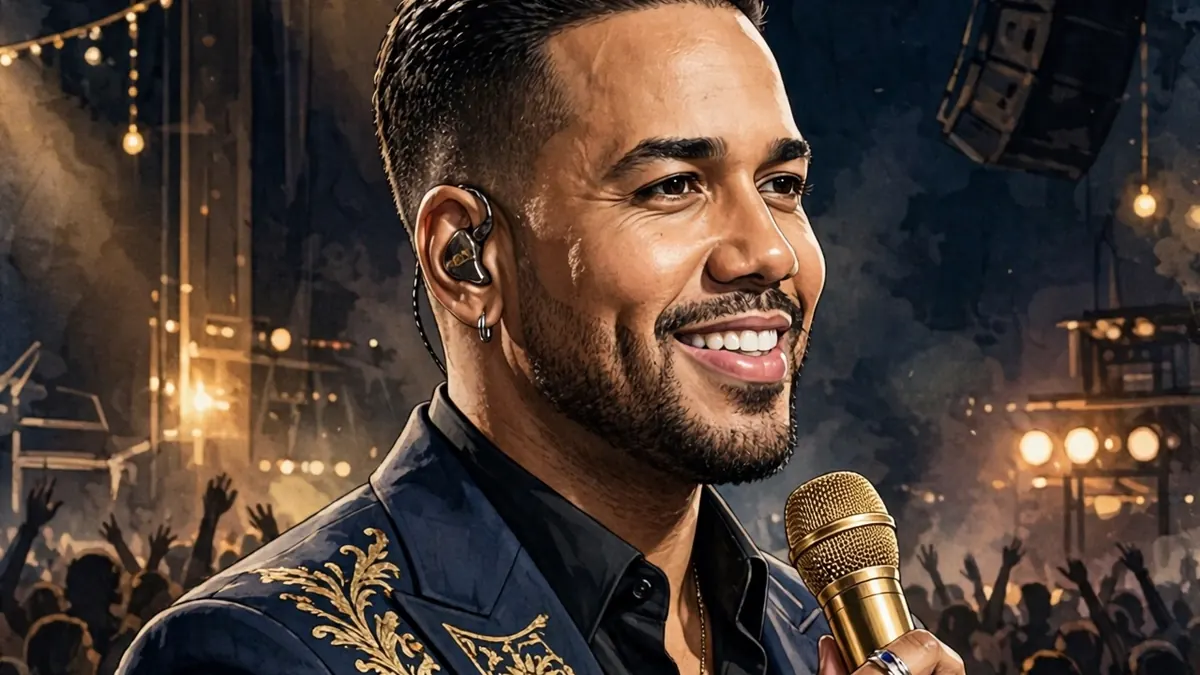
His spending, as far as it is public, runs to the things that show up on stage: the tailored suits, the jewelry, the production. The navy suit with gold embroidery he favors on stage is a small symbol of the brand — Dominican formal wear crossed with arena showmanship — and it is the closest thing Santos has to a visible luxury habit. Off stage he is famously low-key, and the low profile is itself a financial decision: a star who does not burn money on public display keeps more of what the road pays him.
Net Worth Growth Over the Years
Santos’s fortune was not built in a year. It was built in three acts — the group years, the solo explosion, and the stadium era — and the reported estimates track that arc, even if the early numbers are thinner than the recent ones.
| Period | Reported Estimate | What Drove It |
|---|---|---|
| 2002–2009 (Aventura peak) | No reliable public estimate | “Obsesión” and the Aventura album run; heavy touring; publishing on a growing catalog |
| 2011–2014 (solo launch) | No reliable public estimate | Formula, Vol. 1 becomes the best-selling Latin album of 2012; Madison Square Garden; Yankee Stadium double in 2014 |
| 2019 | About $30 million (romeosantos.org timeline) | Utopía, the “Inmortal” Aventura reunion, the Roc Nation deal |
| 2022–2023 | $30–40 million across trackers | Formula, Vol. 3 and a tour grossing more than $106 million |
| 2024 | $40 million (Celebrity Net Worth line) | Aventura’s Cerrando Ciclos farewell tour |
| 2026 | $30–50 million, anchored at $40 million | Joint album and arena tour with Prince Royce; catalog still earning |
The honest caveat is that the early rows are blank for a reason: celebrity wealth trackers did not publish serious Santos estimates during the Aventura years, and any number attached to 2005 or 2011 would be invented. What the record does show is the direction of travel — a working band in the 2000s, a solo star in the 2010s, and a stadium act in the 2020s — and the estimates that appear once the touring money reaches stadium scale.
The shape of the growth also explains why the 2026 estimates disagree. A fortune built on touring jumps in tour years and plateaus between them, so a tracker that last updated before the Formula Vol. 3 tour will show a smaller number than one updated after it. The $30 million figures are not wrong so much as they are early; the $45–50 million figures are not generous so much as they are current. Our range holds both, and the anchor sits where the most trackers meet.
Personal Life and Family
For a man who sings about love for a living, Santos keeps his own love life remarkably private — and he has done so for the whole of his career. He has never married in public, never introduced a partner on a red carpet, and rarely answers questions about his relationships at all. Latin outlets reported in 2016 that he was in a long-term relationship with a partner whose name he has never shared publicly, and that the couple might marry; nothing has been confirmed since, and Santos has not commented. That silence is a choice, and it has mostly held: the gossip press has had almost nothing to work with for twenty years.
What is public is his family. Santos is a father of four sons. His eldest, Alex Damian, was born in 2000, when Santos was still a teenager finding his way with Aventura, and the boy’s existence was kept private for years before Santos began speaking about fatherhood in interviews. Three younger sons — Valentino, Solano and Milano — arrived in the years that followed, and Santos has shared occasional glimpses of them on social media while keeping their daily lives out of the spotlight. He has described fatherhood as the part of his life that keeps him grounded, a counterweight to the arena lights, and he has kept the boys away from the cameras in a way that few stars manage.
His parents remain part of the story he tells about himself. His Dominican father and Puerto Rican mother gave him two musical traditions and one New York childhood, and he credits the household’s music — the bachata records his father played — with the career itself. He is close to his cousin Henry Santos, his Aventura bandmate, and to the Santos family circle that formed the original group. The family business, in the most literal sense, is how this fortune started.
Off stage, Santos is known as a disciplined worker rather than a party figure. He rehearses hard, tours hard, and spends the time between tours writing — the habit that has kept the catalog growing for three decades. He is 45 years old as of November 2026, still in his prime as a live performer, and the 2026 tour schedule suggests he has no plans to slow down. At an age when many pop stars are easing into legacy-act mode, Santos is still selling out the same rooms he played a decade ago, and adding new ones.
Controversies and Legal Questions
Santos’s public record is light on scandal for a star of his size, and the controversies that do exist are mostly the ordinary friction of a long career in the spotlight. The most persistent is a tax question: some low-quality celebrity sites have claimed Santos faced scrutiny over his tax obligations, including a supposed legal battle with the IRS. We could not verify any such case through a reliable outlet, court record or mainstream report, so we do not repeat the claim as fact. Readers who see it should know it traces to content-farm pages, not to news reporting.
His lyrics have drawn criticism at times — bachata’s romantic tradition runs close to territory some listeners find too explicit, and a few of Santos’s more suggestive songs have been debated on Latin radio and social media. That is a matter of taste rather than a scandal, and it has never cost him bookings, awards or airplay. If anything, the edge in the lyrics is part of the brand: Santos writes about desire the way his audience lives it, and the audience has rewarded him for it.
The Aventura hiatus in 2011 produced the usual round of breakup rumors, including claims of feuds between Santos and his bandmates. The record since then answers them: the group reunited for singles, shared stages and a full farewell tour, and the members have spoken warmly about each other in public. Whatever tensions existed inside a band that grew up together, they did not survive into the reunion years.
One more note for readers doing their own research: the internet is full of Santos pages that contradict each other on basic facts — his net worth, his age, even his height. TheMost10, for example, publishes $75 million, $90 million and $180 million on different pages of the same site. When sources disagree that wildly, the right move is the one we made in this article: state the range, name the sources, and say which figure the most trackers agree on.
How Romeo Santos Compares With Latin Music Peers
Context is what turns a number into an understanding. Santos’s $30–50 million fortune sits in the upper tier of Latin music, but the tier has a wide spread — from the reggaeton billionaires-in-waiting at the top to the working stars below him. Here is where he stands next to the peers his audience actually compares him with.
Daddy Yankee’s net worth reflects a career of similar length and larger crossover scale — the reggaeton pioneer retired in 2023 after a farewell tour of his own, and his fortune was built on the same touring-plus-catalog engine, with a bigger global pop footprint. Santos never had a “Despacito”-sized single moment, but he also never needed one: his audience buys tickets for the catalog as a whole, not for one song. Ozuna’s net worth sits below Santos’s at about $24 million on our own site’s estimate — a younger star with a shorter catalog and a touring business still catching up to the King of Bachata’s two decades of arena history.
The comparisons inside his own genre are the most revealing. Feid’s net worth and Peso Pluma’s net worth belong to the new generation of Latin stars — huge streaming numbers, fast rises, and fortunes still in the early chapters. Santos’s advantage over them is not streaming but staying power: twenty years of touring means twenty years of ticket revenue, and a catalog that has been earning since before either of them released a record. Anuel AA’s net worth, estimated at $20 million to $30 million by our sister site GuideNetWorth, makes the same point from the trap side of Latin music — a big star, a loyal audience, and a fortune still short of what two decades of arena touring buys.
The widest comparison is Shakira’s biography and career, which shows what happens when a Latin star crosses over all the way: decades of global pop hits, a Super Bowl halftime show, and a fortune in a different league. Santos’s crossover was narrower and deeper — he brought bachata to the world rather than leaving it behind — and his fortune reflects that choice. He is not the richest Latin star alive. He is the richest bachata star who ever lived, and the gap between those two statements is the story of his career.
| Artist | 2026 Estimate | Where the Money Comes From |
|---|---|---|
| Romeo Santos | $30–50 million, anchored at $40 million | Two decades of arena touring, the Aventura and solo catalogs, songwriting publishing |
| Ozuna | About $24 million (CelebAmerica) | Reggaeton streaming and touring, shorter catalog |
| Anuel AA | $20–30 million (GuideNetWorth) | Latin trap streaming, touring, brand deals |
| Daddy Yankee | See his full profile | Reggaeton pioneer catalog, farewell touring, crossover hits |
| Feid / Peso Pluma | See their full profiles | New-generation streaming scale, fast-rising touring |
| Shakira | See her full profile | Global pop crossover, decades of hits, touring at the largest scale |
The takeaway is not the ranking but the shape. Santos’s money is touring money first and catalog money second, and both of those grow with time rather than fading. A streaming star can lose the algorithm in a year. A touring star with a twenty-year catalog and an audience that brings its children to the shows does not lose the room. That durability is why the $40 million anchor is likely to keep rising while the 2026 tour is still running.
Frequently Asked Questions
How much is Romeo Santos worth in 2026?
Romeo Santos’s net worth in 2026 is estimated at $30 million to $50 million, anchored at $40 million — the figure most often repeated by celebrity wealth trackers, including Celebrity Net Worth, Surprise Sports (updated May 20, 2026) and InfoSeeMedia (updated June 9, 2026). Higher estimates reach $45–50 million (NetWorthExplore, romeosantos.org), while the low end sits at $25–30 million (NetWorthBreakdown, NetWorthPost, MetaUnfolded). The range reflects different methods, not different facts: nobody outside his circle has seen his private finances.
How does Romeo Santos make his money?
Touring is the biggest earner — the Formula Vol. 3 tour alone grossed more than $106 million, according to SeatPick — followed by royalties and streaming from five solo albums and the Aventura catalog, songwriting and publishing income, and business and endorsement work including his Roc Nation management partnership. In our model of a $40 million fortune, touring accounts for roughly 40–50% and royalties and streaming for 20–25%.
How old is Romeo Santos?
Romeo Santos was born Anthony Santos on July 21, 1981, in the Bronx, New York City, which makes him 45 years old as of November 2026. He was still a teenager when Aventura formed in the mid-1990s and 30 when he went solo in 2011.
What is Romeo Santos’s height?
Romeo Santos is 6 feet 1 inch tall (185 cm), according to InfoSeeMedia’s profile updated June 9, 2026. That puts him a little above average for a Latin pop star and in line with the tall, suited stage presence he is known for.
Is Romeo Santos still with Aventura?
Yes — in the sense that matters. Aventura went on hiatus in 2011 so Santos could go solo, but the group never broke up, reuniting for the single “Inmortal” in 2019 and for the Cerrando Ciclos farewell tour in 2024. Santos also reunited with the group on the track “Volví” from Formula, Vol. 3 in 2022. He tours as a solo artist while keeping the Aventura door open.
What is Romeo Santos’s biggest tour?
The Formula Vol. 3 tour is his biggest solo run by gross, at more than $106 million in ticket sales as reported by SeatPick. The 2014 Formula World Tour is his most historic, making him the first Latin artist to sell out Yankee Stadium on two consecutive nights. The 2026 Mejor Tarde Que Nunca Tour with Prince Royce, which began April 1, 2026, at Milwaukee’s Fiserv Forum, is his most ambitious routing yet, spanning North America, Europe and Latin America.
What are Romeo Santos’s biggest songs and albums?
With Aventura, his defining hit is “Obsesión” (2002). As a solo artist, the key records are Formula, Vol. 1 (2011), Formula, Vol. 2 (2014) with “Propuesta Indecente” and “Eres Mía,” Golden (2017), Utopía (2019) with the Aventura reunion single “Inmortal,” and Formula, Vol. 3 (2022) with “Sus Huellas” and “Sin Fin” featuring Justin Timberlake. Formula, Vol. 1 was the best-selling Latin album of 2012.
Is Romeo Santos married, and does he have children?
Santos has never publicly confirmed a marriage and keeps his romantic life private; Latin outlets reported in 2016 that he was in a long-term relationship with a partner he has never named publicly. He is a father of four sons, including his eldest, Alex Damian, born in 2000, and younger sons Valentino, Solano and Milano.
Final Thoughts
Romeo Santos’s net worth in 2026 — $30 million to $50 million, anchored at $40 million — is the price the market has put on thirty years of doing one thing better than anyone else: turning bachata into arena music without losing the genre’s soul. The fortune was not built on one hit or one deal. It was built on a catalog that pays every day, a touring business that fills stadiums in three continents, and a songwriting habit that turns every record into an asset that outlives the tour.
The range matters as much as the number. Trackers who say $25 million are looking at an older picture; trackers who say $50 million are counting the catalog and the road ahead. Both are honest attempts at a private fortune, and the truth sits between them, weighted toward the $40 million figure the most trackers repeat. What is not in doubt is the direction: with the 2026 tour still playing to full houses and a joint album with Prince Royce in the shops, the King of Bachata’s fortune is still growing.
For more Latin music fortunes, see our Net Worth archive.
Sources and How We Estimated
How we estimated: Romeo Santos’s finances are private — no tax return, contract or bank statement is public. We gathered every published 2026 estimate from named celebrity wealth trackers, dated each one, and published the honest range they describe ($30–50 million) with the figure the most trackers agree on ($40 million, from Celebrity Net Worth via Wealth Rector, Surprise Sports and InfoSeeMedia) as the anchor. Where trackers disagree, we show the disagreement rather than hiding it, and we threw out figures that contradict themselves on the same site. Touring grosses come from SeatPick’s tour reporting; tour dates and the Prince Royce joint album come from Ticketmaster and romeosantos.org. Estimates will differ from private reality, and they will move as the 2026 tour plays out.
Sources consulted: Celebrity Net Worth, Wealth Rector, Surprise Sports, InfoSeeMedia, NetWorthSpot, NetWorthExplore, romeosantos.org, NetWorthPost, MetaUnfolded, NetWorthBreakdown, Ticketmaster, SeatPick, Lyreka.
By Celebamerica Editorial Staff. This profile is an independent estimate for readers, not a statement of Santos’s private finances.