By Celebamerica Editorial Staff | Last updated: 15 November 2026
Nikola Jokic is 6 feet 11 inches tall (2.11 metres), and that number has been the same on every official listing that matters — the NBA, ESPN, Basketball-Reference and Wikipedia all agree on it. The Denver Nuggets centre carries that height on a 284-pound (129 kg) frame, and he pairs it with a 7-foot-3 wingspan that lets him play even bigger than his listed height suggests. As of November 2026, the three-time NBA Most Valuable Player stands as one of the most complete big men the league has ever seen, and his size is the foundation of everything he does on a basketball court.
Height is the first thing people ask about Jokic because it shapes the whole story of his game. He is not the tallest player in the league — Victor Wembanyama towers five inches above him — yet he has outplayed and outlasted nearly every seven-footer of his generation. He does it with touch, timing, patience and a passing gift no centre before him has matched, and his 6-foot-11 frame gives him the platform for all of it: the high release on his shot, the view over defences for his passes, and the bulk to hold his ground against the strongest players in the world. This page answers the height question in full, then works through the measurements behind it, the comparisons fans actually search for, the way his size built his career, and the money his frame has earned him.
Quick Facts: Nikola Jokic
| Full Name | Nikola Jokić |
|---|---|
| Date of Birth | 19 February 1995 (age 31 as of November 2026) |
| Birthplace | Sombor, Serbia |
| Height | 6 ft 11 in (2.11 m) — barefoot measurement, NBA official listing |
| Weight | 284 lb (129 kg) |
| Wingspan | 7 ft 3 in (2.21 m) |
| Standing Reach | 9 ft 3 in (reported) |
| Position | Centre |
| Team | Denver Nuggets (NBA), drafted 41st overall in 2014 |
| Headline Honours | 3× NBA MVP (2021, 2022, 2024); NBA champion and Finals MVP 2023; eight-time All-Star selection (2019–2026) |
| Estimated Net Worth | About $120 million (Celebrity Net Worth, 2025); published estimates range from $50 million to $200 million |
| Current Contract | Five-year supermax extension worth $276.1 million, signed July 2022, running through 2027–28 |
| Primary Income Sources | NBA salary, endorsement deals (361 Degrees, Panini, Western Union, Expedia) |
Table of Contents
- Quick Facts: Nikola Jokic
- How Tall Is Nikola Jokic?
- Jokic’s Height in Feet, Metres and Centimetres
- Weight, Wingspan and Standing Reach
- Nikola Jokic Height Compared to Other NBA Stars
- How His Height Shapes His Game
- Early Life and Growth: From Sombor to the NBA
- Career Rise: The 41st Pick Who Became a Three-Time MVP
- The Contract and the Money His Frame Earned
- Nikola Jokic Net Worth in 2026
- Personal Life: Family, Horses and Life Off the Court
- Height Myths and Wrong Numbers, Cleared Up
- Frequently Asked Questions
- Final Thoughts: The Bottom Line on Jokic’s Height
- Sources and Reporting

How Tall Is Nikola Jokic?
Nikola Jokic is 6 feet 11 inches tall. That is the figure on the NBA’s official roster pages for the 2025–26 season, the figure ESPN carries, the figure Basketball-Reference lists, and the figure Wikipedia records as his listed height. It converts to 2.11 metres, or 211 centimetres. There is no real dispute about it: every serious source lands on the same number, which is rare for a star whose height gets talked about as much as his does.
The reason the number is so solid is that the NBA changed the way it measures players in 2019. Before that season, teams could list a player at whatever height suited them, usually the height in shoes, and a few players picked up an inch or two that way. Since 2019, the league has required barefoot measurements, and Jokic’s 6-foot-11 listing is the barefoot figure. Put him in his playing shoes and he stands a shade over seven feet on the court, which is why some fans who have stood near him — or seen him next to a listed seven-footer — swear he is a full seven feet tall. He is not, by the tape measure. He is 6-foot-11 without shoes, and that is the honest number.
That puts Jokic right at the top end of the modern centre position. The average NBA player is around 6 feet 6 inches, so Jokic stands about five inches taller than the league average. The average centre is close to his height — most starting centres in today’s NBA sit between 6-foot-10 and 7 feet — which means Jokic is not unusually tall for his job. What makes him unusual is everything else: the hands, the vision, the patience, and a basketball brain that reads the floor two passes ahead of everyone else. His height is the entry ticket. The rest is what turned a second-round pick into a three-time MVP.
It is worth saying plainly because the internet is full of looser numbers. Some fan pages and older profiles list Jokic at 7 feet, and a handful of sites still carry the pre-2019 shoe measurement. The 6-foot-11 figure is the one the league uses, the one his team uses, and the one the reference books use. When this article talks about his height, that is the number it means.
Jokic’s Height in Feet, Metres and Centimetres
For readers coming from outside the United States, here is the same measurement in every unit that gets searched:
- Feet and inches: 6 ft 11 in
- Metres: 2.11 m
- Centimetres: 211 cm
- Inches: 83 inches
- In shoes: roughly 7 ft 0 in (about 213 cm), since a basketball shoe adds close to an inch
The metric figure is the one most of the world knows him by. Serbian coverage, European basketball sites and the FIBA listings for his Serbia national team appearances all give 2.11 m, and that matches the NBA’s 6-foot-11 exactly — 211 centimetres converts to 6 feet 11.1 inches. There is no gap between the European and American numbers, which is another reason the figure is easy to trust: two different measurement cultures, two different unit systems, one answer.
Searches for his height spike every time he does something that looks impossible for a man his size — a full-court pass off a rebound, a one-handed flick to a cutter, a step-back three over a smaller defender. The number itself never changes. What changes is how people see it, because Jokic moves like a guard and thinks like a point guard while carrying the body of a centre. The contrast is the point of the fascination: a 6-foot-11 man should not pass like that, and the fact that he does is why the question keeps getting asked.
Weight, Wingspan and Standing Reach
Height alone tells only part of the story. A player’s weight, wingspan and reach decide how that height actually plays, and Jokic’s numbers explain a lot about his style.
Weight: 284 pounds (129 kg). That is his current listed weight, and it is a long way from where he started. When Denver drafted him in 2014, reports from his draft year put him close to 300 pounds, a heavy teenager who loved Coca-Cola and had never followed a serious conditioning programme. The Nuggets’ staff worked on his body from the day he arrived, and he slimmed down sharply in the summer of 2020, arriving at the restarted season looking like a different athlete. The 284-pound figure he carries now is a working weight — heavy enough to hold position against anyone, light enough to run the floor and play heavy minutes. For a centre who handles the ball as much as he does, that balance matters more than the raw number.
Wingspan: 7 feet 3 inches (2.21 m). Jokic’s arms stretch four inches beyond his height, which is a solid wingspan for a centre without being freakish. It is the wingspan that lets him finish over defenders, tip rebounds to himself, and deflect passes in the lane. Fans sometimes assume his wingspan must be enormous because he grabs so many rebounds; it is not. His rebounding comes from positioning, timing and those famously soft hands, not from arms that stretch across the paint. The 7-foot-3 number is reported across his profiles, including the player cards that list his measurements side by side with his height.
Standing reach: 9 feet 3 inches (reported). His standing reach — how high he can touch with one arm raised, feet flat on the floor — is listed at 9 feet 3 inches in several player profiles. That means he can touch the rim (10 feet) with a jump of just nine inches, and it explains why he so rarely needs to leave the floor to score inside. He plays below the rim by choice and by design: he does not jump over people, he reaches past them, and the reach is a large part of how he does it. Treat the reach figure as reported rather than officially measured — unlike the height, it has never been published by the league — but it lines up with the way he plays.
Shoe size: reportedly US 16. His feet are as big as his frame demands, and the shoe size is one of the quieter details in his profile. It matters on the court because a size-16 shoe gives him a wide, stable base for the pivots and post moves that define his offence, and it matters off it because his footwear deal is one of his bigger endorsement stories — more on that in the money section below.
The short version: 6 ft 11 in tall, 284 lb, 7 ft 3 in wingspan, 9 ft 3 in standing reach. Every one of those numbers is consistent across the NBA, ESPN, Basketball-Reference and the reference sites that track him, and none of them has moved since the league standardised barefoot measuring in 2019.
Nikola Jokic Height Compared to Other NBA Stars
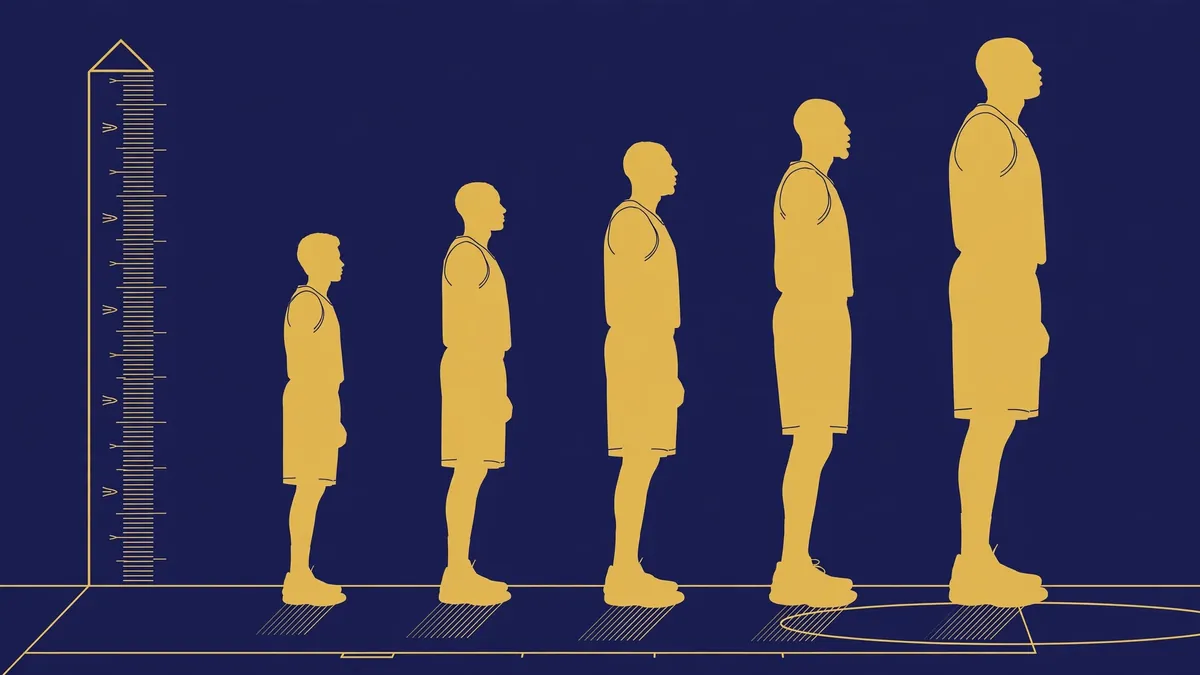
The fastest way to understand what 6-foot-11 means in the modern NBA is to line Jokic up against the other big names fans compare him with. Here is how he stands next to the centres and forwards he meets most often:
| Player | Height | Difference vs Jokic |
|---|---|---|
| Victor Wembanyama | 7 ft 4 in (2.24 m) | 5 inches taller |
| Joel Embiid | 7 ft 0 in (2.13 m) | 1 inch taller |
| Giannis Antetokounmpo | 6 ft 11 in (2.11 m) | Exactly the same height |
| Kevin Durant | 6 ft 11 in (2.11 m) | Exactly the same height |
| Nikola Jokic | 6 ft 11 in (2.11 m) | — |
| LeBron James | 6 ft 9 in (2.06 m) | 2 inches shorter |
| Average NBA player | About 6 ft 6 in (1.98 m) | About 5 inches shorter |
| Average man (USA) | About 5 ft 9 in (1.75 m) | About 14 inches shorter |
The comparison that draws the most searches is Victor Wembanyama’s height. The San Antonio Spurs star is listed at 7-foot-4, a full five inches taller than Jokic, with a wingspan reported at around 8 feet. When the two meet, the difference is visible from the upper deck: Wembanyama’s shoulders sit above Jokic’s head, and his reach lets him contest shots Jokic has to work to create. What makes the match-up so watched is that Jokic has repeatedly outplayed the taller man anyway, using his lower centre of gravity, his wider frame and his passing to drag Wembanyama away from the rim and punish him in space. Height is Wembanyama’s edge; leverage and craft are Jokic’s answer to it.
Joel Embiid, listed at 7 feet, is the other great centre of Jokic’s generation, and the one-inch gap between them has fuelled years of MVP debate. Embiid is the more explosive athlete and the more frequent scorer from the mid-range; Jokic is the better passer and rebounder, and his frame lets him absorb contact and finish through it. Their head-to-head meetings are rare enough — injuries and scheduling have kept them apart more often than fans would like — that each one becomes an event, and the height question always comes up in the build-up. The honest answer is that one inch has never decided anything between them; health and supporting casts have.
Two of the game’s great forwards share Jokic’s exact height. Giannis Antetokounmpo’s biography is a story of a 6-foot-11 athlete who plays like a guard, and the shared measurement is a reminder that the same height can produce wildly different players: Giannis uses it to cover ground in three strides and finish above the rim, while Jokic uses it to see over defences and operate from the post. Kevin Durant’s age and career timeline tells a similar story from the other side — a 6-foot-11 scorer whose height lets him shoot over anyone, where Jokic’s lets him pass over anyone. Same tape-measure number, three completely different games.
Against LeBron James’s biography the gap is two inches in Jokic’s favour, and it shows up in the post, where Jokic can shoot over LeBron’s contests, and on the glass, where he holds his ground. It is also worth noting that Jokic’s own teammate and rival centres make the point from the other direction: the league is full of 7-footers who never became stars, and Jokic’s career is proof that an inch of height is worth far less than a foot of feel for the game.

How His Height Shapes His Game
Jokic’s game is built around his height the way a house is built around its frame: everything else hangs off it, and none of it works without it. Start with the passing, the skill that separates him from every centre who came before him. Because he stands 6-foot-11, he can see over the top of defences that would blind a guard, and because he handles the ball at the top of the key like a point guard, he can throw passes that no other big man can even attempt — full-court outlets off a rebound, no-look flicks to backdoor cutters, touch passes over a double team to the weak-side corner. The height gives him the sightlines; the hands and the brain do the rest. Opponents have learned to guard him with a smaller, quicker player on the perimeter and a bigger one near the rim, and he beats both by simply passing over the top.
Then there is the rebounding. Jokic averaged a triple-double in 2024–25 — 29.6 points, 12.7 rebounds and 10.2 assists per game — becoming the first centre in NBA history to average a triple-double over a full season, and the third player ever after Oscar Robertson and Russell Westbrook. The rebounds come from the combination of his size and his patience: he does not jump early, he does not chase the ball out of position, he seals his man with that 284-pound frame, waits for the ball to come down, and takes it with two hands. He has finished seasons among the league leaders in rebounds without ever looking like he is trying hard, which is the highest compliment a rebounder can earn.
His scoring works the same way. Jokic shoots a soft floater he calls the “Sombor Shuffle” — a one-legged, off-balance push shot that looks ungainly and goes in at an absurd rate — and he takes it from spots where his height means the defender cannot reach it. He posts up smaller players and shoots over them, he faces up bigger players and drives past them, and he steps out to three-point range often enough that defences cannot simply sit in the paint. He is not a leaper; he is a reacher. His standing reach of 9-foot-3 means he barely needs to leave the floor to finish, and his touch means the ball drops softly even when the shot looks rushed.
There is a defensive side to the height too, and it is the one honest weakness in his profile. Jokic is not a shot-blocker — he averages around one block a game, modest for a centre — and quicker players can get past him on the perimeter. Denver has built its defence around that fact for years, pairing him with mobile forwards and asking him to guard the paint rather than chase guards. His size makes him an excellent positional defender and a strong defensive rebounder, and his hands produce steals at a rate few centres match. The trade-off has always been clear: you accept the limits of his lateral quickness because his height and bulk give you everything else.
One more thing his height does is let him play enormous minutes without breaking down the way smaller players do. He regularly plays 36 or more minutes a night, handles the ball more than any centre in the league, and takes a physical beating in the post every single game — and he almost never misses time. Durability is partly luck and partly conditioning, but size helps: a 6-foot-11, 284-pound body absorbs contact that would put a lighter player on the floor. He has missed stretches with wrist and ankle trouble over the years, yet he has played 70 or more games in most of his seasons, and his availability is one of the quiet reasons Denver has stayed near the top of the West for a decade.
Early Life and Growth: From Sombor to the NBA
Nikola Jokic was born on 19 February 1995 in Sombor, a small city in northern Serbia near the Hungarian border, and he grew up in a basketball family. His two older brothers, Strahinja and Nemanja, both played the game — Strahinja in Europe, Nemanja in college basketball in the United States — and the youngest Jokic learned the sport in their shadow, playing in local gyms and on outdoor courts around Sombor. He was a tall child who grew early, and by his mid-teens he was already a big, heavy teenager with soft hands and a feel for passing that coaches noticed before they noticed anything else. The full story of his age and birthday is covered in our profile of Nikola Jokic’s age, and the matching angle on our sister site — how old Nikola Jokic is today — carries the same birthday and the timeline of his seasons by age.
His early career ran through the Serbian club system rather than the American one. He played for Vojvodina Srbijagas in Novi Sad, then moved to Mega Basket (then called Mega Vizura) in Belgrade, the club that has produced a long line of NBA players. At Mega he played against grown men while still a teenager, and the experience taught him to use his body rather than fight it: he learned to seal defenders, to pass out of the post, to read the floor from the elbow. He was never the fastest player on the court, even as a teenager, and he never needed to be — the game slowed down for him in a way it does not slow down for most players, and his height meant he could see everything while it did.
The famous detail of his youth is the Coca-Cola. Jokic has said himself that he used to drink several litres of Coca-Cola a day as a teenager, and the story has become part of his legend because it fits the picture of a kid who was never supposed to become an NBA star. He was heavy, he was slow by NBA standards, and his conditioning was a standing joke in scouting reports. Denver drafted him anyway, 41st overall in the 2014 NBA draft, and the pick was announced during a Taco Bell commercial break on the draft broadcast — a detail that has become the most retold anecdote of his career, because the player picked during an advert went on to become the best player in the world.
By the time he arrived in Denver for the 2015–16 season, he was already close to his full height. His listed height has been 6-foot-11 from the start of his NBA career, and it has not moved since — he was a grown man at 19, and the growth that mattered after that was in his body and his game, not his frame. Reports from his draft year put him near 300 pounds, and the first job Denver’s staff gave him was to reshape that body. He slimmed down steadily over his first five seasons, then sharply in the summer of 2020, and the player who came back from that summer was quicker, fitter and ready to win his first MVP award the following season.
Career Rise: The 41st Pick Who Became a Three-Time MVP
Jokic’s rise is the least likely superstar story in modern basketball, and his height is woven through every chapter of it. He made his NBA debut in the 2015–16 season and finished third in Rookie of the Year voting behind Karl-Anthony Towns and Kristaps Porzingis — two players drafted at the top of the same class, both taller and more athletic than him, both of whom he has long since passed. He became a full-time starter in his second season, and by his third he was the centrepiece of the Nuggets, running the offence from the elbow and the top of the key in a way no centre had done since the days of Arvydas Sabonis and Vlade Divac.
The honours stacked up quickly after that. He made his first All-Star team in 2019 and has been selected every year since, eight selections in all through the 2025–26 season. He won his first MVP award in 2021, becoming the lowest-drafted player ever to win the award and the first centre to win it since Shaquille O’Neal in 2000. He won it again in 2022, making it back-to-back, and he won a third in 2024, joining a short list of players with three or more MVP awards that reads like a hall-of-fame roll call: Kareem Abdul-Jabbar, Michael Jordan, Bill Russell, Wilt Chamberlain, LeBron James, Larry Bird, Magic Johnson and Moses Malone.
The championship came in 2023. Denver beat the Miami Heat in five games in the NBA Finals, and Jokic was named Finals MVP after averaging 30.2 points, 14.0 rebounds and 7.2 assists in the series, including the first triple-double by a centre in Finals history. It was the Nuggets’ first championship in the franchise’s 47-year history, and it was won by a team built entirely around a 6-foot-11 centre who had been picked in the second round. The parade in Denver drew hundreds of thousands of people, and Jokic — famously indifferent to ceremony — spent most of it saying he wanted to go home to his horses in Serbia.
His international career has been just as decorated. He won silver with Serbia at the Rio Olympics in 2016, losing the final to the United States, and bronze at the Paris Olympics in 2024, where he posted a triple-double in the bronze-medal win over Germany. He has carried Serbia at World Cups and European Championships too, and his FIBA listing gives the same 2.11 m that the NBA does — one more independent check on the number.
Across his career he has averaged roughly 22 points, 11 rebounds and 7 assists per game, numbers no centre in history has matched over a full career. The 2024–25 season was his peak as a stat line: 29.6 points, 12.7 rebounds and 10.2 assists per game over 70 games, the first triple-double season by a centre, achieved at age 30. He did it while playing for a Nuggets team in transition, carrying a heavier load than ever, and he finished second in MVP voting that year to Shai Gilgeous-Alexander — a result that still gets argued about in Denver.
The Contract and the Money His Frame Earned
A 6-foot-11 frame with Jokic’s skills is one of the most valuable assets in professional sport, and his contracts show it. His rookie deal was modest — he earned roughly $1.3 million in his first season, per reporting on his early earnings — and his first big payday came in 2018, when he signed a five-year maximum contract worth $147.7 million. That deal made him the highest-paid player in Nuggets history at the time, and it was only the warm-up.
In July 2022, Jokic signed a five-year supermax extension worth $276.1 million, the largest contract in NBA history at the moment he signed it. The deal runs through the 2027–28 season, is fully guaranteed, and carries an average annual value of $55.2 million. The final year is a player option, which means Jokic can choose to become a free agent in the summer of 2027 or take the last year of the deal. Spotrac’s season-by-season breakdown of the supermax looks like this:
| Season | Salary |
|---|---|
| 2023–24 | $47.6 million |
| 2024–25 | $51.4 million |
| 2025–26 | $55.2 million |
| 2026–27 | $59.0 million |
| 2027–28 (player option) | $62.8 million |
| Total | $276.1 million |
By the end of the 2025–26 season, his career NBA earnings will stand at roughly $304.7 million, according to Spotrac’s running total — and that counts salary alone, before endorsements. The two contracts together, the $147.7 million max and the $276.1 million supermax, will pay him more than $410 million by the time the second deal ends. In the summer of 2025 he turned down a three-year extension worth a reported $212 million, not because he wanted to leave Denver — he has said repeatedly that he wants to stay a Nugget — but because waiting a year lets him sign a longer and larger deal in the summer of 2026, when he becomes eligible for a four-year extension worth close to $293 million. The whole league is watching that decision, and it is the clearest sign of how the Nuggets value him: the franchise has made it plain, through its owner and its front office, that the offer will be there whenever he wants it.
His endorsement income is smaller than his salary but still serious. Forbes has put his off-court earnings at around $6 million to $8 million a year. His biggest deal is with 361 Degrees, the Chinese sportswear brand he signed with in December 2023, which made him the face of its basketball line in Asia and launched a signature shoe, the Joker 1. He also has deals with Panini, the trading-card company, and has worked with Western Union and Expedia in past campaigns. The 361 Degrees deal is the one that fits his story best: a player the American shoe giants overlooked, signed by a brand from the market that spotted his value first.
Nikola Jokic Net Worth in 2026
With a supermax contract, a decade of NBA salary and growing endorsement income, Jokic’s wealth is easy to estimate in outline and hard to pin down to a single number. Celebrity Net Worth puts his net worth at $120 million, and that is the figure most outlets use as their anchor. Other published estimates spread wider — some as low as $50 million, one as high as $200 million — which is normal for a player whose money is mostly tied up in future contract payments rather than in businesses or investments that can be valued from the outside. The honest range, based on the published sources, is $50 million to $200 million, with $120 million as the best-supported single figure.
The reason the range is so wide is that net worth and career earnings are different things. Jokic will have earned about $304.7 million in NBA salary by the end of the 2025–26 season, but salary is not wealth: taxes, agent fees, living costs and the simple fact that much of the money arrives in future years all cut into it. What he actually owns today — bank balances, property, investments — is private, and no outlet has a window into it. The $120 million figure is an estimate built from his contracts and his endorsements, and it should be read that way: a reasonable, sourced estimate, not a bank statement.
What is known is that he lives far more modestly than his pay suggests. He still spends his summers in Sombor, he still goes to the harness-racing track, and he has never been a headline buyer of mansions or cars in the way some stars are. He owns property in Denver and in Serbia, and his best-known spending is on horses — he owns and races standardbred horses in Serbia, a passion that predates his NBA career and one he has said he will return to full-time when he retires. It is a fitting picture for a player whose whole career has been about substance over show: the money is real, the lifestyle is quiet, and the horses get more of his attention than the fame does.
Personal Life: Family, Horses and Life Off the Court
Jokic married his longtime partner Natalija Mačešić in October 2020 in Sombor, in a ceremony kept deliberately small and private. The couple’s daughter, Ognjena, was born in September 2021, and reports in late 2024 said they had welcomed a son as well. Natalija keeps a low profile — she has no public career or endorsement deals of her own — and the family splits its time between Denver during the season and Sombor in the summer, where Jokic’s parents and brothers still live.
His older brothers are a running presence in his story. Strahinja, the eldest, played professionally in Europe; Nemanja played college basketball at Detroit Mercy. Both are taller than most people and both are fiercely protective of their youngest brother — Strahinja has become a familiar courtside figure at Nuggets games, and the brothers’ habit of sitting together, dressed alike, has become a small internet tradition of its own. Jokic has said the brothers’ roughhousing as kids taught him to hold his ground, which is a useful education for a centre.
The horses are the other great love of his life. He owns a stable of harness-racing horses in Sombor and follows the sport closely, and he has spoken openly about wanting to be a full-time horseman when basketball ends. It is the detail that explains more about him than any statistic: a man who became the best basketball player in the world and still measures his happiness by a quiet afternoon at the track in his hometown. He is also a practising Serbian Orthodox Christian, a fact he keeps private and rarely discusses, and he has kept his distance from the celebrity side of NBA life — few interviews, no reality television, no social-media presence to speak of. The height gets him noticed; everything else about him tries not to be.
Height Myths and Wrong Numbers, Cleared Up
A player as famous as Jokic collects wrong numbers the way a famous house collects rumours, and his height has picked up a few. Here are the ones worth correcting.
“Jokic is 7 feet tall.” The most common error, and the easiest to understand. In his shoes on the court he is a shade over seven feet, and standing next to a listed 6-foot-9 forward he looks every bit of it. But his barefoot measurement — the number the NBA has used since 2019 — is 6-foot-11, and every official listing says so. If a site tells you he is seven feet, it is using the old shoe measurement or rounding up.
“Jokic is 6-foot-10.” This one shows up on a handful of older profiles and fan wikis, and it is simply a stale number from before his measurements were standardised. The 6-foot-11 figure has been consistent across the NBA, ESPN, Basketball-Reference and Wikipedia for years.
“Jokic is the tallest player in the NBA.” Not close. Victor Wembanyama at 7-foot-4 is five inches taller, and a dozen or so players stand at 7 feet or above. Jokic is tall for a centre, not tall for the league’s giants — and his whole career is a demonstration that the extra inches are not what decide games.
“Jokic grew after being drafted.” There is no evidence for this. He was listed at 6-foot-11 when he entered the league and he is listed at 6-foot-11 now. What changed after the draft was his weight and his conditioning, not his height — and the change in his body is what unlocked the player he became.
“His wingspan is 7-foot-6 or more.” Some fan posts inflate his wingspan to match his rebounding numbers. The reported figure is 7-foot-3, a good wingspan that is four inches longer than his height. He does not need longer arms: his rebounding is built on position, timing and hands, not on reach.
For readers who want more on the league’s biggest names, our Celebrity section carries profiles of the stars covered across this site, including the NBA’s tallest players and the forwards who share Jokic’s exact height.
Frequently Asked Questions
How tall is Nikola Jokic?
Nikola Jokic is 6 feet 11 inches tall (2.11 metres), according to the NBA’s official listing, ESPN, Basketball-Reference and Wikipedia. It is a barefoot measurement under the league’s standardised measuring rules introduced in 2019.
Is Nikola Jokic 7 feet tall?
No. Jokic is 6 ft 11 in without shoes, which is his official listed height. In his basketball shoes on the court he stands a shade over 7 feet, which is why some fans and older profiles describe him as seven feet tall — but the tape-measure figure is 6-foot-11.
How much does Nikola Jokic weigh?
Jokic is listed at 284 pounds (129 kg). He was reported to be close to 300 pounds when Denver drafted him in 2014, and he slimmed down steadily over his first seasons, most noticeably in the summer of 2020.
What is Nikola Jokic’s wingspan?
Jokic’s wingspan is 7 feet 3 inches (2.21 m), four inches longer than his height. His standing reach is reported at 9 feet 3 inches, which lets him finish at the rim without needing a big jump.
How tall is Nikola Jokic compared to Victor Wembanyama?
Victor Wembanyama is listed at 7 feet 4 inches (2.24 m), five inches taller than Jokic’s 6-foot-11. Wembanyama also has a much longer wingspan, reported at around 8 feet, but Jokic has repeatedly outplayed him by using his wider frame, lower centre of gravity and passing to pull him away from the basket.
How tall was Nikola Jokic when he was drafted?
Jokic was already listed at 6-foot-11 when Denver drafted him 41st overall in 2014, and his listed height has not changed since. The growth after the draft was in his body and his conditioning, not his height — he trimmed down from close to 300 pounds to his current 284.
What is Nikola Jokic’s net worth in 2026?
Celebrity Net Worth estimates Nikola Jokic’s net worth at about $120 million. Published estimates range from $50 million to $200 million, with $120 million the best-supported single figure. He is on a five-year, $276.1 million supermax contract with the Denver Nuggets, and his career NBA earnings will reach roughly $304.7 million by the end of the 2025–26 season, per Spotrac.
How old is Nikola Jokic?
Nikola Jokic was born on 19 February 1995 in Sombor, Serbia, which makes him 31 years old as of November 2026. He was drafted by the Denver Nuggets in 2014 at age 19 and has spent his entire NBA career with the franchise.
Final Thoughts: The Bottom Line on Jokic’s Height
Nikola Jokic is 6 feet 11 inches tall, weighs 284 pounds, and stretches 7 feet 3 inches from fingertip to fingertip. Those three numbers have been the same for years, they are confirmed by the NBA, ESPN, Basketball-Reference and Wikipedia, and they are the foundation of one of the great careers in basketball history. The height gives him the sightlines to pass like a guard, the size to rebound like a centre, and the frame to hold his ground against anyone in the league — and the skill, patience and basketball intelligence he built on top of it turned a second-round pick announced during a commercial break into a three-time MVP, an NBA champion and the best passing big man the game has ever seen.
What his height does not do is explain him. Victor Wembanyama is five inches taller, Joel Embiid is an inch taller, and a dozen NBA players stand seven feet or above. None of them passes like Jokic, none of them reads the game like Jokic, and none of them has bent a franchise around a centre the way he has bent Denver. His 6-foot-11 frame is the platform, not the product. The product is the hands, the vision, the touch, and a mind that sees the whole court while everyone else sees one play — and that is why, years after his height stopped being a question, the question keeps getting asked.
Sources and Reporting
Height, weight and wingspan figures in this article are drawn from the NBA’s official roster listings, ESPN, Basketball-Reference and Wikipedia, which all list Jokic at 6 ft 11 in (2.11 m) and 284 lb (129 kg); his 7 ft 3 in wingspan is carried across his player profiles, and his standing reach of 9 ft 3 in is a reported figure rather than an officially published measurement. Career honours and season statistics follow Basketball-Reference and the NBA’s records. Contract figures follow Spotrac, which lists the five-year, $276,122,630 supermax extension signed in July 2022 and the season-by-season salaries used above; career earnings of about $304.7 million are Spotrac’s running total as reported in 2025. Net worth follows Celebrity Net Worth’s $120 million estimate, with the $50 million to $200 million range reflecting other published estimates. Endorsement income follows Forbes’ reporting of roughly $6 million to $8 million a year. Biographical details follow Britannica and the major sports outlets that have profiled Jokic’s early life in Sombor, his family and his horse-racing interests.
How we estimated: the height figure in this article is not an estimate — it is the official listed measurement, confirmed across the NBA, ESPN, Basketball-Reference and Wikipedia, and the same number in metric (2.11 m) on European and FIBA listings. The net worth figure is an estimate: Celebrity Net Worth’s $120 million is the anchor, other published estimates range from $50 million to $200 million, and the true figure is private. Salary figures are contractual and sourced from Spotrac. Where sources disagree, this article says so and gives the range rather than picking the most flattering number.
Source homepages: NBA · ESPN · Basketball-Reference · Spotrac · Celebrity Net Worth · Forbes · Britannica · Wikipedia