John Oliver’s net worth is estimated at $80 million as of November 2026. That is the figure Celebrity Net Worth carries in its snapshot updated in July 2025, and it is the number most mainstream outlets still cite in 2026. Other published estimates run lower — some biography sites put him between $30 million and $50 million — so the honest published range is $30 million to $80 million, with $80 million as the best-anchored figure.
Oliver did not get there on one paycheck. He has hosted Last Week Tonight with John Oliver on HBO since April 2014, and his current deal pays him about $30 million per 30-episode season — roughly $1 million every time the show airs. A July 2026 one-year extension keeps him at HBO through the end of 2027, taking the show into a 14th season. On top of the HBO money sit eight years on The Daily Show, a bestselling children’s book that sold 180,000 copies in two days, voice roles in two blockbuster films, a decade-plus podcast, and a New York penthouse bought for just under $10 million. This article works through every stream, with each figure tied to the outlet that reported it.
By Celebamerica Editorial Staff | Last updated: November 6, 2026
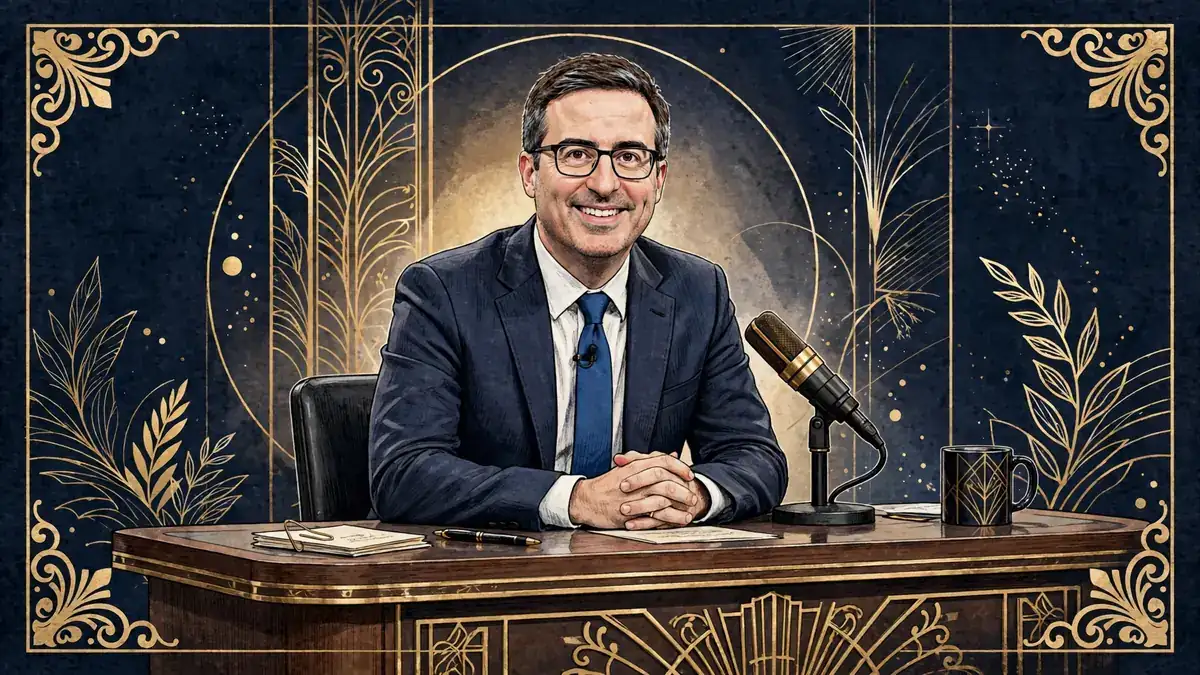
John Oliver Quick Facts
| Full Name | John William Oliver |
|---|---|
| Date of Birth | April 23, 1977 (age 49 in 2026) |
| Birthplace | Erdington, Birmingham, England |
| Estimated Net Worth | $80 million as of November 2026 (Celebrity Net Worth, July 2025 snapshot); published range $30–$80 million |
| Primary Income Source | HBO salary for Last Week Tonight — about $30 million per 30-episode season |
| Key Ventures and Works | Last Week Tonight (HBO, 2014–present), The Daily Show correspondent and guest host (2006–2013), The Bugle podcast (2005–2016), A Day in the Life of Marlon Bundo (2018 book), voice roles in The Smurfs and The Lion King (2019) |
| Awards | 10 personal Emmy Awards; Last Week Tonight has won 30-plus Emmys; Peabody Award (2018); Time 100 (2015) |
| Spouse | Kate Norley, married October 2011; two sons, born 2015 and 2018 |
| Citizenship | Became a U.S. citizen on December 13, 2019 |
Table of Contents
- John Oliver Quick Facts
- Early Life and Education in Birmingham
- The Daily Show Years: From Correspondent to Guest Host
- Last Week Tonight: The Show That Changed Late Night
- The HBO Money: Salary, Contracts and Renewals
- Where the Money Comes From: Income Streams Beyond HBO
- The Marlon Bundo Book and Other Side Projects
- Real Estate and Assets: The New York Penthouse
- Net Worth Growth: Year by Year
- How John Oliver Compares to Other Late-Night Hosts
- Personal Life: Family, Citizenship and Giving
- The 421-a Tax Break and Other Criticism
- John Oliver Net Worth FAQs
- Final Thoughts: The Bottom Line
- Sources and How We Estimated
Early Life and Education in Birmingham
John William Oliver was born on April 23, 1977, in Erdington, a suburb of Birmingham, England. His mother, Carole, taught music. His father, Jim Oliver, was a school headmaster and social worker. Nothing in that upbringing pointed toward American television stardom, and Oliver has often joked on air about how unlikely his path looks in hindsight.
He studied English at Christ’s College, Cambridge, where he served as vice president of the Cambridge Footlights, the university’s famous amateur theatre troupe. The Footlights connection mattered: it put him in a room with other young writers and performers who would shape British comedy for the next two decades, and it gave him his first regular stage time.
After Cambridge, Oliver worked the British stand-up circuit. He first appeared at the Edinburgh Festival Fringe in 2001 as part of “The Comedy Zone,” a showcase for new acts, performing in character as an oily, self-important journalist. His first solo show followed in 2002. Through 2004 and 2005 he worked on the radio show Political Animal with other politically minded performers, and he became a regular panelist on the BBC’s satirical news quiz Mock the Week. He also spent years collaborating with a loose group of comedians known as the Chocolate Milk Gang. The money in those years was modest — fringe shows, radio fees, and panel appearances — but the work built the two skills that would later make him rich: writing sharp jokes about complicated subjects, and delivering them with total confidence.
Oliver’s early career also included a long-running side project that still follows him today. In 2005 he began co-hosting The Bugle, a satirical news podcast with fellow comedian Andy Zaltzman. The show ran until 2016 and built a loyal international audience years before podcasts became a serious income stream. It also kept Oliver’s name circulating in the United States, where The Bugle had a large listenership.
The Daily Show Years: From Correspondent to Guest Host
Oliver’s break in America came in the summer of 2006. Comedian Ricky Gervais, who had never met Oliver but had seen his stand-up, recommended him to Jon Stewart. Oliver flew to New York for an interview — his first visit to the United States — and two weeks later, in July 2006, he moved to New York City to join The Daily Show with Jon Stewart as its Senior British Correspondent.
He stayed for seven years. According to Celebrity Net Worth, Oliver appeared as a correspondent on 356 episodes and worked as a writer on 962 episodes. He won Emmy Awards for outstanding writing for The Daily Show in 2009, 2011, and 2012. He also released his first stand-up special, John Oliver: Terrifying Times, on Comedy Central in 2008, and kept performing stand-up in New York clubs between tapings.
The turning point came in the summer of 2013. Stewart took two months off to direct the film Rosewater, and Oliver stepped in as guest host for 32 episodes. The reviews were glowing. Critics and viewers alike said the show had not missed a beat, and within weeks the conversation in the industry was not whether Oliver deserved his own show but who would give him one first. CBS even discussed him as a possible replacement for Craig Ferguson on The Late Show. Three months after the guest-hosting stint ended, HBO announced it would give Oliver his own weekly program.
The Daily Show years also gave Oliver his most lasting professional relationship: his partnership with Stewart, who remains one of the comedians Oliver names as a hero, alongside Armando Iannucci, David Letterman, Monty Python, Peter Cook, and Richard Pryor.
Last Week Tonight: The Show That Changed Late Night
Last Week Tonight with John Oliver premiered on HBO on April 27, 2014. The format was a deliberate break from nightly talk shows: one 30-minute episode a week, built around a long, deeply researched main segment on a single subject, with no guests plugging projects and no commercial breaks to work around. Because HBO carries no advertising, Oliver had full creative freedom to attack corporations, including companies connected to HBO’s own parent.
The show worked from the start. Early segments on net neutrality, civil forfeiture, and FIFA corruption drew millions of views on YouTube and, in the case of net neutrality, real-world consequences. In 2014, after Oliver’s segment urging viewers to comment on the Federal Communications Commission’s proposal, the FCC’s website crashed under a flood of 3.7 million comments. The FCC later enacted strong net neutrality rules, and the press began calling the phenomenon the “John Oliver effect.”
The awards piled up fast. The show has been nominated for more than 70 Emmys and won 30 or more, according to Celebrity Net Worth; HBO’s own listings counted 32 Emmy wins by February 2026. Oliver personally has won 10 Emmys — one for hosting and nine for writing. The show won a Peabody Award in 2018, and Oliver was named to the Time 100 list of the world’s most influential people in 2015. By 2026 the show had run 13 seasons and 367 episodes, making it the fifth-longest-running program in HBO history.
What makes the show unusual as a business is its efficiency. A nightly talk show tapes four or five episodes a week for most of the year. Last Week Tonight tapes about 30 episodes a season, running from February to November. That short season is exactly why Oliver’s per-episode pay looks so large next to his nightly rivals — and why HBO has been willing to keep paying it. The show delivers prestige, awards, and viral clips on a schedule that leaves Oliver time for everything else.

The HBO Money: Salary, Contracts and Renewals
Oliver’s HBO pay is the best-documented part of his finances, and it tells a clear story: a modest start, then two doublings, then a long plateau. The contract ladder below is drawn from Celebrity Net Worth, LateNighter, and The Hollywood Reporter‘s reporting on the 2026 extension.
| Period | Deal |
|---|---|
| 2014–2016 | First two-year HBO deal: $8 million per year to host Last Week Tonight |
| 2017–2020 | Three-year, $45 million extension signed September 2017: about $15 million per year, roughly doubling his pay |
| 2021–2023 | Three-year extension: $30 million per 30-episode season, about $1 million per episode, doubling his pay again |
| 2024–2026 | Three-year renewal signed December 2023: no raise, holding at about $30 million per season (the 2023 season was cut to 21 episodes by the writers’ strike) |
| 2027 | One-year extension signed July 31, 2026: show renewed through the end of 2027 for a 14th season; pay for the extra year was not disclosed |
The 2023 renewal is the most revealing deal in that ladder. According to a report by Puck’s Matthew Belloni, Oliver believed he deserved a raise and was unhappy when the new three-year deal came in at roughly the same money — or, as three sources told Puck, “about the same salary or even a slight reduction, depending on how you look at it.” Oliver reportedly parted ways with his longtime agency, WME, after the renewal. Belloni’s reporting also noted the wider context: television budgets were contracting, and HBO’s parent, Warner Bros. Discovery, was under financial strain.
The 2026 extension was different again. Instead of the usual three-year pickup, HBO signed Oliver for a single year, through the end of 2027. The Hollywood Reporter first reported the deal on July 31, 2026, and Variety confirmed it. Trade coverage linked the short deal to the uncertainty around Paramount Skydance’s proposed acquisition of Warner Bros. Discovery — a deal Oliver has criticized on air repeatedly since it was announced in September 2025. The one-year structure gives both sides room to renegotiate once the ownership picture clears.
Put the ladder together and the scale of the HBO income becomes clear. From 2014 through 2026, Oliver’s reported HBO salary alone adds up to roughly $250 million before taxes, agents’ fees, and expenses — about $16 million for the first two years, $45 million for the 2017 extension, $90 million for the 2021 extension, and $90 million for the 2024 renewal. That is gross pay, not take-home money, and it is the main reason his net worth sits where it does. It also explains why the $80 million net worth figure, while large, is far below his cumulative earnings: American taxes on top-bracket income, a 10 percent agent’s commission, management and legal fees, and a decade of New York living costs all take their share.
The number to remember: about $1 million per episode. Oliver’s $30 million season fee divided across 30 episodes is the highest per-episode rate in late night, and it has held steady since 2021 — through a renewal with no raise and into the 2027 extension.
Where the Money Comes From: Income Streams Beyond HBO
HBO is the engine, but it is not the whole story. Oliver has built income from five other directions, and together they explain why his wealth kept growing even in years when his HBO pay was flat.
Stand-up comedy. Oliver never stopped doing stand-up. He toured the UK and the US in the 2000s, released the Comedy Central special Terrifying Times in 2008, and still performs live dates between seasons of Last Week Tonight. Stand-up fees for a comedian of his standing run well into six figures per theatre date, and the specials themselves carry licensing fees. No outlet has published his touring income, so we do not put a number on it — but it is a real, recurring stream, not a hobby.
Voice acting. Oliver’s voice work has reached the biggest audiences of his career. He voiced Zazu in Disney’s 2019 remake of The Lion King, a film that grossed more than $1.6 billion worldwide, and appeared in both Smurfs films (2011 and 2013). His television voice credits include Gravity Falls, Rick and Morty, Bob’s Burgers, Randy Cunningham: 9th Grade Ninja, and a guest spot as Booth Wilkes-John in The Simpsons. On screen, he played the recurring role of Professor Ian Duncan on NBC’s Community and made his film debut in The Love Guru in 2008. Voice and acting fees for franchise films are typically paid as flat fees plus residuals, and the Lion King role alone would have carried a seven-figure fee for an actor of his profile.
Writing and producing. Oliver is credited as a writer on hundreds of Daily Show episodes and as creator, writer, and executive producer of Last Week Tonight, which carries producer fees on top of his hosting salary. In 2018 he also began work as an executive producer on HBO’s documentary series Wyatt Cenac’s Problem Areas. Producing credits on HBO series typically pay separate fees from on-camera work.
Podcasting. The Bugle, co-hosted with Andy Zaltzman from 2005 to 2016, was one of the earliest successful comedy podcasts. It ran for more than a decade and built a paying live-show audience. Podcast advertising and live tours were still a young market in those years, so the money was smaller than today’s podcast deals — but it kept Oliver visible in the US and UK at the same time, which fed directly into the Daily Show job.
Books. The Marlon Bundo book is covered in its own section below, but it deserves a line here too: a number-one Amazon bestseller that sold 180,000 copies in its first two days is a genuine income event, even with all proceeds donated to charity. The book also raised Oliver’s profile well beyond late night, which feeds back into his negotiating position with HBO.
What Oliver notably does not do is also worth recording. He has no major endorsement deals, no product line, and no reported investments in startups or property beyond his own home. Unlike many celebrities of his wealth, his money comes almost entirely from work he does himself — writing, hosting, performing — rather than from brands paying to use his name.
The Marlon Bundo Book and Other Side Projects
On the March 18, 2018 episode of Last Week Tonight, Oliver announced a surprise children’s picture book: Last Week Tonight with John Oliver Presents A Day in the Life of Marlon Bundo. It was written by show writer Jill Twiss and illustrated by E.G. Keller, and it told the story of Vice President Mike Pence’s family rabbit, Marlon Bundo, falling in love with another male rabbit named Wesley. It was a direct parody of a children’s book the Pence family had published the same week, Marlon Bundo’s A Day in the Life of the Vice President, written by Pence’s daughter Charlotte and illustrated by his wife, Karen.
The book was a publishing event. It hit number one on Amazon’s bestseller list on its first day, sold out its first printing within a day, and sold 180,000 copies in its first two days, according to figures Oliver shared on Late Night with Seth Meyers. Publisher Chronicle Books went back to press for 400,000 more copies. The book even outsold James Comey’s memoir A Higher Loyalty in its first week. All proceeds went to two charities: The Trevor Project, which works on crisis intervention for LGBTQ young people, and AIDS United.
Oliver has a habit of turning show segments into real-world projects, and the book sits alongside the two most famous examples. In August 2015 he founded and legally incorporated his own church, Our Lady of Perpetual Exemption, to show how easily a group could qualify as a church and claim tax-exempt status in the United States. In June 2016 he bought more than $15 million of medical debt owed by over 9,000 people for about $60,000, then forgave it all on air — the largest giveaway in television history at the time.
The most recent example came in November 2025. On the November 2 episode of Last Week Tonight, Oliver launched “Cabernet SauvignJohn,” a limited-edition wine, and announced it would be sold at a financial loss, with $50,000 of the proceeds going to 16 food banks in California. The online inventory sold out in less than a day, according to LateNighter. These stunts cost Oliver money rather than making it — but they are part of why his audience trusts him, and that trust is the asset HBO keeps paying for.

Real Estate and Assets: The New York Penthouse
The one major asset Oliver owns that is a matter of public record is his New York home. In May 2017, Oliver and his wife Kate paid just under $10 million — about $9.5 million — for a penthouse apartment in Manhattan, according to Celebrity Net Worth. They paid roughly half in cash and financed the rest through J.P. Morgan.
The apartment sits atop a 40-story building and offers just over 3,000 square feet of living space across eight rooms, including four bedrooms, with a private terrace overlooking the city skyline and the Hudson River. The building’s amenities run to a 40,000-square-foot athletic club, a 75-foot indoor pool, a 40-foot indoor rock climbing wall, a bowling alley, and basketball courts. The monthly building fee is about $3,700.
No other property purchase by Oliver has been reported. He has no reported car collection, no private jet, and no second home on the public record. For a celebrity worth an estimated $80 million, that is a notably thin asset list — and it fits the picture of a man whose wealth is mostly held in cash, investments, and future earnings rather than in showy purchases. Oliver has never spoken publicly about his investment portfolio, and no filings disclose one, so we do not guess at its contents.
Net Worth Growth: Year by Year
Oliver’s wealth grew in steps that track his HBO contracts almost exactly. The table below is our own reconstruction from the reported salary ladder and the published net worth estimates — the figures are estimates, not filings, and the range column shows where the sources disagree.
| Year | What changed | Published estimate |
|---|---|---|
| 2006 | Joins The Daily Show; moves to New York | Under $1 million (no published estimate; early-career comedian) |
| 2013 | Guest-hosts The Daily Show for 32 episodes; HBO offers him his own show | Low single-digit millions (no published estimate) |
| 2014 | Last Week Tonight premieres; first HBO deal pays $8 million a year | About $5–$10 million (TheRichest’s old $1 million figure dates from this era and is now stale) |
| 2017 | Three-year, $45 million HBO extension; buys the $9.5 million penthouse | $10–$20 million |
| 2018 | Marlon Bundo book sells 180,000 copies in two days | $20–$25 million (TheMost10 puts 2024 at $20 million on a rising curve) |
| 2021 | HBO pay doubles to $30 million per season — about $1 million per episode | $40–$50 million (Celebily cites $50 million; TheCelebWiki puts $40 million) |
| 2024 | December 2023 renewal holds pay flat at $30 million a season | $50–$80 million |
| 2026 | One-year HBO extension through the end of 2027; show enters its 13th season | $80 million (Celebrity Net Worth, July 2025 snapshot); some bio sites still list $30–$40 million |
Two things stand out in that timeline. First, the biggest jump in Oliver’s wealth came from the 2021 contract, not from any single project — the doubling of his HBO pay from $15 million to $30 million a year is what moved him from the $20 million range into the $40–$50 million range. Second, the gap between the top and bottom published estimates has stayed wide for years: $30 million on the low end, $80 million on the high end. That spread exists because Oliver’s finances are private. There are no public filings, no company accounts, and no property portfolio to count. Every outlet is doing the same rough math — reported salary, minus tax, minus fees, plus a home — and reaching a different answer.
Our judgment, after weighing the sources: the $80 million figure is the best anchor because it comes from the most recent update (July 2025) by the outlet that tracks his contract in the most detail, and because the salary ladder supports it. A comedian who has earned roughly $250 million gross from HBO alone since 2014, with modest spending habits and one major property purchase, can plausibly hold $80 million after tax and fees. The lower figures, $30 million to $40 million, come from biography sites that appear to use older salary data and predate the 2021 pay doubling. Readers should treat $80 million as the headline estimate and $30–$80 million as the full published range.
How John Oliver Compares to Other Late-Night Hosts
Oliver’s deal is unusual in late night, and the comparison that matters most is not net worth but pay per episode. StreamDiag‘s January 2026 ranking of late-night hosts lists Oliver as the highest-paid host in the format, with a $30 million annual salary and an $80 million net worth. The reason is arithmetic, not fame: a nightly host tapes 150 or more episodes a year, while Oliver tapes about 30. His $1 million per episode is a product of scarcity — HBO buys a small number of long, expensive, deeply researched episodes instead of a nightly volume play.
The other hosts in that ranking — Stephen Colbert, Jimmy Fallon, Jimmy Kimmel, and Seth Meyers — all work nightly schedules with larger writing staffs, bigger studios, and far more airtime to fill. Their annual salaries are reported in the same broad range as Oliver’s, but spread across five times as many episodes. Oliver’s weekly format also gives him something they do not have: a research team that spends a full week on a single subject, and a show whose segments are watched as standalone videos for years after they air. The net neutrality segment from 2014, the Miss America investigation, and the medical-debt episode still draw views a decade later. That long tail is part of what HBO is paying for.
There is one more comparison worth making, and it is the one Oliver himself would probably point to: his show’s influence. No other late-night host has crashed a federal agency’s website, forced a beauty pageant to answer questions about its scholarship claims, or had a church incorporated on air to prove a point about tax law. The “John Oliver effect” is not a figure on a balance sheet, but it is the reason his contract keeps getting renewed — and the reason a one-year extension in 2026, rather than a three-year deal, was news at all.
Personal Life: Family, Citizenship and Giving
Oliver married Kate Norley, an Iraq War veteran, in October 2011. The couple have two sons, born in 2015 and 2018. Oliver keeps his family almost entirely out of the public eye — his wife and children rarely appear in coverage, and he almost never discusses them on the show beyond brief mentions.
On December 13, 2019, Oliver became a United States citizen. He has spoken on air about the process, including the citizenship test and the ceremony, in his usual style: treating a bureaucratic milestone as comedy material while making clear it mattered to him. He was born British, worked in the US on a visa for more than a decade, and now holds dual citizenship.
His giving is closely tied to his show. The medical-debt forgiveness in 2016 — $15 million of debt bought for $60,000 and written off for more than 9,000 people — remains the most memorable example. The Marlon Bundo book sent all of its proceeds to The Trevor Project and AIDS United. The Cabernet SauvignJohn wine in 2025 sent $50,000 to 16 California food banks. None of these were tax maneuvers or publicity stunts in the usual sense: each was built into the show itself, and each cost Oliver money rather than making it.
Oliver’s public image is unusually clean for a comedian of his profile. He has no reported legal disputes, no public feuds with other comedians, and no tabloid scandals. The closest thing to a controversy is the tax matter covered in the next section — and even that was a story about a legal loophole, not about wrongdoing.
The 421-a Tax Break and Other Criticism
The one episode that drew sustained criticism of Oliver’s personal finances was his own penthouse purchase. When Oliver and his wife bought the apartment in May 2017, they used New York’s 421-a tax exemption, a program meant to encourage residential development. Under the exemption, their unit was assessed for property-tax purposes at $1.3 million instead of its roughly $9.5 million purchase price, cutting their annual property tax bill from $66,390 to $27,343, according to Celebrity Net Worth.
The irony was hard to miss, and the press did not miss it: Oliver had spent a July 2014 segment attacking tax loopholes that benefit the wealthy, saying, “At this point, the rich are just running up the score.” Three years later he was using one himself. The exemption was entirely legal, and the building’s developer — not Oliver — had set it up. But the story stuck because it cut against the show’s brand. Oliver has not publicly addressed the tax break on the show, and there is no suggestion he broke any law. It remains, though, the single most cited criticism of his personal finances, and it is worth including in any honest account of his wealth.
Beyond that, criticism of Oliver tends to focus on the show rather than the man: arguments that his segments oversimplify complex subjects, or that his style of comedy blurs the line between entertainment and journalism. Oliver himself has always said he is a comedian, not a journalist — even as media researchers argue his show performs real investigative work. Neither side of that debate affects his net worth, but it does explain why his show keeps getting renewed: the argument itself keeps people watching.
John Oliver Net Worth FAQs
What is John Oliver’s net worth in 2026?
John Oliver’s net worth is estimated at $80 million as of November 2026, according to Celebrity Net Worth’s snapshot updated in July 2025. Published estimates across all outlets range from $30 million to $80 million; the lower figures come from biography sites using older salary data, while the $80 million figure reflects his current HBO pay of about $30 million per season.
How much does John Oliver make per year from HBO?
John Oliver earns about $30 million per 30-episode season of Last Week Tonight, which works out to roughly $1 million per episode. That rate has held since his 2021 contract extension; his December 2023 renewal kept the same pay, and the terms of his July 2026 one-year extension were not disclosed.
How long is John Oliver’s HBO contract?
John Oliver’s current HBO deal runs through the end of 2027. He signed a three-year renewal in December 2023 that covered seasons 11 through 13, then a one-year extension on July 31, 2026 that adds a 14th season. The one-year deal was shorter than his usual three-year renewals, which trade coverage linked to uncertainty over Warner Bros. Discovery’s ownership.
How much does John Oliver make per episode?
About $1 million per episode. His reported $30 million season fee is divided across roughly 30 episodes a year, giving him the highest per-episode rate in late-night television. Nightly hosts tape far more episodes, so their per-episode pay is much lower even when their annual salaries are similar.
How did John Oliver make his money?
Almost all of it comes from television. His HBO salary for Last Week Tonight is the main source — about $250 million gross across his contracts from 2014 through 2026 — built on seven years at The Daily Show before that. Smaller streams include stand-up touring, voice roles in The Lion King (2019) and the Smurfs films, the Marlon Bundo book, and his long-running Bugle podcast. He has no major endorsement deals.
What is the Marlon Bundo book?
A Day in the Life of Marlon Bundo is a children’s picture book John Oliver’s team published in March 2018, written by Last Week Tonight writer Jill Twiss and illustrated by E.G. Keller. It parodied a book by Vice President Mike Pence’s family about their rabbit, and it hit number one on Amazon, selling 180,000 copies in its first two days. All proceeds went to The Trevor Project and AIDS United.
Where does John Oliver live?
John Oliver lives in New York City. In May 2017 he and his wife Kate paid just under $10 million — about $9.5 million — for a penthouse in Manhattan with just over 3,000 square feet, four bedrooms, and a private terrace overlooking the Hudson River. They paid roughly half in cash and financed the rest through J.P. Morgan.
Is John Oliver married and does he have children?
Yes. John Oliver married Kate Norley, an Iraq War veteran, in October 2011, and they have two sons, born in 2015 and 2018. Oliver became a U.S. citizen on December 13, 2019, and keeps his family almost entirely out of the public eye.
Final Thoughts: The Bottom Line
John Oliver’s $80 million net worth is the product of one of the most straightforward deals in television: a weekly show, a short season, and a per-episode rate no nightly host can match. His HBO contracts alone account for roughly $250 million in gross pay since 2014, and the 2026 extension through the end of 2027 means that stream keeps running. The lower estimates floating around — $30 million, $40 million — look stale next to the salary ladder: they predate the 2021 doubling that took his pay to $30 million a season.
What makes Oliver’s fortune different from most celebrity wealth is how little of it comes from anything other than the work itself. No endorsements, no product lines, no reported startup bets. The money comes from writing, hosting, and performing — and from a show whose segments still earn views a decade after they air. If HBO renews him again after 2027, the number climbs. If it does not, a decade of $30 million seasons has already done its work.
Sources and How We Estimated
How we estimated: John Oliver’s finances are private — there are no public filings, company accounts, or disclosed investment portfolios. Our headline figure of $80 million is anchored to Celebrity Net Worth‘s profile, updated July 18, 2025, the most recent detailed snapshot available. We checked that figure against other published estimates — BiographyKind ($30–$40 million), TheCelebWiki ($40 million), Celebily ($50 million), StreamDiag ($80 million, January 2026), and TheMost10 ($25 million) — and report the full published range of $30–$80 million. Salary figures come from Celebrity Net Worth’s contract reporting, cross-checked against LateNighter and The Hollywood Reporter for the December 2023 renewal and the July 31, 2026 one-year extension. Book sales figures come from Shelf Awareness and Bustle‘s March 2018 reporting. Real estate details come from Celebrity Net Worth. TheRichest‘s $1 million figure is an old, stale estimate from the early 2010s and was not used. Estimates may differ from private reality; where sources disagree, we show the range rather than picking the most flattering number.
Sources consulted: Celebrity Net Worth · LateNighter · The Hollywood Reporter · Variety · StreamDiag · Shelf Awareness · Bustle · Wikipedia (Last Week Tonight) · BiographyKind · TheCelebWiki · Celebily · TheMost10