By Celebamerica Editorial Staff | Last updated: November 17, 2026
Cristiano Ronaldo is 6 feet 2 inches tall — 187 cm — according to the figure carried by most major football databases, including Sofascore and Sports Illustrated. One listing, UEFA’s own player profile, gives 185 cm instead, so the honest answer is a tight range of 185–187 cm, with 187 cm (6 ft 2 in) as the anchor. That height, paired with a vertical leap measured at around 78 cm, is the physical foundation of the most feared heading game football has ever seen — and it is one of the clearest edges he holds over his great rival Lionel Messi, who stands 5 ft 7 in (170 cm).
This page settles the number with per-source detail: the exact conversions, why two centimetres keep showing up in different places, how Ronaldo’s height stacks up against Messi, Neymar, Mbappé, Kane and Haaland, and how those 187 centimetres turned into 153 headed goals. It also carries a short, sourced look at where his career and fortune stand in November 2026 — still scoring for Al Nassr at 41, fresh off a decision that closed one of the great international careers in the sport’s history.
| Full Name | Cristiano Ronaldo dos Santos Aveiro |
|---|---|
| Date of Birth | 5 February 1985, Funchal, Madeira, Portugal |
| Age | 41 (as of November 2026) |
| Height | 6 ft 2 in / 187 cm (UEFA lists 185 cm; range 185–187 cm) |
| Weight | About 83 kg (183 lbs) |
| Current Club | Al Nassr (Saudi Pro League), contract to June 2027 |
| Position | Forward / striker |
| Career Goals | 985 senior goals for club and country (as of 29 October 2026), 15 short of 1,000 |
| Headed Goals | 153 (as of February 2025, per Sports Illustrated) |
| Estimated Net Worth | About $1.2 billion (Forbes, June 2026); Bloomberg carries him nearer $1.4 billion |
| Primary Income Sources | Al Nassr salary, endorsements (notably Nike), CR7 businesses and licensing |
| Key Honours | 5 Ballon d’Or awards, 5 UEFA Champions League titles, UEFA Euro 2016 with Portugal |
Table of Contents
- How Tall Is Cristiano Ronaldo?
- The 185 cm vs 187 cm Question, Explained
- Ronaldo vs Messi: The 17 cm Gap
- How Ronaldo’s Height Compares With Other Stars
- How His Height Powers His Heading Game
- From Skinny Teenager to a 6 ft 2 in Athlete
- Early Life in Madeira
- Career at a Glance
- What He Is Worth in 2026
- Personal Life and Family
- Frequently Asked Questions
- Final Thoughts
- Sources and Reporting
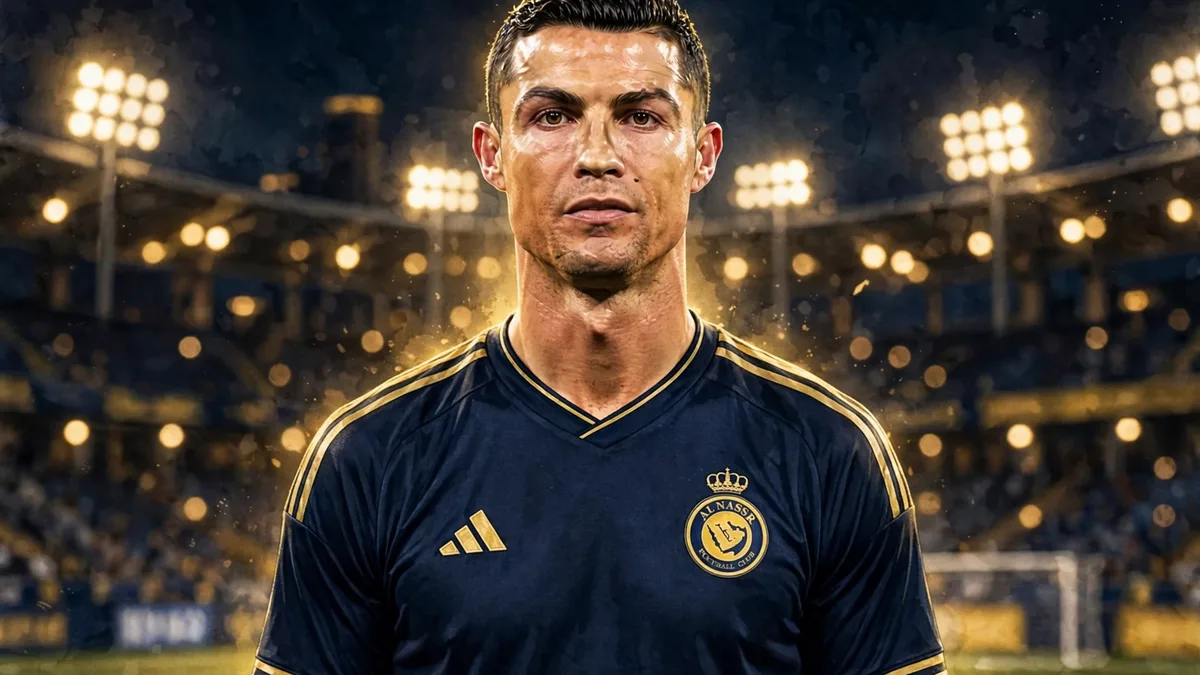
How Tall Is Cristiano Ronaldo?
Cristiano Ronaldo is listed at 6 feet 2 inches (187 cm). That is the figure on his player profiles at Sofascore and FotMob (FotMob gives 188 cm on some pages, a one-centimetre rounding difference), in Sports Illustrated’s player data, and across the football databases that feed the EA Sports games — his EA FC cards have carried 6’2″ / 187 cm for years. Wikipedia’s player infobox gives 1.87 m. In other words, almost every place a fan would look gives the same answer.
The conversions are straightforward. Six feet two inches is 74 inches, which converts to 187.96 cm — sources round that down to 187 cm. In metres, that is 1.87 m. In feet alone, 6.17 ft. And for readers who think in inches, 187 cm is 73.6 inches.
| Unit | Ronaldo’s height |
|---|---|
| Feet and inches | 6 ft 2 in |
| Centimetres | 187 cm (range 185–187 cm across sources) |
| Metres | 1.87 m |
| Inches | 74 in (187 cm = 73.6 in) |
Where does 187 cm sit in context? The average adult man in Portugal stands around 173 cm, so Ronaldo is roughly 14 cm taller than the average man back home. Among professional footballers, forwards tend to cluster around 180–183 cm, so he is a few centimetres above the norm for his position — tall enough to dominate in the air, not so tall that it costs him the agility that built his game. That balance is part of the story: at 6 ft 2 in he is big enough to win headers against most centre-backs and still quick enough, across two decades, to beat full-backs off the dribble.
His listed weight sits alongside the height at about 83 kg (183 lbs), a figure that has barely moved in years. The two numbers together — 187 cm and 83 kg — describe a body fat percentage that has been reported at around 7 percent, far below the average for a professional footballer. The height gets the attention, but the pairing of height with that kind of conditioning is what turned a physical profile into a weapon.
The 185 cm vs 187 cm Question, Explained
If you have ever seen Ronaldo listed at 185 cm, you are not looking at a mistake — you are looking at UEFA. The governing body’s player profile for Ronaldo gives 185 cm, two centimetres below the 187 cm carried by Sofascore, Sports Illustrated, FotMob and most club registrations. A few early-career listings also gave 186 cm, and some pages have carried 189 cm at various points. The spread is small, and the reasons for it are ordinary.
First, football heights are registration figures, not fresh barefoot measurements. A player is measured once — often as a teenager — and the number follows him from club to club, with each new database either copying it, converting it from feet and inches, or rounding it. Six feet two inches converts to 187.96 cm; a source that truncates rather than rounds lands on 187 cm, while a source that started from a metric measurement of 1.85 m and converted the other way lands on 6 ft 1 in. The two-centimetre gap between UEFA’s 185 cm and the common 187 cm is exactly the kind of drift that happens when imperial and metric figures get passed between systems for twenty years.
Second, time of day and footwear matter at the margins. A person’s height varies by up to a centimetre or two between morning and evening as the spine compresses, and a listing taken in boots or trainers adds another centimetre. None of this changes the order of magnitude: every mainstream listing puts Ronaldo at 185–187 cm, and the weight of the evidence — the majority of databases, his club registrations at Manchester United, Real Madrid, Juventus and Al Nassr — sits at 187 cm.
For this article, 187 cm (6 ft 2 in) is the anchor figure, and the 185 cm UEFA listing is the honest footnote. Anyone who tells you the answer is exactly one number, with no variation anywhere, is tidying up a messier reality than the records support.
The short version: Ronaldo is 6 ft 2 in (187 cm) in almost every listing that matters. UEFA says 185 cm. The true figure sits in the 185–187 cm range, and 187 cm is the number to use.
Ronaldo vs Messi: The 17 cm Gap
The most-searched height comparison in football is Ronaldo against Lionel Messi, and the numbers are not close. Messi is listed at 5 ft 7 in (170 cm) — 17 cm shorter than Ronaldo’s 187 cm, a gap roughly the length of a standard pencil, and one of the most quoted measurements in the whole GOAT debate.
The gap shows up everywhere the two shared a pitch. In El Clásico years, Real Madrid’s set-piece routines were built around Ronaldo attacking the far post while Barcelona’s were built around Messi receiving the ball to feet and running at defenders. Neither approach was an accident: a 17 cm difference changes what a player can do. Ronaldo wins the ball in the air; Messi keeps it on the ground, where a low centre of gravity makes him harder to knock off balance. Both men built their games around the body they were given, and both bodies produced numbers no one else has matched.
It is worth saying plainly that the height gap has never settled the debate about who is better. Messi has won eight Ballon d’Or awards to Ronaldo’s five; Ronaldo is the all-time top scorer in men’s international football and in the Champions League. The 17 cm is a fact about their bodies, not a verdict on their careers — but it is a fact that shapes how each of them plays, and it is why “how tall is Ronaldo compared to Messi” is asked millions of times a year.
The comparison also runs the other way in the air. Messi has scored headed goals — his looping header in the 2009 Champions League final against Manchester United is one of the most famous of his career — but heading has never been a central part of his game. For Ronaldo it is a signature: 153 headed goals by February 2025, per Sports Illustrated, a total no other modern forward approaches. The height difference is the starting point of that gap, and the leap is the rest of it.
If you want the same treatment of the other side of the rivalry, our profile of Lionel Messi’s height breaks down his 5 ft 7 in listing the same way, including the growth-hormone treatment he received as a boy in Rosario — a very different height story from Ronaldo’s.
How Ronaldo’s Height Compares With Other Stars
Ronaldo is tall for a forward, but he is not the tallest star in the game. Erling Haaland, the Norwegian striker, is listed at 6 ft 5 in (195 cm) — eight centimetres taller than Ronaldo — and plays like it, a pure penalty-box presence. Harry Kane, England’s captain, is listed at 6 ft 2 in (188 cm), essentially level with Ronaldo. Kylian Mbappé is 5 ft 10 in (178 cm), nine centimetres shorter. Neymar is 5 ft 9 in (175 cm), twelve centimetres shorter. Robert Lewandowski is 6 ft 1 in (185 cm), two centimetres shorter.
| Player | Height |
|---|---|
| Erling Haaland | 6 ft 5 in / 195 cm |
| Harry Kane | 6 ft 2 in / 188 cm |
| Cristiano Ronaldo | 6 ft 2 in / 187 cm |
| Robert Lewandowski | 6 ft 1 in / 185 cm |
| Kylian Mbappé | 5 ft 10 in / 178 cm |
| Neymar | 5 ft 9 in / 175 cm |
| Lionel Messi | 5 ft 7 in / 170 cm |
What the table shows is that Ronaldo sits in a sweet spot. Haaland’s extra eight centimetres make him a bigger aerial target, but Haaland has never matched Ronaldo’s headed-goal output, because heading is not only about height — it is about timing, hang time, and the leap. Mbappé and Neymar, both shorter, built their games on pace and close control rather than the air. Kane, at the same height as Ronaldo, is a fine header of the ball but has never made it the defining feature of his game the way Ronaldo has.
That is the point the comparisons keep missing: height is a raw material, not a result. Ronaldo’s 187 cm matters because of what he did with it — two decades of work on his leap, his timing, and his body. A taller player who cannot time a jump is less dangerous in the air than a 187 cm player who can hang there.
For the same kind of breakdown on the other names in the table, see our profiles of Kylian Mbappé’s height, Erling Haaland’s height and Harry Kane’s height, and Neymar’s age profile for the Brazilian’s career numbers at the same stage of life.

How His Height Powers His Heading Game
Start with the number that stops people: 153. That is how many headed goals Ronaldo had scored by February 2025, according to Sports Illustrated — more than most strikers manage in total across a whole career, and a figure that makes him the greatest header of the ball the modern game has produced. The height is the first ingredient; the leap is the second; the timing is the third.
The most famous single header of his career came in December 2019, playing for Juventus against Sampdoria. Ronaldo met a cross at a contact point measured at 2.56 metres off the ground — higher than the crossbar, which sits at 2.44 metres — after a vertical jump measured at 71 cm on that play, and he seemed to hang in the air for roughly a second and a half before heading the winner. Photographs of the moment, with his knees level with the defenders’ heads, travelled around the world. At 187 cm, with a jump like that, his head reaches heights a 185 cm defender standing flat-footed simply cannot contest.
That was not a one-off. In 2013, in a Champions League tie against Manchester United, Ronaldo rose to meet a cross with his head measured at around 2.93 metres — 9 ft 6 in — off the ground, a leap that left Patrice Evra, the defender marking him, standing underneath him. Real Madrid’s medical staff reportedly measured his vertical leap at 78 cm (about 31 inches) during his time at the club, a figure in the range of an NBA guard rather than a footballer. For comparison, the average vertical leap for a professional footballer is usually given at around 50–60 cm.
The mechanics are simple once they are laid out. A 187 cm player with a 78 cm vertical leap can make contact with the ball at around 2.65 metres — comfortably above the crossbar — and, because his legs are long, his stride and his jump combine to give him time in the air to pick his spot. Defenders who match him for height cannot match the leap; defenders who can jump cannot match the height; and very few can match both. That is why crosses aimed at the far post became a set-piece staple at every club he played for, from Manchester United to Real Madrid to Juventus to Al Nassr.
There is also a less obvious benefit. Height gives a striker a longer stride, and Ronaldo’s stride length has always been part of his counter-attacking threat — fewer steps to cover the same ground, which matters when a team breaks at speed. And in the penalty area, 187 cm makes him a target for long balls and clearances, a release valve when his team is under pressure. His teams have used him that way for twenty years.
None of this happened by accident. Ronaldo’s heading was not a gift of birth — at 18, when he arrived at Manchester United, he was a winger who beat men with stepovers, not a centre-forward who attacked crosses. The transformation into an aerial threat was trained: hours of work on his jump, his core strength, and his timing, built on top of a frame that had grown into 6 ft 2 in. The height gave him the ceiling; the work raised the floor.
From Skinny Teenager to a 6 ft 2 in Athlete
The Ronaldo who arrived at Manchester United in the summer of 2003 was not the physical specimen of today. He was 18, slight, all elbows and stepovers, a winger who tried to beat the same man three times. Sir Alex Ferguson’s staff set about rebuilding his body: gym work, a strict diet, and a training regime that added muscle to the frame without taking away the pace. Over the next six years his body filled out into the 187 cm, 83 kg athlete the world now knows, and his game moved with it — from the wing into central areas, from dribbling past men to arriving in the box to finish.
That physical rebuild is one of the most documented transformations in sport. By his final season at United he was winning headers against centre-backs; by his Real Madrid years he was the most complete goalscorer in the game, scoring with either foot, from distance, from free kicks, and — more than anyone — with his head. The 2008 Champions League final, when he rose above Chelsea’s defence to head United in front, was the early announcement of what the heading game would become.
The maintenance has been just as disciplined as the build. Ronaldo’s training routine — famously built around short, intense gym sessions, swimming, pilates work, and a diet of fish, chicken, vegetables and water, with little alcohol and strict sleep — is the reason the body has held up into his forties. At 41, in November 2026, he is still scoring for Al Nassr in the Saudi Pro League, and his listed height and weight have barely moved in a decade. That is not a coincidence; it is the product of a daily routine that has been reported on, in detail, for twenty years.
There is a useful contrast here with the other great of his generation. Messi’s height story runs the other way: a growth-hormone deficiency diagnosed in childhood, treatment funded first by his family and then by Barcelona, and a final height of 170 cm that he turned into the lowest centre of gravity in elite football. Ronaldo’s story is the opposite — a frame that grew tall and was then engineered, year after year, into a weapon. Both men won everything. Neither body was an accident.
Early Life in Madeira
Cristiano Ronaldo dos Santos Aveiro was born on 5 February 1985 in Funchal, the capital of Madeira, a Portuguese island in the Atlantic. He grew up in the Santo António parish, the fourth child of Maria Dolores dos Santos Aveiro, a cook, and José Dinis Aveiro, a municipal gardener and part-time kit man at the local club Andorinha. Money was short; the family lived in a small tin-roofed house, and Ronaldo has spoken openly about sharing a bedroom with his siblings and about his mother considering, in difficult circumstances, not carrying the pregnancy to term — a story she told in her own memoir.
Football was the escape from the start. He played in the streets with a ball made of whatever was at hand, joined Andorinha at seven, then moved to Nacional, Madeira’s bigger club, where his talent was obvious enough that Sporting CP — one of Portugal’s big three — brought him to Lisbon at 12. Leaving home that young was hard; he has described crying on the phone to his family and struggling with the Lisbon accent of his teammates, who teased him for his Madeiran dialect. He stayed, and within a few years he was the first player in Sporting’s history to play for the under-16, under-17, under-18, B team and first team in a single season.
At 15, doctors found he had a racing heart — tachycardia — and he underwent laser surgery to correct it. He was back training days later. He made his first-team debut for Sporting at 17, in 2002, and within a year, after a friendly in which he tormented Manchester United’s defence, United signed him for £12.24 million in August 2003. He was 18. The skinny winger from Funchal was on his way to becoming the most famous athlete on the planet.
Career at a Glance
Ronaldo’s club career is the most decorated of any outfield player of his generation: Sporting CP, Manchester United (twice), Real Madrid, Juventus, and Al Nassr. At Real Madrid, between 2009 and 2018, he became the club’s all-time top scorer with 450 goals in 438 games, won four Champions League titles, and scored in three finals. At Juventus he won two Serie A titles. Back at United in 2021 he scored 24 goals in his first season back, at 36 and 37 years old. In January 2023 he moved to Al Nassr in Saudi Arabia, a move that opened the floodgates for the Saudi Pro League’s recruitment of Europe’s stars.
| Club | Years |
|---|---|
| Sporting CP | 2002–2003 |
| Manchester United | 2003–2009 |
| Real Madrid | 2009–2018 |
| Juventus | 2018–2021 |
| Manchester United | 2021–2022 |
| Al Nassr | 2023–present (contract to June 2027) |
For Portugal, the story is just as large. He is the all-time top scorer in men’s international football, with 146 goals, and the most-capped men’s player in history. He captained Portugal to the Euro 2016 title — their first major trophy — and to the inaugural Nations League title in 2019. Then, on 5 November 2026, he announced his retirement from international football, ending a 23-year run with Portugal that produced a record 234 caps and 146 goals. He is not finished as a footballer: he keeps playing club football for Al Nassr, and he is 15 goals short of 1,000 in his senior career, a total no man has ever reached in official senior football.
The individual honours fill a room on their own: five Ballon d’Or awards, four European Golden Shoes, the Champions League’s all-time top scorer with 140 goals, and the record for the most goals in a single Champions League season (17, in 2013–14). He has scored more than 950 official senior goals for club and country, and as of 29 October 2026 the count stood at 985 — 839 for his clubs and 146 for Portugal. The 1,000-goal chase, which he has spoken about openly, is the last great milestone in front of him.
Ronaldo’s career in numbers, year by year, is covered in depth in our profile of Cristiano Ronaldo’s age and career timeline, which tracks him from the Madeira streets to 41 years old and still scoring. Readers who want the full arc — every club, every record, every season — will find it there.
What He Is Worth in 2026
A height profile is not a net-worth profile, but Ronaldo’s money is so large that it is part of the story of his longevity. Forbes valued his fortune at about $1.2 billion in June 2026, when it added him to its World’s Billionaires list for the first time. Bloomberg’s Billionaires Index, which first called him football’s first billionaire in October 2025, carries him nearer $1.4 billion. The range reflects the two organisations’ different methods, not a disagreement about the direction: by either measure, he is the first footballer to become a billionaire, and the richest footballer who has ever lived.
The engine is the Al Nassr contract. In June 2025 he signed a two-year extension keeping him at the club until June 2027, a deal widely reported at around €200 million (roughly $215 million) per year — the most lucrative contract in sports history. Forbes estimates he earned about $300 million in the 12 months to May 2026, around $235 million on the field and $65 million off it, making him the highest-paid athlete in the world for the fourth year running. His career earnings now stand at about $2.09 billion before taxes and agent fees, according to Forbes’ October 2026 ranking — the highest total of any athlete in history.
Off the pitch, the CR7 brand — underwear, fragrance, footwear, hotels in partnership with Pestana, gyms and a hair-transplant clinic business — plus a lifetime Nike deal and endorsements with brands such as Herbalife and Clear, add tens of millions a year. He is also the most-followed person on Instagram, an audience of more than 600 million that makes every post he publishes a commercial asset in its own right. The full breakdown of his fortune, his contracts and his business empire is set out in the Cristiano Ronaldo net worth breakdown on GuideNetWorth, which walks through the Forbes and Bloomberg estimates and the Al Nassr money in depth.
For a second angle on the same figures, NetWorthCraft’s Cristiano Ronaldo net worth profile covers the contract history and the endorsement portfolio from the ground up. Both are worth reading alongside this page if the money side is what brought you here — the headline is the same on all three sites: roughly $1.2 billion on the Forbes measure, nearer $1.4 billion on Bloomberg’s, and no other footballer within touching distance.
One caution is worth repeating, because it applies to every net-worth figure on the internet: these are estimates built from public reporting — contracts, filings, endorsements and asset purchases — not audited accounts. The range between Forbes and Bloomberg is honest, and any site that gives you a single figure to the dollar is pretending to know more than it does.
Personal Life and Family
Ronaldo’s private life has been as public as his career. His long-term partner is Georgina Rodríguez, a Spanish model and influencer he met in Madrid in 2016; the two have been together since, and Rodríguez has become a public figure in her own right, with a Netflix documentary series about her life. Together they have two daughters, Alana Martina (born 2017) and Bella Esmeralda (born 2022). Ronaldo also has three older children: his eldest son Cristiano Jr. (born 2010), and twins Eva and Mateo (born 2017).
The family has known grief as well as celebration. In April 2022, Ronaldo and Rodríguez announced that one of their newborn twins, a baby boy named Ángel, had died during childbirth, while his twin sister Bella survived. Ronaldo’s statement at the time — that the loss was “the greatest pain that any parents can feel” — was shared around the world, and the football community’s response, including a minute’s applause at Anfield the following week, was one of the most affecting moments of that season.
His father, José Dinis Aveiro, died in 2005, when Ronaldo was 20 and in his second season at Manchester United, after a long struggle with alcohol. Ronaldo has said his father never saw him become the player he became, and the loss still shapes him: his mother, Maria Dolores, remains a central figure in his life and travels with the family, and his siblings — brother Hugo and sisters Elma and Katia — are part of a close family circle that has stayed with him from Madeira to Manchester to Riyadh.
Off the field, the public image is carefully managed: the CR7 brand, the hotels, the social media presence, and a stream of endorsements that make him one of the most marketable athletes alive. What is less often noted is the charitable work — he has donated to children’s hospitals in Portugal, funded cancer treatment for children, and given blood regularly, declining tattoos in part because blood donation rules in some countries restrict donors with tattoos. The height, the leap and the goals are the public story; the family in Madeira and the five children are the private one.
Frequently Asked Questions
How tall is Cristiano Ronaldo exactly?
Cristiano Ronaldo is listed at 6 feet 2 inches (187 cm) by most major football databases, including Sofascore and Sports Illustrated. UEFA’s player profile lists 185 cm, so the honest range is 185–187 cm, with 187 cm as the anchor figure used across his club registrations.
How tall is Ronaldo in cm and feet?
Ronaldo is 187 cm tall, which is 1.87 metres, 6 feet 2 inches, or 74 inches. In feet alone that is about 6.17 ft. The figure converts to 187.96 cm exactly, which sources round down to 187 cm.
Is Ronaldo taller than Messi?
Yes, by 17 cm. Ronaldo is 6 ft 2 in (187 cm) and Lionel Messi is 5 ft 7 in (170 cm). The gap is one of the most quoted numbers in the rivalry between the two players, and it shapes their games: Ronaldo dominates in the air, while Messi’s lower centre of gravity helps his dribbling.
How high can Ronaldo jump?
Real Madrid’s medical staff reportedly measured Ronaldo’s vertical leap at around 78 cm (about 31 inches). His most famous header, against Sampdoria in December 2019, made contact with the ball at 2.56 metres off the ground after a 71 cm jump, and a 2013 header against Manchester United was measured at around 2.93 metres.
How many headed goals has Ronaldo scored?
153 headed goals as of February 2025, according to Sports Illustrated — the most of any modern forward, and a total that makes heading a signature part of his game rather than a side skill. His height of 187 cm and his 78 cm vertical leap are the two ingredients behind it.
How tall was Ronaldo as a teenager?
Ronaldo arrived at Manchester United in 2003 as a slight, skinny 18-year-old winger and filled out into his 6 ft 2 in frame over the next few years, under a gym and diet programme put together by the club’s staff. His listed height settled at 187 cm, and his weight at around 83 kg, where both figures have stayed for more than a decade.
Who is taller than Ronaldo in football?
Several strikers are taller, most notably Erling Haaland at 6 ft 5 in (195 cm), eight centimetres taller than Ronaldo. Harry Kane is listed at 6 ft 2 in (188 cm), essentially level with him. But height alone does not decide the heading contest: Ronaldo’s 153 headed goals are far ahead of Haaland’s, because timing and leap matter as much as the raw measurement.
How old is Ronaldo and where does he play now?
Ronaldo is 41 years old, born on 5 February 1985, and he plays for Al Nassr in the Saudi Pro League under a contract that runs to June 2027. On 5 November 2026 he announced his retirement from international football, ending a 23-year Portugal career with a record 234 caps and 146 goals. He has 985 senior career goals as of late October 2026, 15 short of 1,000.
Final Thoughts
Cristiano Ronaldo is 6 ft 2 in (187 cm) tall — 185 cm on UEFA’s listing, 187 cm almost everywhere else, and either way a long way above the 170 cm of his great rival Messi and about 14 cm above the average man in Portugal. The number matters because of what it made possible: a leap measured at 78 cm, a header that met the ball at 2.56 metres against Sampdoria, and 153 headed goals that no other modern forward has come close to matching.
But the height on its own never won him anything. The 18-year-old who arrived at Manchester United was skinny, all stepovers and no end product; the athlete who left six years later was 187 cm of muscle, timing and discipline, and the twenty years since have been a study in maintenance — the diet, the sleep, the gym work, the refusal to let the body slip. At 41, still scoring for Al Nassr, still 15 goals short of a thousand, he is proof that a physical gift only becomes a career when it is worked on every day.
If the Portugal farewell on 5 November 2026 closed one chapter, the club story is still being written, and the 1,000-goal chase is the last great milestone in front of him. Whatever number he finishes on, the 187 cm will be part of the explanation — the frame that let him hang in the air longer than anyone else, and head the ball where no one else could reach it. You can find more profiles of the game’s biggest names in our Celebrity archive.
Sources and Reporting
Height figures in this article are drawn from player-profile databases and football reporting: Sofascore and FotMob player profiles (187 cm / 188 cm), Sports Illustrated player data and its February 2025 headed-goals reporting (153 headed goals), UEFA‘s player profile (185 cm), and EA Sports player data (6 ft 2 in / 187 cm). Career, contract and earnings figures come from Forbes (net worth about $1.2 billion, June 2026; about $300 million earned in the year to May 2026; career earnings about $2.09 billion, October 2026) and the Bloomberg Billionaires Index (nearer $1.4 billion; first called him football’s first billionaire in October 2025). The November 2026 international retirement (234 caps, 146 goals) and the 985-goal tally as of 29 October 2026 are reported across major outlets including USA Today, Al Jazeera and NBC Sports. The Sampdoria header (2.56 m contact, 71 cm jump) and the 78 cm vertical leap are reported in Juventus and Real Madrid coverage and in Sports Illustrated’s reporting.
How we estimated: net-worth figures on this page are estimates, not audited accounts. Where Forbes and Bloomberg disagree, we publish the range and name the source that anchors each end of it. Height figures are registration figures from football databases, not fresh barefoot measurements; where sources disagree, we publish the range (185–187 cm) and say which figure the majority of sources carry. All figures were checked against live sources in November 2026 and may change as new reporting appears.